10,000 Matching Annotations
  1. Last 7 days
    1. Somatic mutations in the epidermal growth factor receptor (EGFR) are a major cause of non-small cell lung cancer. Among these structurally diverse alterations, exon 20 insertions represent a unique subset that rarely res

      [Paragraph-level] PMCID: PMC11551396 Section: ABSTRACT PassageIndex: 3

      Evidence Type(s): Predictive, Oncogenic

      Justification: Predictive: The passage discusses the drug sensitivity and resistance of the exon 20 insertion variants, indicating their correlation with response to specific therapies, particularly EGFR tyrosine kinase inhibitors. Oncogenic: The passage describes somatic mutations in the EGFR gene, specifically the exon 20 insertion variants, which contribute to tumor development in non-small cell lung cancer.

      Gene→Variant (gene-first): 1956:L858R 1956:N771insSVD

      Genes: 1956

      Variants: L858R N771insSVD

    1. To assess whether there was also an impact on tumor progression, lesions were graded as being atypical adenomatous hyperplasia (AAH), adenoma (AD), or adenocarcinoma (AC) by histology (Supplementary Fig. 3). This analysi

      [Paragraph-level] PMCID: PMC4234187 Section: RESULTS PassageIndex: 11

      Evidence Type(s): Oncogenic, Functional

      Justification: Oncogenic: The passage discusses the impact of the KrasC118S variant on tumor progression and its association with different tumor types, indicating that this somatic variant contributes to tumor development or progression. Functional: The analysis shows that the KrasC118S variant is associated with reduced P-Akt signaling, suggesting that it alters molecular function related to signaling pathways involved in tumor biology.

      Gene→Variant (gene-first): 4843:C118S

      Genes: 4843

      Variants: C118S

    2. To investigate the effect of mutating C118 on Ras function in vivo during tumorigenesis, a targeting vector was created to insert a single point mutation, namely a G353 transversion to C (G353>C) encoding the C118S mutat

      [Paragraph-level] PMCID: PMC4234187 Section: RESULTS PassageIndex: 3

      Evidence Type(s): Functional, Oncogenic

      Justification: Functional: The passage discusses how the C118S mutation specifically blocks redox-dependent reactions that lead to Ras activation, indicating an alteration in molecular function. Oncogenic: The context of the study involves investigating the effect of the C118S mutation on Ras function during tumorigenesis, suggesting that this somatic variant contributes to tumor development or progression.

      Gene→Variant (gene-first): 4843:C118 4843:C118S 4843:G353 transversion to C 4843:G353>C

      Genes: 4843

      Variants: C118 C118S G353 transversion to C G353>C

    1. We analyzed a cohort of MPM samples (n = 29) by DHPLC and sequencing analysis, and identified eight mutations in the tyrosine kinase domain (TKD) of EGFR. Of the 8 mutations in the TK domain, 7 were novel (W731L, E734Q,

      [Paragraph-level] PMCID: PMC2970593 Section: RESULTS PassageIndex: 3

      Evidence Type(s): Predictive, Oncogenic

      Justification: Predictive: The passage states that the L858R mutation was found to increase sensitivity to the EGFR inhibitor, Erlotinib, indicating a correlation with treatment response. Oncogenic: All mutations mentioned in the passage, including C797Y, E734Q, E868G, L831H, L858R, T785A, W731L, and Y801H, are described as somatic mutations that contribute to tumor development, as they were identified in the tyrosine kinase domain of EGFR in cancer samples.

      Gene→Variant (gene-first): 1956:C797Y 1956:E734Q 1956:E868G 1956:L831H 1956:L858R 1956:T785A 1956:W731L 1956:Y801H

      Genes: 1956

      Variants: C797Y E734Q E868G L831H L858R T785A W731L Y801H

    1. Of the 724 patients in BOLERO-2, 550 patients (76%) underwent PIK3CA cfDNA analysis. The baseline characteristics and clinical outcomes were similar between the cfDNA and overall population (Supplementary Table 1). PIK3C

      [Paragraph-level] PMCID: PMC5355930 Section: RESULTS PassageIndex: 3

      Evidence Type(s): Diagnostic, Predictive

      Justification: Diagnostic: The passage discusses the prevalence of PIK3CA mutations, including specific variants, in a patient population, indicating their association with the disease context. Predictive: The mention of higher prevalence of PIK3CA mutations in the everolimus arm compared to the placebo arm suggests a correlation with treatment response, indicating predictive value.

      Gene→Variant (gene-first): 5290:E542K 5290:E545K 5290:H1047R

      Genes: 5290

      Variants: E542K E545K H1047R

    1. Advances in the understanding of the molecular basis for acute myeloid leukemia (AML) have generated new potential targets for treatment. Fms-like tyrosine kinase 3 (FLT3) is one of the most frequently mutated genes in A

      [Paragraph-level] PMCID: PMC5613053 Section: ABSTRACT PassageIndex: 2

      Evidence Type(s): Predictive, Oncogenic

      Justification: Predictive: The passage discusses the ability of gilteritinib to block mutated FLT3, including the D835Y and F691 mutations, and its correlation with improved survival in models of FLT3-driven AML, indicating a response to therapy. Oncogenic: The D835Y and F691 mutations in FLT3 are implicated in the pathogenesis of acute myeloid leukemia (AML), suggesting that these somatic variants contribute to tumor development or progression.

      Gene→Variant (gene-first): 2322:D835Y 2322:F691

      Genes: 2322

      Variants: D835Y F691

    1. Of the 106 variants tested, we classify 50 as Pathogenic, including 31 ASD. We further classify 10 variants, including 4 ASD, as Likely Pathogenic. We consider 24 variants to be Likely Benign, including 3 ASD: P354Q, T20

      [Paragraph-level] PMCID: PMC7190743 Section: RESULTS PassageIndex: 25

      Evidence Type(s): Diagnostic

      Justification: Diagnostic: The passage discusses the classification of variants as Pathogenic and Likely Pathogenic, indicating their association with specific diseases or subtypes, which aligns with the definition of diagnostic evidence.

      Gene→Variant (gene-first): 5728:A79T 5728:C211W 5728:E157G 5728:H123Q 5728:I135V 5728:I203V 5728:I400V 5728:K342N 5728:K402N 5728:L345V 5728:L70V 5728:M35V 5728:N117S 5728:N228S 5728:N340D 5728:N340H 5728:N356D 5728:P354Q 5728:Q298E 5728:S229T 5728:T202I 5728:T78A 5728:W274L 5728:Y176C 5728:Y180H 5728:Y65C

      Genes: 5728

      Variants: A79T C211W E157G H123Q I135V I203V I400V K342N K402N L345V L70V M35V N117S N228S N340D N340H N356D P354Q Q298E S229T T202I T78A W274L Y176C Y180H Y65C

    2. We selected PTEN MS and nonsense (NS) mutations identified in individuals with ASD, intellectual disability (ID), developmental delay (DD), somatic cancer and PHTS, as well as variants found among the general population

      [Paragraph-level] PMCID: PMC7190743 Section: RESULTS PassageIndex: 3

      Evidence Type(s): Diagnostic, Oncogenic, Functional

      Justification: Diagnostic: The passage discusses the classification of variants, including C124S, G129E, R130X, and R335X, in relation to their association with conditions such as ASD, PHTS, and somatic cancer, indicating their role in defining or confirming these diseases. Oncogenic: The passage mentions that C124S and G129E have been found in somatic cancer, indicating that these variants contribute to tumor development or progression. Functional: The passage describes several variants, including C124S and G129E, as having well-characterized disruptions on protein function, indicating that they alter molecular or biochemical function.

      Gene→Variant (gene-first): 5728:C124S 5728:G129E 5728:R130X 5728:R335X 5728:Y138L

      Genes: 5728

      Variants: C124S G129E R130X R335X Y138L

    1. In the complete absence of TP53, Brca1LP/LP mice developed apparently normal until at least E13.5, although no postnatal survival was observed upon compound heterozygous intercrosses (Table 3). This allowed us to isolate

      [Paragraph-level] PMCID: PMC7612117 Section: RESULTS PassageIndex: 7

      Evidence Type(s): Functional

      Justification: Functional: The passage discusses the evaluation of the functional consequences of the Brca1 p.L1363P variant, indicating that it alters molecular or biochemical function.

      Gene→Variant (gene-first): 7158:p.L1363P

      Genes: 7158

      Variants: p.L1363P

    2. We used CRISPR/Cas9-mediated genome editing in FVB mouse zygotes to model the BRCA1 coiled-coil domain VUS c.4220T>C p.L1407P, which disrupts the interaction of BRCA1 with PALB2. The BRCA1 coiled-coil domain is well cons

      [Paragraph-level] PMCID: PMC7612117 Section: RESULTS PassageIndex: 3

      Evidence Type(s): Functional, Oncogenic

      Justification: Functional: The passage discusses how the variant p.L1407P disrupts the interaction of BRCA1 with PALB2 and predicts that it disables the alpha-helical structure of the coiled-coil domain, indicating an alteration in molecular function. Oncogenic: The use of CRISPR/Cas9 to model the BRCA1 variant in mice suggests that the variant contributes to tumor development or progression, as it is being studied in the context of a gene essential for embryonic development and cancer biology.

      Gene→Variant (gene-first): 672:4220T>C 7158:p.L1363P 672:p.L1407P

      Genes: 672 7158

      Variants: 4220T>C p.L1363P p.L1407P

    1. Four cases had other morphologies at initial biopsy, including pure GG (n = 3, pediatric) and PA (n = 1, adult) histologies. One of the GGs was a 16-year-old girl with an original biopsy demonstrating a pure thalamic GG

      [Paragraph-level] PMCID: PMC5822176 Section: RESULTS PassageIndex: 4

      Evidence Type(s): Oncogenic

      Justification: Oncogenic: The passage discusses the transformation of tumors associated with the K27M variant, indicating its role in tumor development and progression, particularly in the context of glioblastoma transformation.

      Gene→Variant (gene-first): 3417:K27M

      Genes: 3417

      Variants: K27M

    1. Twenty-seven patients with a median age of 49 years (range 23-82) were treated with BRAF inhibitors. Eleven patients received dabrafenib with trametinib, and 16 were treated with vemurafenib. Patients received 150 mg of

      [Paragraph-level] PMCID: PMC5122709 Section: RESULTS PassageIndex: 3

      Evidence Type(s): Predictive, Diagnostic, Oncogenic

      Justification: Predictive: The passage discusses patients treated with BRAF inhibitors, specifically mentioning the BRAF V600E mutation, which correlates with response to these therapies. Diagnostic: The passage states that all patients tested positive for the BRAF V600E mutation, indicating its use in defining or confirming the presence of a specific subtype of melanoma. Oncogenic: The BRAF V600E mutation is implicated in the development of melanoma, suggesting its role as a somatic variant contributing to tumor progression.

      Gene→Variant (gene-first): 673:V600E

      Genes: 673

      Variants: V600E

    1. Results: After combining the result of the two stages, 4 SNPs were significantly associated with HNSCC survival (rs16879870 at 6q14.3: adjusted HR = 2.02, 95%CI = 1.50-2.73, P = 3.88 x 10⁻⁶; rs2641256 at 17p13.2: adjuste

      [Paragraph-level] PMCID: PMC7099049 Section: ABSTRACT PassageIndex: 3

      Evidence Type(s): Prognostic, Functional

      Justification: Prognostic: The passage discusses the association of SNPs with HNSCC survival, indicating that these variants correlate with disease outcome, specifically overall survival, independent of therapy. Functional: The passage mentions that the genotype of rs16879870 and rs854936 is significantly associated with the expression of specific genes in cancer tissues, suggesting that these variants alter molecular function.

      Gene→Variant (gene-first): NA:rs16879870 388325:rs2641256 341019:rs2761591 NA:rs854936

      Genes: NA 388325 341019

      Variants: rs16879870 rs2641256 rs2761591 rs854936

    1. Mutations in the KRAS oncogene are found in more than 90% of patients with pancreatic ductal adenocarcinoma (PDAC), with Gly-to-Asp mutations (KRASG12D) being the most common. Here, we tested the efficacy of a small-mole

      [Paragraph-level] PMCID: PMC9900321 Section: ABSTRACT PassageIndex: 3

      Evidence Type(s): Predictive, Oncogenic

      Justification: Predictive: The passage discusses the efficacy of a small-molecule KRASG12D inhibitor, MRTX1133, in treating pancreatic ductal adenocarcinoma, indicating a correlation between the Gly-to-Asp mutation and response to therapy. Oncogenic: The Gly-to-Asp mutation in the KRAS oncogene is described as contributing to tumor development in pancreatic ductal adenocarcinoma, as it is found in more than 90% of patients with this cancer type.

      Gene→Variant (gene-first): 3845:Gly-to-Asp

      Genes: 3845

      Variants: Gly-to-Asp

    1. PIK3CA encoding the phosphoinositide 3-kinase (PI3K) p110alpha catalytic subunit is frequently mutated in cancer, with mutations occurring widely throughout the primary sequence. The full set of mechanisms underlying how

      [Paragraph-level] PMCID: PMC9837058 Section: ABSTRACT PassageIndex: 1

      Evidence Type(s): Oncogenic, Functional

      Justification: Oncogenic: The passage discusses how mutations in PIK3CA, including G1049R, H1047R, and M1043I/L, contribute to the activation of the PI3K pathway, indicating their role in tumor development or progression. Functional: The passage describes how specific mutations alter the conformation and binding properties of the p110alpha subunit, indicating that these variants affect molecular function related to PI3K activation.

      Gene→Variant (gene-first): 5290:G1049R 5290:H1047R 5290:M1043I/L

      Genes: 5290

      Variants: G1049R H1047R M1043I/L

    2. HDX-MS experiments were carried out for 4-5 timepoints of exchange (3 s at 1 C, 3, 30, 300, and 3000 s at 20 C) for each complex. The full set of all peptides analysed for both p110alpha and p85alpha are shown in the Sou

      [Paragraph-level] PMCID: PMC9837058 Section: RESULTS PassageIndex: 17

      Evidence Type(s): Functional

      Justification: Functional: The passage discusses changes observed for the H1047R variant in the context of HDX-MS experiments, indicating that it alters molecular or biochemical function, specifically in terms of perturbations in conformation.

      Gene→Variant (gene-first): 5290:H1047R

      Genes: 5290

      Variants: H1047R

    1. A 67-year-old Japanese woman, previous healthy, presented with right inguinal pain with no family history of cancer. Fluorodeoxyglucose (FDG)-positron emission tomography with CT showed increased FDG accumulation in the

      [Paragraph-level] PMCID: PMC8881279 Section: RESULTS PassageIndex: 3

      Evidence Type(s): Oncogenic, Functional

      Justification: Oncogenic: The passage describes the ERBB2 E401G variant as a somatic mutation that is associated with ERBB2 gene amplification, indicating its contribution to tumor development or progression. Functional: The passage mentions that multiple computational tools supported a deleterious effect of the ERBB2 E401G variant on the encoded gene product, suggesting that it alters molecular or biochemical function.

      Gene→Variant (gene-first): 2176:E401G

      Genes: 2176

      Variants: E401G

    1. Synthèse d'Information : Troubles de la Communication, Comportements Défis et Transitions dans le Handicap Rare

      Résumé Analytique

      Ce document de synthèse récapitule les interventions clés de la journée d'étude organisée par les Équipes Relais Handicap Rare (ERHR) d'Occitanie.

      Marquant le dixième anniversaire de la création de ce réseau, l'événement s'inscrit dans le cadre du troisième schéma national handicap rare.

      Les points cardinaux de cette analyse soulignent que la communication est le levier fondamental de l'autonomie et de la socialisation.

      Une distinction rigoureuse est établie entre l'expression (manifestation passive) et la communication (acte intentionnel adressé).

      L'analyse démontre que les « comportements défis » sont intrinsèquement liés à des ruptures de communication, des particularités sensorielles non prises en compte ou des transitions mal préparées.

      La gestion de ces situations complexes repose sur une évaluation fonctionnelle systématique, l'anticipation des changements de parcours et l'utilisation impérative de supports visuels pour structurer l'environnement des personnes accompagnées.

      --------------------------------------------------------------------------------

      1. Cadre Institutionnel et Missions des ERHR

      Le réseau des Équipes Relais Handicap Rare (ERHR) célèbre en 2022 dix ans d'existence en Occitanie.

      Le cadre d'action actuel est défini par le troisième schéma national handicap rare, qui se concrétise régionalement par des Contrats d'Objectifs et de Moyens (CPOM) entre l'ARS et les porteurs de projets (IGA et SESDA 34).

      Missions fondamentales des équipes relais :

      Repérage : Identifier les besoins spécifiques liés au handicap rare et recenser les ressources (aidants, professionnels du sanitaire et du médico-social).

      Évaluation : Contribuer à l'élaboration de projets d'accompagnement personnalisés.

      Animation de réseau : Partager les expertises, étayer les pratiques professionnelles et organiser des communautés de pratique.

      Définition du Handicap Rare :

      Le handicap rare ne se limite pas à la faible prévalence d'une pathologie. Il se définit par :

      • La présence de déficiences sensorielles associées à d'autres déficiences graves ou maladies rares.

      • Une combinaison de déficiences qui engendre des situations de dépendance lourdes et complexes.

      • La rareté des expertises nécessaires pour l'évaluation et l'accompagnement.

      --------------------------------------------------------------------------------

      2. Analyse Conceptuelle de la Communication

      La communication est présentée comme l'outil d'action sur le monde. Sans elle, il n'y a ni autonomie, ni socialisation, ni comportement socio-adaptatif efficace.

      La Distinction Expression vs Communication

      Il est crucial pour les professionnels de ne pas confondre ces deux notions :

      L'Expression : Manifestation passive ou manifestation d'un état (ex: se gratter la tête, gémir).

      Elle peut être interprétée par l'entourage, mais elle n'est pas nécessairement une volonté de transmettre un message.

      La Communication : Un acte volontaire, intentionnel et adressé à un interlocuteur. Elle implique deux rôles distincts : le locuteur (qui initie) et l'interlocuteur (qui reçoit et est disponible).

      Typologie des Modes de Communication

      L'analyse propose une clarification terminologique pour sortir du clivage réducteur "parle / ne parle pas" :

      | Catégorie | Définition | Exemples | | --- | --- | --- | | Oral / Non-Oral | Ce qui sort ou non de la bouche (aspect moteur). | Parole vs Signes ou Images. | | Verbal / Non-Verbal | Utilisation du verbe, de la syntaxe et du sens. | Français, LSF, PECS vs Cris, mimiques, postures. |

      Note : Une personne peut être verbale sans être orale (ex : utilisation d'une synthèse vocale ou de la langue des signes).

      --------------------------------------------------------------------------------

      3. Compréhension et Gestion des Comportements Défis

      Les comportements défis (agressions, automutilations, destructions, stéréotypies) sont analysés comme des réponses inadaptées à des besoins légitimes ou des conséquences d'un environnement inadéquat.

      L'Analyse Fonctionnelle

      Toute intervention sur un comportement problème doit être précédée d'une évaluation pour en comprendre la fonction (demande, protestation, évitement).

      L'analyse doit prendre en compte :

      1. Le versant somatique : Vérifier systématiquement l'absence de douleur physique.

      2. Les particularités sensorielles : Identifier les hypersensibilités ou hyposensibilités (besoin de "se remplir" ou de "se vider" de sensations).

      3. Le déficit de communication : Le comportement devient le seul moyen d'agir sur l'environnement quand les outils de communication manquent.

      Stratégies de Prévention et d'Intervention

      Approche positive : Il est plus efficace d'enseigner des compétences nouvelles et des comportements adaptés que de chercher à supprimer les mauvais.

      Espaces de repli : Créer des lieux de retrait (distincts des salles d'isolement) pour permettre la régulation sensorielle, selon les besoins individuels évalués.

      Projet d'établissement : La gestion des comportements défis doit être une démarche institutionnelle partagée, inscrite dans le projet de la structure.

      --------------------------------------------------------------------------------

      4. La Problématique des Transitions

      La transition est définie comme un passage d'un état à un autre, impliquant intrinsèquement un changement.

      Pour les personnes en situation de handicap rare, ces changements sont sources d'angoisse majeure.

      Typologie des Transitions

      Transitions Développementales (Diachronie) : Passage de l'enfance à l'adolescence, puis à l'âge adulte et au vieillissement.

      Transitions Fonctionnelles (Synchronie) : Changements de lieux (domicile/IME/SESSAD), changements d'activités dans la journée, ou changements d'intervenants (départs en retraite, stagiaires).

      Aléas de la vie : Deuils, déménagements, séparations parentales.

      Méthodologie d'Accompagnement des Transitions

      L'objectif est que la personne ne "subisse" pas le changement. Trois piliers sont identifiés :

      1. Anticiper : Prévoir les changements prévisibles (fermetures annuelles, passages en structures adultes) longtemps à l'avance.

      2. Préparer par le Visuel : L'oralisation ne suffit pas en période de stress. L'utilisation de photos, de pictogrammes et de plannings visuels est indispensable pour créer des repères spatio-temporels.

      3. Communiquer : Une fois la personne rassurée par des repères visuels, la communication peut s'établir pour permettre l'expression des questions et des besoins.

      --------------------------------------------------------------------------------

      5. Conclusions et Recommandations Clés

      La journée d'étude conclut sur l'importance de la coordination des interventions.

      L'incohérence entre les différents lieux de vie (école, maison, institution) est un facteur aggravant des troubles.

      Évaluation permanente : Utiliser des échelles et des outils validés (profil sensoriel, Vineland, etc.) plutôt que des interventions intuitives.

      Soutien aux aidants et professionnels : La confrontation aux comportements défis impacte la qualité de vie de tout l'entourage ; un soutien institutionnel est nécessaire.

      Individualisation : Il n'existe pas de solution universelle (ex: l'espace de repli peut être la chambre pour l'un, et un espace ouvert pour l'autre).

      L'observation clinique reste le premier outil de l'accompagnant.

    1. Document de Synthèse : Le Programme EVARS – Enjeux, Histoire et Mise en Application

      Résumé Exécutif

      L’adoption à l’unanimité du programme EVARS (Éducation à la Vie Affective, Relationnelle et Sexuelle) par le Conseil supérieur de l’éducation le 3 février 2025 marque un tournant historique dans le système éducatif français.

      Fruit de plus de 50 ans de luttes et d'évolutions législatives, ce programme vise à institutionnaliser une éducation complète à la sexualité, de la maternelle à la terminale.

      L'objectif central est de transformer une obligation légale souvent négligée — la loi Aubri de 2001 prévoyant trois séances annuelles — en une réalité pédagogique concrète.

      Les enjeux sont multiples : prévention des violences sexuelles (touchant statistiquement trois enfants par classe), lutte contre les stéréotypes de genre, promotion du consentement et déconstruction des représentations toxiques issues notamment de la pornographie.

      Malgré cette victoire institutionnelle, la mise en œuvre se heurte à des défis persistants : une désinformation active de mouvements traditionalistes, un manque de formation des personnels et des contraintes de financement.

      La réussite du programme repose désormais sur une synergie entre l'institution scolaire, les associations expertes et l'implication des familles.

      --------------------------------------------------------------------------------

      1. Perspective Historique et Évolution Légale

      L'éducation à la sexualité n'est pas un concept récent, mais son approche a radicalement évolué, passant d'une logique de contrôle à une logique d'émancipation.

      1.1. Les prémices (XIXe - milieu XXe siècle)

      Fin du XIXe siècle : Apparition des premiers textes, oscillant entre la préservation de l'innocence enfantine et des impératifs de santé publique (lutte contre la syphilis et enjeux démographiques).

      1947-1948 : Le rapport de l'inspecteur général François marque la première prise en compte institutionnelle de la nécessité d'une éducation à la sexualité.

      1.2. De l'information à l'éducation (1973 - 2001)

      1973 : Une circulaire fondamentale distingue l'information sexuelle (reproduction, assurée par les SVT) de l'éducation à la sexualité (dimension affective et sociale).

      1998 : Sous l'impulsion de Jack Lang, la circulaire "Toutmonde" met l'accent sur la prévention du sida.

      4 juillet 2001 (Loi Aubri/Péri) : La loi rend obligatoires trois séances d'éducation à la sexualité par an à chaque niveau de classe.

      Cependant, dans les faits, seuls 15 à 20 % des élèves en bénéficient réellement.

      1.3. Vers le programme EVARS de 2025

      • Le programme adopté en 2025 remplace des initiatives plus fragiles ou contestées comme les "ABCD de l'égalité" (2013).

      • Il s'inscrit dans un cadre européen standardisé, nommant l'enseignement "Éducation à la vie affective et relationnelle" (EVAR) pour le premier degré et y ajoutant le terme "Sexuelle" (EVARS) pour le second degré afin d'apaiser les craintes parentales.

      --------------------------------------------------------------------------------

      2. Les Enjeux Majeurs de l'EVARS

      Le programme repose sur trois piliers de compétences : se connaître et vivre avec son corps, construire des relations épanouies, et trouver sa place dans la société en tant que citoyen libre et responsable.

      2.1. Prévention des violences sexuelles

      Constat alarmant : Selon la CIIVISE, 160 000 enfants sont victimes de violences sexuelles chaque année, soit environ trois enfants par classe.

      Rôle de l'école : L'éducation permet de nommer les parties du corps (brisant le tabou de la "zette" ou du sexe), d'identifier l'intimité et d'apprendre à dénoncer les attouchements.

      Protection : L'absence de mots et une pudeur excessive favorisent les agresseurs. Le programme EVARS apprend aux enfants qu'ils ont le droit de dire "non".

      2.2. Lutte contre les stéréotypes et la masculinité toxique

      Impact du numérique : 73 % des adolescents garçons sont exposés en ligne à des stéréotypes de domination masculine (données d'octobre 2025).

      Déconstruction : Le programme vise à libérer les garçons de l'injonction à la violence ou à la répression émotionnelle ("apprendre à pleurer avant d'apprendre les armes") et les filles de l'intériorisation de la soumission.

      2.3. Accès à une information fiable

      • En l'absence d'éducation formelle, la pornographie devient la source principale d'information, véhiculant des modèles relationnels faussés et violents dès le CM1.

      • L'EVARS offre un cadre clinique et serein pour aborder des sujets complexes sans jugement.

      --------------------------------------------------------------------------------

      3. Modalités d'Application et Défis de Terrain

      3.1. Les "Ateliers de l'égalité" : Un modèle pédagogique

      Des associations comme En avant Toute(s) déploient des interventions concrètes (du CE2 à la 5e) :

      Méthodologie : Utilisation de l'éducation populaire (débats, théâtre-forum, jeux de cartes) pour partir de la parole de l'élève.

      Non-mixité : Des temps séparés entre filles et garçons sont parfois utilisés pour favoriser la libération de la parole sur les violences vécues avant une mise en commun.

      Outils pratiques : Création de "réseaux de soutien" où l'enfant identifie les adultes ressources en cas de problème.

      3.2. Obstacles institutionnels et financiers

      Formation : Il existe un besoin impérieux de former les enseignants via les INSPÉ pour leur donner la confiance nécessaire face aux sujets "sensibles".

      Statut des heures : Si les séances sont obligatoires, elles ne sont pas toujours intégrées aux programmes évalués, ce qui complexifie leur financement (nécessité de dotations horaires pour les heures supplémentaires dans le secondaire).

      Restriction des intervenants : Une circulaire limite l'intervention des associations dans les écoles primaires, laissant la charge aux seuls enseignants, ce qui peut freiner la mise en œuvre faute d'expertise externe.

      3.3. La résistance idéologique

      • L'école fait face à une "hystérie collective" ou des rumeurs persistantes (accusations infondées d'apprendre la masturbation aux jeunes enfants).

      • Des groupes traditionalistes et des mouvements d'extrême droite s'organisent pour délégitimer le programme, utilisant des plateformes médiatiques pour diffuser de la désinformation.

      --------------------------------------------------------------------------------

      4. Recommandations pour une Mise en Œuvre Réussie

      | Axe d'effort | Actions préconisées | | --- | --- | | Transparence | Rendre les programmes consultables par tous les parents sur Éduscol pour désamorcer les fantasmes. | | Implication parentale | Organiser des "cafés des parents" et les inciter à porter la demande d'EVARS dans les conseils d'école. | | Soutien aux enseignants | Assurer la protection institutionnelle des professeurs face aux menaces de groupes radicaux. | | Synergie associative | Maintenir le rôle des associations agréées qui apportent une expertise complémentaire et une posture d'adulte neutre. | | Élargissement | Étendre ces formations au secteur périscolaire et aux établissements spécialisés (IME, CFA). |

      Conclusion

      Le programme EVARS n'est pas une menace pour les familles, mais un "cadeau pour les générations futures".

      En enseignant le respect, le consentement et l'empathie au même titre que la grammaire ou les mathématiques, l'école remplit sa mission fondamentale : former des citoyens lucides, capables d'aimer sans posséder et de s'affirmer sans écraser.

      La réussite de ce projet repose sur le passage définitif de la "pudeur à la pédagogie".

    1. La Santé Mentale des Jeunes : Enjeux, État des Lieux et Pilotage en Milieu Scolaire

      Résumé Exécutif

      La santé mentale des jeunes est devenue une priorité gouvernementale et de santé publique majeure en France.

      Loin d'être une mission périphérique, elle est désormais reconnue comme une condition sine qua non de la réussite scolaire et du bien-être des élèves.

      Les données récentes révèlent une dégradation préoccupante de l'état psychique des jeunes, particulièrement chez les adolescentes, sans amélioration notable après la période COVID-19.

      La stratégie nationale repose sur un changement de paradigme : passer d'une gestion purement médicale des troubles à une approche globale d'« École promotrice de santé ».

      Cela implique la mobilisation de l'ensemble de la communauté éducative — et non seulement des professionnels de santé — pour créer des environnements favorables.

      Le pilotage repose sur des protocoles clairs (du repérage à la prise en charge), une exploitation rigoureuse des données statistiques et une formation accrue des personnels (secouristes en santé mentale).

      --------------------------------------------------------------------------------

      1. État des Lieux Statistique de la Santé Mentale des Jeunes

      Les données issues des enquêtes nationales (ENABY pour le primaire et « En Classe » pour le secondaire) dressent un constat de vulnérabilité croissante.

      Données par Cycle Scolaire

      | Niveau Scolaire | Prévalence des troubles probables | Observations Clés | | --- | --- | --- | | Maternelle (3-11 ans) | 8 % (soit 1 élève sur 12) | Les garçons sont deux fois plus concernés que les filles (troubles d'opposition, hyperactivité). | | Primaire (CP-CM2) | 13 % (soit + de 3 par classe) | Distinction selon le sexe : troubles émotionnels (anxiété, dépression) pour les filles ; troubles du comportement (TDAH) pour les garçons. | | Collège et Lycée | ~14 % de risque de dépression | Dégradation continue entre la 6ème et la terminale. Plus de 50 % des élèves présentent des symptômes physiques ou psychiques fréquents. |

      Focus sur les Risques Graves et Tendances

      Suicide au lycée : 13 % des lycéens déclarent avoir déjà fait une tentative de suicide ; 3 % ont fait une tentative ayant nécessité une hospitalisation (soit environ un élève par classe).

      Évolution temporelle : Tous les indicateurs se sont dégradés entre 2018 et 2022. La vulnérabilité des filles est le principal point d'alerte actuel.

      Contexte global : La santé mentale est impactée par un empilement de crises (économiques, sociales, géopolitiques et climatiques) et par l'influence des réseaux sociaux.

      --------------------------------------------------------------------------------

      2. Cadre Conceptuel et Institutionnel

      Une Définition Tripartite

      La santé mentale ne se résume pas à l'absence de pathologie. Elle comprend trois composantes essentielles :

      1. Le bien-être (santé mentale positive).

      2. Les troubles mentaux (souffrance psychique).

      3. Les maladies mentales (diagnostics cliniques).

      L'École Promotrice de Santé

      Ce dispositif, porté par le ministère depuis 2020, vise à fédérer la communauté éducative autour de la promotion de pratiques favorables au bien-être physique, mental et social.

      Objectif : Intégrer la santé mentale dans tous les actes quotidiens, pédagogiques et éducatifs.

      Priorité politique : Depuis 2022, les circulaires de rentrée placent le bien-être au même niveau que les apprentissages fondamentaux.

      --------------------------------------------------------------------------------

      3. Cadre Juridique : Secret Médical et Aménagements

      La prise en compte de la santé mentale doit s'équilibrer avec les droits fondamentaux des élèves.

      Le Secret Médical : Défini par l'article 226-13 du Code pénal, il est un droit fondamental du patient garantissant la confiance avec les personnels soignants.

      Sa violation est pénalement sanctionnée.

      Le Projet d'Accueil Individualisé (PAI) : Cet outil juridique permet d'organiser la scolarité des élèves ayant des problèmes de santé ou un handicap.

      Il permet d'aménager les régimes alimentaires, les horaires ou les activités de substitution sur prescription médicale, tout en respectant la confidentialité des diagnostics.

      --------------------------------------------------------------------------------

      4. Stratégies de Pilotage et Leviers Opérationnels

      Le pilotage de la santé mentale nécessite une approche à la fois verticale (institutionnelle) et horizontale (territoriale).

      Actions à l'Échelle de l'Établissement

      Le chef d'établissement doit agir comme un pilote en s'appuyant sur plusieurs leviers :

      Diagnostic local : Utiliser les indicateurs de climat scolaire (logiciels infirmiers, enquêtes sociales, évaluations d'établissement).

      Protocole Santé Mentale : Formaliser un document « du repérage à la prise en charge » qui précise le rôle de chaque acteur.

      Instances : Faire vivre le sujet au sein du CESCE, du conseil pédagogique et du conseil d'administration.

      Aménagements physiques : Intégrer le bien-être dans l'aménagement du bâti scolaire, des cours de récréation et de la restauration.

      Dispositifs et Outils Nationaux

      Secouristes en santé mentale : Formation de deux personnels par collège pour repérer les signes de crise (notamment suicidaire) et orienter les élèves.

      3114 : Le numéro national de prévention du suicide, désormais inscrit dans les carnets de correspondance.

      Infolettre EPSA : Publication sur Eduscol fournissant des données et des références pour le pilotage.

      Compétences Psychosociales (CPS) : Levier préventif majeur pour renforcer la résilience des élèves.

      --------------------------------------------------------------------------------

      5. Rôles et Responsabilités des Acteurs

      La santé mentale n'est pas uniquement l'affaire des spécialistes ; elle repose sur une chaîne de responsabilités partagées.

      Personnels de direction : Pilotes de la politique de santé et du climat scolaire.

      Personnels de santé et sociaux (Médecins, Infirmiers, Assistants Sociaux, Psychologues) : Experts-conseils et conseillers techniques. Ils assurent l'évaluation et l'orientation vers le soin extérieur.

      Personnels pédagogiques et éducatifs : Acteurs de première ligne pour le repérage et l'accueil de la parole.

      Partenaires territoriaux : Collectivités territoriales, Agences Régionales de Santé (ARS), et contrats locaux de santé pour assurer la continuité des soins hors de l'école.

      Familles : Reconnues comme les premières spécialistes de leurs enfants, elles sont des partenaires indispensables dans le suivi.

      Conclusion

      L'institution scolaire opère une mutation profonde en intégrant la santé mentale comme un axe de réussite scolaire au même titre que les savoirs académiques.

      Si les indicateurs statistiques restent préoccupants, la mobilisation collective — marquée par la déstigmatisation des troubles et la formation des personnels — constitue le levier principal pour stabiliser et améliorer le bien-être des jeunes générations.

      L'école ne soigne pas, mais elle repère, protège et oriente.

    1. Author response:

      The following is the authors’ response to the original reviews

      Public Reviews:

      Reviewer #1 (Public review):

      Summary:

      This paper investigates the thermal and mechanical unfolding pathways of the doubly knotted protein TrmD-Tm1570 using molecular simulations, optical tweezers experiments, and other methods. In particular, the detailed analysis of the four major unfolding pathways using a well-established simulation method is an interesting and valuable result.

      Strengths:

      A key finding that lends credibility to the simulation results is that the molecular simulations at least qualitatively reproduce the characteristic force-extension distance profiles obtained from optical tweezers experiments during mechanical unfolding. Furthermore, a major strength is that the authors have consistently studied the folding and unfolding processes of knotted proteins, and this paper represents a careful advancement building upon that foundation.

      We appreciate and we thank the reviewer for reading our manuscript.

      Weaknesses:

      While optical tweezers experiments offer valuable insights, the knowledge gained from them is limited, as the experiments are restricted to this single technique.

      The paper mentions that the high aggregation propensity of the TrmD-Tm1570 protein appears to hinder other types of experiments. This is likely the reason why a key aspect, such as whether a ribosome or molecular chaperones are essential for the folding of TrmD-Tm1570, has not been experimentally clarified, even though it should be possible in principle.

      We appreciate the suggestion that clarifying the requirement for molecular chaperones or the ribosome in TrmD-Tm1570 folding is crucial. We are pleased to report that the experiment investigating the role of molecular chaperones in the folding of TrmD-Tm1570 is currently under investigation in our laboratory. These results will provide the clarification on this aspect and will be incorporated into a future manuscript.

      Reviewer #2 (Public review):

      Summary:

      In this manuscript, the authors combined coarse-grained structure-based model simulation, optical tweezer experiments, and AI-based analysis to assess the knotting behavior of the TrmD-Tm1570 protein. Interestingly, they found that while the structure-based model can fold the single knot from TrmD and Tm1570, the double-knot protein TrmD-Tm1570 cannot form a knot itself, suggesting the need for chaperone proteins to facilitate this knotting process. This study has strong potential to understand the molecular mechanism of knotted proteins, supported by much experimental and simulation evidence. However, there are a few places that appear to lack sufficient details, and more clarification in the presentation is needed.

      Strengths:

      A combination of both experimental and computational studies.

      We appreciate and we thank the reviewer for reading our manuscript.

      Weaknesses:

      There is a lack of detail to support some statements.

      (1) The use of the AI-based method, SOM, can be emphasized further, especially in its analysis of the simulated unfolding trajectories and discovery of the four unfolding/folding pathways. This will strengthen the statistical robustness of the discovery.

      We thank the reviewer for this observation. However, the AI-based method, SOM, was applied to obtain the main representative trajectories for the mechanical unfolding MD simulations. Specifically, for the TrmD, Tm1570, and fusion protein (TrmD-Tm1570) we extracted the representative conformational states by selecting the most highly populated SOM clusters shown in SI Figure 5 - figure supplement 3. Then, by identifying the cluster centroid, we selected the nearest point (simulations). These correspond to the clusters number 1 for Tm1570, number 11 for TrmD, and number 7 for TrmD-Tm1570. A sentence was added in the main manuscript to clarify how the main representative confirmation was obtained.

      On the other hand, no AI‑based methods were applied to the thermal unfolding simulations. The four thermal unfolding trajectories shown in Figure 3 were obtained as follows: (i) trajectories where TrmD unfolds first and its knot unties before Tm1570 unfolds, corresponding to pathway 1 (Figure 3A and E); (ii) trajectories where Tm1570 unfolds and unties first, followed by TrmD, corresponding to pathway 3 (Figure 3C and G); and (iii) trajectories where TrmD unfolds first, then Tm1570, after which the TrmD knot unties and finally the Tm1570 knot unties—this corresponds to pathway 2. Pathway 4 follows the same sequence but in the reverse order.

      (2) The manuscript would benefit from a clearer description of the correlation between the simulation and experimental results. The current correlation, presented in the paragraph starting from Line 250, focuses on measured distances. The authors could consider providing additional evidence on the order of events observed experimentally and computationally. More statistical analyses on the experimental curves presented in Figure 4 supplement would be helpful.

      We thank the reviewer for this suggestion. In response, we prepared additional statistical analyses in a table format reporting the average length‑change increments together with their standard deviations, and we clarified in the revised text that the ± values correspond to standard deviations. In addition, we quantified the percentage of TrmD, Tm1570, and TrmD-Tm1570 unfold completely, providing a clearer comparison of the order of events observed experimentally and computationally. These analyses have been incorporated into the revised manuscript, Tables 1 and 2.

      (3) How did the authors calibrate the timescale between simulation and experiment? Specifically, what is the value \tau used in Line 270, and how was it calculated? Relevant information would strengthen the connection between simulation and experiment.

      In our model time unit is defined by a relation , where m is the reduced mass unit, is an average average mass of an amino acid, m = 110 Da = 1.66 x 10<sup>-27</sup> kg, 𝜀 is the reduced energy unit, an average interaction energy between amino acids. We may assume that ε is around 2-3 kcal/mol = 2-3 x 6.95 x 10<sup>-21</sup> J, is a distance unit and is equal to 1 nm.

      After plugging this values into the equation defining 𝜏 , we get: 𝜏 = 3.2 ps.

      The definition of the time unit comes from the fact that this is how one can combine units of mass, distance and energy into an expression that has an unit of time.

      The pulling speeds used in the simulations (0.05–0.15 Å/) correspond to approximately 1.6 -4.7 m/s in real units. These speeds are necessarily much higher than the experimental pulling The pulling speeds used in the simulations (0.05–0.15 Å/ ) correspond to approximately 1.6 - speed (20 nm/s), which is a well‑known limitation of steered molecular dynamics. However, our coarse‑grained model is run in an implicit solvent regime and does not explicitly include hydrodynamic friction. As a consequence, the simulated dynamics do not reproduce absolute real time kinetics. Instead, the comparison between simulation and experiment is made through relative unfolding pathways, force extension behavior, and contour length changes, which remain robust across the range of simulated pulling speeds.

      Thus, 𝜏 = 3.2 ps is derived directly from the coarse‑grained model parameters rather than calibratedτ to experiment, and the connection between simulation and experiment is established through mechanistic agreement rather than matching absolute timescales.

      We have now added a clarifying sentence to the manuscript (Methods and Materials - Mechanical unfolding simulations) explaining how the timescale was defined and how the value of  was obtained.

      Reference: 

      Szymczak, P., and Marek Cieplak. "Stretching of proteins in a uniform flow." The Journal of chemical physics 125.16 (2006).

      (4) In Line 342, the authors comment that whether using native contacts or not, they cannot fold double-knotted TrmD-Tm1570. Could the authors provide more details on how non-native interactions were analyzed?

      To analyze the role of non‑native interactions, we calculated two non‑native contact maps, first using a distance cutoff criterion and second by identifying the highly frustrated contacts based on the frustration index using Frustratometer (http://frustratometer.qb.fcen.uba.ar/) - figure below. From this procedure, the non‑native interactions were incorporated in the SBM C-alpha model to potentially assist refolding or knot formation. However, in neither case we observe successful refolding or the formation of the double‑knotted native topology. These results indicate that the addition of these non‑native contacts are insufficient to drive the refolding of the TrmD–Tm1570 protein. This result may suggest that the protein needs the support of chaperones or the active role of ribosomes to tie the two knots. We have now clarified this point more explicitly in the revised manuscript .

      Author response image 1.

      Native and non‑native contact maps for TrmD–Tm1570. The upper triangle (blue dots) corresponds to the cutoff‑based contact map and shows only unique contacts not present in the native contact map. The lower triangle (red dots) represents highly frustrated contacts, again showing only unique contacts absent from the native map. Black dots indicate the native contacts derived from the structure, and the contact map was generated using the Shadow Contact Map software. The blue and orange shadows correspond to the knot position for TrmD and Tm1570 proteins, respectively. 

      (5) It appears that the manuscript lacks simulation or experimental evidence to support the statement at Line 343: While each domain can self-tie into its native knot, this process inhibits the knotting of the other domain. Specifically, more clarification on this inhibition is needed.

      Explaining this phenomenon remains challenging, and several contributing factors are likely.

      (1) The folding success rates of the individual TrmD and Tm1570 domains are low (<3%); folding of the double-knotted protein is therefore expected to be even less efficient. 

      (2) While formation of a single knot is observed when the two domains are examined, the folded domain adopts a native-like but not fully native conformation, regardless of whether it is TrmD or Tm1570. (2A) Fluctuations of the unfolded second domain may impose a destabilizing load, promoting unfolding of the folded domain. (2B) Conversely, folding of one domain restricts the conformational space available to the other. Such restriction may have either stabilizing or destabilizing effects: although reduced conformational space (crowding) is generally thought to increase the probability of knot formation in polymers, in this system the constraint is localized rather than global.

      (3) It is possible that extending the simulations to much longer timescales would allow formation of the second knot; however, within the timescales accessible here, unfolding of the first knot is observed instead.

      (4) The TrmD–Tm1570 protein forms a dimer with a well-defined interface, whereas our simulations were performed on a monomeric unit. Consequently, both domains are solvent-exposed, forming an open two-domain system with tRNA-binding elements that are not stabilized by intermolecular interactions.

      Taken together, these factors preclude a quantitative assessment of the dominant contribution. Our results suggest that efficient folding may require assistance from molecular chaperones or an active role of the ribosome in coordinating formation of the two knots.

      Recommendations for the authors:

      Reviewer #1 (Recommendations for the authors):

      (1) The paper notes at the beginning of its results section that simulations aiming to fully fold the TrmD-Tm1570 protein from a denatured state were unsuccessful. While the failure to achieve complete folding is itself an instructive and important result, there is room for improvement in how it's presented. The authors provide no specific details on what actually occurred during these simulations. It is plausible that some intermediate state was reached, and one can imagine that the knotting of the C-terminal part, Tm1570, was partially completed. A more detailed description of these outcomes would have been beneficial.

      In the main manuscript (Figure 3), we reported the folding trajectories and the probability of native contact formation for the TrmD–Tm1570 protein, focusing on the four main observed unfolding pathways from our simulations. In addition to these common pathways, we also examined a small number of trajectories which one or both domains may refold. These are presented in Figure 3 - figure supplements 1 and 2, where we highlight a set of trajectories that we classify as rare events. In these rare trajectories, partial refolding and the formation of intermediate states can indeed be observed. However, as described in the main text, successful refolding of the fusion protein only occurs when the knot remains close to its native position and does not undergo large fluctuations along the chain. When the knot drifts significantly, refolding is not completed.

      Figure 3 - figure supplement 1 shows six representative examples of intermediate states sampled during these simulations. As the reviewer suggested, some intermediate conformations were reached, including partial reformation of structural elements. However, only the trajectory which maintains the knot sufficiently close to its native location is able to do substantial refolding. We have now clarified this point more explicitly in the revised manuscript to better explain why full folding was not achieved and how the knot dynamics constrain the refolding process.

      (2) Is it not possible to plot the degree of knot formation as a function of time or Q in Figure 3A-H? Doing so would make the verbally described results much clearer.

      We thank the reviewer for the suggestion. Based on your observation, we have added a new figure in the SI manuscript (Figure 3 - figure supplement 3) showing the knot translocation as a function of the frames with their respective structure representations from the transitions, from folded to unfolded state and knot untied processes.

      (3) Placement of a paragraph starting from line 250 looks odd to me. The paragraph describes simulation results of the mechanical unfolding, which is fully described in the following section. Specifically, the simulation result is discussed before describing its method/outline, which is to be avoided as far as possible.

      According to the standard journal style, the Method section is described after the Discussion section. However, in the simulation's results, a sentence addressing the methods was included to guide the reader through the text. 

      (4) This is only an optional request. It is highly desired to examine the in vitro folding of TrmD-Tm1570 with and without molecular chaperones. At least, authors can envision/discuss this direction.

      We agree that examining the in vitro folding of TrmD–Tm1570 with and without molecular chaperones would provide important mechanistic insights into the role of the fold of knotted proteins. We are planning to perform these experiments as part of our ongoing work, and in the revised manuscript we will add a discussion on this direction and its potential impact.

      Reviewer #2 (Recommendations for the authors):

      (1) Figure 6C was not referenced or discussed in the manuscript.

      We thank the reviewer for pointing this out. Figure 6C is indeed referenced and discussed in the manuscript.

      (2) Several places refer to figures in the Supporting Information, and should be updated to refer to the supplement figures associated with the main figures. 

      In the revised version we ensure that all references are updated and clearly labeled.

    1. La Relation École-Famille : Vers une Coéducation Concertée

      Ce document de synthèse analyse les enjeux, les évolutions et les perspectives de la relation entre l'école et les parents, tels que discutés par des experts lors de l'émission « Au Périscope » de l'IH2EF.

      Résumé Exécutif

      La relation école-famille est aujourd'hui considérée comme un levier essentiel de la réussite de l'enfant et de la cohésion sociale.

      Historiquement marquée par un cloisonnement issu de l'ère Jules Ferry, cette relation a évolué vers un modèle de partenariat institutionnalisé.

      Cependant, le concept central de « coéducation », bien qu'inscrit dans la loi de 2013, demeure flou et manque de stabilisation sémantique et opérationnelle.

      L'analyse met en évidence que l'école ne peut plus être conçue comme un espace clos, mais comme le cœur d'un écosystème incluant les familles, les collectivités territoriales et divers partenaires sociaux.

      Le défi majeur réside dans le passage d'une approche normative — où l'on attend du parent qu'il se conforme aux attentes de l'institution — à une relation de réciprocité et de reconnaissance mutuelle.

      Les experts soulignent la nécessité de dépasser le mythe du « parent démissionnaire », les recherches montrant un investissement réel, bien que parfois invisible ou maladroit, des familles les plus modestes.

      La réussite de cette transition repose sur une formation accrue des professionnels, une meilleure lisibilité des compétences de chaque acteur et une adaptation aux réalités territoriales.

      --------------------------------------------------------------------------------

      1. La Coéducation : Un Concept en Quête de Définition

      Bien que le terme soit entré dans le cadre réglementaire avec la loi de 2013 pour la refondation de l'école de la République, la « coéducation » reste un horizon de sens plutôt qu'un concept opérationnel précis.

      Le « halo sémantique » : Une enquête mentionnée par Pierre Perrier révèle que les enseignants et les parents associent des centaines de mots différents à ce terme, témoignant d'un flou persistant.

      Manque d'indicateurs : Il n'existe pas, au niveau national, de politique générale déclinée en objectifs opérationnels ou en indicateurs de progrès (par exemple dans l'état de l'école de la DEPP).

      Définition proposée : La coéducation peut être comprise comme une action réciproque et concertée entre les acteurs (école, famille, partenaires) dans l'intérêt exclusif de l'enfant.

      --------------------------------------------------------------------------------

      2. Évolution Historique et Institutionnelle

      La relation a transitionné d'un cloisonnement strict vers une ouverture progressive.

      L'héritage de Jules Ferry : À l'origine, l'école visait à fédérer la nation et à moraliser les citoyens, créant une séparation entre la sphère privée (famille) et la sphère publique (état). Toutefois, dès 1883, Ferry recommandait déjà le respect des convictions des pères de famille.

      L'institutionnalisation des parents : Depuis la loi Haby de 1975, la place des parents est gravée dans les textes, leur conférant des droits (participation aux instances, information) et des devoirs en tant que membres de la communauté éducative.

      Persistance des représentations : Malgré les évolutions législatives, un champ sémantique de la réserve et de la prudence persiste, notamment lors des moments de décision (orientation, redoublement).

      --------------------------------------------------------------------------------

      3. L'École au Cœur d'un Écosystème Global

      La journée d'un élève ne se limite pas au temps scolaire. La réussite dépend de la synergie entre plusieurs acteurs.

      Les trois piliers de l'intervention territoriale

      Selon Thierry Vasse, les collectivités territoriales assurent la cohérence de l'accueil de l'enfant à travers :

      1. La continuité éducative : Créer des liens fluides entre les temps périscolaires (accueil du matin, soir) et le temps de la classe.

      2. La complémentarité éducative : Les interventions des animateurs et des ATSEM (langage, règles de vie) complètent l'action pédagogique des enseignants.

      3. La cohérence éducative : Partager des concepts de bienveillance et de respect au sein d'un projet éducatif de territoire (PEDT).

      La diversité des acteurs

      Le document identifie de nombreux professionnels gravitant autour de l'enfant :

      • Animateurs périscolaires et personnels de restauration.

      • ATSEM (Agents territoriaux spécialisés des écoles maternelles).

      • Concierges d'école (rôle de médiateurs au portail).

      • Médiateurs sociaux, chargés de mission handicap et acteurs de la politique de la ville (dans les quartiers prioritaires).

      --------------------------------------------------------------------------------

      4. Obstacles et Malentendus Sociologiques

      L'analyse pointe des décalages importants entre les attentes de l'institution et la réalité des familles.

      Le mythe du parent démissionnaire : Pierre Perrier et Frédéric Wexler réfutent fermement cette idée. Les études (notamment pendant le confinement) montrent que les parents des milieux populaires consacrent souvent plus de temps au suivi scolaire que les autres, en raison de la moindre autonomie de leurs enfants.

      Le « métier » de parent d'élève : L'institution attend souvent un « parent idéal » qui maîtrise les codes scolaires. Or, ces attentes normatives peuvent exclure les parents dont la culture est éloignée de celle de l'école.

      Rapport de pouvoir : La relation est souvent perçue comme descendante (l'école explique au parent ce qu'il doit faire). Un véritable changement de paradigme impliquerait de concevoir les projets avec les parents dès le départ.

      --------------------------------------------------------------------------------

      5. Cadre Juridique : Droits et Obligations

      Le droit de la parentalité dans le cadre scolaire repose sur l'autorité parentale exercée en commun, indépendamment de la situation matrimoniale.

      | Type d'acte | Définition | Exemples | | --- | --- | --- | | Actes usuels | Présomption d'accord entre les parents. L'accord d'un seul suffit. | Justification d'absences brèves, réinscription, demande de dérogation. | | Actes non usuels | Actes rompant avec le passé et engageant l'avenir. Accord conjoint nécessaire. | Changement d'orientation, inscription dans le privé. |

      Obligations des parents :

      • Veiller à l'instruction obligatoire (de 3 à 16 ans) et justifier les absences.

      • Respecter l'institution et ses personnels (loi sur l'école de la confiance).

      • Prendre connaissance et signer le règlement intérieur.

      --------------------------------------------------------------------------------

      6. Leviers pour une Relation Renforcée

      Pour transformer la relation école-famille, plusieurs pistes d'action sont identifiées par les intervenants :

      La formation professionnelle : Les enseignants sont souvent formés à la didactique, mais peu à la relation avec les familles.

      Il est nécessaire d'apprendre à « lâcher une part de pouvoir » pour favoriser la réciprocité.

      La reconnaissance et l'autorisation :

      Reconnaissance mutuelle : Identifier les parents comme des interlocuteurs de valeur dès le début de l'année.   

      Autorisation : Donner une voix aux parents, les considérer comme des « auteurs » de la relation et non de simples exécutants.

      L'accessibilité et la convivialité :

      ◦ Ouvrir physiquement l'école (semaines de la maternelle, cafés des parents).  

      ◦ Créer des espaces dédiés aux parents au sein des établissements pour favoriser la parole entre pairs.

      La lisibilité institutionnelle : Les familles peinent parfois à distinguer les compétences de l'État (pédagogie) de celles des communes (matériel, périscolaire).

      Une parole unifiée est nécessaire, particulièrement en période de crise.

      Adaptation territoriale : La coéducation doit se décliner localement (cités éducatives, quartiers prioritaires) pour tenir compte de la mixité sociale ou de la ségrégation.

    1. Briefing : L'Éducation à la Vie Affective, Relationnelle et à la Sexualité (EVARS) en Milieu Scolaire

      Résumé Exécutif

      Ce document synthétise les enjeux, les contenus et les modalités de mise en œuvre du nouveau programme d'éducation à la vie affective et relationnelle (1er degré) et à la sexualité (2d degré) au sein de l'Éducation nationale.

      Face au constat d'une application inégale de la loi de 2001 (trois séances annuelles obligatoires) et aux défis sociétaux contemporains — accès facilité à la pornographie, cyberviolences, prise de conscience des violences sexuelles intrafamiliales —, le ministère a élaboré un cadre pédagogique clarifié.

      Le programme s'articule autour de trois axes fondamentaux : la connaissance de soi et de son corps, la construction de relations respectueuses, et l'insertion dans la société en tant que citoyen responsable.

      Il repose sur une approche interdisciplinaire et pluricatégoriale, visant à passer d'une logique de « cours » à un espace de réflexion et de transfert de connaissances scientifiques validées.

      L'objectif est de sécuriser les pratiques des personnels tout en garantissant un accès équitable des élèves à cette éducation, essentielle à la prévention des violences et à la promotion de l'égalité.

      --------------------------------------------------------------------------------

      1. Contexte Historique et Justification de la Réforme

      Un long processus législatif et réglementaire

      L'éducation sexuelle en milieu scolaire est une préoccupation ministérielle depuis plus de 50 ans, marquée par des étapes clés :

      1967 & 1975 : Lois sur la contraception et la dépénalisation de l'avortement.

      1973 : Circulaire Fontana instaurant une politique d'information sexuelle.

      2001 : Loi sur l'IVG imposant trois séances annuelles d'éducation à la sexualité par tranche d'âge.

      Juin 2023 : Saisine du Conseil Supérieur des Programmes (CSP) pour élaborer un programme structuré.

      Janvier 2025 : Vote favorable à l'unanimité (60 voix pour, 0 contre) du Conseil Supérieur de l'Éducation sur le projet de programme.

      Les nouveaux défis sociétaux

      Le besoin de clarification des objectifs de formation est accentué par plusieurs facteurs :

      Révolution numérique : Accès massif et précoce des jeunes à l'information et à la désinformation, ainsi qu'à la pornographie via les réseaux sociaux.

      Sécurité et violences : Constat qu'en France, un enfant ou un jeune est victime d'agression sexuelle toutes les trois minutes. Les mouvements comme "Me Too" ont également sensibilisé la société aux violences dans les sphères professionnelles et intrafamiliales.

      Inégalités territoriales : Disparités importantes dans la mise en œuvre effective des séances selon les établissements.

      --------------------------------------------------------------------------------

      2. Architecture et Philosophie du Programme

      Le programme est conçu pour être adapté à la maturité des élèves, avec une distinction sémantique entre les degrés :

      1er degré : Éducation à la vie affective et relationnelle (VAR).

      2d degré : Éducation à la vie affective et relationnelle et à la sexualité (EVARS).

      Les trois axes structurants (de la maternelle au lycée)

      | Axe | Thématique Centrale | Objectif Pédagogique | | --- | --- | --- | | Axe 1 | Se connaître, vivre et grandir avec son corps | Relation à soi-même, compréhension des évolutions physiques et émotionnelles. | | Axe 2 | Rencontrer les autres, construire des relations | Épanouissement relationnel, respect mutuel, amitié, amour et consentement. | | Axe 3 | Trouver sa place dans la société | Liberté, responsabilité, droits, citoyenneté et égalité genres. |

      Principes directeurs

      Équilibre santé et citoyenneté : Le programme vise le développement de l'esprit critique pour permettre des choix favorables à sa santé et à celle d'autrui.

      Approche scientifique et objective : Les contenus s'appuient sur des données validées et non sur des jugements de valeur ou des opinions personnelles d'adultes.

      Respect de l'intime : L'école ne traite pas des pratiques sexuelles privées, mais fournit des repères définitionnels et comportementaux.

      --------------------------------------------------------------------------------

      3. Cadre Juridique et Protection des Mineurs

      La minute du juriste précise les fondements légaux entourant la sexualité des mineurs en France :

      Majorité sexuelle (15 ans) : Seuil à partir duquel un mineur peut consentir à des relations avec un majeur, hors position d'autorité de ce dernier.

      Loi du 21 avril 2021 :

      ◦ Crée un seuil de non-consentement pour les moins de 15 ans face à un majeur (le consentement est juridiquement inopérant).     ◦ Introduit la clause "Roméo et Juliette" (pas de pénalisation si l'écart d'âge est inférieur à 5 ans, hors inceste ou contrainte).   

      ◦ Renforce la lutte contre la "sextorsion" et l'incitation de mineurs à des pratiques sexuelles en ligne.

      Définition du consentement : Il doit être volontaire, libre, éclairé, spécifique, réversible, exprimé et perçu.

      --------------------------------------------------------------------------------

      4. Modalités de Mise en Œuvre et Pilotage

      La réussite du programme repose sur un engagement collectif et une organisation anticipée.

      Rôles des acteurs

      Chefs d'établissement et directeurs d'école : Pilotes de la mise en œuvre, ils constituent des équipes inter-catégorielles, assurent la communication avec les parents et garantissent la protection des personnels.

      Équipes pédagogiques : Travail interdisciplinaire (SVT, Lettres, Philosophie, EPS, EMC, etc.).

      Personnels sociaux et de santé : Rôle central d'expertise et de co-animation.

      Partenaires extérieurs : Les interventions associatives (prioritairement au second degré) doivent être agréées et préparées conjointement avec l'école.

      Leviers opérationnels

      Temps dédiés : Utilisation des heures de vie de classe, de l'enseignement moral et civique (EMC) ou intégration transversale dans les disciplines.

      Instances de coordination : Conseil d'école, conseil pédagogique, CESCE (Comité d'éducation à la santé, à la citoyenneté et à l'environnement) et instances de liaison école-collège.

      Label ÉduSanté : Promotion du développement des compétences psychosociales.

      --------------------------------------------------------------------------------

      5. Accompagnement, Formation et Communication

      Le ministère déploie un dispositif de soutien complet pour lever les freins (peurs des familles, manque de légitimité ressenti par les enseignants).

      Dispositif de formation

      Plan National de Formation (PNF) : Formations pour les pilotes et formateurs académiques dès mars 2025.

      Parcours Magistère : Cinq modules d'auto-formation pour tous les personnels.

      Ressources pédagogiques : Publication de livrets par niveau proposant trois séances types et des pistes d'activités disciplinaires (disponibles sur Éduscol).

      Stratégies de communication

      Transparence avec les familles : Utilisation de plaquettes d'information, de foires aux questions (FAQ) et de capsules vidéo pour expliciter les contenus et rassurer sur l'adaptation aux âges.

      Gestion des contestations : Dialogue en première intention, avec possibilité de s'appuyer sur les cellules "Valeurs de la République" des rectorats. Le document souligne que cet enseignement est obligatoire et soumis à l'obligation d'assiduité.

      --------------------------------------------------------------------------------

      6. Synthèse des Perspectives

      L'introduction de ce programme est perçue comme une « opportunité institutionnelle » pour l'école républicaine. Au-delà de la prévention, les enjeux sont multiples :

      1. Culture commune : Offrir un espace de réflexion sur des notions complexes (intimité, consentement, respect).

      2. Équité territoriale : Garantir que chaque élève reçoive la même éducation, quel que soit son lieu de scolarisation.

      3. Intelligence collective : Encourager l'inventivité pédagogique des équipes pour accueillir la parole des élèves tout en respectant le cadre de la transmission des connaissances.

      « Ce programme ne porte pas atteinte à la vie privée des élèves... il n'est pas là pour imposer un modèle de bonheur... il est là pour faire réfléchir les élèves et réfléchir avec eux. » — Franck Durbage, IGESR honoraire.

    1. Santé et bien-être des élèves : Vers une École Promotrice de Santé

      Ce document de synthèse analyse les interventions et les conclusions issues de l'émission « Opériscope » de l'IH2EF consacrée à la santé et au bien-être des élèves.

      Il détaille les cadres institutionnels, les fondements scientifiques et les modalités de mise en œuvre sur le terrain.

      Synthèse de la problématique

      La santé et le bien-être ne sont plus considérés comme des préoccupations périphériques à l'école, mais comme des conditions essentielles de la réussite scolaire.

      L'institution s'éloigne d'une vision purement médicale pour adopter une approche globale et systémique. La stratégie nationale s'appuie sur deux piliers : le Parcours Éducatif de Santé (PES) et la démarche École Promotrice de Santé (EPSA).

      L'enjeu majeur est de passer d'actions ponctuelles à une culture d'établissement durable, intégrant le développement des compétences psychosociales (CPS), l'amélioration du climat scolaire et une coopération étroite avec les partenaires territoriaux.

      --------------------------------------------------------------------------------

      1. Cadres conceptuels et institutionnels

      Une vision globale de la santé

      Conformément à la définition de l'OMS, la santé à l'école est perçue comme un état de complet bien-être physique, mental et social.

      Lien avec la réussite : Les données (Talis, OCDE, Cnesco) confirment que le stress et le mal-être pèsent sur les apprentissages. Inversement, un environnement favorable réduit l'absentéisme et améliore la concentration.

      Engagement des personnels : Le bien-être des enseignants, lié à leur sentiment de reconnaissance, est indissociable de la qualité du climat scolaire.

      Le Parcours Éducatif de Santé (PES)

      Le PES structure l'accompagnement de l'élève de la maternelle au lycée autour de trois axes :

      1. Éducation à la santé : Développer des connaissances et des capacités pour faire des choix éclairés.

      2. Prévention : Agir sur les facteurs de risque (conduites à risque, écrans, alimentation).

      3. Protection : Garantir un environnement sécurisant et orienter vers les soins si nécessaire.

      La démarche École Promotrice de Santé (EPSA)

      Lancée en 2020 en France (mais existant depuis 1995 à l'international), l'EPSA est une démarche systémique visant à :

      • Coordonner les actions de promotion de la santé préexistantes.

      • Améliorer l'environnement physique et social de la scolarité.

      • Favoriser les comportements favorables à la santé dès le plus jeune âge.

      La labellisation : Elle agit comme un catalyseur et un levier de reconnaissance des projets, plutôt que comme une fin en soi.

      --------------------------------------------------------------------------------

      2. Les leviers de l'efficacité selon la recherche

      Karine Simar souligne que 30 ans de recul scientifique permettent d'identifier les critères d'une démarche « de qualité ».

      Les trois dimensions de l'efficacité (Référentiel Santé Publique France)

      Pratiques éducatives : Elles doivent être intégrées, positives, expérientielles et actives, combinant rituels et approches informelles.

      Environnement soutenant : Qualité des relations sociales et sécurité affective dans les espaces physiques.

      Démarche collective : Les actions doivent devenir un « objet commun » au sein de l'établissement, soutenu par une formation de qualité.

      Le projet "Alliance" : Un modèle de recherche-action

      Ce projet, couvrant 101 écoles et 10 000 élèves, a démontré l'importance de :

      Le diagnostic partagé : Identifier les problèmes spécifiques à chaque école, car « chaque école est unique ».

      Le protocole de signalement : Articuler le pédagogique et le médical (services de santé scolaire) selon la dégradation des indicateurs.

      La durabilité : Une étude sur 10 ans montre que la pérennité des projets dépend de l'implication collective dès le départ et de la planification des actions dans le temps.

      « 50 % des déterminants de la mise en œuvre d'une démarche de qualité sont en lien avec la qualité du travail collectif. »Karine Simar

      --------------------------------------------------------------------------------

      3. Mise en œuvre opérationnelle en établissement

      L'expérience de terrain montre que le passage à l'action nécessite une méthodologie rigoureuse pilotée par le chef d'établissement.

      Construction du diagnostic

      Il s'appuie sur des données fiables et croisées :

      • Bilans infirmiers et sociaux.

      • Indicateurs de vie scolaire (absentéisme, violences verbales, accidents).

      • Enquêtes locales de climat scolaire.

      • Auto-évaluation de l'établissement impliquant le conseil pédagogique et le CESCE.

      Transformation des espaces et des pratiques : Exemples concrets

      | Domaine | Action exemplaire | Impact attendu | | --- | --- | --- | | Espaces de vie | Aménagement d'un hall interdit en galerie d'art et lieu de mentorat. | Responsabilisation, sentiment d'appartenance, autonomie. | | Pédagogie | "Classe dehors", médiation artistique, innovation pédagogique. | Engagement, réduction du stress, plaisir d'apprendre. | | Climat scolaire | Installation d'un piano en libre-service, rénovation des toilettes. | Sécurité affective, entraide entre pairs, bien-être quotidien. | | Citoyenneté | Formations GQS (Gestes qui sauvent), PSC1, dispositif Sentinelles (PHARE). | Solidarité, pouvoir d'agir, engagement républicain. |

      Le rôle du chef d'établissement

      Il est le garant de la cohérence globale. Son action se décline en trois axes :

      1. Donner du sens : Inscrire la santé dans le projet d'établissement.

      2. Fédérer : Mobiliser les instances (CVC, CVL, CESCE) et coordonner les acteurs.

      3. Piloter et évaluer : Ajuster les actions en fonction des indicateurs de réussite et de participation.

      --------------------------------------------------------------------------------

      4. Stratégie et pilotage à l'échelle départementale

      Christian Mindivé (DASEN) souligne l'urgence de traiter la dégradation de la santé psychique et physique des élèves (sédentarité, troubles du comportement dès la maternelle).

      Le Pôle Santé Départemental

      La création d'un pôle unique permet de dépasser le travail en « silos » :

      • Réunir médecins, psychologues, conseillers techniques et inspecteurs.

      • Apporter une réponse globale aux chefs d'établissement.

      • Accompagner le diagnostic et valider les ressources de formation.

      Observatoire de la santé mentale

      Cet outil novateur vise à objectiver les besoins du terrain à travers :

      • L'élaboration de questionnaires types.

      • L'expérimentation dans des réseaux de collèges/lycées cibles.

      • L'accompagnement opérationnel des protocoles nationaux.

      Synergie avec l'activité physique

      L'apprentissage est indissociable du mouvement.

      Objectif : Généraliser les 30 minutes d'activité physique quotidienne (APQ) et encourager les pédagogies actives.

      Partenariats : Coopération nécessaire entre l'UNSS, l'USEP et les collectivités territoriales pour l'accès aux équipements sportifs.

      --------------------------------------------------------------------------------

      5. Partenariats et formation : Les clés de la réussite

      Une responsabilité partagée

      L'école ne peut agir seule. La frontière de sa responsabilité s'arrête là où commence le soin, mais elle doit collaborer avec :

      L'ARS et la CPAM : Pour les enjeux de prévention et de santé publique.

      La CAF : Pour le soutien à la parentalité et la coéducation.

      Les collectivités : Pour l'aménagement des locaux et les temps périscolaires.

      Enjeux de la formation

      Inter-catégorialité : Former ensemble enseignants, personnels de santé, agents et acteurs du périscolaire (ex: former les ATSEM avec les professeurs).

      Formation initiale et continue : La légitimité des acteurs doit se construire dès le début de la carrière à travers un curriculum dédié aux compétences psychosociales.

      Acculturation : Clarifier le rôle de chacun pour éviter que les enseignants ne se sentent investis d'une mission médicale qui n'est pas la leur.

      --------------------------------------------------------------------------------

      Conclusion : Les prérequis d'une démarche durable

      Pour éviter l'écueil du « saupoudrage » ou des actions sans lendemain, quatre conseils majeurs ressortent :

      1. Le diagnostic préalable : Ne pas agir sans avoir identifié les besoins spécifiques du terrain.

      2. L'intégration au projet d'établissement : La santé doit être le socle, pas une option.

      3. La valorisation et la communication : Communiquer en interne et en externe pour stabiliser la nouvelle identité de l'établissement.

      4. L'écoute des acteurs : Placer le pouvoir d'agir des élèves et des équipes au centre du processus.

      « Prendre soin du bien-être, c'est agir sur la réussite et l'égalité des chances. »Sabine Carotti

    1. Briefing Doc : "Le parcours de l'élève au périscope" Source : Excerpts from the radio show "Le parcours de l'élève au périscope"

      Date de diffusion : 11 mars 2025

      Participants :

      • Jean-Marc Moulet : Inspecteur général de l'éducation, du sport et de la recherche
      • Philippe Montoya : IEN en scolarisation des élèves en situation de handicap, conseiller technique école inclusive du recteur de l'académie de Toulouse
      • Patrick Avogadro : Personnel de direction, Lycée professionnel Les Grippeaux (académie de Poitiers)
      • Noémie Olympio : Enseignante-chercheuse sur les trajectoires des élèves (LEST CNRS, Université Aix-Marseille)
      • Raphaël Mata Duvignot : Présentateur de la minute juris

      • Thème principal : Le parcours de l'élève, ses enjeux, les dispositifs d'accompagnement, les inégalités et les perspectives.

      Structure de l'émission (d'après l'extrait) :

      • Enjeux autour du parcours de l'élève : Définition, étapes clés, accompagnement du système éducatif, objectifs au-delà de l'insertion professionnelle, influence du territoire et position de la recherche.

      • Minute Juris : Présentation des cadres légaux et administratifs du parcours de l'élève (socle commun, redoublement, orientation, classes et groupes spécifiques).

      • Témoignages de terrain (Table ronde) : Expériences dans le premier et second degré, forces du système, enjeux territoriaux, discriminations, découverte des métiers, inclusion des élèves en situation de handicap, formation des enseignants et partenaires.

      • Minute Bibli : Présentation de ressources bibliographiques.

      Principaux thèmes et idées clés :

      1. Définition et complexité du parcours de l'élève :

      • Le parcours de l'élève englobe "tout ce qu'un élève va vivre à l'intérieur de l'école à l'extérieur de l'école pour se construire réussir son orientation et arriver à une insertion professionnelle la meilleure possible." (Jean-Marc Moulet)

      • Il existe une distinction avec les "parcours éducatifs" (réforme de 2008) qui sont plus axés sur les éducations transversales, au sein desquels figure le "parcours avenir", central pour l'orientation au collège.

      • Le parcours est différencié selon les niveaux (primaire, collège, lycée), avec des dispositifs spécifiques pour accompagner les difficultés (plans personnalisés au primaire, SEGPA au collège, spécialisations au lycée).

      • Au lycée (surtout professionnel), l'éventail des parcours s'élargit avec des secondes thématiques et des possibilités d'approfondissement ou d'immersion professionnelle en terminale.

      Le lycée général et technologique offre une multiplication des choix de disciplines et de couplages.

      • Le système éducatif accompagne via des heures dédiées à l'orientation dès la 4ème, l'accompagnement personnalisé au lycée et le rôle des équipes éducatives et des psychologues de l'Éducation nationale.

      2. Objectifs multiples du parcours :

      • L'objectif n'est pas uniquement l'insertion professionnelle, mais aussi la "fabrication de citoyens qui soient heureux" et la "diversification des possibles". (Jean-Marc Moulet)

      • Il s'agit de lutter contre le déterminisme social et les pressions de genre en élargissant le "panel des possibles" pour que les élèves se révèlent dans ce qui est le meilleur pour eux.

      • Le socle commun assure l'acquisition des compétences nécessaires à l'orientation pour tous les citoyens à la fin de la scolarité obligatoire.

      3. Personnalisation et choix :

      • L'idée est d'avoir un parcours "le plus personnalisé proche des envies possibles des jeunes". (Jean-Marc Moulet)
      • L'offre de choix est aujourd'hui beaucoup plus large qu'auparavant, correspondant à une plus grande diversité de profils.
      • La valorisation du lycée professionnel est un enjeu éducatif et économique fort, en lien avec les besoins du marché du travail.

      4. Influence du territoire et mobilité :

      • La proximité du secteur économique influence l'orientation.

      L'information sur l'orientation est déléguée aux régions (loi de 2018) pour tenir compte des enjeux économiques locaux et favoriser la mobilité régionale.

      • La mobilité des élèves est centrale, et informer sur les opportunités régionales peut engager certains élèves à s'y orienter.

      • Les projets éducatifs de territoire (PEDT) sont des leviers importants pour lutter contre les inégalités culturelles et favoriser la mobilité dès le primaire.

      • Des initiatives comme les cordées de la réussite et les internats d'excellence visent à pallier les inégalités territoriales et à élever les ambitions des élèves.

      5. Le regard de la recherche : Inégalités et déterminismes :

      • La notion de parcours renvoie aux "périodes charnières" (aménagements précoces, premiers paliers d'orientation en 3ème et seconde). (Noémie Olympio)

      • Malgré la volonté d'uniformité (tronc commun), le système est marqué par des "éléments d'inégalité" et un fort "déterminisme scolaire et social des trajectoires".

      • La performance scolaire en fin de primaire est un bon prédicteur des possibilités futures. L'orientation est socialement marquée (à performance égale, un enfant de parents diplômés du supérieur a plus de chances de faire un bac général).

      • Les données de la DEP (panel d'élèves) montrent l'importance du "capital informationnel des familles", du "niveau d'aspiration des familles" et du "maintien des aspirations" (phénomène de "refroidissement des aspirations" parfois non lié à la performance scolaire).

      • La "représentation de l'utilité des diplômes" est également inégalement répartie et corrélée à la résilience scolaire.

      • Le système actuel, avec des aménagements précoces (comme la SEGPA), peut rendre les trajectoires "peu réversibles" et socialement marquées.

      • Le "capital informationnel" se constitue par la catégorie socio-professionnelle, la représentation du monde, le rapport à la mobilité et les "stratégies éducatives des parents" (plus ou moins "opérantes").

      6. Cadre légal et administratif (Minute Juris) :

      • L'article L 111-1 du code de l'éducation garantit l'organisation des parcours en fonction des élèves.

      • Le socle commun de connaissances, de compétences et de culture (défini par la loi de 2005 et refondé en 2013) est au cœur du système et évalué à la fin de chaque cycle.

      • Le redoublement est un dispositif rare et exceptionnel (codifié à l'article L 31-7), privilégiant des stratégies de prévention et d'accompagnement.

      Il est interdit en maternelle. La décision fait l'objet d'un dialogue avec les familles et peut être contestée.

      • L'orientation scolaire (articles L331-7 et D331-31) est encadrée par des voies définies par arrêté ministériel et implique un dialogue entre familles et équipes pédagogiques. En cas de désaccord, une procédure de recours existe.

      • Des classes et groupes spécifiques (article D 332-5), comme les SEGPA (article D 332-7) et les ULIS (article L12-1), permettent un parcours différencié pour répondre aux besoins des élèves, y compris en situation de handicap.

      La différence de traitement basée sur les besoins n'est pas considérée comme une rupture d'égalité.

      • Le principe de mutabilité du service public d'éducation implique une innovation et un ajustement continu des pratiques pédagogiques.

      7. Témoignages de terrain et solutions :

      • Les parcours diffèrent déjà au primaire en fonction du territoire et des projets menés (y compris le temps périscolaire). La distance au collège et au lycée impacte également les parcours.

      • Les projets éducatifs de territoire (PEDT) et le regroupement de collectivités sont essentiels pour offrir des opportunités culturelles et de mobilité.

      • Les cordées de la réussite lient les collèges à des grandes écoles pour susciter l'ambition. Les internats d'excellence lèvent l'obstacle de la distance.

      • Les campus des métiers d'excellence (CMQ) favorisent la mobilité et le lien avec l'économie des territoires, en produisant des ressources pour les collèges (jeux, plateformes numériques, accueil).

      • Il est crucial de travailler sur l'ouverture du champ des possibles et le capital informationnel sans paternalisme, en s'appuyant sur des données fiables (taux d'employabilité, mobilité professionnelle).

      • La découverte des métiers dès la 5ème (voire plus tôt, comme dans les pays anglo-saxons) est essentielle pour contrer les déterminismes.

      La rencontre avec des professionnels a un impact déterminant (l'exemple d'une heure d'intervention d'une scientifique sur l'orientation des filles).

      • Des actions locales (forums des métiers, visites d'entreprises, mini-stages, stages de seconde) permettent aux élèves de découvrir la diversité des professions.

      • Le soutien au parcours dans les lycées professionnels (ateliers CV, rencontres avec des professionnels et anciens élèves) vise à faciliter l'insertion et la poursuite d'études.

      Le parcours différencié en fin d'année permet des stages de professionnalisation ou des ateliers de préparation à la vie étudiante.

      • La formation d'initiatives locales (FIL) rapproche les enseignants des différents niveaux pour harmoniser les attentes.

      8. Inclusion des élèves en situation de handicap :

      • La mobilité est un enjeu crucial, nécessitant des outils spécifiques (applications d'aide au déplacement).

      • L'ambition pour ces élèves doit être élevée (faible taux en lycée général et technologique). Il existe un "plafond de verre" à faire sauter.

      • Les universités et grandes écoles développent une forte dynamique inclusive (référents handicap, aménagements). La convention "A tout pour tous" à Toulouse et les initiatives pour les étudiants avec TSA sont des exemples.

      • Des plateformes d'accompagnement à l'inclusion professionnelle sont mises en place.

      • La connaissance des dispositifs par les enseignants est fondamentale. L'action "Enseignement supérieur et handicap, c'est possible" vise à informer.

      9. Formation des enseignants et partenaires :

      • Les psychologues de l'Éducation nationale et les CIO ont un rôle central.

      • Il est important d'associer les médecins de l'Éducation nationale pour anticiper les contre-indications dans certaines filières professionnelles.

      • La région (information, orientation mobile), l'ONISEP (compétences à s'orienter, plateforme "Avenir"), les professeurs principaux et les DDFPT (en lycée professionnel) sont des partenaires clés.

      • Le travail en équipe et en réseau (campus des métiers et des qualifications) est essentiel.

      • Il faut renforcer les partenariats entre le collège et le lycée, ainsi qu'avec l'enseignement supérieur (continuum Bac-3 / Bac+3).

      • La gestion algorithmique de l'orientation peut alimenter l'autocensure, nécessitant une meilleure explicitation des stratégies et des accompagnements pour les élèves les moins favorisés.

      • Le bureau des entreprises dans les lycées professionnels renforce le lien avec le monde du travail. Le réseau associatif peut apporter une expertise complémentaire.

      • Il est important de lier le stage de seconde aux expériences vécues au collège.

      Conclusion et perspectives (Jean-Marc Moulet) :

      • Le système éducatif évolue pour faciliter et mieux accompagner les parcours, en aidant les familles les plus fragiles.

      • L'objectif ne doit pas être uniquement l'insertion professionnelle, mais aussi la formation à la mobilité professionnelle et à la plasticité face aux évolutions du marché du travail.

      • La question du décrochage scolaire, souvent lié à des difficultés d'orientation, pourrait faire l'objet d'une prochaine table ronde.

      Ressources bibliographiques (Minute Biblie) :

      Rapport de l'Inspection générale sur la découverte des métiers au collège (mai 2024).

      Articles de Noémie Olympio sur l'orientation en lycée professionnel, les aspirations et le capital social et culturel.

      Site de l'ONISEP et plateforme "Avenir".

    1. Le Climat Scolaire : Enjeux Pédagogiques, Sociaux et Institutionnels

      Résumé Exécutif

      Ce document synthétise l'intervention de M. Canvel (septembre 2017) concernant le climat scolaire au sein de l'institution éducative française. Les points fondamentaux sont les suivants :

      Mutation de la profession : L'enseignement doit être perçu non plus comme un simple métier, mais comme une mission complexe visant à faire de l'élève l'adulte de demain.

      Priorité à l'apprentissage : Le climat scolaire n'est pas une fin en soi, mais une condition et un résultat de l'apprentissage. L'objectif premier de l'enseignant doit être de « faire apprendre » plutôt que d'« enseigner ».

      Lutte contre le décrochage : Le sentiment d'injustice, le désintérêt pour les matières et la qualité de la relation enseignant-élève sont les principaux leviers du décrochage scolaire, qualifié de « cancer de l'école ».

      Déficits institutionnels : Selon les données de l'OCDE, les enseignants français souffrent d'un manque de formation pédagogique et d'une insuffisance de coopération interprofessionnelle.

      Approche systémique : Le climat scolaire repose sur cinq piliers : relationnel, éducatif, sécurité, justice et appartenance.

      --------------------------------------------------------------------------------

      1. La Mission de l'Enseignant et l'École comme Nation

      L'école est définie comme le « creuset de la République ». Avec 12 millions d'élèves, 24 millions de parents et plus d'un million de personnels, elle représente l'incarnation même de la nation.

      De la profession à la mission

      L'enseignement est un métier d'une complexité extrême, comparable aux parcours d'ingénieurs ou de médecins, car il traite de l'humain de manière collective.

      Un enseignant rencontrera entre 7 000 et 8 000 élèves au cours de sa carrière.

      L'investissement total dans cette mission est une nécessité absolue, car sans enseignants, il n'y a pas de jeunesse structurée pour l'avenir.

      « Enseigner » versus « Faire apprendre »

      Une distinction cruciale est opérée entre l'enseignement d'une discipline et l'acte de faire apprendre cette discipline aux élèves.

      L'expert : Se concentre sur l'observation de l'activité de l'élève et adapte son geste professionnel.

      L'enjeu : Un cours jugé « bon » par l'enseignant peut se solder par une absence totale d'apprentissage chez les élèves. L'interlocuteur prioritaire doit toujours rester l'élève et son cheminement mental.

      --------------------------------------------------------------------------------

      2. Analyse du Décrochage et du Bien-être Scolaire

      Malgré une statistique positive (9 élèves sur 10 se disent satisfaits de l'école), le système scolaire fait face à des zones de rupture critiques.

      Les chiffres clés de la souffrance scolaire

      | Phénomène | Impact statistique | | --- | --- | | Élèves se déclarant harcelés | 1 sur 10 | | Sorties sans diplôme ni qualification | 1 sur 5 (soit environ 150 000 jeunes par an) | | Taille d'une génération d'élèves | 750 000 enfants |

      Les causes du décrochage (Étude Catherine Blaya)

      L'analyse des raisons invoquées par les décrocheurs révèle une responsabilité directe de l'institution et de ses acteurs :

      1. Désintérêt pour la matière (17 %) : Souvent lié à un défaut de lien entre la discipline et l'élève.

      2. Relation au professeur (15,5 %) : Une rencontre négative peut être le déclencheur d'un processus irréversible.

      3. Désamour de l'école (13,7 %) : Souvent lié à la peur (harcèlement) et au manque de sécurité.

      4. Sentiment d'être mal aimé (7 %) : Blessures liées aux appréciations sur les bulletins scolaires.

      --------------------------------------------------------------------------------

      3. Le Climat Scolaire : Une Approche Théorique et Systémique

      Le climat scolaire n'est pas une simple perception individuelle, mais un jugement collectif et subjectif porté par les élèves, les parents et les éducateurs sur leur expérience de vie à l'école.

      La théorie de la complexité appliquée à la classe

      S'appuyant sur les travaux d'Edgar Morin, le climat scolaire est analysé selon trois axes :

      L'imprévisibilité : L'humain est imprévisible ; l'erreur de l'enseignant fait partie du système.

      La récursivité : Les apprentissages améliorent le climat, et un bon climat favorise les apprentissages. C'est une boucle rétroactive permanente.

      La totalité : Un établissement n'est pas la simple somme des classes qui le composent. Un incident dans un couloir peut déstabiliser l'ensemble du système (effet papillon).

      --------------------------------------------------------------------------------

      4. Les Cinq Facteurs Constitutifs du Climat Scolaire

      Le climat scolaire est un matériau composite façonné par l'homme.

      | Facteur | Description et enjeux | | --- | --- | | Relationnel | Qualité de l'accueil, propreté des sanitaires (besoin primaire), et qualité de la restauration. | | Éducatif | Cohérence des valeurs partagées par l'ensemble des adultes (enseignants, direction, agents). | | Sécurité | Attention portée à l'autre par l'adulte de référence, présence dans les couloirs et la cour. | | Justice | Perception d'équité. 70 % des élèves jugent l'école injuste, souvent à cause de sanctions inexpliquées. | | Appartenance | Sentiment d'être contributeur d'un projet collectif et d'une communauté éducative. |

      --------------------------------------------------------------------------------

      5. Critiques et Leviers d'Amélioration Institutionnels

      L'analyse souligne des lacunes majeures dans le système français, notamment via les rapports de l'OCDE (Eric Charbonnier).

      Les points de faiblesse

      Formation pédagogique : Les enseignants français seraient parmi les moins bien formés à la pédagogie (comment mettre les élèves au travail) par rapport à la didactique.

      Coopération interprofessionnelle : Travailler ensemble est jugé « très insuffisant ». La collaboration entre pairs est pourtant un facteur clé de la réussite des élèves.

      Isolement : Le modèle français repose trop sur le diplôme initial, au détriment de la formation continue tout au long de la carrière.

      Recommandations pour les personnels

      Pratiquer l'éthologie scolaire : Observer l'élève au travail plutôt que de se focaliser sur sa propre prestation.

      Investir le « Devoirs Faits » : Se mettre « côte à côte » avec l'élève pour comprendre son cheminement mental, une pratique trop souvent réservée aux classes préparatoires.

      Sortir de l'entre-soi : Éviter l'enfermement en salle des professeurs ; aller à la rencontre des CPE, des agents et vivre une journée dans la peau d'un élève pour comprendre la « totalité » de l'établissement.

      Recherche et formation : Adopter une posture d'enseignant-chercheur, en utilisant les outils comme les enquêtes locales de climat scolaire et les ressources ministérielles (Eduscol).

      Conclusion

      La violence scolaire la plus insidieuse est l'incapacité irréversible d'un enfant à apprendre.

      Le rôle de l'enseignant est de garantir les conditions de cet apprentissage par la construction d'un climat de confiance.

      Comme le souligne l'intervention, l'école ne doit pas faire de mal ; elle doit accompagner, sécuriser et inclure chaque élève dans une dynamique collective de réussite.

  2. pressbooks.library.torontomu.ca pressbooks.library.torontomu.ca
    1. Reviewer #2 (Public review):

      Summary:

      This is a mechanistic study that provides new insights into the inhibition of SARS-CoV-2 Mpro.

      Strengths:

      The identification of dimer interface stabilization/destabilization as distinct inhibitory mechanisms and the discovery of C300 as a potential allosteric site for ebselen are important contributions to the field. The experimental approach is modern, multi-faceted, and generally well-executed.

      Weaknesses:

      The primary weaknesses relate to linking the biophysical observations more directly to functional enzymatic outcomes and providing more quantitative rigor in some analyses. While the study is overall strong, addressing its weaknesses and limitations would elevate the impact and translational relevance of the current manuscript.

      (1) Correlation with Functional Activity:

      The most significant gap is the lack of direct enzymatic activity assays under the exact conditions used for MS and HDX. While EC50 values are listed from literature, demonstrating how the observed dimer stabilization (by peptidomimetics) or dimer disruption (by ebselen) directly correlates with inhibition of proteolytic activity in the same experimental setup would solidify the functional relevance of the biophysical observations. For instance, does the fraction of monomer measured by native MS quantitatively predict the loss of activity? Also, the single inhibitor concentration used in each MS experiment needs to be specified in the main text and legends. A discussion on whether the inhibitor concentrations required to observe these dimerization effects (in native MS) or structural dynamics (in HDX-MS) align with EC50 values would be helpful for contextualizing the findings.

      (2) For the two Cys residues found to be targeted by ebselen, what are their respective modification stoichiometry related to the ebselen concentration? Especially for the covalent binding site C300, which is proposed in this study to represent a novel allosteric inhibition mechanism of ebselen, more direct experimental evidence is needed to support this major hypothesis. Does mutation or modification of C300 affect the Mpro dimerization/monomer equilibrium and alter the enzymatic activity? If ebselen acts as a covalent inhibitor linked to multiple Cys, why is its activity only in the uM range?

      (3) For the allosteric inhibitor pelitinib with low-uM activity, no significant differences in deuterium uptake of Mpro were observed. In terms of the binding affinity, what is the difference between pelitinib and ebselen? Some explanations could be provided about the different HDX-MS results between the two non-peptidomimetic inhibitors with similar activities.

      (4) Native MS Quantification:

      The analysis of monomer-dimer ratios from native MS spectra appears qualitative or semi-quantitative. A more rigorous and quantified analysis of the percentage of dimer/monomer species under each condition, with statistical replicates, would strengthen the equilibrium shift claims. For native MS analysis of each inhibitor, the representative spectrum can be shown in the main figure together with quantified dimer/monomer fractions from replicates to show significance by statistical tests.

      (5) Changes of HDX rates in certain regions seem very subtle. For example, as it states 'residues 296-304 in the C-terminal region of M pro were more flexible upon ebselen binding (Figure 4c)', the difference is barely observable. The percentage of HDX rate changes between two conditions (with p values) can be specified in the text for each fragment discussed, and any change below 5% or 10% is negligible.

    2. Author response:

      Public Reviews:

      Reviewer #1 (Public review):

      Summary:

      Since dimerization is essential for SARS-CoV-2 Mpro enzymatic activity, the authors investigated how different classes of inhibitors, including peptidomimetic inhibitors (PF-07321332, PF-00835231, GC376, boceprevir), non-peptidomimetic inhibitors (carmofur, ebselen, and its analog MR6-31-2), and allosteric inhibitors (AT7519 and pelitinib), influence the Mpro monomer-dimer equilibrium using native mass spectrometry. Further analyses with isotope labeling, HDX-MS, and MD simulations examined subunit exchange and conformational dynamics. Distinct inhibitory mechanisms were identified: peptidomimetic inhibitors stabilized dimerization and suppressed subunit exchange and structural flexibility, whereas ebselen covalently bound to a newly identified site at C300, disrupting dimerization and increasing conformational dynamics. This study provides detailed mechanistic evidence of how Mpro inhibitors modulate dimerization and structural dynamics. The newly identified covalently binding site C300 represents novelty as a druggable allosteric hotspot.

      Strengths:

      This manuscript investigates how different classes of inhibitors modulate SARS-CoV-2 main protease dimerization and structural dynamics, and identifies a newly observed covalent binding site for ebselen.

      Weaknesses:

      The major concern is the absence of mutagenesis data to support the proposed inhibitory mechanisms, particularly regarding the role of the inhibitor binding site.

      We thank the reviewer for the comments and recognition of our study. We agree that mutagenesis experiments are very helpful to validate the proposed mechanisms. We will perform site-directed mutagenesis of the key residue C300 and assess the effects of those C300 mutants on dimerization and enzymatic activity of Mpro, and integrate the results and discussion into the revised manuscript.

      Reviewer #2 (Public review):

      Summary:

      This is a mechanistic study that provides new insights into the inhibition of SARS-CoV-2 Mpro.

      Strengths:

      The identification of dimer interface stabilization/destabilization as distinct inhibitory mechanisms and the discovery of C300 as a potential allosteric site for ebselen are important contributions to the field. The experimental approach is modern, multi-faceted, and generally well-executed.

      We thank the reviewer for the positive comments and recognition of our study.

      Weaknesses:

      The primary weaknesses relate to linking the biophysical observations more directly to functional enzymatic outcomes and providing more quantitative rigor in some analyses. While the study is overall strong, addressing its weaknesses and limitations would elevate the impact and translational relevance of the current manuscript.

      We thank the reviewer for the comments that are very helpful for improving the quality and impact of our manuscript.

      (1) Correlation with Functional Activity:

      The most significant gap is the lack of direct enzymatic activity assays under the exact conditions used for MS and HDX. While EC50 values are listed from literature, demonstrating how the observed dimer stabilization (by peptidomimetics) or dimer disruption (by ebselen) directly correlates with inhibition of proteolytic activity in the same experimental setup would solidify the functional relevance of the biophysical observations. For instance, does the fraction of monomer measured by native MS quantitatively predict the loss of activity? Also, the single inhibitor concentration used in each MS experiment needs to be specified in the main text and legends. A discussion on whether the inhibitor concentrations required to observe these dimerization effects (in native MS) or structural dynamics (in HDX-MS) align with EC50 values would be helpful for contextualizing the findings.

      We thank the reviewer for the points and agree that directly linking our biophysical observations to functional outcomes under identical conditions would be more meaningful. We will perform enzymatic activity assays to investigate whether the fraction of monomer measured by native MS can predict the loss of activity. The inhibitor concentrations used in each MS experiment will be explicitly stated in the main text and figure legends, and we will also discuss how these concentrations relate to the EC50/IC50 values, providing content for the biophysical observations.

      (2) For the two Cys residues found to be targeted by ebselen, what are their respective modification stoichiometry related to the ebselen concentration? Especially for the covalent binding site C300, which is proposed in this study to represent a novel allosteric inhibition mechanism of ebselen, more direct experimental evidence is needed to support this major hypothesis. Does mutation or modification of C300 affect the Mpro dimerization/monomer equilibrium and alter the enzymatic activity? If ebselen acts as a covalent inhibitor linked to multiple Cys, why is its activity only in the uM range?

      We thank the reviewer for the insightful comments. To address the stoichiometry of ebselen modification, we will further analyze the data and discuss accordingly. To display more direct evidence of C300 as a novel allosteric inhibition site of ebselen, we will perform site-directed mutagenesis and investigate whether these C300 mutants affect the Mpro dimerization and enzymatic activity. Regarding the modification of C300, several independent studies have been cited in this manuscript and showed that oxidation (by glutathione, Davis et., 2021) or chemical modification of C300 (by glutathione bismuth drugs, Tao et al., 2021, and Tixocortol, Davis et., 2024) leads to Mpro inactivation and promotes monomer formation. We will cite and further discuss these studies in the Discussion. The µM-range activity of ebselen can be explained by its multi-target covalent binding to multiple cysteines. The variable efficacy of cysteine modification may account for ebselen's moderate potency, as not all modifications equally inhibit their targets.

      (3) For the allosteric inhibitor pelitinib with low-uM activity, no significant differences in deuterium uptake of Mpro were observed. In terms of the binding affinity, what is the difference between pelitinib and ebselen? Some explanations could be provided about the different HDX-MS results between the two non-peptidomimetic inhibitors with similar activities.

      Pelitinib has non-covalent binding with Mpro, while the binding between ebselen and Mpro is covalent. We will add some explanations and discussion about their different HDX-MS results in the revised version.

      (4) Native MS Quantification:

      The analysis of monomer-dimer ratios from native MS spectra appears qualitative or semi-quantitative. A more rigorous and quantified analysis of the percentage of dimer/monomer species under each condition, with statistical replicates, would strengthen the equilibrium shift claims. For native MS analysis of each inhibitor, the representative spectrum can be shown in the main figure together with quantified dimer/monomer fractions from replicates to show significance by statistical tests.

      We thank the reviewer for the suggestion, and we will perform a more rigorous and quantitative analysis of the monomer-dimer equilibrium. For each condition (unbound Mpro and Mpro bound to each inhibitor), native MS experiments will be shown in triplicate. As suggested, we will include a representative native MS spectrum for each condition. The quantified monomer/dimer ratios from replicates will be added. The results with statistical analysis will be provided to show significance.

      (5) Changes of HDX rates in certain regions seem very subtle. For example, as it states 'residues 296-304 in the C-terminal region of M pro were more flexible upon ebselen binding (Figure 4c)', the difference is barely observable. The percentage of HDX rate changes between two conditions (with p values) can be specified in the text for each fragment discussed, and any change below 5% or 10% is negligible.

      We agree with the reviewer about the need for quantitative rigor in reporting HDX changes. We will calculate the fractional deuterium uptake difference for each peptide fragment discussed in the text between the inhibitor-bound and unbound states. These values, along with their statistical significance (p-values from a two-tailed t-test), will be provided in the revised figures.

    1. Author response:

      The following is the authors’ response to the previous reviews

      Recommendations for the authors:

      Reviewer #1 (Recommendations for the authors):

      The authors have adequately addressed all of my concerns. I have no further questions or concerns.

      We thank the Reviewer #1. 

      Reviewer #2 (Recommendations for the authors):

      We thank the Reviewer #2 for thoughtful recommendations.

      (1) Figure 1A, 1B, 2B, 2C, etc.: The Y-axis label is confusing. I assume the intention was to make big numbers small by dividing by 1000. The comma makes the label confusing. Perhaps, make the label more "mathematical" as in "Avp density ((transcript/µm2) * 10-3)" or rearrange the math to be clearer as in "Avp density (transcript/1000 per µm2)".

      Great suggestion and done exactly as suggested in Figures 1, 2 and 4.

      (2) Figure 1B and 1C: The figure and legend do not match up. Either switch the figures or the legends. Currently, legend 1B describes image 1C.

      Agreed and done as suggested.

      (3) Figure 2A is broken up into separate pages/panels. It could be integrated better or separated to make A and B, then shift B and C to C and D.

      Great suggestion and we have done exactly as suggested.

      (4) Figure 2 legend: I recommend putting the scale bar info with (A) rather than at the end. The stars used in the figure are not explained in the legend.

      Good points. We have made all necessary changes as suggested.

      (5) Supplementary Figure 1B: The legend states that the data are the number of transcript-containing cells, but the figure states transcript number.

      We thank the Reviewer for pointing out this typo. We corrected all graph legends in the Supplementary Figure 1.

    1. Reviewer #1 (Public review):

      Summary:

      RNA modification has emerged as an important modulator of protein synthesis. Recent studies found that mRNA can be acetylated (ac4c), which can alter mRNA stability and translation efficiency. The role of ac4c mRNA in the brain has not been studied. In this paper, the authors convincingly show that ac4c occurs selectively on mRNAs localized at synapses, but not cell wide. The ac4c "writer" NAT10 is highly expressed in hippocampal excitatory neurons. Using NAT10 conditional KO mice, decreasing levels of NAT10 resulted in decreases in ac4c of mRNAs and also showed deficits in LTP and spatial memory. These results reveal a potential role for ac4c mRNA in memory consolidation.

      This is a new type of mRNA regulation that seems to act specifically at synapses, which may help elucidate the mechanisms of local protein synthesis in memory consolidation. Overall, the studies are well carried out and presented. The precise mRNAs that require ac4c to carry out memory consolidation is not clear, but is an important focus of future work. The specificity of changes occurring only at the end of training, rather than after each day of training is interesting and also warrants further investigation. This timeframe is puzzling because the authors show that ac4c can dynamically increase within 1hr after cLTP.

      Strengths:

      (1) The studies show that mRNA acetylation (ac4c) occurs selectively at mRNAs localized to synaptic compartments (using synaptoneurosome preps).

      (2) The authors identify a few key mRNAs acetylated involved in plasticity and memory - eg Arc.

      (3) The authors show that Ac4c is induced by learning and neuronal activity (cLTP).

      (4) The studies show that the ac4c "writer" NAT10 is expressed in hippocampal excitatory neurons and may relocated to synapses after cLTP/learning induction.

      (5) The authors used floxed NAT10 mice injected with AAV-Cre in the hippocampus (NAT10 cKO) to show that NAT10 may play a role in LTP maintenance and memory consolidation (using the Morris Water Maze).

      Weaknesses:

      (1) The NAT10 cKO mice are useful to test the causal role of NAT10 in ac4a and plasticity/memory but all the experiments used AAV-CRE injections in the dorsal hippocampus that showed somewhat modest decreases in total NAT10 protein levels. For these experiments, it would be better to cross the NAT10 floxed animals to CRE lines where better knock down of NAT10 can be achieved postnatally in specific neurons, with less variability.

      (2) Because knock down is only modest (~50%), it is not clear if the remaining ac4c on mRNAs is due to remaining NAT10 protein or due to alternative writer (as the authors pose).

    2. Author response:

      The following is the authors’ response to the original reviews.

      Public Reviews:

      Reviewer #1 (Public review):

      (1) The authors use a confusing timeline for their behavioral experiments, i.e., day 1 is the first day of training in the MWM, and day 6 is the probe trial, but in reality, day 6 is the first day after the last training day. So this is really day 1 post-training, and day 20 is 14 days post-training.

      We have revised the timeline accordingly. Briefly, mice were trained in the Morris water maze (MWM) with a hidden platform for five consecutive days (training days 1–5). Probe tests were then conducted on day 6 and day 20, which correspond to post-training day 1 and post-training day 15, respectively. We clearly stated as such in the revised manuscript (see results, line 108 – 113) and figure S1 (see figure legend, line 1747 – 1749).

      (2) The authors inaccurately use memory as a term. During the training period in the MWM, the animals are learning, while memory is only probed on day 6 (after learning). Thus, day 6 reflects memory consolidation processes after learning has taken place.

      We have revised the manuscript to distinguish between "learning" and "memory". We refer to the performance during the 5-day training period as "spatial learning" and restrict the term "memory" to the probe tests on day 6, which reflect memory consolidation after learning has taken place.

      (3) The NAT10 cKO mice are useful... but all the experiments used AAV-CRE injections in the dorsal hippocampus that showed somewhat modest decreases... For these experiments, it would be better to cross the NAT10 floxed animals to CRE lines where a better knockdown of NAT10 can be achieved, with less variability.

      We want to clarify the reason for using AAV-Cre injection rather than Cre lines. Indeed, we attempted to generate Nat10 conditional knockouts by crossing Nat10<sup>flox/flox</sup> mice with several CNS-specific Cre lines. Crossing with Nestin-Cre and Emx1-Cre resulted in embryonic and premature lethality, respectively, consistent with the essential housekeeping function of NAT10 during neurodevelopment. We will use the Camk2α-Cre line which starts to express Cre after postnatal 3 weeks specifically in hippocampal pyramidal neurons (Tsien et al., 1996).

      (4) Because knockdown is only modest (~50%), it is not clear if the remaining ac4c on mRNAs is due to remaining NAT10 protein or due to an alternative writer (as the authors pose).

      Our results suggest the existence of alternative writers. As shown in Figure 6D, we identified a population of "NAT10-independent" MISA mRNAs (present in MISA but not downregulated in NASA). Remarkably, these mRNAs possess a consensus motif (RGGGCACTAACY) that is fundamentally different from the canonical NAT10 motif (AGCAGCTG). This distinct motif usage suggests that the residual ac4C signals are not merely due to incomplete knockdown of NAT10, but reflect the activity of other, as-yet-unidentified ac4C writers. We will perform ac4C immunostaining in Nat10-reporter mice which express red fluorescent proteins in Nat10-positive cells. The results that ac4C is expressed in both Nat10-positive and negative cells will support the presence of as-yet-unidentified ac4C writers.

      Reviewer #2 (Public review):

      (1) It is known that synaptosomes are contaminated with glial tissue... So the candidate mRNAs identified by acRIP-seq might also be mixed with glial mRNAs. Are the GO BP terms shown in Figure 3A specifically chosen, or unbiasedly listed for all top ones?

      This reviewer is correct that some ac4C-mRNAs identified by acRIP-seq from the synaptosomes are highly expressed in astrocytes, such as Aldh1l1, ApoE, Sox9 and Aqp4 (see list of ac4C-mRNAs in the synaptosomes, Table S3). In agreement, we found that NAT10 was also expressed in astrocyte in addition to neurons. We have provided a representative image showing NAT10-Cre expression in astrocytes in the revised manuscript (Figure 4F and H). In the figure 3A of original submission, we showed 10 out of 16 top BP items for MISA mRNAs. In the figure 3A of revised manuscript, we showed all the top 16 BP items for MISA mRNAs, which are unbiasedly chosen (also see Table S4).

      (2) Where does NAT10-mediated mRNA acetylation take place within cells generally? Is there evidence that NAT10 can catalyze mRNA acetylation in the cytoplasm?

      The previous studies from non-neuronal cells showed that NAT10 can catalyze mRNA acetylation in the cytoplasm and enhance translational efficiency (Arango et al., 2018; Arango et al., 2022). In this study, we showed that mRNA acetylation occurred both in the homogenates and synapses (see ac4C-mRNA lists in Table S2 and S3). However, spatial memory upregulated mRNA acetylation mainly in the synapses rather than in the homogenates (Fig. 2 and Fig. S2).

      (3) "The NAT10 proteins were significantly reduced in the cytoplasm (S2 fraction) but increased in the PSD fraction..." The small increase in synaptic NAT10 might not be enough to cause a decrease in soma NAT10 protein level.

      We showed that the NAT10 protein levels were increased by one-fold in the PSD fraction, but were reduced by about 50% in the cytoplasm after memory formation (Fig. 5J and K). The protein levels of NAT10 in the homogenates and nucleus were not altered after memory formation (Fig. 5F and I). Due to these facts, we hypothesized that NAT10 proteins may have a relocation from cytoplasm to synapses after memory formation, which was also supported by the immunofluorescent results from cultured neurons (Fig. S4). However, we agree with this reviewer that drawing such a conclusion may require the time-lapse imaging of NAT10 protein trafficking in living animals, which is technically challenging at this moment.

      (4) It is difficult to separate the effect on mRNA acetylation and protein mRNA acetylation when doing the loss of function of NAT10.

      This is a good point. We agree with this reviewer that NAT10 may acetylate both mRNA and proteins. We examined the acetylation levels of a-tubulin and histone H3, two substrate proteins of NAT10 in the hippocampus of Nat10 cKO mice. As shown in Fig S5C, E, and F, the acetylation levels of a-tubulin and histone H3 remained unchanged in the Nat10 cKO mice, likely due to the compensation by other protein acetyltransferases. In contrast, mRNA ac4C levels were significantly decreased in the Nat10 cKO mice (Figure S5G–H). These results suggest that the memory deficits seen in Nat10 cKO mice may be largely due to the impaired mRNA acetylation. Nonetheless, we believe that developing a new technology which enables selective erasure of mRNA acetylation would be helpful to address the function of mRNA acetylation. We discussed these points in the MS (see discussion, line 582-589).

      Reference

      Arango, D., Sturgill, D., Alhusaini, N., Dillman, A. A., Sweet, T. J., Hanson, G., Hosogane, M., Sinclair, W. R., Nanan, K. K., & Mandler, M. D. (2018). Acetylation of cytidine in mRNA promotes translation efficiency. Cell, 175(7), 1872-1886. e1824.

      Arango, D., Sturgill, D., Yang, R., Kanai, T., Bauer, P., Roy, J., Wang, Z., Hosogane, M., Schiffers, S., & Oberdoerffer, S. (2022). Direct epitranscriptomic regulation of mammalian translation initiation through N4-acetylcytidine. Molecular cell, 82(15), 2797-2814. e2711.

      Tsien, J. Z., Chen, D. F., Gerber, D., Tom, C., Mercer, E. H., Anderson, D. J., Mayford, M., Kandel, E. R., & Tonegawa, S. (1996). Subregion-and cell type–restricted gene knockout in mouse brain. Cell, 87(7), 1317-1326.

    1. Reviewer #1 (Public review):

      Summary:

      The study provides insightful characterization of the mycobacterial secreted effector protein MmpE which translocates to the host nucleus and exhibits phosphatase activity. The study characterizes the nuclear localization signal sequences and residues critical for the phosphatase activity, both of which are required for intracellular survival

      Strengths:

      (1) The study addresses the role of nucleomodulins, an understudied aspect in mycobacterial infections.

      (2) The authors employ a combination of biochemical and computational analyses along with in vitro and in vivo validations to characterize the role of MmpE.

      Weaknesses:

      (1) While the study establishes that the phosphatase activity of MmpE operates independently of its NLS, there is a clear gap in understanding how this phosphatase activity supports mycobacterial infection. The investigation lacks experimental data on specific substrates of MmpE or pathways influenced by this virulence factor.

      (2) The study does not explore whether the phosphatase activity of MmpE is dependent on the NLS within macrophages, which would provide critical insights into its biological relevance in host cells. Conducting experiments with double knockout/mutant strains and comparing their intracellular survival with single mutants could elucidate these dependencies and further validate the significance of MmpE's dual functions.

      (3) The study does not provide direct experimental validation of the MmpE deletion on lysosomal trafficking of the bacteria.

      (4) The role of MmpE as a mycobacterial effector would be more relevant using virulent mycobacterial strains such as H37Rv.

      Comments on revisions:

      I appreciate the work the authors have done to address reviewers comments. The revised manuscript looks significantly improved. My major concern in the revised version is the microscopy data where the BCG staining using the DiD fluorescent stain does not bring out the rod-shaped bacilli structure. I suggest the authors either use a GFP reporter or some other fluorescent stain to address this issue.

    2. Reviewer #3 (Public review):

      Summary:

      In this manuscript titled "Mycobacterial Metallophosphatase MmpE Acts as a Nucleomodulin to Regulate Host Gene Expression and Promote Intracellular Survival", Chen et al describe biochemical characterisation, localisation and potential functions of the gene using a genetic approach in M. bovis BCG and perform macrophage and mice infections to understand the roles of this potentially secreted protein in the host cell nucleus. The findings demonstrate the role of a secreted phosphatase of M. bovis BCG in shaping the transcriptional profile of infected macrophages, potentially through nuclear localisation and direct binding to transcriptional start sites, thereby regulating the inflammatory response to infection.

      Strengths:

      The authors demonstrate using a transient transfection method that MmpE when expressed as a GFP-tagged protein in HEK293T cells, exhibits nuclear localisation. The authors identify two NLS motifs that together are required for nuclear localisation of the protein. A deletion of the gene in M. bovis BCG results in poorer survival compared to the wild type parent strain, which is also killed by macrophages. Relative to the WT strain infected macrophages, macrophages infected with the mmpE strain exhibited differential gene expression. Overexpression of the gene in HEK293T led to occupancy of the transcription start site of several genes, including the Vitamin D Receptor. Expression of VDR in THP1 macrophages was lower in case of mmpE infection compared to WT infection. This data supports the utility of the overexpression system in identifying potential target loci of MmpE using the HEK293T transfection model. The authors also demonstrate that the protein is a phosphatase and the phosphatase activity of the protein is partially required for bacterial survival but not for regulation of the VDR gene expression.

      Weaknesses:

      There are significant differences in lysosomal retention between M. tuberculosis and M. bovis BCG. This study uses BCG and MMPE overexpression to draw conclusions about the impact of the MMPE gene on host gene expression and the bacteria's lysosomal localisation. While the authors have convincingly supported their claims with this model system, the relevance of this mechanism in M. tuberculosis infection remains unaddressed.

    3. Author response:

      The following is the authors’ response to the original reviews.

      Public Reviews:

      Reviewer #1 (Public review):

      Summary:

      Review of the manuscript titled " Mycobacterial Metallophosphatase MmpE acts as a nucleomodulin to regulate host gene expression and promotes intracellular survival".

      The study provides an insightful characterization of the mycobacterial secreted effector protein MmpE, which translocates to the host nucleus and exhibits phosphatase activity. The study characterizes the nuclear localization signal sequences and residues critical for the phosphatase activity, both of which are required for intracellular survival.

      Strengths:

      (1) The study addresses the role of nucleomodulins, an understudied aspect in mycobacterial infections.

      (2) The authors employ a combination of biochemical and computational analyses along with in vitro and in vivo validations to characterize the role of MmpE.

      Weaknesses:

      (1) While the study establishes that the phosphatase activity of MmpE operates independently of its NLS, there is a clear gap in understanding how this phosphatase activity supports mycobacterial infection. The investigation lacks experimental data on specific substrates of MmpE or pathways influenced by this virulence factor.

      We thank the reviewer for this insightful comment and agree that identification of the substrates of MmpE is important to fully understand its role in mycobacterial infection. MmpE is a putative purple acid phosphatase (PAP) and a member of the metallophosphoesterase (MPE) superfamily. Enzymes in this family are known for their catalytic promiscuity and broad substrate specificity, acting on phosphomonoesters, phosphodiesters, and phosphotriesters (Matange et al., Biochem J, 2015). In bacteria, several characterized MPEs have been shown to hydrolyze substrates such as cyclic nucleotides (e.g., cAMP) (Keppetipola et al., J Biol Chem, 2008; Shenoy et al., J Mol Biol, 2007), nucleotide derivatives (e.g., AMP, UDP-glucose) (Innokentev et al., mBio, 2025), and pyrophosphate-containing compounds (e.g., Ap4A, UDP-DAGn) (Matange et al., Biochem J., 2015). Although the binding motif of MmpE has been identified, determining its physiological substrates remains challenging due to the low abundance and instability of potential metabolites, as well as the limited sensitivity and coverage of current metabolomic technologies in mycobacteria.

      (2) The study does not explore whether the phosphatase activity of MmpE is dependent on the NLS within macrophages, which would provide critical insights into its biological relevance in host cells. Conducting experiments with double knockout/mutant strains and comparing their intracellular survival with single mutants could elucidate these dependencies and further validate the significance of MmpE's dual functions.

      We thank the reviewer for the comment. Deletion of the NLS motifs did not impair MmpE’s phosphatase activity in vitro (Figure 2F), indicating that MmpE's enzymatic function operates independently of its nuclear localization. Indeed, we confirmed that Fe<sup>3+</sup>-binding ability via the residues H348 and N359 is required for enzymatic activity of MmpE. We have expanded on this point in the Discussion section “MmpE is a bifunctional virulence factor in Mtb”.

      (3) The study does not provide direct experimental validation of the MmpE deletion on lysosomal trafficking of the bacteria.

      We thank the reviewer for the comment. To validate the role of MmpE in lysosome maturation during infection, we conducted fluorescence colocalization assays in THP-1 macrophages infected with BCG strains, including WT, ∆MmpE, Comp-MmpE, Comp-MmpE<sup>ΔNLS1</sup>, Comp-MmpE<sup>ΔNLS2</sup>, Comp-MmpE<sup>ΔNLS1-2</sup>. These strains were stained with the lipophilic membrane dye DiD, while macrophages were treated with the acidotropic probe LysoTracker<sup>TM</sup> Green (Martins et al., Autophagy, 2019). The result indicated that ΔMmpE and MmpE<sup>NLS1-2</sup> mutants exhibited significantly higher co-localization with LysoTracker compared to WT and Comp-MmpE strains (New Figure 5G), suggesting that MmpE deletion leads to enhanced lysosomal maturation during infection.

      (4) The role of MmpE as a mycobacterial effector would be more relevant using virulent mycobacterial strains such as H37Rv.

      We thank the reviewer for the comment. Previously, the role of Rv2577/MmpE as a virulence factor has been demonstrated in M. tuberculosis CDC 1551, where its deletion significantly reduced bacterial replication in mouse lungs at 30 days post-infection (Forrellad et al., Front Microbiol, 2020). However, that study did not explore the underlying mechanism of MmpE function. In our study, we found that MmpE enhances M. bovis BCG survival in macrophages (THP-1 and RAW264.7 both) and in mice (Figure 3, Figure 7A), consistent with its proposed role in virulence. To investigate the molecular mechanism by which MmpE promotes intracellular survival, we used M. bovis BCG as a biosafe surrogate and this model is widely accepted for studying mycobacterial pathogenesis (Wang et al., Nat Immunol, 2015; Wang et al., Nat Commun, 2017; Péan et al., Nat Commun, 2017).

      Reviewer #2 (Public review):

      Summary:

      In this paper, the authors have characterized Rv2577 as a Fe3+/Zn2+ -dependent metallophosphatase and a nucleomodulin protein. The authors have also identified His348 and Asn359 as critical residues for Fe3+ coordination. The authors show that the proteins encode for two nuclease localization signals. Using C-terminal Flag expression constructs, the authors have shown that the MmpE protein is secretory. The authors have prepared genetic deletion strains and show that MmpE is essential for intracellular survival of M. bovis BCG in THP-1 macrophages, RAW264.7 macrophages, and a mouse model of infection. The authors have also performed RNA-seq analysis to compare the transcriptional profiles of macrophages infected with wild-type and MmpE mutant strains. The relative levels of ~ 175 transcripts were altered in MmpE mutant-infected macrophages and the majority of these were associated with various immune and inflammatory signalling pathways. Using these deletion strains, the authors proposed that MmpE inhibits inflammatory gene expression by binding to the promoter region of a vitamin D receptor. The authors also showed that MmpE arrests phagosome maturation by regulating the expression of several lysosome-associated genes such as TFEB, LAMP1, LAMP2, etc. These findings reveal a sophisticated mechanism by which a bacterial effector protein manipulates gene transcription and promotes intracellular survival.

      Strength:

      The authors have used a combination of cell biology, microbiology, and transcriptomics to elucidate the mechanisms by which Rv2577 contributes to intracellular survival.

      Weakness:

      The authors should thoroughly check the mice data and show individual replicate values in bar graphs.

      We kindly appreciate the reviewer for the advice. We have now updated the relevant mice data in the revised manuscript.

      Reviewer #3 (Public review):

      Summary:

      In this manuscript titled "Mycobacterial Metallophosphatase MmpE Acts as a Nucleomodulin to Regulate Host Gene Expression and Promote Intracellular Survival", Chen et al describe biochemical characterisation, localisation and potential functions of the gene using a genetic approach in M. bovis BCG and perform macrophage and mice infections to understand the roles of this potentially secreted protein in the host cell nucleus. The findings demonstrate the role of a secreted phosphatase of M. bovis BCG in shaping the transcriptional profile of infected macrophages, potentially through nuclear localisation and direct binding to transcriptional start sites, thereby regulating the inflammatory response to infection.

      Strengths:

      The authors demonstrate using a transient transfection method that MmpE when expressed as a GFP-tagged protein in HEK293T cells, exhibits nuclear localisation. The authors identify two NLS motifs that together are required for nuclear localisation of the protein. A deletion of the gene in M. bovis BCG results in poorer survival compared to the wild-type parent strain, which is also killed by macrophages. Relative to the WT strain-infected macrophages, macrophages infected with the ∆mmpE strain exhibited differential gene expression. Overexpression of the gene in HEK293T led to occupancy of the transcription start site of several genes, including the Vitamin D Receptor. Expression of VDR in THP1 macrophages was lower in the case of ∆mmpE infection compared to WT infection. This data supports the utility of the overexpression system in identifying potential target loci of MmpE using the HEK293T transfection model. The authors also demonstrate that the protein is a phosphatase, and the phosphatase activity of the protein is partially required for bacterial survival but not for the regulation of the VDR gene expression.

      Weaknesses:

      (1) While the motifs can most certainly behave as NLSs, the overexpression of a mycobacterial protein in HEK293T cells can also result in artefacts of nuclear localisation. This is not unprecedented. Therefore, to prove that the protein is indeed secreted from BCG, and is able to elicit transcriptional changes during infection, I recommend that the authors (i) establish that the protein is indeed secreted into the host cell nucleus, and (ii) the NLS mutation prevents its localisation to the nucleus without disrupting its secretion.

      We kindly appreciate the reviewer for this insightful comment. To confirm the translocation of MmpE into the host nucleus during BCG infection, we first detected the secretion of MmpE by M. bovis BCG, using Ag85B as a positive control and GlpX as a negative control (Zhang et al., Nat commun, 2022). Our results showed that MmpE- Flag was present in the culture supernatant, indicating that MmpE is secreted by BCG indeed (new Figure S1C).

      Next, we performed immunoblot analysis of the nuclear fractions from infected THP-1 macrophages expressing FLAG-tagged wild-type MmpE and NLS mutants. The results revealed that only wild-type MmpE was detected in the nucleus, while MmpE<sup>ΔNLS1</sup>, MmpE<sup>ΔNLS2</sup> and MmpE<sup>ΔNLS1-2</sup> were not detectable in the nucleus (New Figure S1D). Taken together, these findings demonstrated that MmpE is a secreted protein and that its nuclear translocation during infection requires both NLS motifs.

      Demonstration that the protein is secreted: Supplementary Figure 3 - Immunoblotting should be performed for a cytosolic protein, also to rule out detection of proteins from lysis of dead cells. Also, for detecting proteins in the secreted fraction, it would be better to use Sauton's media without detergent, and grow the cultures without agitation or with gentle agitation. The method used by the authors is not a recommended protocol for obtaining the secreted fraction of mycobacteria.

      We kindly appreciate the reviewer for the advice. To avoid the effects of bacterial lysis, we cultured the BCG strains expressing MmpE-Flag in Middlebrook 7H9 broth with 0.5% glycerol, 0.02% Tyloxapol, and 50 µg/mL kanamycin at 37 °C with gentle agitation (80 rpm) until an OD<sub>600</sub> of approximately 0.6 (Zhang et al., Nat Commun, 2022). Subsequently, we assessed the secretion of MmpE-Flag in the culture supernatant, using Ag85B as a positive control and GlpX as a negative control (New Figure S1C). The results showed that GlpX was not detected in the supernatant, while MmpE and Ag85B were detected, indicating that MmpE is indeed a secreted protein in BCG.

      Demonstration that the protein localises to the host cell nucleus upon infection: Perform an infection followed by immunofluorescence to demonstrate that the endogenous protein of BCG can translocate to the host cell nucleus. This should be done for an NLS1-2 mutant expressing cell also.

      We thank the reviewer for the suggestion. We agree that this experiment would be helpful to further verify the ability of MmpE for nuclear import. However, MmpE specific antibody is not available for us for immunofluorescence experiment. Alternatively, we performed nuclear-cytoplasmic fractionation for the THP-1 cells infected with the M. bovis BCG strains expressing FLAG-tagged wild-type MmpE, as well as NLS deletion mutants (MmpE<sup>ΔNLS1</sup>, MmpE<sup>ΔNLS2</sup>, and MmpE<sup>ΔNLS1-2</sup>). The WT MmpE is detectable in both cytoplasmic and nuclear compartments, while MmpE<sup>ΔNLS1</sup>, MmpE<sup>ΔNLS2</sup> or MmpE<sup>ΔNLS1-2</sup> were almost undetectable in nuclear fractions (New Figure S1D), suggesting that both NLS motifs are necessary for nuclear import.

      (2) In the RNA-seq analysis, the directionality of change of each of the reported pathways is not apparent in the way the data have been presented. For example, are genes in the cytokine-cytokine receptor interaction or TNF signalling pathway expressed more, or less in the ∆mmpE strain?

      We thank the reviewer for the comment. The KEGG pathway enrichment diagrams in our RNA-seq analysis primarily reflect the statistical significance of pathway enrichment based on differentially expressed genes, but do not indicate the directionality of genes expression changes. To address this concern, we conducted qRT-PCR on genes associated with the cytokine-cytokine receptor interaction pathway, specifically IL23A, CSF2, and IL12B. The results showed that, compared to the WT strain, infection with the ΔMmpE strain resulted in significantly increased expression levels of these genes in THP-1 cells (Figure 4F, Figure S4B), consistent with the RNA-seq data. Furthermore, we have submitted the complete RNA-seq dataset to the NCBI GEO repository [GSE312039], which includes normalized expression values and differential expression results for all detected genes.

      (3) Several of these pathways are affected as a result of infection, while others are not induced by BCG infection. For example, BCG infection does not, on its own, produce changes in IL1β levels. As the author s did not compare the uninfected macrophages as a control, it is difficult to interpret whether ∆mmpE induced higher expression than the WT strain, or simply did not induce a gene while the WT strain suppressed expression of a gene. This is particularly important because the strain is attenuated. Does the attenuation have anything to do with the ability of the protein to induce lysosomal pathway genes? Does induction of this pathway lead to attenuation of the strain? Similarly, for pathways that seem to be downregulated in the ∆mmpE strain compared to the WT strain, these might have been induced upon infection with the WT strain but not sufficiently by the ∆mmpE strain due to its attenuation/ lower bacterial burden.

      We thank the reviewer for the comment. Previous studies have shown that wild-type BCG induces relatively low levels of IL-1β, while retaining partial capacity to activate the inflammasome (Qu et al., Sci Adv, 2020). Our data (Figures 3G) show that infection with the ΔMmpE strain results in enhanced IL-1β expression, consistent with findings by Master et al. (Cell Host Microbe, 2008), in which deletion of zmp1 in BCG or M. tuberculosis led to increased IL-1β levels due to reduced inhibition of inflammasome activation.

      In the revised manuscript, we have provided additional qRT-PCR data using uninfected macrophages as a baseline control. These results demonstrate that the WT strain suppresses lysosome-associated gene expression, whereas the ΔMmpE strain upregulates these genes, indicating that MmpE inhibits lysosome-related genes expression (Figure 4G). Furthermore, bacterial burden analysis revealed that ∆mmpE exhibited ~3-fold lower intracellular survival than the WT strain in THP-1 cells. However, when lysosomal maturation was inhibited, the difference in bacterial load between the two strains was reduced to ~1-fold (New Figures S6B and C). These findings indicate that MmpE promotes intracellular survival primarily by inhibiting lysosomal maturation, which is consistent with a previous study (Chandra et al., Sci Rep, 2015).

      (4) CHIP-seq should be performed in THP1 macrophages, and not in HEK293T. Overexpression of a nuclear-localised protein in a non-relevant line is likely to lead to several transcriptional changes that do not inform us of the role of the gene as a transcriptional regulator during infection.

      We thank the reviewer for the comment. We performed ChIP-seq in HEK293T cells based on their high transfection efficiency, robust nuclear protein expression, and well-annotated genome (Lampe et al., Nat Biotechnol, 2024; Marasco et al., Cell, 2022). These characteristics make HEK293T an ideal system for the initial identification of genome-wide chromatin binding profiles by MmpE.

      Further, we performed comprehensive validation of the ChIP-seq findings in THP-1 macrophages. First, CUT&Tag and RNA-seq analyses in THP-1 cells revealed that MmpE modulates genes involved in the PI3K–AKT signaling and lysosomal maturation pathways (Figure 4C; Figure S5A-B). Correspondingly, we found that infection with the ΔMmpE strain led to reduced phosphorylation of AKT (S473), mTOR (S2448), and p70S6K (T389) (New Figure 5E-F), and upregulation of lysosomal genes such as TFEB, LAMP1, and LAMP2 (Figure 4G), compared to infection with the WT strain, and lysosomal maturation in cells infected with the ΔMmpE strain more obviously (New Figure 5G). Additionally, CUT&Tag profiling identified MmpE binding at the promoter region of the VDR gene, which was further validated by EMSA and ChIP-qPCR. Also, qRT-PCR demonstrated that MmpE suppresses VDR transcription, supporting its role as a transcriptional regulator (Figure 6). Collectively, these data confirm the biological relevance and functional significance of the ChIP-seq findings obtained in HEK293T cells.

      (5) I would not expect to see such large inflammatory reactions persisting 56 days post-infection with M. bovis BCG. Is this something peculiar for an intratracheal infection with 1x10⁷ bacilli? For images of animal tissue, the authors should provide images of the entire lung lobe with the zoomed-in image indicated as an inset.

      We thank the reviewer for the comment. The lung inflammation peaked at days 21–28 and had clearly subsided by day 56 across all groups (New Figure 7B), consistent with the expected resolution of immune responses to an attenuated strain like M. bovis BCG. This temporal pattern is in line with previous studies using intravenous or intratracheal BCG vaccination in mice and macaques, which also demonstrated robust early immune activation followed by resolution over time (Smith et al., Nat Microbiol, 2025; Darrah et al., Nature, 2020).

      In this study, the infectious dose (1×10<sup>7</sup> CFU intratracheal) was selected based on previous studies in which intratracheal delivery of 1×10<sup>7</sup> CFU produced consistent and measurable lung immune responses and pathology without causing overt illness or mortality (Xu et al., Sci Rep, 2017; Niroula et al., Sci Rep, 2025). We have provided whole-lung lobe images with zoomed-in insets in the source dataset.

      (6) For the qRT-PCR based validation, infections should be performed with the MmpE-complemented strain in the same experiments as those for the WT and ∆mmpE strain so that they can be on the same graph, in the main manuscript file. Supplementary Figure 4 has three complementary strains. Again, the absence of the uninfected, WT, and ∆mmpE infected condition makes interpretation of these data very difficult.

      We thank the reviewer for the comment. As suggested, we have conducted the qRT-PCR experiment including the uninfected, WT, ∆mmpE, Comp-MmpE, and the three complementary strains infecting THP-1 cells (Figure 4F and G; New Figure S4B–D).

      (7) The abstract mentions that MmpE represses the PI3K-Akt-mTOR pathway, which arrests phagosome maturation. There is not enough data in this manuscript in support of this claim. Supplementary Figure 5 does provide qRT-PCR validation of genes of this pathway, but the data do not indicate that higher expression of these pathways, whether by VDR repression or otherwise, is driving the growth restriction of the ∆mmpE strain.

      We thank the reviewer for the comment. In the updated manuscript, we have provided more evidence. First, the RNA-seq analysis indicated that MmpE affects the PI3K-AKT signaling pathway (Figure 4C). Second, CUT&Tag analysis suggested that MmpE binds to the promoter regions of key pathway components, including PRKCBPLCG2, and PIK3CB (Figure S5A). Third, confocal microscopy showed that ΔMmpE strain promotes significantly increased lysosomal maturation compared to the WT, a process downstream of the PI3K-AKT-mTOR axis (New Figure 5G).

      Further, we measured protein phosphorylation for validating activation of the pathway (Zhang et al., Stem Cell Reports, 2017). Our results showed that cells infected with WT strains exhibited significantly higher phosphorylation of Akt, mTOR, and p70S6K compared to those infected with ΔMmpE strains (New Figures 5E and F). Moreover, the dual PI3K/mTOR inhibitor BEZ235 abolished the survival advantage of WT strains over ΔMmpE mutants in THP-1 macrophages (New Figure S6B and C). Collectively, these results support that MmpE activates the PI3K–Akt–mTOR signaling pathway to enhance bacterial survival within the host.

      (8) The relevance of the NLS and the phosphatase activity is not completely clear in the CFU assays and in the gene expression data. Firstly, there needs to be immunoblot data provided for the expression and secretion of the NLS-deficient and phosphatase mutants. Secondly, CFU data in Figure 3A, C, and E must consistently include both the WT and ∆mmpE strain.

      We thank the reviewer for the comment. We have now added immunoblot analysis for expression and secretion of MmpE mutants. The result show that NLS-deficient and phosphatase mutants can detected in supernatant (New Figure S1C). Additionally, we have revised Figures 3A, 3C, and 3E to consistently include both the WT and ΔMmpE strains in the CFU assays (Figures 3A, 3C, and 3E).

      Recommendations for the authors:

      Reviewer #2 (Recommendations for the authors):

      The authors should attempt to address the following comments:

      (1) Please perform densitometric analysis for the western blot shown in Figure 1E.

      We sincerely thank the reviewer for the suggestion. In the updated manuscript, we have performed densitometric analysis of the western blot shown in New Figure 1F and G.

      (2) Is it possible to measure the protein levels for MmpE in lysates prepared from infected macrophages.

      We thank the reviewer for the comment. In the revised manuscript, we performed immunoblot analysis to measure MmpE levels in lysates from infected macrophages. The results demonstrated that wild-type MmpE was present in both the cytoplasmic and nuclear fractions during infection in THP-1 cells (New Figure S1D).

      (3) The authors should perform circular dichroism studies to compare the secondary structure of wild type and mutant proteins (in particular MmpEHis348 and MmpEAsn359.

      We thank the reviewer for this valuable suggestion. We agree that circular dichroism spectroscopy could provide useful information in comparison of the differences on the secondary structures. However, due to the technical limitations, we instead compared the structures of wild-type MmpE and the His348 and Asn359 mutant proteins predicted by AlphaFold. These structural models showed almost no differences in secondary structures between the wild-type and mutants (Figure S1B).

      (4) The authors should perform more experiments to determine the binding motif for MmpE in the promoter region of VDR.

      We thank the reviewer for this suggestion. In the current study, we have identified the MmpE-binding motif within the promoter region of VDR using CUT&Tag sequencing. This prediction was further validated by ChIP-qPCR and EMSA (Figure 6). These complementary approaches collectively support the identification of a specific MmpE-binding motif and demonstrate its functional relevance. Such approach was acceptable in many publications (Wen et al., Commun Biol, 2020; Li et al., Nat Commun, 2022).

      (5) Were the transcript levels of VDR also measured in the lung tissues of infected animals?

      We thank the reviewer for this suggestion. In the revised manuscript, we have performed qRT-PCR to assess VDR transcript levels in the lung tissues of infected mice (New Figure S8B).

      (6) How does MmpE regulate the expression of lysosome-associated genes?

      We thank the reviewer for this question. Our experiments suggested that MmpE suppresses lysosomal maturation probably by activating the host PI3K–AKT–mTOR signaling pathway (New Figure 5E–I). This pathway is well established as a negative regulator of lysosome biogenesis and function (Yang et al., Signal Transduct Target Ther, 2020; Cui et al., Nature, 2023; Cui et al., Nature, 2025). During infection, THP-1 cells infected with the WT showed increased phosphorylation of Akt, mTOR, and p70S6K compared to those infected with ΔMmpE (New Figure S5C, New Figure 5E and F), and concurrently downregulated key lysosomal maturation markers, including TFEB, LAMP1, LAMP2, and multiple V-ATPase subunits (Figure 4G). Given that PI3K–AKT–mTOR signaling suppresses TFEB activity and lysosomal gene transcription (Palmieri et al., Nat Commun, 2017), we propose that MmpE modulates lysosome-associated gene expression and lysosomal function probably by PI3K–AKT–mTOR signaling pathway.

      (7) Mice experiment:

      (a) The methods section states that mice were infected intranasally, but the legend for Figure 6 states intratracheally. Kindly check?

      (b) Supplementary Figure 7 - this is not clear. The legend says bacterial loads in spleens (CFU/g) instead of DNA expression, as shown in the figure.

      (c) The data in Figure 6 and Figure S7 seem to be derived from the same experiment, but the number of animals is different. In Figure 6, it is n = 6, and in Figure S7, it is n=3.

      We thank the reviewer for the comments.

      (a) The infection was performed intranasally, and the figure legend for New Figure 7 has now been corrected.

      (b) We adopted quantitative PCR method to measure bacterial DNA levels in the spleens of infected mice. We have now revised the legend.

      (c) We have conducted new experiments where each experiment now includes six mice. The results are showed in Figure 7B and C, as well as in the new Figure S8.

      (8) The authors should show individual values for various replicates in bar graphs (for all figures).

      We thank the reviewer for this helpful suggestion. We have now updated all relevant bar graphs to include individual data points for each biological replicate.

      (9) The authors should validate the relative levels of a few DEGs shown in Figure 3F, Figure 3G, and Figure S4C, in the lung tissues of mice infected with wild-type, mutant, and complemented strains.

      We thank the reviewer for this suggestion. In the revised manuscript, we have performed qRT-PCR to validate the expression levels of selected DEGs, including inflammation-related and lysosome-associated genes, in lung tissues from mice infected with wild-type, mutant, and complemented strains (New Figure S8C-H).

      (10) Did the authors perform an animal experiment using a mutant strain complemented with the phosphatase-deficient MmpE (Comp-MmpE-H348AN359H)?

      We appreciate the reviewer's comment. We agree that an additional animal experiment would be useful to assess the effects of the phosphatase. However, our study mainly focused on interpreting the function of the nuclear localization of MmpE during BCG infection. Additionally, we have assessed the role of the phosphatase of MmpE during infection with cell model (Figure 3E).

      Minor comment:

      The mutant strain should be verified by either Southern blot or whole genome sequencing.

      We thank the reviewer for this comment. We verified deletion of mmpE gene by PCR method (Figure S3A-D) which was acceptable in many publications (Zhang et al., PLoS Pathog, 2020; Zhang et al., Nat Commun, 2022).

      Reviewer #3 (Recommendations for the authors):

      (1) Line 195: cytokine.

      We thank the reviewer for the comments. We have now corrected it.

      (2) Line 225: rewording required.

      Corrected.

      (3) Figure 4A. "No difference" instead of "No different".

      Corrected.

      (4) "KommpE" should be replaced with "∆mmpE strain" (∆=delta symbol).

      Corrected.

      (5) Supplementary Figure 7. The figure legend states CFU assays, but the y-axis and the graph seem to depict IS1081 quantification.

      We thank the reviewer for the comment. The figure is based on IS1081 quantification using qRT-PCR, not CFU assays. We have now revised the legend for New Figure S8A.

      References

      Chandra P, Ghanwat S, Matta SK, Yadav SS, Mehta M, Siddiqui Z, Singh A, Kumar D (2015) Mycobacterium tuberculosis Inhibits RAB7 Recruitment to Selectively Modulate Autophagy Flux in Macrophages Sci Rep 5:16320.

      Darrah PA, Zeppa JJ, Maiello P, Hackney JA, Wadsworth MH 2nd, Hughes TK, Pokkali S, Swanson PA 2nd, Grant NL, Rodgers MA, Kamath M, Causgrove CM, Laddy DJ, Bonavia A, Casimiro D, Lin PL, Klein E, White AG, Scanga CA, Shalek AK, Roederer M, Flynn JL, Seder RA (2020) Prevention of tuberculosis in macaques after intravenous BCG immunization Nature 577:95-102. 

      Forrellad MA, Blanco FC, Marrero Diaz de Villegas R, Vázquez CL, Yaneff A, García EA, Gutierrez MG, Durán R, Villarino A, Bigi F (2020) Rv2577 of Mycobacterium tuberculosis Is a virulence factor with dual phosphatase and phosphodiesterase functions Front Microbiol 11:570794.

      Innokentev A, Sanchez AM, Monetti M, Schwer B, Shuman S (2025) Efn1 and Efn2 are extracellular 5'-nucleotidases induced during the fission yeast response to phosphate starvation mBio 16: e0299224.

      Keppetipola N, Shuman S (2008) A phosphate-binding histidine of binuclear metallophosphodiesterase enzymes is a determinant of 2',3'-cyclic nucleotide phosphodiesterase activity J Biol Chem 283:30942-9.

      Lampe GD, King RT, Halpin-Healy TS, Klompe SE, Hogan MI, Vo PLH, Tang S, Chavez A, Sternberg SH (2024) Targeted DNA integration in human cells without double-strand breaks using CRISPR-associated transposases Nat Biotechnol 42:87-98.

      Li Z, Sheerin DJ, von Roepenack-Lahaye E, Stahl M, Hiltbrunner A (2022) The phytochrome interacting proteins ERF55 and ERF58 repress light-induced seed germination in Arabidopsis thaliana Nat Commun 13:1656.

      Marasco LE, Dujardin G, Sousa-Luís R, Liu YH, Stigliano JN, Nomakuchi T, Proudfoot NJ, Krainer AR, Kornblihtt AR (2022) Counteracting chromatin effects of a splicing-correcting antisense oligonucleotide improves its therapeutic efficacy in spinal muscular atrophy Cell 185:2057-2070.e15.

      Martins WK, Santos NF, Rocha CS, Bacellar IOL, Tsubone TM, Viotto AC, Matsukuma AY, Abrantes ABP, Siani P, Dias LG, Baptista MS (2019) Parallel damage in mitochondria and lysosomes is an efficient way to photoinduce cell death Autophagy 15:259-279.

      Master SS, Rampini SK, Davis AS, Keller C, Ehlers S, Springer B, Timmins GS, Sander P, Deretic V (2008) Mycobacterium tuberculosis prevents inflammasome activation Cell Host Microbe 3:224-32.

      Matange N, Podobnik M, Visweswariah SS (2015) Metallophosphoesterases: structural fidelity with functional promiscuity Biochem J 467:201-16.

      Niroula N, Ghodasara P, Marreros N, Fuller B, Sanderson H, Zriba S, Walker S, Shury TK, Chen JM (2025) Orally administered live BCG and heat-inactivated Mycobacterium bovis protect bison against experimental bovine tuberculosis Sci Rep 15:3764.

      Palmieri M, Pal R, Nelvagal HR, Lotfi P, Stinnett GR, Seymour ML, Chaudhury A, Bajaj L, Bondar VV, Bremner L, Saleem U, Tse DY, Sanagasetti D, Wu SM, Neilson JR, Pereira FA, Pautler RG, Rodney GG, Cooper JD, Sardiello M (2017) mTORC1-independent TFEB activation via Akt inhibition promotes cellular clearance in neurodegenerative storage diseases Nat Commun 8:14338.

      Péan CB, Schiebler M, Tan SW, Sharrock JA, Kierdorf K, Brown KP, Maserumule MC, Menezes S, Pilátová M, Bronda K, Guermonprez P, Stramer BM, Andres Floto R, Dionne MS (2017) Regulation of phagocyte triglyceride by a STAT-ATG2 pathway controls mycobacterial infection Nat Commun 8:14642.

      Qu Z, Zhou J, Zhou Y, Xie Y, Jiang Y, Wu J, Luo Z, Liu G, Yin L, Zhang XL (2020) Mycobacterial EST12 activates a RACK1-NLRP3-gasdermin D pyroptosis-IL-1β immune pathway Sci Adv 6: eaba4733.

      Shenoy AR, Capuder M, Draskovic P, Lamba D, Visweswariah SS, Podobnik M (2007) Structural and biochemical analysis of the Rv0805 cyclic nucleotide phosphodiesterase from Mycobacterium tuberculosis J Mol Biol 365:211-25.

      Smith AA, Su H, Wallach J, Liu Y, Maiello P, Borish HJ, Winchell C, Simonson AW, Lin PL, Rodgers M, Fillmore D, Sakal J, Lin K, Vinette V, Schnappinger D, Ehrt S, Flynn JL (2025) A BCG kill switch strain protects against Mycobacterium tuberculosis in mice and non-human primates with improved safety and immunogenicity Nat Microbiol 10:468-481.

      Wang J, Ge P, Qiang L, Tian F, Zhao D, Chai Q, Zhu M, Zhou R, Meng G, Iwakura Y, Gao GF, Liu CH (2017) The mycobacterial phosphatase PtpA regulates the expression of host genes and promotes cell proliferation Nat Commun 8:244.

      Wang J, Li BX, Ge PP, Li J, Wang Q, Gao GF, Qiu XB, Liu CH (2015) Mycobacterium tuberculosis suppresses innate immunity by coopting the host ubiquitin system Nat Immunol 16:237–245

      Wen X, Wang J, Zhang D, Ding Y, Ji X, Tan Z, Wang Y (2020) Reverse Chromatin Immunoprecipitation (R-ChIP) enables investigation of the upstream regulators of plant genes Commun Biol 3:770.

      Xu X, Lu X, Dong X, Luo Y, Wang Q, Liu X, Fu J, Zhang Y, Zhu B, Ma X (2017) Effects of hMASP-2 on the formation of BCG infection-induced granuloma in the lungs of BALB/c mice Sci Rep 7:2300.

      Zhang L, Hendrickson RC, Meikle V, Lefkowitz EJ, Ioerger TR, Niederweis M. (2020) Comprehensive analysis of iron utilization by Mycobacterium tuberculosis PLoS Pathog 16: e1008337.

      Zhang L, Kent JE, Whitaker M, Young DC, Herrmann D, Aleshin AE, Ko YH, Cingolani G, Saad JS, Moody DB, Marassi FM, Ehrt S, Niederweis M (2022) A periplasmic cinched protein is required for siderophore secretion and virulence of Mycobacterium tuberculosis Nat Commun 13:2255.

      Zhang X, He X, Li Q, Kong X, Ou Z, Zhang L, Gong Z, Long D, Li J, Zhang M, Ji W, Zhang W, Xu L, Xuan A (2017) PI3K/AKT/mTOR Signaling Mediates Valproic Acid-Induced Neuronal Differentiation of Neural Stem Cells through Epigenetic Modifications Stem Cell Reports 8:1256-1269.

    1. Briefing : Prévention des Addictions et Accompagnement des Jeunes (3-25 ans)

      Synthèse

      Ce document synthétise les enjeux actuels de la lutte contre les addictions chez les jeunes, tels que présentés par la Mission interministérielle de lutte contre les drogues et les conduites addictives (MILDECA).

      Le point central de cette analyse est la vulnérabilité biologique du cerveau des jeunes, qui ne finit sa maturation qu'aux alentours de 25 ans.

      Toute consommation prématurée altère le système nerveux et impacte directement la réussite scolaire et l'insertion sociale.

      La stratégie de prévention préconisée repose sur un changement de paradigme : s'éloigner des interventions ponctuelles pour privilégier le développement des compétences psychosociales (CPS) à travers des programmes probants évalués par la recherche.

      --------------------------------------------------------------------------------

      I. État des Lieux et Réalité des Addictions en France

      L'addiction est définie comme une dépendance psychique et comportementale liée à l'utilisation de substances psychoactives qui perturbent le système nerveux central.

      Contrairement aux idées reçues, le profil de l'addict n'est pas marginalisé ; il concerne l'ensemble de la population.

      Données de santé publique et coûts sociaux

      Les chiffres soulignent une problématique majeure de santé publique, souvent banalisée par rapport à d'autres crises sanitaires :

      Tabac : 75 000 décès par an.

      Alcool : 41 000 décès par an (soit un "demi-Covid" annuel récurrent).

      Coût social : L'alcool et le tabac coûtent chacun 120 milliards d'euros par an à la société, contre 10 milliards pour les autres drogues.

      Violences : L'alcool est impliqué dans plus d'un tiers des violences en général, et jusqu'à 80 % des violences faites aux femmes selon certains territoires.

      La banalisation culturelle

      La France présente des taux de consommation excessivement élevés. Un adulte sur quatre dépasse les repères de consommation à moindre risque (plus de 2 verres par jour ou 10 verres par semaine).

      Cette culture de l'alcool s'installe dès l'enfance, souvent au sein de la famille (initiation lors de fêtes familiales, usage de boissons type "Champomy" qui préparent au marketing de l'alcool).

      --------------------------------------------------------------------------------

      II. Les Jeunes : Une Population à Haute Vulnérabilité

      L'adolescence est une période à risque marqué par le besoin de découverte de sensations et l'influence du groupe de pairs.

      Le cerveau en construction

      Le cerveau humain n'achève sa formation qu'à 25 ans.

      Toute consommation de substances psychoactives avant cet âge provoque des altérations cognitives durables, affectant directement les capacités d'apprentissage.

      Lien avec le décrochage scolaire

      Les addictions alimentent différentes formes de décrochage :

      1. Le décrochage discret : L'élève est présent physiquement mais désengagé, ses facultés étant altérées par les produits (ex: consommation de cannabis avant les cours).

      2. Le décrochage par l'échec : Malgré un travail réel, l'élève ne parvient plus à suivre en raison des effets cognitifs des substances.

      3. L'influence de l'environnement : Le manque de cadre protecteur familial et l'accessibilité trop aisée aux produits (vente interdite aux mineurs mal respectée) aggravent ces risques.

      --------------------------------------------------------------------------------

      III. Analyse des Substances et Nouveaux Comportements

      | Substance / Comportement | État de la situation chez les jeunes | Risques et caractéristiques | | --- | --- | --- | | Alcool | 44 % d'expérimentation en 6ème ; 85 % à 17 ans. | Développement du binge drinking (API) ; consommation banalisée en famille. | | Tabac | En baisse constante (perçu comme cher, "odorant" et sans effet immédiat). | Le risque n'est pas proportionnel à la quantité : l'arrêt total est la seule protection réelle. | | Cannabis | 600 000 jeunes de 17 ans en situation de dépendance. | Teneur en THC beaucoup plus élevée qu'il y a 20 ans ; risques de psychose et mal-être accrus. | | Cocaïne | Diffusion croissante dans tous les milieux professionnels. | Risques cardiovasculaires graves (AVC) avant 50 ans ; absence de traitement médical de substitution. | | Protoxyde d'azote | Usage de plus en plus fréquent via de grandes bonbonnes industrielles. | Risques immédiats : brûlures, chutes, paralysies neurologiques graves. | | Jeux d'argent | Croissance de 30 à 40 % (paris sportifs, poker). | Marketing agressif ciblant les milieux défavorisés ; risque financier et isolement. | | Écrans / Jeux vidéo | Usage intensif (plus de 4h/jour pour les 15-24 ans). | Impact sur le sommeil et l'activité physique ; pas de lien direct systématique avec l'échec scolaire. |

      --------------------------------------------------------------------------------

      IV. La Prévention par les Compétences Psychosociales (CPS)

      La MILDECA préconise de délaisser les "coups médiatiques" ou les interventions policières ponctuelles au profit du développement des CPS.

      Ce sont les capacités d'une personne à répondre aux épreuves de la vie et à maintenir un état de bien-être.

      Les trois piliers des CPS

      Cognitives : Prise de décision, auto-contrôle, pensée critique face au marketing.

      Émotionnelles : Régulation du stress, gestion des émotions, confiance en soi.

      Sociales : Empathie, communication, résistance à la pression des pairs.

      Programmes probants et évalués

      Plusieurs programmes ont démontré leur efficacité par des suivis longitudinaux de chercheurs :

      Tina et Tony (4-6 ans) : Activités ludiques en maternelle.

      Good Behavior Game (Élémentaire) : Travail sur le comportement en groupe.

      Unplug (12-14 ans) : 12 séances interactives en collège pour apprendre à dire non et décrypter les influences.

      Primavera : Programme de transition école-collège.

      --------------------------------------------------------------------------------

      V. Recommandations pour les Professionnels et les Familles

      Posture éducative

      Changement de comportement des adultes : Le développement des CPS nécessite que les adultes incarnent eux-mêmes ces compétences (coopération, gestion non violente des conflits).

      Valorisation positive : La "prédiction de l'échec" par un enseignant peut enfermer l'élève dans un cercle vicieux. À l'inverse, une vision positive favorise la résilience.

      Lutte contre les contrevérités : Il est crucial de déconstruire l'idée que le cannabis est une "drogue douce" ou que l'alcool est inoffensif en milieu familial.

      Dispositifs d'aide

      CJC (Consultations Jeunes Consommateurs) : Accueil anonyme et gratuit pour les jeunes et leurs parents.

      Plateformes numériques :

      Faminum : Pour réguler l'usage des écrans en famille.    ◦ Maad Digital : Média d'information scientifique sur les addictions adapté aux jeunes.

      Programmes de soutien à la parentalité : Travailler la relation jeune-famille pour renforcer l'environnement protecteur.

      En conclusion, la prévention efficace ne consiste plus à parler uniquement des produits, mais à armer les jeunes de capacités relationnelles et émotionnelles leur permettant de faire des choix responsables face à un environnement de plus en plus incitatif.

    1. Reviewer #1 (Public review):

      Summary:

      This study uncovers a protective role of the ubiquitin-conjugating enzyme variant Uev1A in mitigating cell death caused by over-expressed oncogenic Ras in polyploid Drosophila nurse cells and by RasK12 in diploid human tumor cell lines. The authors previously showed that over-expression of oncogenic Ras induces death in nurse cells, and now they perform a deficiency- screen for modifiers. They identified Uev1A as a suppressor of this Ras-induced cell death. Using genetics and biochemistry, the authors found that Uev1A collaborates with the APC/C E3 ubiquitin ligase complex to promote proteasomal degradation of Cyclin A. This function of Uev1A appears to extend to diploid cells, where its human homologs UBE2V1 and UBE2V2 suppress oncogenic Ras-dependent phenotypes in human colorectal cancer cells in vitro and in xenografts in mice.

      Strengths:

      (1) Most of the data is supported by sufficient sample size and appropriate statistics.

      (2) Good mix of genetics and biochemistry.

      (3) Generation of new transgenes and Drosophila alleles that will be beneficial for the community.

      Comments on revisions:

      The authors have greatly improved the manuscript and satisfactorily addressed all of my concerns.

    2. Reviewer #2 (Public review):

      Summary:

      The authors performed a genetic screen using deficiency lines and identified Uev1a as a factor that protects nurse cells from RasG12V-induced cell death. According to a previous study from the same lab, this cell death is caused by aberrant mitotic stress due to CycA upregulation (Zhang et al.). This paper further reveals that Uev1a forms a complex with APC/C to promote proteasome-mediated degradation of CycA.

      In addition to polyploid nurse cells, the authors also examined the effect of RasG12V-overexpression in diploid germline cells, where RasG12V-overexpression triggers active proliferation not cell death. Uev1a was found to suppress its overgrowth as well.

      Finally, the authors show that the overexpression of the human homolog, UBE2V1 and UBE2V2, suppresses tumor growth in human colorectal cancer xenografts and cell lines. Notably, these genes' expression correlates with the survival of colorectal cancer patients carrying Ras mutation.

      Strength:

      This paper presents a significant finding that UBE2V1/2 may serve as a potential therapy for cancers harboring Ras mutations. The authors propose a fascinating mechanism in which Uev1a forms a complex with APC/C to inhibit aberrant cell cycle progression.

      Comments on revisions:

      The authors have addressed several of the major concerns, including the addition of new data and improved figure presentation. However, some issues remain insufficiently resolved, particularly regarding control reuse (Major Comment 3) and experimental interpretation (Major Comments 5 and 8).

      Regarding Major Comment 5, the authors state that UAS copy number affects the frequency of egg chamber degradation in Fig. 2D, and thus explains the reduced phenotype in RasG12V + GFP-RNAi compared to RasG12V alone. However, this explanation is not consistent with other data in the manuscript. UAS-RasG12V combined with UAS-lacZ in Fig. 2G shows a phenotype comparable to UAS-RasV12 alone, despite also increasing the UAS copy number. This suggests that the effect is not simply due to copy number.

      I understand that the authors used UAS-RasG12V + GFP-RNAi as a control for the RNAi experiments and UAS-RasG12V + lacZ for the overexpression experiments. I suggest examining the phenotype frequency of UAS-RasG12V + UAS-GFP, to figure the reason out. Overall, these results indicate that there is a spectrum of phenotype frequencies, and therefore appropriate controls should be included for each experiment rather than reusing the same dataset across different experiments, as also noted in Major Comment 3.

    3. Author response:

      The following is the authors’ response to the original reviews.

      eLife Assessment

      This valuable study examines the role of E2 ubiquitin enzyme, Uev1a in tissue resistance to oncogenic RasV12 in Drosophila melanogaster polyploid germline cells and human cancer cell lines. The incomplete evidence suggests that Uev1a works with the E3 ligase APC/C to degrade Cyclin A, and the strength of evidence could be increased by addressing the expression of CycA in the ovaries and the uev1a loss of function in human cancer cells. This work would be of interest to researchers in germline biology and cancer.

      Thank you for your valuable assessment. The requested data on CycA expression (Figure 4E-G) and uev1a loss-of-function in human cancer cells (Figure 8 and Figure 8-figure supplement 2) have been added to the revised manuscript.

      Public Reviews:

      Reviewer #1 (Public review):

      Summary:

      This study uncovers a protective role of the ubiquitin-conjugating enzyme variant Uev1A in mitigating cell death caused by over-expressed oncogenic Ras in polyploid Drosophila nurse cells and by RasK12 in diploid human tumor cell lines. The authors previously showed that overexpression of oncogenic Ras induces death in nurse cells, and now they perform a deficiency screen for modifiers. They identified Uev1A as a suppressor of this Ras-induced cell death. Using genetics and biochemistry, the authors found that Uev1A collaborates with the APC/C E3 ubiquitin ligase complex to promote proteasomal degradation of Cyclin A. This function of Uev1A appears to extend to diploid cells, where its human homologs UBE2V1 and UBE2V2 suppress oncogenic Ras-dependent phenotypes in human colorectal cancer cells in vitro and in xenografts in mice.

      Strengths:

      (1) Most of the data is supported by a sufficient sample size and appropriate statistics.

      (2) Good mix of genetics and biochemistry.

      (3) Generation of new transgenes and Drosophila alleles that will be beneficial for the community.

      We greatly appreciate your comments.

      Weaknesses:

      (1) Phenotypes are based on artificial overexpression. It is not clear whether these results are relevant to normal physiology.

      Downregulation of Uev1A, Ben, and Cdc27 together significantly increased the incidence of dying nurse cells in normal ovaries (Figure 5-figure supplement 2), indicating that the mechanism we uncovered also protects nurse cells from death during normal oogenesis.

      (2) The phenotype of "degenerating ovaries" is very broad, and the study is not focused on phenotypes at the cellular level. Furthermore, no information is provided in the Materials and Methods on how degenerating ovaries are scored, despite this being the most important assay in the study.

      Thank you for pointing out this issue. We quantified the phenotype of nurse cell death using “degrading/total egg chambers per ovary”, not “degenerating ovaries”. Normal nurse cell nuclei exhibit a large, round morphology in DAPI staining (see the first panel in Figure 1D). During early death, they become disorganized and begin to condense and fragment (see the second panel in Figure 1D). In late-stage death, they are completely fragmented into small, spherical structures (see the third panel in Figure 1D), making cellular-level phenotypic quantification impossible. Since all nurse cells within the same egg chamber are interconnected, their death process is synchronous. Thus, quantifying the phenotype at the egg-chamber level is more practical than at the cellular level. We have added the description of this death phenotype and its quantification to the main text (Lines 104-108).

      (3) In Figure 5, the authors want to conclude that uev1a is a tumor-suppressor, and so they over-express ubev1/2 in human cancer cell lines that have RasK12 and find reduced proliferation, colony formation, and xenograft size. However, genes that act as tumor suppressors have loss-of-function phenotypes that allow for increased cell division. The Drosophila uev1a mutant is viable and fertile, suggesting that it is not a tumor suppressor in flies. Additionally, they do not deplete human ubev1/2 from human cancer cell lines and assess whether this increases cell division, colony formation, and xenograph growth.

      We apologize for any misleading description. We aimed to demonstrate that UBE2V1/2, like Uev1A in Drosophilanos>Ras<sup>G12V</sup>+bam-RNAi” germline tumors, suppress oncogenic KRAS-driven overgrowth in diploid human cancer cells. Importantly, this function of Uev1A and UBE2V1/2 is dependent on Ras-driven tumors; there is no evidence that they act as broad tumor suppressors in the absence of oncogenic Ras. Drosophila uev1a mutants were lethal, not viable (see Lines 135-137), and germline-specific knockdown of uev1a (nos>uev1a-RNAi) caused female sterility without inducing tumors. These findings suggest that Uev1A lacks tumor-suppressive activity in the Drosophila female germline in the absence of Ras-driven tumors. We have revised the manuscript to prevent misinterpretation. Furthermore, we have added data demonstrating that the combined knockdown of UBE2V1 and UBE2V2 significantly promotes the growth of KRAS-mutant human cancer cells, as suggested (Figure 8 and Figure 8-figure supplement 2).

      (4) A critical part of the model does not make sense. CycA is a key part of their model, but they do not show CycA protein expression in WT egg chambers or in their over-expression models (nos.RasV12 or bam>RasV12). Based on Lilly and Spradling 1996, Cyclin A is not expressed in germ cells in region 2-3 of the germarium; whether CycA is expressed in nurse cells in later egg chambers is not shown but is critical to document comprehensively.

      We appreciate your critical comment. CycA is a key cyclin that partners with Cdk1 to promote cell division (Edgar and Lehner, 1996). Notably, nurse cells are post-mitotic endocycling cells (Hammond and Laird, 1985) and typically do not express CycA (Lilly and Spradling, 1996) (see the last sentence, page 2518, paragraph 3 in this 1996 paper). However, their death induced by oncogenic Ras<sup>G12V</sup> is significantly suppressed by monoallelic deletion of either cycA or cdk1 (Zhang et al., 2024). Conversely, ectopic CycA expression in nurse cells triggers their death (Figure 4C, D). These findings suggest that polyploid nurse cells exhibit high sensitivity to aberrant division-promoting stress, which may represent a distinct form of cellular stress unique to polyploid cells. In the revised manuscript, we have provided the CycA-staining data, comparing its expression in normal nurse cells versus cells undergoing oncogenic Ras<sup>G12V</sup>-induced death (Figure 4E-G).

      (5) The authors should provide more information about the knowledge base of uev1a and its homologs in the introduction.

      Thank you for your suggestion. In the revised introduction, we have provided a more detailed description of Uev1A (Lines 72-79). Additionally, we have introduced its human homologs, UBE2V1 and UBE2V2, in the main text (Lines 143-145).

      Reviewer #2 (Public review):

      Summary:

      The authors performed a genetic screen using deficiency lines and identified Uev1a as a factor that protects nurse cells from RasG12V-induced cell death. According to a previous study from the same lab, this cell death is caused by aberrant mitotic stress due to CycA upregulation (Zhang et al.). This paper further reveals that Uev1a forms a complex with APC/C to promote proteasome-mediated degradation of CycA.

      In addition to polyploid nurse cells, the authors also examined the effect of RasG12V-overexpression in diploid germline cells, where RasG12V-overexpression triggers active proliferation, not cell death. Uev1a was found to suppress its overgrowth as well.

      Finally, the authors show that the overexpression of the human homologs, UBE2V1 and UBE2V2, suppresses tumor growth in human colorectal cancer xenografts and cell lines. Notably, the expression of these genes correlates with the survival of colorectal cancer patients carrying the Ras mutation.

      Strength:

      This paper presents a significant finding that UBE2V1/2 may serve as a potential therapy for cancers harboring Ras mutations. The authors propose a fascinating mechanism in which Uev1a forms a complex with APC/C to inhibit aberrant cell cycle progression.

      We greatly appreciate your comments.

      Weakness:

      The quantification of some crucial experiments lacks sufficient clarity.

      Thank you for highlighting this issue. We have provided more details regarding the quantification data in the revised manuscript.

      References

      Edgar, B.A., and Lehner, C.F. (1996). Developmental control of cell cycle regulators: a fly's perspective. Science 274, 1646-1652.

      Hammond, M.P., and Laird, C.D. (1985). Chromosome structure and DNA replication in nurse and follicle cells of Drosophila melanogaster. Chromosoma 91, 267-278.

      Lilly, M.A., and Spradling, A.C. (1996). The Drosophila endocycle is controlled by Cyclin E and lacks a checkpoint ensuring S-phase completion. Genes Dev 10, 2514-2526.

      Zhang, Q., Wang, Y., Bu, Z., Zhang, Y., Zhang, Q., Li, L., Yan, L., Wang, Y., and Zhao, S. (2024). Ras promotes germline stem cell division in Drosophila ovaries. Stem Cell Reports 19, 1205-1216.

      Recommendations for the authors:

      Reviewer #1 (Recommendations for the authors):

      (1) The figure legends insufficiently describe the figures. One example is Figure 3, where there are no details in the figure legend about what conditions apply to each panel and each lane of the gels.

      For clarity and brevity, detailed experimental conditions are described in the Materials and Methods section. Figure legends therefore focus on summarizing the key findings. Thank you for your understanding!

      (2) The font size on the figure is too small.

      Thank you for your constructive suggestion. In response, we have enlarged all font sizes to improve readability.

      (3) There are places where the authors overstate their results, and there are issues with the clarity of the text:

      (3a) Lines 170: "excessive" is not appropriate. Their prior study showed a mild increase in proliferation.

      “Excessive” has been removed in the revised manuscript (Lines 215-216).

      (3b) Line 187-8: The authors should restate this sentence. Here's a possibility. Over-expression of Uev1a suppressed the phenotypes caused by CycA over-expression.

      This sentence has been restated as “Notably, this cell death was suppressed by co-overexpression of CycA and Uev1A, indicating a genetic interaction between them”. (Lines 229-231).

      (3c) Lines 266-7: The properties of Uev1a (ie, lacking a conserved Cys) should be in the introduction.

      This information has been added to the revised introduction (Lines 74-76).

      (3d) Line 318: "markedly" is an overstatement of the prior results.

      Our quantification data revealed that “nos>Ras<sup>G12V</sup>; bam<sup>-/-</sup>” ovaries are three times larger than “nos>GFP; bam<sup>-/-</sup>” control ovaries (see Figure 4A-C in Zhang et al., Stem Cell Reports 19, 1205-1216). Given this substantial difference, we think that using "markedly" is not an overstatement.

      (4) Data not shown occurs in a few places in the text. Given the ability to supply supplemental information in eLife preprints, these data should be shown.

      Thanks for your suggestion. All “not shown” data have been added to the revised manuscript.

      Reviewer #2 (Recommendations for the authors):

      Major Comments

      (1) Cyclin A (CycA) is a key player in this study, but the authors do not provide evidence showing the upregulation of CycA following Ras overexpression in either polyploid or diploid cells. Data on CycA expression should be included.

      Thank you for your constructive suggestion. These data have been added to the revised manuscript (Figure 4E-G).

      (2) DNA replication stress, cellular senescence, and cell death should be assessed under Ras overexpression (RasOE) and RasOE + Uev1A RNAi conditions to support the model proposed in Figure 4F.

      We apologize for any confusion caused by our initial model. We do not have evidence that DNA replication stress and cellular senescence occur under these conditions. Cell death can be readily detected through the presence of fragmented nuclei and condensed DNA (see Figure 1D). The model has been updated accordingly (Figure 9E).

      (3) Appropriate controls should be performed alongside the experimental sets. The same nos>Ras+GFPi data set was repeatedly used in Figures 1I, 2B, 2H, and Figures 2, S2B, which is not ideal.

      All these experiments were performed under identical conditions. Therefore, we deem it appropriate to use the same control data across these analyses.

      (4) Overall, the microscopic images are too small and hard to see.

      Thank you for raising this important point. In the revised manuscript, all images and the font size on figures have been enlarged for improved clarity.

      (5) Figure 1H

      Why is the frequency of egg chamber degradation quite less in nos>RasG12V+GFP-RNAi (about 40%) than nos > RasG12V (about 80%)? And the authors do not show that there is a significant difference between those two conditions, although it should be there. We will need the explanation from the authors on why there is a difference here.

      These overexpression experiments were conducted using the GAL4/UAS system. While both “nos>Ras<sup>G12V</sup>+GFP-RNAi” and “nos>Ras<sup>G12V</sup>” contain a single nos-GAL4 driver, they differ in UAS copy number: the former incorporates two UAS elements compared to only one in the latter (see the detailed genotypes in Source data 2). These results demonstrate that UAS copy number impacts experimental outcomes in our system.

      In the previous paper (Zhang et al. (2024), Figure 7H shows that the frequency of egg chambers in nos>RasG12V is 33%, although this paper shows it as about 80%. There seems to be a difference in flies' age (previous paper: 7d, this paper: 3d), but this data raises the question of why nos>RasG12V shows more egg chamber degradation this time.

      We greatly appreciate your careful observation. The nurse-cell-death phenotype exhibits a spectrum from mild to severe manifestations [see Figure 1D and our response to weekness (2) in Reviewer #1’s public reviews]. While our 2024 paper exclusively quantified egg chambers with severe phenotypes as degrading, the current study included both mild and severe cases in this classification. We do not think fly age could account for this substantial phenotypic difference. A detailed description of the nurse-cell-death phenotype and its quantification have been added to the revised manuscript (Lines 104-108).

      In the following experiments, only nos>RasG12V+GFP-RNAi is used as a control (Figures 2B, H, S2B). I wonder if these results would give us a different conclusion if nos>RasG12V were used as a control.

      As explained above, the UAS copy number does matter in our analyses, so it is important to keep them identical for comparison.

      (6) In the abstract, the authors mention that uev1a is an intrinsic factor to protect cells from RasG12V-induced cell death. RasG12V does not induce much cell death of cystocytes with bam-gal4, whereas it induces a lot of nurse cells' death. Does it mean the intrinsic expression level of uev1a is low in nurse cells (or polyploid cells) compared to cystocytes (or diploid cells)?

      Overexpression of Ras<sup>G12V</sup> driven by bam-GAL4 exhibited only minimal nurse cell death (Figure 1D, E). Additionally, Uev1A exhibited low intrinsic expression levels in both cystocytes and nurse cells (Figure 3E and Figure 5-figure supplement 1).

      (7) Is uev1a-RNAi alone sufficient to induce egg chamber degradation? Or does it have any effect on ovarian development? (Related to question #1 in minor comments)

      While nos>uev1a-RNAi resulted in female sterility, it alone was insufficient to induce egg chamber degradation. However, simultaneous downregulation of Uev1A, Ben, and Cdc27 triggered significant egg chamber degradation (Figure 5-figure supplement 2).

      (8) Which stages of egg chambers get degraded with RasG12V induction?

      This is a good question. In our analyses, we noted that degrading egg chambers exhibited considerable size variability (Figure 1D). Because degradation disrupts normal morphological cues, precise staging of these egg chambers is nearly impossible.

      (9) I suggest testing the cellular senescence marker as well if the authors mention that CycA-degradation by Uev1a-APC/C complex prevents cellular senescence induced by RasG12V in a schematic image of Figure 4 (e.g., Dap/p21, SA-β-gal).

      As addressed in our response to your Major Comment (2), we lacked experimental evidence to support cellular senescence in this context. We have therefore revised the model accordingly (Figure 9E). While this study focuses specifically on cell death, investigating potential roles of cellular senescence remains an important direction for future research. Thank you for your suggestion!

      Minor Comments

      (1) Figure 1D: Df#7584

      It seems that the late-stage egg chamber is missing in this condition. Why does this occur without egg chamber degradation? Is there a possibility that we do not see egg chamber degradation because this deficiency line does not have a properly developed egg chamber that can have a degradation?

      While this image represents only a single sample, we have confirmed the presence of late-stage egg chambers in other samples. If “Df#7584/+” females were unable to support late-stage egg chamber development, complete sterility would be expected due to the lack of mature eggs. However, as shown in this image (Figure 1D), the ovary contains mature eggs, and the “Df#7584/+” fly strain remains fertile.

      (2) Based on the results that DDR signaling functions as keeping egg chambers from degradation, the authors may be better to check the DNA-damage markers in nos>RasG12V, nos>RasG12V +uev1a. (e.g. γ-H2AX)

      Thank you for your constructive recommendation. These data have been added to the revised manuscript (Figure 3C).

    1. Reviewer #1 (Public review):

      Summary:

      The authors used an in vitro microfluidic system where HUVECs are exposed to high, low or physiologic (normal) shear stress to demonstrate that both high and low shear stress for 24 hours resulted in decreased KLF6 expression, decreased lipid peroxidation and increased cell death which was reversible upon treatment with Fer-1, the ferroptosis inhibitor. RNA sequencing (LSS vs normal SS) revealed decreased steroid synthesis and UPR signaling in low shear stress conditions, which they confirmed by showing reduced expression of proteins that mitigate ER stress under both LSS and HSS. Decreased KLF6 expression after exposure to HSS/LSS was associated with decreased expression of regulators of ER stress (PERK, BiP, MVD) which was restored with KLF6 overexpression. Overexpression of KLF6 also restored SLC7A11 expression, Coq10 and reduced c11 bodipy oxidation state- all markers of lipid peroxidation and ferroptosis. The authors then used vascular smooth muscle cells (atherosclerotic model) with HUVECs and monocytes to show that KLF6 overexpression reduces the adhesion of monocytes and lipid accumulation in conditions of low shear stress.

      Strengths:

      (1) The use of a microfluidic device used to simulate shear stress while keeping the pressure constant when varying shear stress applied is improved and more physiologic compared to traditional cone and shearing devices. Similarly, the utilization of both low and high shear stress in most experiments is a strength.

      (2) This study provides a link between disturbed shear stress and ferroptosis, which is novel, and fits nicely with existing knowledge that endothelial cell ferroptosis promote atherosclerosis. This concept was also recently reported Sept 2025 when a publication also demonstrated that LSS trigger ferroptosis in vascular endothelial cells (PMID: 40939914), which partly validates these findings.

      Weaknesses:

      (1) While HUVECs are commonly used in endothelial in vitro studies, it would be preferable to confirm the findings using an arterial cell line such as human coronary artery cells when studying mechanisms of early atherosclerosis. Furthermore, physiologic arterial shear stress is higher than venous shear stress, and different vascular beds have varying responses to altered shear stress and as such, the up and downregulated pathways in HUVECs should be confirmed in an arterial system.

      (2) The authors provide convincing evidence of disturbances in shear stress inducing endothelial ferroptosis with assays for impaired lipid peroxidation and increased cell death that was reversed with a ferroptosis inhibitor. However more detailed characterization of ferroptosis with iron accumulation assays, as well as evaluating GPX4 activity as a consequence of the impaired mevalonate pathway, and testing for concomitant apoptosis in addition to ferroptosis would add to the data.

      (3) The authors state that KLF2 and KLF4 are not amongst the differentially expressed genes downregulated by reduced shear stress, which is contrary to previous data, where both KLF2 and KLF4 are well studied to be upregulated by physiologic laminar shear stress. While this might be due to the added pressure in their microfluidic system, it also might be due to changes in gene expression over time. In this case, a time course experiment would be needed. It is possible that KLF2, KLF4 and KLF6 are all reduced in low (and high) shear stress and cooperatively regulate the endothelial cell phenotype. Both KLF2 and KLF4 have been shown to be protective against atherosclerosis.

      Comments on revisions:

      The authors have failed to respond to all the preceding critiques with supporting experimental data. Recommend a reassessment of the initial critiques.

    2. Author response:

      The following is the authors’ response to the original reviews

      Public Reviews:

      Reviewer #2 (Public review):

      Points to be addressed:

      (1) As a statistical test, the authors report having used unpaired t-tests; however, often three groups are compared for which t-tests are inadequate. This is faulty as, amongst other things, it does not take multiple comparison testing into account.

      We have adopted the reviewers' suggestions and conducted a variance analysis (ANOVA) to reanalyze the experimental results with three or more different condition groups. At the same time, we have retained the t-test results for experiments with only two condition groups.

      (2) Both B-Actin and GAPDH seem to have been used for protein-level normalization. Why? The Figure 2HL first panel reports B-actin, whereas the other three report GAPDH. The same applies to Figures 3E-F, where both are shown, and it is not mentioned which of the two has been used. Moreso, uncropped blots seem to be unavailable as supplementary data for proper review. These should be provided as supplementary data.

      In Figures 2G and 3E-F, β-actin and GAPDH both have been used for protein level normalization. The main issue is the mixed use of these two housekeeping proteins, without taking consistency into account in advance. In addition, the expression levels of these two proteins show no significant differences in response to different fluid shear stresses. The uncropped blot images have been organized and provided in the supplementary data.

      (3) LSS and MSS were compared based on transcriptomic analysis. Conversely, RNA sequencing was not reported for the HSS. Why is this data missing? It would be valuable to assess transcriptomics following HSS, and also to allow transcriptomic comparison of LSS and HSS.

      In the current study, we have only conducted the transcriptomic comparative analysis between LSS and MSS conditions, mainly considering that most of current researches focuses on the endothelial dysfunction and atherosclerosis under LSS. Since our HSS condition is overall about 24 dyn/cm<sup>2</sup>, which is also recognized within the normal physiological range in some reports. Moreover, the transcriptomic data are primarily used to identify the targets in our study. Interestingly, for these selected genes, they share the same trend involved in endothelial cell ferroptosis induced by LSS and HSS. At the same time, we strongly agree with the reviewer’s claim that the RNA sequencing results under HSS are also valuable. Therefore, in the future, we are planning to perform the transcriptomic sequencing analysis under the HSS or higher level of shear stress, aiming to discover new insights.

      (4) Actual sample sizes should be reported rather than "three or more". Moreso, it would be beneficial to show individual datapoints in bar graphs rather than only mean with SD if sample sizes are below 10 (e.g., Figures 1B-H, Figure 2G, etc.).

      After rechecking our original data, All analyzed results were from three biological replicates, so they are uniformly marked as 'n=3' in the article. According to the reviewer's suggestion, the position of each data point has been added in the chart of the statistical results along with the standard deviation bars.

      (5) The authors claim that by modifying the thickness of the middle layer, shear stress could be modified, whilst claiming to keep on-site pressure within physiological ranges (approx. 70 mmHg) as a hallmark of their microfluidic devices. Has it been experimentally verified that pressures indeed remain around 70 mmHg.

      It is a very interesting question. In this article, the cross-sectional areas of different tunnel-like channel is related to the thickness of the middle layer, resulting in different level of shear stress. Since all flow rates under three conditions keep same at 1.6 ml/min, the average pressure is calculated to be around 70 mmHg based on our previously reported formula (PMID: 37662690). To address the reviewer's question about the actual pressure values, we used a water-filled tube connected to a chip and measured the height of the water surface in the elevated end relative to the chip position, as shown in the Author response image 1. As expected, when the height of the middle layer bulging to the same value (0.7 mm) as under the LSS condition, the water level reaches to 900 mm, which is corresponding to about 70 mmHg.

      Author response image 1.

      Schematic diagram of on-chip pressure detection

      (6) A coculture model (VSMC, EC, monocytes) is mentioned in the last part of the results section without any further information. Information on this model should be provided in the methods section (seeding, cell numbers, etc.). Moreover, comparison of LSS vs LSS+KLF6 OE and HSS vs HSS+KLF6 OE is shown. It would benefit the interpretation of the outcomes if MSS were also shown. It would also be beneficial to demonstrate differences between LSS, MSS, and HSS in this coculture model (without KLF6 OE).

      The specific methods for constructing the co-culture models (vascular smooth muscle cells, endothelial cells, monocytes) mentioned in the results section have been introduced in our previous paper. For the convenience for reading this article, we have added a brief description in the section of “Methods and materials” in this paper, including cell seeding and numbers. In this study, the results of LSS vs LSS+KLF6 OE and HSS vs HSS+KLF6 OE are presented to verify the role of KLF6 in LSS- or HSS-induced promotion of early atherosclerotic events. In our previously published paper (PMID: 37662690), we have showed the effects of three different shear stresses on the atherosclerotic events (shown in Fig. 4 in that paper). Those results have demonstrated that both LSS and HSS significantly promote early atherosclerotic events compared with the MSS.

      (7) The experiments were solely performed with a venous endothelial cell line (HUVECs). Was the use of an arterial endothelial cell line considered? It may translate better towards atherosclerosis, which occurs within arteries. HUVECs are not accustomed to the claimed near-physiological pressures.

      The human umbilical vein endothelial cell (HUVEC) is a commonly used cell line for many in vitro studies of vascular endothelium under fluid shear stress conditions. Although human arterial endothelial cells (HAECs) may be more suitable than HUVECs for responding to physiologically relevant pressure, HUVECs are more easy to obtain and maintain. However, we are going to order HAECs and will use them to validate the conclusion for the potential translatability.

      Recommendations for the authors:

      Reviewer #2 (Recommendations for the authors):

      (1) Information on seeding of the microfluidic device is absent in the methods section (i.e., seeding, cell density, passage number, confluence, etc.). Moreso, treatment with Fer-1 is not reported in the methods section.

      We have described the cell seeding information in‘Preparation of cell culture in the microfluidic chip’ and the Fer-1 treatment in ‘Cell death assay’ in the Method section.

      (2) Figure 3F has "MSS", "HSS", and "LSS+KLF6" as groups on the x-axis; the latter should probably be "HSS+KLF6".

      Thank you for pointing out this error in Figure 3F. We have made the correction.

      (3) Data should be made available in online repositories rather than "making it available upon reasonable request". As it was not provided, the sequencing data could not be reviewed. In addition, it was stated that a preprint was available on BioRxiv, but I could not find it.

      Thank you for the suggestion. We have uploaded the RNA-seq data to the NCBI GEO database, which was publicly available on December 9, 2025.

    1. Traumas, Criminalité et Judiciarisation : Analyse des Trajectoires de Rétablissement des Jeunes Hommes

      Résumé Exécutif

      Ce document synthétise les recherches menées par l'Institut universitaire Jeunes en difficulté sur les liens profonds entre les expériences traumatiques vécues durant l'enfance (ACE) et les parcours criminels des garçons et jeunes hommes au Québec.

      L'analyse révèle que la population judiciaire masculine présente une surreprésentation massive de traumas complexes, souvent négligés par rapport à ceux des femmes.

      Ces traumas altèrent le développement neurologique et créent une « mentalité de zone de guerre » où la déviance devient une stratégie de survie logique.

      Le processus de « désistement » (l'abandon de la criminalité) ne se limite pas à l'arrêt des délits, mais nécessite une transformation identitaire profonde, souvent entravée par un système carcéral qui génère de nouveaux traumatismes.

      L'intervention doit impérativement évoluer vers des approches sensibles aux traumas pour briser le cycle de la violence et de la réincarcération.

      --------------------------------------------------------------------------------

      1. Cadre Conceptuel des Expériences Potentiellement Traumatisantes (EPT)

      Définition et Prévalence

      Les expériences potentiellement traumatisantes vécues durant l’enfance (souvent appelées ACE - Adverse Childhood Experiences) sont des événements de sévérité variable, souvent chroniques, survenant dans l'environnement familial ou social. Elles perturbent le développement physique et psychologique.

      Les dix catégories principales identifiées sont :

      • 1. Abus émotionnel
      • 2. Abus physique
      • 3. Abus sexuel
      • 4. Négligence émotionnelle
      • 5. Négligence physique
      • 6. Violence familiale
      • 7. Usage de substances chez un parent
      • 8. Incarcération d'un parent
      • 9. Séparation ou divorce des parents
      • 10. Placement hors de la famille d'origine

      Impacts Statistiques sur la Santé et le Comportement

      L'exposition à ces expériences multiplie de manière exponentielle les risques à l'âge adulte :

      Santé mentale : Une personne exposée à sept traumas durant l'enfance a 980 % de risques supplémentaires de développer un trouble de santé mentale.

      Suicide : Le risque de tentative de suicide est 30 fois plus élevé chez les personnes ayant vécu plusieurs ACE.

      Dépendances : Risque 5 fois plus élevé pour l'alcoolisme et 10 fois plus élevé pour la toxicomanie (drogues illicites).

      Victimisation : Risque 7 fois plus élevé d'être victime de violence à l'âge adulte.

      --------------------------------------------------------------------------------

      2. Mécanismes de Liaison : Du Trauma à la Délinquance

      Impacts Neurobiologiques

      Les traumas affectent des zones critiques du cerveau, expliquant certains comportements dits « criminels » :

      Hippocampe : Atrophie ou dysfonctionnement impactant la régulation des émotions.

      Lobe préfrontal : Altération de la gestion des émotions, des communications interpersonnelles et du raisonnement moral.

      Fonctions exécutives : Difficulté à contrôler les impulsions, à planifier l'avenir et à réagir aux renforcements (positifs ou négatifs).

      Cela rend les approches classiques cognitivo-comportementales moins efficaces si le trauma n'est pas traité.

      Le Trauma Complexe et la Masculinité

      Le trauma complexe, bien que non encore intégré au DSM-5, est reconnu internationalement. Chez les garçons, il se manifeste souvent par :

      La « Mentalité de zone de guerre » : Le jeune perçoit le monde comme hostile et traite tout étranger comme un ennemi potentiel. La déviance est alors perçue comme une réponse logique et justifiée.

      Insensibilité et retrait : Sous l'influence d'une vision hégémonique de la masculinité (stoïcisme, force), les jeunes hommes peuvent refuser l'aide, se replier sur eux-mêmes ou paraître dénués d'empathie, ce qui est en réalité un symptôme traumatique.

      --------------------------------------------------------------------------------

      3. Le Cycle de la Violence et de l'Incarcération

      Le système actuel tend à nourrir un cercle vicieux plutôt qu'à le briser :

      1. Trauma initial : Exposition aux ACE.

      2. Stratégies d'adaptation : Usage de drogues, criminalité pour survie ou appartenance.

      3. Incarcération : Souvent vécue comme un nouveau traumatisme. Les mesures de coercition, l'isolement et la violence entre détenus exacerbent les symptômes de stress post-traumatique.

      4. Conséquences carcérales : Les personnes ayant vécu au moins quatre ACE ont 15 fois plus de risques de s'automutiler et 8 fois plus de risques de tenter de se suicider en prison.

      « Je ne me sens pas en sécurité en ce moment, ni dehors, ni en dedans. Si je rentre en dedans... je n'aurai pas le choix de me crisser la corde autour du cou, sinon il y en a d'autres qui vont le faire. » — Témoignage d'un jeune judiciarisé.

      --------------------------------------------------------------------------------

      4. Les Trajectoires de Désistement du Crime

      Le désistement n'est pas simplement l'absence de récidive, mais un processus identitaire décliné en trois niveaux :

      Primaire : Une simple pause ou accalmie dans les activités criminelles.

      Secondaire : Changement d'identité (ne plus se percevoir comme un contrevenant).

      Tertiaire : Reconnaissance sociale et intégration pleine dans la communauté.

      Typologies des parcours de désistement

      | Type | Caractéristiques | Besoins | | --- | --- | --- | | Convertis | Faible statut socio-économique, besoin d'appartenance comblé par le crime. | Soutien communautaire massif pour adopter une identité prosociale. | | Repentants | Statut social favorable, délits rationalisés, peu d'ACE. | L'arrestation suffit souvent à provoquer la prise de conscience. | | Rescapés | Grand isolement, troubles de santé mentale sévères, multiples ACE. | Équipes multidisciplinaires spécialisées (santé, logement, pharmacologie). |

      --------------------------------------------------------------------------------

      5. Le Cas Particulier des Gangs de Rue : Blessures Morales

      Pour les jeunes affiliés aux gangs, le trauma prend la forme de blessures morales :

      Trahison : Le gang, initialement perçu comme une famille de substitution face à la négligence parentale, finit par exploiter la vulnérabilité du jeune.

      Dissonance cognitive : Sentiment de honte et de culpabilité lié aux actes violents commis sous pression.

      Syndrome de Stockholm : Développement d'un lien affectif fondé sur le trauma envers ceux qui les mettent en danger.

      --------------------------------------------------------------------------------

      6. Pistes d'Intervention et Recommandations

      L'analyse conclut à l'urgence de transformer les pratiques judiciaires et cliniques :

      1. Intervention sensible aux traumas : Tester des modèles (comme le Special Housing Unit aux États-Unis) qui forment le personnel et les détenus.

      Résultats observés : diminution de l'anxiété, de la dépression et des agressions physiques.

      2. Dépistage systématique des ACE : Comprendre le passé pour ne pas voir le jeune comme un « déchet » (terme cité par les répondants) mais comme un individu en réaction à son milieu.

      3. Humanisation des services correctionnels : Réduire l'utilisation de la force et de l'isolement, particulièrement pour ceux ayant des troubles de santé mentale.

      4. Rétablir l'espoir : Le désistement est possible pour la majorité si l'on agit sur la santé mentale, les dépendances et la création de nouvelles relations sociales valorisantes.

      « On n'est pas des déchets... on est des êtres vivants pareils. » — Appel à la reconnaissance de la dignité humaine par un jeune incarcéré.

    1. Reviewer #1 (Public review):

      The study provides a robust bioinformatic characterization of the evolution of pT181. My main criticism of the work is the lack of experimental validation for the hypotheses proposed by the authors.

      Comments on the study:

      (1) One potential reason for the decline in pT181 copy number over time may be a high cost associated with the multicopy state. In this sense, it would be interesting if the authors could use (or construct) isogenic strains differing only in the state of the plasmid (multicopy/integrated). With this system, the authors could measure the fitness of the strains in the presence and absence of tetracycline, and they could be able to understand the benefit associated with the plasmid transition. The authors discuss these ideas, but it would be nice to test them.

      (2) It would be interesting to know the transfer frequencies of the multicopy mobilizable pT181 plasmid, compared to the transfer frequency of the plasmid integrated into the SSCmec element (which can be co-transferred, integrated in conjugative plasmids, or by transduction).

      (3) One important limitation of the study that should be mentioned is that inferring pT181 PCN from whole genome data can be problematic. For example, some DNA extraction methods may underestimate the copy number of small plasmids because the small, circular plasmids are preferentially depleted during the process (see, for example, https://www.nature.com/articles/srep28063).

    2. Reviewer #2 (Public review):

      Summary:

      The authors performed bioinformatic analyses to trace the genomic history of the clinically relevant pT181 plasmid. Specifically, they:

      (1) tracked the presence of pT181 across different S. aureus strain backgrounds through time. It was first found in one, later multiple strains, though this may reflect changes in sampling over time.

      (2) estimated the mutation rate of the chromosome and plasmid.

      (3) estimated the plasmid copy number of pT181, and found that it decreased over time. The latter was supported by two sets of statistical analyses, first showing that the number of single-copy isolates increased over time, and second, that the multicopy isolates demonstrated a lower PCN over time.

      (4) reported the different integration sites at which pT181 integrated into the genome.

      As a caveat, they mentioned that identical plasmid sequences have variable plasmid copy numbers across different genomes in their dataset.

      Strengths:

      This is a very solid, well-considered bioinformatic study on publicly available data. I greatly appreciate the thoughtful approach the authors have taken to their subject matter, neither over- nor underselling their results. It is a strength that the authors focussed on a single plasmid in a single bacterial species, as it allowed them to take into account unique knowledge about the biology of this system and really dive deep into the evolution of this specific plasmid. It makes for a compelling case study. At the same time, I think the introduction and discussion can be strengthened to demonstrate what lessons might be drawn from this case study for other plasmids.

      Weaknesses:

      The finding that the pT181 copy number declined over time is the most interesting claim of the paper to me, and not something that I have seen done before. While the authors have looked at some confounders in this analysis, I think this could be strengthened further in a revision.

      For the flow of the storyline, I also think the estimation of mutation rates (starting L181) and integration into the chromosome (starting L255) could be moved to the supplement or a later position in the main text.

      Clearly, the use of publicly available data prevents the authors from controlling the growth and sequencing conditions of the isolates. It is striking that they observe a clear signal in spite of this, but I would have loved to see more discussion of the metadata that came with the publicly available sequences and even more use of that metadata to control for confounding.

    3. Author response:

      eLife Assessment

      Using genome databases, the authors performed solid bioinformatic analyses to trace the genomic history of the clinically relevant Staphylococcus aureus tetracycline resistance plasmid pT181 over the last seven decades. They discovered that this element has transitioned from a multicopy plasmid to a chromosomally integrated element, and the work represents a valuable demonstration of the use of publicly available data to investigate plasmid biology and inform clinical epidemiology. This work will appeal to researchers interested in staphylococcal evolution and plasmid biology.

      Thank you, we agree with this overview. We also think this work is interesting to people interested in antimicrobial resistance and bacterial genome structure.

      Public Reviews:

      Reviewer #1 (Public review):

      The study provides a robust bioinformatic characterization of the evolution of pT181. My main criticism of the work is the lack of experimental validation for the hypotheses proposed by the authors.

      Comments on the study:

      (1) One potential reason for the decline in pT181 copy number over time may be a high cost associated with the multicopy state. In this sense, it would be interesting if the authors could use (or construct) isogenic strains differing only in the state of the plasmid (multicopy/integrated). With this system, the authors could measure the fitness of the strains in the presence and absence of tetracycline, and they could be able to understand the benefit associated with the plasmid transition. The authors discuss these ideas, but it would be nice to test them.

      We agree that the relative fitness of integrated versus multicopy plasmids is interesting and a costly multicopy state could explain the transition of independent pT181 replicons to chromosomal integration. This is a project we are exploring for a future study. However, we think that this additional experimental work goes beyond the scope of the paper.

      (2) It would be interesting to know the transfer frequencies of the multicopy mobilizable pT181 plasmid, compared to the transfer frequency of the plasmid integrated into the SSCmec element (which can be co-transferred, integrated in conjugative plasmids, or by transduction).

      We agree with the reviewer that this is an interesting question. However, we think inferring these rates from natural sequence data is not feasible in this case given the low heterogeneity of the plasmid sequence. A laboratory-based experimental study could not address the real transfers we observe over the course of decades, as in vitro S. aureus transfer rates are often not good proxies for in vivo (McCarthy et al., 2014). In addition, we do not know what is moving the integrated plasmid. pT181 could be moved by a phage or plasmid, so we are uncertain what the correct experiment would be to explore this.

      (3) One important limitation of the study that should be mentioned is that inferring pT181 PCN from whole genome data can be problematic. For example, some DNA extraction methods may underestimate the copy number of small plasmids because the small, circular plasmids are preferentially depleted during the process (see, for example, https://www.nature.com/articles/srep28063).

      We will investigate this issue further in the revisions. The kits used to extract DNA for the earlier-collected samples may possibly yield more plasmid DNA relative to the chromosome compared to newer ones on average; however, we think this is not driving the decline that we observe in multicopy pT181 copy number. Multiple BioProjects find the same result, where earlier samples have higher copy number compared to later samples. We expect extraction methods to be consistent within a BioProject, suggesting that this decline is genuine and not technical. In revisions, we intend to evaluate the effect of date of sequencing and additional metadata on copy number.

      Reviewer #2 (Public review):

      Summary:

      The authors performed bioinformatic analyses to trace the genomic history of the clinically relevant pT181 plasmid. Specifically, they:

      (1) Tracked the presence of pT181 across different S. aureus strain backgrounds through time. It was first found in one, later multiple strains, though this may reflect changes in sampling over time.

      (2) Estimated the mutation rate of the chromosome and plasmid.

      (3) Estimated the plasmid copy number of pT181, and found that it decreased over time. The latter was supported by two sets of statistical analyses, first showing that the number of single-copy isolates increased over time, and second, that the multicopy isolates demonstrated a lower PCN over time.

      (4) Reported the different integration sites at which pT181 integrated into the genome.

      As a caveat, they mentioned that identical plasmid sequences have variable plasmid copy numbers across different genomes in their dataset.

      Strengths:

      This is a very solid, well-considered bioinformatic study on publicly available data. I greatly appreciate the thoughtful approach the authors have taken to their subject matter, neither over- nor underselling their results. It is a strength that the authors focused on a single plasmid in a single bacterial species, as it allowed them to take into account unique knowledge about the biology of this system and really dive deep into the evolution of this specific plasmid. It makes for a compelling case study. At the same time, I think the introduction and discussion can be strengthened to demonstrate what lessons might be drawn from this case study for other plasmids.

      Weaknesses:

      The finding that the pT181 copy number declined over time is the most interesting claim of the paper to me, and not something that I have seen done before. While the authors have looked at some confounders in this analysis, I think this could be strengthened further in a revision.

      In the revisions, we will further explore the impact that technical variation could have in contributing to copy number variation and update our claims for the decline in copy number of the independent replicon over time and variation for the same plasmid sequence accordingly. Multiple BioProjects show earlier samples have higher copy number compared to later samples; we expect extraction methods to be consistent within a BioProject, supporting our initial findings that this decline over time is not due to technical variation.

      For the flow of the storyline, I also think the estimation of mutation rates (starting L181) and integration into the chromosome (starting L255) could be moved to the supplement or a later position in the main text.

      We will revisit the text organization for flow and clarity of storyline.

      Clearly, the use of publicly available data prevents the authors from controlling the growth and sequencing conditions of the isolates. It is striking that they observe a clear signal in spite of this, but I would have loved to see more discussion of the metadata that came with the publicly available sequences and even more use of that metadata to control for confounding.

      In revisions, we will further investigate possible contributors to the observed decline in copy number of multicopy pT181 over time. We have incorporated the date of sample collection and BioProject in our analysis, but not the date of sequencing or extraction technique.

      References

      McCarthy, A. J., Loeffler, A., Witney, A. A., Gould, K. A., Lloyd, D. H., & Lindsay, J. A. (2014). Extensive horizontal gene transfer during Staphylococcus aureus co-colonization in vivo. Genome Biology and Evolution, 6(10), 2697–2708. https://doi.org/10.1093/gbe/evu214

    1. Reviewer #3 (Public review):

      Summary:

      Bhattacharya et al. describe significant differences in prey capture behaviour in PSD-95 KO (Knockout) and wild-type (WT) mice. This work develops logically from their previous findings that KO of PSD-95 inhibits the maturation in the primary visual cortex. However, their previous work revealed that the visual deficits in the KO mice were relatively modest. Here, by employing an ethologically-relevant behavioural task, they show that several aspects of prey capture are impaired in the KO. Importantly, the deficits in predatory behavior in the KO mouse improved with monocular deprivation, consistent with deficits in binocular vision.

      Strengths:

      Overall, the data presented are convincing and valuable, and support the idea that PSD-95 expression is important for the maturation of visual responses.

      Weaknesses:

      The manuscript could be strengthened by consideration of the following points:

      (1) The deficits in predatory behavior are interpreted to reveal several possible visual defects, including the absence of binocularity, binocular summation, or binocular mismatch in V1 neurons. Yet this is done with insufficient detail about each possible mechanism and without direct neuronal evidence.

      (2) The observation that binocular visual field bias is intact in the PSD-95 KO mice is interesting but appears to contradict other data suggesting the absence of binocularity in the KO visual system, and this is not discussed in sufficient detail.

      (3) No consideration of previous work using constitutive PSD-95 KOs that documented a learning deficit.

      (4) Throughout the manuscript, including the first paragraph of the discussion, the authors state that "This study explored whether the maturation of CP closure, inhibited by PSD-95 influences binocular visual behaviour". However, if this were the case, the current experiments would have compared cricket capture behavior at two ages across the two genotypes: pre- and post-CP closure in WTs and at matching chronological ages in KOs.

      (5) Freeman and others have shown that the influence of binocular summation on orientation discrimination is highest at low stimulus contrast and short duration stimuli. How does this impact the interpretation of predatory behavior and discrimination in the VWT?

    2. Author response:

      We thank the reviewers for their thorough and constructive evaluation of our manuscript titled “PSD-95 drives binocular vision maturation critical for predation”. The reviewers raised several important conceptual and technical points. Here, we address and provide additional context on the major themes and outline our planned revisions.

      We acknowledge that the current prey capture task cannot directly adjudicate between PSD-95 binocular vision impairments or sensorimotor processing deficits. However, we did not observe any major impairment supporting a sensorimotor processing deficit, in contrast to a major impairment in line with binocular vision impairment. Evidence from Huang et al. (2015) [1], Favaro et al. (2018) [2] and our data with the visual water task (VWT) — thus requiring identical sensorimotor but differential visual processing—clearly demonstrated intact visual acuity but impaired orientation discrimination in PSD-95 KO mice. Therefore, we believe that a binocular integration deficit is the most likely explanation of PSD-95 KO binocular impairments. In line with this, it is unlikely that aberrations in binocular eye movements account for the observations. We appreciate that alternative explanations remain possible and merit explicit discussion. Accordingly, we intend to expand the discussion of these alternatives.

      Importantly, we will provide additional experimental data demonstrating that knock-down of PSD-95 in V1 but not in superior colliculus, significantly decreases orientation discrimination analyzed with the VWT, as we had shown for PSD-95 KO mice (while control knock-down does not have this effect). We believe that this new evidence better delineates the potential neuroanatomical locus of the PSD-95-associated deficits.

      Furthermore, we will provide additional head movement analyses, as suggested by Reviewer 1. Specifically, we will investigate the head angle in relation to the cricket (azimuth) in time (±1 second) around prey contact under light and dark conditions.

      We will also address the potential impact of PSD-95 KO learning deficits. We agree that there are more impairments in the PSD-95 KO brain, as has been published previously. But strikingly, the binocular impairment was dominating the sensory processing. This cannot be convincingly explained by learning deficits. In fact, we have observed improved learning of PSD-95 KO mice with some tasks (e.g. cocaine conditioned place preference) [3], but no significant differences in the VWT [1,2]. Learning differences were described for another PSD-95 mouse line, expressing the N-terminus with two PDZ domains [4]. To avoid potential learning dependent confounds, we have chosen salient stimuli, like water aversion, and prey capture to reduce impacts of potential learning defects.

      We agree on the strength of the random dot stereograms to isolate stereoscopic computations. However, it requires special filters in front of either eye, which renders it unsuitable for the VWT. The lengthy training with less silent stimuli of water reward, could potentially add additional confounds of PSD-95 KO deficits. Thus, we think that this would be something for future experiments to allow for integration of different visual inputs. However, the combined improved performance of WT mice with binocular vision for prey capture (depth percept) and orientation discrimination (summation) is already supporting the importance of binocular vision in mice and the dominant defect in PSD-95 KO mice.

      Finally, we will address the other points raised by the reviewers through clearer exposition and reorganization of the manuscript.

      Once again, we would like to thank the reviewers for their thoughtful and constructive feedback, which we believe will substantially strengthen the manuscript.

      (1) Huang, X., Stodieck, S. K., Goetze, B., Cui, L., Wong, M. H., Wenzel, C., Hosang, L., Dong, Y., Löwel, S., and Schlüter, O. M. (2015). Progressive maturation of silent synapses governs the duration of a critical period. Proc. Natl. Acad. Sci. 112, E3131–E3140. https://doi.org/10.1073/pnas.1506488112.

      (2) Favaro, P.D., Huang, X., Hosang, L., Stodieck, S., Cui, L., Liu, Y., Engelhardt, K.-A., Schmitz, F., Dong, Y., Löwel, S., et al. (2018). An opposing function of paralogs in balancing developmental synapse maturation. PLOS Biol. 16, e2006838. https://doi.org/10.1371/journal.pbio.2006838.

      (3) Shukla, A., Beroun, A., Panopoulou, M., Neumann, P.A., Grant, S.G., Olive, M.F., Dong, Y., and Schlüter, O.M. (2017). Calcium‐permeable AMPA receptors and silent synapses in cocaine‐conditioned place preference. EMBO J. 36, 458–474. https://doi.org/10.15252/embj.201695465.

      (4) Migaud, M., Charlesworth, P., Dempster, M., Webster, L.C., Watabe, A.M., Makhinson, M., He, Y., Ramsay, M.F., Morris, R.G.M., Morrison, J.H., et al. (1998). Enhanced long-term potentiation and impaired learning in mice with mutant postsynaptic density-95 protein. Nature 396, 433–439. https://doi.org/10.1038/24790.

    1. R0:

      Reviewer #1:

      Minor comments: 1. In lines 172 and 179, PCV13 is incorrectly written as “VCP-13” and “VPC-13” and should be corrected.

      1. The abbreviations PCV-13 and PCV13 are both used in the manuscript. Authors should be consistent and use a single form.

      2. The title of Figure 2 contains an error, it reads “stautt” instead of “status”.

      3. The WHO reference used for the pneumonia case definition links to a French-language document. Authors should change this to a link to an English version of the document.

      4. The endpoint of the Cox analysis is time to hospital discharge; however, the authors use different terms to describe this outcome (e.g. “recovery”, “released cured”, and “discharge”), consistent terminology for time to hospital discharge would improve clarity.

      5. The study does not capture information on siblings and their vaccination status. As vaccinated siblings may provide indirect protection (on a household-level), this unmeasured factor could influence disease severity and time to hospital discharge and should be mentioned as a limitation.

      Major comments: 7. Although a dose–response analysis is performed in a secondary linear regression analysis, the primary Cox model groups children with one or two PCV13 doses together with unvaccinated children. As children with one or two doses are likely to have some level of protection, this grouping may make the effect of full vaccination appear smaller. The authors may consider a sensitivity analysis using separate vaccination dose categories in the Cox model.

      1. Please clarify whether repeat hospitalizations of the same child were possible during the study period and, if so, how this was handled in the analysis, repeat hospitalizations are often not random and could influence the estimated effect of vaccination.

      2. As the study includes children from 3 different hospitals, it would be helpful to clarify whether admission practices and discharge criteria were comparable across sites, and whether differences were considered in the analysis, as these could influence time to hospital discharge.

    1. R0:

      Reviewer #1:

      What are “cover clothes “ ? It’s interesting that the majority state that they would take their child to a clinic for symptoms of scabies . Does this include taking to children to traditional healers as well as a government or private medical clinic? I am trying to reconcile this finding with the section that shows support for traditional treatments rather than orthodox treatments. Likewise does this question “Seeking medical help for scabies is unnecessary” include traditional healers ? “Scabies treatment is too expensive for most families in our community” . It would be informative to explain this further in the discussion – roughly how much does the treatment cost in this setting It is interesting that mothers achieving a higher level of education were also amongst those with poorer practices. Have you any explanation for this ? Is there a role for the “expert” patient in prevention ?

      Reviewer #2:

      The manuscript meets the publication criteria for PLOS Global Public Health. It contributes to existing knowledge gaps, and the results align with and support the stated research objectives.

      Regarding the methodology, the author presents the overall approach clearly; however, a few areas require clarification:

      1. In the Materials and Methods of the manuscript, the author provided that all mothers of under-five children who consented to participate were included in the study. However, the sampling technique used is not clearly described. It is unclear whether the author employed simple random sampling, purposive sampling, or another approach. Clarifying the sampling method is important for understanding the representativeness of the study population and the generalizability of the findings. So, there is a need for clarity.

      2. In the manuscript, under study variables, it states that participants 0–5 were classified as having poor knowledge and those scoring 6–9 as having good knowledge. However, the results table presents only item-level frequencies and percentages for the nine knowledge questions. While this shows awareness of individual items, it does not allow readers to determine overall knowledge levels. The table does not reflect the good/poor knowledge classification described in the methods, making it difficult to assess the overall knowledge gap on scabies. I recommend revising the table or adding a separate summary table that reports the proportion of participants with good versus poor knowledge to ensure clarity and consistency between the analysis and the results. I suggest the author extends this modification to attitude and practice.

      For the statistical analysis section, it clearly presents frequencies and percentages and attempts to identify socio-demographic variables associated with KAP. However, additional clarification is needed regarding the analysis of the attitude score. In the manuscript, under the study variable, it states that attitude was measured using a 14-item Likert scale, with total scores of 0–8 categorized as negative attitude and 9–14 as positive attitude. Since Likert responses are non-dichotomous, it is unclear how individual item responses were coded to produce these totals. Clarifying the scoring method used to convert the Likert responses into these two attitude categories is necessary, as it may have influenced the study’s findings.

      For the availability data underlying the findings in the manuscript, they were fully available and easy to follow.

      Reviewer #3:

      This paper examines the knowledge, attitudes, and preventative practices toward scabies infections among mothers (N = 320) of children under the age of five in Ibadan, Nigeria. The findings are nuanced and show that knowledge about the infection is mixed, and practices are generally poor. The results will be useful to conduct targeted educational campaigns to improve mothers’ knowledge, attitudes, and practices toward scabies infections in the region. Overall, I feel positive about this paper, but I have several issues that need to be addressed before publication.

      Major points: - Attitudes scale: what is the meaning of “traditional” vs. “orthodox” treatments? Do participants know the difference? To me, they sound the same. - The Attitudes question about the effectiveness of traditional vs. orthodox treatments seems rather a knowledge question because it seems to have a clear True/False answer. - “Once a child has had scabies, they become immune to future infections.” This is a knowledge question with a clear True/False answer, not an Attitudes question. - Why are the parts of the questionnaire in the Appendix E and F not reported in the Results? The questions look interesting.

      Minor points: English: - In the title (and throughout the paper): write “attitudes” instead of “attitude.” - Throughout the paper, instead of “Majority of the” write “Most.” - Whenever you report results, you need to put the numbers and percentages in parentheses. For example, “A large number of respondents (254, or 79.3%),” and so on.

      Regression tables: - Instead of including the baseline category under the list of coefficients with a 0 next to it, remove each baseline category and instead write a note at the bottom of the table where you indicate the baseline category for each variable.

      Academic Editor:

      Thank you for sharing this interesting manuscript. Kindly carefully review suggestions from our reviewers. One of the main issues is the English and academic writing that should be revised throughout the manuscript. In addition, please provide point-by-point information to indicate your revisions per individual comments, including line numbers and pages.

      We hope to receive your revision soon.

    1. Repérer et accompagner les vulnérabilités pour soutenir la persévérance scolaire : Document d'information

      Résumé Exécutif

      Ce document synthétise les enjeux de la vulnérabilité des élèves comme levier fondamental de la persévérance scolaire.

      Loin d'être un simple concept sociologique, la vulnérabilité agit comme un « analyseur » permettant de comprendre la réalité vécue par les élèves, souvent masquée par des biais de désirabilité sociale dans les enquêtes officielles.

      Le décrochage scolaire est présenté non comme un événement soudain, mais comme un processus multifactoriel où des vulnérabilités internes (personnelles, familiales) croisent des vulnérabilités scolaires (pédagogies, interactions).

      Les points clés identifiés sont :

      L'écart entre perception et réalité : Alors que 92 % des élèves déclarent se sentir bien, des études approfondies révèlent qu'environ la moitié d'entre eux souffrent de mal-être (maux physiques, angoisse de l'évaluation).

      La vulnérabilité comme dénominateur commun : Les problématiques de violence, de harcèlement et de radicalisation sont des manifestations de vulnérabilités sous-jacentes.

      Le concept de « masque social » : Les élèves développent un « faux self » pour survivre à l'environnement scolaire, au prix d'une consommation d'énergie massive et d'un déni de soi.

      Le levier des Compétences Psychosociales (CPS) :

      Le développement de l'autonomie et du bien-être passe par l'acquisition de compétences cognitives, émotionnelles et sociales, soutenues par une pédagogie de la bienveillance et de la réussite.

      --------------------------------------------------------------------------------

      1. La Réalité de la Vulnérabilité : Au-delà du Déni

      L'analyse souligne un déni systémique de la vulnérabilité, masqué par des enquêtes nationales (ADEP) montrant un taux de bien-être de 92 à 94 %. Toutefois, les recherches en sciences sociales révèlent une réalité plus nuancée et inquiétante.

      Données de recherche contrastées

      | Source / Chercheur | Constat clé | | --- | --- | | Sébastien Rocher | Seuls 2/3 des élèves disent aimer l'école. | | Béatrice Mabillon Bonfils | 50 % des élèves de Première signalent un mal-être (maux de ventre, larmes, oppressions). | | Agnès Florin / Philippe Guimard | 2/3 des élèves ont peur d'avoir une mauvaise note. | | UNICEF | 45 à 55 % des élèves sont angoissés le matin à l'idée d'être évalués. | | Enquête de terrain | 1/6 des élèves (17,1 %) se trouve en situation de véritable souffrance. |

      2. Le Processus de Décrochage et les Problématiques Sociales

      Le décrochage n'est pas une fatalité mais une combinaison de facteurs singuliers (internes et externes au système scolaire).

      Facteurs Externes : Climat familial, environnement social, parcours d'immigration (processus particulièrement vulnérabilisant).

      Facteurs Internes : Rapport aux professeurs, relations entre pairs, sentiment d'injustice.

      Symptomatologie comportementale : Il convient de requalifier les « élèves perturbateurs » en élèves dont le « comportement est perturbé ».

      Les incivilités, l'absentéisme et même la radicalisation sont à interpréter comme des symptômes de vulnérabilités intrafamiliales ou communautaires.

      Répartition géographique : Bien que les problématiques soient plus denses en éducation prioritaire, 74 % des élèves en grande difficulté sont répartis hors de ces zones.

      3. Typologie Multidimensionnelle des Vulnérabilités

      La vulnérabilité est définie comme une « blessure » touchant les besoins psychologiques fondamentaux. Elle se décline en plusieurs formes qui s'accumulent.

      Les vulnérabilités de base

      1. Physique et Sexuelle : Inclut le manque de sommeil, la malnutrition et les violences sexuelles (estimées à 1 élève sur 10, soit environ 3 par classe). Ces dernières peuvent mener à l'amnésie traumatique.

      2. Psychologique et Affective : Menaces, humiliations, chantage, rejet ou manque de lien sécurisant à la maison (Violence Éducative Ordinaire - VEO).

      3. Cognitive : Difficultés liées au jugement de valeur en classe, obstacles à l'apprentissage et au discernement.

      Les vulnérabilités émergentes et sociétales

      Climatique (Éco-anxiété) : Inquiétude face à l'avenir de la planète.

      Économique : Impact de la pauvreté et de la précarité résidentielle.

      Numérique : Exposition à la cyberviolence et à la désinformation sur les réseaux sociaux.

      Médias : Sentiment de fragilité accru par la dramatisation médiatique des conflits mondiaux.

      4. Le Masque Social et le "Faux Self"

      Pour s'adapter à l'école, lieu décrit comme symboliquement et factuellement violent (classement, comparaison, pédagogie magistrale), l'élève adopte un « masque social ».

      Mécanisme de survie : Le masque (élève parfait, élève anesthésié, élève autonome à l'excès) permet de sauver les apparences mais empêche l'accomplissement authentique de la personne.

      Conséquences : Ce « faux self » est un grand consommateur d'énergie et peut entraîner un sentiment de ne jamais se réaliser, persistant jusqu'à l'âge adulte.

      Double peine : L'élève vulnérable qui n'est pas compris par l'adulte subit une stigmatisation supplémentaire, ce qui accroît son mal-être et bloque sa résilience.

      5. Les Compétences Psychosociales (CPS) comme Solution

      Les CPS sont définies par Santé Publique France comme un ensemble de capacités psychologiques permettant de maintenir un état de bien-être et de faire face aux difficultés de la vie.

      Catégories de CPS

      Cognitives : Conscience de soi, contrôle des impulsions, prise de décisions constructives.

      Émotionnelles : Identification et gestion des émotions, capacité de « coping » (adaptation).

      Sociales : Communication positive, écoute empathique, résolution de conflits de manière prosociale.

      L'Universalisme Proportionné : Cette approche consiste à proposer le développement des CPS à tous les élèves, tout en intensifiant l'accompagnement pour les plus fragiles.

      6. Leviers pour la Persévérance Scolaire

      Le document identifie des pratiques concrètes pour transformer la vulnérabilité en force.

      Posture de l'adulte et climat scolaire

      Qualité relationnelle : L'enseignant doit être authentique, disponible et manifester une confiance sincère.

      La relation « académique » suffit aux élèves favorisés, mais les plus fragiles ont besoin d'une relation humaine profonde.

      Cadrage bienveillant : Un environnement sécurisant où les problèmes sont discutés collectivement plutôt que niés.

      Reconnaissance des besoins fondamentaux : Sécurité, appartenance, justice et estime de soi.

      Stratégies didactiques

      Pédagogie active et différenciée : Favoriser la réussite dans la zone proximale de développement pour restaurer l'estime de soi.

      Droit à l'erreur : Utiliser les feedbacks positifs centrés sur la tâche.

      Espaces de parole : Créer des lieux de dialogue authentique (ex: dispositif Prodas) où l'élève peut s'exprimer sans crainte du jugement de ses pairs (60 % des adolescents craignent la moquerie en allant voir un professionnel de l'établissement).

      Formation des personnels

      Le texte conclut sur la nécessité pour les adultes de travailler sur leurs propres compétences psychosociales et leurs propres masques sociaux.

      La formation continue doit inclure des moments d'analyse de la vulnérabilité des enseignants pour améliorer la relation pédagogique et réduire les tensions en classe.

    1. Reviewer #2 (Public review):

      Summary:

      The authors derived a time-specific signature of reactogenicity from mouse muscle following exposure to vaccines /TLRs for capturing the reactogenicity patterns. They tested this reactogenicity signature in mouse blood, and then they applied the reactogenicity signature to human blood from subjects having received different vaccines. They identified biomarkers in mouse muscle which are also observed in mouse and human blood and could be used as a reactogenicity signature in mice, instead of CRP.

      Strengths:

      (1) The authors used transcriptomic response following vaccination and used common genes to human and mice for defining a reactogenic signature.

      (2) As the authors used different formulations in mice, the model was trained across a broad reactogenicity spectrum, which has the advantage of being used for evaluating new vaccines/vaccine platforms.

      Weaknesses:

      (1) The muscle gene signature reflects local reactogenicity. Systemic reactogenicity is not specifically addressed, except where overlapping gene signatures are observed for both local and systemic reactogenicity.

      (2) In the same logic, could we find additional genes in the blood which are not captured in the muscle?

      (3) The peak of the reactogenicity is usually 24h; it is not certain that additional TPs have helped the findings. If they have, the authors should explain.

    1. Reviewer #1 (Public review):

      This manuscript by Toczyski and colleagues explores the role of ubiquitin-dependent degradation in the co-regulation between pro- and anti-apoptotic proteins. The binding of the pro-apoptotic sensor Bim to BCL2 anti-apoptotic proteins sequesters it into inactive complexes, inhibiting BCL2 members but also preventing Bim from activating the apoptotic executors BAX and BAK. The authors now suggest that the E3 ubiquitin ligase Cul5-Wsb2 targets Bim turnover while in complex with BLC2 members. The authors reveal the importance of WSB2 in apoptosis of neuroblastoma cell lines, highlighting the importance of Wsb2 as a cancer biomarker. In sum, this study identifies Bim as a novel Wsb2 target and suggests a novel co-receptor mechanism using BCL-2 members as bridging factors, thus adding a novel mechanistic layer to the apoptosis repressor role of Wsb2. Their experimental approach is sound, and in most cases, the conclusions are justified. However, whether Cul5-Wsb2 targets Bim via BLC2 anti-apoptotic members would require further analysis.

      Major comments:

      (1) They find that Wsb2 or Cul5 downregulation increases the levels of Puma and Bim isoforms, and that Wsb2 strongly interacts with all Bim isoforms. Moreover, Wsb2 regulates Bim turnover, especially visible for Bim-EL, and controls Bim-L ubiquitylation. Finally, Figure 2E suggests that Wsb2-Bim interaction is bridged by Bcl-xL, and they identify the domain in Bcl-xL/Wsb2 responsible for their binding in Figure 4A-E. However, Figure 4F shows only a mild decrease between Bim-EL and HA-Wsb2EEE, which is inconsistent with their model. This important gap should be backed up by further experimental evidence. For example, by performing (a) coIP studies between Bim and Wsb2 in the presence of Bcl-xlAAA and (b) Bim stability and ubiquitylation analysis in the presence of either Bcl-xlAAA or Wsb2EEE.

      (2) The manuscript lacks quantifications and statistical analysis in most figures, which are particularly important for Figure 1D - especially regarding the upregulation of Puma and Bim isoforms upon downregulation of Cul5 and Wsb2, for Fig 3A - also including statistical analyses of Bim1 stability in presence or absence of proteasomal inhibitors, and for Figure 4D, F, especially regarding the interaction of Bim-EL- with WT and mutant Bcl-xL in 4D and with WT and mutant Wsb2 in 4F.

      (3) The localization of BCL2 family members at the mitochondrial outer membrane is a crucial step in the implementation of apoptosis, and BCL2 members recruit Bim to the OM. Despite their finding suggesting that Bim insertion into the OM might be dispensable for interaction with Bim, the interaction was abolished by BH3-mimetics that disrupt Bcl-xL interaction with BIM. This suggests that Wsb2 interacts with Bim at the mitochondrial surface. Therefore, it would be interesting to investigate the sub-cellular localization Bim and WSB2 with and without ABT-263.

      (4) Wsb2 mildly interacts with Bcl-xL and with Mcl1, but does not interact with Bcl-w or Bcl2. However, they show that Wsb2 recognizes Bcl-xl through a motif conserved between Bcl-xl, Bcl-w and Bcl2. Therefore, it would be helpful to precipitate Bcl-w or Bcl2 and check interaction with Wsb2.

    1. Reviewer #3 (Public review):

      Summary:

      The LC3 family of proteins, which includes LC3B, are ubiquitin-like proteins that are covalently linked to phosphatidylethanolamine in the expanding autophagosomal membrane during autophagy. LC3 family members bind to short sequences of amino acids that reside within dynamic regions in a wide variety of proteins. These sequences, termed LC3 Interacting Regions (LIRs), were initially thought to function primarily to link LIR-containing autophagy cargo receptors to LC3 family members to help facilitate their capture during autophagy. However, the functional importance of LIRs in autophagy has broadened to include more general functions in autophagy as well. While a general consensus for LIR sequences has been described as [FWY]0-X1-X2-[LVI]3, recent work has suggested that additional sequences outside of the canonical LIR sequence can bind LC3 family members and play important roles in autophagy. In this manuscript by Kosmatka et al, the authors perform a high-throughput screen using bacterial surface display coupled with fluorescence-associated cell sorting to identify which human sequences can bind to LC3B. They identify a variety of peptides capable of binding LC3B, including peptides from proteins that have not previously been described as LC3B-binding proteins. The results from the bacterial surface display were then used to guide sequence analysis, mutational analysis, and structural studies to further characterize the range of LIR sequences that are capable of binding LC3B. Taken together, this work adds to the growing knowledge of how LIR sequences interact with LC3 family members and demonstrates which amino acids both inside and outside of the LIR sequence aid in binding. This work also identifies new potential LC3 binding proteins, which may play unknown roles in autophagy regulation. Lastly, this work reinforces the importance of alternative LIR sequences such as the [WFY]0-X1-X2-[WFY]3 sequence, which the authors have dubbed the LIR+ sequence.

      Strengths:

      The manuscript uses a robust approach to identify and characterize different peptide sequences that can interact with LC3B. They validate a large number of sequences using biolayer interferometry (BLI) and attempt to correlate different amino acids with their binding affinity for LC3B. The large number of LC3B binding sequences and their dissociation constants adds significant new information to the field that will help others understand what sequences can bind to LC3B. The authors are also very careful to accurately report on their data and not overly interpret their findings.

      Weaknesses:

      After the authors identify proteins from their bacterial display assay, the remainder of the manuscript is focused on characterizing the different types of sequences that are identified in addition to validating the LC3B-LIR interactions using biochemical approaches, including BLI and X-ray crystallography. However, it's not entirely clear if the screen identified novel LC3B binders that interact with LC3B in cells. While I acknowledge that the focus of the manuscript is on the characterization of LIR sequences that can bind LC3B, it seems like a missed opportunity not to validate a few of the novel LC3B binders in vivo. This may result in the demonstration of novel binders of LC3B in cells and may further demonstrate the strength of this approach for identifying LC3 family member binding partners. Therefore, it would be helpful to look at a few proteins identified in the HC set that have not previously been identified as LC3B binders in cells to determine if they CO-IP with LC3B or interact with LC3B using a different approach.

    1. Reviewer #1 (Public review):

      Kotzadimitriou et al. investigate how synaptotagmin-7 (syt7) contributes to short-term plasticity at cortical glutamatergic synapses. Using quantal-level iGluSnFR imaging and failure-based analyses at single boutons, the authors distinguish between synchronous and asynchronous glutamate release across boutons with differing baseline efficacy. They show that knocking out syt7 abolishes facilitation of synchronous release while leaving asynchronous facilitation largely intact, although reduced in magnitude. Furthermore, they argue that synchronous and asynchronous events arise from functionally distinct vesicle pools. The manuscript concludes that syt7 is essential for the facilitation of synchronous release, while other calcium sensors govern asynchronous release.

      Strengths:

      (1) The use of iGluSnFR provides a robust readout of single-synapse activity. Unlike traditional ephys methods that average the activity of thousands of synapses (which may mask the facilitation of low Pr synapses), the authors employ quantal imaging to analyze thousands of individual boutons and stratify them by efficacy. The representative images and traces in Figure 1 are of high quality, and the quantal analysis demonstrating multiple quantal peaks aligns well with previously published work (Mendonca et al., 2022; Wang et al., 2022).

      (2) The failure-based analysis is thoughtfully implemented. By isolating trials in which no release occurred, the authors effectively separate facilitation from depletion, strengthening their central argument that syt7 is required for facilitation independent of vesicle depletion.

      (3) The proposed model (depicted in Figure 7) is interesting and may reconcile the contradictory roles attributed to syt7, as described by others in the field. Specifically, the authors provide data to address syt7's potential function in facilitation, asynchronous release, and replenishment. However, to further support their model, which argues that "multiple Ca2+ sensors have both unique and overlapping roles in regulating synaptic plasticity," additional experiments are needed (see point 2 below).

      Weaknesses:

      (1) While the authors use cultures from syt7 knockout mice (and wild-type controls), there are no acute rescue experiments (e.g., syt7 viral transduction in KO cultures) or checks for compensatory changes in other proteins. Previous studies (Bacaj et al., 2013; Jackman et al., 2016) have utilized viral rescues to confirm specificity. Without such experiments, it remains theoretically possible that the chronic loss of syt7 leads to downregulation of another protein essential for facilitation. At a minimum, the authors should perform rescue experiments for at least some of their findings. Additionally, western blots for syt1 and syt7 should be conducted to confirm that their knockout is specific to syt7.

      (2) The manuscript acknowledges the possible roles of Doc2a and syt3 but fails to address them experimentally. Recent work (Wu et al., 2024; Weingarten et al., 2024) has identified Doc2a as the primary sensor for asynchronous release. Even if its expression in cortical cultures remains unconfirmed (as claimed by the authors), they should, at the very least, perform Western blots for Doc2a and syt3 in both wild-type (to determine basal expression levels) and syt7 knockout cultures. Without analyzing the levels of these proteins, the mechanism/model behind the "remaining" asynchronous release remains speculative. Is it possible that these other calcium sensors are upregulated in their syt7 KO cultures and could instead explain their results?

    2. Reviewer #3 (Public review):

      In this manuscript, the authors examine the role of Syt7 in the plasticity of synchronous and asynchronous release in cultured neurons. The experimental approach is the imaging of SF-iGluSnFR.A184V expressed in cultured neurons while delivering stimulation through whole-cell patch clamping of single neurons in the culture. In this manner, they could examine the optical signature of glutamate release in single presynaptic terminals, while separating the release events into synchronous (<10ms) and asynchronous (>10ms) while delivering both paired pulses or trains of stimuli (at 20 Hz, 50 ms between stimuli).

      This manuscript employs techniques previously reported by the research group in their Mendoca et al., Nat Comms 2022 paper. This paper uses this approach to specifically examine the role of Syt7. The use of iGluSnFR in this manner provides significant rigor to the paper. The most significant weakness is that some of the events the authors discuss in this manuscript are rare, and the strength of the conclusions regarding those is somewhat unclear.

      The main novel contribution of this manuscript is that single-bouton high-frequency imaging allowed them to examine paired-pulse plasticity in boutons that had not released neurotransmitter during the first pulse (failure-based analysis), thus separating between the effects of vesicle depletion and facilitation of the release machinery. This approach also allowed them to segregate their observations according to bouton-specific release efficacy. Both examinations are unavailable when performing cell-level analysis of neurotransmitter release, as is reported by most electrophysiological approaches.

      The authors conclude that Syt7 contributes specifically to facilitation of synchronous release, not asynchronous release, while reducing the magnitude of the asynchronous component. Finally, the authors suggest segregation of synchronous and asynchronous release, either by differential use of calcium sensors or spatial segregation of the vesicles contributing to both modes of release.

      This report contributes significantly to the discussion of the control of synaptic plasticity by different molecular players. It is not the first to examine Syt7, but its contribution to the examination of this protein is significant.

      I find this report to be well executed and reasoned. In my opinion, the authors could improve the manuscript by clarifying the description of several methodological and experimental sections. Furthermore, in my opinion, some of the conclusions are overstated.

      The authors state: "Because boutons along a single axon originate from the same presynaptic neuron, they are expected to share broadly similar molecular components of the vesicular release machinery and experience comparable presynaptic action potential waveforms." The authors should address the idea that presynaptic terminals from the same neuron on different postsynaptic targets can differ in the molecular components, as well as in the presynaptic side. There is ample evidence for differences between synapses onto glutamatergic and GABAergic neurons of the same neuron.

      The authors used 4ms-long frames, but the stimuli are delivered at 20Hz (50ms apart). Therefore, in paired pulse stimulation, isn't there going to be a difference between the first and second stimuli regarding the timing of the frames relative to the stimulus? Isn't the deconvolution sensitive to such an offset?

      A 10ms threshold for defining synchronous vs. asynchronous release full in-between frames. Doesn't this increase the chance of assigning borderline events to the wrong category?

      On page 11 of the conclusion, the authors state that "Our data indicate that in our conditions during paired-pulse protocol Syt7 primarily enhances release probability rather than increasing the RRP size." While I understand the reasoning behind this statement, it should be toned down. The authors did not directly address the RRP size.

      In failure-based analysis, the number of failure events in high-efficiency boutons is expected to be low. How does this affect the conclusions of the authors concerning the effects of Syt7 deletion on facilitation in high-efficiency boutons?<br /> SourceData.xlsx was not available to me, as far as I could tell.

      How can the conclusions of the authors on the differential molecular composition of vesicles contributing to synchronous and asynchronous release be related to the reported effect of strontium on the nature of release? (see 10.1523/JNEUROSCI.20-12-04414.2000)

      Is this the first use of failure-based analysis? If not, the authors should cite precedents. In 10.1016/s0896-6273(00)80338-4, failure of release during the 1st AP was presented, with facilitation during the 2nd, although no formal analysis was performed.

  3. k51qzi5uqu5dgbb7ivfscw95jb8zh8n2roliqvb5ri1kw974tjf7fn6281ppgt.ipns.dweb.link k51qzi5uqu5dgbb7ivfscw95jb8zh8n2roliqvb5ri1kw974tjf7fn6281ppgt.ipns.dweb.link
    1. mirror between Peergos & IPFS infracons

      Exploriment

      = infracons

      • commons based
      • Peer-to-Peer,
      • co-
        • evolving
        • Produced
      • auto
        • poietic
        • nomous
      • permanent
      • evergreen
      • un
        • en-closeable
        • unstopable
        • surveiable
      • born multiplayer
      • human Actor Centric
      • as opposed to machine/provider centric

      named networks based InterPlanetary omn-optinal intentionally transparent

      holonic info-norphic-com(unication|putation) infrastructure

      built from Trust for Trust

      autopoietic evergreen

      designed to be easy to emulate compelling to do

      Flip the Web Open

      permanent link to mutable content on both Peergos and IPNS

    1. État des Lieux et Mécanismes des Inégalités Scolaires en France

      Ce document de synthèse analyse les interventions de Sébastien Goudot, chercheur en psychologie sociale, concernant les mécanismes de reproduction des inégalités sociales au sein du système éducatif français.

      Il examine les données statistiques récentes, les processus d'interaction en classe et les leviers d'action pour les professionnels de l'éducation.

      Synthèse de la problématique

      La France figure parmi les pays de l’OCDE où l’origine sociale pèse le plus lourdement sur la réussite scolaire.

      Loin d'être une fatalité, ces inégalités se construisent dès le plus jeune âge (3 ans) et se nichent dans les détails infimes de la vie scolaire.

      Si l'école maternelle est bénéfique pour tous, elle ne parvient pas à gommer les différences initiales de capital culturel.

      Le système français se caractérise par une "démocratisation quantitative" (davantage d'élèves issus de milieux populaires accèdent au supérieur) qui masque une ségrégation qualitative persistante, où les filières d'élite restent quasi inaccessibles aux plus défavorisés.

      --------------------------------------------------------------------------------

      1. Un constat statistique : le poids du déterminisme social

      Les données produites par la DEPP (Direction de l’évaluation, de la prospective et de la performance) mettent en lumière l'ampleur du phénomène :

      | Indicateur | Données Clés | | --- | --- | | Poids de l'origine sociale | En France, l'origine sociale explique 20 % de la variance de réussite (contre 15 % en moyenne dans l'OCDE). | | Précocité des écarts | Dès l'âge de 3 ans (Petite Section), des différences marquées apparaissent en langage, mathématiques et fonctions exécutives. | | Entrée en 6ème | 95 % des élèves favorisés maîtrisent les compétences fondamentales en français, contre 75 % pour les milieux populaires. En mathématiques, l'écart est plus violent : seulement 50 % de réussite pour les élèves défavorisés. | | Évolution CP-CM2 | 50 % des élèves en grande difficulté en CP ne le sont plus en CM2. Cependant, cette ascension profite majoritairement aux élèves favorisés grâce au recours massif au tutorat privé extérieur. | | Orientation post-3ème | Malgré une mixité maintenue jusqu'en 3ème, les trajectoires divergent radicalement après le collège (voie générale vs voie professionnelle/décrochage). |

      Autres facteurs d'inégalité identifiés :

      Le mois de naissance : Un enfant né en décembre est statistiquement plus en difficulté qu'un enfant né en janvier en raison de l'écart de maturation biologique (presque un an).

      Le genre : Si les filles réussissent mieux globalement jusqu'au CP, une inversion s'opère en mathématiques et dans certains domaines scientifiques plus tard dans la scolarité.

      --------------------------------------------------------------------------------

      2. La mécanique de construction des inégalités en classe

      Sébastien Goudot souligne que les inégalités ne résultent pas d'un manque de bienveillance des enseignants, mais de mécanismes souvent inconscients qui se déploient lors des interactions quotidiennes.

      La prise de parole : un marqueur social

      Les recherches utilisant des laboratoires portables (caméras à 360°) révèlent qu'à niveau scolaire égal, les élèves issus de milieux favorisés :

      • Prennent plus souvent la parole spontanément.

      • Sont interrogés nommément plus fréquemment par l'enseignant.

      • Coupent davantage la parole aux autres.

      • Produisent des interventions plus longues.

      Congruence et décalage culturel

      Ce phénomène s'explique par la socialisation familiale :

      Milieux favorisés : L'enfant est invité tôt à exprimer son avis et ses projets.

      L'école est le prolongement naturel de la maison ("pédagogisation de la vie quotidienne").

      Milieux populaires : L'éducation valorise souvent le respect des règles et la discrétion ("ne pas faire son intéressant").

      L'élève cherche à se fondre dans la masse, ce qui peut être interprété à tort comme un manque d'intérêt.

      Le cercle vicieux de la comparaison sociale

      L'école place en permanence les élèves en situation de comparaison. Les élèves qui maîtrisent déjà certains codes (ex: savoir lire avant le CP) réussissent plus vite et avec moins d'effort apparent.

      Conséquence psychologique : L'élève en difficulté finit par se percevoir comme "moins intelligent" ou "pas fait pour l'école". Ce manque de sentiment d'auto-efficacité réduit sa persévérance et son engagement.

      Conséquence systémique : L'école valide ainsi une hiérarchie qui préexistait à l'entrée en classe.

      --------------------------------------------------------------------------------

      3. Les mythes et biais du système éducatif

      Le piège de la méritocratie

      La croyance méritocratique (réussir par le seul talent et l'effort) remplit une fonction psychologique rassurante mais occulte la réalité sociale :

      • Elle masque le "travail invisible" réalisé dans les familles favorisées lors des loisirs ou des repas.

      • Elle rejette la responsabilité de l'échec sur l'élève ou sa famille, interprétant la difficulté comme un manque d'effort.

      Biais de jugement et d'évaluation

      Les études montrent que l'évaluation n'est pas neutre. À travail rigoureusement identique :

      • Les enseignants trouvent statistiquement plus d'erreurs dans les copies d'élèves perçus comme issus de milieux populaires.

      • Les garçons sont davantage orientés vers les filières scientifiques que les filles à niveau égal.

      --------------------------------------------------------------------------------

      4. Leviers d'action pour les acteurs éducatifs

      Sébastien Goudot insiste sur la distinction entre ce qui relève du contrôle des acteurs et ce qui dépend du système national.

      Au niveau de la classe et de l'établissement

      Réduire la comparaison sociale : Éviter de rendre les notes à voix haute ou de classer les élèves publiquement.

      Réguler la parole : Veiller activement à une répartition équitable du temps de parole, au-delà de la spontanéité des élèves.

      Formation des personnels : Sensibiliser les enseignants et chefs d'établissement à la psychologie sociale des inégalités pour déconstruire les stéréotypes.

      Questionner les pratiques : Réfléchir collectivement à la place des devoirs à la maison (source majeure d'inégalité) et à l'usage de l'enseignement explicite.

      Au niveau systémique (Perspectives)

      Lutter contre la ségrégation : Agir sur la mixité sociale et scolaire entre les établissements.

      Répartition des moyens : Aligner les ressources (enseignants expérimentés, budgets) sur les besoins réels des territoires les plus précaires.

      L'égalité des places : Selon le concept de François Dubet, réduire les écarts de salaire et de prestige entre les métiers "à l'arrivée" permettrait de diminuer la pression sélective "au départ" et de rendre l'échec scolaire moins tragique socialement.

      Citation clé : "Les inégalités ne sont pas une fatalité mais elles se nichent dans les détails parfois même les plus infimes de la vie de l'écolier dans la classe." — Sébastien Goudot.

    1. Reviewer #1 (Public review):

      Summary:

      This preprint investigates the molecular mechanism by which warm temperature induces female-to-male sex reversal in the ricefield eel (Monopterus albus), a protogynous hermaphroditic fish of significant aquacultural value in China. The study identifies Trpv4 - a temperature-sensitive Ca<sup>2+</sup> channel - as a putative thermosensor linking environmental temperature to sex determination. The authors propose that Trpv4 causes Ca<sup>2+</sup> influx, leading to activation of Stat3 (pStat3). pStat3 then transcriptionally upregulates the histone demethylase Kdm6b (aka Jmjd3), leading to increased dmrt1 gene expression and ovo-testes development. This work aims to bridge ecological cues with molecular and epigenetic regulators of sex change and has potential implications for sex control in aquaculture.

      Strengths:

      (1) This study proposes the first mechanistic pathway linking thermal cues to natural sex reversal in adult ricefield eel, extending the temperature-dependent sex determination paradigm beyond embryonic reptiles and saltwater fish

      (2) The findings could have applications for aquaculture, where skewed sex ratios apparently limit breeding efficiency

      Weaknesses:

      Although the revised manuscript represents an improvement over the original version, substantial weaknesses remain.

      Scientific Concerns

      (1) Western blot normalization and exposure: The loading controls (GAPDH) in Fig. S3C appear overexposed, as do several Foxl2 blots. Because these signals are likely outside the linear range, I am not convinced that normalization is reliable. This raises concerns about the validity of the quantified results.

      (2) Antibody validation and referencing (Line 776): The authors need to refer explicitly to figures demonstrating antibody validation. At present, these data are provided only as a supplementary file that is not cited in the manuscript. In addition, the Sox9a antibody appears to yield indistinguishable signals in control and RNAi conditions, suggesting that it may not recognize eel Sox9a. This issue is not addressed by the authors. Furthermore, antibody validation Western blots should be quantified.

      (3) Unclear sample sizes (N values): Sample sizes remain unclear for several figures:

      (a) Fig. 3F - No N value is provided. Each graph shows three data points; does this indicate that only three samples were quantified? If ten samples were collected, why were all not quantified?

      (b) Fig. 4 - No N values are reported.

      (c) Fig. 5A - Again, only three data points are shown per group, despite the apparent availability of twelve samples. The rationale for this discrepancy is not explained.

      (4) qRT-PCR normalization: The manuscript does not specify the reference gene(s) used for qRT-PCR normalization. Although expression levels are reported as "relative," neither the identity of the reference gene(s) nor the justification for their selection is provided.

      (5) Specificity of key antibodies: While the authors have made some effort to validate anti-Amh, anti-Sox9, and anti-Dmrt antibodies, the results remain incomplete. The Amh and Dmrt antibodies detect reduced protein levels following knockdown of their respective targets, which is encouraging. However, the Sox9a antibody shows no difference between control and RNAi conditions, suggesting it does not recognize eel Sox9. This is not acknowledged in the manuscript. In addition, no validation data are presented for Foxl2. Antibody validation data must be clearly referenced in the main text and presented in an interpretable and quantitative manner.

      (6) Immunofluorescence data quality: The immunofluorescence images remain difficult to interpret. I strongly encourage the authors to enlarge the image panels and to present monochrome images (white signal on black background). The current presentation severely limits interpretability.

      (7) Unreferenced supplementary figure: Fig. S4 is included in the submission but is not referenced anywhere in the manuscript text.

      (8) Fig. 5B image resolution: The micrographs in Fig. 5B are too small to allow meaningful evaluation of the data.

      (9) Unexplained data inclusion (Fig. 5E): Fig. 5E includes a pERK blot that is not mentioned in the Results section. The rationale for including these data is unclear.

      (10) Poor blot quality (Fig. S3C): The blots in Fig. S3C exhibit high background and overexposure. I am concerned about the reliability of the quantification shown in panel D.

      (11) Poor blot quality (Fig. S5G): The Stat3 blots in Fig. S5G contain numerous white artifacts, raising concerns about their suitability for normalization in panel H.

      (12) Missing controls (Fig. 6E): Fig. 6E lacks controls for HO-3867 and Colivelin treatments alone. Without these controls, it is not possible to determine whether the reported effects are meaningful.

      (13) Graphical presentation: The use of a light blue-to-pink gradient in bar graphs throughout the manuscript does not aid interpretation. I recommend using more distinct colors (e.g., red, orange, green, blue, purple, gray, black) to improve clarity. In summary, the interpretation of the study remains limited by persistent issues related to data presentation, image quality, and reagent specificity.

    2. Author response:

      The following is the authors’ response to the original reviews.

      Public Reviews: 

      Reviewer #1 (Public review): 

      Summary:

      This study investigates the molecular mechanism by which warm temperature induces female-to-male sex reversal in the ricefield eel (Monopterus albus), a protogynous hermaphroditic fish of significant aquacultural value in China. The study identifies Trpv4 - a temperature-sensitive Ca<sup>2+</sup> channel - as a putative thermosensor linking environmental temperature to sex determination. The authors propose that Trpv4 causes Ca<sup>2+</sup> influx, leading to activation of Stat3 (pStat3).pStat3 then transcriptionally upregulates the histone demethylase Kdm6b (aka Jmjd3), leading to increased dmrt1 gene expression and ovo-testes development. This work aims to bridge ecological cues with molecular and epigenetic regulators of sex change and has potential implications for sex control in aquaculture.

      Strengths:

      (1) This study proposes the first mechanistic pathway linking thermal cues to natural sex reversal in adult ricefield eel, extending the temperature-dependent sex determination paradigm beyond embryonic reptiles and saltwater fish.

      (2) The findings could have applications for aquaculture, where skewed sex ratios apparently limit breeding efficiency.

      We thank you for the encouraging comments of our work, and answering your questions has greatly improved the quality of the manuscript.

      Weaknesses:

      (A) Scientific Concerns:

      (1) There is insufficient replication and data transparency. First, the qPCR data are presented as bar graphs without individual data points, making it impossible to assess variability or replication. Please show all individual data points and clarify n (sample size) per group. Second, the Western blotting is only shown as single replicates. If repeated 2-3 times as stated, quantification and normalization (e.g., pStat3/Stat3, GAPDH loading control) are essential. The full, uncropped blots should be included in the supplementary data.

      We thank you for the critical comments. Now we have remade the bar graphs with individual data points, and added the sample size per group if possible. Quantification and/or normalization of the WB data based on at least two replicates were included. The representative uncropped blots have also been loaded as the supplementary data.

      (2) The biological significance of the results is not clear. Many reported fold changes (e.g., kdm6b modulation by Stat3 inhibition, sox9a in S3A) are modest (<2-fold), raising concerns about biological relevance. Can the authors define thresholds of functional relevance or confirm phenotypic outcomes in these animals?

      We thank you for the inspiring comments. Most of the experiments were transient in nature, for instance, warm temperature treatment of fish for 3-4 days, the fold change of gene expression were modest.

      We admit that there are some shortcomings in this work. The major one is lacking of data showing that Trpv4 inhibition/activation,or pStat3 inhibition/activation can cause a gonadal phenotype change, for instance, from ovary to ovotestis or causing females to intersex fish. We only showed that pharmacological or RNAi can lead to change in sex-biased gene expression or affect temperature-induced gene expression, but not gonadal transformation.

      In natural population, the sex change of ricefield eel may take several months to one year or even longer. We propose that the magnitude and duration of temperature exposure promote sex change of ricefield eel by driving the accumulation of testicular differentiation genes in sufficient quantities. In experimental condition, to realize the gonadal phenotype change, animals may need to be under repeated pharmaceutical treatment (3 day interval treatment) for longer time to reach a threshold. However, long term treatment significantly increases the death rate of the animals, caused by stress or frequent manipulation.

      Inspired by your comment, we are optimizing the experimental conditions in order to cause some phenotypic outcomes, thanks.

      (3) The specificity of key antibodies is not validated. Key antibodies (Stat3, pStat3, Foxl2, Amh) were raised against mammalian proteins. Their specificity for ricefield eel proteins is unverified. Validation should include siRNA-mediated knockdown with immunoblot quantification with 3 replicates. Homemade antibodies (Sox9a, Dmrt1) also require rigorous validation.

      We thank you for the comments about the specificity of the antibodies. First,when choosing the commercial antibodies, we have compared the immunogen of the animal with the corresponding amino acids of ricefield eel, making sure that it was conserved to some extent (at least> 85% similarity). Second, we have referred the published work, where the antibodies have been proven to work in zebrafish, frogs, and turtles et al. This was true for pStat3 and Stat3 antibodies (Weber et al. 2020; Ge et al., 2024). Third, the specificity for each antibody was assessed using WB, based on the predicted size of the protein and the correct control setting.

      For instance, we are very confident for the specificity for Dmrt1 antibody. First, Dmrt1 protein was readily detected in testes of males but barely detected in ovaries of females (Author response image 1). Second, Dmrt1 protein was not detected in ovary of fish at cool temperature, but clearly detected in nuclei of follicles in warm temperature-treated fish (Figure 3C, 4B), in line with our qPCR results. Third, by performing IF, Dmrt1 was not detected in females reared at lower temperature. By contrast, after warm temperature treatment or Trpv4 activation, it was detected in the nuclei in specific cell types but not everywhere (Figure 3E, 6C).

      Author response image 1.

      Although we have carefully evaluated the antibodies before experiments as described above, in response to your concerns, we went on to validate Amh, Dmrt1, Sox9a, and Stat3 antibodies using the corresponding siRNAs (Author response image 2). The results indicated that the antibodies, although not perfect, can be used in this work, as the expected band was gone or reduced in intensity. The experiments were repeated two times, and shown were representative.

      Author response image 2.

      (4) Most of the imaging data (immunofluorescence) is inconclusive. Immunofluorescence panels are small and lack monochrome channels, which severely limits interpretability. Larger, better-contrasted images (showing the merge and the monochrome of important channels) and quantification would enhance the clarity of these findings.

      We apologize for the poor quality of the IF images. At your suggestion, we have repeated the majority of the IF experiments, and imaging data with better quality were presented in the revised manuscript. Quantification of WB and IF was also included to enhance the clarity. Please see the revised manuscript, Thanks.

      (B) Other comments about the science: 

      (1) In S3A, sox9a expression is not dose-responsive to Trpv4 modulation, weakening the causal inference.

      We have repeated the experiments, and new data was included for the replacement of the old one in the revised manuscript.

      (2) An antibody against Kdm6b (if available) should be used to confirm protein-level changes.

      We thank you for the nice suggestion. Unfortunately, current commercial antibody for Kdm6b is for mammals, which was not working in ricefield eel. At your suggestion, we are going to make one in future.

      In sum, the interpretations are limited by the above concerns regarding data presentation and reagent specificity.

      Reviewer #2 (Public review):

      Summary:

      This study presents valuable findings on the molecular mechanisms driving the female-to-male transformation in the ricefield eel (Monopterus albus) during aging. The authors explore the role of temperature-activated TRPV4 signaling in promoting testicular differentiation, proposing a TRPV4-Ca<sup>2+</sup>-pSTAT3-Kdm6b axis that facilitates this gonadal shift.

      We thank you for the encouraging comments. Answering your questions has greatly improved our understanding of Trpv4 function in ricefield eel, and the quality of the manuscript.

      Strengths:

      The manuscript describes an interesting mechanism potentially underlying sex differentiation in M. albus.

      Weaknesses:

      The current data are insufficient to fully support the central claims, and the study would benefit from more rigorous experimental approaches.

      (1) Overstated Title and Claims:

      The title "TRPV4 mediates temperature-induced sex change" overstates the evidence. No histological confirmation of gonadal transformation (e.g., formation of testicular structures) is presented. Conclusions are based solely on molecular markers such as dmrt1 and sox9a, which, although suggestive, are not definitive indicators of functional sex reversal.

      We thank you for pointing out this. The title has been changed to “Trpv4 links environmental temperature to testicular differentiation in hermaphroditic ricefield eel.”

      (2) Temperature vs Growth Rate Confounding (Figure 1E):<br /> The conclusion that warm temperature directly induces gonadal transformation is confounded by potential growth rate effects. The authors state that body size was "comparable" between 25C and 33C groups, but fail to provide supporting data. In ectotherms, growth is intrinsically temperature-dependent. Given the known correlation between size and sex change in M. albus, growth rate-rather than temperature per se-may underlie the observed sex ratio shifts. Controlled growth-matched comparisons or inclusion of growth rate metrics are needed.

      We thank you for the critical comments. We have repeated the experiments, and have carefully compared the body length and weight, and results showed that there is no big difference between 25 and 33 degree groups. Please see Figure S1D-E, and the text in the last paragraph of “Warm temperature promotes gonadal transformation” section in the Results part.

      (3) TRPV4 as a Thermosensor-Insufficient Evidence:<br /> The characterisation of TRPV4 as a direct thermosensor lacks biophysical validation. The observed transcriptional upregulation of Trpv4 under heat (Figure 2) reflects downstream responses rather than primary sensor function. Functional thermosensors, including TRPV4, respond to heat via immediate ion channel activity-typically measurable within seconds-not mRNA expression over hours. No patch-clamp or electrophysiological data are provided to confirm TRPV4 activation thresholds in eel gonadal cells.

      We thank you for the critical comments. The patch-clamp or electrophysiological experiments require special equipment and well-trained expert, unfortunately, our lab members and nearby collaborators have no experience in performing the kind of experiments. The Trpv4 is a well-known cation channel protein that is activated by moderate heat (> 27 degree). And a body of published work has demonstrated its role in the regulation of Ca<sup>2+</sup> signals via change its configuration in response to temperature (J Physiol. 2017 Oct 25;595(22):6869–6885. doi: 10.1113/JP275052; Cell Death Dis 11, 1009 (2020). https://doi.org/10.1038/s41419-020-03181-7; Cell Death Dis 10, 497 (2019). https://doi.org/10.1038/s41419-019-1708-9; Cell calcium, https://doi.org/10.1016/j.ceca.2026.103108).

      Consistently, warm temperature increased calcium influx within an hour, similar to the Trpv4 agonist treatment (Figure 2E, 5D), and addition of ion channel Trpv4 inhibitor prevents the calcium signals by war temperature treatment. Moreover, calcium signaling activity is closely linked with pStat3 activity and expression of sex-biased genes (Figures 5G, 6F). Although we did not show biophysical data, these results implied that Trpv4 is a thermosensor, and regulate the downstream pathway via the regulation of calcium signals, in line with it functions as an ion channel.

      Additionally, the Ca<sup>2+</sup> imaging assay (Figure 2F) lacks essential details: the timing of GSK1016790A/RN1734 administration relative to imaging is unclear, making it difficult to distinguish direct channel activity from indirect transcriptional effects.

      We have added more information for Ca<sup>2+</sup> imaging assay (now Figure 2E and the corresponding text in Figure 2 legend, in the revised manuscript). In particular, we added the timing of treatment to better show that it was a direct effect.

      (4) Cellular Context of TRPV4 Activity Is Unclear:<br /> In situ hybridisation suggests TRPV4 expression shifts from interstitial to somatic domains under heat (Figures. 2H, S2C), implying potential cell-type-specific roles. However, the study does not clarify: (i) whether TRPV4 plays the same role across these cell types, (ii) why somatic cells show stronger signal amplification, or (iii) the cellular composition of explants used in in vitro assays. Without this resolution, conclusions from pharmacological manipulation (e.g., GSK1016790A effects) cannot be definitively linked to specific cell populations.

      We thank you for the inspiring comments. We have performed IF experiments using Trpv4 specific antibodies (antibody specificity was confirmed). It was clearly shown that Trpv4 was expressed in a portion of follicle cells. To explore the identity of Trpv4-expressing somatic cells, we have performed double IF experiments using Trpv4 and Foxl2, a granulosa cell marker. The results (Figure 2H) clearly showed that Trpv4-expressing cells are a portion of Foxl2-positive granulosa cells. We propose that Trpv4-expressing granulosa cells may play an important role in sensing the temperature, and that Trpv4-expressing granulosa cells transdifferentiate into Sertoli cells by warm temperature exposure, because Dmrt1, a Sertoli cell marker, started within follicles in a typical granulosa cell location. Unfortunately, current Dmrt1/Trpv4 antibodies are both produced from rabbit. To overcome this, we are ordering mouse Dmrt1 antibodies, and in future we will perform Trpv4/Dmrt1 double IF to show if Dmrt1 positive cells co-localize with Trpv4 expressing cells. We would like to update the results to you once the antibody was available.

      As our animal experiments (Figure 2H) have clearly shown the identify of Trpv4 expressing somatic cells, we did not repeat the experiments using explants, to explore the cellular composition of explants used in in vitro assays.

      (5) Rapid Trpv4 mRNA Elevation and Channel Function:<br /> The authors report a dramatic increase in Trpv4 mRNA within one day of heat exposure (Figures 4D, S2B). Given that TRPV4 is a membrane channel, not a transcription factor, its rapid transcriptional sensitivity to temperature raises mechanistic questions. This finding, while intriguing, seems more correlational than functional. A clearer explanation of how TRPV4 senses temperature at the molecular level is needed.

      We appreciate you for your inspiring comments. Actually, we are also wondering about how trpv4 mRNA was regulated by warm temperature. First of all, the up-regulation of trpv4 mRNA is true, as evidenced by multiple pieces of data using qPCR and ISH experiments. It appears that ovarian cells respond to the temperature changes by increasing calcium influx via Trpv4 ion channel,as well as by increasing trpv4 mRNA expression levels.

      Then, how trpv4 mRNA is regulated by heat? It is well-known that gene expression can be regulated by subtle temperature change via some direct temperature sensing genes (Haltenhof et al., 2020). We hypothesized that trpv4 is a downstream target of these thermosensors, displaying a mechanism similar to mammals. Actually, we have performed some experiments, and the preliminary data were obtained, which support our hypothesis.

      Because the mechanistic explanation study is undergoing and not published, we chose not to discuss it in detail in the revised manuscript. We wish to report it by the end of this year, and by then are pleased to update you with the progress.

      (6) Inconclusive Evidence for the Ca<sup>2+</sup>-pSTAT3-Kdm6b Axis: Although the authors propose a TRPV4-Ca<sup>2+</sup>-pSTAT3-Kdm6b-dmrt1 pathway, intermediate steps remain poorly supported. For example, western blot data (Figures 3C, 4B) do not convincingly demonstrate significant pSTAT3 elevation at 34C. Higher-resolution and properly quantified blots are essential. The inferred signalling cascade is based largely on temporal correlation and pharmacological inhibition, which are insufficient to establish direct regulatory relationships.

      We thank you for the critical comments. In response to your concerns, we have repeated experiments, and better resolution WB data with proper quantification were included in the revised manuscript. In particular, we convincingly demonstrate that 34 degree caused significant pStat3 elevation.

      To directly establish regulatory relationship of the members, at your suggestion, we provided some genetic and molecular biology data to support our conclusion in the revised manuscript. For instance, we have knockdown the stat3 gene by using siRNAs, and as shown in Figure 6F, we further showed that pStat3 is functionally downstream of Trpv4. Moreover, ChIP and luciferase assays were performed to show that pStat3 directly binds and activate kdm6b (Figure 7B-C). We have also performed various pharmacological inhibition to further strength our conclusion (Figures 6B-E).

      (7) Species-Specific STAT3-Kdm6b Regulation Is Unresolved:<br /> The proposed activation of Kdm6b by pSTAT3 contrasts with findings in the red-eared slider turtle (Trachemys scripta), where pSTAT3 represses Kdm6b. This divergence in regulatory direction between the two TSD species is surprising and demands further justification. Cross-species differences in binding motifs or epigenetic context should be explored. Additional evidence, such as luciferase reporter assays (using wild-type and mutant pSTAT3 binding motifs in the Kdm6b promoter) is needed to confirm direct activation.

      We thank you for the inspiring comments. At your suggestion, we have performed luciferase assay using kdm6b promotor that is intact or mutated. The results were in favor of our statement. Please see Figure 7C and the related text.

      A rescue experiment-testing whether Kdm6b overexpression can compensate for pSTAT3 inhibition-would also greatly strengthen the model.

      We thank you for the nice suggestion. It is technically challenging to perform kdm6b overexpression or any Kdm6b gain of function experiments (we have tried to make lentivirus, however, it was not working). There is no Kdm6b-specific agonists.

      Inspired by you, we are establishing constitutive kdm6b transgenic ricefield eel. Although it require at least a year to allow the fish to grow up for functional experiments, once it was established, we can directly answer some important questions.

      (8) Immunofluorescence-Lack of Structural Markers: <br /> All immunofluorescence images should include structural markers to delineate gonadal boundaries. Furthermore, image descriptions in the figure legends and main text lack detail and should be significantly expanded for clarity.

      We thank you for the critical comments. At your comments, we have first performed IF using beta-catenin as structural marker. However, the results were not good for some unknown reasons. Then, we used Vimentin as a structural maker, as it can label all the cells in gonads. Foxl2 was used as granulosa cell marker. Dmrt1 was used as Sertoli cell marker.

      Some essential description was added in the figure legend as requested. Please see detail in the revised manuscript.

      (9) Pharmacological Reagents-Mechanisms and References: <br /> The manuscript lacks proper references and mechanistic descriptions for the pharmacological agents used (e.g., GSK1016790A, RN1734, Stattic). Established literature on their specificity and usage context should be cited to support their application and interpretation in this study.

      These pharmacological agents have been used by others (Ge et al., 2017; Liu et al., 2021; Weber et al., 2020; Wu et al.,2024), and they are properly cited in the manuscript.

      (10) Efficiency of Experimental Interventions: <br /> The percentage of gonads exhibiting sex reversal following pharmacological or RNAi treatments should be reported in the Results. This is critical for evaluating the strength and reproducibility of the interventions.

      We thank you for the critical and important comments. Actually another reviewer has asked the same question. We admit that this was the big shortcoming of the work, as we did not provide data demonstrating that Trpv4 inhibition/activation, or pStat3 inhibition/activation can cause a gonadal phenotype change, for instance, from ovary to ovotestis or causing sex reversal of fish. We only showed that pharmacological or RNAi can lead to alteration of sex-biased gene expression or affect temperature induced gene expression.

      In wild population, the entire sex change of ricefield eel may take months to one year or even longer. We propose that the magnitude and duration of temperature exposure promote sex change of ricefield eel by driving the accumulation of testicular differentiation genes in sufficient quantities. In experimental condition, to realize the gonadal phenotype change, animals may need to be under repeated pharmaceutical treatment (3 day interval treatment) for longer time to reach a threshold, however, long term treatment significantly increases the death rate of the animals, caused by stress or frequent manipulation. Actually, my students have tried the experiments, unfortunately, either the number of sex-versing animals were small or the experiments lacked of repeat. So no percentage of gonadal transformation after treatment can be provided at this time, but we have indicated the number of samples when performing molecular experiments (showing expression of sex-biased genes).

      Inspired by your important comment, we are optimizing the experimental conditions in order to cause some phenotypic outcomes. By then, the percentage of gonads exhibiting sex reversal following pharmacological or RNAi treatments can be calculated, showing the biological significance.

      Recommendations for the authors:

      Reviewer #1 (Recommendations for the authors):

      Editorial Concerns: 

      (1) The term "sex reversal" should be clearly defined upfront as female-to-male, and the developmental consequences (e.g., increase in body size post-transition) should be explicitly stated early in the introduction.

      We thank our editorial for pointing out this. We have added those in the introduction Part. It reads “The species begins life as a female and then develops into a male through an intersex stage, thus displaying a female-to-male sex reversal during aging. Females are small in size (< 25 cm), and during and after sex change, there is a gradual increase in body size (> 55 cm for the majority of males).”

      Additional information was shown in the first and second paragraph in the results Part.

      (2) The manuscript references skewed sex ratios in cultured ricefield eel but fails to specify the direction (e.g., too many males or females). This should be clarified to contextualize the biological and commercial problem. 

      According to your suggestion, we now added additional information, and it reads “The reproductive mode of ricefield eel, which leads to much more females than males in spawning season, severely affects the sex ratio, and decreases the productivity of broodstock. Moreover, adult females lay limited eggs (~200) due to its small size.”

      (3) Define TSD (temperature-dependent sex determination) upon first use, not at the second mention.

      We have checked this, and make sure it was properly done.

      (4) The phrase "quality fries for aquaculture" should be reworded or defined; it is unclear to non-specialists.

      We thank you for pointing out this. Now it reads “adult females lay limited eggs (~200) due to its small size, which is a limiting factor for massive production of seedling for aquaculture industry”.

      (5) Several in-text citations (e.g., Weber 2020, Wu 2024) are absent from the bibliography. ]

      We have double checked the reference, thanks.

      (6) The inclusion of page and line numbers would facilitate peer review.

      We have now shown the page and line.

      (7) The discussion is written vaguely. Clarify species names when discussing comparative biology and consider breaking down complex sentences to aid comprehension for a broad audience, such as that of eLife. 

      We have added the species name, and try our best to use concise expression. Thanks.

    1. Hotspot für Openness in den Anwendungsdomänen Digital Humanities

      Viele Fremd- und Fachwörter, für Personen, die aus den Geisteswissenschaften kommen vielleicht schwer zu verstehen

    1. Kontakt: Universität Potsdam Potsdam Graduate School QUADRIGA Datenkompetenzzentrum Am Kanal 47 14467 Potsdam Tel.: +49 331 977-4595 Fax: +49 331 977-4555 E-Mail: robin.moeser@uni-potsdam.de Impressum der Universität Potsdam

      Das ist richtig so?

    1. In diesem Kapitel wurde durch eine quantitative Analyse von Worthäufigkeiten des semantischen Felds “Grippe” die Forschungsfrage untersucht,

      Haben wir untersucht...

    1. Inzwischen lassen sich zahlreiche weitere Beispiele finden, die zeigen, wie aufschlussreich n-Gramm-Analysen sein können. Betrachtet man etwa im englischen Google-Books-Korpus alle 2-Gramme, die mit dem Verb “to hate” (hassen) beginnen und mit einem Substantiv enden, so gehört 2-Gramme “hate war” (den Krieg hassen) zu den häufigsten Treffern. Auffällig sind dabei zwei sehr ausgeprägte Häufigkeitsspitzen, die zeitlich mit dem Ersten und dem Zweiten Weltkrieg zusammenfallen.

      Spannend

    1. Die Grundlage unserer Analyse besteht darin, die Textstellen zu identifizieren

      Die Analyse hat das Ziel Textstellen... Sehr komplizierter Satz gerade

    2. In der Korpusanalyse kehren wir wieder zu unserer Fragestellung und auf die Operationalisierung der Fragestellung zurück. Unsere Fragestellung lautet:

      Kehren wir zu unserer Fragestellung zurück, die lautet...

    1. Im Folgenden wird exemplarisch der Roman “Feldblumen” von Adalbert Stifter (txt-Datei) mit der Bibliothek spaCy annotiert. Es werden folgendene Schritte durchgeführt:

      ganz oft folgend

    1. Guide de Référence Parcoursup 2026 : Stratégies et Mécanismes de Formulation des Vœux

      Synthèse Opérationnelle

      La procédure Parcoursup 2026 s'inscrit dans une volonté de simplification et de transparence accrue pour les lycéens et leurs familles.

      S'appuyant sur une offre diversifiée de 25 000 formations, la plateforme centralise un calendrier unique et un dossier de candidature commun. Les points critiques à retenir pour cette session incluent :

      Calendrier charnière : La formulation des vœux s'étend du 19 janvier au 12 mars 2026, avec une date limite de finalisation des dossiers fixée au 1er avril.

      Souveraineté pédagogique : Contrairement aux idées reçues, ce n'est pas un algorithme qui analyse les candidatures, mais les équipes pédagogiques (enseignants) de chaque établissement.

      Outils de décision : Le simulateur de chances, basé sur les données réelles des trois dernières années, devient un outil central pour lutter contre l'autocensure et la surconfiance.

      Sécurisation : La plateforme garantit la gratuité des démarches (hors frais de concours spécifiques) et interdit toute demande d'acompte financier avant l'admission définitive.

      --------------------------------------------------------------------------------

      1. Structure et Principes Fondamentaux de la Plateforme

      Parcoursup est conçu comme un outil de simplification administrative regroupant la quasi-totalité de l'offre d'enseignement supérieur en France.

      Une procédure unifiée

      Le système repose sur trois piliers d'unification :

      Dossier unique : Un seul dossier à constituer quel que soit le nombre d'établissements visés.

      Calendrier unique : Des échéances identiques pour tous, évitant la multiplication des calendriers spécifiques.

      Cadre de présentation unique : Toutes les "fiches formations" utilisent la même structure pour faciliter la comparaison objective (statut public/privé, taux d'accès, frais de scolarité).

      Garanties pour les familles

      La plateforme offre des protections spécifiques :

      Liberté de choix : Aucune pression ne peut être exercée sur l'ordre des vœux des candidats.

      Interdiction des acomptes : Les établissements ne peuvent exiger de paiement pour "réserver" une place avant l'obtention du baccalauréat et l'inscription administrative finale.

      Transparence : Les critères de sélection et les chiffres des années précédentes doivent être explicitement affichés.

      --------------------------------------------------------------------------------

      2. Typologie des Formations et Modalités d'Admission

      Il est crucial de distinguer les catégories de formations pour adapter sa stratégie de vœux.

      Formations sélectives vs Non-sélectives

      | Type de formation | Exemples | Capacité de refus | | --- | --- | --- | | Non-sélectives | Licences (L.AS, PPPE), PASS | Admission possible dans la limite des places ; si saturation, classement des dossiers. | | Sélectives | CPGE, BTS, BUT, Écoles d'infirmiers, Écoles de commerce/ingénieurs | Possibilité de refuser un candidat si son profil ne correspond pas aux critères. |

      Le cas spécifique de l'apprentissage

      L'apprentissage permet d'alterner formation théorique (CFA) et pratique (employeur).

      Double compteur : Un candidat peut formuler jusqu'à 10 vœux en apprentissage en plus de ses 10 vœux sous statut étudiant.

      Condition d'admission : La proposition d'admission n'est validée que par la signature d'un contrat d'apprentissage avec un employeur.

      Conseil stratégique : Il est recommandé de postuler à la fois sous statut étudiant et en apprentissage pour un même diplôme afin de sécuriser sa rentrée.

      --------------------------------------------------------------------------------

      3. Analyse des Candidatures : Critères et Mécanismes

      L'examen des vœux est une prérogative humaine exercée par les commissions pédagogiques des établissements.

      Critères d'évaluation

      Chaque formation définit sa propre pondération. À titre d'exemple, une fiche formation peut afficher :

      Résultats scolaires : Jusqu'à 70 % de la note finale.

      Méthode de travail : Environ 20 %.

      Savoir-être / Motivation : Entre 5 % et 30 % (notamment pour les filières de santé).

      Engagement et activités : Souvent entre 2 % et 5 %.

      Dossier et pièces constitutives

      Le dossier remonte automatiquement les notes du lycée via l'Identifiant National Élève (INE).

      Étudiants à l'étranger (AEFE) : L'identifiant est fourni par l'établissement (souvent le numéro Cyclade).

      Fiche Avenir : Remplie par les enseignants pour les lycéens de terminale.

      Fiche de suivi : Pour les étudiants en réorientation, permettant d'expliciter leur nouveau projet.

      Frais de candidature : Certaines écoles (IEP, ingénieurs) peuvent demander des frais de dossier (ex: 150€), à régler avant le 1er avril.

      --------------------------------------------------------------------------------

      4. Outils d'Aide à l'Orientation : Le Simulateur et les Statistiques

      Pour la session 2026, Parcoursup met en avant des outils de visualisation basés sur l'historique 2023-2025.

      Visualisation des chiffres d'accès

      Chaque fiche formation propose une rubrique détaillant l'admission de l'année précédente :

      • Nombre total de candidats.

      • Nombre de propositions d'admission envoyées.

      • Nombre d'étudiants ayant finalement intégré la formation.

      • Taux d'accès par type de baccalauréat (Général, Technologique, Professionnel).

      Le simulateur de chances

      Cet outil permet de tester son profil (spécialités choisies et moyenne générale) :

      Objectif : Lutter contre l'autocensure (notamment chez les jeunes filles pour les filières sélectives) et la surconfiance (inciter à diversifier les vœux même pour les dossiers brillants).

      Indicateurs : Le simulateur indique si des profils similaires ont été admis "régulièrement" (20 % à 50 % de chances) ou "très fréquemment" au cours des trois dernières années.

      Interprétation : Ce sont des données statistiques et non une garantie d'admission.

      --------------------------------------------------------------------------------

      5. Recommandations Stratégiques et Pratiques

      Diversification des vœux

      Il est impératif de ne pas se limiter à un seul vœu, même avec un excellent dossier. Une stratégie équilibrée doit alterner :

      1. Vœux d'ambition : Formations très sélectives.

      2. Vœux de raison : Formations correspondant au profil.

      3. Vœux de précaution : Formations avec un taux d'accès élevé (licences non-sélectives).

      Suivi et alertes

      Coordonnées : Il est fortement conseillé de renseigner un numéro de téléphone portable pour recevoir les alertes SMS.

      Accompagnement parental : Les parents peuvent ajouter leur adresse mail dans le dossier de leur enfant pour recevoir les notifications en double, assurant ainsi le respect des délais.

      Contact humain : L'information numérique ne remplace pas les Journées Portes Ouvertes (JPO) et le dialogue avec les professeurs principaux ou les conseillers d'orientation.

      Calendrier récapitulatif

      19 janvier - 12 mars : Création du dossier et saisie des vœux.

      Jusqu'au 1er avril : Finalisation des dossiers et confirmation des vœux.

      2 juin : Début de la phase de réponses des établissements.

      2 juin - 11 juillet : Phase de décision et choix final pour les candidats.

    1. Author response:

      The following is the authors’ response to the original reviews.

      Public Reviews:

      Reviewer #1 (Public review):

      Summary:

      Abdelmageed et al. investigate age-related changes in the subcellular localization of DNA polymerase kappa (POLK) in the brains of mice. POLK has been actively investigated for its role in translesion DNA synthesis and involvement in other DNA repair pathways in proliferating cells, very little is known about POLK in a tissue-specific context, let alone in post-mitotic cells. The authors investigated POLK subcellular distribution in the brains of young, middle-aged, and old mice via immunoblotting of fractioned tissue extracts and immunofluorescence (IF). Immunoblotting revealed a progressive decrease in the abundance of nuclear POLK, while cytoplasmic POLK levels concomitantly increased. Similar findings were present when IF was performed on brain sections. Further, IF studies of the cingulate cortex (Cg1), the motor cortex (M1, M2), and the somatosensory (S1) cortical regions all showed an age-related decline in nuclear POLK. Nuclear speckles of POLK decrease in each region, meanwhile, the number of cytoplasmic POLK granules decreases in all four regions, but granule size is increasing. The authors report similar findings for REV1, another Y-family DNA polymerase.

      The authors then investigate the colocalization of POLK with other DNA damage response (DDR) proteins in either pyramidal neurons or inhibitory interneurons. At 18 months of age, DNA damage marker gH2AX demonstrated colocalization with nuclear POLK, while strong colocalization of POLK and 8-oxo-dG was present in geriatric mice. The authors find that cytoplasmic POLK granules colocalize with stress granule marker G3BP1, suggesting that the accumulated POLK ends up in the lysosome.

      Brain regions were further stained to identify POLK patterns in NeuN+ neurons, GABAergic neurons, and other non-neuronal cell types present in the cortex. Microglia associated with pyramidal neurons or inhibitory interneurons were found to have a higher abundance of cytoplasmic POLK. The authors also report that POLK localization can be regulated by neuronal activity induced by Kainic acid treatment. Lastly, the authors suggest that POLK could serve as an aging clock for brain tissue, but POLK deserves further characterization and correlation to functional changes before being considered as a biomarker.

      Strengths:

      Investigation of TLS polymerases in specific tissues and in post-mitotic cells is largely understudied. The potential changes in sub-cellular localization of POLK and potentially other TLS polymerases open up many questions about DNA repair and damage tolerance in the brain and how it can change with age.

      Weaknesses:

      The work is quite novel and interesting, and the authors do suggest some potentially interesting roles for POLK in the brain, but these are in and of themselves a bit speculative. The majority of the findings of this paper draw upon findings from POLK antibody and its presumed specificity for POLK. However, this antibody has not been fully validated and needs further work. Further validation experiments using Polk-deficient or knocked-down cells to investigate antibody specificity for both immunoblotting and immunofluorescence should be performed. More mechanistic investigation is needed before POLK could be considered as a brain aging clock.

      We are thankful for the overall enthusiasm and positive comments.

      (a) Concern over POLK antibody characterization in mouse:

      We performed siRNA and shRNA knock downs in mouse primary cortical neurons as well as efficiently transfectable murine lines like 4T1 and Neuro-2A showing knock down of 99kDa and 120kDa bands recognized by sc-166667 anti-POLK antibody (exact figure number Figure 1 and S1). We show that in IF sc-166667 and A12052 (Figure S1G) shows similar immunostaining patterns and we used sc-166667 in all reported figures and western blots.

      (b) More mechanistic investigation is needed before POLK could be considered as a brain aging clock:

      We sincerely appreciate the valuable suggestion. We agree as a terminal assay POLK nucleo-cytoplasmic status is not practical for longitudinal studies. However, we believe it may serve an investigative/correlative endogenous signal for determining tissue age, that may be useful to "date" brain sections, since not many such cell biological markers exist. We have added clarification texts to address this.

      Reviewer #2 (Public review):

      Summary:

      Abdelmageed et al., demonstrate POLK expression in nervous tissue and focus mainly on neurons. Here they describe an exciting age-dependent change in POLK subcellular localization, from the nucleus in young tissue to the cytoplasm in old tissue. They argue that the cytosolic POLK is associated with stress granules. They also investigate the cell-type specific expression of POLK, and quantitate expression changes induced by cell-autonomous (activity) and cell nonautonomous (microglia) factors.

      I think it is an interesting report but requires a few more experiments to support their findings in the latter half of the paper. Additionally, a more mechanistic understanding of the pathways regulating POLK dynamics between the nucleus and cytosol, what is POLK doing in the cytosol, and what is it interacting with; would greatly increase the impact of this report. However, additional mechanistic experiments are mostly not needed to support much of the currently presented results, again, it would simply increase the impact.

      (a) Concern on more mechanistic understanding of the pathways regulating POLK dynamics between the nucleus and cytosol:

      We sincerely appreciate the reviewer’s enthusiasm and valuable guidance in helping us better understand the mechanism of nuclear-cytoplasmic POLK dynamics. Previously, we developed a modified aniPOND (accelerated native isolation of proteins on nascent DNA) protocol, which we termed iPoKD-MS (isolation of proteins on Pol kappa synthesized DNA followed by mass spectrometry), to capture proteins bound to nascent DNA synthesized by POLK in human cell lines (bioRxiv https://www.biorxiv.org/content/10.1101/2022.10.27.513845v3). In this dataset, we identified potential candidates that may regulate nuclear/cytoplasmic POLK dynamics. These candidates are currently undergoing validation in human cell lines, and we are preparing a manuscript on these findings. Among these, some candidates, including previously identified proteins such as exportin and importin (Temprine et al., 2020, PMID: 32345725), are being explored further as potential POLK nuclear/cytoplasmic shuttles. We are also conducting tests on these candidates in mouse cortical primary neurons to assess their role in POLK dynamics. In the revised version of the manuscript, we have included a discussion of our current understanding.

      (b) Question on “… what is POLK doing in the cytosol, and what is it interacting with …”: Our data so far indicate that POLK accumulates in stress granules and lysosomes. We are very grateful for the reviewer’s insightful suggestions and will make every effort to incorporate them in the revised manuscript. We characterized POLK accumulation in the cytoplasm using six additional endo-lysosomal markers, as recommended by the reviewer. This data is now part of entirely new Figure 3.

      Reviewer #3 (Public review):

      Summary:

      In this study, the authors show that DNA polymerase kappa POLK relocalizes in the cytoplasm as granules with age in mice. The reduction of nuclear POLK in old brains is congruent with an increase in DNA damage markers. The cytoplasmic granules colocalize with stress granules and endo-lysosome. The study proposes that protein localization of POLK could be used to determine the biological age of brain tissue sections.

      Strengths:

      Very few studies focus on the POLK protein in the peripheral nervous system (PNS). The microscopy approach used here is also very relevant: it allows the authors to highlight a radical change in POLK localization (nuclear versus cytoplasmic) depending on the age of the neurons. 

      The conclusions of the study are strong. Several types of neurons are compared, the colocalization with several proteins from the NHEJ and BER repair pathways is tested, and microscopy images are systematically quantified.

      Weaknesses:

      The authors do not discuss the physical nature of POLK granules. There is a large field of research dedicated to the nature and function of condensates: in particular numerous studies have shown that some condensates but not all exhibit liquid-like properties (https://www.nature.com/articles/nrm.2017.7, https://pubmed.ncbi.nlm.nih.gov/33510441/ https://www.mdpi.com/2073-4425/13/10/1846). The change of physical properties of condensates is particularly important in cells undergoing stress and during aging. The authors should discuss this literature.

      We highly appreciate the reviewer bringing up the context of biomolecular condensates. Our iPoKD-MS data referenced above suggests candidates from various biomolecular condensates that we are currently investigating. We appreciate the reviewer providing important literature cited these articles in text and potential biomolecular condensates are discussed in the revised version. 

      Recommendations for the authors:

      Reviewer #1 (Recommendations for the authors):

      The work is quite novel and interesting, and the authors do suggest some potentially interesting roles for POLK in the brain, but these are in of themselves a bit speculative. The majority of the findings of this paper rely upon the POLK antibody and its specificity for POLK, which is not fully characterized and needs further work (validation of antibodies using immunoblots of Polk KO cells or siRNA KD of POLK in murine cells) to provide confidence in the authors' findings. 

      Points

      siRNA knockdown of Polk in primary neurons showed a dramatic reduction in signal by IF even though qPCR analysis showed a reduction of only ~35% at the transcript level. Typically many DNA repair genes need to be knocked down by 80% or more to see discernable differences at the protein level. siRNA knockdown in a murine cell line (MEFs, neurons, or some other easily transfectable cell type) needs to be performed with immunoblotting with whole cell and fractionated (nuclear/cytoplasmic) lysates in order to better validate the anti-POLK antibodies and which bands that are visualized during immunoblotting are specific to POLK.

      We performed siRNA and shRNA knock downs in mouse primary cortical neurons as well as efficiently transfectable murine lines like 4T1 and Neuro-2A showing knock down of 99kDa and 120kDa bands recognized by sc-166667 anti-POLK antibody (exact figure number Figure 1 and S1). We show that in IF sc-166667 and A12052 (Figure S1G) shows similar immunostaining patterns and we used sc-166667 in all reported figures and western blots.

      Figure 1B and C, it is not clear which antibody(ies) are used for the immunoblotting of nuclear and cytoplasmic fractions and for a blot with whole tissue lysates. Please place the antibody vendor or clone next to the corresponding blot or describe it in the figure legend. Bands of varying sizes are present in 1B (and Figure S1) but only a band at 99 kDa was shown in 1C. Because there are no bands of equivalent size present in the nuclear and cytoplasmic fractions in Figure 1B, please describe or denote which bands were used for quantification purposes for nuclear and cytoplasmic POLK.

      This has been clarified by using only one antibody throughout the manuscript sc-166667. We observed in whole cell lysate an intense ~99kDa and a faint ~120kDa band, which gets intense in nuclear fraction and is absent in cytoplasmic fraction. We have noted this in multiple human cell lines and hiPSC-derived neurons, which is our ongoing work. We do not know yet if the ~120kDa is a modification or isoform of POLK. We have hints from our proteomics data that it may be SUMOylated or ubiquitinylated or other post translational modifications. We added this in the discussion section.

      Figure 1I, is there a quantification beyond just the representative image? There is no green staining pattern outside the cytoplasm in the 1-month-old M1 images that is present in all the other images in the panel.

      Fig 1I is now Fig S1G in the revised manuscript. Since REV1 and POLH were not central to the study that focused on POLK, they were meant to be exploratory data panels and as such we did not quantify beyond the qualitative evaluation, which broadly resembled POLK’s disposition with age. We have noted there are some sample to sample variability in the background signal. In general, outside the cytoplasm as subcellularly segmented by fluorescent nissl expression, tends to be variable by brain areas but also higher in older brains

      "Association with PRKDC further suggests POLK's role in the "gap-filling" step in the NHEJ repair pathway in neurons." There is no strong evidence in the literature for mammalian POLK playing a role in NHEJ. Some description of a role in HR has been described, however. The reference regarding the iPoKD-MS data set that provides evidence of POLK associating with BER and NHEJ factors is listed as Paul, 2022 but is in the reference list as Shilpi Paul 2022.

      We removed this speculative statement and citation fixed.

      Figure 4A, what is the age of the mouse for the representative images?

      19 months and now mentioned in the figure legend

      Figure 4C, Could the data from the different ages be plotted side by side to better evaluate the differences for each cell type/region?

      Data is plotted side by side

      Why was the one-month time point chosen as this could still represent the developing and not mature murine brain? 

      Reviewer correctly noted that a 1 month brain is still developing, but mostly from the behavioral and circuit maturation standpoint. However, from cell division and neurogenesis perspective, that is considered to be complete by first postnatal month, with neuron production thereafter largely restricted to specialized adult niches in the dentate gyrus and subventricular zone–olfactory bulb pathway; these adult neurogenic stem cells are embryonically derived and are regulated in ways that are distinct from the early, expansionary developmental waves of neurogenesis. In our study we performed our measurements in the cortical areas only. (Caviness et al., 1995, PMID: 7482802; Ansorg et al., 2012, PMID: 22564330; Ming & Song, 2011, PMID: 21609825; Bond et al., 2015, PMID: 26431181; Bond et al., 2021, PMID: 33706926; Bartkowska et al., 2022, PMID: 36078144). Also, in Figure 6A it was incorrectly mentioned to be just 1month, we rechecked our metadata and noted that young brains were comprised of 1 and 2 month old brains and now it has been corrected.

      Furthermore, can the authors describe which sex of mice was used in these experiments and the justification if a single sex was used? If both sexes were used, were there any dimorphic differences in POLK localization patterns?

      This is an important aspect, but in the beginning to keep mice numbers within manageable limits, we were focusing more on the age component. While both males and female brains were assayed but due to uneven sample distribution between sexes, we could not estimate if there were any statistically significant sexual dimorphic differences in IN, PN and NNs. Future studies will investigate the sex component as a function of age.

      The suggestion of POLK as a brain aging clock may be a bit premature as the functional and behavioral consequences of cytoplasmic POLK sequestration are not fully known. Furthermore, investigation of POLK levels in other genetic models of neurodegeneration or with gerotherapeutics would be needed to establish if the POLK brain clock is responsive to changes that shift brain aging. Lastly, this clock may be impractical and not useful for longitudinal studies due to the terminal nature of assessing POLK levels.

      We agree as a terminal assay POLK nucleo-cytoplasmic status is not practical for longitudinal studies. However, we believe it may serve an investigative/correlative endogenous signal for determining tissue age, that may be useful to "date" brain sections, since not many such cell biological markers exist. We have added clarification text.

      Some discussion of the Polk-null mice is warranted, as they only have a slightly shortened lifespan, and any disease phenotypes were not reported. This stands in contrast to other DNA repair-deficient mice that mimic premature aging and show behavioral and motor deficits. This calls into question the role of POLK in brain aging.

      Discussion statements on Polk-null mice has been added.

      Please correct the catalog number for the SCBT anti-POLK antibody to sc-166667

      Typographical error has been corrected

      Reviewer #2 (Recommendations for the authors):

      Results:

      Figure by figure 

      (1) A progressive age-associated shift in subcellular localization of POLK The authors state that POLK has not been studied in nervous tissue before and they want to see if it is expressed, and if it changes subcellular location as a function of age. The authors argue age = stress like that seen in previous models using genotoxic agents and cancer cells. Indeed, POLK seems to convincingly change subcellular location from the nucleus to larger cytosolic puncta. 

      (2) Nuclear POLK co-localizes with DNA damage response and repair proteins This was a difficult dataset for me to decipher. To me, it appears as though POLK colocalizes with these examined proteins in the CYTOSOL, not the nucleus. Especially, in the oldest mice.

      We added in the discussion that DNA repair proteins were observed to be present in the cytoplasm and biomolecular condensates citing relevant reviews and primary references.

      (3) POLK in the cytoplasm is associated with stress granules and lysosomes in old brains LAMP1 has some issues as a lysosome marker. The authors even state it can be on endosomes. It would be nice to use a marker for mature lysosomes, some fluorescent reporter that is activated only by lysosomal proteases or pH. It is also of interest if POLK is localized to the membrane or the inside of these structures. The authors have access to an airyscan which is sufficient to examine luminal vs membrane localization on larger organelles like lysosomes.

      We thank the reviewer for pushing us to investigate the nature of cytoplasmic POLK in endo-lysosomal compartments. We have now added a full-page figure on the cell biological results from six different markers, subset (Cathepsin B and D) are known to present in the lumens of endo-lysosomes, in Figure 3. Further high-resolution membrane vs lumen was not pursued, which is perhaps better suited in cultured neurons rather than thick fixed tissues.

      (4) Differentially altered POLK subcellular expression amongst excitatory, inhibitory, and nonneuronal cells in the cortex.

      This seems fine. I don't see anything wrong with the author's statement that there is more POLK in neurons vs non-neuronal cells. 

      (5) Microglia associated with IN and PN have significantly higher levels of cytoplasmic POLK I don't see really any convincing evidence of the author's claim here. They find a difference at early-old age, but not at old-old, or other ages. This is explained by "However, this effect is lost in late-old age (Figure 5D), likely due to the MG-mediated removal of the INs.". But no trend being observed, no experiment to show sufficiency, and no experiment to uncover a directional relationship; this is a tough claim to stand by.

      Changes made in text to reflect speculative nature of this observation

      (6) Subcellular localization of POLK is regulated by neuronal activity

      Interesting and fairly difficult experiment. Can the authors talk more about what these values mean? I am confused as to why there is a decline in nuclear puncta at 80 min. Also, why are POLK counts in 6c similar at baseline between young and early-old? In Figures 5 and 6 I also worry about statistical analysis. Are all assumptions checked to use t-tests? Why not always use a test that has fewer assumptions?

      We have explained in the text the artificial nature of few hour long acute slice preparations is very different and inherently a stressful environment, especially for the old brains, compared to the vascular perfused PFA fixed brain tissues tested between young and old ages.

      We don’t have a proper explanation for the initial dip in nuclear puncta in both young and old brains at 80min of very similar magnitude. It could be a separate biological phenomenon that occurs at much shorter time scales that would not otherwise be captured in a fixed tissue assay and needs careful investigation using live tissue fluorescence imaging that is beyond the scope of this manuscript.

      We apologize for the typographical error in the figure legend. We rechecked our R code and the tests were all Wilcoxon rank-sum (Mann–Whitney U) two-sided nonparametric.

      Figure 6B & E had absurdly small p values due to large sample numbers. So, we implemented random sampling of 100 cells repeating for 200 times and presented the distribution of p values and Cohen’s d in the supplement and reported the median p value and Cohen’s in the main plot.

      (7) POLK as an endogenous "aging clock" for brain tissue

      Trainable model. What are the criteria for the model, and how does it work? The cutoffs it uses to classify each age group might be interesting in that the model may have identified a trait the researchers were unaware of. Otherwise, it is not especially useful. Maybe as an independent 'blind' analysis of the data?

      We have added a better description of the models, assumptions and how two different unsupervised approaches converge on the same set of features with high AUROCs.

      Minor questions:

      The cartoons (1a, 2a-b, 5a, 6a) help a lot. However, I still had to work a bit to understand some of the graphs (e.g., 5d, 6b-e, fig 7). Is there a simpler way to present them? Maybe simply additional labelling? I'm not sure.

      A more thorough discussion of statistical tests is warranted I think. I am not very clear why some were chosen (t-test vs nonparametric with fewer assumptions). Infinitesimally small p values also make me think maybe incorrect tests were done or no power analysis was performed beforehand. A fix for this is just discussing what went into the testing methods and why they were chosen.

      Statistical analysis for Fig2 (using Generalized Estimating Equations), and Fig6 (with random repeated subsampling; method explained in text, figure legend updated and supplementary data on the distribution of p values and cohen’s d are added) to address the very small p values. Descriptions rewritten in relevant text.

      In the absence of further mechanistic experiments, it would still be interesting to hear what the authors think is going on and what the significance of this altered subcellular location means. How do the authors think this is occurring? I think they are arguing that cytosolic localization of POLK is 100% detrimental to the neuron. ("The reduction of nuclear POLK in old brains is congruent with an increase in DNA damage markers") Do they have any idea what the 'bug' is in the POLK system then?

      Statements in the discussion has been added.

      Reviewer #3 (Recommendations for the authors):

      POLK is detected as small " as small "speckles" inside the nucleus at a young age (1-2 months) and larger "granules" can be seen in the cytoplasm at progressively older time points (>9 months). In the nucleus, is POLK bound to DNA? In the cytoplasm, how are the POLK molecules organized: are they bound to a substrate or are they just organized as a proteins condensate without DNA?

      In human U2OS cell line Dnase1 treatment leads to loss of POLK from the nucleus as well as its activity as reported in Fig5 of Paul, S. et. al. 2023 bioRxiv. While we haven’t reproduced these results in mouse primary neurons, we anticipate a similar situation which will be tested in the future. We have addressed limited aspects of the POLK in the cytoplasm in all new Fig3 with six endo-lysosomal markers, and added text.

      When POLK proteins accumulate in the cytoplasm in aging cells, do they also repair condensates in the cytoplasm? What is the function of cytoplasmic POLK granules? More generally, is it known if other granules or foci, such as repair foci are found in the cytoplasms in aging cells, or in cells under stress?

      Six markers for endo-lysosomes were tested to characterize the cytoplasmic granules now shown in Fig3.

      While the authors quantify the number and sizes of the POLK signal, they don't discuss their physical nature. Some membrane-less condensates exhibit liquid-like properties, such as stress granules, P-bodies, or in the nucleus some repair condensates. In some diseased tissues, some condensates lose their liquid properties and become solid-like. Is it known if POLK condensates behave like liquid condensates or they are simply formed by bound molecules on DNA? Since they are larger and fewer in the cytoplasm, is it because several small puncta fused together to form a larger one? It would be worthwhile to discuss these points.

      Discussion statements on the nature of condensates in context of the POLK cytoplasmic signal has been added.

    1. Reviewer #2 (Public review):

      This manuscript by Carmona, Zagotta, and Gordon is generally well-written. It presents a crude and incomplete structural analysis of the voltage-gated proton channel based on measured FRET distances. The primary experimental approach is Förster Resonance Energy Transfer (FRET), using a fluorescent probe attached to a noncanonical amino acid. This strategy is advantageous because the noncanonical amino acid likely occupies less space than conventional labels, allowing more effective incorporation into the channel structure.

      Fourteen individual positions within the channel were mutated for site-specific labeling, twelve of which yielded functional protein expression. These twelve labeling sites span discrete regions of the channel, including P1, P2, S0, S1, S2, S3, S4, and the dimer-connecting coiled-coil domain. FRET measurements are achieved using acridon-2-ylalanine (Acd) as the acceptor, with four tryptophan or four tyrosine residues per monomer serving as donors. In addition to estimating distances from FRET efficiency, the authors analyze full FRET spectra and investigate fluorescence lifetimes on the nanosecond timescale.

      Despite these strengths, the manuscript does not provide a clear explanation of how channel structure changes during gating. While a discrepancy between AlphaFold structural predictions and the experimental measurements is noted, it remains unclear whether this mismatch arises from limitations of the model or from the experimental approach. No further structural analysis is presented to resolve this issue or to clarify the conformational states of the protein.

      The manuscript successfully demonstrates that Acd can be incorporated at specific positions without abolishing channel function, and it is noteworthy that the reconstituted proteins function as voltage-activated proton channels in liposomes. The authors also report reversible zinc inhibition of the channel, suggesting that zinc induces structural changes in certain channel regions that can be reversed by EDTA chelation. However, this observation is not explored in sufficient depth to yield meaningful mechanistic insight.

      Overall, while the study introduces an interesting labeling strategy and provides valuable methodological observations, the analysis appears incomplete. Additional structural interpretation and mechanistic insight are needed.

      Major Points

      (1) Tryptophan and tyrosine exhibit similar quantum yields, but their extinction coefficients differ substantially. Is this difference accounted for in your FRET analysis? Please clarify whether this would result in a stronger weighting of tryptophan compared to tyrosine.

      (2) Is the fluorescence of acridon-2-ylalanine (Acd) pH-dependent? If so, could local pH variations within the channel environment influence the probe's photophysical properties and affect the measurements?

      (3) Several constructs (e.g., K125Tag, Y134Tag, I217Tag, and Q233Tag) display two bands on SDS-PAGE rather than a single band. Could this indicate incomplete translation or premature termination at the introduced tag site? Please clarify.

      (4) In Figure 5F, the comparison between predicted FRET values and experimentally determined ratio values appears largely uninformative. The discussion on page 9 suggests either an inaccurate structural model or insufficient quantification of protein dynamics. If the underlying cause cannot be distinguished, how do the authors propose to improve the structural model of hHV1 or better describe its conformational dynamics?

      (5) Cu²⁺, Ru²⁺, and Ni²⁺ are presented as suitable FRET acceptors for Acd. Would Zn²⁺ also be expected to function as an acceptor in this context? If so, could structural information be derived from zinc binding independently of Trp/Tyr?

      (6) The investigated structure is most likely dimeric. Previous studies report that zinc stabilizes interactions between hHV1 monomers more strongly than in the native dimeric state. Could this provide an explanation for the observed zinc-dependent effects? Additionally, do the detergent micelles used in this study predominantly contain monomers or dimers?

      (7) hHV1 normally inserts into a phospholipid bilayer, as used in the reconstitution experiments. In contrast, detergent micelles may form monolayers rather than bilayers. Could the authors clarify the nature of the micelles used and discuss whether the protein is expected to adopt the same fold in a monolayer environment as in a bilayer?

    1. Reviewer #1 (Public review):

      Summary:

      GID/CTLH-type RING ligases are huge multi-protein complexes that play an important role in protein ubiquitylation. The subunits of its core complex are distinct and form a defined structural arrangement, but there can be variations in subunit composition, such as exchange of RanBP9 and RanBP10. In this study, van gen Hassend and Schindelin provide new crystal structures of (parts of) key subunits and use those structures to elucidate the molecular details of the pairwise binding between those subunits. They identify key residues that mediate binding partner specificity. Using in vitro binding assays with purified protein, they show that altering those residues can switch specificity to a different binding partner.

      Strengths:

      This is a technically demanding study that sheds light on an interesting structural biology problem in residue-level detail. The combination of crystallization, structural modeling, and binding assays with purified mutant proteins is elegant and, in my eyes, convincing.

      Weaknesses:

      I mainly have some suggestions for further clarification, especially for a broad audience beyond the structural biology community.

      (1) The authors establish what they call an 'engineering toolkit' for the controlled assembly of alternative compositions of the GID complex. The mutagenesis results are great for the specific questions asked in this manuscript. It would be great if they could elaborate on the more general significance of this 'toolkit' - is there anything from a technical point of view that can be generalized? Is there a biological interest in altering the ring composition for functional studies?

      (2) Along the same lines, the mutagenesis required to rewire Twa1 binding was very complex (8 mutations). While this is impressive work, the 'big picture conclusion' from this part is not as clear as for the simpler RanBP9/10. It would be great if the authors could provide more context as to what this is useful for (e.g., potential for in vivo or in vitro functional studies, maybe even with clinical significance?)

      (3) For many new crystal structures, the authors used truncated, fused, or otherwise modified versions of the proteins for technical reasons. It would be helpful if the authors could provide reasoning why those modifications are unlikely to change the conclusions of those experiments compared to the full-length proteins (which are challenging to work with for technical reasons). For instance, could the authors use folding prediction (AlphaFold) that incorporates information of their resolved structures and predicts the impact of the omitted parts of the proteins? The authors used AlphaFold for some aspects of the study, which could be expanded.

    2. Reviewer #2 (Public review):

      Summary:

      This is a very interesting study focusing on a remarkable oligomerization domain, the LisH-CTLH-CRA module. The module is found in a diverse set of proteins across evolution. The present manuscript focuses on the extraordinary elaboration of this domain in GID/CTLH RING E3 ubiquitin ligases, which assemble into a gigantic, highly ordered, oval-shaped megadalton complex with strict subunit specificity. The arrangement of LisH-CTLH-CRA modules from several distinct subunits is required to form the oval on the outside of the assembly, allowing functional entities to recruit and modify substrates in the center. Although previous structures had shown that data revealed that CTLH-CRA dimerization interfaces share a conserved helical architecture, the molecular rules that govern subunit pairing have not been explored. This was a daunting task in protein biochemistry that was achieved in the present study, which defines this "assembly specificity code" at the structural and residue-specific level.

      The authors used X-ray crystallography to solve high-resolution structures of mammalian CTLH-CRA domains, including RANBP9, RANBP10, TWA1, MAEA, and the heterodimeric complex between RANBP9 and MKLN. They further examined and characterized assemblies by quantitative methods (ITC and SEC-MALS) and qualitatively using nondenaturing gels. Some of their ITC measurements were particularly clever and involved competitive titrations and titrations of varying partners depending on protein behavior. The experiments allowed the authors to discover that affinities for interactions between partners is exceptionally tight, in the pM-nM range, and to distill the basis for specificity while also inferring that additional interactions beyond the LisH-CTLH-CRA modules likely also contribute to stability. Beyond discovering how the native pairings are achieved, the authors were able to use this new structural knowledge to reengineer interfaces to achieve different preferred partnerings.

      Strengths:

      Nearly everything about this work is exceptionally strong.

      (1) The question is interesting for the native complexes, and even beyond that, has potential implications for the design of novel molecular machines.

      (2) The experimental data and analyses are quantitative, rigorous, and thorough.

      (3) The paper is a great read - scholarly and really interesting.

      (4) The figures are exceptional in every possible way. They present very complex and intricate interactions with exquisite clarity. The authors are to be commended for outstanding use of color and color-coding throughout the study, including in cartoons to help track what was studied in what experiments. And the figures are also outstanding aesthetically.

      Weaknesses:

      There are no major weaknesses of note, but I can make a few recommendations for editing the text.

    3. Reviewer #3 (Public review):

      Summary:

      Protein complexes, like the GID/CTLH-type E3 ligase, adopt a complex three-dimensional structure, which is of functional importance. Several domains are known to be involved in shaping the complexes. Structural information based on cryo-EM is available, but its resolution does not always provide detailed information on protein-protein interactions. The work by van gen Hassend and Schindelin provides additional structural data based on crystal structures.

      Strengths:

      The work is solid and very carefully performed. It provides high-resolution insights into the domain architecture, which helps to understand the protein-protein interactions on a detailed molecular level. They also include mutant data and can thereby draw conclusions on the specificity of the domain interactions. These data are probably very helpful for others who work on a functional level with protein complexes containing these domains.

      Weaknesses:

      The manuscript contains a lot of useful, very detailed information. This information is likely very helpful to investigate functional and regulatory aspects of the protein complexes, whose assembly relies on the LisH-CTLH-CRA modules. However, this goes beyond the scope of this manuscript.

    1. Reviewer #1 (Public review):

      Summary:

      This study investigates the molecular mechanisms allowing the KSM mite to infest tea plants, a host that is toxic to the closely related TSSM mite due to high concentrations of phenolic catechins. The authors utilize a comparative approach involving tea-adapted KSM, non-adapted KSM, and TSSM to assess behavioral avoidance and physiological tolerance to catechins. The main finding is that tea-adapted KSM possesses a specific detoxification mechanism mediated by an enzyme, TkDOG15, which was acquired via horizontal gene transfer. The study demonstrates that adaptation is a two-step process: (1) structural refinement of the TkDOG15 enzyme through amino acid substitutions that enhance enzymatic efficiency against catechins, and (2) significant transcriptional upregulation of this gene in response to tea feeding. This enzymatic adaptation allows the mites to cleave and detoxify tea catechins, enabling survival on a toxic host plant.

      Strengths:

      A multiomics approach (transcriptomics and proteomics) provided a compelling cross-validation of its findings. Functional bioassays, such as RNAi and recombinant enzyme assays, demonstrated that the adapted mite has higher activity against catechins via TkDOG15. Other methodologies, like feeding assay using a parafilm-covered leaf disc, were effective in avoiding contact chemosensation.

      Weaknesses:

      Although TkDOG15 is assumed to "detoxify" catechins by ring cleavage, the study doesn't identify or characterize the breakdown metabolic products. If the metabolites are indeed non-toxic compared to the parent catechins, that would strengthen the detoxification hypothesis. Also, the transcriptomic and proteomic analyses identified other potential detoxification enzymes, such as CCEs, UGTs, and ABC (Supplementary Tables 3-1 & 3-2), which were also upregulated. The manuscript focuses almost exclusively on TkDOG15, potentially overlooking a multigenic adaptation mechanism, where these other enzymes might play synergistic roles, although it was mentioned in the discussion section.

    2. Reviewer #2 (Public review):

      Summary:

      The fascinating topic of the host range of arthropods, including insects, and the detoxification of host secondary metabolites has been elucidated through studies of the host specificity of two closely related species. The discovery that key genes were acquired from fungi through horizontal gene transfer (HGT) is particularly significant.

      Strengths:

      (1) The discovery that the TkDOG15 enzyme, acquired through HGT from fungi, plays a key role in the detoxification of green tea catechins in the Kanzawa mite, revealing a new mechanism of plant-herbivore interactions, is highly encouraging.

      (2) The verification of this finding through various experiments, including behavioral, toxicological, transcriptomic, and proteomic analyses, RNAi-based gene function analysis, and recombinant enzyme activity assays, is also highly commendable.

      (3) By proposing a two-step model in which amino acid substitutions and expression regulation of a specific enzyme gene (TkDOG15) enable host adaptive evolution, this study contributes significantly to our understanding of the evolutionary mechanisms of speciation and plant defense overcoming.

      Weaknesses:

      While transcriptome/proteome analyses reported changes in the expression of other detoxification-related enzymes, including CCEs, UGTs, ABC transporters, DOG1, DOG4, and DOG7, it is regrettable that the contribution of each enzyme, including its interaction with TkDOG15 and the functional analysis of each enzyme within the overall catechin detoxification system, was not investigated.

    1. Reviewer #2 (Public review):

      The work by Spokaite et al describes the discovery of a novel Rab5 binding site present in complex II of class III PI3K using a combination of HDX and Cryo EM. Extensive mutational and sequence analysis define this as the primordial Rab5 interface. The data presented are convincing that this is indeed a biologically relevant interface, and is important in defining mechanistically how VPS34 complexes are regulated.

      This paper is a very nice expansion of their previous cryo-ET work from 2021, and is an excellent companion piece on high-resolution cryo-EM of the complex I class III complex bound to Rab1 from the Hurley lab in 2025. Overall, this work is of excellent technical quality and answers important unexplained observations on some unexpected mutational analysis from the previous work.

      They used their increased affinity VPS34 mutant to determine the 3.2 ang structure of Rab5 bound to VPS34-CII. Clear density was seen for the original Rab5 interface, but an additional site was observed. Based on this structure, they mutated out the VPS34 interface, allowing for a high-resolution structure of the Rab5 bound at the VPS15 interface.

      They extensively validated the VPS15 interface in the yeast variant of VPS34, showing that the Vp215-Rab5 (VPS21) interface identified is critical in controlling complex II VPS34 recruitment.

      The major strengths of this paper are that the experiments appear to be done carefully and rigorously, and I have very few experimental suggestions.

      Here is what I recommend based on some very minor weaknesses I observed

      (1) My main concern has to do a little bit with presentation. My main issue is how the authors use mutant description. They clearly indicate the mutant sequence in the human isoform (for example, see Figure 2A, VPS15 described as 579-SHMIT-583>DDMIE); however, when they shift to the yeast version, they shift to saying VPS15 mutant, but don't define the mutant, Figure 2G). I would recommend they just include the same sequence numbering and WT to mutant replacement every time a new mutant (or species) is described. It is always easier to interpret what is being shown when the authors are jumping between species, when the exact mutant is included. This is particularly important in this paper, where we are jumping between different subunits and different species, so a clear description in the figure/figure legends makes it much easier to read for non-specialists.

      (2) The HDX data very clearly shows that Rab5 is likely able to bind at both sites, which back ups the cryo EM data nicely. I am slightly confused by some of the HDX statements described in the methods.

      (3) The authors state, "Only statistically significant peptides showing a difference greater than 0.25 Da and greater than 5% for at least two timepoints were kept." This seems to be confusing as to why they required multiple timepoints, and before they also describe that they required a p-value of less than 0.05. It might be clearer to state that significant differences required a 0.25 Da, 5%, and p-value of <0.05 (n=3). Also, what do they mean by kept? Does this mean that they only fully processed the peptides with differences?

      (4) They show peptide traces for a selection in the supplement, but it would be ideal to include the full set of HDX data as an Excel file, including peptides with no differences, as there is a lot of additional information (deuteration levels for everything) that would be useful to share, as recommended from the Masson et al 2019 recommendations paper. This may be attached, but this reviewer could not see an example of it in the shared data dropbox folder.

    2. Reviewer #3 (Public review):

      Summary:

      The manuscript of Spokaite et al. focuses on the Vps34 complex involved in PI3P production. This complex exists in two variants, one (class I) specific for autophagy, and a second one (class II) specific for the endocytic system. Both differ only in one subunit. The authors previously showed that the Vps34 complexes interact with Rab GTPases, Rab1 or Rab5 (for class II), and the identified site was found at Vps34. Now, the authors identify a conserved and overlooked Rab5 binding site in Vps15, which is required for the function of the Class II complex. In support of this, they show cryo-EM data with a second Rab5 bound to Vps15, identify the corresponding residues, and show by mutant analysis that impaired Rab5 binding also results in defects using yeast as a model system.

      Overall, this is a most complete study with little to criticize. The paper shows convincingly that the two Rab5 binding sites are required for Vps34 complex II function, with the Vps15 binding site being critical for endosomal localization. The structural data is very much complete. What I am missing are a few controls that show that the mutations in Vps15 do not affect autophagy. I also found the last paragraph of the results section a bit out of place, even though this is a nice observation that the N-terminal part of BECLIN has these domains. However, what does it add to the story?

    1. Joint Public review:

      Summary

      This interesting work by Shuhao Li and colleagues suggests that developmental sleep and feeding behavior in larval flies is genetically programmed to prepare the animal for adult contingencies, such as in the case of flies living in harsh ecological environments, such as deserts. Thus, the work proposes that desert-dwelling flies such as Drosophila mojavensis sleep less and feed more than D. melanogaster as larvae, which allows them to feed less and sleep more as adults in the harsh desert conditions where they live. The authors argue that this is evidence for developmental sleep reallocation, which helps the adult flies survive in the desert. In general, their results support this compelling hypothesis, so this work provides a new perspective on how sleep might be differentially programmed across developmental stages according to the requirements of an ecological niche. This work is particularly innovative for several reasons. First, it extends the Drosophila sleep field beyond D. melanogaster and directly addresses questions about the evolution of sleep that remain largely unexplored. Second, it investigates the possibility that changes in sleep across development may be adaptive, rather than sleep being a static trait. Overall, this work opens new avenues of research, effectively bridges the fields of sleep biology and evolutionary ecology, and should be of broad interest to a general readership. The manuscript is scientifically sound and clearly written for a generalist audience.

      There are, however, two important weaknesses that should be addressed. The first is the implicit assumption that all observed behavioral differences are adaptive; this would benefit from a more cautious framing. Second, the manuscript would be strengthened by a more detailed discussion, and potentially additional data, regarding the ecological differences experienced by D. mojavensis and D. melanogaster at distinct life-cycle stages.

      Strengths:

      (1) The study astutely uses desert Drosophila species as models to understand how sleep is optimized in a challenging environment. The manuscript is rigorous, experiments are well controlled, the work is very clearly presented, and the results support the main conclusions, which are quite exciting.

      (2) The manuscript examines previously unexplored sleep differences in a non-melanogaster species.

      (3) The study provides evidence that selective pressure can be restricted to specific developmental stages.

      (4) This work offers evolutionary insights into the trade-offs between sleep and feeding across development.

      Weaknesses

      (1) The authors should soften interpretations so that it is not assumed that any observed difference between mojavensis and melanogaster is necessarily adaptive, or evolved due to food availability or temperature stress.

      (2) The study relies on comparisons and correlations. While it seems likely that the observed differences in sleep explain the increased food consumption and energy storage in the larvae of desert flies, demonstrating this through sleep manipulation would strengthen the authors' conclusions.

      (3) The question arises regarding whether transiently quiescent larvae are always really sleeping, and whether it is appropriate to treat sleep as a stochastic population-level phenomenon rather than as an individual trait.

      (4) The manuscript would benefit from comparative analysis beyond mojavensis and melanogaster.

      (5) A deeper discussion of the ecological differences between the 2 Drosophila species would place the results in a broader context.

      (6) The feeding parameters used in adults and larvae measure different aspects of feeding, confounding comparisons.

    1. Author response:

      The following is the authors’ response to the original reviews.

      Reviewer #1:

      We thank the reviewer for great suggestions.

      (1) The X-axis labels in some panels in Figure 2C and Supplementary Figure 2B overlap, making them difficult to read. Adjusting the label spacing or formatting would improve clarity.

      We thank the reviewer for the comment. All panels including Figure 2C and Supplementary Figure 2B, have now been organized the way in which X-axis labels are easily read.

      (2) In the scatter dot plot bar diagrams, it appears that n=3 for most of the data. Does this represent the number of mice used or the number of tissue sections per sample? This should be clarified in the figure legends for better transparency. 

      Great suggestion. In Results (page 7, lines 135-136), we now clarified that quantification was performed on every tenth section of the brain from 3 female and 3 male mice. Additionally, in the legends for scatter dot plot bar diagrams we also mentioned that n=3 represents the number of mice used.

      (3) In Supplemental Figure 2B, the positive signals are not clearly visible. Providing higher-magnification images is recommended.

      Great suggestion. The revised Supplemental Figure 2B, but also Figure 2A, now provide higher magnification inset images with distinctive positive signals.

      Reviewer #2:

      We thank the reviewer for great and critical suggestions.

      (1) Introduction:

      Line 58: References should be provided for this statement as it is based on a robust field of research, not on a new concept.

      We thank the reviewer for the comment. We have now included relevant references as suggested (page 4, line 58).

      (2) Line 100-102: This sentence seems to make new, an idea that has been well-documented since the late 1970s. Posterior pituitary hormones oxytocin and vasopressin have long been known to have multiple peripheral targets, and at least a subset of vasopressin and oxytocin neurons have robust central projections. The central targets have been the focus of study for numerous labs. Reference 34 does not relate to posterior pituitary hormones and seems mis-cited.

      We have changed this sentence, excluded the reference that does not relate to posterior pituitary hormones and added 4 further references reporting other non-traditional roles of vasopressin and oxytocin (page 6, lines 100-102).

      (3) Lines 102-108: While the regulation of bone is an interesting example of an under-appreciated impact of vasopressin, the example does not build to the rationale for examining central Avp and Avpr1a expression.

      We mean no disrespect here, but we have recently reported neural brain-bone connections using the SNS-specific PRV152 virus (Ryu et al., 2024; PMID: 38963696) and submitted Single Transcript Level Atlas of Oxytocin and the Oxytocin Receptor in the Mouse Brain (doi: https://doi.org/10.1101/2024.02.15.580498). Surprisingly, we detected Avpr1a and Oxtr expression in certain brain areas (for example, PVH and MPOM) that connect to both bone and adipose tissue through the SNS—raising an important question regarding a central role of Avpr1a and Oxtr in bodily mass and fat regulation. 

      (4) Line 111: Avp expression and Avpr1a expression have both been studied using in situ hybridization. Thus, the overall concept is less novel than hinted at in the text. Avp expression has been studied quite extensively. Avpr1a expression has not been studied in an exhaustive fashion. 

      We thank the reviewer for this comment and absolutely agree that brain AVP expression has been studied extensively. As with the Avpr, we believe that RNAscope probe design and signal amplification system employed in our study allow for more specific and sensitive detection of individual RNA targets at the single transcript level with much cleaner background noise comparing to in situ hybridization method. 

      (5) Results:

      Line 143: RNAscope is indeed a powerful method of detecting mRNA at the single transcript level. However, using that single transcript resolution only to provide transcript per brain region analysis, losing all of the nuance of the individual transcript expression, seems like a poor use of the method potential.

      This is a good point and we did notice that Avpr1a transcript expression in several brain nuclei displayed individual pattern of expression versus more ubiquitous expression in most of the other brain areas. We noted this finding in Results (page 9, lines 164-168); however, because of the word limits in Discussion, we are not sure what would be dropped to make more room and whether this is truly necessary.

      (6 &7) Line 135: Sections were coded from 3 males and 3 females. I would argue that there is not enough statistical power to make inferences regarding sex differences or regional differences. In fact, the authors did not provide any statistical analysis in the manuscript at all, even though they stated they had completed statistical tests on the methods.

      150-157: All statements regarding sex differences in expression are made without statistical analyses, which, if conducted, would be underpowered. Given the limitations of performing and analyzing RNAscope data en masse a low n is understandable, but it requires a much more precise description of the data and a more careful look at how the results can be interpreted.

      We thank the reviewer for these comments. We mean no disrespect here, but while statistical analysis for main brain regions is relevant, it is not meaningful as far as nuclei, sub-nuclei and regions are concerned. It is noteworthy to mention that RNAscope data analysis in the whole mouse brain is an extremely drawn-out process requiring almost 2 months to conduct exhaustive manual counting of single Avpr1a transcripts in a single mouse brain—authors analyzed 6 brains. That said, statistical tests have been performed and exact P values are now shown in graphs.

      (8) Line 146: I am flagging this instance, but it should be corrected everywhere it occurs. Since we cannot know the gender of a given mouse, I would recommend referring to the mouse's "sex" rather than its "gender."

      Good suggestion. We made adequate changes throughout the manuscript.

      (9) Line 153: The authors switch to discussing cell numbers. Why is this data relegated to the supplemental material?

      Main figures in the manuscript report Avp and Avpr1a transcript density which has more important biological significance in terms of signal efficiency and cellular response dynamics. Due to the graph abundancy in the main text, we included all graphs with Avp and Avpr1a transcript counts in the supplemental material.

      (10) Methods:

      Line 369: "For simplicity and clarity, exact test results and exact P values are not presented." Simplicity or clarity is not a scientific rationale not to provide accurate statistics.

      We now provide exact P values in the graphs and the sentence in line 369 has been corrected accordingly (page 18, lines 379-380).

      (11) Line 362: The description of how data were analyzed is inadequate. More detail is needed.

      Agreed. We now included a detailed description on how data was analyzed (page 18, lines 365-374).

      (12) Discussion:

      Line 321: "This contrasts the rudimentary attribution of a single function per brain area." While brain function is often taught in such rudimentary terms to make the information palatable to students, I do not think the scientific literature on vasopressin function published over the past 50 years would suggest that we are so naïve in interpreting the functional role of vasopressin in the brain. Clearly, vasopressin is involved in numerous brain functions that likely cross behavioral modalities.

      Agreed and we removed this sentence.

      (13) Line 322: "The approach of direct mapping of receptor expression in the brain and periphery provides the groundwork." On its face, this statement is true, but the present data build on the groundwork laid by others (multiple papers from Ostrowski et al. in the early 1990s).

      Agreed.

      (14) Figures:

      Figure 1: 1B, I do not know the purpose of creating graphs with single bars (3V, ic, pir-male, and pir-female); there are no comparisons made in the graph. In the graphs with many brain regions, very little data can be effectively represented with the scale as it is. I recommend using tables to provide the count/density data and making graphs of only the most robust areas. In addition, although there is no statistical comparison, combining males and females in the same graphs might be beneficial to make a visual comparison easier. Why were cell counts only included in the supplemental material? Is that data not relevant?

      We thank the reviewer for this comment. Now all figures are presented in a more effective and aesthetically pleasing way.

      (15) There is a real missed opportunity to highlight some of the findings. For example, cell counts and density measures are provided for regions in the hippocampus, thalamus, and cortex that are not typically reported to contain vasopressin-expressing cells. Photomicrographs of these locations showing the RNAscope staining would be far more impactful in reporting these data. Are there cells expressing Avp, or is the Avp mRNA in these areas contained in fibers projecting to these areas from hypothalamic and forebrain sources?

      Great suggestion. We now see in Figure 1D showing novel Avp transcript expression in the hippocampus, thalamus and cortex. Based on counterstained hematoxylin staining, Avp mRNA transcripts were found in somata.

      (16) Figure 1C legend suggests images of the hippocampus and cortex, but all images are from the hypothalamus. Abbreviations are not defined.

      Thank you for the comment. We corrected Figure 1C legend and separately included Figure 1D showing novel Avp mRNA expression in the hippocampus and cortex.

      (17) Figure 2: The analysis of Avpr1a suffers from some of the same issues as the Avp analysis. In Figure 2A, the photomicrographs do not do a very good job of illustrating representative staining. The central canal image does not appear to have any obvious puncta, but the density of Avpr1a puncta suggests something different. The sex difference in the arcuate is also not clearly apparent in representative images. There is minimal visualization of the data for a project that depends so heavily on the appearance of puncta in tissue, coupled with the lack of clarity in the images provided, greatly diminished the overall enthusiasm for the data presentation. The figures in 2C would be more useful as tables with graphs used to highlight specific regions; as is, most of the data points are lost against the graph axis. Photomicrographs would also provide a better understanding of the data than graphs.

      Great suggestion. The revised Figure 2A but also Supplemental Figure 2B now provide higher magnification inset images with distinctive positive signals. As with Figures 2C, we arranged all graphs in a more effective and aesthetically pleasing manner.

      (18) Figure 3: Given the low number of animals and, therefore, low statistical power, I do not think that illustrating the ratios of male to female is a statistically valid comparison.

      Please see response to Point 6 & Point 7.

      (19) Figure 4: Pituitary is an interesting choice to analyze. However, why was only the posterior pituitary analyzed? Were Avp transcripts contained in terminals of vasopressin neuron axons or other cells? Was Avpr1a transcript present in blood vessel cells where Avp is released? A different cell type? Why not examine the anterior pituitary, which also expresses Avp receptors (although the literature suggests largely Avpr1b)?

      Thank you for the great comment. We included only posterior pituitary because there were no positive Avp/Avpr1a transcripts found in the anterior pituitary. Unfortunately, we have not performed cell type-specific staining, which would have enabled greater variation in AVP and its receptor expression across various cell types.

    1. L’Évaluation dans le Système Éducatif : Enjeux, Mécanismes et Perspectives d'Évolution

      Synthèse de l'intervention

      Ce document de synthèse analyse les réflexions d'un enseignant-chercheur sur la nature et l'évolution de l'évaluation au sein du système éducatif français.

      L'analyse met en lumière le malaise persistant autour de la notation traditionnelle et propose une transition vers une « évaluation positive ».

      Le postulat central est que l'évaluation ne doit plus être un simple outil de certification appartenant au système, mais devenir un moteur d'apprentissage dont l'élève doit progressivement s'emparer.

      L'objectif ultime est de transformer l'acte d'évaluer en un levier de réussite et d'autonomie, en dépassant le simple « malentendu » de la note pour instaurer une véritable culture de la réflexion sur l'action.

      --------------------------------------------------------------------------------

      1. Perspective Historique et Paradoxes de la Notation

      L'évaluation chiffrée en France n'est pas une donnée naturelle mais une construction historique liée à des fonctions de sélection et de certification.

      Les racines de la note : La notation sur 10 a été instaurée sous Jules Ferry pour le certificat d'études primaires, dans une logique de rationalisation héritée de la Révolution française.

      La notation sur 20, quant à elle, apparaît avec la création du baccalauréat en 1808 par Napoléon, marquant une hiérarchie symbolique entre le secondaire et le primaire.

      L'évolution des enjeux sociaux : En 1900, seulement 1 % d'une classe d'âge obtenait le baccalauréat, contre plus de 60 % à la fin du XXe siècle.

      Ce changement d'échelle rend l'échec scolaire (les 7 % de sorties sans diplôme) socialement « mortel », alors qu'il était la norme autrefois.

      La « constante macabre » : Concept d'André Antibi cité pour illustrer la tendance des enseignants à reproduire une courbe de Gauss (distribution des notes entre bons et mauvais élèves) indépendamment de la réalité des acquis, par peur de manquer de crédibilité ou de sélectivité.

      --------------------------------------------------------------------------------

      2. Déconstruction du Processus d'Évaluation

      L'évaluation est définie comme un processus cognitif en trois étapes, souvent invisible, qui se distingue de la simple communication d'un résultat.

      Les piliers du processus

      Le Référent : Ce à quoi l'on se rapporte (le modèle, les critères, l'objectif idéal).

      L'auteur souligne l'importance de construire ce référent de manière concrète, voire de le co-construire avec les élèves.

      Le Référé : La performance réelle de l'élève, l'objet observé (travail écrit, prestation orale, geste technique).

      La Mesure de l'écart : L'estimation de la distance entre le référé et le référent. L'auteur précise que l'on ne « mesure » jamais vraiment en éducation (absence de mètre étalon) ; on « bricole » une estimation.

      La différence entre évaluer et communiquer

      Il existe une distinction majeure entre la fabrication de l'évaluation (l'analyse interne de l'enseignant) et sa communication (la note ou le commentaire).

      Le malaise actuel provient souvent d'un défaut de communication ou d'un codage inadéquat de cet écart.

      --------------------------------------------------------------------------------

      3. Typologie des Codes d'Évaluation

      Le système utilise divers codes pour traduire l'évaluation, chacun présentant des limites spécifiques :

      | Code d'évaluation | Caractéristiques et Limites | | --- | --- | | Notes (0-10 / 0-20) | Système dominant en France (système décimal). Perçu comme rationnel mais souvent utilisé pour classer plutôt que pour faire apprendre. | | Commentaires ouverts | Destinés à conseiller, ils sont souvent redondants (« Très bien » pour un 16) ou trop spécialisés pour être compris sans feedback. | | Lettres (A, B, C, D, E) | Souvent un échec en France car calquées sur la moyenne (A = au-dessus, E = en dessous), perdant leur intérêt de création de groupes homogènes. | | Smileys et Codes couleurs | Utiles pour une communication endogène à la classe ; moins stigmatisants et centrés sur la fonction psychologique. | | Grilles d'évaluation | Outil le plus complet et proche des compétences (type « checklist » de pilote), mais extrêmement lourd à gérer au quotidien. |

      --------------------------------------------------------------------------------

      4. L'Évaluation comme Moteur d'Apprentissage

      L'évolution vers une évaluation positive nécessite une rupture épistémologique.

      Évaluation Formative vs Sommative : L'auteur refuse de choisir entre les deux (« les deux mon colonel »).

      L'évaluation doit être formative (donner de l'information pour ajuster l'enseignement) pendant la formation, et sommative (certifier un niveau) au moment de l'examen.

      La boucle de l'action réfléchie : S'inspirant de Philippe Perrenoud et de Marguerite Altet, l'auteur propose un cycle : Action -> Réflexion -> Théorisation -> Entraînement -> Retour à l'action. L'évaluation est l'activité réflexive au cœur de ce cycle.

      La « Dépossession » : L'enjeu est que l'enseignant ne soit plus le seul détenteur de l'évaluation. L'élève doit apprendre à s'auto-évaluer pour devenir autonome. « Il n'y a pas d'autonomie des élèves tant qu'ils ne sont pas capables d'auto-évaluation. »

      --------------------------------------------------------------------------------

      5. Dimensions Institutionnelles et Professionnelles

      L'évaluation est présentée comme un « premier geste de métier » pour lequel les enseignants sont paradoxalement peu formés.

      Le manque de formation : La formation des enseignants est souvent fragmentée entre savoirs disciplinaires et didactique, négligeant les gestes professionnels transversaux comme l'évaluation et l'orientation.

      Le rôle de l'établissement : Une innovation isolée sur l'évaluation (comme une classe sans notes) est fragile.

      Pour faire bouger le système, l'action doit être portée par l'équipe de l'établissement, en lien avec la direction, pour créer un « effet de levier ».

      La posture réflexive : L'évaluation ne doit pas seulement porter sur les élèves, mais aussi sur les pratiques enseignantes elles-mêmes.

      Il est nécessaire d'évaluer les dispositifs d'évaluation (méta-évaluation) par le biais d'analyses de situations éducatives.

      --------------------------------------------------------------------------------

      Citations Clés

      « Le paradoxe du métier d'enseignant, c'est que l'on n'est pas toujours formé au premier geste de métier : évaluer et orienter. »

      « On ne peut pas ne pas évaluer. Nous sommes condamnés à évaluer. »

      « L'évaluation doit être formative pendant la formation et sommative pendant la certification. Je ne monterais pas à bord d'un Airbus où le pilote n'aurait fait que du simulateur de vol. »

      « Faire de l'évaluation le moteur des apprentissages est la meilleure voie vers les savoirs et le savoir-agir. »

      --------------------------------------------------------------------------------

      Conclusion

      L'évaluation dans le système éducatif français est à la croisée des chemins entre un héritage sélectif du XIXe siècle et les nécessités sociales du XXIe siècle.

      Passer d'une évaluation subie à une évaluation « moteur » exige de clarifier le contrat de communication avec l'élève, de co-construire les critères de réussite et de réintégrer l'évaluation au cœur de la pratique réflexive des enseignants et des chefs d'établissement.

      L'autonomie de l'apprenant, finalité de l'école, passe nécessairement par sa capacité à évaluer son propre cheminement vers le savoir.

    1. Reviewer #1 (Public review):

      Summary:

      In this manuscript, the authors describe the generation of a Drosophila model of RVCL-S by disrupting the fly TREX1 ortholog cg3165 and by expressing human TREX1 transgenes (WT and the RVCL-S-associated V235Gfs variant). They evaluate organismal phenotypes using OCT-based cardiac imaging, climbing assays, and lifespan analysis. The authors show that loss of cg3165 compromises heart performance and locomotion, and that expression of human TREX1 partially rescues these phenotypes. They further report modest differences between WT and mutant hTREX1 under overexpression conditions. The study aims to establish Drosophila as an in vivo model for RVCL-S biology and future therapeutic testing.

      Strengths:

      (1) The manuscript addresses an understudied monogenic vascular disease where animal models are scarce.

      (2) The use of OCT imaging to quantify fly cardiac performance is technically strong and may be useful for broader applications.

      (3) The authors generated both cg3165 null mutants and humanized transgenes at a defined genomic landing site.

      (4) The study provided initial in vivo evidence that human TREX1 truncation variants can induce functional impairments in flies.

      Weaknesses:

      (1) Limited mechanistic insight.

      RVCL-S pathogenesis is strongly linked to mislocalization of truncated TREX1, DNA damage accumulation, and endothelial/podocyte cellular senescence. The current manuscript does not examine any cellular, molecular, or mechanistic readouts - e.g. DNA damage markers, TREX1 subcellular localization in fly tissues, oxidative stress, apoptosis, or senescence-related pathways. As a result, the model remains largely phenotypic and descriptive.

      To strengthen the impact, the authors should provide at least one mechanistic assay demonstrating that the humanized TREX1 variants induce expected molecular consequences in vivo.

      (2) The distinction between WT and RVCL-S TREX1 variants is modest.

      In the cg3165 rescue experiments, the authors do not observe differences between hTREX1 and the V235Gfs variant (e.g., Figure 3A-B). Phenotypic differences only emerge under ubiquitous overexpression, raising two issues:

      (i) It is unclear whether these differences reflect disease-relevant biology or artifacts of strong Act5C-driven expression.

      (ii) The authors conclude that the model captures RVCL-S pathogenicity, yet the data do not robustly separate WT from mutant TREX1 under physiological expression levels.

      The authors should clarify these limitations and consider additional data or explanations to support the claim that the model distinguishes WT vs RVCL-S variants.

      (3) Heart phenotypes are presented as vascular defects without sufficient justification.

      RVCL-S is a small-vessel vasculopathy, but the Drosophila heart is a contractile tube without an endothelial lining. The authors refer to "vascular integrity restoration," but the Drosophila heart lacks vasculature.

      The manuscript would benefit from careful wording and from a discussion of how the fly heart phenotypes relate to RVCL-S microvascular pathology.

      (4) General absence of tissue-level or cellular imaging.

      No images of fly hearts, brains, eyes, or other tissues are shown. TREX1 nuclear mislocalization is a hallmark of RVCL-S, yet no localization studies are included in this manuscript.

      Adding one or two imaging experiments demonstrating TREX1 localization or tissue pathology would greatly enhance confidence in the model.

    2. Reviewer #2 (Public review):

      Summary:

      The authors used the Drosophila heart tube to model Retinal vasculopathy with the goal of building a model that could be used to identify druggable targets and for testing chemical compounds that might target the disease. They generated flies expressing human TREX1 as well as a line expressing the V235G mutation that causes a C-terminal truncation that has been linked to the disease. In humans, this mutation is dominant. Heart tube function was monitored using OCM; the most robust change upon overexpression of wild-type or mutant TREX1was heart tube restriction, and this effect was similar for both forms of TREX1. Lifespan and climbing assays did show differential effects between wt and mutant forms when they were strongly and ubiquitously expressed by an actin-Gal4 driver. Unfortunately, these types of assays are less useful as drug screening tools. Their conclusion that the primary effect of TREX is on neuronal function is inferential and not directly supported by the data.

      Strengths:

      The authors do not show that CG3165 is normally expressed in the heart. Further fly heart tube function was similarly restricted in response to expression of either wild-type or mutant TREX1. The fact that expression of any form of human TREX1 had deleterious effects on heart function suggests that TREX1 serves different roles in flies compared to humans. Thus, in the case of this gene, it may not be a useful model to use to identify targets or use it as a drug screening tool.

      The significant effects on lifespan and climbing that did show differential effects required ubiquitous overexpression using an actin-gal4 driver that does not allow the identification of tissue-specific effects. Thus, their assertion that the results suggested a strong positive correlation between Drosophila neuromotor regulation and transgenic hTREX1 presence and a negative impact from hTREX1 V235G" is not supported by these data. Also worrisome was the inability to identify the mutant TREX1 protein by Western blot despite the enhanced expression levels suggested by qPCR analysis. Mutant TREX1 cannot exert a dominant effect on cell function if it isn't present.

      There are also some technical problems. The lifespan assays lack important controls, and the climbing assays do not appear to have been performed correctly. It is unclear what the WT genetic background is in Figure 1-3, so it is unclear if the appropriate controls have been used. Finally, the lack of information on the specific statistical analyses used for each graph makes it difficult to judge the significance of the data. Overall, the current findings establish the Retinal vasculopathy disease model platform, but with only incremental new data and without any mechanistic insights.

    1. Reviewer #1 (Public review):

      Summary:

      The manuscript titled, "Sleep-Wake Transitions Are Impaired in the AppNL-G-F Mouse Model of Early Onset Alzheimer's Disease", is about a study of sleep/wake phenomena in a knockin mouse strain carrying "three mutations in the human App gene associated with elevated risk for early onset AD". Traditional, in-depth characterization of sleep/wake states, EEG parameters, and response to sleep loss are employed to provide evidence, "supporting the use of this strain as a model to investigate interventions that mitigate AD burden during early disease stages". The sleep/wake findings of earlier studies (especially Maezono et al., 2020, as noted by the authors) were extended by several important, genotype-related observations, including age-related hyperactivity onset that is typically associated with increased arousal, a normal response to loss of sleep and to multiple sleep latency testing, and a stronger AD-like phenotype in females. The authors conclude that the AppNL-G-F mice demonstrate many of the human AD prodromal symptoms and suggest that this strain may serve as a model for prodromal AD in humans, confirming the earlier results and conclusions of Maezono et al. Finally, based on state bout frequency and duration analyses, it is suggested that the AppNL-G-F mice may develop disruptions in mechanism(s) involved in state transition.

      Strengths:

      The study appears to have been, technically, rigorously conducted with high quality, in-depth traditional assessment of both state and EEG characteristics, with the concordant addition of activity and temperature. The major strengths of this study derive from observations that the AppNL-G-F mice: (1) are more hyperactive in association with decreased transitions between states; (2) maintain a normal response to sleep deprivation and have normal MSLT results; and (3) display a sex specific, "stronger" insomnia-like effect of the knockin in females.

      Weaknesses:

      The weaknesses stem from the study's impact being limited due to its being largely confirmatory of the Maezono et al. study, with advances of importance to a potentially more focused field. Further, the authors conclude that AppNL-G-F mice have disrupted mechanism(s) responsible for state transition; however, these were not directly examined. The rationale for this conclusion is stated by the authors as based on the observations that bouts of both W and NREM tend to be longer in duration and decreased in frequency in AppNL-G-F mice. Although altered mechanism(s) of state transition (it is not clear what mechanisms are referenced here) cannot be ruled out, other explanations might be considered. For example, increased arousal in association with hyperactivity would be expected to result in increased duration of W bouts during the active phase. This would also predictably result in greater sleep pressure that is typically associated with more consolidated NREM bouts, consistent with the observations of bout duration and frequency.

    2. Reviewer #3 (Public review):

      Summary:

      In this study, Tisdale et al. studied the sleep/wake patterns in the biological mouse model of Alzheimer's disease. The results in this study, together with the established literature on the relationship of sleep and Alzheimer's disease progression, guided the authors to propose this mouse model for the mechanistic understanding of sleep states that translates to Alzheimer's disease patients. However, the manuscript currently suffers from a disconnect between the physiological data and the mechanistic interpretations. Specifically, the claim of "impaired transitions" is logically at odds with the observed increase in wake-state stability or possible hyperactivity. Additionally, the description of the methods, the quantification, and the figure presentation could be substantially improved. I detail some of my concerns below.

      Strengths:

      The selection of the knock-in model is a notable strength as it avoids the artifacts associated with APP overexpression and more closely mimics human pathology. The study utilizes continuous 14-day EEG recordings, providing a unique dataset for assessing chronic changes in arousal states. The assessment of sex as a biological variable identifies a more severe "insomniac-like" phenotype in females, which aligns with the higher prevalence and severity of Alzheimer's disease in women.

      Weaknesses:

      The study seems to lack a clear hypothesis-driven approach and relies mostly on explorative investigations. Moreover, lack of quantitative analytical methods as well as shaky logical conclusions, possibly not supported by data in its current form, leaves room for major improvement.

      Since this paper studied sleep states, the "Methods" section is quite unclear on what specific criteria were used to classify sleep states. There is no quantitative description of classifying sleep based on clear, reproducible procedures. There are many reasonably well-characterized sleep scoring systems used in rat electrophysiological literature, which could be useful here. The authors are generally expected to describe movement speed and/or EMG and/or EEG (theta/delta/gamma) criteria used to classify these epochs. The subjective (manual) nature of this procedure provides no verifiable validation of the accuracy and interpretability of the results.

      One of the bigger claims is that "state transition mechanism(s)" are impaired. However, Figure 7 shows that model mice exhibit significantly more long wake bouts (>260s) and fewer short wake bouts (<60s). Logically, an "impaired switch" (the flip-flop model, Saper et al., 2010) results in state fragmentation. The data here show the opposite: the wake state has become too stable. This suggests the primary defect is not in the transition mechanism itself, but possibly in a pathological increase in arousal drive (hyper-arousal), likely linked to the dark-phase hyperactivity shown in Figures 4 and 5. Also, a point to note is that this finding is not new.

      Figure 3 heatmaps lack color bars and units. Spectral power must be quantitatively defined and methods well-explained in the Methods section. Without these, the reader cannot discern if the "reduced power" in females is a global suppression of signal or a frequency-specific shift. Additionally, the representative example used to claim shorter sleep bouts lacks the statistical weight required for a major physiological conclusion. How does a cooler color (not clear what range and what the interpretation is) mean shorter sleep bout in female mice? The authors should clearly mark the frequency ranges that support their claims. In this figure, there is a question mark following the theta/delta range. The authors should avoid speculation and state their claims based on facts. They should also add the theta and delta ranges in the plot, such that readers can draw their own conclusions.

      Figure 8 and the MSLT results show that model mice are "no sleepier than WT mice" and have a functional homeostatic rebound. This presents a logical flaw in the "insomnia" narrative. True insomnia in AD patients typically involves a failure of the homeostatic process or a debilitating accumulation of sleep debt. If these mice do not show increased sleepiness (shorter latency) despite ~19% less sleep, the authors might be describing a "reduced need" for sleep or a "hyper-aroused" state, possibly not a clinical insomnia phenotype.

      In Figure 9, LFP power shown and compared in percentages is problematic, as LFP power distribution is known to be skewed (follows power law). This is particularly problematic here because all the frequencies above ~20 Hz seem to be totally flattened or nonexistent, which makes this comparison of power severely limited and biased towards the relative frequency in the highly skewed portion of the LFP power spectrum, i.e., very low frequency ranges like delta, theta, and possibly beta. This ignores low, mid, and high gamma as well as ripple band frequencies. NREM sleep is known to have relatively greater ripple band (100-250 Hz) power bursts in hippocampal regions, and REM sleep is known to have synchronous theta-gamma relationships.

    3. Author response:

      Public Reviews:

      Reviewer #1 (Public review):

      Summary:

      The manuscript titled, "Sleep-Wake Transitions Are Impaired in the AppNL-G-F Mouse Model of Early Onset Alzheimer's Disease", is about a study of sleep/wake phenomena in a knockin mouse strain carrying "three mutations in the human App gene associated with elevated risk for early onset AD". Traditional, in-depth characterization of sleep/wake states, EEG parameters, and response to sleep loss are employed to provide evidence, "supporting the use of this strain as a model to investigate interventions that mitigate AD burden during early disease stages". The sleep/wake findings of earlier studies (especially Maezono et al., 2020, as noted by the authors) were extended by several important, genotype-related observations, including age-related hyperactivity onset that is typically associated with increased arousal, a normal response to loss of sleep and to multiple sleep latency testing, and a stronger AD-like phenotype in females. The authors conclude that the AppNL-G-F mice demonstrate many of the human AD prodromal symptoms and suggest that this strain may serve as a model for prodromal AD in humans, confirming the earlier results and conclusions of Maezono et al. Finally, based on state bout frequency and duration analyses, it is suggested that the AppNL-G-F mice may develop disruptions in mechanism(s) involved in state transition.

      Strengths:

      The study appears to have been, technically, rigorously conducted with high quality, in-depth traditional assessment of both state and EEG characteristics, with the concordant addition of activity and temperature. The major strengths of this study derive from observations that the AppNL-G-F mice: (1) are more hyperactive in association with decreased transitions between states; (2) maintain a normal response to sleep deprivation and have normal MSLT results; and (3) display a sex specific, "stronger" insomnia-like effect of the knockin in females.

      Weaknesses:

      The weaknesses stem from the study's impact being limited due to its being largely confirmatory of the Maezono et al. study, with advances of importance to a potentially more focused field. Further, the authors conclude that AppNL-G-F mice have disrupted mechanism(s) responsible for state transition; however, these were not directly examined. The rationale for this conclusion is stated by the authors as based on the observations that bouts of both W and NREM tend to be longer in duration and decreased in frequency in AppNL-G-F mice. Although altered mechanism(s) of state transition (it is not clear what mechanisms are referenced here) cannot be ruled out, other explanations might be considered. For example, increased arousal in association with hyperactivity would be expected to result in increased duration of W bouts during the active phase. This would also predictably result in greater sleep pressure that is typically associated with more consolidated NREM bouts, consistent with the observations of bout duration and frequency.

      Reviewer 1 succinctly summarizes the advances of this study beyond the ground-breaking Maezono et al (2020) study of this “humanized” mouse model exhibiting amyloid deposition. Whereas Maezono et al. conducted sleep/wake studies on male App<sup>NL-G-F</sup> mice at 6 and 12 months of age, we had the unusual opportunity to study both sexes of homozygous App<sup>NL-G-F</sup> mice and WT littermates at 14-18 months of age and to conduct a longitudinal assessment of many of the same individuals at 18-22 months. In addition to baseline sleep/wake and EEG spectral analyses, we (1) measured subcutaneous body temperature and activity to obtain a broader picture of the physiology and behavior of this strain at advanced ages; (2) assessed baseline sleepiness in this strain using the murine version of the clinically-relevant Multiple Sleep Latency Test (MSLT); (3) evaluated the response of App<sup>NL-G-F</sup> mice and WT littermates to a perturbation of the sleep homeostat; (4) compared the sleep/wake characteristics of male vs. female App<sup>NL-G-F</sup> mice at 18-22 months and, (5) to assess the stability of the phenotypes, analyzed these data over a continuous 14-d recording rather than the conventional 24h recordings typical of most sleep/wake studies including Maezono et al. We found that a long wake/short sleep phenotype was characteristic of homozygous App<sup>NL-G-F</sup> mice at these advanced ages which is also evident in the Maezono et al. (2020) study at 12 months of age (but not at 6 months), although the authors do not comment on this phenotype and instead focus on the reduced REM sleep which is particularly evident in female App<sup>NL-G-F</sup> mice in our study. Remarkably, despite being awake ~20% longer per day, we find that App<sup>NL-G-F</sup> mice are no sleepier than WT mice as determined by the MSLT and that their sleep homeostat is intact when challenged by 6-h sleep deprivation. At both advanced ages, the long wake/short sleep phenotype is due primarily to longer Wake bouts and shorter bouts of both NREM and REM sleep during the dark phase. Moreover, hyperactivity develops in older in App<sup>NL-G-F</sup> mice, particularly females, which contributes to this phenotype. We agree with Reviewer 1 that “hyperactivity would be expected to result in increased duration of W bouts during the active phase” and that this could result in more consolidated NREM bouts and we will modify the manuscript to discuss this alternative. However, the suggestion of greater sleep pressure is not borne out by the MSLT studies as we did not observe the shorter sleep latencies and increased sleep during the nap opportunities on the MSLT that we have observed in other mouse strains. Moreover, due to their short sleep phenotype, App<sup>NL-G-F</sup> mice would be entering the sleep deprivation study with a greater sleep debt than WT mice, yet we did not observe greater EEG Slow Wave Activity in this strain during recovery from sleep deprivation. Thus, we have suggested that App<sup>NL-G-F</sup> mice are unable to transition from Wake to sleep as readily as their WT littermates. Our observations summarized above set the stage for subsequent mechanistic studies in aged App<sup>NL-G-F</sup> mice, although realistically, mice of this age and genotype are a rare commodity.

      Reviewer #2 (Public review):

      Summary:

      The authors have used a knock-in mouse model to explore late-in-life amyloid effects on sleep. This is an excellent model as the mutated genes are regulated by the endogenous promoter system. The sleep study techniques and statistical analyses are also first-rate.

      The group finds an age-dependent increase in motor activity in advanced age in the NLGF homozygous knock-in mice (NLGF), with a parallel age-dependent increase in body temperature, both effects predominate in the dark period. Interestingly, the sleep patterns do not quite follow the sleep changes. Wake time is increased in NLGF mice, and there is no progression in increased wake over time. NREMS and REM sleep are both reduced, and there is no progression. Sleep-wake effects, however, show a robust light:dark effect with larger effects in the dark period. These findings support distinct effects of this mutation on activity and temperature and on sleep. This is the first description of the temporal pattern of these effects. NLGF mice show wake stability (longer bout durations in the dark period (their active period) and fewer brief arousals from sleep. Sleep homeostasis across the lights-on period is normal. Wake power spectral density is unaffected in NLGF mice at either age. Only REM power spectra are affected, with NLGF mice showing less theta and more delta. There are interesting sex differences, with females showing no gene difference in wake bout number, while males show a gene effect. Similarly, gene effects on NREM bout number seem larger in males than in females. Although there was no difference in homeostatic response, there was normalization of sleep-wake activity after sleep deprivation.

      Strengths:

      Approach (model extent of sleep phenotyping), analysis.

      Weaknesses:

      The weaknesses are summarized below and are viewed as "addressable".

      (1) The term insomnia. Insomnia is defined as a subjective dissatisfaction with sleep, which cannot be ascertained in a mouse model. The findings across baseline sleep in NLGF mice support increased wake consolidation in the active period. The predominant sleep period (lights on) is largely unaffected, and the active period (lights off) shows increased activity and increased wake with longer bouts. There is a fantastic clue where NLGF effects are consistent with increased hypocretinergic (orexinergic) neuron activity in the dark period, and/or increased drive to hypocretin neurons from PVH.

      (2) Sleep-wake transitions are impaired: This should not be termed an impairment. It could actually be beneficial to have greater state stability, especially wake stability in the dark or active period. There is reduced sleep in the model that can be normalized by short-term sleep loss. It is fascinating that recovery sleep normalized sleep in the NLGF in the immediate lights-on and light-off period. This is a key finding.

      Reviewer 2 suggests a provocative hypothesis to test. Curiously, although a recent Science paper suggests that hyperexcitable hypocretin/orexin neurons in aging mice results in greater sleep/wake fragmentation, hyperexcitability of this system could result in hyperactivity and longer wake bouts in aged App<sup>NL-G-F</sup> mice.

      Reviewer #3 (Public review):

      Summary:

      In this study, Tisdale et al. studied the sleep/wake patterns in the biological mouse model of Alzheimer's disease. The results in this study, together with the established literature on the relationship of sleep and Alzheimer's disease progression, guided the authors to propose this mouse model for the mechanistic understanding of sleep states that translates to Alzheimer's disease patients. However, the manuscript currently suffers from a disconnect between the physiological data and the mechanistic interpretations. Specifically, the claim of "impaired transitions" is logically at odds with the observed increase in wake-state stability or possible hyperactivity. Additionally, the description of the methods, the quantification, and the figure presentation could be substantially improved. I detail some of my concerns below.

      Strengths:

      The selection of the knock-in model is a notable strength as it avoids the artifacts associated with APP overexpression and more closely mimics human pathology. The study utilizes continuous 14-day EEG recordings, providing a unique dataset for assessing chronic changes in arousal states. The assessment of sex as a biological variable identifies a more severe "insomniac-like" phenotype in females, which aligns with the higher prevalence and severity of Alzheimer's disease in women.

      Weaknesses:

      The study seems to lack a clear hypothesis-driven approach and relies mostly on explorative investigations. Moreover, lack of quantitative analytical methods as well as shaky logical conclusions, possibly not supported by data in its current form, leaves room for major improvement.

      Since this paper studied sleep states, the "Methods" section is quite unclear on what specific criteria were used to classify sleep states. There is no quantitative description of classifying sleep based on clear, reproducible procedures. There are many reasonably well-characterized sleep scoring systems used in rat electrophysiological literature, which could be useful here. The authors are generally expected to describe movement speed and/or EMG and/or EEG (theta/delta/gamma) criteria used to classify these epochs. The subjective (manual) nature of this procedure provides no verifiable validation of the accuracy and interpretability of the results.

      One of the bigger claims is that "state transition mechanism(s)" are impaired. However, Figure 7 shows that model mice exhibit significantly more long wake bouts (>260s) and fewer short wake bouts (<60s). Logically, an "impaired switch" (the flip-flop model, Saper et al., 2010) results in state fragmentation. The data here show the opposite: the wake state has become too stable. This suggests the primary defect is not in the transition mechanism itself, but possibly in a pathological increase in arousal drive (hyper-arousal), likely linked to the dark-phase hyperactivity shown in Figures 4 and 5. Also, a point to note is that this finding is not new.

      Figure 3 heatmaps lack color bars and units. Spectral power must be quantitatively defined and methods well-explained in the Methods section. Without these, the reader cannot discern if the "reduced power" in females is a global suppression of signal or a frequency-specific shift. Additionally, the representative example used to claim shorter sleep bouts lacks the statistical weight required for a major physiological conclusion. How does a cooler color (not clear what range and what the interpretation is) mean shorter sleep bout in female mice? The authors should clearly mark the frequency ranges that support their claims. In this figure, there is a question mark following the theta/delta range. The authors should avoid speculation and state their claims based on facts. They should also add the theta and delta ranges in the plot, such that readers can draw their own conclusions.

      Figure 8 and the MSLT results show that model mice are "no sleepier than WT mice" and have a functional homeostatic rebound. This presents a logical flaw in the "insomnia" narrative. True insomnia in AD patients typically involves a failure of the homeostatic process or a debilitating accumulation of sleep debt. If these mice do not show increased sleepiness (shorter latency) despite ~19% less sleep, the authors might be describing a "reduced need" for sleep or a "hyper-aroused" state, possibly not a clinical insomnia phenotype.

      In Figure 9, LFP power shown and compared in percentages is problematic, as LFP power distribution is known to be skewed (follows power law). This is particularly problematic here because all the frequencies above ~20 Hz seem to be totally flattened or nonexistent, which makes this comparison of power severely limited and biased towards the relative frequency in the highly skewed portion of the LFP power spectrum, i.e., very low frequency ranges like delta, theta, and possibly beta. This ignores low, mid, and high gamma as well as ripple band frequencies. NREM sleep is known to have relatively greater ripple band (100-250 Hz) power bursts in hippocampal regions, and REM sleep is known to have synchronous theta-gamma relationships.

      We agree with the reviewer that the “Classification of arousal states” section was missing the key description of how we scored the recordings into arousal states based on EEG, EMG and locomotor activity; this was an oversight as the corresponding text exists in all our previous sleep/wake studies published over several decades. Reviewer 1 also points out the alternative interpretation that “the wake state has become too stable.” However, I think we are using different words to say the same thing: that the transition from wake to sleep is impaired whether it is due to hyperarousal or to a defect in the flip/flop switch that results in greater Wake stability. We will revise Fig 3 (Reviewer 2 suggests combining with Fig 14) but note that the X-axis is labelled 0-25 Hz and that this figure was intended to be descriptive -- illustrating how unusual the female App<sup>NL-G-F</sup> mice are relative to WT -- rather than a quantitative analysis of spectral power as in Fig. 14. Both Reviewer 2 and 3 suggest that we are using “insomnia” incorrectly, which we have simply used to describe less sleep per 24h period. Reviewer 2 states that “Insomnia is defined as a subjective dissatisfaction with sleep” and Reviewer 3 suggests a narrow definition of insomnia as due only to “a failure of the homeostatic process or a debilitating accumulation of sleep debt.” In a revised manuscript, we will define “insomnia” as an operational term to succinctly mean “less sleep”. Regarding the problem of presenting spectral power in percentages, we completely agree with the reviewer. However, we intentionally presented spectral power density, a measure of relative power, as in Figure 3A and 3B of Maezono et al. (2020). At the risk of making Fig. 9 even more busy, we will revise Fig. 9 to add labels for all Y-axes.

      In addition to a revised Fig. 9, in the revised manuscript, we will reformat Tables 1-3, Figs. S1 and S2 for legibility and correct an error in Fig. 7.

    1. Reviewer #1 (Public review):

      While the revised manuscript includes additional methodological details and a supplementary comparison with conventional NMF, it would be great if the authors could add the point below as limitations in the manuscript or change the title and abstract accordingly, since core issues remain:

      (1) The study claims to evaluate rehabilitation outcomes without demonstrating that patients actually improved functionally

      (2) The comparison with existing methods lacks the quantitative rigor needed to establish superiority

      (3) The added value of this complex framework over much simpler alternatives has not been demonstrated

      The strength of evidence supporting the main claims remains incomplete. I would encourage the authors to consider discussing these points

      (1) including or adding a limitation section about functional outcome measures that go beyond clinical scale scores, (2) providing/discussing quantitative benchmarks showing their method outperforms alternatives on specific, predefined metrics, and (3) clarifying the clinical pathway by which these biomarkers would inform treatment decisions.

      There are specific, relatively minor points, that require attention

      The authors write: "we did not focus on such complementary evidence in this study." This is a weakness for a paper claiming to provide "biomarkers of therapeutic responsiveness." The FMA-UE threshold defines responders, but there's no independent validation that patients actually functioned better in daily life. Can you please clarify?

      Maybe I missed the exact point about this, but with the added NMF plot, the authors list 'lower dimensionality' among their framework's advantages, but the basis for this claim is not clear because given that 12 network components were extracted compared to 11 "conventional" synergies. Can you please clarify, as it is not clear. You claim 'lower dimensionality' as an advantage of the proposed framework (in the Supplementary Materials), yet you extracted 12 components (5 redundant + 7 synergistic networks) compared to 11 synergies from the conventional NMF approach, which does not support a clinical / outcome advantage of this method. Please clarify.

    2. Author response:

      The following is the authors’ response to the original reviews.

      Public Reviews:

      Reviewer #1 (Public review):

      Summary:

      This study addresses an important clinical challenge by proposing muscle network analysis as a tool to evaluate rehabilitation outcomes. The research direction is relevant, and the findings suggest further research. The strength of evidence supporting the claims is, however, limited: the improvements in function are not directly demonstrated, the robustness of the method is not benchmarked against already published approaches, and key terminology is not clearly defined, which reduces the clarity and impact of the work.

      Comments:

      There are several aspects of the current work that require clarification and improvement, both from a methodological and a conceptual standpoint.

      First, the actual improvements associated with the rehabilitation protocol remain unclear. While the authors report certain quantitative metrics, the study lacks more direct evidence of functional gains. Typically, rehabilitation interventions are strengthened by complementary material (e.g., videos or case examples) that clearly demonstrate improvements in activities of daily living. Including such evidence would make the findings more compelling.

      We thank the reviewer for their careful consideration of our work. We agree that direct evidence for the functional gains achieved by patients is important for establishing the efficacy of a clinical intervention and that this evidence should provide comprehensive insights for clinicians, from videos to case examples as suggested. Our aim here was apply a novel computational framework to a cohort of patients undergoing rehabilitation, and in doing so, provide empirical support for its utility in standardised motor assessments. We have shown that our novel approach can identify distinct physiological responses to VR vs PT conditions across the post-stroke cohort (see Fig.2B and associated text). Hence, although the data contains virtual reality vs. conventional physical therapy experimental conditions which likely holds important insights into the clinical use case of virtual reality interventions, we did not focus on such complementary evidence in this study. In future work, research groups (including our own) investigating the important question of clinical intervention efficacy will likely gain unique and useful mechanistic insights using our approach.

      Moreover, a threshold of 5 points at the FMA-UE was considered as MCID, to distinguish between responder and non-responder patients, which represents an acknowledged and applicable measure in the clinical field. The use of single cases represents low evidence of change from the perspective of expert clinicians, raising concerns on the clinical meaningful of reported results. All this given, we chose to provide stronger evidence of clinical effect (i.e. comparison between responders and non-responders) interpreted from the perspective of muscle synergies, than to support our results in single selected cases, representing a bias in terms of translation to population of people survived to a stroke.

      Second, the claim that the proposed muscle network analysis is robust is not sufficiently substantiated. The method is introduced without adequate reference to, or comparison with, the extensive literature that has proposed alternative metrics. It is also not evident whether a simpler analysis (e.g., EMG amplitude) might produce similar results. To highlight the added value of the proposed method, it would be important to benchmark it against established approaches. This would help clarify its specific advantages and potential applications. Moreover, several studies have shown very good outcomes when using AI and latent manifold analyses in patients with neural lesions. Interpreting the latent space appears even easier than interpreting muscle networks, as the manifolds provide a simple encoding-decoding representation of what the patient can still perform and what they can no longer do.

      To address the reviewers concerns regarding adequate evidence for the claims made about the presented framework, we have now included an application of the conventional muscle synergy analysis approach based on non-negative matrix factorisation to the post-stroke cohort (see Supplementary materials Fig.5 and associated text). We made efforts to make this comparison as fair as possible by applying the conventional approach at the population level also and clustering the activation coefficients using a similar yet more conventional approach, agglomerative clustering. Accompanying the output of this application, we have included several points of where our framework improves significantly upon conventional muscle synergy analysis:

      “Comparison with conventional approaches

      To more directly illustrate the advantages of the proposed framework, we carried out a standardised pre-processing of the EMG data in line with conventional muscle synergy analysis. This included rectification, low-pass filtration (cut-off: 20Hz) and smooth resampling of EMG waveforms to 50 timepoints. All data for each participant at each session was separately normalised by channel-wise variance, concatenated together and input into non-negative matrix factorisation (NMF) ('nnmf' Matlab function, 10 replications) to extract 11 muscle synergies (W1-11 of Supplementary Materials Fig.5(Left)) and their time-varying activations. The number of components to extract was determined in a conventional way as the number of components required to explain >75% of the data variance. The extracted muscle synergies included distinct shoulder- (e.g. W2), elbow (e.g. W8) and forearm-level (e.g. W1) muscle covariation patterns along with more isolated muscle contributions (e.g. UT in W3, TL in W10).

      Regarding the clustering results of our framework and how they compare to conventional approaches, to facilitate this comparison we applied agglomerative clustering to the time-varying activation coefficients of all participants, trials, tasks separately for pre- and post-sessions and employed the 'evalclusters' Matlab function (Ward linkage clustering, Calinski Harabasz criterion, Klist search = 2:21) for each session. We identified two clusters both at pre-session (Criterion = 1.69) and post-session (Criterion = 1.81) as optimal fits to the population data (see Supplementary Materials Fig.5(Right)). We found no associations between pre- or post-session cluster partitions and participants FMA-UE scores. Nevertheless, we did identify significant associations between the pre-session clustering’s and S_Pre (X<sup>2</sup> = 7.08, p = 0.008) and between post-session clustering’s and conventionally-defined treatment responders (X<sup>2</sup> = 4.2, p = 0.04). These findings, along with the similar two-way clustering structure found using the NIF, highlights important commonalities between these approaches.

      To summarise the main advantages of our framework over this conventional approach:

      - Lower dimensionality and enhanced interpretability of extracted components.

      Our framework yields a lower number of population-level components that correspond more consistently to meaningful biomechanical and physiological functions.

      - Integration of pairwise muscle relationships.

      By incorporating muscle-pair level analysis, our framework captures coordinated interactions between primary and stabilising muscles—relationships that conventional NMF approaches overlook.

      - Separation of task-relevant and task-irrelevant activity.

      The NIF isolates task-relevant coordination patterns, distinguishing them from task-irrelevant interactions driven by biomechanical or task constraints. On the other hand, task-relevant and -irrelevant muscle contributions are intermixed in conventional muscle synergy analysis.

      - Ability to identify complementary functional roles.

      The NIF characterises whether muscle pairs act in similar or complementary ways, providing richer insight into motor control strategies.

      - Reduced dependence on variance-based optimisation.

      Unlike conventional methods that rely on maximising variance explained, our framework allows detection of subtle but functionally significant interactions that contribute less to total variance.

      - Improved detection of clinically relevant population structure.

      The clustering component of our framework revealed distinct post-stroke subgroups with important clinical relevance, distinguishing moderately and severely impaired cohorts and treatment responders and non-responders from pre-treatment data.”

      This supplementary analysis is referred to in the Methods section of the main text with reference to previous similar comparisons between our framework and conventional approaches:

      “Towards finding an effective approach to clustering participants in this data based on differences in impairment severity and therapeutic (non-)responsiveness, we found that conventional clustering algorithms (e.g. agglomerative, k-means etc.) could not provide substantive outputs (see Supplementary Materials Fig.5 and associated text for a direct comparison with conventional approaches), perhaps resulting from the complex interdependencies between the modular activations.”

      “To facilitate comparisons with existing approaches, we performed a conventional muscle synergy analysis on the post-stroke cohort (see Supplementary Materials Fig.5 and associated text). Further comparisons with conventional approaches can be found in our previous work (O’Reilly & Delis, 2022).”

      Further, we have also referred to a previous analysis of this post-stroke dataset using the conventional approach in the discussion section, where we point out how our approach can identify salient features of post-stroke physiological responses that conventional approaches cannot:

      “Further, the NIF demonstrated here an enhanced capability over traditional approaches to identify these crucial patterns, as earlier work on related versions of this dataset could not identify any differentiable fractionation events across the cohort (Pregnolato et al., 2025).”

      Overall, the utility of conventional muscle synergy analysis is well recognised across the field (Hong et al 2021). Our proposed approach builds on this conventional method by addressing key limitations to further enhance this clinical utility. We also agree that manifold learning approaches are an exciting area of research that we aim to incorporate into our framework in future research. Specifically, manifold learning methods like Laplacian eigenmaps can readily be applied to the co-membership matrix produced by our clustering algorithm, exploiting the geometry of this matrix to provide a continuous rather than discrete representation of population structure. We have highlighted this possibility in the discussion section:

      “Indeed, in future work, we aim to apply manifold learning approaches to the co-membership matrix derived from this clustering algorithm, providing a continuous representation of the population structure.”

      Third, the terminology used throughout the manuscript is sometimes ambiguous. A key example is the distinction made between "functional" and "redundant" synergies. The abstract states: "Notably, we identified a shift from redundancy to synergy in muscle coordination as a hallmark of effective rehabilitation-a transformation supported by a more precise quantification of treatment outcomes."

      However, in motor control research, redundancy is not typically seen as maladaptive. Rather, it is a fundamental property of the CNS, allowing the same motor task to be achieved through different patterns of muscle activity (e.g., alternative motor unit recruitment strategies). This redundancy provides flexibility and robustness, particularly under fatiguing conditions, where new synergies often emerge. Several studies have emphasized this adaptive role of redundancy. Thus, if the authors intend to use "redundancy" differently, it is essential to define the term explicitly and justify its use to avoid misinterpretation.

      We appreciate the reviewers concerns regarding the terminology employed in this study. Indeed, we agree that redundancy is seen in the motor control literature as a positive feature of biological systems, appearing to contradict the interpretations of the redundancy-to-synergy information conversion result we have presented. We also wish to highlight that across the motor control literature and beyond, the idea of redundancy is often conflated with the related but distinct notion of degeneracy. Traditional motor control research has also recognised this difference, for example, Latash has outlined this difference in the seminal work on motor abundance (https://doi.org/10.1007/s00221-012-3000-4). A key reference discussing this conflation and these two concepts in an information-theoretic way is found here: https://doi.org/10.1093/cercor/bhaa148. To summarise what their arguments mean for our work:

      - System degeneracy relates to the ability of different system components to contribute towards the same task in a context-specific way.

      - System redundancy corresponds to the degree of functional overlap among system components.

      Hence, conceptually speaking, informational redundancy as employed in our study (i.e. functionally-similar muscle interactions) links with system redundancy in that it quantifies the functional overlap of system components. This definition of system redundancy implies that it is an unavoidable by-product of degenerate systems (inefficient use of degrees of freedom) which should be minimised where possible. As a result of stroke, in our study and related previous work patients displayed increased informational redundancy, linking with the abnormal co-activations they typically experience for example and with previous results from traditional muscle synergy analysis showing fewer components extracted as a function of motor impairment post-stroke (i.e. higher informational redundancy) (Clark et al. 2010). Our novel contribution here is to convey how effective rehabilitation is underpinned by a redundancy-to-synergy information conversion across the muscle networks, relating in a loose sense conceptually to a reduction in system redundancy and enhancement of system degeneracy (i.e. functionally differentiated system components contributing towards task performance).

      Together, and alongside the mathematical descriptions of redundant (functionally-similar) and synergistic (functionally-complementary) information in what types of functional relationships they capture, we believe the intuition behind this finding has clear links with previous research showing a) the merging of muscle synergies in response to post-stroke impairment (i.e. functional de-differentiation), b) reduction in abnormal couplings with effective rehabilitation (i.e. functional re-differentiation). To communicate this more clearly to readers, we have included the following in the corresponding discussion section:

      “Previous research has shown that functional redundancy increases post-stroke (Cheung et al., 2012; Clark et al., 2010), reflecting the characteristic loss of functional specificity (i.e. functional de-differentiation) of muscle interactions post-stroke. Enhanced synergy with treatment here thus reflects the functional re-differentiation of predominantly flexor-driven muscle networks towards different, complementary task-objectives across the seven upper-limb motor tasks performed (Kim et al., 2024b), leading to improved motor function among responders.”

      Finally, we have screened the updated manuscript for consistent use of terminology including functional/redundant/synergistic.

      References

      Clark DJ, Ting LH, Zajac FE, Neptune RR, Kautz SA. Merging of healthy motor modules predicts reduced locomotor performance and muscle coordination complexity post-stroke. Journal of neurophysiology. 2010 Feb;103(2):844-57.

      Hong YN, Ballekere AN, Fregly BJ, Roh J. Are muscle synergies useful for stroke rehabilitation?. Current Opinion in Biomedical Engineering. 2021 Sep 1;19:100315.

      Latash ML. The bliss (not the problem) of motor abundance (not redundancy). Experimental brain research. 2012 Mar;217(1):1-5.

      O'Reilly D, Delis I. Dissecting muscle synergies in the task space. Elife. 2024 Feb 26;12:RP87651.

      Sajid N, Parr T, Hope TM, Price CJ, Friston KJ. Degeneracy and redundancy in active inference. Cerebral Cortex. 2020 Nov;30(11):5750-66.

      Reviewer #2 (Public review):

      Summary:

      This study analyzes muscle interactions in post-stroke patients undergoing rehabilitation, using information-theoretic and network analysis tools applied to sEMG signals with task performance measurements. The authors identified patterns of muscle interaction that correlate well with therapeutic measures and could potentially be used to stratify patients and better evaluate the effectiveness of rehabilitation.

      However, I found that the Methods and Materials section, as it stands, lacks sufficient detail and clarity for me to fully understand and evaluate the quality of the method. Below, I outline my main points of concern, which I hope the authors will address in a revision to improve the quality of the Methods section. I would also like to note that the methods appear to be largely based on a previous paper by the authors (O'Reilly & Delis, 2024), but I was unable to resolve my questions after consulting that work.

      I understand the general procedure of the method to be: (1) defining a connectivity matrix, (2) refining that matrix using network analysis methods, and (3) applying a lower-dimensional decomposition to the refined matrix, which defines the sub-component of muscle interaction. However, there are a few steps not fully explained in the text.

      (1) The muscle network is defined as the connectivity matrix A. Is each entry in A defined by the co-information? Is this quantity estimated for each time point of the sEMG signal and task variable? Given that there are only 10 repetitions of the measurement for each task, I do not fully understand how this is sufficient for estimating a quantity involving mutual information.

      We acknowledge the confusion caused here in how many datapoints were incorporated into the estimation of II. The number of datapoints included in each variable involved was in fact no. of timepoints x 10 repetitions. Hence for the EMGs employed in this analysis with a sampling rate of 2000Hz, the length of variables involved in this analysis could easily extend beyond 20,000 datapoints each. We have clarified this more specifically in the corresponding section of the methods:

      “We carried out this application in the spatial domain (i.e. interactions between muscles across time (Ó’Reilly & Delis, 2022)) by concatenating the 10 repetitions of each task executed on a particular side (i.e. variables of length no. of timepoints x 10 trials) and quantifying II with respect to this discrete task parameter codified to describe the motor task performed at each timepoint for each trial included.”

      In the previous paper (O'Reilly & Delis, 2024), the authors initially defined the co-information (Equation 1.3) but then referred to mutual information (MI) in the subsequent text, which I found confusing. In addition, while the matrix A is symmetrical, it should not be orthogonal (the authors wrote A<sup>T</sup>A = I) unless some additional constraint was imposed?

      We thank the reviewer for spotting this typo in the previous paper describing a symmetric matrix as A<sup>T</sup>A = I which is in fact related to orthogonality instead. To clarify this error, in the current study we have correctly described the symmetric matrix as A = A<sup>T</sup> here:

      “We carried out this application in the spatial domain (i.e. interactions between muscles across time (Ó’Reilly & Delis, 2022)) by concatenating the 10 repetitions of each task executed on a particular side (i.e. variables of length no. of timepoints x 10 trials) and quantifying II with respect to this discrete task parameter codified to describe the motor task performed at each timepoint for each trial included. This computation was performed on all unique m<sub>x</sub> and m<sub>y</sub> pairings, generating symmetric matrices (A) (i.e. A = A<sup>T</sup>) composed separately of non-negative redundant and synergistic values (Fig.5).”

      Regarding the reviewers point about the reference to MI after equation 1.3 of the previous paper where co-Information is defined, we were referring both to the task-relevant and task-irrelevant estimates analysed there collectively in a general sense as ‘MI estimates’ as they both are derived from mutual information, task-irrelevant being the MI between two muscles conditioned on a task variable (conditional mutual information) and task-relevant being the difference between two MI values (co-I is a higher-order MI estimate). This removed the need to continuously refer to each separately throughout the paper which may in its own way cause some confusion. For clarity, in the results of that paper we also provided context for each MI estimate on how they were estimated (see beginning of “Task-irrelevant muscle couplings” and “Task-redundant muscle couplings” and “Task-synergistic muscle couplings” results sections), referring throughout the Venn diagrams depicting them (see Fig.1 of previous paper). In the present study however, for brevity and focus we did not perform an analysis on task-irrelevant muscle interactions and so decided to focus our terminology on co-I (II), a higher-order MI estimate. We acknowledge that this may have caused some confusion but highlight the efforts made to communicate each measure throughout the previous and present study. We have explicitly pointed out this specific focus on task-dependent muscle couplings in this paper at the end of the introduction of the updated manuscript:

      “To do so, here we focussed our analysis on quantifying task-dependent muscle couplings (collectively referred to as II), extracting functionally-similar (i.e. redundant) and -complementary (i.e. synergistic) modules…”

      (2) The authors should clarify what the following statement means: "Where a muscle interaction was determined to be net redundant/synergistic, their corresponding network edge in the other muscle network was set to zero."

      We acknowledge this sentence was unclear/misleading and have now clarified this statement in the following way:

      “This computation was performed on all unique m<sub>x</sub> and m<sub>y</sub> pairings, generating sparse symmetric matrices (A) (i.e. A = A<sup>T</sup>) composed separately of non-negative redundant and synergistic values (Fig.5).” Additionally, we have now included an additional figure (fig.5) describing this text graphically.

      (3) It should be clarified what the 'm' values are in Equation 1.1. Are these the co-information values after the sparsification and applying the Louvain algorithm to the matrix 'A'? Furthermore, since each task will yield a different co-information value, how is the information from different tasks (r) being combined here?

      We thank the reviewer for their attention to detail. For clarity, at the related section of Equation 1.1, we have clarified that the input matrix is composed of co-I estimates:

      “The input matrix for PNMF consisted of the sparsified A on both affected and unaffected sides from all participants at both pre- and post-sessions concatenated in their vectorised forms. More specifically, the input matrix composed of redundant or synergistic values was configured such that the set of unique muscle pairings (1 … K) on affected and unaffected sides (m<sub>aff</sub> and m<sub>unaff</sub> respectively)…”.

      The co-I estimates in this input matrix are indeed those that survived sparsification in previous steps, however, for determining the number of modules to extract using the Louvain algorithm, this step has no direct impact or transformation on the co-I estimates and is simply employed to derive an empirical input parameter for dimensionality reduction. We refer the reviewer to the following part of this paragraph where this is described:

      “The number of muscle network modules identified in this final consensus partition was used as the input parameter for dimensionality reduction, namely projective non-negative matrix factorisation (PNMF) (Fig.1(D)) (Yang & Oja, 2010). The input matrix for PNMF consisted of the sparsified A on both affected and unaffected sides from all participants at both pre- and post-sessions concatenated together in their vectorised form.”

      Finally, as the reviewer has mentioned, the co-I estimates from the same muscles pairings but for different tasks, experimental sessions and participants are indeed different, reflecting their task-specific tuning, changes with rehabilitation and individual differences. To combine these representations into low-dimensional components, we employed projective non-negative matrix factorisation (PNMF). As outlined in the previous paper and earlier work on this framework (O’ Reilly & Delis, 2022), application of dimensionality reduction here can generate highly generalisable motor components, highlighting their ability to effectively represent large populations of participants, tasks and sessions, while allowing interesting individual differences mentioned by the reviewer to be buffered into the corresponding activation coefficients. These activation coefficients are for this reason the focus of the cluster analyses in the present study to characterise the post-stroke cohort. We have explicitly provided this reason in the methods section of the updated manuscript:

      “We focussed on $a$ here as the extraction of population-level functional modules enabled the buffering of individual differences into the space of modular activations, making them an ideal target for identifying population structure.”

      (4) In general, I recommend improving the clarity of the Methods section, particularly by being more precise in defining the quantities that are being calculated. For example, the adjacency matrix should be defined clearly using co-information at the beginning, and explain how it is changed/used throughout the rest of the section.

      We thank the reviewer for their constructive advice and have gone to lengths to improve the clarity of the methods section. Firstly, we have addressed all the reviewers comments on various specific sections of the methods, including more clearly the ‘why’ and ‘how’ of what was performed. Secondly, we have now included an additional figure illustrating how co-information was quantified at the network level and separated into redundant and synergistic values (see Fig.5 of updated manuscript). Finally, we have re-structured several paragraphs of the methods section to enhance flow with additional subheadings for clarity.

      (5) In the previous paper (O'Reilly & Delis, 2024), the authors applied a tensor decomposition to the interaction matrix and extracted both the spatial and temporal factors. In the current work, the authors simply concatenated the temporal signals and only chose to extract the spatial mode instead. The authors should clarify this choice.

      The reviewer is correct in that a different dimensionality reduction approach was employed in the previous paper. In the present study, we instead chose to employ projective non-negative matrix factorisation, as was employed in a preliminary paper on this framework (O’Reilly & Delis, 2022). This decision was made simply based on aiming to maintain brevity and simplicity in the analysis and presentation of results as we introduce other tools to the framework (i.e. the clustering algorithm). Indeed, we could have just as easily employed the tensor decomposition to extract both spatial and temporal components, however we believed the main take away points for this paper could be more easily communicated using spatial networks only. To clarify this difference for readers we have included the following in the methods section:

      “The choice of PNMF here, in contrast to the space-time tensor decomposition employed in the parent study (O’Reilly & Delis, 2024), was chosen simply to maintain brevity by focussing subsequent analyses on the spatial domain.”

      References

      Ó’Reilly D, Delis I. A network information theoretic framework to characterise muscle synergies in space and time. Journal of Neural Engineering. 2022 Feb 18;19(1):016031.

      O'Reilly D, Delis I. Dissecting muscle synergies in the task space. Elife. 2024 Feb 26;12:RP87651.

      Recommendations for the authors:

      Reviewing Editor Comments:

      Both reviewers are concerned with the manuscript in its current form. They questioned the relevance of the current approach in providing functional or mechanistic explanations about the rehabilitation process of post-stroke patients. Our eLife Assessment would change if you include comparisons between your current method and classical ones, in addition to improving the description of your method to strengthen the evidence of its robustness.

      Reviewer #1 (Recommendations for the authors):

      There is a minor typographical error in Figure 2 ("compononents" should be corrected).

      This error has been rectified.

      Reviewer #2 (Recommendations for the authors):

      The authors should be able to address most of my concerns by providing a substantially improved version of the Methods section.

      See above responses to the reviewers comments regarding the methods section.

      However, I would like the authors to explain in full detail (potentially including a simulation or power analysis) the procedure for estimating the co-information quantity, and to clarify whether it is robust given the sample size used in this paper.

      We refer the reviewer to our previous responses outlining with greater clarity the number of samples included in the estimation of co-I. We would also like to mention here that our framework does not make inferences on the statistical significance of individual muscle couplings (i.e. co-I estimates). Instead, these estimates are employed collectively for the sole purpose of pattern recognition. Nevertheless, to generate reliable estimates of the muscle couplings, we have employed a substantial number of samples for each co-I estimate (>20k samples in each variable) addressing the reviewers main concern her.

    1. Reviewer #3 (Public review):

      Summary:

      The authors develop a tool for marking presynaptic active zones in Drosophila brains, dependent on the GAL4 construct used to express a fragment of GFP, which will incorporate with a genome-engineered partial GFP attached to the active zone protein bruchpilot - signal will be specific to the GAL4 expressing neuronal compartment. They then use various GAL4s to examine innervation onto the mushroom bodies to dissect compartment specific differences in the size and intensity of active zones. After a description of these differences, they induce learning in flies with classic odour/electric shock pairing and observe changes after conditioning that are specific to the paired conditioning/learning paradigm.

      Strengths:

      The imaging and analysis appears strong. The tool is novel and exciting.

      Weaknesses:

      I feel that the tool could do with a little more characterisation. It is assumed that the puncta observed are AZs with no further definition or characterisation. It is not resolved if the AZs visualised here simply tagged, or are the constructs incorporated to be an active functional part of the AZ.

      Comments on revisions:

      Apologies, I should have thought of this in the first round of review. An experiment I would suggest (and it is not a difficult one) to address the functionality of the marker: It is mentioned that the genetically tagged half of the construct is homozygous lethal. Can this be placed in trans to a brp null, with a neuronal UAS-expression of the other half of Brp-GFP - Are the animals then 1) alive, and 2) able to fly (brp mutants can't fly, hence the name 'crashpilot') - a rescue would suggest (and that is all that would be needed here) that the reconstituted brp-GFP has function.

      On another note, the paper keeps switching between different DAN-GAL4 lines. In 1H, 2Band 4A, there are informative cartoons showing the extension of the neurons for PPL1, APL and DPM neurons - could these be incorporated into figures 5, 6 and 7, and the supplementary figures to help orient the reader. Ideally they would refer to a figure (in Fig 1?) -to refer to the groups of DANs in the adult brain that are known to innervate the MBs (e.g. Fig1 in Mao and Davis, Front in Neural Circuits 2009). I suggest this because I feel that this tool will be widely used, and if non-MB aficionados can follow what's being done here I feel it will be more widely accepted.

    2. Author response:

      The following is the authors’ response to the original reviews.

      Public Reviews:

      Reviewer #1 (Public review):

      Summary:

      The study by Wu et al. uses endogenous bruchpilot expression in a cell-type-specific manner to assess synaptic heterogeneity in adult Drosophila melanogaster mushroom body output neurons. The authors performed genomic on locus tagging of the presynaptic scaffold protein bruchpilot (BRP) with one part of splitGFP (GFP11) using the CRISPR/Cas9 methodology and co-expressed the other part of splitGFP (GFP1-10) using the GAL4/UAS system. Upon expression of both parts of splitGFP, fluorescent GFP is assembled at the N-terminus of BRP, exactly where BRP is endogenously expressed in active zones. For manageable analysis, a high-throughput pipeline was developed. This analysis evaluated parameters like location of BRP clusters, volume of clusters, and cluster intensity as a direct measure of the relative amount of BRP expression levels on site, using publicly available 3D analysis tools that are integrated in Fiji. Analysis was conducted for different mushroom body cell types in different mushroom body lobes using various specific GAL4 drivers. To test this new method of synapse assessment, Wu et al. performed an associative learning experiment in which an odor was paired with an aversive stimulus and found that, in a specific time frame after conditioning, the new analysis solidly revealed changes in BRP levels at specific synapses that are associated with aversive learning.

      Strengths:

      Expression of splitGFP bound to BRP enables intensity analysis of BRP expression levels as exactly one GFP molecule is expressed per BRP. This is a great tool for synapse assessment. This tool can be widely used for any synapse as long as driver lines are available to co-express the other part of splitGFP in a cell-type-specific manner. As neuropils and thus the BRP label can be extremely dense, the analysis pipeline developed here is very useful and important. The authors have chosen an exceptionally dense neuropil - the mushroom bodies - for their analysis and convincingly show that BRP assessment can be achieved with such densely packed active zones. The result that BRP levels change upon associative learning in an experiment with odor presentation paired with punishment is likewise convincing, and strongly suggests that the tool and pipeline developed here can be used in an in vivo context.

      Weaknesses:

      Although BRP is an important scaffold protein and its expression levels were associated with function and plasticity, I am still somewhat reluctant to accept that synapse structure profiling can be inferred from only assessing BRP expression levels and BRP cluster volume. Also, is it guaranteed that synaptic plasticity is not impaired by the large GFP fluorophore? Could the GFP10 construct that is tagged to BRP in all BRP-expressing cells, independent of GAL4, possibly hamper neuronal function? Is it certain that only active zones are labeled? I do see that plastic changes are made visible in this study after an associative learning experiment with BRP intensity and cluster volume as read-out, but I would be reassured by direct measurement of synaptic plasticity with splitGFP directly connected to BRP, maybe at a different synapse that is more accessible.

      We appreciate the reviewer’s comments. In the revised manuscript, we have clarified that Brp is an important, but not the only player in the active zone. We have included new data to demonstrate that split-GFP tagging does not severely affect the localization and plasticity of Brp and the function of synapses by showing: (1) nanoscopic localization of Brp::rGFP using STED imaging; (2) colocalization between Brp::rGFP and anti-Brp signals/VGCCs; (3) activity-dependent Brp remodeling in R8 photoreceptors; (4) no defect in memory performance when labeling Brp::rGFP in KCs; These four lines of additional evidence further corroborate our approach to characterize endogenous Brp as a proxy of active zone structure.

      Reviewer #2 (Public review):

      Summary:

      The authors developed a cell-type specific fluorescence-tagging approach using a CRISPR/Cas9 induced spilt-GFP reconstitution system to visualize endogenous Bruchpilot (BRP) clusters as presynaptic active zones (AZ) in specific cell types of the mushroom body (MB) in the adult Drosophila brain. This AZ profiling approach was implemented in a high-throughput quantification process, allowing for the comparison of synapse profiles within single cells, cell types, MB compartments, and between different individuals. The aim is to analyse in more detail neuronal connectivity and circuits in this centre of associative learning. These are notoriously difficult to investigate due to the density of cells and structures within a cell. The authors detect and characterize cell-type-specific differences in BRP-dependent profiling of presynapses in different compartments of the MB, while intracellular AZ distribution was found to be stereotyped. Next to the descriptive part characterizing various AZ profiles in the MB, the authors apply an associative learning assay and detect consequent AZ re-organisation.

      Strengths:

      The strength of this study lies in the outstanding resolution of synapse profiling in the extremely dense compartments of the MB. This detailed analysis will be the entry point for many future analyses of synapse diversity in connection with functional specificity to uncover the molecular mechanisms underlying learning and memory formation and neuronal network logics. Therefore, this approach is of high importance for the scientific community and a valuable tool to investigate and correlate AZ architecture and synapse function in the CNS.

      Weaknesses:

      The results and conclusions presented in this study are, in many aspects, well-supported by the data presented. To further support the key findings of the manuscript, additional controls, comments, and possibly broader functional analysis would be helpful. In particular:

      (1) All experiments in the study are based on spilt-GFP lines (BRP:GFP11 and UAS-GFP1-10).The Materials and Methods section does not contain any cloning strategy (gRNA, primer, PCR/sequencing validation, exact position of tag insertion, etc.) and only refers to a bioRxiv publication. It might be helpful to add a Materials and Methods section (at least for the BRP:GFP11 line). Additionally, as this is an on locus insertion the in BRP-ORF, it needs a general validation of this line, including controls (Western Blot and correlative antibody staining against BRP) showing that overall BRP expression is not compromised due to the GFP insertion and localizes as BRP in wild type flies, that flies are viable, have no defects in locomotion and learning and memory formation and MB morphology is not affected compared to wild type animals.

      We thank the reviewer for suggesting these important validations. We included details of the design of the construct and insertion site to the Methods section, performed several new experiments to validate the split-GFP tagging of Brp, and present the data in the revision.

      First, to examine whether the transcription of the brp gene is unaffected by the insertion of GFP<sub>11</sub>, we conducted qRT-PCR to compare the brp mRNA levels between brp::GFP<sub>11</sub>, UAS-GFP1-10 and UAS-GFP1-10 and found no difference (Figure 1 - figure supplement 1A).

      To further verify the effect of GFP<sub>11</sub> tagging at the protein level, we performed anti-Brp (nc82) immunohistochemistry of brains where GFP is reconstituted pan-neuronally. We found unaltered neuropile localization of nc82 signals (Figure 1 - figure supplement 1C). In presynaptic terminals of the mushroom body calyx, we found integration of Brp::rGFP to nc82 accumulation (Figure 1D). We performed super-resolution microscopy to verify the configuration of Brp::rGFP and confirmed the donut-shape arrangement of Brp::rGFP in the terminals of motor neurons (see Wu, Eno et al., 2025 PLOS Biology), corroborating the nanoscopic assembly of Brp::rGFP at active zones (Kittel et al., 2006 Science).

      Furthermore, co-expression of RFP-tagged voltage-gated calcium channel alpha subunit Cacophony (Cac) and Brp::rGFP in PAM-γ5 dopaminergic neurons revealed strong presynaptic colocalization of their punctate clusters (Figure 1E), suggesting that rGFP tagging of Brp did not damage key protein assembly at active zones (Kawasaki et al., 2004 J Neuroscience; Kittel et al., Science).

      These lines of evidence suggest that the localization of endogenous Brp is barely affected by the C-terminal GFP<sub>11</sub> insertion or GFP reconstitution therewith. This is in line with a large body of studies confirming that the N-terminal region and coiled-coil domains, but not the C-terminal, region of Brp are necessary and sufficient for active zone localization (Fouquet et al., 2009 J Cell Biol; Oswald et al., 2010 J Cell Biol; Mosca and Luo, 2014 eLife; Kiragasi et al., 2017 Cell Rep; Akbergenova et al., 2018 eLife; Nieratschker et al., 2009 PLoS Genet; Johnson et al., 2009 PLoS Biol; Hallermann et al., 2010 J Neurosci). We nevertheless report homozygous lethality and found the decreased immunoreactive signals in flies carrying the GFP<sub>11</sub> insertion (Figure 1 - figure supplement 1B).

      For these reasons, we always use heterozygotes for all the experiments therefore there is no conspicuous defect in locomotion as reported in the original study (Wagh et al., 2005 Neuron). To functionally validate the heterozygotes, we measured the aversive olfactory memory performance of flies where GFP reconstitution was induced in Kenyon cells using R13F02-GAL4. We found that all these transgenes did not alter mushroom body morphology (Figure 7 - figure supplement 1) or memory performance as compared to wild-type flies (Figure 7 - figure supplement 2), suggesting the synapse function required for short-term memory formation is not affected by split-GFP tagging of Brp.

      (2) Several aspects of image acquisition and high-throughput quantification data analysis would benefit from a more detailed clarification.

      (a) For BRP cluster segmentation it is stated in the Materials and Methods state, that intensity threshold and noise tolerance were "set" - this setting has a large effect on the quantification, and it should be specified and setting criteria named and justified (if set manually (how and why) or automatically (to what)). Additionally, if Pyhton was used for "Nearest Neigbor" analysis, the code should be made available within this manuscript; otherwise, it is difficult to judge the quality of this quantification step.

      (b) To better evaluate the quality of both the imaging analysis and image presentation, it would be important to state, if presented and analysed images are deconvolved and if so, at least one proof of principle example of a comparison of original and deconvoluted file should be shown and quantified to show the impact of deconvolution on the output quality as this is central to this study.

      We thank the reviewer for suggesting these clarifications. We have included more description to the revised manuscript to clarify the setting of segmentation, which was manually adjusted to optimize the F-score (previous Figure 1D, now moved to Figure 1 -figure supplement 5). We have included the code used for analyzing nearest neighbor distance, AZ density and local Brp density in the revised manuscript (Supplementary file 1), together with a pre-processed sample data sheet (Supplementary file 2).

      Regarding image deconvolution, we have clarified the differential use of deconvolved and not-deconvolved images in the revised manuscript. We have also included a quantitative evaluation of Richardson-Lucy iterative deconvolution (Figure 1 - figure supplement 4). We used 20 iterations due to only marginal FWHM improvement beyond this point (Figure 1 - figure supplement 4).

      (3) The major part of this study focuses on the description and comparison of the divergent synapse parameters across cell-types in MB compartments, which is highly relevant and interesting. Yet it would be very interesting to connect this new method with functional aspects of the heterogeneous synapses. This is done in Figure 7 with an associative learning approach, which is, in part, not trivial to follow for the reader and would profit from a more comprehensive analysis.

      (a) It would be important for the understanding and validation of the learning induced changes, if not (only) a ratio (of AZ density/local intensity) would be presented, but both values on their own, especially to allow a comparison to the quoted, previous AZ remodelling analysis quantifying BRP intensities (ref. 17, 18). It should be elucidated in more detail why only the ratio was presented here.

      We thank the reviewer for the suggestion on the presentation of learning-induced Brp remodeling. The reported values in Figure 7C are the correlation coefficient of AZ density and local intensity in each compartment, but not the ratio. These results suggest that subcompartment-sized clusters of AZs with high Brp accumulation (Figure 6) undergo local structural remodeling upon associative learning (Figure 7). For clarity, we have included a schematic of this correlation and an example scatter plot to Figure 6. Unlike the previous studies (refs 17 and 18), we did not observe robust learning-dependent changes in the Brp intensity, possibly due to some confounding factors such as overall expression levels and conditioning protocols as described in the previous and following points, respectively.

      (b) The reason why a single instead of a dual odour conditioning was performed could be clarified and discussed (would that have the same effects?).

      (c) Additionally, "controls" for the unpaired values - that is, in flies receiving neither shock nor odour - it would help to evaluate the unpaired control values in the different MB compartments.

      We use single odor conditioning because it is the simplest way to examine the effect of odor-shock association by comparing the paired and unpaired group. Standard differential conditioning with two odors contains unpaired odor presentation (CS-) even in the ‘paired’ group. We now show that single-odor conditioning induces memory that lasts one day as in differential conditioning (Figure 7B; Tully and Quinn, J Comp Phys A 1985).

      (d) The temporal resolution of the effect is very interesting (Figure 7D), and at more time points, especially between 90 and 270 min, this might raise interesting results.

      The sampling time points after training was chosen based on approximately logarithmic intervals, as the memory decay is roughly exponential (Figure 7B). This transient remodeling is consistent with the previous studies reporting that the Brp plasticity was short-lived (Zhang et al., 2018 Neuron; Turrel et al., 2022 Current Biol).

      (e) Additionally, it would be very interesting and rewarding to have at least one additional assay, relating structure and function, e.g. on a molecular level by a correlative analysis of BRP and synaptic vesicles (by staining or co-expression of SV-protein markers) or calcium activity imaging or on a functional level by additional learning assays.

      We thank the reviewer for raising this important point. We have performed calcium imaging of KC presynaptic terminals to correlate the structure and function in another study (see Figure 2 in Wu, Eno et al., 2025 PLOS Biology for more detail). The basal presynaptic calcium pattern along the γ compartments is strikingly similar to the compartmental heterogeneity of Brp accumulation (see also Figure 2 in this study). Considering colocalization of other active-zone components, such as Cac (Figure 1E), we propose that the learning-induced remodeling of local Brp clusters should transiently modulate synaptic properties.

      As a response to other reviewers’ interest, we used Brp::rGFP to measure different forms of Brp-based structural plasticity upon constant light exposure in the photoreceptors and upon silencing rab3 in KCs. Since these experiments nicely reproduced the results of previous studies (Sugie et al., Neuron 2013; Graf et al., Neuron 2009), we believe the learning-induced plasticity of Brp clustering in KCs has a transient nature.

      Reviewer #3 (Public review):

      Summary:

      The authors develop a tool for marking presynaptic active zones in Drosophila brains, dependent on the GAL4 construct used to express a fragment of GFP, which will incorporate with a genome-engineered partial GFP attached to the active zone protein bruchpilot - signal will be specific to the GAL4-expressing neuronal compartment. They then use various GAL4s to examine innervation onto the mushroom bodies to dissect compartment-specific differences in the size and intensity of active zones. After a description of these differences, they induce learning in flies with classic odour/electric shock pairing and observe changes after conditioning that are specific to the paired conditioning/learning paradigm.

      Strengths:

      The imaging and analysis appear strong. The tool is novel and exciting.

      Weaknesses:

      I feel that the tool could do with a little more characterisation. It is assumed that the puncta observed are AZs with no further definition or characterisation.

      We performed additional validation on the tool, including (1) nanoscopic localization of Brp::rGFP using STED imaging; (2) colocalization between Brp::rGFP and anti-Brp signals/VGCCs (Figure 1D-E); 3) activity-dependent active zone remodeling in R8 photoreceptors (Figure 1F). These will be detailed in our point-by-point response below.

      Recommendations for the authors:

      Reviewer #1 (Recommendations for the authors):

      (1) The authors keep stating, they profile or assess synaptic structure by analyzing BRP localization, cluster volume, and intensity. However, I do not think that BRP cluster volume and intensity warrant an educated statement about presynaptic structure as a whole. I do not challenge the usefulness of BRP cluster analysis for synapse evaluation, but as there are so many more players involved in synaptic function, BRP analysis certainly cannot explain it all. This should at least be discussed.

      It is correct that Brp is not the only player in the active zone. We have included more discussion on the specific role of Brp (line 84 to 89) and other synaptic markers (line 250) and edited potentially misunderstanding text.

      (2) I do see that changes in BRP expression were observed following associative learning, but is it certain, that synaptic plasticity is generally unaffected by the large GFP fluorophore? BRP is grabbing onto other proteins, both with its C- and N-termini. As the GFP is right before the stop codon, it should be at the N-terminus. How far could BRP function be hampered by this? Is there still enough space for other proteins to interact?

      We thank the reviewer for sharing the concerns. We here provided three lines of evidence to demonstrate that the Brp assembly at active zones required for synaptic plasticity is unaffected by split-GFP tagging.

      First, we assessed olfactory memory of flies that have Brp::rGFP labeled in Kenyon cells and found the performance comparable to wild-type (Figure 7 - figure supplement 2), suggesting the Brp function required for olfactory memory (Knapek et al., J Neurosci 2011) is unaffected by split-GFP tagging.

      Second, we measured Brp remodeling in photoreceptors induced by constant light exposure (LL; Sugie et al., 2015 Neuron). Consistent with the previous study, we found that LL decreased the numbers of Brp::rGFP clusters in R8 terminals in the medulla, as compared to constant dark condition (DD). This result validates the synaptic plasticity involving dynamic Brp rearrangement in the photoreceptors. We have included this result into the revised manuscript (Figure 1F).

      To further validate protein interaction of Brp::rGFP, we focused on Rab3, as it was previously shown to control Brp allocation at active zones (Graf et al., 2009 Neuron). To this end, we silenced rab3 expression in Kenyon cells using RNAi and measured the intensity of Brp::rGFP clusters in γ Kenyon cells. As previously reported in the neuromuscular junction, we found that rab3 knock-down increased Brp::rGFP accumulation to the active zones, suggesting that Brp::rGFP represents the interaction with Rab3. We have included all the new data to the revised manuscript (Figure 1 - figure supplement 3).

      (3) It may well be that not only active-zone-associated BRP is labeled but possibly also BRP molecules elsewhere in the neuron. I would like to see more validation, e.g., the percentage of tagged endogenous BRP associated with other presynaptic proteins.

      To answer to what extent Brp::rGFP clusters represent active zones, we double-labelled Brp::rGFP and Cac::tdTomato (Cacophony, the alpha subunit of the voltage-gated calcium channels). We found that 97% of Brp::rGFP clusters showed co-localization with Cac::tdTomato in PAM-γ5 dopamine neurons terminals (Figure 1E), suggesting most Brp::rGFP clusters represent functional AZs.

      (4) Z-size is ~200 nm, while x/y pixel size is ~75 nm during acquisition. How far down does the resolution go after deconvolution?

      The Z-step was 370 nm and XY pixel size was 79 nm for image acquisition. We performed 20 iterations of Richarson-Lucy deconvolution using an empirical point spread function (PSF). We found that the effect of deconvolution on the full-width at half maximum (FWHM) of Brp::rGFP clusters improves only marginally beyond 20 iterations, when the XY FWHM is around 200 nm and the XZ FWHM is around 450 nm (Figure 1 - figure supplement 4).

      (5) Figure Legend 7: What is a "cytoplasm membrane marker"? Does this mean membrane-bound tdTom is sticking into the cytoplasm?

      We apologize for the typo and have corrected it to “plasma membrane marker”.

      (6) At the end of the introduction: "characterizing multiple structural parameters..." - which were these parameters? I was under the assumption that BRP localization, cluster volume, and intensity were assessed. I do not see how these are structural parameters. Please define what exactly is meant by "structural parameters".

      We apologize for the confusion. By "structural parameters”, we indeed referred to the volume, intensity and molecular density of Brp::rGFP clusters. We have revised the sentence to “Characterizing the distinct parameters and localization of Brp::rGFP cluster.”

      (7) Next to last sentence of the introduction: "Characterizing multiple structural parameters revealed a significant synaptic heterogeneity within single neurons and AZ distribution stereotypy across individuals." What do the authors mean by "significant synaptic heterogeneity"?

      By “synaptic heterogeneity”, we refer to the intracellular variability of active zone cytomatrices reported by Brp clusters. For instance, the intensities of Brp::rGFP clusters within Kenyon cell subtypes were variable among compartments (Figure 2). Intracellular variability of the Brp concentration of individual active zones was higher in DPM and APL neurons than Kenyon cells (Figure 3). These variabilities demonstrate intracellular synaptic heterogeneity. We have revised the sentence to be more specific to the different characters of Brp clusters.

      (8) I do not understand the last sentence of the introduction. "These cell-type-specific synapse profiles suggest that AZs are organized at multiple scales, ranging from neighboring synapses to across individuals." What do the authors mean by "ranging from neighboring synapses to across individuals"? Does this mean that even neighboring synapses in the same cell can be different?

      We have revised the sentence to “These cell-type-specific synapse profiles suggest that AZs are spatially organized at multiple scales, ranging from interindividual stereotypy to neighboring synapses in the same cells.”

      By “neighboring synapses", we refer to the nearest neighbor similarity in Brp levels in some cell-types (Figure 6A-C), and also the sub-compartmental dense AZ clusters with high Brp level in Kenyon cells (Figure 6D-H). By “across individuals”, we refer to the individually conserved active zone distribution patterns in some neurons (Figure 5).

      (9) The title talks about cell-type-specific spatial configurations. I do not understand what is meant by "spatial configurations"? Do you mean BRP cluster volume? I think the title is a little misleading.

      By “spatial configuration”, we refer to the arrangement of Brp clusters within individual mushroom body neurons. This statement is based on our findings on the intracellular synaptic heterogeneity (see also response to comment #7). We have streamlined the text description in the revised manuscript for clarity.

      Reviewer #2 (Recommendations for the authors):

      (1) For Figure 3A: exemplary two AZs are compared here, a histogram comparing more AZs would aid in making the point that in general, AZ of similar size have different BRP level (intensities) and how much variation exists.

      We have included histograms for Brp::rGFP intensity and cluster volumes to Figure 3 in the revised manuscript.

      (2) Line 52: "endogenous synapses" is a confusing term; it's probably meant that the protein levels within the synapse are endogenous and not overexpressed. 

      We apologize for the confusion and have revised the term to “endogenous synaptic proteins.”

      (3) It is not clear from the Materials and Methods section, whether and where deconvolved or not-deconvolved images were used for the quantification pipeline. Please comment on this. 

      We have now revised the Method section to clarify how deconvolved or not-deconvolved images were differently used in the pipeline.

      (4) Line 664 (C) not bold.

      We have corrected the error.

      (5) 725 "Files" should be Flies.

      We have corrected the error.

      (6) 727 two times "first".

      We have corrected the error.

      (7) Figure 7. All (A) etc., not bold - there should be consistent annotation. 

      We want to thank the reviewer for the detailed proof and have corrected all the errors spotted.

      Reviewer #3 (Recommendations for the authors):

      (1) Has there been an expression of the construct in a non-neuronal cell? Astrocyte-like cell? Any glia? As some sort of control for background and activity?

      As the reviewer suggested, we verified the neuronal expression specificity of Brp::rGFP. Using R86E01-GAL4 and Amon-GAL4, we compared Brp::rGFP in astrocyte-like glia and neuropeptide-releasing neurons. We found no Brp::rGFP puncta in the neuropils in astrocyte-like glia compared to neurons, suggesting Brp::rGFP is specific to neurons. We have included this new dataset to the revised manuscript (Figure 1 - figure supplement 2).

      (2) Similarly, expression of the construct co-expressed with a channelrhodopsin, and induction of a 'learning'-like regime of activity, similarly in a control type of experiment, expression of an inwardly rectifying channel (e.g. Kir2.1) to show that increases in size of the BRP puncta are truly activity dependent? The NMJ may be an optimal neuron to use to see the 'donut' structures of the AZs and their increase with activity. Also, are these truly AZs we are seeing here? Perhaps try co-expressing cacophony-dsRed? If the GFP Puncta are active zones, then they should be surrounded by cacophony.

      We would like to clarify that we did not find Brp::rGFP size increase upon learning. Instead, we demonstrated that associative training transiently remodelled sub-compartment-sized AZ “hot spots” in Kenyon cells, indicated by the correlation of local intensity and AZ density (Figure 6-7).

      To demonstrate split-GFP tagging does not affect activity-dependent plasticity associated with Brp, we measured Brp remodeling in photoreceptors induced by constant light exposure (LL; Sugie et al., 2015 Neuron). Consistent with the previous study, we found that LL decreased the numbers of Brp::rGFP clusters in R8 terminals in the medulla, as compared to constant dark condition (DD). This result validates the synaptic plasticity involving dynamic Brp rearrangement in the photoreceptors (Figure 1F).

      As the reviewer suggested, we performed the STED microscopy for the larval motor neuron and confirmed the donut-shape arrangement of Brp::rGFP (Wu, Eno et al., PLOS Biol 2025).

      Also following the reviewer’s suggestion, we double-labelled Brp::rGFP and Cac::tdTomato (Cacophony, the alpha subunit of the voltage-gated calcium channels). We found that 97% Brp::rGFP clusters showed co-localization with Cac::tdTomato in PAM-γ5 dopamine neurons terminals (Figure 1E), suggesting most Brp::rGFP clusters represent functional AZs.

      (3) In the introduction: Intro, a sentence about BRP - central organiser of the active zone, so a key regulator of activity.

      We have included a few more sentences about the role Brp in the active zones to the revised manuscript.

      (4) Figure 1 E, line 650 'cite the resource here'. 

      We thank the reviewer for pointing out the error and we have corrected it.

      (5) Many readers may not be MB aficionados, and to make the data more accessible, perhaps use a cartoon of an MB with the cell bodies of the neurons around the MB expressing the constructs highlighted so that the reader can have a wider idea of the anatomy in relation to the MB.

      We appreciate these comments and have appended cartoons of the MB to figures to help readers understand the anatomy.

    1. Configure the Trigger Trigger type: When record matches conditions Table: User Tests Add condition 1: Status → is → Failed Add condition 2: Finalize → is → checked ✅ 3 Add Action: Create Record Click + Add advanced logic or action Select: Create record Table: Bugs 4 Map the Field Click + Choose field Select: Relevant Test Click the blue + insert button on the right Choose: Airtable record ID (from the trigger step "When record matches conditions")

      End step missing:

      Examples = -> Press confirm -> Move onto next step or move onto step 5

    1. Reviewer #1 (Public review):

      Summary:

      This study focuses on characterizing the EEG correlates of item-specific proportion congruency effects. Two types of learned associations are characterized, one being associations between stimulus features and control states (SC), and the other being stimulus features and responses (SR). Decoding methods are used to identify time-resolved SC and SR correlates, which are used to test properties of their dynamics.

      The conclusion is reached that SC and SR associations can independently and simultaneously guide behavior. This conclusion is based on results showing SC and SR correlates are: (1) not entirely overlapping in cross-decoding; (2) simultaneously observed on average over trials in overlapping time bins; (3) independently correlate with RT; and (4) have a positive within-trial correlation.

      Strengths:

      Fearless, creative use of EEG decoding to test tricky hypotheses regarding latent associations.

      Nice idea to orthogonalize ISPC condition (MC/MI) from stimulus features.

      Weaknesses:

      I still have my concern from the first round that the decoders are overfit to temporally structured noise. As I wrote before, the SC and SR classes are highly confounded with phase (chunk of session). I do not see how the control analyses conducted in the revision adequately deal with this issue.

      In the figures, there are several hints that these decoders are biased. Unfortunately, the figures are also constructed in such a way that hides or diminishes the salience of the clues of bias. This bias and lack of transparency discourage trust in the methods and results.

      I have two main suggestions:

      (1) Run a new experiment with a design that properly supports this question.

      I don't make this suggestion lightly, and I understand that it may not be feasible to implement given constraints; but I feel that this suggestion is warranted. The desired inferences rely on successful identification of SC and SR representations. Solidly identifying SC and SR representations necessitates an experimental design wherein these variables are sufficiently orthogonalized, within-subject, from temporally structured noise. The experimental design reported in this paper unfortunately does not meet this bar, in my opinion (and the opinion of a colleague I solicited).

      An adequate design would have enough phases to properly support "cross-phase" cross-validation. Deconfounding temporal noise is a basic requirement for decoding analyses of EEG and fMRI data (see e.g., leave-one-run-out CV that is effectively necessary in fMRI; in my experience, EEG is not much different, when the decoded classes are blocked in time, as here). In a journal with a typical acceptance-based review process, this would be grounds for rejection.

      Please note that this issue of decoder bias would seem to weaken the rest of the downstream analyses that are based on the decoded values. For instance, if the decoders are biased, in the within-trial correlation analysis, how can we be sure that co-fluctuations along certain dimensions within their projected values are driven by signal or noise? A similar issue clouds the LMM decoding-RT correlations.

      (2) Increase transparency in the reporting of results throughout main text.

      Please do not truncate stimulus-aligned timecourses at time=0. Displaying the baseline period is very useful to identify bias, that is, to verify that stimulus-dependent conditions cannot be decoded pre-stimulus. Bias is most expected to be revealed in the baseline interval when the data are NOT baseline-corrected, which is why I previously asked to see the results omitting baseline correction. (But also note that if the decoders are biased, baseline-correcting would not remove this bias; instead, it would spread it across the rest of the epoch, while the baseline interval would, on average, be centered at zero.)

      Please use a more standard p-value correction threshold, rather than Bonferroni-corrected p<0.001. This threshold is unusually conservative for this type of study. And yet, despite this conservativeness, stimulus-evoked information can be decoded from nearly every time bin, including at t=0. This does not encourage trust in the accuracy of these p-values. Instead, I suggest using permutation-based cluster correction, with corrected p<0.05. This is much more standard and would therefore allow for better comparison to many other studies.

      I don't think these things should be done as control analyses, tucked away in the supplemental materials, but instead should be done as a part of the figures in the main text -- including decoding, RSA, cross-trial correlations, and RT correlations.

      Other issues:

      Regarding the analysis of the within-trial correlation of RSA betas, and "Cai 2019" bias:

      The correction that authors perform in the revision -- estimating the correlation within the baseline time interval and subtracting this estimate from subsequent timepoints -- assumes that the "Cai 2019" bias is stationary. This is a fairly strong assumption, however, as this bias depends not only on the design matrix, but also on the structure of the noise (see the Cai paper), which can be non-stationary. No data were provided in support of stationarity. It seems safer and potentially more realistic to assume non-stationarity.

      This analysis was included in the supplemental material. However, given that the correlation analysis presented in the Results is subject to the "Cai 2019" bias, it would seem to be more appropriate to replace that analysis, rather than supplement it.

      Regardless, this seems to be a moot issue, given that the underlying decoders seem to be overfit to temporally structured noise (see point above regarding weakening of downstream analyses based on decoder bias).

      Outliers and t-values:

      More outliers with beta coefficients could be because the original SD estimates from the t-values are influenced more by extreme values. When you use a threshold on the median absolute deviation instead of mean +/-SD, do you still get more outliers with beta coefficients vs t-values?

      Random slopes:

      Were random slopes (by subject) for all within-subject variables included in the LMMs? If not, please include them, and report this in the Methods.

    2. Reviewer #2 (Public review):

      Summary:

      In this EEG study, Huang et al. investigated the relative contribution of two accounts to the process of conflict control, namely the stimulus-control association (SC), which refers to the phenomenon that the ratio of congruent vs. incongruent trials affects the overall control demands, and the stimulus-response association (SR), stating that the frequency of stimulus-response pairings can also impact the level of control. The authors extended the Stroop task with novel manipulation of item congruencies across blocks in order to test whether both types of information are encoded and related to behaviour. Using decoding and RSA they showed that the SC and SR representations were concurrently present in voltage signals and they also positively co-varied. In addition, the variability in both of their strengths was predictive of reaction time. In general, the experiment has a sold design and the analyses are appropriate for the research questions.

      Strength:

      (1) The authors used an interesting task design that extended the classic Stroop paradigm and is effective in teasing apart the relative contribution of the two different accounts regarding item-specific proportion congruency effect.

      (2) Linking the strength of RSA scores with behavioural measure is critical to demonstrating the functional significance of the task representations in question.

      Weakness:

      (1) The distinction between Phase 2 and Phase 1&3 behavioral results, specifically the opposite effect of MC/MI in congruent trials raises some concerns with regard to the effectiveness of the ISPC manipulation. Why do RTs and error rates under MC congruent condition in Phase 2 seem to be worse than MI congruent? Could there be other factors at play here, e.g. order effect? How does this potentially affect the neural analyses where trials from different phases were combined? Also, the manuscript does not mention whether there is counterbalancing for the color groups across participants, so far as I can tell.

    3. Author response:

      The following is the authors’ response to the original reviews.

      eLife Assessment

      This useful study uses creative scalp EEG decoding methods to attempt to demonstrate that two forms of learned associations in a Stroop task are dissociable, despite sharing similar temporal dynamics. However, the evidence supporting the conclusions is incomplete due to concerns with the experimental design and methodology. This paper would be of interest to researchers studying cognitive control and adaptive behavior, if the concerns raised in the reviews can be addressed satisfactorily.

      We thank the editors and the reviewers for their positive assessment of our work and for providing us with an opportunity to strengthen this manuscript. Please see below our responses to each comment raised in the reviews.

      Public Reviews:

      Reviewer #1 (Public review):

      Summary:

      This study focuses on characterizing the EEG correlates of item-specific proportion congruency effects. In particular, two types of learned associations are characterized. One being associations between stimulus features and control states (SC), and the other being stimulus features and responses (SR). Decoding methods are used to identify SC and SR correlates and to determine whether they have similar topographies and dynamics.

      The results suggest SC and SR associations are simultaneously coactivated and have shared topographies, with the inference being that these associations may share a common generator.

      Strengths:

      Fearless, creative use of EEG decoding to test tricky hypotheses regarding latent associations. Nice idea to orthogonalize the ISPC condition (MC/MI) from stimulus features.

      Thank you for acknowledging the strength in EEG decoding and design. We have addressed all your concerns raised below point by point.

      Weaknesses:

      (1a) I'm relatively concerned that these results may be spurious. I hope to be proven wrong, but I would suggest taking another look at a few things.

      While a nice idea in principle, the ISPC manipulation seems to be quite confounded with the trial number. E.g., color-red is MI only during phase 2, and is MC primarily only during Phase 3 (since phase 1 is so sparsely represented). In my experience, EEG noise is highly structured across a session and easily exploited by decoders. Plus, behavior seems quite different between Phase 2 and Phase 3. So, it seems likely that the classes you are asking the decoder to separate are highly confounded with temporally structured noise.

      I suggest thinking of how to handle this concern in a rigorous way. A compelling way to address this would be to perform "cross-phase" decoding, however I am not sure if that is possible given the design.

      Thank you for raising this important issue. To test whether decoding might be confounded by temporally structured noise, we performed a control decoding analysis. As the reviewer correctly pointed out, cross-phase decoding is not possible due to the experimental design. Alternatively, to maximize temporal separation between the training and test data, we divided the EEG data in phase 2 and phase 1&3 into the first and second half chronologically. Phase 1 and 3 were combined because they share the same MC and MI assignments. We then trained the decoders on one half and tested them on the other half. Finally, we averaged the decoding results across all possible assignments of training and test data. The similar patterns (Supplementary Fig.1) observed confirmed that the decoding results are unlikely to be driven by temporally structured noise in the EEG data. The clarification has been added to page 13 of the revised manuscript.

      (1b) The time courses also seem concerning. What are we to make of the SR and SC timecourses, which have aggregate decoding dynamics that look to be <1Hz?

      As detailed in the response to your next comment, some new results using data without baseline correction show a narrower time window of above-chance decoding. We speculate that the remaining results of long-lasting above-chance decoding could be attributed to trials with slow responses (some responses were made near the response deadline of 1500 ms). Additionally, as shown in Figure 6a, the long-lasting above-chance decoding seems to be driven by color and congruency representations. Thus, it is also possible that the binding of color and congruency contributes to decoding. This interpretation has been added to page 17 of the revised manuscript.

      (1c) Some sanity checks would be one place to start. Time courses were baselined, but this is often not necessary with decoding; it can cause bias (10.1016/j.jneumeth.2021.109080), and can mask deeper issues. What do things look like when not baselined? Can variables be decoded when they should not be decoded? What does cross-temporal decoding look like - everything stable across all times, etc.?

      As the reviewer mentioned, baseline-corrected data may introduce bias to the decoding results. Thus, we cited the van Driel et al (2021) paper in the revised manuscript to justify the use of EEG data without baseline-correction in decoding analysis (Page 27 of the revised manuscript), and re-ran all decoding analysis accordingly. The new results revealed largely similar results (Fig. 2, 4, 6 and 8 in the revised manuscript) with the following exceptions: narrower time window for separatable SC subspace and SR subspace (Fig. 4b), narrower time window for concurrent representations of SC and SR (Fig. 6a-b), and wider time window for the correlations of SC/SR representations with RTs (Fig. 8).

      (2) The nature of the shared features between SR and SC subspaces is unclear.

      The simulation is framed in terms of the amount of overlap, revealing the number of shared dimensions between subspaces. In reality, it seems like it's closer to 'proportion of volume shared', i.e., a small number of dominant dimensions could drive a large degree of alignment between subspaces.

      What features drive the similarity? What features drive the distinctions between SR and SC? Aside from the temporal confounds I mentioned above, is it possible that some low-dimensional feature, like EEG congruency effect (e.g., low-D ERPs associated with conflict), or RT dynamics, drives discriminability among these classes? It seems plausible to me - all one would need is non-homogeneity in the size of the congruency effect across different items (subject-level idiosyncracies could contribute: 10.1016/j.neuroimage.2013.03.039).

      Thank you for this question. To test what dimensions are shared between SC and SR subspaces, we first identify which factors can be shared across SC and SR subspaces. For SC, the eight conditions are the four colors × ISPC. Thus, the possible shared dimensions are color and ISPC. Additionally, because the four colors and words are divided into two groups (e.g., red-blue and green-yellow, counterbalanced across subjects, see Methods), the group is a third potential shared dimension. Similarly, for SR decoders, potential shared dimensions are word, ISPC and group. Note that each class in SC and SR decoders has both congruent and incongruent trials. Thus, congruency is not decodable from SC/SR decoders and hence unlikely to be a shared dimension in our analysis. To test the effect of sharing for each of the potential dimensions, we performed RSA on decoding results of the SC decoder trained on SR subspace (SR | SC) (Supplementary Fig. 4a) and the SR decoder trained on SC subspace (SC | SR) (Supplementary Fig. 4b), where the decoders indicated the decoding accuracy of shared SC and SR representations. In the SC classes of SR | SC, word red and blue were mixed within the same class, same were word yellow and green. The similarity matrix for “Group” of SR | SC (Supplementary Fig. 4a) shows the comparison between two word groups (red & blue vs. yellow & green). The similarity matrix for “Group” of SC | SR (Supplementary Fig. 4b) shows the comparison between two color groups (red & blue vs. yellow & green).

      The RSA results revealed that the contributions of group to the SC decoder (Supplementary Fig. 5a) and the SR decoder (Supplementary Fig. 5b) were significant. Meanwhile, a wider time window showed significant effect of color on the SC decoder (approximately 100 - 1100 ms post-stimulus onset, Supplementary Fig. 5a) and a narrower time window showed significant effect of word on SR decoder (approximately 100 - 500 ms post-stimulus onset, Supplementary Fig. 5b). However, we found no significant effect of ISPC on either SC or SR decoders. We also performed the same analyses on response-locked data from the time window -800 to 200 ms. The results showed shared representation of color in the SC decoder (Supplementary Fig. 5c) and group in both decoders (Supplementary Fig. 5c-d). Overall, the above results demonstrated that color, word and group information are shared between SC and SR subspaces.

      Lastly, we would like to stress that our main hypothesis for the cross-subspace decoding analysis is that SR and SC subspaces are not identical. This hypothesis was supported by lower decoding accuracy for cross-subspace than within-subspace decoders and enables following analyses that treated SC and SR as separate representations.

      We have added the interpretation to page 13-14 of the revised manuscript.

      (3) The time-resolved within-trial correlation of RSA betas is a cool idea, but I am concerned it is biased. Estimating correlations among different coefficients from the same GLM design matrix is, in general, biased, i.e., when the regressors are non-orthogonal. This bias comes from the expected covariance of the betas and is discussed in detail here (10.1371/journal.pcbi.1006299). In short, correlations could be inflated due to a combination of the design matrix and the structure of the noise. The most established solution, to cross-validate across different GLM estimations, is unfortunately not available here. I would suggest that the authors think of ways to handle this issue.

      Thank you for raising this important issue. Because the bias comes from the covariance between the regressors and the same GLM was applied to all time points in our analysis, we assume that the inflation would be similar at different time points. Therefore, we calculated the correlation of SC and SR betas ranging from -200 to 0 ms relative to stimulus onset as a baseline (i.e., no SC or SR representation is expected before the stimulus onset) and compared the post-stimulus onset correlation coefficients against this baseline. We hypothesized that if the positively within-trial correlation of SC and SR betas resulted from the simultaneous representation instead of inflation, we should observe significantly higher correlation when compared with the baseline. To examine this hypothesis, we first performed the linear discriminant analysis (Supplementary Fig. 7a) and RSA regression (Supplementary Fig. 7b) on the -200 - 0 ms window relative to stimulus onset. We then calculated the average r<sub>baseline</sub> of SC and SR betas on that time window for each participant (group results at each time point are shown in Supplementary Fig. 7c) and computed the relative correlation at each post-stimulus onset time point using (fisher-z (r) - fisher-z (r<sub>baseline</sub>)). Finally, we performed a simple t test at the group level on baseline-corrected correlation coefficients with Bonferroni correction. The results (Fig. 6c) showed significantly more positive correlation from 100 - 500 ms post-stimulus onset compared with baseline, supporting our hypothesis that the positive within-trial correlation of SC and SR betas arise from simultaneous representation rather than inflation. The related interpretation was added to page 17 of the revised manuscript.

      (4) Are results robust to running response-locked analyses? Especially the EEG-behavior correlation. Could this be driven by different RTs across trials & trial-types? I.e., at 400 ms poststim onset, some trials would be near or at RT/action execution, while others may not be nearly as close, and so EEG features would differ & "predict" RT.

      Thanks for this question. We now pair each of the stimulus-locked EEG analysis in the manuscript with response-locked analysis. To control for RT variations among trial types, when using the linear mixed model (LMM) to predict RTs from trial-wise RSA results, we included a separate intercept for each of the eight trial types in SC or SR. Furthermore, at each time point, we only included trials that have not generated a response (for stimulus-locked analysis) or already started (for response-locked analysis). All the results (Fig. 3, 5, 7, 9 in the revised manuscript) are in support of our hypothesis. We added these detailed to page 31 of the revised manuscript.

      (5) I suggest providing more explanation about the logic of the subspace decoding method - what trialtypes exactly constitute the different classes, why we would expect this method to capture something useful regarding ISPC, & what this something might be. I felt that the first paragraph of the results breezes by a lot of important logic.

      In general, this paper does not seem to be written for readers who are unfamiliar with this particular topic area. If authors think this is undesirable, I would suggest altering the text.

      To improve clarity, we revised the first paragraph of the SC and SR association subspace analysis to list the conditions for each of the SC and SR decoders and explain more about how the concept of being separatable can be tested by cross-decoding between SC and SR subspaces. The revised paragraph now reads:

      “Prior to testing whether controlled and non-controlled associations were represented simultaneously, we first tested whether the two representations were separable in the EEG data.

      In other words, we reorganized the 16 experimental conditions into 8 conditions for SC (4 colors × MC/MI, while collapsing across SR levels) and SR (4 words × 2 possible responses per word, while collapsing across SC levels) associations separately. If SC and SR associations are not separable, it follows that they encode the same information, such that both SC and SR associations can be represented in the same subspace (i.e., by the same information encoded in both associations). For example, because (1) the word can be determined by the color and congruency and (2) the most-likely response can be determined by color and ISPC, the SR association (i.e., association between word and most-likely response) can in theory be represented using the same information as the SC association. On the other hand, if SC and SR associations are separable, they are expected to be represented in different subspaces (i.e., the information used to encode the two associations is different). Notably, if some, but not all, information is shared between SC and SR associations, they are still separable by the unique information encoded. In this case, the SC and SR subspaces will partially overlap but still differ in some dimensions. To summarize, whether SC and SR associations are separable is operationalized as whether the associations are represented in the same subspace of EEG data. To test this, we leveraged the subspace created by the LDA (see Methods). Briefly, to capture the subspace that best distinguishes our experimental conditions, we trained SC and SR decoders using their respective aforementioned 8 experimental conditions. We then projected the EEG data onto the decoding weights of the LDA for each of the SC and SR decoders to obtain its respective subspace. We hypothesized that if SC and SR subspaces are identical (i.e., not separable), SC/SR decoding accuracy should not differ by which subspace (SC or SR) the decoder is trained on. For example, SC decoders trained in SC subspace should show similar decoding performance as SC decoders trained in SR subspace. On the other hand, if SC and SR association representations are in different subspaces, the SC/SR subspace will not encode all information for SR/SC associations. As a result, decoding accuracy should be higher using its own subspace (e.g., decoding SC using the SC subspace) than using the other subspace (e.g., decoding SC using the SR subspace). We used cross-validation to avoid artificially higher decoding accuracy for decoders using their own subspace (see Methods).” (Page 11-12).

      We also explicitly tested what information is shared between SC and SR representations (see response to comment #2). Lastly, to help the readers navigate the EEG results, we added a section “Overview of EEG analysis” to summarize the EEG analysis and their relations in the following manner:

      “EEG analysis overview. We started by validating that the 16 experimental conditions (8 unique stimuli × MC/MI) were represented in the EEG data. Evidence of representation was provided by above-chance decoding of the experimental conditions (Fig. 2-3). We then examined whether the SC and SR associations were separable (i.e., whether SC and SR associations were different representations of equivalent information). As our results supported separable representations of SC and SR association (Fig. 4-5), we further estimated the temporal dynamics of each representation within a trial using RSA. This analysis revealed that the temporal dynamics of SC and SR association representations overlapped (Fig. 6a-b, Fig. 7a-b). To explore the potential reason behind the temporal overlap of the two representations, we investigated whether SC and SR associations were represented simultaneously as part of the task representation, independently from each other, or competitively/exclusively (e.g., on some trials only SC association was represented, while on other trials only SR association was represented). This was done by assessing the correlation between the strength of SC and SR representations across trials (Fig. 6c, Fig. 7c). Lastly, we tested how SC and SR representations facilitated performance (Fig.8-9).” (Page 8-9).

      Minor suggestions:

      (6) I'd suggest using single-trial RSA beta coefficients, not t-values, as they can be more stable (it's a t-value based on 16 observations against 9 or so regressors.... the SE can be tiny).

      Thank you for your suggestion. To choose between using betas and t-values, we calculate the proportion of outliers (defined as values beyond mean ± 5 SD) for each predictor of the design matrix and each subject. We found that outliers were less frequent for t-values than for beta coefficients (t-values: mean = 0.07%, SD = 0.009%; beta-values: mean = 0.19%, SD = 0.033%). Thus, we decided to stay with t-values.

      (7) Instead of prewhitening the RTs before the HLM with drift terms, try putting those in the HLM itself, to avoid two-stage regression bias.

      Thank you for your suggestion. Because our current LMM included each of the eight trial types in SC or SR as separate predictors with their own intercepts (as mentioned above), adding regressors of trial number and mini blocks (1-100 blocks) introduced collinearity (as ISPC flipped during the experiment). We therefore excluded these regressors from the current LMM (Page 31).

      (8) The text says classical MDS was performed on decoding *accuracy* - is this accurate?

      We now clarify in the manuscript that it is the decoders’ probabilistic classification results (Page 28).

      (9) At a few points, it was claimed that a negative correlation between SC and SR would be expected within single trials, if the two were temporally dissociable. Wouldn't it also be possible that they are not correlated/orthogonal?

      We agree with the reviewer and revised the null hypothesis in the cross-trial correlation analysis to include no correlation as SC and SR association representations may be independent from each other (Page 17, 22).

      Reviewer #2 (Public review):

      Summary:

      In this EEG study, Huang et al. investigated the relative contribution of two accounts to the process of conflict control, namely the stimulus-control association (SC), which refers to the phenomenon that the ratio of congruent vs. incongruent trials affects the overall control demands, and the stimulus-response association (SR), stating that the frequency of stimulusresponse pairings can also impact the level of control. The authors extended the Stroop task with novel manipulation of item congruencies across blocks in order to test whether both types of information are encoded and related to behaviour. Using decoding and RSA, they showed that the SC and SR representations were concurrently present in voltage signals, and they also positively co-varied. In addition, the variability in both of their strengths was predictive of reaction time. In general, the experiment has a solid design, but there are some confounding factors in the analyses that should be addressed to provide strong support for the conclusions.

      Strengths:

      (1) The authors used an interesting task design that extended the classic Stroop paradigm and is potentially effective in teasing apart the relative contribution of the two different accounts regarding item-specific proportion congruency effect, provided that some confounds are addressed.

      (2) Linking the strength of RSA scores with behavioural measures is critical to demonstrating the functional significance of the task representations in question.

      Thank you for your positive feedback. We hope our responses below address your concerns.

      Weakness:

      (1) While the use of RSA to model the decoding strength vector is a fitting choice, looking at the RDMs in Figure 7, it seems that SC, SR, ISPC, and Identity matrices are all somewhat correlated. I wouldn't be surprised if some correlations would be quite high if they were reported. Total orthogonality is, of course, impossible depending on the hypothesis, but from experience, having highly covaried predictors in a regression can lead to unexpected results, such as artificially boosting the significance of one predictor in one direction, and the other one to the opposite direction. Perhaps some efforts to address how stable the timed-resolved RSA correlations for SC and SR are with and without the other highly correlated predictors will be valuable to raising confidence in the findings.

      Thank you for this important point. The results of proportion of variability explained shown in the Author response table 1 below, indicated relatively higher correlation of SC/SR with Color and Identity. We agree that it is impossible to fully orthogonalize them. To address the issue of collinearity, we performed a control RSA by removing predictors highly correlated with others. Specifically, we calculated the variance inflation factor (VIF) for each predictor. The Identity predictor had a high VIF of 5 and was removed from the RSA. All other predictors had VIFs < 4 and were kept in the RSA. The results (Supplementary Fig. 6) showed patterns similar to the results with the Identity predictor, suggesting that the findings are not significantly influenced by collinearity. We have added the interpretation to page 17 of the revised manuscript.

      Author response table 1.

      Proportion of variability explained (r<sup>2</sup>) of RSA predictors.

      (2) In "task overview", SR is defined as the word-response pair; however, in the Methods, lines 495-496, the definition changed to "the pairing between word and ISPC" which is in accordance with the values in the RDMs (e.g., mccbb and mcirb have similarity of 1, but they are linked to different responses, so should they not be considered different in terms of SR?). This needs clarification as they have very different implications for the task design and interpretation of results, e.g., how correlated the SC and SR manipulations were.

      Thank you for pointing out this important issue with how our operationalization captures the concept in questions. In the revised manuscript, we clarified the stimulus-response (SR) association is the link between the word and the most-likely response (i.e., not necessarily the actual response on the current trial). This association is likely to be encoded based on statistical learning over several trials. On each trial, the association is updated based on the stimulus and the actual response. Over multiple trials, the accumulated association will be driven towards the most-common (i.e., most-likely) response. In our ISPC manipulation, a color is presented in mostly congruent/incongruent (MC/MI) trials, which will also pair a word with a most-likely response. For example, if the color blue is MC, the color blue, which leads to the response blue, will co-occur with the word blue with high frequency. In other words, the SR association here is between the word blue and the response blue. As the actual response is not part of the SR association, in the RDM two trial types with different responses may share the same SR association, as long as they share the same word and the same ISPC manipulation, which, by the logic above, will produce the same most-likely response. These clarifications have been added to page 4 and 29 of the revised manuscript.

      In the revised manuscript (Page 17), we addressed how much the correlated SC and SR predictors in the RDM could affect the correlation analysis between SC and SR association representation strength. Specifically, we conducted the RSA using the same GLM on EEG data prior to stimulus onset (Supplementary Fig. 7a-b). As no SC and SR associations are expected to be present before stimulus onset, the correlation between SC and SR representation would serve as a baseline of inflation due to correlated predictors in the GLM (Supplementary Fig. 7c, also see comment #3 of R1). The SC-SR correlation coefficients following stimulus onset was then compared to the baseline to control for potential inflation (Fig. 6c). Significantly above-baseline correlation was still observed between ~100-500 ms post-stimulus onset, providing support for the hypothesis that SC and SR are encoded in the same task representation.

      Minor suggestions:

      (3) Overall, I find that calling SC-controlled and SR-uncontrolled representations unwarranted. How is the level controlledness defined? Both are essentially types of statistical expectation that provide contextual information for the block of tasks. Is one really more automatic and requires less conscious processing than the other? More background/justification could be provided if the authors would like to use these terms.

      Following your advice, we have added more discussion on how controlledness is conceptualized in this work and in the literature, which reads:

      “We consider SC and SR as controlled and uncontrolled respectively based on the literature investigating the mechanism of ISPC effect. The SC account posits that the ISPC effect results from conflict and involves conflict adaptation, which requires the regulation of attention or control (Bugg & Hutchison, 2013; Bugg et al., 2011; Schmidt, 2018; Schmidt & Besner, 2008). On the other hand, the SR account argues that ISPC effect does not require conflict adaptation but instead reflects contingency leaning. That is, the response can be directly retrieved from the association between the stimulus and the most-likely response without top-down regulation of attention or control. As more empirical evidence emerged, researchers advocating control view began to acknowledge the role of associative learning in cognitive control regarding the ISPC effect (Abrahamse et al., 2016). SC association has been thought to include both automatic that is fast and resource saving and controlled processes that is flexible and generalizable (Chiu, 2019). Overall, we do not intend to claim that SC is entirely controlled or SR is completely automatic. We use SC-controlled and SR-uncontrolled representations to align with the original theoretical motivation and to highlight the conceptual difference between SC and SR associations.” (Page 24-25)

      (4) Figures 3c and d: the figures could benefit from more explanation of what they try to show to the readers. Also for 3d, the dimensions were aligned with color sets and congruencies, but word identities were not linearly separable, at least for the first 3 axes. Shouldn't one expect that words can be decoded in the SR subspace if word-response pairs were decodable (e.g., Figure 3b)?

      Thank you for the insightful observation. We now clarified that Fig. 3c and d in the original manuscript (Fig. 4c and d in the current manuscript) aim to show how each of the 8 trial types in the SC and SR subspaces are represented. The MDS approach we used for visualization tries to preserve dissimilarity between trial types when projecting from data from a high dimensional to a low dimensional space. However, such projection may also make patterns linearly separatable in high dimensional space not linearly separatable in low dimensional space. For example, if the word blue has two points (-1, -1) and (1, 1) and the word red has two points (-1, 1) and (1, -1), they are not linearly separatable in the 2D space. Yet, if they are projected from a 3D space with coordinates of (-1, -1, -0.1), (1, 1, -0.1), (-1, 1, 0.1) and (1, -1, 0.1), the two words can be linearly separatable using the 3<sup>rd</sup> dimension. Thus, a better way to test whether word can be linearly separated in SR subspace is to perform RSA on the original high dimensional space. We performed the RSA with word (Supplementary Fig. 2) on the SR decoder trained on the SR subspace. Note that in Fig. 3c and d of the original script (Fig. 4c and d in the current manuscript) there are two pairs of words that are not linearly separable: red-blue and yellow-green. Thus, we specifically tested the separability within the two pairs using the one predictor for each pair, as shown in Supplementary Fig. 2. The results showed that within both word pairs individual words were presented above chance level (Supplementary Fig. 3). Considering that the decoders are linear, this finding indicates linear separability of the word pairs in the original SR subspace. The clarification has been added to page 13 (the end of the second paragraph) of the revised manuscript.

      References

      Abrahamse, E., Braem, S., Notebaert, W., & Verguts, T. (2016). Grounding cognitive control in associative learning. Psychological Bulletin, 142(7), 693-728.doi:10.1037/bul0000047.

      Bugg, J. M., & Hutchison, K. A. (2013). Converging evidence for control of color-word Stroop interference at the item level. Journal of Experimental Psychology:Human Perception and Performance, 39(2), 433-449. doi:10.1037/a0029145.

      Bugg, J. M., Jacoby, L. L., & Chanani, S. (2011). Why it is too early to lose control in accounts of item-specific proportion congruency effects. Journal of Experimental Psychology: Human Perception and Performance, 37(3), 844-859. doi:10.1037/a0019957.

      Chiu, Y.-C. (2019). Automating adaptive control with item-specific learning. In Psychology of Learning and Motivation (Vol. 71, pp. 1-37).

      Schmidt, J. R. (2018). Evidence against conflict monitoring and adaptation: An updated review. Psychonomic Bulletin & Review, 26(3), 753-771. doi:10.3758/s13423018-1520-z.

      Schmidt, J. R., & Besner, D. (2008). The Stroop effect: Why proportion congruent has nothing to do with congruency and everything to do with contingency. Journal of Experimental Psychology: Learning, Memory, and Cognition, 34(3), 514-523. doi:10.1037/0278-7393.34.3.514.

    1. For any claim you make in your thesis, you must be able to provide reasons and examples for your opinion. You can rely on personal observations in order to do this, or you can consult outside sources to demonstrate that what you assert is valid. A worthy argument is backed by examples and details. Assertiveness A thesis statement that is assertive shows readers that you are, in fact, making an argument. The tone is authoritative and takes a stance that others might oppose. Confidence In addition to creating authority in your thesis statement, you must also use confidence in your claim. Phrases such as “I feel” or “I believe” actually weaken the readers’ sense of your confidence because these phrases imply that you are the only person who feels the way you do. In other words, your stance has insufficient backing. Taking an authoritative stance on the matter persuades your readers to have faith in your argument and open their minds to what you have to say.

      Focuses on 1-3 main points that you'll explain in the essay. A thesis shows what your essay will argue and how it's organized.

    1. While many queer oral history projects have been developed over the past decades, similar to Chicana/Latina feminist history, there is still much work to be done.

      This ending thought leaves me with questions and makes me think about how these people have been neglected.

    1. “Why hasn’t your group completed the task in the allotted time?” “What is so challenging about this step?” “You look frustrated. What is causing you to feel that way?” “I notice no group has moved on to step 3. Why not?”

      I love how these questions get straight to the point, but they will be beneficial for us as educators. I think when teaching in the arts, things will always have to change and be explained. These questions address them, but also are not accusatory which is also not beneficial to objectively understanding.

    2. Each circle identifies what students do. Students 1) imagine, examine, and perceive; 2) explore, experiment, and develop craft; 3) create; 4) reflect, assess, and revise, and 5) share their products with others. The arrows indicate the ways teachers can guide students through the creative process.

      I appreciate having these steps to help students through the creative process. It is so important that students take ownership of their creativity, but I have often asked, " How do you do this? These steps really help lay it out and help us know how to motivate them.

    1. Note: This response was posted by the corresponding author to Review Commons. The content has not been altered except for formatting.

      Learn more at Review Commons


      Reply to the reviewers

      General Response to Review

      We would like to thank all three reviewers for their encouraging comments on our manuscript. We now submit our revised study after considerable efforts to address each of the reviewer concerns. I will first provide a response related to a major change we have made in the revision that addressed a concern common to all three reviewers, followed by a point-by-point response to individual comments.

      Replacing LRRK2ARM data with a LRRK2 specific type II kinase inhibitor: The most critical issue for all 3 reviewers was the use of our new CRISPR-generated truncation mutant of LRRK2 that we called LRRK2ARM. We had not provided direct evidence of the protein product of this truncation, which was a significant limitation. To address this we performed proteomics analysis of all clones, and to our surprise, we identified 7 peptides that were C-terminal to our "predicted" stop codon we had engineered into the CRISPR design. A repeat of the deep sequencing analysis in both directions then more clearly revealed site specific mutations leading to 4 amino acid changes at the junction of exon 19, without introducing a stop codon. Given that we could not detect the protein by western blot (even though proteomics now indicated the region of LRRK2 recognized by our antibodies was present) we decided to remove this clone from the manuscript. In the meantime we had compared the ineffectiveness of MLi-2 to block Rab8 phosphorylation during iron overload in the LRRK2G2019S cells with a type II kinase inhibitor called rebastinib. The data showed very clearly that treatment with rebastinib reversed the iron-induced phospho-Rab8 at the plasma membrane (and by western blot, in new Fig 3). Since this inhibitor is very broad spectrum inhibiting ~30% of the kinome we reached out to Sam Reck-Peterson and Andres Leschziner, experts in LRRK2 structure/function, who recently developed a much more selective LRRK2-specific type II kinase inhibitor they called RN341 and RN277 (developed with Stefan Knapp PMID: 40465731). These compounds effectively coupled the MLi-2 compound through an indole ring to a rebastinib type II compound to provide LRRK2 binding specificity to the efficient DYG "out" type II inhibitor. As with rebastinib, the new LRRK-specific kinase inhibitors also effectively reversed the cell surface p-Rab8 seen in LRRK2G2019S, iron loaded cells. These new data provide the first biological paradigm where the kinase activity of LRRK2 is resistant to type I MLi-2, yet remains highly sensitive to type II inhibitors. While the loss of our LRRK2ARM clone marks a significant change in the manuscript we believe the main message is stronger with the addition of the new LRRK2 specific type II kinase inhibitor. Our data show that it is indeed the active kinase function of LRRK2G2019S that is impacting the iron phenotypes we observe but highlight the conformational specificity upon iron overload such that MLi-2 is ineffective. The overall phenotypes we observe in LRRK2G2019S macrophages remain unchanged and are now expanded within the manuscript. We hope reviewers will agree that our work provides important new insights into LRRK2 function in iron homeostasis while opening new avenues of research in future studies.

      Given this new information we have changed the title from "LRRK2G2019S acts as a dominant interfering mutant in the context of iron overload" to the more accurate "LRRK2G2019S interferes with NCOA4 trafficking in response to iron overload leading to oxidative stress and ferroptotic cell death."

      Response to Reviewer 1

      Reviewer 1 (R1): There are two major concerns with the data in their present form. In brief, first, the G2019S cells express much less LRRK2 and more Rab8 that the WT cells and this severely affects interpretability.

      Heidi McBride (HM): We agree that the LRRK2G2019S lines express lower levels of LRRK2 than wild type, which is a previously documented phenomenon, presumably as the cell attempts to downregulate the increased kinase activity by reducing protein expression. However, the levels of Rab8 across 10s of experiments do not consistently show any differences between the wild type, G2019S and KO. We have provided more comprehensive quantifications of the blots in the revised version, and the Rab8 levels are consistent across all the blots presented in the manuscript (Figure 1A and 1B).

      R1: Second, the investigators used CRISPR to truncate the endogenous LRRK2 locus to produce a hypothetical truncated LRRK2-ARM polypeptide. This appears to have robust effects on NCOA4, in particular, which drives the overall interpretation of the data. However, the expression of this novel LRRK2 species is not confirmed nor compared to WT or G2019S in these cells (although admittedly the investigators did seek to address this with subsequent KO in the ARM cells). It would be premature to account for the changes reported without evidence of protein expression. This latter issue may be more easily addressed and could provide very strong support for a novel function/finding, see more detailed comments below, most seeking clarifications beyond the above.

      HM: As described in my common response above, we have removed the LRRK2ARM data from the manuscript.

      R1: Need to make clear in the results whether the G2019S CRISPR mutant is heterozygous or homozygous (presumably homozygous, same for ARM)

      HM: The RAW cell line we generated is homozygous for the G2019S and the KO alleles. We added this to the beginning of the results section and methods.

      R1: The text of the results implies that MLi2 was used in both WT and G2019S Raw cells, but it's only shown for G2019S. Given the premise for the use of RAW cells, it's important to show that there is basal LRRK2 kinase activity in WT cells to go along with its high protein expression. This is particularly important as the G2019S blot suggests minor LRRK2-independent phosphorylation of Rab8a (and other detected pRabs). One would imagine that pRab8 levels in both WT and G2019S would reduce to the same base line or ratio of total Rab in the presence of MLi2, but WT untreated is similar to G2019S with MLi2. This suggests no basal LRRK2 activity in the Raw cells, but I don't think that is the case.

      HM: We have included the data from MLi-2 treatment of wild type cells in Fig 3C quantified in D. Again, the baseline levels of Rab8 are unchanged across the genotypes. However, the reviewer is correct that there is some baseline LRRK2 kinase activity that is sensitive to MLi2 in wild type cells. This is seen most clearly on the autophosphorylation of LRRK2 at S1292 in Fig 3C. The pRab8 blots is not as clear in wild type cells. It is likely that LRRK2 must be actively recruited to membranes (as seen by others with LLOME, etc) to easily visualize p-Rabs in wild type cells. Nevertheless, we do clearly see the activity of autophosphorylation in wild type cells. Therefore while we understand the reviewers point that there should be some Rab8 phosphorylation in wild type cells, we don't see a significant, or very convincing, amount of it in our RAW macrophages.

      R1: Also, in terms of these cells, the levels of LRRK2 are surprisingly unmatched (Fig 1A, 1D, 1H, S1D, etc.) as are total levels of Rab8 (but in opposite directions) between the WT and G2019S. This is not mentioned in the Results text and is clearly reproducible and significant. Why do the investigators think this is? If Rab8 plays a role in iron, how do these differences affect the interpretation of the G2019S cells (especially given that MLi2 does not rescue)? Are other LRRK2-related Rabs affected at the protein (not phosphorylation level)? Could reduced levels of LRRK2 or increase Rab 8 alone or together account for some of these differences? Substantial further characterization is required as this seriously affects the interpretability of the data. Since pRab8 is not normalized to total Rab8, this G2019S model may not reflect a total increase in LRRK2 kinase activity, and could in fact have both less LRRK2 protein and less cellular kinase activity than WT (in this case).

      HM: In our hands, the RAW cells with homozygous LRRK2G2019S mutations show clearly that the total protein levels of LRRK2 is reduced compared to wild type, which is likely a compensatory effect to reduce cellular kinase activity overall. We understand that some of our previous blots were not so clear on the total Rab8 levels across the different experiments. We have repeated many of these experiments and hope the reviewer can see in Figs 1A, 3C, 3E, 3J, and Sup3A that the total Rab8 levels are stable across the conditions. We also present quantifications from 3 independent experiments normalizing the pRab8/Rab8 levels in all three genotypes in untreated and iron-loaded conditions (Supp Fig 3A and B), and upon MLi2 treatment (Fig 3C). In 3C and D the data show the effectiveness of MLi-2 to reduce pRab8 in control conditions, but the resistance to MLi-2 in FAS treated cells.

      R1: Presumably, the blots in 1H are whole cell lysates and account for the pooled soluble and insoluble NCOA4 (increased in G2019S), as there is no difference in soluble NCOA4 (Fig 2H). I suspect the prior difference is nicely reflected in the insoluble fraction (Fig 2H). This should be better explained in the Results text. This is a very interesting finding and I wonder what the investigators believe is driving this phenotype? Is the NCOA4 partitioning into a detergent-inaccessible compartment? Does this replicate with other detergents, those perhaps better at solubilizing lipid rafts? Is this a phenotype reversible with MLi2? Very interesting data.

      HM: We apologize for not being clearer in the text describing the behavior of NCOA4. The reviewer is correct that the major change in G2019S is the increased triton-X100 insoluble NCOA4. Previous work has established that NCOA4 segregates into detergent-insoluble foci upon iron overload as a way to release it from ferritin cages, and this fraction is then internalized into lysosomes through a microautophagy pathway (see Mizushima's work PMID: 36066504). In Fig 1I we show that the elevation in NCOA4 and ferritin heavy chain seen in untreated G2019S cells can be cleared upon iron chelation with DFO, indicating that the canonical NCOA4 mediated ferritinophagy (macroautophagy) pathway remains intact to recycle the iron in conditions of iron starvation. However in Figure 2 we show that conditions of iron overload, when NCOA4 segregates from ferritin (to allow cytosolic storage of iron), this form of NCOA4 cannot be degraded within the lysosome through the microautophagy pathway, and begins to accumulate. We see this with our live and fixed imaging compared to wild type cells (Fig 2A,D), and by the lack of clearance seen by western blot (Fig 2E). As for the impact of MLi-2, we observe some reversal of NCOA4 accumulation in untreated cells at 4 and 8 hrs after MLi-2 treatment (Supp Fig 2F). However, in iron loaded conditions the high NCOA4 levels in G2019S cells are MLi2 insensitive, while the elevated NCOA4 in wild type cells is reduced upon MLi2 addition (Fig. 2F, compare lates 3vs4 in wt with lanes 7vs8 in G2019S). This is consistent with a block in the microautophagy pathway of phase-separated NCOA4 degradation in G2019S cells.

      R1: Figure 2 describes the increased NCOA4-positive iron structures after iron load, but does not emphasize that the G2019S cells begin preloaded with more NCOA4. How do the investigators account for differential NCOA4 in this interpretation? Is this simply a reflection of more NCOA4 available in G2019S cells? This seems reasonable.

      HM: The reviewer is correct, we showed that there is some turnover of NCOA4 in untreated conditions through canonical ferritinophagy, but in iron overload this appears to be blocked, the NCOA4 segregates from ferritin and remains within insoluble, phase-separated structures that cannot be degraded through microautophagy. We have written the text to be more clear on these points.

      R1: These are very long exposures to iron, some as high as 48 hr which will then take into account novel transcriptomic and protein changes. Did the investigators evaluate cell death? Iron uptake would be trackable much quicker.

      HM: We agree that many things will change after our FAS treatments and now provide a full proteomics dataset on wild type and G2019S cells with and without iron overload, which is presented in Figure 4A-B. Indeed Figure 4 is entirely new to this revised submission. The proteomics highlighted a series of cellular changes that reflect major cell stress responses including the upregulation of HMOX1 (western blots to validate in Supp Fig 4A), an NRF2 transcriptional target consistent with our observation that NRF2 is stabilized and translocated to the nucleus in G2019S iron loaded cells (Sup Fig 4B,C). There are several interesting changes, and we highlighted the three major nodes, which are changes in iron response proteins, lysosomal proteins - particularly a loss of catalytic enzymes like lysozymes and granzymes consistent with the loss of hydrolytic capacity we show in Fig. 4C,D. We also noted changes in cytoskeletal proteins we suspect is consistent with the "blebbing" of the plasma membrane we see decorated with pRab8 in Fig 3. To test the activation of lipid oxidation likely resulting from the elevation in Fe2+ and oxidation signatures we employed the C11-bodipy probe and observe strong signal specific to the G2019 iron-loaded cells, particularly labelling endocytic compartments and the cell surface (Fig. 4E-G).

      Lastly, an analysis of SYTOX green uptake experiments was done to monitor the uptake of the dye into cells that have died of cell membrane rupture, commonly used to examine ferroptotic cell death. We now show the G2019S cells are very susceptible to this form of death (Fig 4H,I). These data add new functional evidence for the consequence of the G2019S mutation in an increased susceptibility to iron stress.

      R1: The legend for 2F is awkward (BSADQRED)

      HM: We have changed this to BSA-DQRed, which is a widely used probe to monitor the hydrolytic capacity of the lysosome.

      R1: Why are WT cells not included in Fig 2G?

      HM: We have now included new panels in Fig 3C,D showing wild type and G2019S +/- FAS and +/-ML-i2 with quantifications of pRab8/Rab8.

      R1: The biochemical characterization of NCOA4 in the LRRK2-arm cells is a great experiment and strength of the paper. The field would benefit by a bit further interrogation, other detergents, etc.

      HM: We have removed all of the LRRK2ARM data given our confusion over the impact of the 4 amino acid changes in exon 19 and our inability to monitor this protein by western blot. The concept that NCOA4 enters into TX100 insoluble, phase separated compartments has been well established, so we didn't explore other detergents at this point.

      R1: Have the investigators looked for aberrant Rab trafficking to lysosomes in the LRRK2-arm cells? Is pRab8 mislocalized compared to WT? Other pRabs?

      HM: We did initially show that pRab8 was also at the plasma membrane in the LRRK2ARM cells, and we still focus on this finding for the G2019S, seen in Fig 3A,B,F,H. We did try to look at other p-Rabs known to be targets of LRRK2 but none of them worked in immunofluorescence so we couldn't easily monitor specific traffic and/or localization changes for them.

      R1: The expression levels and therefore stability of the ARM fragment is not shown. This is necessary for interpretation. While very intriguing, the data in Aim 3 rely on the assumption that the ARM fragment is expressed, and at comparable levels to G2019S to account for phenotypes. The generation of second clone is admirable, but the expression of the protein must be characterized. This is especially true because of the different LRRK2 levels between WT and G2019S. One could easily conceive of exogenous expression of a tagged-ARM fragment into LRRK2 KO cells, for example, as another proof-of-concept experiment. If it is truly dominant, does this effect require or benefit from some FL LRRK2? It seems easy enough to express the LRRK2-ARM in at least WT and KO RAW cells.

      HM: We agree and our attempts to understand this clone resulted in its removal from the manuscript. We did also express cDNA encoding our ARM domain (up to exon 19), but it didn't phenocopy the CRISPR clone, which of course made sense once we had better proteomics and repeated our deep sequencing.

      In our further efforts to understand why our phenotype was MLi-2 resistant upon iron overload we expanded to examine the impact of pan-specific TypeII kinase inhibitors, and then reached out to the Reck-Peterson and Leschziner labs to obtain a newly developed LRRK2 selective type II kinase inhibitor. These all very efficiently reversed the pRab8 signals seen at the plasma membrane of G2019S cells upon iron overload (Fig 3E-K). Therefore the G2019S is not dominant negative, as we had initially supposed, rather there is a specific conformation of LRRK2 in high iron that potentially opens the ATP binding pocket to bind the type II inhibitors, but not MLi2. We do not understand exactly what this conformation is but likely involves new protein interactions specific to high iron, or perhaps LRRK2 binds iron directly as a sensor somehow that ultimately leads to the differential sensitivity we observe between type I and type II kinase inhibitors. Our data indicate that MLi-2 treatment in clinic will not be protective against iron toxicity phenotypes that may contribute to PD, where these newer selective type II LRRK2 kinase inhibitors would be effective in this conformation-specific context of iron toxicity.

      R1: Does iron overload induce Rab8a phosphorylation in a LRRK2 KO cell? This would be a solid extension on the ARM data and support the important finding that an additional kinase(s) can phosphorylate Rab8a under these conditions, and while not unexpected, this may not have been demonstrated by others as clearly. It also addresses whether the ARM domain is important to this other putative kinase(s), which may add value to the authors' model.

      HM: Iron overload does not induce pRab8 in LRRK2 KO cells, as seen by immunofluorescence in Fig 3A,B, and western blot in Supp Fig 3 A,B. With our new type II kinase inhibitor data we can confirm that the plasma membrane localized Rab8 is indeed phosphorylated by LRRK2.

      R1: Minor concern - the abstract but not the introduction emphasizes a hypothesis that loss of neuromelanin may promote cell loss in PD (through loss of iron chelation), while post mortem studies are by definition only correlative, early works suggested that the higher melanized DA neurons were preferentially lost when compared to poorly melanized neurons in PD. This speculation in the abstract is not necessary to the novel findings of the paper.

      HM: We appreciate that the links to iron in PD are correlative, we have maintained some of our discussion on this point within the manuscript given the lack of attention the field has paid to the cell biology of iron homeostasis in PD models. If there is a cell autonomous nature to the loss of DA neurons in PD, iron is very likely to be a part of this specificity in our opinion. Most of the newer MRI studies looking at iron levels in patient brains are showing higher free iron and working on this as potential biomarkers of disease. The precise timing of this relative to the stability/loss of neuromelanin is, I agree, not really clear.

      R1: (Significance (Required)): This study could shed light on a both novel and unexpected behavior of the LRRK2 protein, and open new insights into how pathogenic mutations may affect the cell. While studied in one cell line known for unusually high LRRK2 expression levels, data in this cell type have been broadly applicable elsewhere. Give the link to Parkinson's disease, Rab-dependent trafficking, and iron homeostasis, the findings could have import and relevance to a rather broad audience.

      HM: We are so very appreciative that reviewer 1 feels our work will be of interest to the PD and cell biology communities.

      Response to Reviewer 2

      Reviewer 2 (R2): Major: Please confirm that the observed phenotype is conserved within bone marrow-derived macrophages of LRRK2 G2019S mice. These mice are widely available within the community and frozen bone marrow could be sent to the labs. The main reason for this experiment is that CRISPR macrophage cell lines do sometimes acquire weird phenotypes (at least in our lab they sometimes do!) and it would strengthen the validity of the observations.

      HM: We did a series of experiments on primary BMDM derived from 3 pairs of wild type, LRRK2G2019S and LRRK2KO mice. We examined levels of ferritin heavy and light chains in steady state and withFAS treatment experiments. Unfortunately the data did not phenocopy the RAW macrophage lines we present here since FTL and FTH were mostly unchanged. We did observe an increase in NCOA4 levels, consistent with potential issues with microautophagy as observed in our RAW system.

      While we understand the danger that our phenotypes are nonspecific and linked to a CRISPR-based anomaly, there are a number of arguments we would make that these data and pathways are potentially very important to our understanding of LRRK2 mutant phenotypes and pathology. The first point is that we now include a LRRK2-specific type II kinase inhibitor that reverses the iron-overload pRab8 accumulation at the plasma membrane in LRRK2G2019S cells, showing that this is at least directly linked to LRRK2 kinase activity, even though it is resistant to MLi2.

      Second, Suzanne Pfeffer recently published their single cell RNAseq datasets from brains of untreated LRRK2G2019S mice (PMID: 39088390). She reported major changes in Ferritin heavy chain (it is lost) in very specific cell types of the brain, astrocytes, microglia and oligodendrocytes, with no changes in other cell types at all (her Fig 6 included left). This is consistent with a very context specific impact of LRRK2 on iron homeostasis that we don't yet understand.

      Third, the labs of both Cookson, Mamais and Lavoie have been working on the impact of LRRK2 mutations on iron handling in a few different model systems, including iPSCs, and see changes in transferrin recycling and iron accumulation. Those studies did not go into much detail on ferritin, NCOA4 and other readouts of iron homeostasis but are roughly in agreement with our work here. In the last biorxiv study submitted after we sent this work for review they concluded their phenotypes were reversed by MLi2 treatment, however they required 7 days of treatment for a ~20% restoration in iron levels. Given our work it would seem the impact of LRRK2G019S in high iron conditions is also very resistant to MLi2 treatment. In all these studies we do not yet know for sure whether iron overload in the brain may be a precursor to DA neuron cell death, which could be exacerbated in G2019S carriers. But we hope the reviewer will agree that our approach and findings will be useful for the field to expand on these concepts within different models of PD.

      R2: Minor comments: Supplementary Fig 1: I don't think one should normalize all controls to 1 and then do a statistical test as obviously the standard deviation of control is 0.

      HM: We agree with the reviewer that statistical testing is not appropriate when the WT control is fixed to a value of 1, as this necessarily eliminates variance in that group; accordingly, we have removed both statistical comparisons and standard deviation from the WT control while retaining variability measures for all experimental conditions. Raw densitometry values could not be pooled across independent experiments due to substantial inter-blot variability, and therefore normalization to the WT control was used solely to allow relative comparison within experiments, acknowledging the inherent quantitative limitations of Western blot densitometry. Ultimately the magnitude of the changes relative to the control lanes in each biological replicate was consistent across experiments, even if the absolute density of the bands between experiments was not always the same.

      R2: The raw data needs to be submitted to PRIDE or similar.

      HM: All of our data is being uploaded to the GEO databases, protocols to protocols.io and raw data deposited on Zenodo site in compliance with our ASAP funding requirements and the journals.

      R2: Some of the western blots could be improved. If these are the best shown, I am a little concerned about the reproducibility. How often has they been done?

      HM: We now ensure there is quantification of all the blots for at least 3 independent experiments and have worked to improve the quality of them throughout the revision period.

      R2: (Significance (Required)): Considering the importance of LRRK2 biology in Parkinson's and the new biology shown, this paper will be of great interest to the community and wider research fields.

      HM: We are so very grateful that the reviewer appreciates that the LRRK2 and PD community will find our work of interest. We hope our revisions will prove satisfactory even in the absence of ferritin changes in primary G2019S BMDM.

      Response to Reviewer 3

      Reviewer 3 (R3): What is missing in the study is the physiological relevance of these findings, mainly whether this effect actually results in higher cell death during iron overload. Since iron overload is known to result in ferroptosis, it is surprising that the authors have not checked whether the LRRK2 G2019S and ARM cells undergo more ferroptosis relative to LRRK2 WT cells.

      HM: We thank the reviewer for pushing us to monitor the functional implications of the iron mishandling upon iron overload in the G2019S RAW cell system. We now add a completely new Figure 4 to get to these functional points. We employed two tools to look at established aspects of ferroptosis, first the C11-bodipy probe that labels oxidized lipids and we see significant signals specific to the G2019S iron loaded cells, where it labels endocytic membranes and the cell surface (Fig 4 E-G). This is consistent with the elevation of free iron 2+. We also used the SYTOX green death assay where the dye is internalized into cells when the cell surface is ruptured and show that G2019S cells die upon iron overload, but not the LRRK2KO or wild type cells (Fig 4 H,I). Lastly, we performed full proteomics analysis of the wt and G2019S RAW cells in iron overload conditions. These data provide a better view of the full stress response initiated in the G2019S cells, including the upregulation of HMOX1 (an NRF2 target gene), changes in lysosomal hydrolytic enzymes consistent with the reduction in BSA-DQRed signals, and in cytoskeleton, which is consistent with the plasma membrane blebbing phenotypes we see in G2019S (Fig. 4A-D and Supp. Fig 4 data). We hope these new data help to position the phenotype into a more physiological output.

      R3: Moreover, their conclusion of the findings as "resistant to LRRK2 kinase inhibitors" is not convincing, since in most of the studies, they have removed the kinase domain, and this description implies the use of pharmacological kinase inhibition which has not been done in this paper.

      HM: We took this comment to heart and, as explained in the general response we removed the LRRK2ARM clones from the study. To understand the kinase function in the iron overload conditions we first explored the pan-specific type II kinase inhibitor rebastinib, shown to inhibit LRRK2. In contrast to MLi2, this drug effectively blocked p-Rab8 in G2019S cells exposed to high iron. However, since it is not specific and likely inhibits about 30-40% of all kinases we reached out to the Reck-Peterson and Leschziner labs who have developed a LRRK2 specific type II kinase inhibitor (published in June 2025 PMID: 40465731). They provided these to us (along with a great deal of discussion) and the two drugs both blocked the effect of LRRK2G2019 on p-Rab8 at the plasma membrane. These data show that the phenotypes we observe are indeed linked to the increased kinase activity of LRRK2, even though they are fully resistant to MLi-2. It suggests that high iron results in some alteration in LRRK2 conformation that alters the ability of MLi2 to block the kinase activity, while still allowing the type II kinase inhibitors that bind deeper in the ATP-binding pocket, to functionally block activity. We believe that these new data remove a great deal of confusion we had in the initial submission to explain the MLi-2 resistance.

      R3: There is lower LRRK2 expression in LRRK2 G2019S cells, have the authors checked Rab phosphorylation to validate the mutation?

      HM: We agree that the G2019S mutation leads a reduction in total LRRK2 levels in the cell, which is likely a compensatory effect to lower kinase activity in the cell. We do show that the G2019S mutation has clear activation of phosphorylation on both Rab8 and at the autophosphorylation site S1292 of LRRK2, as seen in Fig 1A, quantified in Fig 1B. In untreated conditions, these phosphorylation events are reversible upon treatment with MLi-2. We also provide the sequencing data in the supplement to confirm the presence of the G2019S mutation in this clone, shown in Supp Fig. 1A.

      R3: The authors should specify if their cells are heterozygous or homozygous since they are discussing a dominant interfering mutant.

      HM: The G2019S and LRRK2 KO are both homozygous. We state this early in the results section and the methods.

      R3: The transferrin phenotype validated through proteomics and western blot is solid. HM: We agree, thank you very much!

      R3: Quantification in figure 1F-G is problematic, not clear what they mean by "diffuse and lysosomal". Puncta is either colocalising with lysosomes or not colocalising. This needs to be clarified and re-analysed.

      HM: We apologize for the confusion. In control cells the Cherry tagged FTL is efficiently cycling through the lysosomes and we don't see a strong cytosolic (diffuse) pool, which likely reflects the relatively iron-poor culture conditions. However, in G2019S cells, there is a highly elevated amount of FTL, with a strong cytosolic/diffuse stain in steady state, with some flux into lysosomes. In this experiment we chelated iron to test whether this cytosolic pool of FTL was capable of clearing through the lysosomes (ferritinophagy). While there is a cytosolic (diffuse) pool that remains, the pool that fluxes into the lysosome increases in G2019S chelated cells. This is also seen by the reduction in total FTL seen by western blot (endogenous FTL). Our conclusion here is that the general ferritinophagy machinery remains functional in G2019S cells. We have changed the term "diffuse" to "cytosolic" and improved our description of this experiment in the text.

      R3: Text in the first results part called "LRRK2G2019S RAW macrophages have altered iron homeostasis" is very long. It could be divided into more sections to improve readability. HM: We have improved the text to be more descriptive of the conclusions and added new sections

      R3: If the effect is armadillo-dependent, where does LRRK2 G2019S is implicated since there is no kinase domain in these cells?

      HM: Our new data employing the LRRK2-specific type II kinase inhibitors now confirm that the effects of the G2019S on iron overload are indeed kinase dependent, it's just insensitive to MLi2.

      R3: The authors do not show any controls (PCR, sequencing) confirming knockout or truncation. HM: We did higher resolution proteomics and deep sequencing and learned that the "Arm" mutation was not a truncation but a series of 4 point mutations around exon 19. Therefore we removed all data referring to this clone and replaced it with the use of the type II kinase inhibitor experiments. We feel this removed a lot of confusion and provides much clearer conclusions on the role of the kinase activity in iron overload. We may continue to explore what the 4 amino acid mutations created such strong phenotypes, as it could reflect a critical conformational change that impacts the kinase activity. But that is for future work. We now include the sequencing files of the G2019 and KO as Supplementary Data Files 1 and 2.

      R3: The data is interesting and the image quality with the insets is very high. HM: We thank the reviewer for their positive comments!

      R3: Mutant not clearly described in text, did the authors remove just the kinase and ROC-COR domains or all the domains downstream of the Armadillo domain? This is not clear. HM: We have removed the clone from the manuscript.

      R3: The authors cannot conclude that their phenotype is due to the independence of the kinase domain specifically as they are also interfering with the GTPase activity by removing the ROC-COR domains. HM: We agree and our new drugs allow us to confirm that the phenotypes are due to kinase activity, but there is a new conformation of LRRK2 induced in high iron that renders the kinase domain resistant to MLi-2 inhibition. We discuss this in the manuscript now.

      R3: In Figure 3E, is the difference between the "ARM CTRL" and the "ARM FAS" conditions significant? A trend appears to be there, but the p-value is not shown. HM: these data are now removed.

      R3: In figure 4A, it would have been important to check if Rab8 phosphorylation is also observed in LRRK2 KO cells after administration of FAS to further evaluate the mechanism through which this Rab8 phosphorylation is occurring.

      HM: We show that the pRab8 is specific to the G2019S lines and not seen in LRRK2 KO (Fig 3A,B, Supp. Fig. 3A,B).

      R3: The vinculin bands in figure 4A are misaligned with the rest of the bands.

      HM: We now provide new blots for all of these experiments (in Fig 3) as we removed the LRRK2ARM data from the manuscript and the appropriate loading controls are all included.

      R3: The authors do not have any controls to validate the pRab8 staining in IF. This is an important caveat and needs to be addressed. HM: We now include siRNA validation of Rab8 (vs Rab10) to confirm the specificity of the antibody to pRab8 in IF where it labels the plasma membrane in G2019S iron loaded cells.

      R3: The authors should have checked if FAS administration in the LRRK2 G2019S and the ARM cells is leading to ferroptotic cell death (or cell death in general). This is key to validate the link between the altered iron homeostasis in LRRK2 G2019S cells and increased cytotoxicity observed during neurodegeneration.

      HM: As mentioned above, we have added extensively to our new Fig 4 to include full proteomics analysis of the changes in iron loaded G2019S cells, we use C11-Bodipy probes to monitor lipid oxidation, and SYTOX green assays to monitor cell death through cell surface rupture (consistent with ferroptosis). We thank the reviewer for pushing us to do these experiments and provide further relevance to the potential for LRRK2 mutations to promote cell toxicity during neurodegeneration.

      R3: Regarding the literature, the authors are missing some important papers that are preprinted and these studies need to be discussed. This includes a report with opposite findingshttps://www.biorxiv.org/content/10.1101/2025.09.26.678370v1.full and a report showing kinase independent cell death in macrophages https://www.biorxiv.org/content/10.1101/2023.09.27.559807v1.abstract

      HM: We thank the reviewers for alerting us to the biorxiv papers, one of which was submitted after we sent our manuscript to review. We are excited to see the growing interest in the impact of LRRK2 function in iron homeostasis and hope our work will contribute to this. Upon reading the study from the LaVoie lab they do show some sensitivity of the iron loaded phenotype in G2019S cells, however they see a ~20% reduction in lysosomal iron after 7 days of MLi treatment in Astrocytes (their Fig 2L). To us, this is very likely an indication of a relatively high resistance to the drug. I'm sure if they tried these new Type II inhibitors the iron load would be much more rapidly reversed. The specificity of their phenotype to Rab8 is also very interesting considering the cell surface localization we see for pRab8 in our iron loaded system. Similar comments for the Guttierez study in macrophages. We have included the findings of these papers within the manuscript and thank the reviewer for pointing them out.

    2. Note: This preprint has been reviewed by subject experts for Review Commons. Content has not been altered except for formatting.

      Learn more at Review Commons


      Referee #3

      Evidence, reproducibility and clarity

      In this paper, the authors report an interesting phenotype of the LRRK2 G2019S mutation on iron homeostasis in RAW264.7 macrophages. The phenotype is well characterised through proteomic and western blot approaches investigating transferrin and ferritin trafficking. The study is well conducted and data of high quality. The authors also appear to have discovered a cellular context where Rab8 is phosphorylated independently of LRRK2. This is a major finding which can potentially have an important impact in the LRRK2 field. What is missing in the study is the physiological relevance of these findings, mainly whether this effect actually results in higher cell death during iron overload. Since iron overload is known to result in ferroptosis, it is surprising that the authors have not checked whether the LRRK2 G2019S and ARM cells undergo more ferroptosis relative to LRRK2 WT cells. Moreover, their conclusion of the findings as "resistant to LRRK2 kinase inhibitors" is not convincing, since in most of the studies, they have removed the kinase domain, and this description implies the use of pharmacological kinase inhibition which has not been done in this paper.

      Significance

      Major comments

      In Figure 1:

      • There is lower LRRK2 expression in LRRK2 G2019S cells, have the authors checked Rab phosphorylation to validate the mutation?
      • The authors should specify if their cells are heterozygous or homozygous since they are discussing a dominant interfering mutant.
      • The transferrin phenotype validated through proteomics and western blot is solid.
      • Quantification in figure 1F-G is problematic, not clear what they mean by "diffuse and lysosomal". Puncta is either colocalising with lysosomes or not colocalising. This needs to be clarified and re-analysed.
      • Text in the first results part called "LRRK2G2019S RAW macrophages have altered iron homeostasis" is very long. It could be divided into more sections to improve readability.

      In Figure 2:

      • If the effect is armadillo-dependent, where does LRRK2 G2019S is implicated since there is no kinase domain in these cells?
      • The authors do not show any controls (PCR, sequencing) confirming knockout or truncation.
      • The data is interesting and the image quality with the insets is very high.

      In Figure 3:

      • Mutant not clearly described in text, did the authors remove just the kinase and ROC-COR domains or all the domains downstream of the Armadillo domain? This is not clear.
      • The authors cannot conclude that their phenotype is due to the independence of the kinase domain specifically as they are also interfering with the GTPase activity by removing the ROC-COR domains.
      • In Figure 3E, is the difference between the "ARM CTRL" and the "ARM FAS" conditions significant? A trend appears to be there, but the p-value is not shown.

      In Figure 4:

      • In figure 4A, it would have been important to check if Rab8 phosphorylation is also observed in LRRK2 KO cells after administration of FAS to further evaluate the mechanism through which this Rab8 phosphorylation is occurring.
      • The vinculin bands in figure 4A are misaligned with the rest of the bands.
      • The authors do not have any controls to validate the pRab8 staining in IF. This is an important caveat and needs to be addressed.
      • The authors should have checked if FAS administration in the LRRK2 G2019S and the ARM cells is leading to ferroptotic cell death (or cell death in general). This is key to validate the link between the altered iron homeostasis in LRRK2 G2019S cells and increased cytotoxicity observed during neurodegeneration. Regarding the literature, the authors are missing some important papers that are preprinted and these studies need to be discussed. This includes a report with opposite findings https://www.biorxiv.org/content/10.1101/2025.09.26.678370v1.full and a report showing kinase independent cell death in macrophages https://www.biorxiv.org/content/10.1101/2023.09.27.559807v1.abstract
    3. Note: This preprint has been reviewed by subject experts for Review Commons. Content has not been altered except for formatting.

      Learn more at Review Commons


      Referee #1

      Evidence, reproducibility and clarity

      Goldman et al describe some novel findings with respect to LRRK and iron handling in a series of RAW macrophage cell lines. This cell background is chosen for its recognized high levels of endogenous LRRK2 protein expression, its somewhat broad use in the field, and the investigators add its relevance due to phagocytosis of red blood cells, thus requiring iron robust metabolic processes. Proteomic analyses of WT and G2019S RAW cells revealed multiple iron-related proteins affected by LRRK2 mutation. A deeper candidate-based analysis revealed complex changes in ferritin heavy and light chain and changes in ferric and ferrous iron. Notably, reliable changes in the levels and/or solubility of NCOA4 result from this pathogenic LRRK2 mutation. Unexpectedly, however, these changes were not sensitive to LRRK2 kinase inhibitor treatment. The investigators suggest a dominant effect rather than loss-of-function as subsequent experiments revealed that these effects could be replicated with a LRRK2 variant lacking the kinase domain (LRRK2-ARM) and were not replicated by LRRK2 KO. The data are internally consistent throughout and could certainly shed new important light onto unique and unexpected effects of this LRRK2 mutation.

      There are two major concerns with the data in their present form. In brief, first, the G2019S cells express much less LRRK2 and more Rab8 that the WT cells and this severely affects interpretability. Second, the investigators used CRISPR to truncate the endogenous LRRK2 locus to produce a hypothetical truncated LRRK2-ARM polypeptide. This appears to have robust effects on NCOA4, in particular, which drives the overall interpretation of the data. However, the expression of this novel LRRK2 specie is not confirmed nor compared to WT or G2019S in these cells (although admittedly the investigators did seek to address this with subsequent KO in the ARM cells). It would be premature to account for the changes reported without evidence of protein expression. This latter issue may be more easily addressed and could provide very strong support for a novel function/finding, see more detailed comments below, most seeking clarifications beyond the above.

      • Need to make clear in the results whether the G2019S CRISPR mutant is heterozygous or homozygous (presumably homozygous, same for ARM)
      • The text of the results implies that MLi2 was used in both WT and G2019S Raw cells, but it's only shown for G2019S. Given the premise for the use of RAW cells, it's important to show that there is basal LRRK2 kinase activity in WT cells to go along with its high protein expression. This is particularly important as the G2019S blot suggests minor LRRK2-independent phosphorylation of Rab8a (and other detected pRabs). One would imagine that pRab8 levels in both WT and G2019S would reduce to the same base line or ratio of total Rab in the presence of MLi2, but WT untreated is similar to G2019S with MLi2. This suggests no basal LRRK2 activity in the Raw cells, but I don't think that is the case.
      • Also, in terms of these cells, the levels of LRRK2 are surprisingly unmatched (Fig 1A, 1D, 1H, S1D, etc.) as are total levels of Rab8 (but in opposite directions) between the WT and G2019S. This is not mentioned in the Results text and is clearly reproducible and significant. Why do the investigators think this is? If Rab8 plays a role in iron, how do these differences affect the interpretation of the G2019S cells (especially given that MLi2 does not rescue)? Are other LRRK2-related Rabs affected at the protein (not phosphorylation level)? Could reduced levels of LRRK2 or increase Rab 8 alone or together account for some of these differences? Substantial further characterization is required as this seriously affects the interpretability of the data. Since pRab8 is not normalized to total Rab8, this G2019S model may not reflect a total increase in LRRK2 kinase activity, and could in fact have both less LRRK2 protein and less cellular kinase activity than WT (in this case).
      • Presumably, the blots in 1H are whole cell lysates and account for the pooled soluble and insoluble NCOA4 (increased in G2019S), as there is no difference in soluble NCOA4 (Fig 2H). I suspect the prior difference is nicely reflected in the insoluble fraction (Fig 2H). This should be better explained in the Results text. This is a very interesting finding and I wonder what the investigators believe is driving this phenotype? Is the NCOA4 partitioning into a detergent-inaccessible compartment? Does this replicate with other detergents, those perhaps better at solubilizing lipid rafts? Is this a phenotype reversible with MLi2? Very interesting data.
      • Figure 2 describes the increased NCOA4-positive iron structures after iron load, but does not emphasize that the G2019S cells begin preloaded with more NCOA4. How do the investigators account for differential NCOA4 in this interpretation? Is this simply a reflection of more NCOA4 available in G2019S cells? This seems reasonable.
      • These are very long exposures to iron, some as high as 48 hr which will then take into account novel transcriptomic and protein changes. Did the investigators evaluate cell death? Iron uptake would be trackable much quicker.
      • The legend for 2F is awkward (BSADQRED)
      • Why are WT cells not included in Fig 2G?
      • The biochemical characterization of NCOA4 in the LRRK2-arm cells is a great experiment and strength of the paper. The field would benefit by a bit further interrogation, other detergents, etc.
      • Have the investigators looked for aberrant Rab trafficking to lysosomes in the LRRK2-arm cells? Is pRab8 mislocalized compared to WT? Other pRabs?
      • The expression levels and therefore stability of the ARM fragment is not shown. This is necessary for interpretation. While very intriguing, the data in Aim 3 rely on the assumption that the ARM fragment is expressed, and at comparable levels to G2019S to account for phenotypes. The generation of second clone is admirable, but the expression of the protein must be characterized. This is especially true because of the different LRRK2 levels between WT and G2019S. One could easily conceive of exogenous expression of a tagged-ARM fragment into LRRK2 KO cells, for example, as another proof-of-concept experiment. If it is truly dominant, does this effect require or benefit from some FL LRRK2? It seems easy enough to express the LRRK2-ARM in at least WT and KO RAW cells.
      • Does iron overload induce Rab8a phosphorylation in a LRRK2 KO cell? This would be a solid extension on the ARM data and support the important finding that an additional kinase(s) can phosphorylate Rab8a under these conditions, and while not unexpected, this may not have been demonstrated by others as clearly. It also addresses whether the ARM domain is important to this other putative kinase(s), which may add value to the authors' model.

      Minor concern - the abstract but not the introduction emphasizes a hypothesis that loss of neuromelanin may promote cell loss in PD (through loss of iron chelation), while post mortem studies are by definition only correlative, early works suggested that the higher melanized DA neurons were preferentially lost when compared to poorly melanized neurons in PD. This speculation in the abstract is not necessary to the novel findings of the paper.

      Significance

      This study could shed light on a both novel and unexpected behavior of the LRRK2 protein, and open new insights into how pathogenic mutations may affect the cell. While studied in one cell line known for unusually high LRRK2 expression levels, data in this cell type have been broadly applicable elsewhere. Give the link to Parkinson's disease, Rab-dependent trafficking, and iron homeostasis, the findings could have import and relevance to a rather broad audience.

    1. Note: This response was posted by the corresponding author to Review Commons. The content has not been altered except for formatting.

      Learn more at Review Commons


      Reply to the reviewers

      We would like to thank all the reviewers for their comments and suggestions.

      Please find below our point-by-point response to the Reviewers' comments, which details the corrections already made and outlines the planned revisions, experiments, and analyses.

      Reviewer 1

      Major comments:

      • Reviewer 1 commented that the 'manuscript would greatly benefit from having someone spend time on the figures, and associated text, to ensure they are fully comprehensible'. We agree wholeheartedly with the reviewer and apologise. We have now revisited the text, figures, and associated figure legends to ensure that they are more easily accessible and fully comprehensible to readers from across disciplines. This includes adding labels to point out specific anatomical features on images, and ensuring figures and text align. Further specific examples are included in the points below.
      • In response to concerns raised by Reviewer 1 relating to: Figure 1 and the lack of figure citations; 'the persistence of mCherry in the H2B Fucci'; how mCherry seems to persist longer in H1 (compare Figs 1D and 1G)':
      • We apologise for the lack of figure citations in the text. We have now reworked the figures relating to the constructs (original Figures 1 and S1) and have made these Figures 1, 2 and S1 in our updated version.
      • Figure 1 is now an introductory background figure which illustrates the differences between Fucci(SA) and Fucci(CA) reporters, with additional details provided in the associated legend, and call outs to the figure starting in the introduction.
      • Regarding 'the persistence of mCherry in the H2B Fucci', what we are trying to articulate is that the mCherry degradation that we observed in the Fucci(2A) expressing DF1 cells extended beyond the end of S phase and into G2/M, compared with what would be expected (Revised Figure 2H, arrows).
      • We have now replaced these montages with a more representative example. Additionally, the new images (Figures 2C and 2G) are synchronised (both starting at G2/M), restricted to a single cell cycle, are larger in size, and have the cell cycle stage labelled. We believe these changes will aid interpretation.
      • Specifically relating to the lack of labelling in Figure 3A, we agree that this figure was not labelled sufficiently, and neither was there enough detail included in the text or figure legend for readers to follow easily and make their own conclusions. We have now added additional labels to this figure, broken the figure down into more panels (Figures 4A-4D in revised manuscript), and included more detailed descriptions in the associated figure legend and text.
      • We thank the reviewer for making the important point that it is 'hard to know where the biosensor is reporting patterns that are already well established (eg neural tube), and where the biosensor is reporting patterns that are novel - and if so, what these patterns are' which was made more challenging by insufficient references to previous studies.
      • Firstly, as for the point above, we have now added labels to many of the panels (Figure 4 in revision), including highlighting features such as the non-proliferative dermal condensates and demarcating the proliferative retinal pigmented epithelium (Figures 4F and 4G in revision). Secondly, we have also now included additional references in the text, specifically relating to the neural tube, digits, and forming feathers, where our proliferation profiles are consistent with previous literature.
      • With regards to the Reviewer's comment regarding the difficulty in drawing conclusions 'about cell cycle in different tissue layers without sectioning' in original Figure 3B we will include more sections of FuChi embryos which include structures such as mesenchymal condensates.
      • To make our data on cell cycle stages as 'cells egress from the primitive streak, to form prechordal plate' clearer we have added additional labels to the figures (Figures 4B and 6E in revised manuscript). We will complement this adding sections of gastrulating FuChi embryos to further demonstrate the cell cycle status of cells that form the pre-chordal plates.

      Minor comments

      • We have added additional references relating to the data in original Figure 3 (now Figure 4 see above), and any new descriptions of known proliferation profiles that we include will have appropriate citations.
      • In this current revision we have addressed figure call out issues, and added labels to enhance readability, clarity and data interpretation. Reviewer 2

      Major comments

      • Reviewer 2 rightly pointed out that the 'description of the bicistronic tandem-Fucci(CA) system in paragraph 6 is not consistent with what is described in the original bibliographic reference indicated by the authors'. We have now added additional text to properly explain the CDT1 probe dynamics, as per the cited manuscript, and also referenced the schematics to help readers.
      • To address whether the FuChi model can be accurately 'used to study embryogenesis' and following up on the suggestion to 'indicate if the size of the embryos is comparable to the wildtype' we have now included size comparisons of FuChi and wild-type/non-transgenic embryos at mid (E9) and late (E18) gestational stages demonstrating that there is no significant difference between genotypes during embryogenesis (Figure 3D in revised manuscript). For all earlier stages, we did not see any developmental or size differences. We believe if there were any differences, these would be reflected in size at the mid and late gestational stages we analysed.
      • Reviewer 2 made very valuable observations and suggestions regarding our data and interpretation of somitogenesis, specifically in response to our sentence saying that "the mesenchyme, which is predominantly in G1 as they undergo condensation". Furthermore, they noted that Supplementary Video 4 "shows distinct green fluorescence (S) in the presomitic mesoderm for the first hour or so, only then turning to magenta (G1)". We were asked to review the sentence/video to clarify if this is a significant finding or if this is not representative of their observations.
      • We thank the reviewer for this suggestion. From looking again at our timelapse movies, and also analysing additional static images, we agree that presomitic mesoderm (PSM) does appear to be green (S phase), which then may transition to G1 as the somites form. To address this, we plan to quantify cell cycle status in the PSM on embryos to see if this is a significant finding.
      • We hope this quantification of the PSM may also enable us to include discussion on how our findings relate to the Cell Cycle model for somitogenesis proposed in the Collier et al, 2000 paper suggested by the Reviewer.
      • We agree with the Reviewer that "the fluorescence profiles in original Figure 4C do not seem similar regarding the Myc-tag epitope" and believe this difference is likely just a reflection of the part of the image we used. We will include a more representative image once we have repeated the staining.
      • Reviewer 2 has asked for quantitative support for our fluorescence-based interpretations. We thank the reviewer for this suggestion and are now planning to perform quantitative analyses of different tissues (similar to our quantification in germ cells) and in embryos to support our observations. These will include the PSM (see above), neural tube, intestine, and early embryos (also see Reviewer 3 response for blastoderm quantification).
      • Since our original submission, we have further refined our in situ hybridisation protocol on FuChi embryos (Figures 5A & B in revision), finding that strong reporter expression is maintained for all the fluorescent proteins of the H1-Fucci(CA)2 reporter. Therefore, the "notably fainter" appearance of the hGMNN-mVenus in Figure 4A from the first version of the paper was likely a result of the experimental protocol not being 100% optimal.
      • *

      Minor comments

      • We have reordered the paragraphs relating to the different Fucci versions in the introduction as per the suggestions by the reviewer for better clarity.
      • To address the issues with Fucci system nomenclatures which made reading difficult, we have now added a background figure (new Figure 1 in revised draft) which is cited in the introduction, made sure constructs are introduced appropriately, and ensured we are consistent with our nomenclature.
      • Supplementary Figure lettering corrected.
      • All figure panels are now mentioned in the main text, and the incorrect call outs noted by the Reviewer have been corrected
      • Removed period and included clarifying statement in the figure legend relating to the comment regarding the extraembryonic region in Figure 5 (original) / Figure 6 (revised).
      • Other issues raised relating to reference duplication and missing words have been resolved.
      • We have corrected the legend of Figure 1 of the original paper, see related Reviewer 1 response provided above.

      Reviewer #3

      Minor comments

      • We have corrected all the figure call outs (see responses to similar comments by Reviewers 1 and 2) to ensure that all data presented is accurately reported.
      • We would like to thank the reviewer for suggesting modifications to the cell cycle montages (original figures 1D, 1G and 2F). We agree it would help the reader to enlarge the image, and therefore reduced the montage to include just one cell cycle, and have also included annotations of cell cycle stages in Figures 2C and 2G of the revised manuscript. We have also added some labels to Figure 3E (original figure 2F) and enlarged this.
      • In response to Reviewer 3's comment regarding fluorescent intensity. We quantified fluorescence levels in multiple individual DF1 cells expressing either the H1.0-Fucci(CA)2 or H2B-Fucci(SA)2 reporters, and this is shown as the fluorescent index in Figures 2D, 2E, 2H and 2I of the revised manuscript, where reporter levels were measured across time. In terms of overall mean intensity levels of the reporters, we found the reporters to be comparable in brightness and have similar mean intensity levels across the cell populations in the flow cytometry data (Figures 2F and 2J).
      • To enhance speedy interpretation, we will also process our supplementary videos to include annotations and arrows to highlight key cells and events (e.g. a cell undergoing mitosis).
      • As recommended by Reviewer 3, we have now quantified cell cycle status in blastoderm cells, confirming that a high proportion are in the G2/M phase. We will include these data in the final revision, which will complement our planned quantification of cell cycle status in other tissues (see response to Reviewer 2).
      • For our final revision, we will include higher magnification/zoomed in images of selected regions of the somites, neural tube (lumen) and retina (epithelium). Revisiting our images of the neural tube showed that dividing cells lumen did so in the perpendicular plane and we will include these images in our revision to provide further evidence of the fidelity of the FuChi reporter. We thank the reviewer for this excellent idea to show the efficacy of our system.
      • To address the levels of proliferation in somites, we plan to generate a cropped video with a fixed ROI to enable proliferation in individual cells of the forming somites to be more readily visualised. This will be further complemented by the quantification of cell cycle status in forming somites (see responses to other reviewers).
      • We have added lines to the discussion regarding the use of our reporter in other conventional model systems.
    2. Note: This preprint has been reviewed by subject experts for Review Commons. Content has not been altered except for formatting.

      Learn more at Review Commons


      Referee #3

      Evidence, reproducibility and clarity

      The manuscript by Sudderick and colleagues describes the development and characterisation of a new generation of cell cycle reporter that can distinguish between cells in G1, S, G2 and M phases. Furthermore, the authors have developed a transgenic chicken line incorporating this reporter and demonstrated faithful discrimination of cell cycle stages in the in vivo context of developing transgenic embryos. Of note is the addition of epitope tags, which facilitate discrimination of cell cycle stages in tissue fixed using various techniques. This is a very important paper for the following reasons:

      • The authors have achieved faithful discrimination of all four cell cycle stages, which is a major advance in itself.
      • This generation of the FuChi transgenic chick is of enormous importance. This will facilitate accurate in vivo studies in a broad range of fixed and living tissue types and is a major milestone in the further establishment of the chick as a transgenic model system.

      Th characterisation of the cell cycle reporter as presented is robust and convincing. The authors further demonstrate the potential utility of the FuChi chickens through their observation of partial cell cycle synchrony during onset of development. I therefore only have minor suggestions that may facilitate easier interpretation of their data.

      Results 2

      • I can't see any mention of Figures 1C and D. Presumably the authors have carried out fluorescence intensity measurements using the two cell cycle reporters here, but this is not mentioned in the main text.
      • Figure 1D&G: I find these difficult to follow given the small size of the cells as presented. The authors may consider enlarging these and clearly annotating for cell cycle stage. They may find it helpful to focus on a single cell cycle, although I appreciate that displaying two cell cycles strengthens the claim of efficacy of the newly developed sensor. The supplementary videos associated with these figure panels are excellent as they display several cells with faithful reporter activity, but again, the authors may wish to annotate a few of these cells to enhance speedy interpretation. I have similar comments for Figure 2F and the associated movie.

      Results 4

      • The authors state that a large proportion of blastoderm cells were in G2/M. They may wish to formally quantify this, perhaps by performing simple cell counts in designated regions of interest. A similar quantification for gastrulating embryos would also be helpful.
      • It would be helpful to see zoomed in images of selected regions of the somites, neural tube and retina displayed in Figure 3B. This would be particularly appropriate in the context of the neural tube and retina (which are not discussed in the main text) as the positioning of the nucleus is defined by the stage of the cell cycle and should therefore serve to highlight the efficacy of the reporter.
      • Video 4 beautifully demonstrates the high levels of proliferation in somites, but again, it would be useful to have a zoomed in view. I appreciate the difficulty involved in doing this, given the movement of the embryo, but perhaps the authors could focus on a fixed ROI or present a separate movie of a few cells undergoing a full cell cycle.

      Discussion

      • The authors could perhaps expand on their discussion about potential utility in other conventional model systems (e.g. mouse, fish, etc).

      Significance

      General assessment: A timely piece of work that introduces a faithful cell cycle reporter that will be of broad interest.

      Advance: The ability to discriminate between all four stages of the cell cycle is a clear advance here.

      Audience: Broad interest, including those studying cell cycle and embryonic development in several tissue contexts.

      Expertise: Chick embryology, in vivo live imaging, neurogenesis, cellular developmental biology

    3. Note: This preprint has been reviewed by subject experts for Review Commons. Content has not been altered except for formatting.

      Learn more at Review Commons


      Referee #2

      Evidence, reproducibility and clarity

      Summary:

      This work presents a novel transgenic chicken model with fluorescent reporters that allow in vivo monitoring of the four phases of the cell cycle. To achieve this, the authors clearly identify the limitations of previous Fucci systems and developed an optimised reporter construct that overcomes the major technical challenges identified. Addition of epitope tags to cell cycle stage-specific markers further enables antibody detection in fixed tissues. Proof of concept is provided by live imaging of chick embryos in early developmental stages, evidencing dynamic cell cycle states in tissues and migrating cells.

      Major comments:

      1. Introduction: Description of the bicistronic tandem-Fucci(CA) system in paragraph 6 is not consistent with what is described in the original bibliographic reference indicated by the authors. Namely: "...accumulation of the CTD1 probe..." should be expected in the G1-S transition (not S-G2) and the yellow reporter should be expected in G2 and M phases (not S and G2, as described). Please review this portion of the text.
      2. The authors state that "Of note, hatched FuChi chicks are initially smaller than wild type counterparts but grow at comparative rates and are fertile". If the model is to be used to study embryogenesis, it would be useful to indicate if the size of the embryos is comparable to the wildtype, at least for the major developmental stages mentioned in the manuscript.
      3. When referring to somitogenesis, the authors state "...the mesenchyme, which is predominantly in G1 as they undergo condensation". Suppl Video 4, however, shows distinct green fluorescence (S) in the presomitic mesoderm for the first hour or so, only then turning to magenta (G1). The authors should review the sentence/video to clarify if this is a significant finding or if this is not representative of their observations.
      4. (Optional) It would be interesting to describe if the authors' observations of cell cycle dynamics in the presomitic mesoderm support the proposed Cell Cycle model for somitogenesis (Collier et al., J.Theor.Biol.2000).
      5. The fluorescence profiles in Figure 4C do not seem similar regarding the Myc-tag epitope (contrarily to what is stated). The authors should rephrase or revisit this image to clarify their findings.
      6. Quantitative support for several fluorescence-based interpretations made throughout the manuscript. In some instances, conclusions are drawn from qualitative differences in signal intensity. For example, the statement in Fig. 4A that hGMNN-mVenus appears "notably fainter" than the other reporters. Incorporating simple quantitative analyses would strengthen these claims and ensure that observed differences reflect biological behaviour rather than technical or optical factors.

      Minor comments:

      1. Organization of the information in the Introduction: Paragraphs 3-5 introduce sequentially improved versions of the Fucci system. Then, paragraph 6 returns to the system described in the 4th paragraph. Authors should consider including paragraph 5 (description of Fucci4 and its limitations) just prior to the description of chickens as valuable developmental models (current paragraph 8) for clarity of the text.
      2. Fucci system nomenclature. Many different Fucci systems are mentioned, but nomenclature consistency throughout the manuscript is lacking, which makes reading difficult. For example, the terms "Fucci(SA)2" and "Fucci(CA)2" should be defined in the introduction, as they are employed to describe the construction of the new biosensor in the following sections.
      3. Some figure panels are not mentioned in the main text (for ex. Figures 1B and C, Figure 2C)
      4. The legend of Figure 1 (D & G) mentions "denoted by *", but the * seems to be missing in the figure.
      5. Supplementary Figure 1 has two D panels (and is missing the E).
      6. In the main text, where it reads "...Flow cytometry analysis of three independent PGC lines... (Figures 2G & S2E)", S2E should be replaced by S1E.
      7. In the Figure 4A legend, hCDT1-mVenus should be corrected to hCDT1-mcherry. Also, it is not clear why the authors state that "hGMNN-mVenus expression is notably fainter compared with hCDT1-mVenus and H1.0-mCerulean expression".
      8. In Figure 5E, the optical sections "i" seem to pertain to the extraembryonic tissue/area opaca and not to anterior mesoderm, as stated in the figure legend. Also, there is a period between "prechordal plate" and "and" in the legend's last sentence.
      9. Discussion: The last sentence of the third paragraph lacks "to" between "used" and "interrogate".
      10. References 10 and 23 are identical.

      Referee cross-commenting

      I agree with all comments from reviewers 1 and 3

      Significance

      This is a beautiful paper, describing a long sought-after model system to study cell cycle dynamics in vivo. The methodological details are thorough, and the results obtained are clearly presented, highlighting the utility of the new model in various embryonic stages and tissues/organs.

      This work is of pivotal importance to the developmental/stem cell biology community, as well as to the wider community that employs the chicken embryo as a preclinical model to assess therapeutic or teratogenic potential of biologically- or chemically-derived products.

      My expertise is in chicken embryo development, namely gastrulation, somitogenesis and limb bud outgrowth.

    4. Note: This preprint has been reviewed by subject experts for Review Commons. Content has not been altered except for formatting.

      Learn more at Review Commons


      Referee #1

      Evidence, reproducibility and clarity

      Summary:

      The manuscript reports the development of a novel Fucci (Fluorescent Ubiquitination-based cell cycle indicator) system for analysing cell cycle analysis, including live imaging of cell cycle. The novel biosensor (H1.0-Fucci(CA)2) has been developed for analyses of chick cells and tissues: chick embryos are a valuable developmental model that have (and in the future, will) particularly informed our understanding of early stages of embryogenesis, and of development of numerous tissues, including the neural tube, somites, limb bud. The authors conclude that the novel system has advantages over previous Fucci systems, including faithful labelling of all four cell cycle phases. Importantly, the authors have generated a stable germline of H1.0-Fucci(CA)2 transgenic chicks, enabling, for the first time, the discrimination and tracking of cells in all 4 phases of the cell cycle - i.e. in vivo studies of cell cycle progression in vivo, in intact tissues and organs. Additional epitope tags mean that the biosensor can be detected in fixed tissues, enabling comparison of cell cycle with expression of mRNA and proteins that mediate other aspects of development/label particular cells and tissues. The authors map proliferation dynamics across numerous tissues in the developing chick, at numerous stages of development, and conclude in particular that transition from S phase may be a key morphogenetic event in gastrulation, as mesendoderm cells leave the primitive streak to form embryonic stuctures such as prechordal plate

      Major comments:

      The novel biosensor looks to be an incredibly useful tool, and the manuscript suggests patterns of cell cycle progression in different tissues, and at different points in time, that look intriguing. But it is sometimes difficult to draw the strong conclusions suggested by the authors because the text and figures are sometimes difficult to follow. The manuscript would greatly benefit from having someone spend time on the figures, and associated text, to ensure they are fully comprehensible.

      Specifically:

      Conclusion1: That the new FUCCI biosensor is a superior cell cycle probe, better at discriminating all cell cycle phases than previous versions. I was very convinced by the vidoes (video 1 and 2) but had problems with Figure 1. Potentially, this is because I am not an expert in these types of analyses - but it was not helped by the fact that components of the figure were not cited in the text. I was particularly confused by the statement remarking on 'the persistence of mCherry in the H2B Fucci' as mCherry seems to persist longer in H1 (compare Figs 1D and 1G). Please explain, in the Figure legend, why this appears to be the case.

      Conclusion 2: that the FuChi chicks are the first viable stably expressing avian cell cycle biosensor model. I agree, and the authors should be congratulated on the development of this important tool.

      Conclusion 3: the authors monitor cell cycle progression in chicks, in vivo, looking at stages from blastoderm, through gastrulation, and into organogenesis, and draw various conclusions

      For example: Fig 3A and text: 'as gastrulation progresses, the primitive streak an presomitic mesoderm display...., whereas the .... And neural plate contains...'

      Figure 3A covers an enormous range of stages and tissues. The figure is barely labelled. The text and figure need to better align, and key features in each figure panel need to be labelled so that the reader can better follow, and draw conclusions.

      Fig 3B: Reports expression in numerous tissues. There are some beautiful examples of cells segregating relative to cell cycle - for instance, in the neural tube. But I found it hard to know where the biosensor is reporting patterns that are already well established (eg neural tube), and where the biosensor is reporting patterns that are novel - and if so, what these patterns are. Again, this is not described adequately in the text (for instance, there is no mention of the neural tube). And in some cases, references are provided (allowing comparison with previous studies) - but in other cases, there are no references to previous studies. The reader must be given the opportunity to compare this study with previous studies.

      Overall - I can appreciate that there are some fascinating patterns, but it is very difficult to draw the conclusions suggested by the authors. Primarily this is due to poor labelling of figures, and lack of clarity between figures and text, and poor referencing. Additionally, it is not clear that strong conclusions can be drawn about cell cycle in different tissue layers without sectioning some embryos.

      Fig 3C: The authors remark 'The results confirm that the ... FuChi embryos recapitulate known cell cycle profiles of those tissues'. See my comments in 3B.

      Conclusion 4: Robust stability of biosensor in fixed tissues. I agree, and the authors should be congratulated for having made a construct that can be paired with in situ hybridisation and immunohistochemistry - this is invaluable.

      Conclusion 5: The authors investigate the potential of the new system for live imaging, and focus on a couple of novel dynamic examples.

      The data indicating that PGCs at initial migratory stages are not undergoing frequent cell division is clear.

      However, the data indicating that cell cycle status changes as cells egress form the primitive streak, to form prechordal plate, is not clear. The figures need to be better labelled, and the text needs to be more clear (eg ' and prechordal plate. and anterior mesoderm'..

      Minor comments:

      • Specific experimental issues that are easily addressable.

      I would recommend that the authors section some embryos, to better support key conclusions (eg in figure 3 and 5) - Are prior studies referenced appropriately?

      Not always - see comment above (Fig 3) - Are the text and figures clear and accurate?

      No - this needs work. Not all figures cited in text, or cited in wrong order; Figures are poorly labelled - making it hard to follow - Do you have suggestions that would help the authors improve the presentation of their data and conclusions?

      Label figures more carefully and ensure figures and text align

      Referee cross-commenting

      I agree with all comments from reviewers 2 and 3

      Significance

      • Describe the nature and significance of the advance (e.g. conceptual, technical, clinical) for the field.

      Technically this is a fantastic resource. As detailed above, the novel biosensor (H1.0-Fucci(CA)2) has been developed for analyses of chick cells and tissues: chick embryos are a valuable developmental model that have (and in the future, will) particularly informed our understanding of early stages of embryogenesis, and of development of numerous tissues, including the neural tube, somites, limb bud. Increasingly, studies show the importance of cell cycle for development, differentiation and morphogenesis - it is a huge breakthrough to be able to perform in vivo studies of cell cycle progression in intact tissues and organs.<br /> - State what audience might be interested in and influenced by the reported findings.

      Broad basic research, including developmental biologists, stem cell biologists, modellers. - Define your field of expertise with a few keywords to help the authors contextualize your point of view. Indicate if there are any parts of the paper that you do not have sufficient expertise to evaluate.

      Developmental biologist, with expertise in chick

    1. Information science[1][2][3] (abbreviated as infosci) is an academic field that is primarily concerned with the analysis, collection, classification, manipulation, storage, retrieval, movement, dissemination, and protection of information.[4]

      Si bien es una concepción general muy contundente y clara, desde un punto subjetivo no deja de ser susceptible a cambios y redefiniciones dependiendo de la persona y el campo desde el que se explique, ya que esto es un campo de acción tan amplio que no se puede limitar a una simple (o única) definición

    2. La ciencia de la información [ 1 ] [ 2 ] [ 3 ] (abreviada como infosci ) es un campo académico que se ocupa principalmente del análisis , la recopilación, la clasificación , la manipulación, el almacenamiento, la recuperación , el movimiento, la difusión y la protección de la información

      A demás de lo que se menciona sobre la ciencia de la informacion, agregaria que es una necesidad del ser humano para su desarrollo integral.

    1. Rejet, victimisation par les pairs et émotions négatives : Synthèse des dynamiques d'influence en milieu scolaire

      Synthèse opérationnelle

      Ce document présente une analyse approfondie des recherches récentes menées par l'Institut universitaire Jeunes en difficulté concernant les liens entre l'isolement social, la victimisation par les pairs et les émotions négatives chez les élèves du primaire.

      Les points saillants de cette étude sont les suivants :

      Prévalence élevée : Un nombre significatif de jeunes, particulièrement les filles, éprouvent une détresse émotionnelle quotidienne et un sentiment de non-acceptation dès le début du secondaire, des tendances amorcées au primaire.

      Renversement de la perspective traditionnelle :

      Contrairement à l'idée reçue voulant que les problèmes relationnels causent les émotions négatives, les résultats indiquent que les émotions négatives (tristesse, désespoir) précèdent et prédisent souvent la victimisation.

      Boucle de rétroaction pour l'isolement : Il existe une relation bidirectionnelle entre l'isolement et les émotions négatives, créant un cycle d'aggravation mutuelle.

      Stabilité des traits vs États changeants : L'étude distingue les caractéristiques chroniques des élèves des fluctuations momentanées, révélant que si les relations sociales peuvent se réinitialiser partiellement entre deux années scolaires, les émotions négatives ont tendance à persister, voire à s'intensifier lors des transitions.

      Nécessité d'interventions multidimensionnelles : La simple prévention de l'intimidation est jugée insuffisante.

      Les interventions doivent impérativement intégrer la promotion du bien-être et la gestion des émotions pour rompre les cycles de victimisation.

      --------------------------------------------------------------------------------

      1. État des lieux : Un portrait préoccupant chez les jeunes

      Les données statistiques issues d'enquêtes canadiennes et québécoises révèlent une réalité complexe pour les élèves :

      | Indicateur | Garçons | Filles | | --- | --- | --- | | Tristesse ou désespoir quotidien (début secondaire) | 19 % | 36 % | | Sentiment de ne pas être accepté tel que l'on est | 36 % | 52 % | | Victimes d'intimidation (12 derniers mois - Québec) | ~11 % | ~11 % |

      Note sur la victimisation : Bien que le chiffre de 11 % soit cité, la proportion peut grimper jusqu'à 20 %, voire 40 % pour des événements isolés, soulignant la difficulté de cerner précisément ce phénomène.

      --------------------------------------------------------------------------------

      2. Définition des concepts fondamentaux

      L'étude s'articule autour de trois réalités distinctes mais interconnectées :

      Émotions négatives : Comprennent la tristesse, le sentiment de désespoir et les idées négatives.

      Elles sont considérées comme des précurseurs de la dépression, bien qu'elles ne correspondent pas nécessairement à un diagnostic clinique à ce stade (primaire).

      Isolement des pairs : Fait d'avoir peu d'interactions sociales, que ce soit par choix ou par rejet subi. Le rejet est la forme d'isolement non volontaire la plus fréquente.

      Victimisation : Actes d'agressivité intentionnels et répétitifs caractérisés par un déséquilibre des forces (physiques ou de réputation).

      Elle peut être directe (frapper, insulter) ou indirecte (nuire à la réputation, propager des rumeurs).

      --------------------------------------------------------------------------------

      3. Modèles théoriques de la relation pairs-émotions

      Trois modèles alternatifs tentent d'expliquer l'interaction entre ces variables :

      1. Modèle des risques interpersonnels : Les expériences difficiles avec les pairs agissent comme des stresseurs qui s'accumulent et génèrent des émotions négatives.

      C'est le modèle le plus testé et documenté à ce jour.

      2. Modèle axé sur les symptômes : Les émotions négatives (ou l'affectivité négative) entraînent un retrait social ou une vulnérabilité qui fait de l'élève une cible privilégiée pour la victimisation.

      3. Modèle transactionnel : Suppose une influence réciproque et un renforcement mutuel entre les émotions et les expériences sociales.

      --------------------------------------------------------------------------------

      4. Méthodologie de la recherche

      L'étude a suivi 992 élèves de la 3e à la 6e année du primaire (Québec) sur deux années scolaires, avec quatre points de mesure.

      L'originalité de l'approche réside dans l'utilisation de modèles statistiques ("modèles à décalage croisé avec intercept aléatoire") permettant de distinguer :

      Le Trait (stable/chronique) : La tendance d'un élève à être d'une certaine façon sur le long terme.

      L'État (changeant) : Les fluctuations d'un élève autour de sa propre tendance stable à un moment précis.

      --------------------------------------------------------------------------------

      5. Analyse des résultats : Des dynamiques différenciées

      Interrelations stables (Traits)

      De manière chronique, les trois dimensions sont liées : un élève ayant une tendance stable à l'isolement aura également une tendance stable à la victimisation et aux émotions négatives.

      Ces réalités co-occurrent sans ordre temporel défini.

      Dynamiques temporelles (États changeants)

      L'analyse des fluctuations d'un moment à l'autre révèle des mécanismes distincts :

      Émotions négatives et Isolement : Suivent un modèle transactionnel.

      Un niveau élevé d'émotions négatives en début d'année prédit un isolement accru en fin d'année, et inversement. C'est une boucle d'accentuation.

      Émotions négatives et Victimisation : Suivent un modèle axé sur les symptômes.

      Les émotions négatives en début d'année prédisent une victimisation accrue plus tard, mais la victimisation ne semble pas augmenter les émotions négatives de manière immédiate.

      Ce lien est direct et ne passe pas par l'intermédiaire de l'isolement.

      Stabilité temporelle :

      ◦ La victimisation et l'isolement sont plus stables au sein d'une même année qu'entre deux années.

      Le changement de classe ou d'enseignant atténue l'effet de réputation.    ◦

      Les émotions négatives sont plus stables entre les années scolaires, suggérant une anticipation anxieuse de la rentrée ou une persistance des traits internes malgré les changements d'environnement.

      Constat important : Ces mécanismes sont identiques pour les garçons et les filles, ainsi que pour les élèves plus jeunes ou plus vieux au sein du primaire.

      --------------------------------------------------------------------------------

      6. Conclusions et orientations pour l'action

      Pour la recherche

      Les résultats de cette étude québécoise, bien que novateurs, ne font pas encore consensus au niveau international, d'autres études montrant parfois des résultats inverses ou sexués.

      Une réplication du modèle est prévue en Belgique (Flandre) pour valider ces observations.

      Pour l'intervention en milieu scolaire

      L'étude remet en question les stratégies d'intervention uniquement centrées sur le comportement social :

      Insuffisance de la lutte contre l'intimidation seule : Retirer un élève d'une situation de victimisation ne garantit pas la disparition de ses émotions négatives.

      Approche multifactorielle : Il est impératif d'agir simultanément sur l'environnement social et sur le bien-être psychologique interne.

      Priorité à la promotion du bien-être : La prévention de la dépression et la gestion des émotions négatives dès le primaire sont des leviers essentiels pour réduire, par ricochet, les risques de victimisation et d'isolement.

      "Les efforts de prévenir la victimisation sont essentiels, mais nos résultats suggèrent qu'ils ne sont potentiellement pas suffisants parce qu'il y a une dynamique plus large."

    1. Briefing : L’autorégulation chez les enfants victimes d’agression sexuelle

      Résumé exécutif

      Ce document synthétise les résultats de recherches doctorales portant sur l’autorégulation des enfants ayant survécu à une agression sexuelle (AS).

      L’autorégulation, définie comme la capacité à moduler ses réponses cognitives et émotionnelles pour générer des comportements adaptatifs, est un processus clé souvent altéré par le trauma.

      Les conclusions principales soulignent que si l’agression sexuelle est globalement associée à des difficultés de fonctionnement exécutif (inhibition et flexibilité cognitive), l'impact n'est pas uniforme.

      La recherche identifie quatre profils distincts d'autorégulation chez les victimes : disrégulé, inhibé, flexible et régulation identifiée par les parents.

      L'étude démontre également que des facteurs tels que le sexe de l'enfant, l'historique de maltraitance multiple et l'environnement socio-économique (défavorisation du quartier) influencent de manière significative les capacités d'autorégulation.

      Les implications cliniques suggèrent d'abandonner les approches universelles au profit d'interventions différenciées et d'évaluations multi-méthodes (tâches cognitives et questionnaires) impliquant plusieurs répondants (parents et enseignants).

      --------------------------------------------------------------------------------

      1. Cadre théorique et définitions

      L'agression sexuelle est une problématique de santé publique mondiale touchant environ une fille sur cinq et un garçon sur dix avant l'âge de 18 ans.

      Elle entraîne des conséquences psychologiques variées, notamment des problèmes de comportement intériorisés (dépression, retrait) et extériorisés (agression, opposition).

      L'autorégulation

      Le concept d'autorégulation repose sur deux composantes interdépendantes :

      La régulation émotionnelle : Stratégies et compétences modulant l'expression et l'expérience des émotions.

      Les fonctions exécutives : Processus mentaux orientés vers un but, incluant :

      L'inhibition : Capacité à freiner une réponse automatique face à un stimulus (ex: répondre "nuit" quand on montre un soleil).    ◦ La flexibilité cognitive : Capacité à s'adapter au changement de règles dans l'environnement.

      Le mécanisme biologique du trauma

      L'exposition précoce à un stress intense (maltraitance, pauvreté) provoque une dysrégulation des hormones de stress, entraînant des atteintes structurelles et fonctionnelles au cerveau, ce qui fragilise les capacités d'autorégulation.

      --------------------------------------------------------------------------------

      2. Impact de l'agression sexuelle sur les fonctions exécutives

      Les recherches présentées indiquent que l'agression sexuelle est un prédicteur significatif de difficultés exécutives, même après avoir contrôlé d'autres facteurs comme le TDAH ou la défavorisation sociale.

      Constats par type de fonction

      Flexibilité cognitive : L'agression sexuelle est directement associée à une moins bonne performance dans les tâches mesurant cette capacité.

      Inhibition : Les enfants victimes montrent une performance significativement inférieure aux enfants non victimes.

      Effet modérateur du sexe

      L'étude révèle des différences marquées selon le sexe de l'enfant :

      Garçons : Les enseignants rapportent beaucoup plus de difficultés de fonctionnement exécutif chez les garçons victimes que chez les non-victimes. Ils affichent également des performances plus faibles aux tâches d'inhibition.

      Filles : Il y a peu de différence significative entre les filles victimes et non victimes sur le plan de l'évaluation des fonctions exécutives par les enseignants ou dans les tâches d'inhibition.

      --------------------------------------------------------------------------------

      3. Typologie des profils d'autorégulation

      L'analyse a permis de dégager quatre profils types chez les enfants victimes d'agression sexuelle (échantillon de 225 enfants) :

      | Profil | Proportion | Caractéristiques principales | Problèmes de comportement associés | | --- | --- | --- | --- | | Disrégulé | 39 % | Faible performance cognitive, forte labilité émotionnelle, difficultés rapportées par les parents. | Problèmes intériorisés et extériorisés élevés (comorbidité). | | Inhibé | 19 % | Excellente performance aux tâches d'inhibition, mais faibles compétences émotionnelles perçues par les parents. | Niveaux les plus élevés de problèmes intériorisés. | | Flexible | ~28 % | Autorégulation supérieure à la moyenne, profil concordant (maison/école), résilience. | Faible symptomatologie. | | Régulation (Parents) | 14 % | Performance cognitive faible, mais parents rapportant de très bonnes capacités (profil discordant). | Symptômes visibles par les enseignants mais sous-estimés par les parents. |

      Analyse des profils spécifiques

      Le profil "Inhibé" : Ces enfants semblent utiliser une sur-régulation cognitive pour contrôler leurs impulsions, mais au prix d'une grande détresse interne.

      Chez les filles, ce profil est un facteur de risque pour les problèmes intériorisés, tandis que chez les garçons, il semble agir comme un facteur de protection apparent contre les problèmes extériorisés.

      Le profil "Discordant" : Souvent associé à des agressions sexuelles intrafamiliales (80-90 % des cas dans ce groupe). Les parents peuvent surévaluer les compétences de l'enfant par désir de normalité ou sous l'effet d'un cadre familial trop rigide.

      --------------------------------------------------------------------------------

      4. Facteurs de risque et de protection contextuels

      L'autorégulation ne dépend pas uniquement de l'acte traumatique, mais d'un écosystème de facteurs :

      Historique de maltraitance : Les profils "disrégulé" et "inhibé" sont corrélés à une exposition à un plus grand nombre de formes de maltraitance.

      Défavorisation du quartier : Les enfants vivant dans des quartiers favorisés présentent une meilleure autorégulation. Cela s'expliquerait par l'accès aux ressources (bibliothèques, musées, espaces verts) et une moindre exposition à la violence communautaire.

      Éducation parentale : Un niveau d'études plus élevé chez les parents favorise le développement des compétences langagières, lesquelles soutiennent directement l'autorégulation de l'enfant.

      --------------------------------------------------------------------------------

      5. Recommandations pour l'intervention clinique

      Évaluation multidimensionnelle

      Il est impératif de multiplier les sources d'information :

      1. Multi-modalité : Combiner les questionnaires (perceptions) et les tâches cognitives (mesures objectives), car les résultats sont souvent divergents.

      2. Multi-répondants : Inclure systématiquement le point de vue des enseignants pour identifier les difficultés qui pourraient être masquées dans le cadre familial.

      Approche différenciée

      L'intervention ne doit pas être identique pour tous les profils :

      Pour les enfants disregulés : Approche standard axée sur le renforcement des fonctions exécutives et de la régulation émotionnelle.

      Pour les enfants inhibés : Éviter de renforcer l'inhibition (potentiellement néfaste). Prioriser la reconnaissance, la compréhension et l'expression des émotions, ainsi que la flexibilité cognitive.

      Pour les enfants "flexibles" : L'intervention sur l'autorégulation peut être inutile. Se concentrer sur le soutien psychosocial et la prévention de la revictimisation.

      Pour le profil discordant : Évaluer la flexibilité des parents et utiliser des sources d'évaluation externes pour pallier la sous-estimation parentale des difficultés.

      Pistes d'activités pratiques

      Pour l'inhibition : Jeux de type "1, 2, 3 Soleil", coloriage attentionnel (arrêter au signal), ou jeux de rôle où l'enfant doit attendre son tour face à une frustration.

      Pour la flexibilité : Jeux avec changement de règles fréquent (ex: varier qui gagne à "Roche-Papier-Ciseau"), résolution de problèmes avec des solutions multiples ou inversions de rôles.

      Implication des parents : Travailler sur l'autorégulation propre des parents et favoriser un attachement sécurisant, facteur de protection majeur pour l'enfant.

      --------------------------------------------------------------------------------

      Conclusion

      La recherche souligne la complexité des trajectoires de développement après une agression sexuelle.

      Le constat majeur est que le trauma n'entraîne pas systématiquement une dysrégulation.

      Près de 42 % des enfants présentent des profils adaptés.

      L'enjeu clinique réside dans l'identification des profils "surrégulés" ou "discordants", qui peuvent passer inaperçus tout en présentant des risques élevés de pathologie à long terme.

    1. Comportements Parentaux Disrégulés et Fonctionnement des Enfants Victimes de Maltraitance : Document de Synthèse

      Résumé Analytique

      Ce document synthétise les résultats d'une thèse doctorale portant sur les liens entre les comportements parentaux disrégulés (CPD) et le développement socio-émotionnel de jeunes enfants suivis par les services de protection de la jeunesse.

      L'analyse met en lumière un cycle de transmission intergénérationnelle de la maltraitance : les parents ayant vécu des traumatismes durant leur propre enfance sont plus susceptibles de manifester des comportements parentaux atypiques, effrayants ou intrusifs.

      Les conclusions majeures de la recherche indiquent que :

      1. Impact des CPD : Des niveaux élevés de comportements parentaux disrégulés sont directement associés à l'attachement désorganisé et à des problèmes de comportement (intériorisés et extériorisés) chez l'enfant.

      2. Effet Protecteur : L'attachement sécurisant agit comme un modérateur crucial, protégeant l'enfant des impacts néfastes des CPD sur son développement comportemental.

      3. Efficacité de l'Intervention : L'Intervention Relationnelle (IR), basée sur la rétroaction vidéo, réduit significativement la sévérité des comportements parentaux disrégulés, offrant ainsi une avenue clinique prometteuse pour les services de protection de l'enfance.

      --------------------------------------------------------------------------------

      1. Caractérisation des Comportements Parentaux Disrégulés (CPD)

      Les comportements parentaux disrégulés sont des manifestations atypiques et perturbatrices qui surviennent lors des interactions avec l'enfant, particulièrement face à sa détresse.

      Ces comportements sont souvent observés chez les parents signalés pour abus ou négligence.

      Typologie des comportements selon l'échelle AMBIANCE

      La recherche s'appuie sur la mesure AMBIANCE pour catégoriser cinq sous-types de comportements disrégulés :

      | Sous-type de comportement | Description | | --- | --- | | Erreurs de communication affective | Minimiser, ignorer ou répondre de manière inappropriée à la détresse (ex: rire ou imiter l'enfant qui pleure). | | Confusion des rôles | Le parent aborde l'enfant comme s'il devait répondre aux propres besoins du parent (renversement de rôle) ou traite l'enfant comme un partenaire intime. | | Comportements effrayants ou apeurés | Manifestations d'effroi face aux besoins de l'enfant ou adoption d'une posture menaçante. | | Intrusion et négativité | Hostilité physique ou verbale, contrôle excessif des mouvements ou des interactions. | | Retrait | Création active d'une distance physique ou verbale, position d'impuissance et évitement de l'enfant lors des réunions. |

      Le paradoxe de la peur sans solution

      Ces comportements placent l'enfant dans un paradoxe insoluble.

      La source habituelle de réconfort (le parent) devient simultanément la source de menace ou de détresse.

      L'enfant ne peut donc pas élaborer de stratégie cohérente pour réguler son stress, ce qui mène à une désorganisation de l'attachement.

      --------------------------------------------------------------------------------

      2. Analyse des Impacts Développementaux et Facteurs de Protection

      L'étude de 70 familles signalées au centre jeunesse de Montréal révèle les dynamiques entre l'exposition aux CPD et le fonctionnement de l'enfant.

      Corrélations entre CPD et dysfonctionnement

      L'exposition à des niveaux élevés de CPD est associée à :

      L'attachement désorganisé : Présent chez 50 % des enfants de l'échantillon.

      Problèmes de comportement : Augmentation des comportements agressifs (extériorisés) et des symptômes de retrait ou d'anxiété (intériorisés).

      Difficultés sociales et cognitives : Méfiance envers autrui, difficultés d'apprentissage et déficits de régulation émotionnelle.

      L'attachement sécurisant comme bouclier

      Un résultat central de la recherche montre que l'attachement sécurisant joue un rôle de facteur de protection.

      • Pour les enfants ayant un attachement insécurisant, il existe un lien direct et significatif entre la sévérité des CPD et la présence de problèmes de comportement.

      • À l'inverse, chez les enfants ayant un attachement sécurisant, ce lien n'est pas significatif.

      Ces enfants présentent moins de problèmes de comportement malgré l'exposition aux mauvais traitements ou aux CPD.

      --------------------------------------------------------------------------------

      3. L'Intervention Relationnelle (IR) : Mécanismes et Efficacité

      La recherche a évalué l'efficacité de l'Intervention Relationnelle par rapport aux services habituels (psycho-éducatifs).

      Protocole de l'intervention

      L'IR se déroule généralement sur 8 séances d'environ 1h30 et utilise la rétroaction vidéo comme levier de changement :

      1. Discussion thématique : Aborde le rôle parental et le développement de l'enfant.

      2. Période de jeu filmée (10-15 min) : Le parent réalise une activité spécifique avec une consigne orientée (ex: "observez votre enfant et décrivez ce qu'il fait").

      3. Rétroaction vidéo : L'intervenant souligne les forces du parent et ses comportements sensibles.

      Cela permet au parent de constater l'impact positif de ses actions sur son enfant (contacts visuels, rires, apaisement).

      Résultats cliniques

      L'intervention a démontré une réduction significative de plusieurs types de CPD comparativement au groupe contrôle :

      • Diminution des erreurs de communication affective.

      • Diminution des comportements d'intrusion.

      • Diminution des comportements de retrait.

      • Amélioration du score global de régulation parentale.

      Note : Les comportements apeurés/effrayants et la confusion des rôles se sont révélés plus difficiles à modifier, étant plus subtils et moins facilement identifiables par le parent lors de la rétroaction vidéo.

      --------------------------------------------------------------------------------

      4. Implications pour les Services de Protection

      L'étude conclut à la nécessité d'intégrer l'évaluation des CPD dans les pratiques cliniques courantes.

      Utilisation d'outils adaptés : L'adoption de l'instrument AMBIANCE brief est recommandée pour permettre aux intervenants de terrain de repérer les CPD sans nécessiter les protocoles lourds de recherche.

      Ciblage de l'attachement : Les interventions doivent viser prioritairement la sécurité d'attachement comme levier pour atténuer les conséquences des traumatismes.

      Formation continue : Former les intervenants à la reconnaissance des signaux de disrégulation subtils (hésitations, expressions faciales, postures) pour mieux accompagner les parents dans la réparation des interactions perturbées.

      En résumé, l'Intervention Relationnelle s'avère être un outil puissant non seulement pour optimiser la sensibilité parentale, mais aussi pour réduire les placements à l'extérieur du milieu familial en améliorant la qualité fondamentale du lien parent-enfant.

    1. Fifthly, They are to have a Governor and Council appointed from among themselves, to see the Laws of the Assembly put in due execution; but the Governor is to rule but 3 years, and then learn to obey; also he hath no power to lay any Tax, or make or abrogate any Law, without the Consent of the Colony in their Assembly

      Talking about freedom of choosing their government

    1. Synthèse du Séminaire sur l'Enseignement Explicite : Des Coulisses à la Classe

      Ce document de breffage synthétise les interventions du séminaire organisé par l'Université de Mons (UMons) et l'Institut d'administration scolaire.

      Il détaille les fondements théoriques, les modalités pratiques et les outils de recherche liés à l'enseignement explicite, une approche pédagogique éprouvée pour favoriser l'équité et l'efficacité des systèmes éducatifs.

      Résumé Exécutif

      L'enseignement explicite (EE) est une approche pédagogique issue de l'observation de pratiques de classe efficaces, particulièrement dans les milieux défavorisés.

      Son principe central est de « rendre visible » ce qui est invisible : les démarches cognitives de l'enseignant et les processus d'apprentissage des élèves.

      Fondée sur le modèle PIC (Préparation, Interaction, Consolidation), cette méthode suit une progression rigoureuse : ouverture, modelage (« Je fais »), pratique guidée (« Nous faisons »), pratique autonome (« Tu fais ») et clôture.

      Au-delà de la transmission des savoirs, l'EE s'applique également à la gestion des comportements et s'appuie sur une « vision professionnelle » que les outils technologiques, comme le suivi oculaire (eye-tracking), permettent désormais d'objectiver.

      La formation des enseignants repose sur une collaboration étroite au sein d'une triade (stagiaire, maître de stage, superviseur) visant à transformer le novice en un praticien réflexif capable d'ajuster ses gestes professionnels aux besoins de ses élèves.

      --------------------------------------------------------------------------------

      1. Cadre de Référence et Principes Fondamentaux

      L'intérêt de l'Université de Mons pour l'enseignement explicite s'inscrit dans une réflexion de vingt ans sur l'amélioration des systèmes éducatifs.

      Objectifs de l'Éducation

      Équité et Efficacité : L'objectif est de réduire les écarts entre les élèves et d'élever la moyenne des résultats, tant sur le plan cognitif (instruction) que comportemental (éducation).

      Liberté et Responsabilité : Si la liberté d'enseignement est garantie, elle doit s'appuyer sur des choix documentés et éclairés par la recherche pour éviter les modes passagères.

      Libération du Déterminisme : L'école doit permettre à chaque individu de se libérer des déterminismes sociaux dont il n'est pas responsable.

      Le Modèle de l'Enseignant Efficace

      L'enseignement est comparé à la médecine ou au sport de haut niveau : c'est un métier complexe qui repose sur des savoir-faire qui ne sont pas innés, mais qui s'apprennent et se développent par l'accumulation de connaissances et la pratique.

      --------------------------------------------------------------------------------

      2. Le Modèle de l'Enseignement Explicite

      L'enseignement explicite n'est pas une théorie abstraite mais une approche issue de recherches corrélationnelles débutées dans les années 70.

      La Structure PIC (Préparation, Interaction, Consolidation)

      Préparation (Planification) : Travail de l'enseignant en amont de la classe.

      Interaction : Le cœur de la leçon, décomposé en cinq étapes chronologiques.

      Consolidation : Automatisation des acquis et évaluation.

      Les 5 Étapes de l'Interaction en Classe

      | Étape | Rôle de l'Enseignant | Description Clé | | --- | --- | --- | | Ouverture | Présenter | Annonce des objectifs, du plan de cours et réactivation des connaissances préalables. | | Modelage | « Je fais » | L'enseignant met un « haut-parleur sur sa pensée » pour expliciter ses démarches à voix haute. | | Pratique Guidée | « Nous faisons » | Vérification constante de la compréhension. L'enseignant questionne les élèves jusqu'à obtenir 80 % de réussite. | | Pratique Autonome | « Tu fais » | L'élève travaille seul. L'enseignant circule pour apporter un support individualisé. | | Clôture | Objectiver | Synthèse de la leçon, métacognition et lien avec la leçon suivante. |

      Caractère Itératif : Cette démarche n'est pas figée. Si la pratique guidée échoue, l'enseignant doit revenir au modelage. Elle permet ainsi une différenciation pédagogique réelle en fonction des besoins des élèves.

      --------------------------------------------------------------------------------

      3. Gestion de Classe et des Comportements

      L'enseignement explicite considère que la gestion des apprentissages et la gestion de classe sont deux rouages indissociables : l'un ne peut fonctionner sans l'autre.

      L'Objectivation de la Compréhension

      L'enseignant doit rendre observable le cheminement de pensée des élèves. On distingue plusieurs types d'objectivations :

      Stéréotypée : « Ça va ? Vous avez compris ? » (Peu efficace car l'élève répond souvent par l'affirmative sans preuve).

      Spécifique : « Peux-tu reformuler avec tes propres mots ? » ou « Cite les caractéristiques de... ».

      Métacognitive : Questionner les étapes par lesquelles l'élève est passé pour trouver une réponse.

      L'Enseignement Explicite des Comportements

      Plutôt que de punir l'élève qui ne sait pas se comporter, on lui enseigne les attentes sociales.

      1. Définir les valeurs : (ex: Respect, Responsabilité, Sécurité).

      2. Traduire en comportements observables : Utiliser des formulations positives (ex: « Je marche calmement » au lieu de « Ne pas courir »).

      3. Appliquer la démarche EE : Modelage du comportement attendu, pratique guidée et renforcement en contexte réel (classe, couloirs, réfectoire).

      --------------------------------------------------------------------------------

      4. Vision Professionnelle et Observation des Pratiques

      L'expertise enseignante réside dans la capacité à balayer l'environnement, repérer les indices pertinents et raisonner avant d'agir.

      Différences entre Novices et Experts (Apports de l'Eye-Tracking)

      Grâce au suivi oculaire, la recherche à l'UMons a identifié des différences marquées dans l'observation d'une classe :

      Enseignants Experts / Formateurs :

      ◦ Focus prioritaire sur les élèves, notamment ceux à risque ou discrets.  

      ◦ Balayage visuel dynamique et itératif (stratégies de « coup d'œil »).  

      ◦ Raisonnement basé sur l'anticipation des conséquences et les cadres théoriques.

      Enseignants Novices / Futurs Enseignants :

      ◦ Focus excessif sur l'enseignant ou les éléments visuels saillants (bruit, mouvement).   

      ◦ Attention portée uniquement aux élèves « hyper-participatifs » ou très perturbateurs.   

      ◦ Difficulté à se détacher de la gestion disciplinaire immédiate.

      Outils de Formation

      Micro-enseignement : Entraînement en milieu sécurisé devant ses pairs avant de faire face à de vrais élèves.

      Grille Miroir : Outil de codage des gestes professionnels permettant un feedback objectif basé sur la vidéo.

      Vidéos enrichies : Utilisation de prompts (indices visuels) pour orienter le regard du novice vers les zones importantes.

      --------------------------------------------------------------------------------

      5. La Triade de l'Accompagnement en Stage

      Le développement du futur enseignant repose sur une interaction entre trois acteurs clés : le stagiaire, le maître de stage (terrain) et le superviseur (institution).

      Le Dialogue Collaboratif

      La recherche souligne l'importance de dépasser le simple échange « question-réponse » pour viser la co-construction.

      Style de Supervision : Les superviseurs doivent être capables de moduler leur style (directif ou non-directif) comme un musicien change de registre.

      Défis de la Collaboration : Le dialogue peut être freiné par la peur de l'évaluation ou par des visions discordantes entre l'université et le terrain.

      Objectif : Transformer le stage en un espace de réflexion où le stagiaire n'est pas un simple exécutant, mais un praticien capable d'analyser ses propres erreurs comme des leviers d'apprentissage.

      --------------------------------------------------------------------------------

      Conclusion

      L'enseignement explicite est une approche pragmatique qui refuse l'opposition entre instruction et éducation.

      En outillant les enseignants avec des gestes professionnels documentés et en développant leur vision professionnelle, ce modèle vise à instaurer une culture de la réussite où l'enseignant est pleinement responsable de la progression de chaque élève, tout en conservant sa liberté pédagogique au sein d'un cadre scientifique rigoureux.

    1. Reviewer #1 (Public review):

      Summary:

      Using high-precision eyetracking, the authors measure foveolar sensitivity modulations before, during, and after instructed microsaccades to a centrally cued orientation stimulus.

      Strengths:

      The article is clearly written, and the stimulus presentation method is sophisticated and well-established. The data provide interesting insights that will be useful for comparisons between trans-saccadic and trans-microsaccadic sensitivity modulations.

      Weaknesses:

      Nonetheless, I have major concerns regarding the interpretation of the measured time courses (in particular, inconsistencies in distinguishing enhancement from suppression), the attempt to disentangle these effects from endogenous attention shifts, and the overstatement of the findings' novelty.

      (1) Overstatement of novelty

      The authors motivate their study by stating that "the temporal dynamics of these pre-microsaccadic modulations remain unknown" (l. 55-56). However, Shelchkova & Poletti (2020) already report a microsaccade-aligned sensitivity time course. I understand that the present study uses shorter target durations and thus provides a more resolved estimate. Nonetheless, a fairer characterization of the study's novelty would be that observers' discrimination performance is continuously measured across the pre-, intra-, and post-movement interval, within the same observers and experimental design. Relatedly, the authors state that it is unclear whether pre-microsaccadic sensitivity modulations reflect "suppression at the non-foveated location, enhancement at the microsaccade target, or both" (l. 70). Guzhang et al. (2024) examined the spatial spread of pre-microsaccadic sensitivity modulations by measuring performance at the PRL, the movement target, and several other equidistant locations. They report that "whereas fine spatial vision is enhanced at the microsaccade goal location, it drops at the very center of gaze". The current authors' reasoning seems to be that performances at locations that are neither the target nor the PRL may behave differently. Why would that be the case? If my understanding is correct, I would recommend incorporating these clarifications into the motivation paragraph, so that readers less familiar with the literature do not overestimate the novelty of the findings. Moreover, and related to point 3, I am unsure if the current analyses provide decisive evidence to distinguish enhancement from suppression, as claimed by the authors.

      (2) Distinction from endogenous attention

      To "rule out the possible influence of covert attention" (l. 232), the authors compute a cue-aligned in addition to the movement-aligned performance time course. A difference in alignment cannot rule out the influence of a certain mechanism; it can only dilute it. Just like endogenous attention may contribute to the movement-aligned time course, movement preparation will necessarily contribute to the cue-aligned time course, since these timelines are intrinsically correlated: as the trial progresses, observers will be in later and later stages of saccade preparation. For this and several additional reasons, an effect in the cue-aligned time course is in fact expected-and, in my view, clearly present (see below). As the authors themselves note, endogenous attention has been shown to operate within the foveola and should therefore be engaged in the present experiment in addition to movement-related attentional shifts (unless the authors believe that specific design features, e.g., stimulus timing, preclude its involvement?). Regardless of the theoretical considerations, the empirical data show a pronounced, near-linear increase in performance at the target location, with d′ doubling from approximately 1 to 2. Although the interaction between condition and time does not reach significance (p = 0.09), this result should not be taken as conclusive evidence against a plausible and perhaps expected contribution of endogenous attention. I suggest an additional analysis that could more directly address these issues. In previous work (Rolfs & Carrasco, 2012; Kroell & Rolfs, 2025; see Figure 3), the relative contributions of cue-alinged influences and pre-saccadic attention were disentangled by reweighting each data point according to its position on both the cue-locked and saccade-locked timelines. Applied to the present study, the authors could compute, for each cue-to-target offset bin, its proportional contribution to each pre-movement time bin. Microsaccade-locked sensitivities could then be reweighted based on these proportions. As a result, each movement-locked time bin would contain equal contributions from all cue-locked time bins, effectively isolating the effect of microsaccade preparation.

      (3) Interpretation and analysis of the time course

      (3.1) Discrimination before microsaccade onset<br /> In lines 151-153, the author state "While the enhancement at the target location did not reach significance relative to baseline, the impairment at the non-target location did", suggesting that pre-movement sensitivity advantages for information presented at the target location are due to a decrease in performance at the non-target location and not an enhancement at the target location per se. After analyzing the difference between the two locations, the authors state, "These results show that approximately 100 milliseconds before microsaccade onset, discrimination rapidly improved at the intended target location while decreasing at the non-target location." (l. 159-161). How is the statement that discrimination performance rapidly improved (which is repeated throughout the manuscript) justified by the results?

      More generally, the authors may benefit from applying bootstrapping or permutation-based analyses to their data. Such approaches would, for example, allow direct comparisons between congruent and incongruent conditions at every individual time point in Figure 3B and may be more sensitive to temporally confined sensitivity variations while requiring fewer assumptions than analyses based on manually segregated temporal bins and aggregate measures. If enhancement at the target location does not reach significance even in these analyses, all corresponding statements should be removed throughout the manuscript. The term "enhancement" should then be rephrased as "detection advantage" or "relative performance benefit" to emphasize the contrast to enhancement effects classically associated with pre-saccadic attention shifts.

      Relatedly, the authors state that pre-microsaccadic enhancement peaks around 70 ms before microsaccade onset, which is earlier than sensitivity enhancements preceding large-scale saccades that often increase monotonically up until movement onset. The authors suggest potential reasons for this in the Discussion, yet an additional one seems conceivable based on Figure 3B. Performances at both the cue-congruent and incongruent location decrease leading up to the movement, reaching values even below their early baselines around 100 ms and 25 ms before movement onset for the incongruent and congruent location, respectively. A spatially non-specific decline that drives sensitivities toward a common absolute minimum may thus dictate the time course of detection advantages. In other words, a spatially widespread decrease in foveolar sensitivity likely contributes to both "suppression" at the non-target location and the decrease in "enhancement" at the target location. If this general decrease is due to saccadic suppression, as the authors suggest, it appears to exert a much more pronounced influence on sensitivity modulations than it does before large-scale saccades (which is interesting). Are there other findings suggesting an increased magnitude of micro-saccadic (as compared to saccadic) suppression? Another potentially related phenomenon is the decrease in pre-saccadic foveal detection performances reported twice before (Hanning & Deubel, 2022; Kroell & Rolfs, 2022). It is possible that whatever mechanism triggers this decrease is engaged by the preparation of microsaccadic and saccadic motor programs alike. In any case, I would ask the authors to acknowledge this general decrease early on to clarify that any currently significant advantage for the target location relies on varied degrees of suppression, and not on true enhancement similar to pre-saccadic attention shifts.

      Moreover, in Figure 3C, the final 25 ms before microsaccade onset are excluded from the aggregate measure, presumably since including this interval substantially reduces the effect size. Since the last 25 ms before movement onset is the interval most commonly associated with saccadic suppression, I think that this choice can be justified. Nonetheless, it should be mentioned explicitly in the main text. On a minor note, the authors state that "Performance (evaluated as percent of correct responses) was averaged within a 50 millisecond sliding window, advancing in 1 ms steps (with 24 ms overlap)". Why is the overlap not 49 ms?

      (3.2) Discrimination during the microsaccade:<br /> The authors state that "in the "during" trials the target must be presented during the peak speed of the microsaccade." Since the target was presented for 50 ms and the average microsaccade duration was around 60 ms, this implies that the intra-microsaccadic condition includes many trials in which the target overlapped with the pre- or post-movement fixation interval. Were there not enough trials to isolate purely intra-microsaccadic presentations? Are the results descriptively comparable?

      (4) Additional analyses

      Several additional analyses could strengthen the authors' conclusions. If there are enough trials in which observers erroneously saccaded to the uncued (i.e., wrong) location, these trials could experimentally isolate the influence of pre-microsaccadic attention, assuming that endogenous attention went to the cued location. In addition, the authors speculate whether differences in saccadic and microsaccadic movement latencies may underlie the differences in perceptual time courses. The latency distributions provided in the manuscript look sufficiently broad, such that intra-individual variation could be harnessed to explore this question. Do sensitivity time courses differ before microsaccades with shorter vs. longer latencies?

      (5) Clarifications regarding the design

      At 50 ms, the duration of the to-be discriminated stimulus, although shorter than in previous investigations, is still rather long. What is the reason for this? I would encourage the authors to state in the main text that the duration of the analyzed/plotted time bins is often shorter than the stimulus duration (i.e., there is some overlap between bins that likely introduces smoothing). In Figure 3A, it would be helpful to plot raw data points computed from non-overlapping bins on top of the moving-window estimates, to allow readers to assess the degree of smoothing and potential temporal delays introduced by this analysis. Moreover, I wonder whether the abrupt onset of the target unmasked by flickering noise masks might induce saccadic inhibition, which would manifest as a transient dip in saccade execution probability. The distributions shown in Figure 2B appear too smoothed or fitted to clearly reveal such a dip. How exactly are all distributions in the manuscript computed (e.g., binning, smoothing, fitting procedures)? Finally, on a minor note, explicitly stating on line 105 that two different orientations can be presented at the cued and non-cued location would help avoid potential confusion.

    2. Reviewer #2 (Public review):

      Summary and overall evaluation:

      The authors assessed how visual discrimination of stimuli in the foveola changes before, during, and after small instructed eye movements (in the "micro" range). Consistent with (and advancing) related prior work, their main finding regards a pre-saccadic modulation of visual performance at the saccade target vs. the opposite location. This pre-saccadic modulation in foveal vision peaks ~70 ms prior to the instructed small saccade.

      Strengths:

      The study uses an impressive, technically advanced set-up and zooms in on peri-saccadic modulations in visual acuity at the micro scale. The findings build on related prior findings from the literature on smaller and larger eye movements and add temporal granularity over prior work from the same lab. The writing is easy to follow, and the figures are clear.

      Weaknesses:

      At the same time, the findings remain relatively empirical in nature and do not profoundly advance theoretical understanding beyond adding valuable granularity to existing knowledge. Relevant prior literature could be better introduced and acknowledged. In addition, there remain concerns regarding potential cue-driven attentional influences that may confound the reported effects (leaving the possibility that the reported effects may be related to cue-driven attention, rather than saccade planning/execution per se). There are also some issues regarding specific statistical inferences. I detail these points below.

      Major Points:

      (1) Novelty framing and introduction of relevant prior literature

      At times, this study is introduced as if no prior study explored the time course of changes in visual perception surrounding small (micro) saccades. Yet, it appears that a prior study from the same lab, using a very similar task, already showed a time course (Figure 5 in Shelchkova & Poletti, 2020). While this study is discussed in the introduction, it is not mentioned that at least some pre-saccade time course was already reported there, albeit a more crude one than the one in the current article. Moreover, the 2013 study by Hafed also specifically looked at "peri-microsaccade modulation in visual perception" and also already showed a temporal modulation that peaked ~50 ms before microsaccade onset. I appreciate how the current study differs in a number of ways (focusing on visual acuity in the foveola), but I was nevertheless surprised to see the first reference to this relevant prior finding in the discussion (and without any elaboration). Though more recent, the same could be argued for the 2025 study by Bouhnik et al. on pre-microsaccade modulations in visual processing in V1, which, like the Hafed study, is first mentioned only in the discussion. Perhaps these studies could be introduced in the paragraph starting at line 48, or in the next paragraph, to do better justice to the existing literature on this topic when motivating the study. This would likely also help to better point out the major advances provided by the current study.

      Relatedly, in Shelchkova & Poletti (PNAS, 2020), an apparently similar congruency effect on performance was reported >200 ms milliseconds before saccade onset, as evident from Fig 5 in that article. How should readers rhyme this with the current findings? Ideally, the authors would not only acknowledge that such a time course was already reported previously, but also discuss the discrepancies between these findings further: why may the performance effects appear much earlier in this prior study compared to in the current study, where the congruency effect emerges only ~100 ms prior to the instructed small saccade?

      (2) Saccade- or cue-driven? (assumption that attention is unaltered in failed saccade trials)

      Because the authors used a cue to instruct saccade direction, it remains a possibility that the reported modulations in visual performance may be driven directly by the spatial cue (cue-related attentional allocation), rather than the instructed small saccade per se. While the authors are clearly aware of this potential confound, questions remain regarding the convincingness of the presented control analyses. In my view, a more compelling control would require an additional experiment.

      The central argument against a cue-locked (purely attentional) modulation is the absence of a performance modulation in so-called "failed" saccade trials. However, a key assumption here is that putative cue-driven attention was unaltered in these trials. This is never verified and, in my opinion, highly unlikely. Rather, trials with failed microsaccades could very well be the result of failing to process the cue in the first place (indeed, if the task is to make a saccade to the cue, failure to make a saccade equates failure to perform the task). In such trials, any putative cue-driven influences over spatial attention would also be expected to be substantially reduced. Accordingly, just because failed saccade trials show little performance modulation does not rule out cue-driven attention effects, because attention may also have "failed" in these failed saccade trials. The control for potential cue-driven attention effects would be more convincing if the authors included a condition with the same cues, where participants are simply not instructed to make any saccades to the cues. Unfortunately, such an experimental condition appears not to have been included here. The author may still consider adding such a control experiment.

      Another argument against a cue-driven effect is that the authors found no interaction with time in the cue-locked data, whereas they did find such an interaction in the saccade-locked data. However, the lack of significance in the cue-locked data but significance in the saccade-locked data is not strong evidence against a cue-driven influence. Statistically, there is no direct comparison here, and more importantly, with longer delays, the cue-locked data may also start to show a dip (this could potentially be tested by the authors if they have enough trials available to extend their cue-locked analysis further in time). Indeed, exogenous attention, that may have been automatically evoked by the spatial cue, is known to be transient and to eventually even reverse after a brief initial facilitation (see e.g., Klein TiCS, 2000).

      Finally, the authors consistently refer to "endogenous" attention (starting at line 221) when addressing potential cue-driven attention confounds. However, because the cue is not predictive, but is a spatial cue that differs in a bottom-up manner between left and right cues, "exogenous" attention is a more likely confound here in my view. Specifically, the spatial cue may automatically trigger attention in the direction of the target location it points to (and such exogenous effects would be expected even for unpredictive cues).

      (3) Benefit and cost, or just cost?

      Line 151 states that no statistically significant benefit for the saccade target was found compared to the neutral baseline. Yet, the claim throughout the article is distinct, such as in line 159: "These results show that approximately 100 milliseconds before microsaccade onset, discrimination rapidly improved at the intended target location". I do not question the robustness of the congruency effect, but the authors should be more careful when inferring "improved" perception at the target location because, as far as I could tell (as well as in the authors' own writing in line 151), this is not substantiated statistically when compared to the neutral baseline.

      Related to this point, in Figure 3B, it would be informative to also see the average performance in the neutral cue condition (for example, as a straight line as in some other figures). This would help to better appreciate the relative benefits and/or costs compared to the neutral condition, also in the time-resolved data.

      (4) Statistical inference for the comparison between failed and non-failed trials

      Currently, the lack of modulation in the failed saccade trials hinges on a null effect. It would be stronger to support the claims with a significant difference in the congruency effect between failed and non-failed trials. Indeed, lack of significance in failed saccade trials does by itself not constitute valid evidence that the congruency effect is larger in saccade compared to failed saccade trials. For this, a significant interaction between saccade-trial-type (failed/non-failed) and congruency (congruent/incongruent) should be established (see e.g., Nieuwenhuis et al., Nat Neurosci, 2011).

      (5) Time window justification

      While the authors nicely depict their data across the full time axis, all statistics are currently performed on data extracted from specific time windows. How exactly were these time windows determined and justified? Likewise, how were the specific times picked for visualizing and statistically quantifying the data in e.g., Figures 3D and E? It would be reassuring to add justification for these specific time windows and/or to verify (using follow-up analyses) that the presented results are robust when different time windows are chosen.

      (6) Microsaccade definition

      Microsaccades are explicitly defined as being below half a degree. This appears rather arbitrary and rigid. Does the size of saccades not ultimately depend on the task and stimulus (e.g., Otero-Millan et al., PNAS, 2013) rather than being a fixed biological property? Perhaps this could be stated less rigidly, such as by stating how microsaccades are often observed below 0.5 degrees.

      (Relatedly, one may wonder whether the type of instructed saccades that the authors studied here involves the same type of eye movements as the type of fixational microsaccades that have been the focus of ample prior studies. However, I recognize that this specific reflection may open a debate that is beyond the scope of this article.

    1. Reviewer #1 (Public review):

      Review of the revised submission:

      I thank the authors for their detailed consideration of my comments and for the additional data, analyses, and clarifications they have incorporated. The new behavioral experiments, quantification of targeted manipulations, and expanded methodological details strengthen the manuscript and address many of my initial concerns. While some questions remain for future work, the authors' careful responses and the additional evidence provided help resolve the main issues I raised, and I am generally satisfied with the revisions.

      Review of original submission:

      Summary

      In this article, Kawanabe-Kobayashi et al., aim to examine the mechanisms by which stress can modulate pain in mice. They focus on the contribution of noradrenergic neurons (NA) of the locus coeruleus (LC). The authors use acute restraint stress as a stress paradigm and found that following one hour of restraint stress mice display mechanical hypersensitivity. They show that restraint stress causes the activation of LC NA neurons and the release of NA in the spinal cord dorsal horn (SDH). They then examine the spinal mechanisms by which LC→SDH NA produces mechanical hypersensitivity. The authors provide evidence that NA can act on alphaA1Rs expressed by a class of astrocytes defined by the expression of Hes (Hes+). Furthermore, they found that NA, presumably through astrocytic release of ATP following NA action on alphaA1Rs Hes+ astrocytes, can cause an adenosine-mediated inhibition of SDH inhibitory interneurons. They propose that this disinhibition mechanism could explain how restraint stress can cause the mechanical hypersensitivity they measured in their behavioral experiments.

      Strengths:

      (1) Significance. Stress profoundly influences pain perception; resolving the mechanisms by which stress alters nociception in rodents may explain the well-known phenomenon of stress-induced analgesia and/or facilitate the development of therapies to mitigate the negative consequences of chronic stress on chronic pain.

      (2) Novelty. The authors' findings reveal a crucial contribution of Hes+ spinal astrocytes in the modulation of pain thresholds during stress.

      (3) Techniques. This study combines multiple approaches to dissect circuit, cellular, and molecular mechanisms including optical recordings of neural and astrocytic Ca2+ activity in behaving mice, intersectional genetic strategies, cell ablation, optogenetics, chemogenetics, CRISPR-based gene knockdown, slice electrophysiology, and behavior.

      Weaknesses:

      (1) Mouse model of stress. Although chronic stress can increase sensitivity to somatosensory stimuli and contribute to hyperalgesia and anhedonia, particularly in the context of chronic pain states, acute stress is well known to produce analgesia in humans and rodents. The experimental design used by the authors consists of a single one-hour session of restraint stress followed by 30 min to one hour of habituation and measurement of cutaneous mechanical sensitivity with von Frey filaments. This acute stress behavioral paradigm corresponds to the conditions in which the clinical phenomenon of stress-induced analgesia is observed in humans, as well as in animal models. Surprisingly, however, the authors measured that this acute stressor produced hypersensitivity rather than antinociception. This discrepancy is significant and requires further investigation.

      (2) Specifically, is the hypersensitivity to mechanical stimulation also observed in response to heat or cold on a hotplate or coldplate?

      (3) Using other stress models, such as a forced swim, do the authors also observe acute stress-induced hypersensitivity instead of stress-induced antinociception?

      (4) Measurement of stress hormones in blood would provide an objective measure of the stress of the animals.

      (5) Results:

      (a) Optical recordings of Ca2+ activity in behaving rodents are particularly useful to investigate the relationship between Ca2+ dynamics and the behaviors displayed by rodents.

      (b) The authors report an increase in Ca2+ events in LC NA neurons during restraint stress: Did mice display specific behaviors at the time these Ca2+ events were observed such as movements to escape or orofacial behaviors including head movements or whisking?

      (c) Additionally, are similar increases in Ca2+ events in LC NA neurons observed during other stressful behavioral paradigms versus non-stressful paradigms?

      (d) Neuronal ablation to reveal the function of a cell population.

      (e) The proportion of LC NA neurons and LC→SDH NA neurons expressing DTR-GFP and ablated should be quantified (Figures 1G and J) to validate the methods and permit interpretation of the behavioral data (Figures 1H and K). Importantly, the nocifensive responses and behavior of these mice in other pain assays in the absence of stress (e.g., hotplate) and a few standard assays (open field, rotarod, elevated plus maze) would help determine the consequences of cell ablation on processing of nociceptive information and general behavior.

      (f) Confirmation of LC NA neuron function with other methods that alter neuronal excitability or neurotransmission instead of destroying the circuit investigated, such as chemogenetics or chemogenetics, would greatly strengthen the findings. Optogenetics is used in Figure 1M, N but excitation of LC→SDH NA neuron terminals is tested instead of inhibition (to mimic ablation), and in naïve mice instead of stressed mice.

      (g) Alpha1Ars. The authors noted that "Adra1a mRNA is also expressed in INs in the SDH".

      (h) The authors should comprehensively indicate what other cell types present in the spinal cord and neurons projecting to the spinal cord express alpha1Ars and what is the relative expression level of alpha1Ars in these different cell types.

      (i) The conditional KO of alpha1Ars specifically in Hes5+ astrocytes and not in other cell types expressing alpha1Ars should be quantified and validated (Figure 2H).

      (j) Depolarization of SDH inhibitory interneurons by NA (Figure 3). The authors' bath applied NA, which presumably activates all NA receptors present in the preparation.

      k) The authors' model (Figure 4H) implies that NA released by LC→SDH NA neurons leads to the inhibition of SDH inhibitory interneurons by NA. In other experiments (Figure 1L, Figure 2A), the authors used optogenetics to promote the release of endogenous NA in SDH by LC→SDH NA neurons. This approach would investigate the function of NA endogenously released by LC NA neurons at presynaptic terminals in the SDH and at physiological concentrations and would test the model more convincingly compared to the bath application of NA.

      (l) As for other experiments, the proportion of Hes+ astrocytes that express hM3Dq, and the absence of expression in other cells, should be quantified and validated to interpret behavioral data.

      (m) Showing that the effect of CNO is dose-dependent would strengthen the authors' findings.

      (n) The proportion of SG neurons for which CNO bath application resulted in a reduction in recorded sIPSCs is not clear.

      (o) A1Rs. The specific expression of Cas9 and guide RNAs, and the specific KD of A1Rs, in inhibitory interneurons but not in other cell types expressing A1Rs should be quantified and validated.

      (6) Methods:

      It is unclear how fiber photometry is performed using "optic cannula" during restraint stress while mice are in a 50ml falcon tube (as shown in Figure 1A).

    2. Reviewer #3 (Public review):

      Summary

      This is an exciting and timely study addressing the role of descending noradrenergic systems in nocifensive responses. While it is well-established that spinally released noradrenaline (aka norepinephrine) generally acts as an inhibitory factor in spinal sensory processing, this system is highly complex. Descending projections from the A6 (locus coeruleus, LC) and the A5 regions typically modulate spinal sensory processing and reduce pain behaviours, but certain subpopulations of LC neurons have been shown to mediate pronociceptive effects, such as those projecting to the prefrontal cortex (Hirshberg et al., PMID: 29027903).

      The study proposes that descending cerulean noradrenergic neurons potentiate touch sensation via alpha-1 adrenoceptors on Hes5+ spinal astrocytes, contributing to mechanical hyperalgesia. This finding is consistent with prior work from the same group (dd et al., PMID:). However, caution is needed when generalising about LC projections, as the locus coeruleus is functionally diverse, with differences in targets, neurotransmitter co-release, and behavioural effects. Specifying the subpopulations of LC neurons involved would significantly enhance the impact and interpretability of the findings.

      Strengths

      The study employs state-of-the-art molecular, genetic, and neurophysiological methods, including precise CRISPR and optogenetic targeting, to investigate the role of Hes5+ astrocytes. This approach is elegant and highlights the often-overlooked contribution of astrocytes in spinal sensory gating. The data convincingly support the role of Hes5+ astrocytes as regulators of touch sensation, coordinated by brain-derived noradrenaline in the spinal dorsal horn, opening new avenues for research into pain and touch modulation.

      Furthermore, the data support a model in which superficial dorsal horn (SDH) Hes5+ astrocytes act as non-neuronal gating cells for brain-derived noradrenergic (NA) signalling through their interaction with substantia gelatinosa inhibitory interneurons. Locally released adenosine from NA-stimulated Hes5+ astrocytes, following acute restraint stress, may suppress the function of SDH-Vgat+ inhibitory interneurons, resulting in mechanical pain hypersensitivity. However, the spatially restricted neuron-astrocyte communication underlying this mechanism requires further investigation in future studies.

      Comments on revisions:

      One important point remains insufficiently resolved. In Figure S4C, two of the three visible neurons in the A5 example appear to show a white "halo" at the cell border, suggesting a merge of eGFP (green) and TH (magenta) and therefore possible transgene positivity. To draw a confident conclusion about the specificity of the approach for the A6 (LC) population, the authors are kindly asked to provide high-resolution images of several representative A5 sections, presented both as merged and as separate colour channels. Ideally, quantification across multiple rostrocaudal sections of A5, A6 and A7 should be provided. This is essential for determining whether any transgene expression occurs within the A5 nucleus, particularly given its several-millimetre rostrocaudal extent. As the behavioural phenotype arises from manipulation of only a small subset of A6 neurons, ruling out any contribution from A5 (or A7) is critical for validating pathway specificity, especially in light of prior reports showing that similar approaches can label A5 fibres.

    3. Author response:

      The following is the authors’ response to the original reviews.

      Public reviews:

      Reviewer #1 (Public review):

      Summary:

      In this article, Kawanabe-Kobayashi et al., aim to examine the mechanisms by which stress can modulate pain in mice. They focus on the contribution of noradrenergic neurons (NA) of the locus coeruleus (LC). The authors use acute restraint stress as a stress paradigm and found that following one hour of restraint stress mice display mechanical hypersensitivity. They show that restraint stress causes the activation of LC NA neurons and the release of NA in the spinal cord dorsal horn (SDH). They then examine the spinal mechanisms by which LC→SDH NA produces mechanical hypersensitivity. The authors provide evidence that NA can act on alphaA1Rs expressed by a class of astrocytes defined by the expression of Hes (Hes+). Furthermore, they found that NA, presumably through astrocytic release of ATP following NA action on alphaA1Rs Hes+ astrocytes, can cause an adenosine-mediated inhibition of SDH inhibitory interneurons. They propose that this disinhibition mechanism could explain how restraint stress can cause the mechanical hypersensitivity they measured in their behavioral experiments.

      Strengths:

      (1) Significance. Stress profoundly influences pain perception; resolving the mechanisms by which stress alters nociception in rodents may explain the well-known phenomenon of stress-induced analgesia and/or facilitate the development of therapies to mitigate the negative consequences of chronic stress on chronic pain.

      (2) Novelty. The authors' findings reveal a crucial contribution of Hes+ spinal astrocytes in the modulation of pain thresholds during stress.

      (3) Techniques. This study combines multiple approaches to dissect circuit, cellular, and molecular mechanisms including optical recordings of neural and astrocytic Ca2+ activity in behaving mice, intersectional genetic strategies, cell ablation, optogenetics, chemogenetics, CRISPR-based gene knockdown, slice electrophysiology, and behavior.

      Weaknesses:

      (1) Mouse model of stress. Although chronic stress can increase sensitivity to somatosensory stimuli and contribute to hyperalgesia and anhedonia, particularly in the context of chronic pain states, acute stress is well known to produce analgesia in humans and rodents. The experimental design used by the authors consists of a single one-hour session of restraint stress followed by 30 min to one hour of habituation and measurement of cutaneous mechanical sensitivity with von Frey filaments. This acute stress behavioral paradigm corresponds to the conditions in which the clinical phenomenon of stress-induced analgesia is observed in humans, as well as in animal models. Surprisingly, however, the authors measured that this acute stressor produced hypersensitivity rather than antinociception. This discrepancy is significant and requires further investigation.

      We thank the reviewer for evaluating our work and for highlighting both its strengths and weaknesses. As stated by the reviewer, numerous studies have reported acute stress-induced antinociception. However, as shown in a new additional table (Table S1) in which we have summarized previously published data using the acute restraint stress model employed in our present study, most studies reporting antinociceptive effects of acute restraint stress assessed behavioral responses to heat stimuli or formalin. This observation is consistent with the findings from our previous study (Uchiyama et al., Mol Brain, 2022 (PMID: 34980215)). The present study also confirms that acute restraint stress reduces behavioral responses to noxious heat (see also our response to Comment #2 below). In contrast to the robust and consistent antinociceptive effects observed with thermal stimuli, some studies evaluating behavioral responses to mechanical stimuli have reported stress-induced hypersensitivity (see Table S1), which aligns with our current findings. Taken together, these data support our original notion that the effects of acute stress on pain-related behaviors depend on several factors, including the nature, duration, and intensity of the stressor, as well as the sensory modality assessed in behavioral tests. We have incorporated this discussion and Table S1 into the revised manuscript (lines 344-353). Furthermore, we have slightly modified the text including the title, replacing "pain facilitation" with "mechanical pain hypersensitivity" to more accurately reflect our research focus and the conclusion of this study that LC<sup>→SDH</sup> NAergic signaling to spinal astrocytes is required for stress-induced mechanical pain hypersensitivity. Finally, while mouse models of stress could provide valuable insights, the clinical relevance of stress-induced mechanical pain hypersensitivity remains to be elucidated and requires further investigation. We hope these clarifications address your concerns.

      (2) Specifically, is the hypersensitivity to mechanical stimulation also observed in response to heat or cold on a hotplate or coldplate?

      Thank you for your important comment. We have now conducted additional behavioral experiments to assess responses to heat using the hot-plate test. We found that mice subjected to restraint stress did not exhibit behavioral hypersensitivity to heat stimuli; instead, they displayed antinociceptive responses (Figure S2; lines 95-98). These results are consistent with our previous findings (Uchiyama et al., Mol Brain, 2022 (PMID: 34980215)) as well as numerous other reports (Table S1).

      (3) Using other stress models, such as a forced swim, do the authors also observe acute stress-induced hypersensitivity instead of stress-induced antinociception?

      As suggested by the reviewer, we conducted a forced swim test. We found that mice subjected to forced swimming, which has been reported to produce analgesic effects on thermal stimuli (Contet et al., Neuropsychopharmacology, 2006 (PMID: 16237385)), did not exhibit any changes in mechanical pain hypersensitivity (Figure S2; lines 98-99). Furthermore, a previous study demonstrated that mechanical pain sensitivity is enhanced by other stress models, such as exposure to an elevated open platform for 30 min (Kawabata et al., Neuroscience, 2023 (PMID: 37211084)). However, considering our data showing that changes in mechanosensory behavior induced by restraint stress depend on the duration of exposure (Figure S1), and that restraint stress also produced an antinociceptive effect on heat stimuli (Figure S2), stress-induced modulation of pain is a complex phenomenon influenced by multiple factors, including the stress model, intensity, and duration, as well as the sensory modality used for behavioral testing (lines 100-103).

      (4) Measurement of stress hormones in blood would provide an objective measure of the stress of the animals.

      A previous study has demonstrated that plasma corticosterone levels—a stress hormone—are elevated following a 1-hour exposure to restraint stress in mice (Kim et al., Sci Rep, 2018 (PMID: 30104581)), using a stress protocol similar to that employed in our current study. We have included this information with citing this paper (lines 104-105).

      (5) Results:

      (a) Optical recordings of Ca2+ activity in behaving rodents are particularly useful to investigate the relationship between Ca2+ dynamics and the behaviors displayed by rodents.

      In the optical recordings of Ca<sup>2+</sup> activity in LC neurons, we monitored mouse behavior during stress exposure. We have now included a video of this in the revised manuscript (video; lines 111-114).

      (b) The authors report an increase in Ca2+ events in LC NA neurons during restraint stress: Did mice display specific behaviors at the time these Ca2+ events were observed such as movements to escape or orofacial behaviors including head movements or whisking?

      By reanalyzing the temporal relationship between Ca<sup>2+</sup> events and mouse behavior during stress exposure, we found that the Ca<sup>2+</sup> transients and escape behaviors (struggling) occurred almost simultaneously (video). A similar temporal correlation is also observed in Ca<sup>2+</sup> responses in the bed nucleus of the stria terminalis (Luchsinger et al., Nat Commun, 2021 (PMID: 34117229)). The video file has been included in the revised manuscript (video; lines 111-113, 552-553, 573-575).

      Additionally, as described in the Methods section and shown in Figure S2 of the initial version (now Figure S3), non-specific signals or artifacts—such as those caused by head movements—were corrected (although such responses were minimal in our recordings).

      (c) Additionally, are similar increases in Ca2+ events in LC NA neurons observed during other stressful behavioral paradigms versus non-stressful paradigms?

      We appreciate the reviewer's valuable suggestion. Since the present, initial version of our manuscript focused on acute restraint stress, we did not measure Ca<sup>2+</sup> events in LC-NA neurons in other stress models, but a recent study has shown an increase in Ca<sup>2+</sup> responses in LC-NA neurons by social defeat stress (Seiriki et al., BioRxiv, https://www.biorxiv.org/content/10.1101/2025.03.07.641347v1).

      (d) Neuronal ablation to reveal the function of a cell population.

      This method has been widely used in numerous previous studies as an effective experimental approach to investigate the role of specific neuronal populations—including SDH-projecting LC-NA neurons (Ma et al., Brain Res, 2022 (PMID: 34929182); Kawanabe et al., Mol Brain, 2021 (PMID: 33971918))—in CNS function.

      (e) The proportion of LC NA neurons and LC→SDH NA neurons expressing DTR-GFP and ablated should be quantified (Figures 1G and J) to validate the methods and permit interpretation of the behavioral data (Figures 1H and K). Importantly, the nocifensive responses and behavior of these mice in other pain assays in the absence of stress (e.g., hotplate) and a few standard assays (open field, rotarod, elevated plus maze) would help determine the consequences of cell ablation on processing of nociceptive information and general behavior.

      As suggested, we conducted additional experiments to quantitatively analyze the number of LC<sup>→SDH</sup>-NA neurons. We used WT mice injected with AAVretro-Cre into the SDH (L4 segment) and AAV-FLEx[DTR-EGFP] into the LC. In these mice, 4.4% of total LC-NA neurons [positive for tyrosine hydroxylase (TH)] expressed DTR-GFP, representing the LC<sup>→SDH</sup>-NA neuronal population (Figure S4; lines 126-127). Furthermore, treatment with DTX successfully ablated the DTR-expressing LC<sup>→SDH</sup>-NA neurons. Importantly, the neurons quantified in this analysis were specifically those projecting to the L4 segment of the SDH; therefore, the total number of SDH-projecting LC-NA neurons across all spinal segments is expected to be much higher.

      We also performed the rotarod and paw-flick tests to assess motor function and thermal sensitivity following ablation of LC<sup>→SDH</sup>-NA neurons. No significant differences were observed between the ablated and control groups (Figure S5; lines 131-134), indicating that ablation of these neurons does not produce non-specific behavioral deficits in motor function or other sensory modalities.

      (f) Confirmation of LC NA neuron function with other methods that alter neuronal excitability or neurotransmission instead of destroying the circuit investigated, such as chemogenetics or chemogenetics, would greatly strengthen the findings. Optogenetics is used in Figure 1M, N but excitation of LCLC<sup>→SDH</sup> NA neuron terminals is tested instead of inhibition (to mimic ablation), and in naïve mice instead of stressed mice.

      We appreciate the reviewer’s comment. The optogenetic approach is useful for manipulating neuronal excitability; however, prolonged light illumination (> tens of seconds) can lead to undesirable tissue heating, ionic imbalance, and rebound spikes (Wiegert et al., Neuron, 2017 (PMID: 28772120)), making it difficult to apply in our experiments, in which mice are exposed to stress for 60 min. For this reason, we decided to employ the cell-ablation approach in stress experiments, as it is more suitable than optogenetic inhibition. In addition, as described in our response to weakness (1)-a) by Reviewer 3 (Public review), we have now demonstrated the specific expression of DTRs in NA neurons in the LC, but not in A5 or A7 (Figure S4; lines 127-128), confirming the specificity of LCLC<sup>→SDH</sup>-NAergic pathway targeting in our study. Chemogenetics represent another promising approach to further strengthen our findings on the role of LCLC<sup>→SDH</sup>-NA neurons, but this will be an important subject for future studies, as it will require extensive experiments to assess, for example, the effectiveness of chemogenetic inhibition of these neurons during 60 min of restraint stress, as well as optimization of key parameters (e.g., systemic DCZ doses).

      (g) Alpha1Ars. The authors noted that "Adra1a mRNA is also expressed in INs in the SDH".

      The expression of α<sub>1A</sub>Rs in inhibitory interneurons in the SDH is consistent with our previous findings (Uchiyama et al., Mol Brain, 2022 (PMID: 34980215)) as well as with scRNA-seq data (http://linnarssonlab.org/dorsalhorn/, Häring et al., Nat Neurosci, 2018 (PMID: 29686262)).

      (h) The authors should comprehensively indicate what other cell types present in the spinal cord and neurons projecting to the spinal cord express alpha1Ars and what is the relative expression level of alpha1Ars in these different cell types.

      According to the scRNA-seq data (https://seqseek.ninds.nih.gov/genes, Russ et al., Nat Commun, 2021 (PMID: 34588430); http://linnarssonlab.org/dorsalhorn/, Häring et al., Nat Neurosci, 2018 (PMID: 29686262)), we confirmed that α<sub>1A</sub>Rs are predominantly expressed in astrocytes and inhibitory interneurons in the spinal cord. Also, an α<sub>1A</sub>R-expressing excitatory neuron population (Glut14) expresses Tacr1, GPR83, and Tac1 mRNAs, markers that are known to be enriched in projection neurons of the SDH. This raises the possibility that α<sub>1A</sub> Rs may also be expressed in a subset of projection neurons, although further experiments are required to confirm this. In DRG neurons, α<sub>1A</sub>R expression was detected to some extent, but its level seems to be much lower than in the spinal cord (http://linnarssonlab.org/drg/ Usoskin et al., Nat Neurosci, 2015 (PMID: 25420068)). Consistent with this, primary afferent glutamatergic synaptic transmission has been shown to be unaffected by α<sub>1A</sub>R agonists (Kawasaki et al., Anesthesiology, 2003 (PMID: 12606912); Li and Eisenach, JPET, 2001 (PMID: 11714880)). This information has been incorporated into the Discussion section (lines 317-319).

      (i) The conditional KO of alpha1Ars specifically in Hes5+ astrocytes and not in other cell types expressing alpha1Ars should be quantified and validated (Figure 2H).

      We have previously shown a selective KO of α<sub>1A</sub>R in Hes5<sup>+</sup> astrocytes in the same mouse line (Kohro et al., Nat Neurosci, 2020 (PMID: 33020652)). This information has been included in the revised text (line 166-167).

      (j) Depolarization of SDH inhibitory interneurons by NA (Figure 3). The authors' bath applied NA, which presumably activates all NA receptors present in the preparation.

      We believe that the reviewer’s concern may pertain to the possibility that NA acts on non-Vgat<sup>+</sup> neurons, thereby indirectly causing depolarization of Vgat<sup>+</sup> neurons. As described in the Method section of the initial version, in our electrophysiological experiments, we added four antagonists for excitatory and inhibitory neurotransmitter receptors—CNQX (AMPA receptor), MK-801 (NMDA receptor), bicuculline (GABA<sub>A</sub> receptor), and strychnine (glycine receptor)—to the artificial cerebrospinal fluid to block synaptic inputs from other neurons to the recorded Vgat<sup>+</sup> neurons. Since this method is widely used for this purpose in many previous studies (Wu et al., J Neurosci, 2004 (PMID: 15140934); Liu et al., Nat Neurosci, 2010 (PMID: 20835251)), it is reasonable to conclude that NA directly acts on the recorded SDH Vgat<sup>+</sup> interneurons to produce excitation (lines 193-196).

      (k) The authors' model (Figure 4H) implies that NA released by LC→SDH NA neurons leads to the inhibition of SDH inhibitory interneurons by NA. In other experiments (Figure 1L, Figure 2A), the authors used optogenetics to promote the release of endogenous NA in SDH by LC→SDH NA neurons. This approach would investigate the function of NA endogenously released by LC NA neurons at presynaptic terminals in the SDH and at physiological concentrations and would test the model more convincingly compared to the bath application of NA.

      We appreciate the reviewer’s valuable comment. As noted, optogenetic stimulation of LC<sup>→SDH</sup>-NA neurons would indeed be useful to test this model. However, in our case, it is technically difficult to investigate the responses of Vgat<sup>+</sup> inhibitory neurons and Hes5<sup>+</sup> astrocytes to NA endogenously released from LC<sup>→SDH</sup>-NA neurons. This would require the use of Vgat-Cre or Hes5-CreERT2 mice, but employing these lines precludes the use of NET-Cre mice, which are necessary for specific and efficient expression of ChrimsonR in LC<sup>→SDH</sup>-NA neurons. Nevertheless, all of our experimental data consistently support the proposed model, and we believe that the reviewer will agree with this, without additional experiments that is difficult to conduct because of technical limitations (lines 382-388).

      (l) As for other experiments, the proportion of Hes+ astrocytes that express hM3Dq, and the absence of expression in other cells, should be quantified and validated to interpret behavioral data.

      We thank the reviewer for raising this point. In our experiments, we used an HA-tag (fused with hM3Dq) to confirm hM3Dq expression. However, it is difficult to precisely analyze individual astrocytes because, as shown in Figure 3J, the boundaries of many HA-tag<sup>+</sup> astrocytes are indistinguishable. This seems to be due to the membrane localization of HA-tag, the complex morphology of astrocytes, and their tile-like distribution pattern (Baldwin et al., Trends Cell Biol, 2024 (PMID: 38180380)). Nevertheless, our previous study demonstrated that ~90% of astrocytes in the superficial laminae are Hes5<sup>+</sup> (Kohro et al., Nat Neurosci, 2020 (PMID: 33020652)), and intra-SDH injection of AAV-hM3Dq labeled the majority of superficial astrocytes (Figure 3J). Thus, AAV-FLEx[hM3Dq] injection into Hes5-CreERT2 mice allows efficient expression of hM3Dq in Hes5<sup>+</sup> astrocytes in the SDH. Importantly, our previous studies using Hes5-CreERT2 mice have confirmed that hM3Dq is not expressed in other cell types (neurons, oligodendrocytes, or microglia) (Kohro et al., Nat Neurosci, 2020 (PMID: 33020652); Kagiyama et al., Mol Brain, 2025 (PMID: 40289116)). This information regarding the cell-type specificity has now been briefly described in the revised version (lines 218-219).

      (m) Showing that the effect of CNO is dose-dependent would strengthen the authors' findings.

      Thank you for your comment. We have now demonstrated a dose-dependent effect of CNO on Ca<sup>2+</sup> responses in SDH astrocytes (please see our response to Major Point (4) from Reviewer #2 (Recommendations for the Authors) (Figure S7; lines 225-228). In addition, we also confirmed that the effect of CNO is not nonspecific, as CNO application did not alter sIPSCs in spinal cord slices prepared from mice lacking hM3Dq expression in astrocytes (Figure S7; lines 225-228).

      (n) The proportion of SG neurons for which CNO bath application resulted in a reduction in recorded sIPSCs is not clear.

      We have included individual data points in each bar graph to more clearly illustrate the effect of CNO on each neuron (Figure 3L, N).

      (o) A1Rs. The specific expression of Cas9 and guide RNAs, and the specific KD of A1Rs, in inhibitory interneurons but not in other cell types expressing A1Rs should be quantified and validated.

      In addition to the data demonstrating the specific expression of SaCas9 and sgAdora1 in Vgat<sup>+</sup> inhibitory neurons shown in Figure 3G of the initial version, we have now conducted the same experiments with a different sample and confirmed this specificity: SaCas9 (detected via HA-tag) and sgAdora1 (detected via mCherry) were expressed in PAX2<sup>+</sup> inhibitory neurons (Author response image 1). Furthermore, as shown in Figure 3H and I in the initial version, the functional reduction of A<sub>1</sub>Rs in inhibitory neurons was validated by electrophysiological recordings. Together, these results support the successful deletion of A<sub>1</sub>Rs in inhibitory neurons.

      Author response image 1.

      Expression of HA-tag and mCherry in inhibitory neurons (a different sample from Figure 3G) SaCas9 (yellow, detected by HA-tag) and mCherry (magenta) expression in the PAX2<sup>+</sup> inhibitory neurons (cyan) at 3 weeks after intra-SDH injection of AAV-FLEx[SaCas9-HA] and AAV-FLEx[mCherry]-U6-sgAdora1 in Vgat-Cre mice. Arrowheads indicate genome-editing Vgat<sup>+</sup> cells. Scale bar, 25 µm.
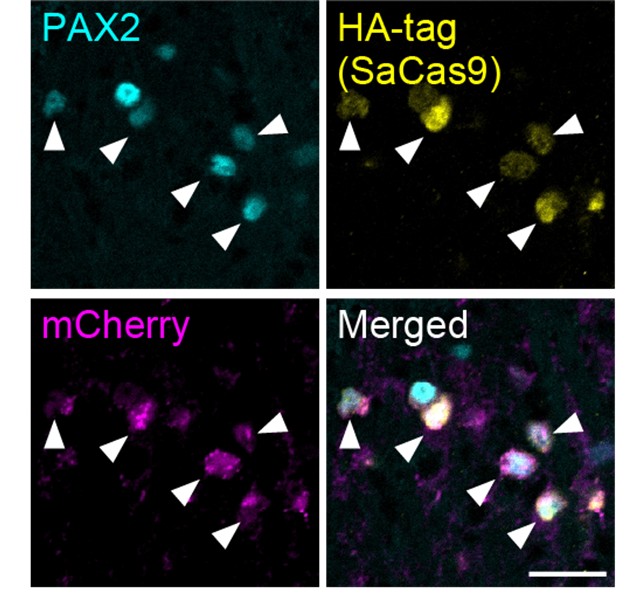
      (6) Methods:

      It is unclear how fiber photometry is performed using "optic cannula" during restraint stress while mice are in a 50ml falcon tube (as shown in Figure 1A).

      We apologize for the omission of this detail in the Methods section. To monitor Ca<sup>2+</sup> events in LC-NA neurons during restraint stress, we created a narrow slit on the top of the conical tube, allowing mice to undergo restraint stress while connected to the optic fiber (see video). This information has now been added to the Methods section (lines 552-553).

      Recommendations for the authors:

      Reviewer #1 (Recommendations for the authors):

      (1) Scientific rigor:

      It is unclear if the normal distribution of the data was determined before selecting statistical tests.

      We apologize for omitting this description. For all statistical analyses in this study, we first assessed the normality of the data and then selected appropriate statistical tests accordingly. We have added this information to the revised manuscript (lines 711-712).

      (2) Nomenclature:

      (a) Mouse Genome Informatics (MGI) nomenclature should be used to describe mouse genotypes (i.e., gene name in italic, only first letter is capitalized, alleles in superscript).

      (b) FLEx should be used instead of flex.

      Thank you for the suggestion. We have corrected these terms (including FLEx) according to MGI nomenclature.

      Reviewer #2 (Public review):

      Summary:

      This study investigates the role of spinal astrocytes in mediating stress-induced pain hypersensitivity, focusing on the LC (locus coeruleus)-to-SDH (spinal dorsal horn) circuit and its mechanisms. The authors aimed to delineate how LC activity contributes to spinal astrocytic activation under stress conditions, explore the role of noradrenaline (NA) signaling in this process, and identify the downstream astrocytic mechanisms that influence pain hypersensitivity.

      The authors provide strong evidence that 1-hour restraint stress-induced pain hypersensitivity involves the LC-to-SDH circuit, where NA triggers astrocytic calcium activity via alpha1a adrenoceptors (alpha1aRs). Blockade of alpha1aRs on astrocytes - but not on Vgat-positive SDH neurons - reduced stress-induced pain hypersensitivity. These findings are rigorously supported by well-established behavioral models and advanced genetic techniques, uncovering the critical role of spinal astrocytes in modulating stress-induced pain.

      However, the study's third aim - to establish a pathway from astrocyte alpha1aRs to adenosine-mediated inhibition of SDH-Vgat neurons - is less compelling. While pharmacological and behavioral evidence is intriguing, the ex vivo findings are indirect and lack a clear connection to the stress-induced pain model. Despite these limitations, the study advances our understanding of astrocyte-neuron interactions in stress-pain contexts and provides a strong foundation for future research into glial mechanisms in pain hypersensitivity.

      Strengths:

      The study is built on a robust experimental design using a validated 1-hour restraint stress model, providing a reliable framework to investigate stress-induced pain hypersensitivity. The authors utilized advanced genetic tools, including retrograde AAVs, optogenetics, chemogenetics, and subpopulation-specific knockouts, allowing precise manipulation and interrogation of the LC-SDH circuit and astrocytic roles in pain modulation. Clear evidence demonstrates that NA triggers astrocytic calcium activity via alpha1aRs, and blocking these receptors effectively reduces stress-induced pain hypersensitivity.

      Weaknesses:

      Despite its strengths, the study presents indirect evidence for the proposed NA-to-astrocyte(alpha1aRs)-to-adenosine-to-SDH-Vgat neurons pathway, as the link between astrocytic adenosine release and stress-induced pain remains unclear. The ex vivo experiments, including NA-induced depolarization of Vgat neurons and chemogenetic stimulation of astrocytes, are challenging to interpret in the stress context, with the high CNO concentration raising concerns about specificity. Additionally, the role of astrocyte-derived D-serine is tangential and lacks clarity regarding its effects on SDH Vgat neurons. The astrocyte calcium signal "dip" after LC optostimulation-induced elevation are presented without any interpretation.

      We appreciate the reviewer's careful reading of our paper. According to the reviewer's comments, we have performed new additional experiments and added some discussion in the revised manuscript (please see the point-by-point responses below).

      Reviewer #2 (Recommendations for the authors):

      The astrocyte-mediated pathway of NA-to-astrocyte (alpha1aRs)-to-adenosine-to-SDH Vgat neurons (A1R) in the context of stress-induced pain hypersensitivity requires more direct evidence. While the data showing that the A1R agonist CPT inhibits stress-induced hypersensitivity and that stress combined with Aβ fiber stimulation increases pERK in the SDH are intriguing, these findings primarily support the involvement of A1R on Vgat neurons and are only behaviorally consistent with SDH-Vgat neuronal A1R knockdown. The role of astrocytes in this pathway in vivo remains indirect. The ex vivo chemogenetic Gq-DREADD stimulation of SDH astrocytes, which reduced sIPSCs in Vgat neurons in a CPT-dependent manner, needs revision with non-DREADD+CNO controls to validate specificity. Furthermore, the ex vivo bath application of NA causing depolarization in Vgat neurons, blocked by CPT, adds complexity to the data leaving me wondering how astrocytes are involved in such processes, and it does not directly connect to stress-induced pain hypersensitivity. These findings are potentially useful but require additional refinement to establish their relevance to the stress model.

      We thank the reviewer for the insightful feedback. First, regarding the role of astrocytes in this pathway in vivo, we showed in the initial version that mechanical pain hypersensitivities induced by intrathecal NA injection and by acute restraint stress were attenuated by both pharmacological blockade and Vgat<sup>+</sup> neuron-specific knockdown of A<sub>1</sub>Rs (Figure 4A, B). Given that NA- and stress-induced pain hypersensitivity is mediated by α<sub>1A</sub>R-dependent signaling in Hes5<sup>+</sup> astrocytes (Kohro et al., Nat Neurosci, 2020 (PMID: 33020652); this study), these findings provide in vivo evidence supporting the involvement of the NA → Hes5<sup>+</sup> astrocyte (via α<sub>1A</sub>Rs) → adenosine → Vgat<sup>+</sup> neuron (via A<sub>1</sub>Rs) pathway. As noted in the reviewer’s major comment (2), in vivo monitoring of adenosine dynamics in the SDH during stress exposure would further substantiate the astrocyte-to-neuron signaling pathway. However, we did not detect clear signals, potentially due to several technical limitations (see our response below). Acknowledging this limitation, we have now added a new paragraph in the end of Discussion section to address this issue. Second, the specificity of the effect of CNO has now been validated by additional experiments (see our response to major point (4)). Third, the reviewer’s concern regarding the action of NA on Vgat<sup>+</sup> neurons has also been addressed (see our response to major point (3) below).

      Major points:

      (1) The in vivo pharmacology using DCK to antagonize D-serine signaling from alpha1a-activated astrocytes is tangential, as there is limited evidence on how Vgat neurons (among many others) respond to D-serine. This aspect requires more focused exploration to substantiate its relevance.

      We propose that the site of action of D-serine in our neural circuit model is the NMDA receptors (NMDARs) on excitatory neurons, a notion supported by our previous findings (Kohro et al., Nat Neurosci, 2020 (PMID: 33020652); Kagiyama et al., Mol Brain, 2025 (PMID: 40289116)). However, we cannot exclude the possibility that D-serine also acts on NMDARs expressed by Vgat<sup>+</sup> inhibitory neurons. Nevertheless, given that intrathecal injection of D-serine in naïve mice induces mechanical pain hypersensitivity (Kohro et al., Nat Neurosci, 2020 (PMID: 33020652)), it appears that the pronociceptive effect of D-serine in the SDH is primarily associated with enhanced pain processing and transmission, presumably via NMDARs on excitatory neurons. We have added this point to the Discussion section in the revised manuscript (lines 325-330).

      (2) Additionally, employing GRAB-Ado sensors to monitor adenosine dynamics in SDH astrocytes during NA signaling would significantly strengthen conclusions about astrocyte-derived adenosine's role in the stress model.

      We agree with the reviewer’s comment. Following this suggestion, we attempted to visualize NA-induced adenosine (and ATP) dynamics using GRAB-ATP and GRAB-Ado sensors (Wu et al., Neuron, 2022 (PMID: 34942116); Peng et al., Science, 2020 (PMID: 32883833)) in acutely isolated spinal cord slices from mice after intra-SDH injection of AAV-hSyn-GRABATP<sub>1.0</sub> and -GRABAdo<sub>1.0</sub>. We confirmed expression of these sensors in the SDH (Author response image 2a) and observed increased signals after bath application of ATP (0.1 or 1 µM) or adenosine (1 µM) (Author response image 2b, c). However, we were unable to detect clear signals following NA stimulation (Author response image 2b, c). The reason for this lack of detectable changes remains unclear. If the release of adenosine from astrocytes is a highly localized phenomenon, it may be measurable using high-resolution microscopy capable of detecting adenosine levels at the synaptic level and more sensitive sensors. Further investigation will therefore be required (lines 340-341).

      Author response image 2.

      Ex vivo imaging of GRAB-ATP and GRAB-Ado sensors.(a) Representative images of GRAB<sub>ATP1.0</sub> (left, green) or GRAB<sub>Ado1.0</sub> (right, green) expression in the SDH at 3 weeks after SDH injection of AAV-hSyn-GRAB<sub>Ado1.0</sub> or AAV-hSyn-GRAB<sub>Ado1.0</sub> in Hes5-CreERT2 mice. Scale bar, 200 µm. (b) Left: Representative fluorescence images showing GRAB<sub>ATP1.0</sub> responses before and after perfusion with NA or ATP. Right: Representative traces showing responses to ATP (0.1 and 1 µM) or NA (10 µM). (c) Left: Representative fluorescence images showing GRABAdo1.0 responses before and after perfusion with NA or adenosine (Ado). Right: Representative traces showing responses to Ado (0.01, 0.1, and 1 µM), NA (10 µM), or no application (negative control).
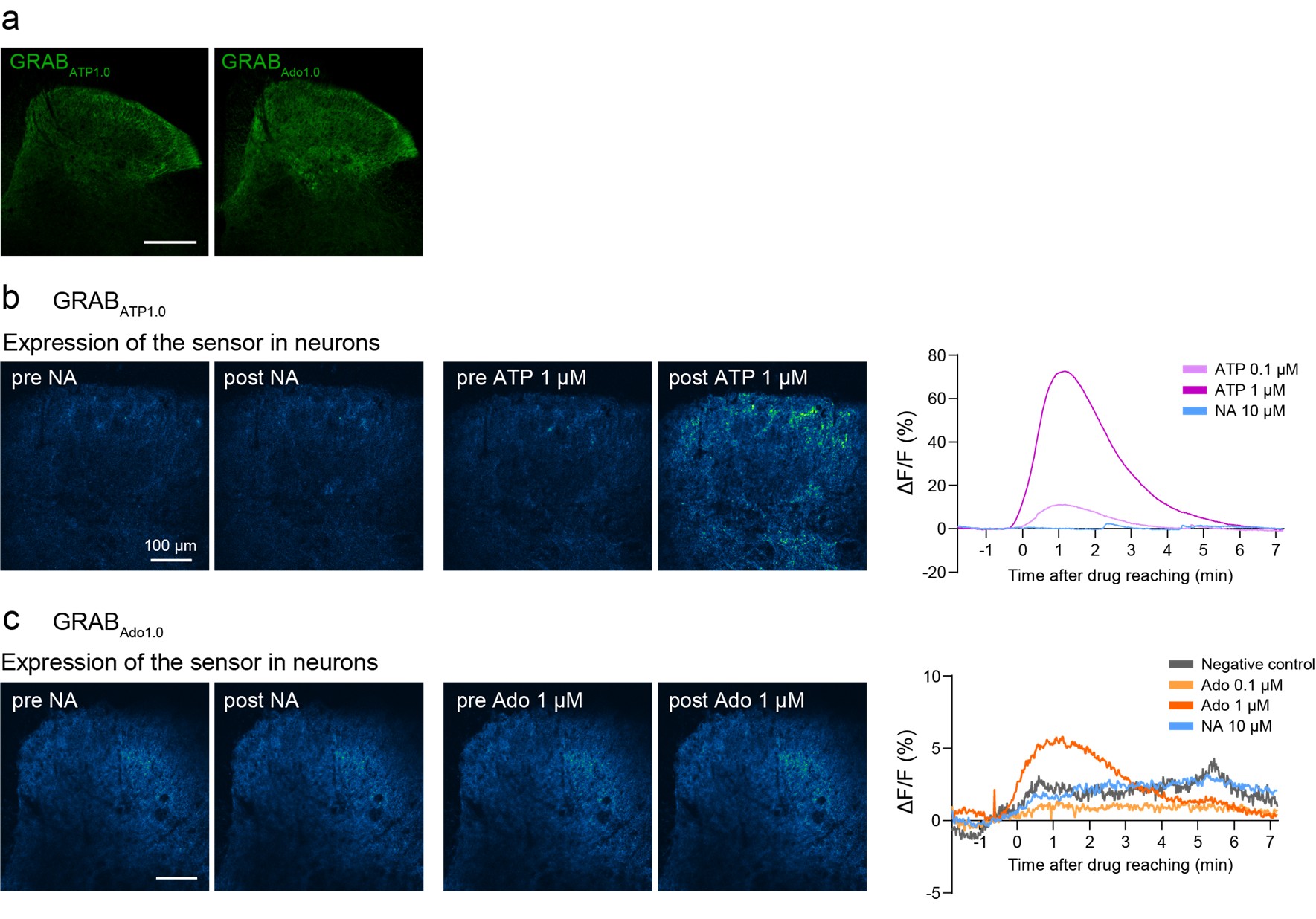
      (3) The interpretation of Figure 3D is challenging. The manuscript implies that 20 μM NA acts on Adra1a receptors on Vgat neurons to depolarize them, but this concentration should also activate Adra1a on astrocytes, leading to adenosine release and potential inhibition of depolarization. The observation of depolarization despite these opposing mechanisms requires explanation, as does the inhibition of depolarization by bath-applied A1R agonist. Of note, 20 μM NA is a high concentration for Adra1a activation, typically responsive at nanomolar levels. The discussion should reconcile this with prior studies indicating dose-dependent effects of NA on pain sensitivity (e.g., Reference 22).

      Like the reviewer, we also considered that bath-applied NA could activate α<sub>1A</sub>Rs expressed on Hes5<sup>+</sup> astrocytes. To clarify this point, we have performed additional patch-clamp recordings and found that knockdown of A<sub>1</sub>Rs in Vgat<sup>+</sup> neurons tended to increase the proportion of Vgat<sup>+</sup> neurons with NA-induced depolarizing responses (Figure S8). Therefore, it is conceivable that NA-induced excitation of Vgat<sup>+</sup> neurons may involve both a direct effect of NA activating α<sub>1A</sub>Rs in Vgat<sup>+</sup> neurons and an indirect inhibitory signaling from NA-stimulated Hes5<sup>+</sup> astrocytes via adenosine (lines 298-300).

      The concentration of NA used in our ex vivo experiments is higher than that typically used in vitro with αR-<sub>1A</sub>expressing cell lines or primary culture cells, but is comparable to concentrations used in other studies employing spinal cord slices (Kohro et al., Nat Neurosci, 2020 (PMID: 33020652); Baba et al., Anesthesiology, 2000 (PMID: 10691236); Lefton et al., Science, 2025 (PMID: 40373122)). In slice experiments, drugs must diffuse through the tissue to reach target cells, resulting in a concentration gradient. Therefore, higher drug concentrations are generally necessary in slice experiments, in contrast to cultured cell experiments, where drugs are directly applied to target cells. Importantly, we have previously shown that the pharmacological effects of 20 μM NA on Vgat<sup>+</sup> neurons and Hes5<sup>+</sup> astrocytes are abolished by loss of α<sub>1A</sub>Rs in these cells (Uchiyama et al., Mol Brain, 2022 (PMID: 34980215); Kohro et al., Nat Neurosci, 2020 (PMID: 33020652)), confirming the specificity of these NA actions.

      Regarding the dose-dependent effect of NA on pain sensitivity, NA-induced pain hypersensitivity is abolished in Hes5<sup>+</sup> astrocyte-specific α<sub>1A</sub>R-KO mice (Kohro et al., Nat Neurosci, 2020 (PMID: 33020652)), indicating that this behavior is mediated by α<sub>1A</sub>Rs expressed on Hes5<sup>+</sup> astrocytes. In contrast, the suppression of pain sensitivity by high doses of NA was unaffected in the KO mice (Kohro et al., Nat Neurosci, 2020 (PMID: 33020652)), suggesting that other adrenergic receptors may contribute to this phenomenon. Clarifying the responsible receptors will require future investigation.

      (4) In Figure 3K-M, the CNO concentration used (100 μM) is unusually high compared to standard doses (1 to a few μM), raising concerns about potential off-target effects. Including non-hM3Dq controls and using lower CNO concentrations are essential to validate the specificity of the observed effects. Similarly, the study should clarify whether astrocyte hM3Dq stimulation alone (without NA) would induce hyperpolarization in Vgat neurons and how this interacts with NA-induced depolarization.

      We acknowledge that the concentration of CNO used in our experiments is relatively high compared to that used in other reports. However, in our experiments, application of CNO at 1, 10, and 100 μM induced Ca<sup>2+</sup> increases in GCaMP6-expressing astrocytes in spinal cord slices in a concentration-dependent manner (Figure S7). Among these, 100 μM CNO most effectively replicated the NA-induced Ca<sup>2+</sup> signals in astrocytes. Based on these findings, we selected this concentration for use in both the current and previous studies (Kohro et al., Nat Neurosci., 2020 (PMID: 33020652)). Importantly, to rule out non-specific effects, we conducted control experiments using spinal cord slices from mice that did not express hM3Dq in astrocytes and confirmed that CNO had no effect on Ca<sup>2+</sup> responses in astrocytes and sIPSCs in substantial gelatinosa (SG) neurons (Figure S7; lines 223-228). Thus, although the CNO concentration used is relatively high, the observed effects of CNO are not non-specific but result from the chemogenetic activation of hM3Dq-expressing astrocytes.

      In this study, we used Hes5-CreERT2 and Vgat-Cre mice to manipulate gene expression in Hes5<sup>+</sup> astrocytes and Vgat<sup>+</sup> neurons, respectively. In order to fully address the reviewer’s comment, the use of both Cre lines is necessary. However, simultaneous and independent genetic manipulation in each cell type using Cre activity alone is not feasible with the current genetic tools. We have mentioned this as a technical limitation in the Discussion section (lines 382-388).

      (5) The role of D-serine released by hM3Dq-stimulated astrocytes in (separately) modulating sub-types of neurons including excitatory neurons and Vgat positives needs more detailed discussion. If no effect of D-serine on Vgat neurons is observed, this should be explicitly stated, and the discussion should address why this might be the case.

      As mentioned in our response to Major Point (1) above, we have added a discussion of this point in the revised manuscript (lines 325-330).

      (6) Finally, the observed "dip" in astrocyte calcium signals below baseline following the large peaks with LC optostimulation should be discussed further, as understanding this phenomenon could provide valuable insights into astrocytic signaling dynamics in the context of single acute or repetitive chronic stress.

      Thank you for your comment. We found that this phenomenon was not affected by pretreatment with the α<sub>1A</sub>R-specific antagonist silodosin (Author response image 3), which effectively suppressed Ca<sup>2+</sup> elevations evoked by stimulation of LC-NA neurons (Figure 2F). This implies that the phenomenon is independent of α<sub>1A</sub>R signaling. Elucidating the detailed underlying mechanism remains an important direction for future investigation.

      Author response image 3.

      The observed "dip" in astrocyte Ca<sup>2+</sup> signals was not affected by pretreatment with the α<sub>1A</sub>R-specific antagonist silodosin. Representative traces of astrocytic GCaMP6m signals in response to optogenetic stimulation of LC-NAe<sup>→SDH</sup>rgic axons/terminals in a spinal cord slice. Each trace shows the GCaMP6m signal before and after optogenetic stimulation (625 nm, 1 mW, 10 Hz, 5 ms pulse duration, 10 s). Slices were pretreated with silodosin (40 nM) for 5 min prior to stimulation.
      Reviewer #3 (Public review):

      Summary:

      This is an exciting and timely study addressing the role of descending noradrenergic systems in nocifensive responses. While it is well-established that spinally released noradrenaline (aka norepinephrine) generally acts as an inhibitory factor in spinal sensory processing, this system is highly complex. Descending projections from the A6 (locus coeruleus, LC) and the A5 regions typically modulate spinal sensory processing and reduce pain behaviours, but certain subpopulations of LC neurons have been shown to mediate pronociceptive effects, such as those projecting to the prefrontal cortex (Hirshberg et al., PMID: 29027903).

      The study proposes that descending cerulean noradrenergic neurons potentiate touch sensation via alpha-1 adrenoceptors on Hes5+ spinal astrocytes, contributing to mechanical hyperalgesia. This finding is consistent with prior work from the same group (dd et al., PMID:). However, caution is needed when generalising about LC projections, as the locus coeruleus is functionally diverse, with differences in targets, neurotransmitter co-release, and behavioural effects. Specifying the subpopulations of LC neurons involved would significantly enhance the impact and interpretability of the findings.

      Strengths:

      The study employs state-of-the-art molecular, genetic, and neurophysiological methods, including precise CRISPR and optogenetic targeting, to investigate the role of Hes5+ astrocytes. This approach is elegant and highlights the often-overlooked contribution of astrocytes in spinal sensory gating. The data convincingly support the role of Hes5+ astrocytes as regulators of touch sensation, coordinated by brain-derived noradrenaline in the spinal dorsal horn, opening new avenues for research into pain and touch modulation.

      Furthermore, the data support a model in which superficial dorsal horn (SDH) Hes5+ astrocytes act as non-neuronal gating cells for brain-derived noradrenergic (NA) signalling through their interaction with substantia gelatinosa inhibitory interneurons. Locally released adenosine from NA-stimulated Hes5+ astrocytes, following acute restraint stress, may suppress the function of SDH-Vgat+ inhibitory interneurons, resulting in mechanical pain hypersensitivity. However, the spatially restricted neuron-astrocyte communication underlying this mechanism requires further investigation in future studies.

      Weaknesses

      (1) Specificity of the LC Pathway targeting

      The main concern lies with how definitively the LC pathway was targeted. Were other descending noradrenergic nuclei, such as A5 or A7, also labelled in the experiments? The authors must convincingly demonstrate that the observed effects are mediated exclusively by LC noradrenergic terminals to substantiate their claims (i.e. "we identified a circuit, the descending LC→SDH-NA neurons").

      (a) For instance, the direct vector injection into the LC likely results in unspecific effects due to the extreme heterogeneity of this nucleus and retrograde labelling of the A5 and A7 nuclei from the LC (i.e., Li et al., PMID: 26903420).

      We appreciate the reviewer's valuable comments. To address this point, we performed additional experiments and demonstrated that intra-SDH injection of AAVretro-Cre followed by intra-LC injection of AAV2/9-EF1α-FLEx[DTR-EGFP] specifically results in DTR expression in NA neurons of the LC, but not of the A5 or A7 regions (Figure S4; lines 127-128). These results confirm the specificity of targeting the LC<sup>→SDH</sup>-NAergic pathway in our study.

      (b) It is difficult to believe that the intersectional approach described in the study successfully targeted LC→SDH-NA neurons using AAVrg vectors. Previous studies (e.g., PMID: 34344259 or PMID: 36625030) demonstrated that similar strategies were ineffective for spinal-LC projections. The authors should provide detailed quantification of the efficiency of retrograde labelling and specificity of transgene expression in LC neurons projecting to the SDH.

      Thank you for your comment. As we described in our response to the weakness (5)-e) of Reviewer #1 (Public review), our additional analysis showed that, under our experimental conditions, expression of genes (for example DTR) was observed in 4.4% of NA (TH<sup>+</sup>) neurons in the LC (Figure S4; lines 126-127).

      The reasons for this difference between the previous studies and our current study is unclear; however, it is likely attributed to methodological differences, including the type of viral vectors employed, species differences (mouse (PMID: 34344259, our study) vs. rat (PMID: 36625030)), the amount of AAV injected into the SDH (300 nL at three sites (PMID: 34344259), and 300 nL at a single site (our study)) and LC (500 nL at a single site (PMID: 34344259), and 300 nL at a single site (our study)), as well as the depth of AAV injection in the SDH (200–300 µm from the dorsal surface of the spinal cord (PMID: 34344259), and 120–150 µm in depth from the surface of the dorsal root entry zone (our study)).

      (c) Furthermore, it is striking that the authors observed a comparably strong phenotypical change in Figure 1K despite fewer neurons being labelled, compared to Figure 1H and 1N with substantially more neurons being targeted. Interestingly, the effect in Figure 1K appears more pronounced but shorter-lasting than in the comparable experiment shown in Figure 1H. This discrepancy requires further explanation.

      Although only a representative section of the LC was shown in the initial version, LC<sup>→SDH</sup>-NA neurons are distributed rostrocaudally throughout the LC, as previously reported (Llorca-Torralba et al., Brain, 2022 (PMID: 34373893)). Our additional experiments analyzing multiple sections of the anterior and posterior regions of the LC have now revealed that approximately sixty LC<sup>→SDH</sup>-NA neurons express DTR, and these neurons are eliminated following DTX treatment (Figure S4; lines 126-128) (it should be noted that these neurons specifically project to the L4 segment of the SDH, and the total number of LC<sup>→SDH</sup>-NA neurons is likely much higher). Considering the specificity of LC<sup>→SDH</sup>-NAergic pathway targeting demonstrated in our study (as described above), together with the fact that primary afferent sensory fibers from the plantar skin of the hindpaw predominantly project to the L4 segment of the SDH, these data suggest that the observed behavioral changes are attributable to the loss of these neurons and that ablation of even a relatively small number of NA neurons in the LC can have a significant impact on behavior. We have added this hypothesis in the Discussion section (lines 373-382).

      Regarding the data in Figures 1H and 1K, as the reviewer pointed out, a statistically significant difference was observed at 90 min in mice with ablation of LC-NA neurons, but not in those with LC<sup>→SDH</sup>-NA neuron ablation. This is likely due to a slightly higher threshold in the control group at this time point (Figure 1K), and it remains unclear whether there is a mechanistic difference between the two groups at this specific time point.

      (d) A valuable addition would be staining for noradrenergic terminals in the spinal cord for the intersectional approach (Figure 1J), as done in Figures 1F/G. LC projections terminate preferentially in the SDH, whereas A5 projections terminate in the deep dorsal horn (DDH). Staining could clarify whether circuits beyond the LC are being ablated.

      As suggested, we performed DTR immunostaining in the SDH; however, we did not detect any DTR immunofluorescence there. A similar result was also observed in the spinal terminals of DTR-expressing primary afferent fibers (our unpublished data). The reason for this is unclear, but to the best of our knowledge, no studies have clearly shown DTR expression at presynaptic terminals, which may be because the action of DTX on the neuronal cell body is necessary for cell ablation. Nevertheless, as described in our response to the weakness (5)-f) by Reviewer 1 (Public review), we have now confirmed the specific expression of DTR in the LC, but not in the A5 and A7 regions (Figure S4; lines 127-128).

      (e) Furthermore, different LC neurons often mediate opposite physiological outcomes depending on their projection targets-for example, dorsal LC neurons projecting to the prefrontal cortex PFCx are pronociceptive, while ventral LC neurons projecting to the SC are antinociceptive (PMIDs: 29027903, 34344259, 36625030). Given this functional diversity, direct injection into the LC is likely to result in nonspecific effects.

      To avoid behavioral outcomes resulting from a mixture of facilitatory and inhibitory effects caused by activating the entire population of LC-NA neurons, we employed a specific manipulation targeting LC<sup>→SDH</sup>-NA neurons using AAV vectors. The specificity of this manipulation was confirmed in our previous study (Kohro et al., Nat Neurosci, 2020 (PMID: 33020652)) and in the current study (Figure S4). Using this approach, we previously demonstrated that LC neurons can exert pronociceptive effects via astrocytes in the SDH (Kohro et al., Nat Neurosci, 2020 (PMID: 33020652)). This pronociceptive role is further supported by the current study, which uses a more selective manipulation of LC<sup>→SDH</sup>-NA neurons through a NET-Cre mouse line. In addition, intrathecal administration of relatively low doses of NA in naïve mice clearly induces mechanical pain hypersensitivity. Nevertheless, we have also acknowledged that several recent studies have reported an inhibitory role of LC<sup>→SDH</sup>-NA neurons in spinal nociceptive signaling. The reason for these differing behavioral outcomes remains unclear, but several methodological differences may underlie the discrepancy. First, the degree of LC<sup>→SDH</sup>-NA neuronal activity may play a role. Although direct comparisons between studies reporting pro- and anti-nociceptive effects are difficult, our previous studies demonstrated that intrathecal administration of high doses of NA in naïve mice does not induce mechanical pain hypersensitivity (Kohro et al., Nat Neurosci, 2020 (PMID: 33020652)). Second, the sensory modality used in behavioral testing may be a contributing factor as the pronociceptive effect of NA appears to be selectively observed in responses to mechanical, but not thermal, stimuli (Kohro et al., Nat Neurosci, 2020 (PMID: 33020652)). This sensory modality-selective effect is also evident in mice subjected to acute restraint stress (Table S1). Therefore, the role of LC<sup>→SDH</sup>-NA neurons in modulating nociceptive signaling in the SDH is more complex than previously appreciated, and their contribution to pain regulation should be reconsidered in light of factors such as NA levels, sensory modality, and experimental context. In revising the manuscript, we have included some points described above in the Discussion (lines 282-291).

      Conclusion on Specificity: The authors are strongly encouraged to address these limitations directly, as they significantly affect the validity of the conclusions regarding the LC pathway. Providing more robust evidence, acknowledging experimental limitations, and incorporating complementary analyses would greatly strengthen the manuscript.

      We appreciate the reviewer’s comments. We fully acknowledge the limitations raised and agree that addressing them directly is important for the rigor of our conclusions on the LC pathway. To this end, we have performed additional experiments (e.g., Figure A and S4), which are now included in the revised manuscript. Furthermore, we have also newly added a new paragraph for experimental limitations in the end of Discussion section (lines 373-408). We believe these new data substantially strengthen the validity of our findings and have clarified these points in the Discussion section.

      (2) Discrepancies in Data

      (a) Figures 1B and 1E: The behavioural effect of stress on PWT (Figure 1E) persists for 120 minutes, whereas Ca2+ imaging changes (Figure 1B) are only observed in the first 20 minutes, with signal attenuation starting at 30 minutes. This discrepancy requires clarification, as it impacts the proposed mechanism.

      Thank you for your important comment. As pointed out by the reviewer, there is a difference between the duration of behavioral responses and Ca<sup>2+</sup> events, although the exact time point at which the PWT begins to decline remains undetermined (as behavioral testing cannot be conducted during stress exposure). A similar temporal difference was also observed following intraplantar injection of capsaicin (Kohro et al., Nat Neurosci, 2020 (PMID: 33020652)); while LC<sup>→SDH</sup>-NA neuron-mediated astrocytic Ca<sup>2+</sup> responses in SDH astrocytes last for 5–10 min after injection, behavioral hypersensitivity peaks around 60 min post-injection and gradually returns to baseline over the subsequent 60–120 min. These findings raise the possibility that astrocyte-mediated pain hypersensitivity in the SDH may involve a sustained alteration in spinal neural function, such as central sensitization. We have added this hypothesis to the Discussion section of the revised manuscript (lines 399-408), as it represents an important direction for future investigation.

      (b) Figure 4E: The effect is barely visible, and the tissue resembles "Swiss cheese," suggesting poor staining quality. This is insufficient for such an important conclusion. Improved staining and/or complementary staining (e.g., cFOS) are needed. Additionally, no clear difference is observed between Stress+Ab stim. and Stress+Ab stim.+CPT, raising doubts about the robustness of the data.

      As suggested, we performed c-FOS immunostaining and obtained clearer results (Figure 4E,F; lines 243-252). We also quantitatively analyzed the number of c-FOS<sup>+</sup> cells in the superficial laminae, and the results are consistent with those obtained from the pERK experiments.

      (c) Discrepancy with Existing Evidence: The claim regarding the pronociceptive effect of LC→SDH-NAergic signalling on mechanical hypersensitivity contrasts with findings by Kucharczyk et al. (PMID: 35245374), who reported no facilitation of spinal convergent (wide-dynamic range) neuron responses to tactile mechanical stimuli, but potent inhibition to noxious mechanical von Frey stimulation. This discrepancy suggests alternative mechanisms may be at play and raises the question of why noxious stimuli were not tested.

      In our experiments, ChrimsonR expression was observed in the superficial and deeper laminae of the spinal cord (Figure S6). Due to the technical limitations of the optical fibers used for optogenetics, the light stimulation could only reach the superficial laminae; therefore, it may not have affected the activity of neurons (including WDR neurons) located in the deeper laminae. Furthermore, the study by Kucharczyk et al. (Brain, 2022 (PMID: 35245374)) employed a stimulation protocol that differed from ours, applying continuous stimulation over several minutes. Given that the levels of NA released from LC<sup>→SDH</sup>-NAergic terminals in the SDH increase with the duration of terminal stimulation (as shown in Figure 2B), longer stimulation may result in higher levels of NA in the SDH. Considering also our data indicating that the pro- and anti-nociceptive effects of NA are dose dependent (Kohro et al., Nat Neurosci, 2020 (PMID: 33020652)), these differences may be related to LC<sup>→SDH</sup>-NA neuron activity, NA levels in the SDH, and the differential responses of SDH neurons in the superficial versus deeper laminae (lines 388-395).

      (3) Sole reliance on Von Frey testing

      The exclusive use of von Frey as a behavioural readout for mechanical sensitisation is a significant limitation. This assay is highly variable, and without additional supporting measures, the conclusions lack robustness. Incorporating other behavioural measures, such as the adhesive tape removal test to evaluate tactile discomfort, the needle floor walk corridor to assess sensitivity to uneven or noxious surfaces, or the kinetic weight-bearing test to measure changes in limb loading during movement, could provide complementary insights. Physiological tests, such as the Randall-Selitto test for noxious pressure thresholds or CatWalk gait analysis to evaluate changes in weight distribution and gait dynamics, would further strengthen the findings and allow for a more comprehensive assessment of mechanical sensitisation.

      Thank you for your suggestion. Based on our previous findings that Hes5<sup>+</sup> astrocytes in the SDH selectively modulate mechanosensory signaling (Kohro et al., Nat Neurosci, 2020 (PMID: 33020652)), the present study focused on behavioral responses to mechanical stimuli using von Frey filaments. As we have not previously conducted most of the behavioral tests suggested by the reviewers, and as we currently lack the necessary equipments for these tests (e.g., Randall–Selitto test, CatWalk gait analysis, and weight-bearing test), we were unable to include them in this study. However, it will be of great interest in future research to investigate whether activation of the LC<sup>→SDH</sup>-NA neuron-to-SDH Hes5<sup>+</sup> astrocyte signaling pathway similarly sensitizes behavioral responses to other types of mechanical stimuli and also to investigate the sensory modality-selective pro- and antinociceptive role of LC<sup>→SDH</sup>-NAergic signaling in the SDH (lines 396-399).

      Overall Conclusion

      This study addresses an important and complex topic with innovative methods and compelling data. However, the conclusions rely on several assumptions that require more robust evidence. Specificity of the LC pathway, experimental discrepancies, and methodological limitations (e.g., sole reliance on von Frey) must be addressed to substantiate the claims. With these issues resolved, this work could significantly advance our understanding of astrocytic and noradrenergic contributions to pain modulation.

      We have made every effort to address the reviewer’s concerns through additional experiments and analyses. Based on the new control data presented, we believe that our explanation is reasonable and acceptable. Although additional data cannot be provided on some points due to methodological constraints and limitations of the techniques currently available in our laboratory, we respectfully submit that the evidence presented sufficiently supports our conclusions.

      Reviewer #3 (Recommendations for the authors):

      A lot of beautiful and challenging-to-collect data is presented. Sincere congratulations to all the authors on this achievement!

      Notwithstanding, please carefully reconsider the conclusions regarding the LC pathway, as additional evidence is required to ensure their specificity and robustness.

      We thank the reviewer for the kind comments and for raising an important point regarding the LC pathway. The reviewer’s feedback prompted us to conduct additional investigations to further strengthen the validity of our conclusions. We have incorporated these new data and analyses into the revised manuscript, and we believe that these revisions substantially enhance the robustness and reliability of our findings.

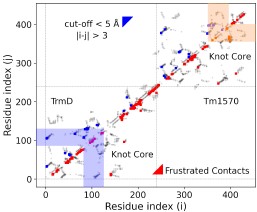
    1. Reviewer #3 (Public review):

      Disclaimer:

      My expertise is in live single-molecule imaging of RNA and transcription, as well as associated data analysis and modeling. While this aligns well with the technical aspects of the manuscript, my background in translation is more limited, and I am not best positioned to assess the novelty of the biological conclusions.

      Summary:

      This study combines live-cell imaging of nascent proteins on single mRNAs with time-series analysis to investigate the kinetics of mRNA translation.<br /> The authors (i) used a calibration method for estimating absolute ribosome counts, and (ii) developed a new Bayesian approach to infer ribosome counts over time from run-off experiments, enabling estimation of elongation rates and ribosome density across conditions.

      They report (i) translational bursting at the single-mRNA level, (ii) low ribosome density (~10% occupancy {plus minus} a few percents), (iii) that ribosome density is minimally affected by perturbations of elongation (using a drug and/or different coding sequences in the reporter), suggesting a homeostatic mechanism potentially involving a feedback of elongation onto initiation, although (iv) this coupling breaks down upon knockout of elongation factor eIF5A.

      Strengths:

      (1) The manuscript is well written and the conclusions are in general appropriately cautious (besides the few improvements I suggest below).

      (2) The time-series inference method is interesting and promising for broader application.

      (3) Simulations provide convincing support for the modeling (though some improvements are possible).

      (4) The reported homeostatic effect on ribosome density is surprising and carefully validated with multiple perturbations.

      (5) Imaging quality and corrections (e.g., flat-fielding, laser power measurements) are robust.

      (6) Mathematical modeling is clearly described and precise; a few clarifications could improve it further.

      Weaknesses:

      (1) The absolute quantification of ribosome numbers (via the measurement of $i_{MP}$​) should be improved. This only affects the finding that ribosome density is low, not that it appears to be under homeostatic control. However, if $i_{MP}$​ turns out to be substantially overestimated (hence ribosome density underestimated), then "ribosomes queuing up to the initiation site and physically blocking initiation" could become a relevant hypothesis. In my first review of this work, I made recommendations, which the authors did not follow. In my view, the robustness of this particular aspect of this study remains moderate.

      (2) The proposed initiation-elongation coupling is plausible, but alternative explanations such as changes in abortive elongation frequency should be considered. In their response to my previous comments, the authors indicate that this is "beyond the scope of the present work".

      (3) More an opportunity for improvement than a weakness: It is unclear what the single-mRNA nature of the inference method is bringing since it is only used here to report _average_ ribosome elongation rate and density (averaged across mRNAs and across time during the run-off experiments -although the method, in principle, has the power to resolve these two aspects). In response to my previous comment, the authors note that such analyses could be incorporated in future work.

    2. Author response:

      The following is the authors’ response to the original reviews.

      Public Reviews:

      Reviewer #1 (Public review): 

      Summary:

      In this study, Lamberti et al. investigate how translation initiation and elongation are coordinated at the single-mRNA level in mammalian cells. The authors aim to uncover whether and how cells dynamically adjust initiation rates in response to elongation dynamics, with the overarching goal of understanding how translational homeostasis is maintained. To this end, the study combines single-molecule live-cell imaging using the SunTag system with a kinetic modeling framework grounded in the Totally Asymmetric Simple Exclusion Process (TASEP). By applying this approach to custom reporter constructs with different coding sequences, and under perturbations of the initiation/elongation factor eIF5A, the authors infer initiation and elongation rates from individual mRNAs and examine how these rates covary.

      The central finding is that initiation and elongation rates are strongly correlated across a range of coding sequences, resulting in consistently low ribosome density ({less than or equal to}12% of the coding sequence occupied). This coupling is preserved under partial pharmacological inhibition of eIF5A, which slows elongation but is matched by a proportional decrease in initiation, thereby maintaining ribosome density. However, a complete genetic knockout of eIF5A disrupts this coordination, leading to reduced ribosome density, potentially due to changes in ribosome stalling resolution or degradation.

      Strengths:

      A key strength of this work is its methodological innovation. The authors develop and validate a TASEP-based Hidden Markov Model (HMM) to infer translation kinetics at single-mRNA resolution. This approach provides a substantial advance over previous population-level or averaged models and enables dynamic reconstruction of ribosome behavior from experimental traces. The model is carefully benchmarked against simulated data and appropriately applied. The experimental design is also strong. The authors construct matched SunTag reporters differing only in codon composition in a defined region of the coding sequence, allowing them to isolate the effects of elongation-related features while controlling for other regulatory elements. The use of both pharmacological and genetic perturbations of eIF5A adds robustness and depth to the biological conclusions. The results are compelling: across all constructs and conditions, ribosome density remains low, and initiation and elongation appear tightly coordinated, suggesting an intrinsic feedback mechanism in translational regulation. These findings challenge the classical view of translation initiation as the sole rate-limiting step and provide new insights into how cells may dynamically maintain translation efficiency and avoid ribosome collisions.

      We thank the reviewer for their constructive assessment of our work, and for recognizing the methodological innovation and experimental rigor of our study.

      Weaknesses:

      A limitation of the study is its reliance on exogenous reporter mRNAs in HeLa cells, which may not fully capture the complexity of endogenous translation regulation. While the authors acknowledge this, it remains unclear how generalizable the observed coupling is to native mRNAs or in different cellular contexts.

      We agree that the use of exogenous reporters is a limitation inherent to the SunTag system, for which there is currently no simple alternative for single-mRNA translation imaging. However, we believe our findings are likely generalizable for several reasons.

      As discussed in our introduction and discussion, there is growing mechanistic evidence in the literature for coupling between elongation (ribosome collisions) and initiation via pathways such as the GIGYF2-4EHP axis (Amaya et al. 2018, Hickey et al. 2020, Juszkiewicz et al. 2020), which might operate on both exogenous and endogenous mRNAs.

      As already acknowledged in our limitations section, our exogenous reporters may not fully recapitulate certain aspects of endogenous translation (e.g., ER-coupled collagen processing), yet the observed initiation-elongation coupling was robust across all tested constructs and conditions.

      We have now expanded the Discussion (L393-395) to cite complementary evidence from Dufourt et al. (2021), who used a CRISPR-based approach in Drosophila embryos to measure translation of endogenous genes. We also added a reference to Choi et al. 2025, who uses a ER-specific SunTag reporter to visualize translation at the ER (L395-397).

      Additionally, the model assumes homogeneous elongation rates and does not explicitly account for ribosome pausing or collisions, which could affect inference accuracy, particularly in constructs designed to induce stalling. While the model is validated under low-density assumptions, more work may be needed to understand how deviations from these assumptions affect parameter estimates in real data.

      We agree with the reviewer that the assumption of homogeneous elongation rates is a simplification, and that our work represents a first step towards rigorous single-trace analysis of translation dynamics. We have explicitly tested the robustness of our model to violations of the low-density assumption through simulations (Figure 2 - figure supplement 2). These show that while parameter inference remains accurate at low ribosome densities, accuracy slightly deteriorates at higher densities, as expected. In fact, our experimental data do provide evidence for heterogeneous elongation: the waiting times between termination events deviate significantly from an exponential distribution (Figure 3 - figure supplement 2C), indicating the presence of ribosome stalling and/or bursting, consistent with the reviewer's concern. We acknowledge in the Limitations section (L402-406) that extending the model to explicitly capture transcript-dependent elongation rates and ribosome interactions remains challenging. The TASEP is difficult to solve analytically under these conditions, but we note that simulation-based inference approaches, such as particle filters to replace HMMs, could provide a path forward for future work to capture this complexity at the single-trace level.

      Furthermore, although the study observes translation "bursting" behavior, this is not explicitly modeled. Given the growing recognition of translational bursting as a regulatory feature, incorporating or quantifying this behavior more rigorously could strengthen the work's impact.

      While we do not explicitly model the bursting dynamics in the HMM framework, we have quantified bursting behavior directly from the data. Specifically, we measure the duration of translated (ON) and untranslated (OFF) periods across all reporters and conditions (Figure 1G for control conditions and Figure 4G-H for perturbed conditions), finding that active translation typically lasts 10-15 minutes interspersed with shorter silent periods of 5-10 minutes. This empirical characterization demonstrates that bursting is a consistent feature of translation across our experimental conditions. The average duration of silent periods is similar to what was inferred by Livingston et al. 2023 for a similar SunTag reporter; while the average duration of active periods is substantially shorter (~15 min instead of ~40 min), which is consistent with the shorter trace duration in our system compared to theirs (~15 min compared to ~80 min, on average). Incorporating an explicit two-state or multi-state bursting model into the TASEP-HMM framework would indeed be computationally intensive and represents an important direction for future work, as it would enable inference of switching rates alongside initiation and elongation parameters. We have added this point to the Discussion (L415-417).

      Assessment of Goals and Conclusions:

      The authors successfully achieve their stated aims: they quantify translation initiation and elongation at the single-mRNA level and show that these processes are dynamically coupled to maintain low ribosome density. The modeling framework is well suited to this task, and the conclusions are supported by multiple lines of evidence, including inferred kinetic parameters, independent ribosome counts, and consistent behavior under perturbation.

      Impact and Utility:

      This work makes a significant conceptual and technical contribution to the field of translation biology. The modeling framework developed here opens the door to more detailed and quantitative studies of ribosome dynamics on single mRNAs and could be adapted to other imaging systems or perturbations. The discovery of initiation-elongation coupling as a general feature of translation in mammalian cells will likely influence how researchers think about translational regulation under homeostatic and stress conditions.

      The data, models, and tools developed in this study will be of broad utility to the community, particularly for researchers studying translation dynamics, ribosome behavior, or the effects of codon usage and mRNA structure on protein synthesis.

      Context and Interpretation:

      This study contributes to a growing body of evidence that translation is not merely controlled at initiation but involves feedback between elongation and initiation. It supports the emerging view that ribosome collisions, stalling, and quality control pathways play active roles in regulating initiation rates in cis. The findings are consistent with recent studies in yeast and metazoans showing translation initiation repression following stalling events. However, the mechanistic details of this feedback remain incompletely understood and merit further investigation, particularly in physiological or stress contexts. 

      In summary, this is a thoughtfully executed and timely study that provides valuable insights into the dynamic regulation of translation and introduces a modeling framework with broad applicability. It will be of interest to a wide audience in molecular biology, systems biology, and quantitative imaging.

      We appreciate the reviewer's thorough and positive assessment of our work, and that they recognize both the technical innovation of our modeling framework and its potential broad utility to the translation biology community. We agree that further mechanistic investigation of initiation-elongation feedback under various physiological contexts represents an important direction for future research.

      Reviewer #2 (Public review):

      Summary:

      This manuscript uses single-molecule run-off experiments and TASEP/HMM models to estimate biophysical parameters, i.e., ribosomal initiation and elongation rates. Combining inferred initiation and elongation rates, the authors quantify ribosomal density. TASEP modeling was used to simulate the mechanistic dynamics of ribosomal translation, and the HMM is used to link ribosomal dynamics to microscope intensity measurements. The authors' main conclusions and findings are:

      (1) Ribosomal elongation rates and initiation rates are strongly coordinated.

      (2) Elongation rates were estimated between 1-4.5 aa/sec. Initiation rates were estimated between 0.5-2.5 events/min. These values agree with previously reported values.

      (3) Ribosomal density was determined below 12% for all constructs and conditions.

      (4) eIF5A-perturbations (KO and GC7 inhibition) resulted in non-significant changes in translational bursting and ribosome density.

      (5) eIF5A perturbations resulted in increases in elongation and decreases in initiation rates.

      Strengths:

      This manuscript presents an interesting scientific hypothesis to study ribosome initiation and elongation concurrently. This topic is highly relevant for the field. The manuscript presents a novel quantitative methodology to estimate ribosomal initiation rates from Harringtonine run-off assays. This is relevant because run-off assays have been used to estimate, exclusively, elongation rates.

      We thank the reviewer for their careful evaluation of our work and for recognizing the novelty of our quantitative methodology to extract both initiation and elongation rates from harringtonine run-off assays, extending beyond the traditional use of these experiments.

      Weaknesses:

      The conclusion of the strong coordination between initiation and elongation rates is interesting, but some results are unexpected, and further experimental validation is needed to ensure this coordination is valid. 

      We agree that some of our findings need further experimental investigation in future studies. However, we believe that the coordination between initiation and elongation is supported by multiple results in our current work: (1) the strong correlation observed across all reporters and conditions (Figure 3E), and (2) the consistent maintenance of low ribosome density despite varying elongation rates. While additional experimental validation would be valuable, we note that directly manipulating initiation or elongation independently in mammalian cells remains technically challenging. Nevertheless, our findings are consistent with emerging mechanistic understanding of collision-sensing pathways (GIGYF2-4EHP) that could mediate such coupling, as discussed in our manuscript.

      (1) eIF5a perturbations resulted in a non-significant effect on the fraction of translating mRNA, translation duration, and bursting periods. Given the central role of eIF5a, I would have expected a different outcome. I would recommend that the authors expand the discussion and review more literature to justify these findings.

      We appreciate this comment. This finding is indeed discussed in detail in our manuscript (Discussion, paragraphs 6-7). As we note there, while eIF5A plays a critical role in elongation, the maintenance of bursting dynamics and ribosome density upon perturbation can be explained by compensatory feedback mechanisms. Specifically, the coordinated decrease in initiation rates that counterbalances slower elongation to maintain homeostatic ribosome density. We also discuss several factors that complicate interpretation: (1) potential RQC-mediated degradation masking stronger effects in proline-rich constructs, (2) differences between GC7 treatment and genetic knockout suggesting altered stalling resolution kinetics, and (3) the limitations of using exogenous reporters that lack ER-coupled processing, which may be critical for eIF5A function in endogenous collagen translation (as suggested by Rossi et al., 2014; Mandal et al., 2016; Barba-Aliaga et al., 2021). The mechanistic complexity and tissue-specific nature of eIF5A function in mammals, which differs substantially from the better-characterized yeast system, likely contributes to the nuanced phenotype we observe. We believe our Discussion adequately addresses these points.

      (2) The AAG construct leading to slow elongation is very surprising. It is the opposite of the field consensus, where codon-optimized gene sequences are expected to elongate faster. More information about each construct should be provided. I would recommend more bioinformatic analysis on this, for example, calculating CAI for all constructs, or predicting the structures of the proteins.

      We agree that the slow elongation of the AAG construct is counterintuitive and indeed surprising. Following the reviewer's suggestion, we have now calculated the Codon Adaptation Index (CAI) for all constructs (Renilla 0.89, Col1a1 0.78, Col1a1 mutated 0.74). It is therefore unlikely that codon bias explains the slow translation, particularly since we designed the mutated Col1a1 construct with alanine codons selected to respect human codon usage bias, thereby minimizing changes in codon optimality. As we discuss in the manuscript, we hypothesize that the proline-to-alanine substitutions disrupted co-translational folding of the collagen-derived sequence. Prolines are critical for collagen triple-helix formation (Shoulders and Raines, 2009), and their replacement with alanines likely generates misfolded intermediates that cause ribosome stalling (Barba-Aliaga et al., 2021; Komar et al., 2024). This interpretation is supported by the high frequency (>30%) of incomplete run-off traces for AAG, suggesting persistent stalling events. Our findings thus illustrate an important potential caveat: "optimizing" a sequence based solely on codon usage can be detrimental when it disrupts functionally important structural features or co-translational folding pathways.

      This highlights that elongation rates depend not only on codon optimality but also on the interplay between nascent chain properties and ribosome progression.

      (3) The authors should consider using their methodology to study the effects of modifying the 5'UTR, resulting in changes in initiation rate and bursting, such as previously shown in reference Livingston et al., 2023. This may be outside of the scope of this project, but the authors could add this as a future direction and discuss if this may corroborate their conclusions. 

      We thank the reviewer for this excellent suggestion. We agree that applying our methodology to 5'-UTR variants would provide a complementary test of initiation-elongation coupling, and we have now added this as a future direction in the Discussion (L417-420).

      (4) The mathematical model and parameter inference routines are central to the conclusions of this manuscript. In order to support reproducibility, the computational code should be made available and well-documented, with a requirements file indicating the dependencies and their versions. 

      We have added the Github link in the manuscript (https://github.com/naef-lab/suntag-analysis) and have also deposited the data (.ome.tif) on Zenodo (https://zenodo.org/records/17669332).

      Reviewer #3 (Public review):

      Disclaimer:

      My expertise is in live single-molecule imaging of RNA and transcription, as well as associated data analysis and modeling. While this aligns well with the technical aspects of the manuscript, my background in translation is more limited, and I am not best positioned to assess the novelty of the biological conclusions.

      Summary:

      This study combines live-cell imaging of nascent proteins on single mRNAs with time-series analysis to investigate the kinetics of mRNA translation.

      The authors (i) used a calibration method for estimating absolute ribosome counts, and (ii) developed a new Bayesian approach to infer ribosome counts over time from run-off experiments, enabling estimation of elongation rates and ribosome density across conditions.

      They report (i) translational bursting at the single-mRNA level, (ii) low ribosome density (~10% occupancy

      {plus minus} a few percents), (iii) that ribosome density is minimally affected by perturbations of elongation (using a drug and/or different coding sequences in the reporter), suggesting a homeostatic mechanism potentially involving a feedback of elongation onto initiation, although (iv) this coupling breaks down upon knockout of elongation factor eIF5A.

      Strengths:

      (1) The manuscript is well written, and the conclusions are, in general, appropriately cautious (besides the few improvements I suggest below).

      (2) The time-series inference method is interesting and promising for broader applications. 

      (3) Simulations provide convincing support for the modeling (though some improvements are possible). 

      (4) The reported homeostatic effect on ribosome density is surprising and carefully validated with multiple perturbations.

      (5) Imaging quality and corrections (e.g., flat-fielding, laser power measurements) are robust.

      (6) Mathematical modeling is clearly described and precise; a few clarifications could improve it further.

      We thank the reviewer for recognizing the novelty of the approach and its rigour, and for providing suggestions to improve it further.

      Weaknesses:

      (1) The absolute quantification of ribosome numbers (via the measurement of $i_{MP}$ ) should be improved.This only affects the finding that ribosome density is low, not that it appears to be under homeostatic control. However, if $i_{MP}$ turns out to be substantially overestimated (hence ribosome density underestimated), then "ribosomes queuing up to the initiation site and physically blocking initiation" could become a relevant hypothesis. In my detailed recommendations to the authors, I list points that need clarification in their quantifications and suggest an independent validation experiment (measuring the intensity of an object with a known number of GFP molecules, e.g., MS2-GFP MS2-GFP-labeled RNAs, or individual GEMs).

      We agree with the reviewer that the estimation of the number of ribosomes is central to our finding that translation happens at low density on our reporters. This result derives from our measurement of the intensity of one mature protein (i<sub>MP</sub>), that we have achieved by using a SunTag reporter with a RH1 domain in the C terminus of the mature protein, allowing us to stabilise mature proteins via actin-tethering. In addition, as suggested by the reviewer, we already validated this result with an independent estimate of the mature protein intensity (Figure 5 - figure supplement 2B), which was obtained by adding the mature protein intensity directly as a free parameter of the HMM. The inferred value of mature protein intensity for each construct (10-15 a.u) was remarkably close to the experimental calibration result (14 ± 2 a.u.). Therefore, we have confidence that our absolute quantification of ribosome numbers is accurate.

      (2) The proposed initiation-elongation coupling is plausible, but alternative explanations, such as changes in abortive elongation frequency, should be considered more carefully. The authors mention this possibility, but should test or rule it out quantitatively. 

      We thank the reviewer for the comment, but we consider that ruling out alternative explanations through new perturbation experiments is beyond the scope of the present work.

      (3) The observation of translational bursting is presented as novel, but similar findings were reported by Livingston et al. (2023) using a similar SunTag-MS2 system. This prior work should be acknowledged, and the added value of the current approach clarified.

      We did cite Livingston et al. (2023) in several places, but we recognized that we could add a few citations in key places, to make clear that the observation of bursting is not novel but is in agreement with previous results. We now did so in the Results and Discussion sections.

      (4) It is unclear what the single-mRNA nature of the inference method is bringing since it is only used here to report _average_ ribosome elongation rate and density (averaged across mRNAs and across time during the run-off experiments - although the method, in principle, has the power to resolve these two aspects).

      While decoding individual traces, our model infers shared (population-level) rates. Inferring transcript-specific parameters would be more informative, but it is highly challenging due to the uncertainty on the initial ribosome distribution on single transcripts. Pooling multiple transcripts together allows us to use some assumptions on the initial distribution and infer average elongation and initiation-rate parameters, while revealing substantial mRNA-to-mRNA variability in the posterior decoding (e.g. Figure 3 - figure Supplement 2C). Indeed, the inference still informs on the single-trace run-off time distribution (Figure 3 A) and the waiting time between termination events (Figure 3 - figure supplement 2C), suggesting the presence of stalling and bursting. In addition, the transcript-to-transcript heterogeneity is likely accounted for by our model better than previous methods (linear fit of the average run-off intensity), as suggested by their comparison (Figure 3 - figure supplement 2 A). In the future the model could be refined by introducing transcript-specific parameters, possibly in a hierarchical way, alongside shared parameters.

      (5) I did not find any statement about data availability. The data should be made available. Their absence limits the ability to fully assess and reproduce the findings.

      We have added the Github link in the manuscript (https://github.com/naef-lab/suntag-analysis) and have also deposited the data (.ome.tif) on Zenodo (https://zenodo.org/records/17669332).

      Recommendations for the authors:

      Reviewer #1 (Recommendations for the authors): 

      Major Comments:

      (1) Lack of Explicit Bursting Model

      Although translation "bursts" are observed, the current framework does not explicitly model initiation as a stochastic ON/OFF process. This limits insight into regulatory mechanisms controlling burst frequency or duration. The authors should either incorporate a two-state/more-state (bursting) model of initiation or perform statistical analysis (e.g., dwell-time distributions) to quantify bursting dynamics. They should clarify how bursting influences the interpretation of initiation rate estimates.

      We agree with the reviewer that an explicit bursting model (e.g., a two-state telegraph model) would be the ideal theoretical framework. However, integrating such a model into the TASEP-HMM inference framework is computationally intensive and complex. As a robust first step, we have opted to quantify bursting empirically based on the decoded single-mRNA traces. As shown in Figure 1G (control) and Figure 4G (perturbed conditions), we explicitly measured the duration of "ON" (translated) and "OFF" (untranslated) periods. This statistical analysis provides a quantitative description of the bursting dynamics without relying on the specific assumptions of a telegraph model. We have clarified this in the text (L123-125) and, as suggested, added a discussion (L415-417) on the potential extensions of the model to include explicit switching kinetics in the Outlook section.

      (2) Assumption of Uniform Elongation Rates

      The model assumes homogeneous elongation across coding sequences, which may not hold for stalling-prone inserts (e.g., PPG). This simplification could bias inference, particularly in cases of sequence-specific pausing. Adding simulations or sensitivity analysis to assess how non-uniform elongation affects the accuracy of inferred parameters. The authors should explicitly discuss how ribosome stalling, collisions, or heterogeneity might skew model outputs (see point 4).

      A strong stalling sequence that affects all ribosomes equally should not deteriorate the inference of the initiation rate, provided that the low-density assumption holds. The scenario where stalling events lead to higher density, and thus increased ribosome-ribosome interactions, is comparable to the conditions explored in Figure 2E. In those simulations, we tested the inference on data generated with varying initiation and elongation rates, resulting in ribosome densities ranging from low to high. We demonstrated that the inference remains robust at low ribosome densities (<10%). At higher densities, the accuracy of the initiation rate estimate decreases, whereas the elongation rate estimate remains comparatively robust. Additionally, the model tends to overestimate ribosome density under high-density conditions, likely because it neglects ribosome interference at the initiation site (Figure 2 figure supplement 2C). We agree that a deeper investigation into the consequences of stochastic stalling and bursting would be beneficial, and we have explicitly acknowledged this in the Limitations section.

      (3) Interpretation of eIF5A Knockout Phenotype

      The observation that eIF5A KO reduces initiation more than elongation, leading to decreased ribosome density, is biologically intriguing. However, the explanation invoking altered RQC kinetics is speculative and not directly tested. The authors should consider validating the RQC hypothesis by monitoring reporter mRNA stability, ribosome collision markers, or translation termination intermediates.

      We thank the reviewer for the comment, but we consider that ruling out alternative explanations through new experiments is beyond the scope of the present work.

      (4) To strengthen the manuscript, the authors should incorporate insights from three studies.

      - Livingston et al. (PMC10330622) found that translation occurs in bursts, influenced by mRNA features and initiation factors, supporting the coupling of initiation and elongation.

      - Madern et al. (PMID: 39892379) demonstrated that ribosome cooperativity enhances translational efficiency, highlighting coordinated ribosome behavior.

      - Dufourt et al. (PMID: 33927056) observed that high initiation rates correlate with high elongation rates, suggesting a conserved mechanism across cell cultures and organisms.

      Integrating these studies could enrich the manuscript's interpretation and stimulate new avenues of thought.

      We thank the reviewer for the valuable comment. We added citations of Livingston et al. in the context of translational bursting. We already cited Madern et al. in multiple places and, although its observations of ribosome cooperativity are very compelling, they cannot be linked with our observations of a feedback between initiation and elongation, and it would be very challenging to see a similar effect on our reporters. This is why we did not expressly discuss cooperativity. We also integrated Dufourt et al. in the Discussion about the possibility of designing genetically-encoded reporter. We also added a sentence about the possibility of using an ER-specific SunTag reporter, as done recently in Choi et al., Nature (2025) (https://doi.org/10.1038/s41586-025-09718-0).

      Minor Comments:

      (1) Use consistent naming for SunTag reporters (e.g., "PPG" vs "proline-rich") throughout.

      Thank you for the comment. However, the term proline-rich always appears together with PPG, so we believe that the naming is clear and consistent.

      (2) Consider a schematic overview of the experimental design and modeling pipeline for accessibility.

      Thank you for the suggestion. We consider that experimental design and modeling is now sufficiently clearly described and does not justify an additional scheme. 

      (3) Clarify how incomplete run-off traces are handled in the HMM inference.

      Incomplete run-off traces are treated identically to complete traces in our HMM inference. This is possible because our model relies on the probability of transitions occurring per time step to infer rates. It does not require observing the final "empty" state to estimate the kinetic parameters ɑ and λ. The loss of signal (e.g., mRNA moving out of the focal volume or photobleaching) does not invalidate the kinetic information contained in the portion of the trace that was observed. We have clarified this in the Methods section.

      Reviewer #2 (Recommendations for the authors):

      (1) Reproducibility:

      (1.1) The authors should use a GitHub repository with a timestamp for the release version.

      The code is available on GitHub (https://github.com/naef-lab/suntag-analysis).

      (1.2) Make raw images and data available in a figure repository like Figshare.

      The raw images (.ome.tif) are now available on Zenodo (https://zenodo.org/records/17669332).

      (2) Paper reorganization and expansion of the intensity and ribosome quantification:

      (2.1) Given the relevance of the initiation and elongation rates for the conclusions of this study, and the fact that the authors inferred these rates from the spot intensities. I recommend that the authors move Figure 1 Supplement 2 to the main text and expand the description of the process to relate spot intensity and number of ribosomes. Please also expand the figure caption for this image.

      We agree with the importance of this validation. We have expanded the description of the calibration experiment in the main text and in the figure caption.

      (2.2) I suggest the authors explicitly mention the use of HMM in the abstract.

      We have now explicitly mentioned the TASEP-based HMM in the abstract.

      (2.3) In line 492, please add the frame rate used to acquire the images for the run-off assays.

      We have added the specific frame rate (one frame every 20 seconds) to the relevant section.

      (3) Figures and captions:

      (3.1) Figure 1, Supplement 2. Please add a description of the colors used in plots B, C. 

      We have expanded the caption and added the color description.

      (3.2) In the Figure 2 caption. It is not clear what the authors mean by "traceseLife". Please ensure it is not a typo.

      Thank you for spotting this. We have corrected the typo.

      (3.3) Figure 1 A, in the cartoon N(alpha)->N-1, shouldn't the transition also depend on lambda?

      The transition probability was explicitly derived in the “Bayesian modeling of run-off traces” section (Eqs. 17-18), and does not depend on λ, but only on the initiation rate under the low-density assumption.

      (3.4) Figure 3, Supplement 2. "presence of bursting and stalling.." has a typo.

      Corrected.

      (3.5) Figure 5, panel C, the y-axis label should be "run-off time (min)."

      Corrected.

      (3.6) For most figures, add significance bars.

      (3.7) In the figure captions, please add the total number of cells used for each condition.

      We have systematically indicated the number of traces (n<sub>t</sub>) and the number of independent experiments (n<sub>e</sub>) in the captions in this format (n<sub>t</sub>, n<sub>e</sub>).

      (4) Mathematical Methods:

      We greatly thank the reviewer for their detailed attention to the mathematical notation. We have addressed all points below.

      (4.1) In lines 555, Materials and Methods, subsection, Quantification of Intensity Traces, multiple equations are not numbered. For example, after Equation (4), no numbers are provided for the rest of the equations. Please keep consistency throughout the whole document.

      We have ensured that all equations are now consistently numbered throughout the document.

      (4.2) In line 588, the authors mention "$X$ is a standard normal random variable with mean $\mu$ and standard deviation $s_0$". Please ensure this is correct. A standard normal random variable has a 0 mean and std 1. 

      Thank you for the suggestion, we have corrected the text (L678).

      (4.3) Line 546, Equation 2. The authors use mu(x,y) to describe a 2d Gaussian function. But later in line 587, the authors reuse the same variable name in equation 5 to redefine the intensity as mu = b_0 + I.

      We have renamed the 2D Gaussian function to \mu_{2D}(x,y) in the spot tracking section

      (4.4) For the complete document, it could be beneficial to the reader if the authors expand the definition of the relationship between the signal "y" and the spot intensity "I". Please note how the paragraph in lines 582-587 does not properly introduce "y".

      We have added an explicit definition of y and its relationship to the underlying spot intensity I in the text to improve readability and clarity.

      (4.5) Please ensure consistency in variable names. For example, "I" is used in line 587 for the experimental spot intensity, then line 763 redefines I(t) as the total intensity obtained from the TASEP model; please use "I_sim(t)" for simulated intensities. Please note that reusing the variable "I" for different contexts makes it hard for the reader to follow the text. 

      We agree that this was confusing. We have implemented the suggestion and now distinguish simulated intensities using the notation I<sub>S</sub> .

      (4.6) Line 555 "The prior on the total intensity I is an "uninformative" prior" I ~ half_normal(1000). Please ensure it is not "I_0 ~ half_normal(1000)."? 

      We confirm that “I” is the correct variable representing the total intensity in this context; we do not use an “I<sub>0</sub>” variable here.

      (4.7) In lines 595, equation 6. Ensure that the equation is correct. Shouldn't it be: s_0^2 = ln ( 1 + (sigma_meas^2 / ⟨y⟩^2) )? Please ensure that this is correct and it is not affecting the calculated values given in lines 598.

      Thank you for catching this typo. We have corrected the equation in the manuscript. We confirm that the calculations performed in the code used the correct formula, so the reported values remain unchanged.

      (4.8) In line 597, "the mean intensity square ^2". Please ensure it is not "the square of the temporal mean intensity."

      We have corrected the text to "the square of the temporal mean intensity."

      (4.9) In lines 602-619, Bayesian modeling of run-off traces, please ensure to introduce the constant "\ell". Used to define the ribosomal footprint?

      We have added the explicit definition of 𝓁 as the ribosome footprint size (length of transcript occupied by one ribosome) in the "Bayesian modeling of run-off traces" section.

      (4.10) Line 687 has a minor typo "[...] ribosome distribution.. Then, [...]"

      We have corrected the punctuation.

      (4.11) In line 678, Equation 19 introduces the constant "L_S", Please ensure that it is defined in the text.

      We have added the explicit definition of L<sub>S</sub> (the length of the SunTag) to the text surrounding Equation 19.

      (4.12) In line 695, Equation 22, please consider using a subscript to differentiate the variance due to ribosome configuration. For example, instead of "sigma (...)^2" use something like "sigma_c ^2 (...)". Ensure that this change is correctly applied to Equation 24 and all other affected equations.

      Thank you, we have implemented the suggestions.

      (4.13) In line 696, please double-check equations 26 and 27. Specifically, the denominator ^2. Given the previous text, it is hard to follow the meaning of this variable. 

      We have revised the notation in Equations 26 and 27 to ensure the denominator is consistent with the definitions provided in the text.

      (4.14) In lines 726, the authors mention "[...], but for the purposes of this dissertation [...]", it should be "[...], but for the purposes of this study [...]"

      Thank you for spotting this. We have replaced "dissertation" with "study."

      (4.15) Equations 5, 28, 37, and the unnumbered equation between Equations 16 and 17 are similar, but in some, "y" does not explicitly depend on time. Please ensure this is correct. 

      We have verified these equations and believe they are correct.

      (4.16) Please review the complete document and ensure that variables and constants used in the equations are defined in the text. Please ensure that the same variable names are not reused for different concepts. To improve readability and flow in the text, please review the complete Materials and Methods sections and evaluate if the modeling section can be written more clearly and concisely. For example, Equation 28 is repeated in the text.

      We have performed a comprehensive review of the Materials and Methods section. To improve conciseness and flow, we have merged the subsection “Observation model and estimation of observation parameters” with the “Bayesian modeling of run-off traces” section. This allowed us to remove redundant definitions and repeated equations (such as the previous Equation 28). We have also checked that all variables and constants are defined upon first use and that variable names remain consistent throughout the manuscript.

      Reviewer #3 (Recommendations for the authors):

      (1) Data Presentation

      (1.1) In main Figures 1D and 4E, the traces appear to show frequent on-off-on transitions ("bursting"), but in supplementary figures (1-S1A and 4-S1A), this behavior is seen in only ~8 of 54 traces. Are the main figure examples truly representative?

      We acknowledge the reviewer's point. In Figure 1D, we selected some of the longest and most illustrative traces to highlight the bursting dynamics. We agree that the term "representative" might be misleading if interpreted as "average." We have updated the text to state "we show bursting traces" to more accurately reflect the selection.

      (1.2) There are 8 videos, but I could not identify which is which.

      Thank you for pointing this out. We have renamed the video files to clearly correspond to the figures and conditions they represent.

      (2) Data Availability:

      As noted above, the data should be shared. This is in accordance with eLife's policy: "Authors must make all original data used to support the claims of the paper, or that are required to reproduce them, available in the manuscript text, tables, figures or supplementary materials, or at a trusted digital repository (the latter is recommended). [...] eLife considers works to be published when they are posted as preprints, and expects preprints we review to meet the standards outlined here." Access to the time traces would have been helpful for reviewers.

      We have now added the Github link for the code (https://github.com/naef-lab/suntag-analysis) and deposited the raw data (.ome.tif files) on Zenodo (10.5281/zenodo.17669332).

      (3) Model Assumptions:

      (3.1) The broad range of run-off times (Figure 3A) suggests stalling, which may be incompatible with the 'low-density' assumption used on the TASEP model, which essentially assumes that ribosomes do not bump into each other. This could impact the validity of the assumptions that ribosomes behave independently, elongate at constant speed (necessary for the continuum-limit approximation), and that the rate-limiting step is the initiation. How robust are the inferences to this assumption?

      We agree that the deviation of waiting times from an exponential distribution (Figure 3 - figure supplement 2C) suggests the presence of stalling, which challenges the strict low-density assumption and constant elongation speed. We explicitly explored the robustness of our model to higher ribosome densities in simulations. As shown in Figure 2 - figure supplement 2, while the model accuracy for single parameters deteriorates at very high densities (overestimating density due to neglected interference), it remains robust for estimating global rates in the regime relevant to our data. We have expanded the discussion on the limitations of the low density and homogeneous elongation rate assumptions in the text (L404-408).

      (3.2) Since all constructs share the same SunTag region, elongation rates should be identical there and diverge only in the variable region. This would affect $\gamma (t)$ and hence possibly affect the results. A brief discussion would be helpful.

      This is a valid point. Currently, our model infers a single average elongation rate that effectively averages the behavior over the SunTag and the variable CDS regions. Modeling distinct rates for these regions would be a valuable extension but adds significant complexity. While our current "effective rate" approach might underestimate the magnitude of differences between reporters, it captures the global kinetic trend. We have added a brief discussion acknowledging this simplification (L408-412).

      (3.3) A similar point applies to the Gillespie simulations: modeling the SunTag region with a shared elongation rate would be more accurate.

      We agree. Simulating distinct rates for the SunTag and CDS would increase realism, though our current homogeneous simulations serve primarily to benchmark the inference framework itself. We have noted this as a potential future improvement (L413-414).

      (3.4) Equation (13) assumes that switching between bursting and non-bursting states is much slower than the elongation time. First, this should be made explicit. Second, this is not quite true (~5 min elongation time on Figure 3-s2A vs ~5-15min switching times on Figure 1). It would be useful to show the intensity distribution at t=0 and compare it to the expected mixture distribution (i.e., a Poisson distribution + some extra 'N=0' cells). 

      We thank the reviewer for this insightful comment. We have added a sentence to the text explicitly stating the assumption that switching dynamics are slower than the translation time. While the timescales are indeed closer than ideal (5 min vs. 5-15 min), this assumption allows for a tractable approximation of the initial conditions for the run-off inference. Comparing the intensity distribution at t=0 to a zero-inflated Poisson distribution is an excellent suggestion for validation, which we will consider for future iterations of the model.

      (4) Microscopy Quantifications:

      (4.1) Figure 1-S2A shows variable scFv-GFP expression across cells. Were cells selected for uniform expression in the analysis? Or is the SunTag assumed saturated? which would then need to be demonstrated. 

      All cell lines used are monoclonal, and cells were selected via FACS for consistent average cytoplasmic GFP signal. We assume the SunTag is saturated based on the established characterization of the system by Tanenbaum et al. (2014), where the high affinity of the scFv-GFP ensures saturation at expression levels similar to ours.

      (4.2) As translation proceeds, free scFv-GFP may become limiting due to the accumulation of mature SunTag-containing proteins. This would be difficult to detect (since mature proteins stay in the cytoplasm) and could affect intensity measurements (newly synthesized SunTag proteins getting dimmer over time).

      This effect can occur with very long induction times. To mitigate this, we optimized the Doxycycline (Dox) incubation time for our harringtonine experiments to prevent excessive accumulation of mature protein. We also monitor the cytoplasmic background for granularity, which would indicate aggregation or accumulation.

      (4.3) The statements "for some traces, the mRNA signal was lost before the run-off completion" (line 195) and "we observed relatively consistent fractions of translated transcripts and trace duration distributions across reporters" (line 340) should be supported by a supplementary figure.

      The first statement is supported by Figure 2 - figure supplement 1, which shows representative run-off traces for all constructs, including incomplete ones.

      The second statement regarding consistency is supported by the quantitative data in Figure 1E and G, which summarize the fraction of translated transcripts and trace durations across conditions.

      (4.4) Measurements of single mature protein intensity $i_{MP}$:

      (4.4.1) Since puromycin is used to disassemble elongating ribosomes, calibration may be biased by incomplete translation products (likely a substantial fraction, since the Dox induction is only 20min and RNAs need several minutes to be transcribed, exported, and then fully translated).

      As mentioned in the “Live-cell imaging” paragraph, the imaging takes place 40 min after the end of Dox incubation. This provides ample time for mRNA export and full translation of the synthesized proteins. Consequently, the fraction of incomplete products generated by the final puromycin addition is negligible compared to the pool of fully synthesized mature proteins accumulated during the preceding hour.

      (4.4.2) Line 519: "The intensity of each spot is averaged over the 100 frames". Do I understand correctly that you are looking at immobile proteins? What immobilizes these proteins? Are these small aggregates? It would be surprising that these aggregates have really only 1, 2, or 3 proteins, as suggested by Figure 1-S2A.

      We are visualizing mature proteins that are specifically tethered to the actin cytoskeleton. This is achieved using a reporter where the RH1 domain is fused directly to the C-terminus of the Renilla protein (SunTag-Renilla-RH1). The RH1 domain recruits the endogenous Myosin Va motor, which anchors the protein to actin filaments, rendering it immobile. Since each Myosin Va motor interacts with one RH1 domain (and thus one mature protein), the resulting spots represent individual immobilized proteins rather than aggregates. We have now revised the text and Methods section to make this calibration strategy and the construct design clearer (L130-140).

      (4.4.3) Estimating the average intensity $i_{MP}$ of single proteins all resides in the seeing discrete modes in the histogram of Figure 1-S2B, which is not very convincing. A complementary experiment, measuring *on the same microscope* the intensity of an object with a known number of GFP molecules (e.g., MS2-GFP labeled RNAs, or individual GEMs https://doi.org/10.1016/j.cell.2018.05.042 (only requiring a single transfection)) would be reassuring to convince the reader that we are not off by an order of magnitude.

      While a complementary calibration experiment would be valuable, we believe our current estimate is robust because it is independently validated by our model. When we inferred i<sub>MP</sub> as a free parameter in the HMM (Figure 5 - figure supplement 2B), the resulting value (10-15 a.u.) was remarkably consistent with our experimental calibration (14 ± 2 a.u.). We have clarified this independent validation in the text to strengthen the confidence in our quantification (L264-272).

      (4.4.4) Further on the histogram in Figure 1-S2B:

      - The gap between the first two modes is unexpectedly sharp. Can you double-check? It means that we have a completely empty bin between two of the most populated bins.

      We have double-checked the data; the plot is correct, though the sharp gap is likely due to the small sample size (n=29).

      - I am surprised not to see 3 modes or more, given that panel A shows three levels of intensity (the three colors of the arrows).

      As noted below, brighter foci exist but fall outside the displayed range of the histogram.

      - It is unclear what the statistical test is and what it is supposed to demonstrate.

      The Student's t-test compares the means of the two identified populations to confirm they are statistically distinct intensity groups.

      - I count n = 29, not 31. (The sample is small enough that the bars of the histogram show clear discrete heights, proportional to 1, 2, 3, 4, and 5 --adding up all the counts, I get 29). Is there a mistake somewhere? Or are some points falling outside of the displayed x-range?

      You are correct. Two brighter data points fell outside the displayed range. The total number of foci in the histogram is 29. We have corrected the figure caption and the text accordingly.

      (5) Miscellaneous Points: 

      (5.1) Panel B in Figure 2-s1 appears to be missing.

      The figure contains only one panel.

      (5.2) In Equation (7), $l$ is not defined (presumably ribosome footprint length?). Instead, $J$ is defined right after eq (7), as if it were used in this equation.

      Thank you for pointing this out, we have corrected it.

      (5.3) Line 703, did you mean to write something else than "Equation 26" (since equation 26 is defined after)?

      Yes, this was a typo. We have corrected the cross-reference.

    1. Stratégies d’apaisement et d’autorégulation en milieu scolaire : Analyse et mise en œuvre

      Résumé exécutif

      Ce document synthétise les perspectives de Madame Claudia Verrette, docteure en sciences de l’activité physique et professeure à l’UQAM, sur le déploiement des mesures d'apaisement en milieu scolaire.

      Initialement issues du domaine de la santé mentale et de l'ergothérapie pour des besoins spécifiques (autisme, troubles sensoriels), ces mesures sont désormais utilisées plus largement pour favoriser l'autorégulation de tous les élèves.

      L'objectif central est de maintenir ou de restaurer la « disponibilité pour l’apprentissage » de l’élève.

      L'analyse identifie quatre catégories majeures d'outils : l'aménagement de l'espace, les techniques physiques, les stratégies de diversion ou d'ancrage, et l'activité physique.

      La réussite de ces interventions ne repose pas sur l'objet lui-même, mais sur un processus d'accompagnement réflexif mené par l'adulte.

      Pour être efficaces, ces stratégies doivent s'inscrire dans un changement de paradigme au sein de l'équipe-école, passant d'une approche punitive à une gestion bienveillante et proactive des comportements.

      --------------------------------------------------------------------------------

      Définition et fondements des mesures d'apaisement

      Les mesures d'apaisement constituent une famille d'outils et d'activités visant à aider l'élève à s'autocontrôler.

      Bien que le terme « apaisement » suggère principalement le calme (référant aux calming tools en anglais), il est plus juste de parler de mesures d'autorégulation.

      Objectifs clés

      Disponibilité : Permettre à l'élève de rester dans une zone propice à l'apprentissage.

      Modulation : Selon le besoin, activer l'élève (vigilance) ou le calmer.

      Alternative : Offrir une option aux mesures coercitives traditionnelles pour gérer les comportements.

      Origines et évolution

      Ces outils proviennent initialement de la psychiatrie et de l'ergothérapie, conçus pour des élèves présentant des troubles du spectre de l'autisme ou des troubles d'intégration sensorielle.

      Par la médiation sensorielle (pression profonde, stimulation des récepteurs musculaires), ils envoient des signaux d'apaisement au cerveau.

      Aujourd'hui, leur usage s'est généralisé, notamment au primaire, pour pallier l'hyperactivité ou l'inattention.

      --------------------------------------------------------------------------------

      Typologie des mesures d'autorégulation

      Les interventions se divisent en quatre grandes catégories distinctes, chacune répondant à des besoins spécifiques de l'élève.

      | Catégorie | Exemples d'outils et d'activités | Objectifs visés | | --- | --- | --- | | Aménagement de la salle | Coins calmes, coins « zen », chaises berçantes, coussins, musique douce, écouteurs. | Offrir un espace de retrait volontaire (non punitif) loin des stimulus de la classe. | | Mesures physiques | Respiration lente et profonde (yoga, méditation), automassage (balles, rouleaux), technique de Jacobson (contraction/relâchement). | Envoyer un signal physiologique de sécurité au cerveau par la voie sensorielle et musculaire. | | Diversion et Ancrage | Ancrage : Objets lourds (animaux lestés), musique, autocollants texturés, Fidget spinners. Diversion : Puzzles, démontage d'objets, tri de blocs. | Réorienter l'attention ou se « sortir » d'une situation difficile par l'imagerie positive ou la concentration sur un objet. | | Activité physique | Corridors actifs, pauses actives, séances de 20 min d'intensité élevée, décharge motrice. | Améliorer la concentration post-effort et utiliser le mouvement comme outil de gestion comportementale. |

      --------------------------------------------------------------------------------

      L'activité physique comme levier d'intervention multiniveau

      L'activité physique occupe une place prépondérante dans les stratégies d'apaisement, structurée selon un modèle de réponse à l'intervention :

      1. Niveau Universel : Éducation physique, récréations et corridors actifs accessibles à tous les élèves pour favoriser la santé et le calme général.

      2. Niveau Ciblé : Périodes supplémentaires d'activité pour des sous-groupes d'élèves, parfois utilisées comme récompense pour un comportement attendu.

      3. Niveau Individualisé (Le cas du « Ring ») :

      Concept : Salle de décharge motrice pour élèves avec troubles graves du comportement.  

      Fonctionnement : Séquences contrôlées (ex: 10 Jumping Jacks, poussées au mur, saut à la corde) entrecoupées de respirations profondes.    

      Accompagnement : Un adulte guide la réflexion de l'élève sur son état émotionnel (ex: passage de la colère à une zone de retour en classe).  

      Résultat : Ce dispositif est identifié par les élèves comme la mesure la plus efficace et appréciée.

      --------------------------------------------------------------------------------

      Conditions de réussite et mise en œuvre efficace

      L'efficacité d'une mesure d'apaisement ne réside pas dans l'objet lui-même, qui peut sinon devenir une simple source de distraction.

      Le processus d'autorégulation assistée

      Pour que l'élève devienne autonome, l'adulte doit l'accompagner dans un processus cognitif en trois étapes :

      Reconnaissance : Aider l'élève à nommer son état (colère, agitation, envahissement par les pensées).

      Choix : Sélectionner l'outil approprié dans un répertoire personnel préalablement pratiqué (est-ce un besoin d'activation ou de calme ?).

      Retour réflexif : Évaluer après coup si l'outil a été efficace et s'il peut être réutilisé.

      Facteurs de succès organisationnels

      Habituation : Permettre à tous les élèves d'explorer les outils au début pour dissiper l'effet de nouveauté (« lune de miel »).

      Cohérence de l'équipe-école : Les stratégies doivent être communes à tous les intervenants entourant l'élève pour assurer une prévisibilité et une efficacité accrue.

      Vision bienveillante : Abandonner le présupposé que l'élève « devrait être capable » de s'autoréguler seul, surtout au secondaire où les besoins persistent.

      --------------------------------------------------------------------------------

      Conclusion : Le changement de paradigme

      Le passage aux mesures d'apaisement exige une réflexion profonde sur la discipline.

      Un même objet (comme un banc) peut servir de punition ou d'outil d'autorégulation selon l'intention de l'adulte.

      Le succès de ces mesures dépend de la volonté de l'équipe-école de s'engager vers des pratiques axées sur l'autodétermination et la bienveillance, plutôt que sur la coercition.

      Sans cette concertation et cet accompagnement humain, les outils d'apaisement risquent d'être délaissés après quelques mois d'utilisation inefficace.

    1. Synthèse de la Matinale Associations : Fiscalité, Mécénat et Fonds de Dotation

      Résumé Exécutif

      Ce document synthétise les interventions de la Direction Régionale des Finances Publiques (DRFIP) d’Île-de-France lors d'un webinaire consacré à l'actualité fiscale des organismes sans but lucratif (OSBL).

      La gestion fiscale des associations et fonds de dotation est marquée par une recherche accrue de sécurité juridique, illustrée par une hausse constante des demandes de rescrit fiscal (près de 50 % des demandes totales concernent le secteur associatif).

      Les points critiques à retenir sont le renforcement des contrôles sur l'émission des reçus fiscaux suite à la loi du 24 août 2021, l'application rigoureuse des critères de non-lucrativité (règle des « 4P » et gestion désintéressée), et la distinction impérative entre le mécénat et le parrainage commercial.

      Enfin, le cadre des fonds de dotation, bien que plus souple, impose des obligations déclaratives et de dotation minimale (15 000 €) strictes.

      --------------------------------------------------------------------------------

      I. Le Cadre d'Action de la DRFIP et la Sécurité Juridique

      La Direction Régionale des Finances Publiques d'Île-de-France, et plus particulièrement son pôle de contrôle fiscal et des affaires juridiques, assure une mission de sécurisation de la dépense fiscale.

      1. La montée en puissance du rescrit fiscal

      Le rescrit est une procédure volontaire permettant à un organisme d'obtenir une prise de position formelle de l'administration sur son régime fiscal.

      Statistiques : En 2025, la DRFIP prévoit de traiter environ 1 140 demandes de rescrits, dont 493 concernent spécifiquement les associations (soit environ 45 %).

      Objectif : Sécuriser l'émission des reçus fiscaux pour les donateurs afin d'éviter des remises en cause ultérieures lors de contrôles.

      Limites : Le rescrit ne protège l'organisme que si les informations fournies sont exhaustives et conformes à la réalité. Il n'empêche pas un contrôle fiscal ultérieur.

      2. Le renforcement des contrôles (Loi du 24 août 2021)

      La loi confortant le respect des principes de la République a transformé la nature des contrôles :

      Avant 2021 : Simple contrôle de concordance des montants.

      Depuis 2021 : Contrôle de validité sur le fond. L'administration vérifie si l'organisme est réellement fondé à émettre des reçus fiscaux au regard des critères d'intérêt général.

      --------------------------------------------------------------------------------

      II. Analyse de la Lucrativité : Critères et Méthodologie

      Le régime par défaut d'une association est l'exonération des impôts commerciaux, basée sur une présomption simple de non-lucrativité.

      L'administration peut toutefois apporter la preuve contraire en suivant une analyse par étapes.

      1. La gestion désintéressée

      C’est la condition préalable indispensable. Elle repose sur trois piliers :

      Absence de rémunération des dirigeants : Les dirigeants doivent être bénévoles.

      Une tolérance existe pour une rémunération ne dépassant pas les 3/4 du SMIC, appréciée annuellement.

      Absence de distribution de ressources : Aucun bénéfice ne doit être reversé aux membres.

      Absence d'attribution de parts d'actif : Les membres ne peuvent pas s'approprier les biens de l'association, même lors de sa dissolution.

      2. L'examen de la concurrence et la règle des « 4P »

      Si une association intervient dans un secteur concurrentiel, l'administration évalue ses modalités de gestion par rapport aux entreprises commerciales selon le faisceau d'indices dit des « 4P » (par ordre d'importance décroissante) :

      | Critère | Analyse | | --- | --- | | Produit | L'utilité sociale du service rendu (ex: méthodes adaptées pour les troubles dys). | | Public | Le service s'adresse-t-il à des personnes ne pouvant normalement pas y accéder (critères sociaux) ? | | Prix | Les tarifs sont-ils nettement inférieurs au marché ou modulés selon les revenus ? | | Publicité | L'association utilise-t-elle des méthodes commerciales de promotion ou une simple information ? |

      3. La notion de communauté d'intérêt

      Une association peut être jugée lucrative si elle constitue le prolongement d'une entreprise commerciale ou lui offre des débouchés.

      Jurisprudence "Audace" (2016) : Une association servant de « capteur de clientèle » pour une société d'assistance juridique dirigée par la même personne a été requalifiée en organisme lucratif.

      Relations privilégiées : Cette notion s'applique lorsque l'association permet à des entreprises membres de réduire leurs dépenses (ex: études de marché à moindre coût), leur offrant ainsi un avantage concurrentiel.

      --------------------------------------------------------------------------------

      III. Le Régime du Mécénat et du Parrainage

      Le dispositif du mécénat a été libéralisé par la loi de décembre 2023 (entrée en vigueur en janvier 2024), mais reste soumis à des définitions strictes.

      1. L'intérêt général fiscal

      L'intérêt général au sens fiscal (articles 200 et 238 bis du CGI) diffère du sens commun. Il exige :

      • Une gestion désintéressée.

      • Une activité non lucrative.

      • L'absence de bénéfice pour un « cercle restreint » de personnes.

      2. Distinction Mécénat vs Parrainage (Sponsoring)

      La distinction repose sur la valorisation des contreparties :

      Mécénat : Il doit exister une disproportion marquée entre le don et les contreparties reçues par le donateur (ex: simple mention du nom du donateur).

      Parrainage (Sponsoring) : Si les contreparties (publicité, logos sur maillots, cocktails premium, places réservées) ont une valeur proche du montant versé, il s'agit d'une prestation de service commerciale taxable.

      3. Cas particulier du spectacle vivant

      Le législateur autorise certains organismes lucratifs (ex: sociétés commerciales détenues par des entités publiques) à bénéficier du mécénat pour des activités de spectacle vivant, de cinéma ou d'expositions d'art contemporain, à condition que la gestion reste désintéressée.

      --------------------------------------------------------------------------------

      IV. Les Fonds de Dotation : Un Outil Spécifique

      Créés par la loi de 2008, les fonds de dotation visent à favoriser le mécénat pour le financement de missions d'intérêt général.

      1. Modes de fonctionnement

      Fonds opérateur : Réalise lui-même des activités d'intérêt général.

      Fonds redistributeur : Collecte des fonds pour les reverser à d'autres organismes d'intérêt général.

      Mixte : Combine les deux activités.

      2. Obligations et fiscalité

      Dotation minimale : 15 000 €.

      Obligations déclaratives : Déclaration annuelle en préfecture précisant le montant de la collecte et des redistributions.

      Consomptibilité : Si les statuts prévoient que la dotation peut être consommée, le fonds perd certains avantages fiscaux sur ses revenus patrimoniaux (soumission à l'IS à taux réduit).

      Taxe sur les salaires : Les fonds de dotation y sont soumis sans l'abattement dont bénéficient les associations (2 144 €), sauf pour les salaires liés à l'organisation de six manifestations de bienfaisance annuelles.

      --------------------------------------------------------------------------------

      V. Jurisprudences et Exemples de Contrôle

      L'administration s'appuie sur des cas concrets pour illustrer l'application des règles :

      École de voile de Carantec : Requalification lucrative car la zone de chalandise (touristes venant de toute la France) et les tarifs étaient comparables aux écoles de voile commerciales de la région.

      Arrêt "Piou-Piou" (2022) : Une association de ski pour enfants entretenait des relations privilégiées avec les moniteurs de l'ESF (membres de l'association), car elle leur fournissait un débouché économique direct.

      Défense de la mémoire (Affaire Maréchal Pétain) : Le mécénat est refusé si l'activité éligible (ex: un musée) est accessoire par rapport à l'objet principal de l'association qui, lui, ne rentre pas dans les critères de la loi.

      VI. Secteur Lucratif Accessoire et Sectorisation

      Une association non lucrative peut exercer des activités commerciales accessoires.

      Franchise d'impôts : Jusqu'à un seuil de 90 011 € (chiffre cité pour 2023/2024), ces revenus ne sont pas imposés si l'activité non lucrative reste prépondérante.

      Au-delà du seuil : L'association doit sectoriser ses activités. Elle paie des impôts commerciaux sur le secteur lucratif dès le premier euro.

      Critère de prépondérance : L'administration ne regarde pas seulement les recettes, mais aussi la mobilisation des ressources (temps de bénévolat, occupation des locaux, salaires) pour déterminer si l'activité non lucrative reste dominante.

    1. Reviewer #3 (Public review):

      Summary:

      The manuscript by Chaya and Syed focuses on understanding the link between cell cycle and temporal patterning in central brain type II neural stem cells (NSCs). To investigate this, the authors perturb the progression of the cell cycle by delaying the entry into M phase and preventing cytokinesis. Their results convincingly show that temporal factor expression requires progression of the cell cycle in both Type 1 and Type 2 NSCs in the Drosophila central brain. Overall, this study establishes an important link between the two timing mechanisms of neurogenesis.

      Strengths:

      The authors provide solid experimental evidence for the coupling of cell cycle and temporal factor progression in Type 2 NSCs. The quantified phenotype shows an all-or-none effect of cell cycle block on the emergence of subsequent temporal factors in the NSCs, strongly suggesting that both nuclear division and cytokinesis are required for temporal progression. The authors also extend this phenotype to Type 1 NSCs in the central brain, providing a generalizable characterization of the relationship between cell cycle and temporal patterning.

      Weaknesses:

      One major weakness of the study is that the authors do not explore the mechanistic relationship between cell cycle and temporal factor expression. Although their results are quite convincing, they do not provide an explanation as to why Cdk1 depletion affects Syp and EcR expression but not the onset of svp. This result suggests that at least a part of the temporal cascade in NSCs is cell-cycle independent which isn't addressed or sufficiently discussed.

    2. Author response:

      The following is the authors’ response to the original reviews.

      Public Reviews:

      Reviewer #1 (Public review):

      Summary:

      Drosophila larval type II neuroblasts generate diverse types of neurons by sequentially expressing different temporal identity genes during development. Previous studies have shown that the transition from early temporal identity genes (such as Chinmo and Imp) to late temporal identity genes (such as Syp and Broad) depends on the activation of the expression of EcR by Seven-up (Svp) and progression through the G1/S transition of the cell cycle. In this study, Chaya and Syed examined whether the expression of Syp and EcR is regulated by cell cycle and cytokinesis by knocking down CDK1 or Pav, respectively, throughout development or at specific developmental stages. They find that knocking down CDK1 or Pav either in all type II neuroblasts throughout development or in single-type neuroblast clones after larval hatching consistently leads to failure to activate late temporal identity genes Syp and EcR. To determine whether the failure of the activation of Syp and EcR is due to impaired Svp expression, they also examined Svp expression using a Svp-lacZ reporter line. They find that Svp is expressed normally in CDK1 RNAi neuroblasts. Further, knocking down CDK1 or Pav after Svp activation still leads to loss of Syp and EcR expression. Finally, they also extended their analysis to type I neuroblasts. They find that knocking down CDK1 or Pav, either at 0 hours or at 42 hours after larval hatching, also results in loss of Syp and EcR expression in type I neuroblasts. Based on these findings, the authors conclude that cycle and cytokinesis are required for the transition from early to late temporal identity genes in both types of neuroblasts. These findings add mechanistic details to our understanding of the temporal patterning of Drosophila larval neuroblasts.

      Strengths:

      The data presented in the paper are solid and largely support their conclusion. Images are of high quality. The manuscript is well-written and clear.

      We appreciate the reviewer’s detailed summary and recognition of the study’s strengths.

      Weaknesses:

      The quantifications of the expression of temporal identity genes and the interpretation of some of the data could be more rigorous.

      (1) Expression of temporal identity genes may not be just positive or negative. Therefore, it would be more rigorous to quantify the expression of Imp, Syp, and EcR based on the staining intensity rather than simply counting the number of neuroblasts that are positive for these genes, which can be very subjective. Or the authors should define clearly what qualifies as "positive" (e.g., a staining intensity at least 2x background).

      We thank the reviewer for this helpful suggestion. In the new version, we have now clarified how positive expression was defined and added more details of our quantification strategy to the Methods section (page 11, lines 380-388; lines 426-434 in tracked changes file). Fluorescence intensity for each neuroblast was normalized to the mean intensity of neighboring wild-type neuroblasts imaged in the same field. A neuroblast was considered positive for a given factor when its normalized nuclear intensity was at least 2× the local background. This scoring criterion was applied uniformly across all genotypes and time points. All quantifications were performed on the raw LSM files in Fiji prior to assembling the figure panels.

      (2) The finding that inhibiting cytokinesis without affecting nuclear divisions by knocking down Pav leads to the loss of expression of Syp and EcR does not support their conclusion that nuclear division is also essential for the early-late gene expression switch in type II NSCs (at the bottom of the left column on page 5). No experiments were done to specifically block the nuclear division in this study specifically. This conclusion should be revised.

      We blocked both cell cycle progression and cytokinesis, and both these manipulations affected temporal gene transitions, suggesting that both cell cycle and cytokinesis are essential. To our knowledge, no mechanism/tool exists that selectively blocks nuclear division while leaving cell cycle progression intact. We have added more clarification on page 4, line 123 onwards (lines 126 onwards in tracked changes file).

      (3) Knocking down CDK1 in single random neuroblast clones does not make the CDK1 knockdown neuroblast develop in the same environment (except still in the same brain) as wild-type neuroblast lineages. It does not help address the concern whether "type 2 NSCS with cell cycle arrest failed to undergo normal temporal progression is indirectly due to a lack of feedback signaling from their progeny", as discussed (from the bottom of the right column on page 9 to the top of the left column on page 10). The CDK1 knockdown neuroblasts do not divide to produce progeny and thus do not receive a feedback signal from their progeny as wild-type neuroblasts do. Therefore, it cannot be ruled out that the loss of Syp and EcR expression in CDK1 knockdown neuroblasts is due to the lack of the feedback signal from their progeny. This part of the discussion needs to be clarification.

      Thanks to the reviewer for raising this critical point. We agree and have added more clarification of our interpretations and limitations to our studies in the revised text on page 8, line 278-282 (lines 296-300 in tracked changes file)

      (4) In Figure 2I, there is a clear EcR staining signal in the clone, which contradicts the quantification data in Figure 2J that EcR is absent in Pav RNAi neuroblasts. The authors should verify that the image and quantification data are consistent and correct.

      When cytokinesis is blocked using pav-RNAi, the neuroblasts become extremely large and multinucleated. In some large pav RNAi clones, we observed a weak EcR signal near the cell membrane. However, more importantly, none of the nuclear compartments showed detectable EcR staining, where EcR is typically localized. We selected a representative nuclear image for the figure panel. To clarify this observation, we have now added an explanatory note to the discussion section on page 8, lines 283-291 (lines 301-309 in tracked changes file).

      Reviewer #2 (Public review):

      Summary:

      Neural stem cells produce a wide variety of neurons during development. The regulatory mechanisms of neural diversity are based on the spatial and temporal patterning of neural stem cells. Although the molecular basis of spatial patterning is well-understood, the temporal patterning mechanism remains unclear. In this manuscript, the authors focused on the roles of cell cycle progression and cytokinesis in temporal patterning and found that both are involved in this process.

      Strengths:

      They conducted RNAi-mediated disruption on cell cycle progression and cytokinesis. As they expected, both disruptions affected temporal patterning in NSCs.

      We appreciate the reviewer’s positive assessment of our experimental results.

      Weaknesses:

      Although the authors showed clear results, they needed to provide additional data to support their conclusion sufficiently.

      For example, they need to identify type II NSCs using molecular markers (Ase/Dpn).The authors are encouraged to provide a more detailed explanation of each experiment. The current version of the manuscript is difficult for non-expert readers to understand.

      Thanks for your feedback. We have now included a detailed description of how we identify type II NSCs in both wild-type and mutant clones. We have also added a representative Asense staining to clearly distinguish type 1 (Ase<sup>+</sup>) from type 2 (Ase<sup>-</sup>) NSCs see Figure S1. We have also added a resources table explaining the genotypes associated with each figure, which was omitted due to an error in the previous version of the manuscript. 

      Reviewer #3 (Public review):

      Summary:

      The manuscript by Chaya and Syed focuses on understanding the link between cell cycle and temporal patterning in central brain type II neural stem cells (NSCs). To investigate this, the authors perturb the progression of the cell cycle by delaying the entry into M phase and preventing cytokinesis. Their results convincingly show that temporal factor expression requires progression of the cell cycle in both Type 1 and Type 2 NSCs in the Drosophila central brain. Overall, this study establishes an important link between the two timing mechanisms of neurogenesis.

      Strengths:

      The authors provide solid experimental evidence for the coupling of cell cycle and temporal factor progression in Type 2 NSCs. The quantified phenotype shows an all-ornone effect of cell cycle block on the emergence of subsequent temporal factors in the NSCs, strongly suggesting that both nuclear division and cytokinesis are required for temporal progression. The authors also extend this phenotype to Type 1 NSCs in the central brain, providing a generalizable characterization of the relationship between cell cycle and temporal patterning.

      We thank the reviewer for recognizing the robustness of our data linking the cell cycle to temporal progression.

      Weaknesses:

      One major weakness of the study is that the authors do not explore the mechanistic relationship between the cell cycle and temporal factor expression. Although their results are quite convincing, they do not provide an explanation as to why Cdk1 depletion affects Syp and EcR expression but not the onset of svp. This result suggests that at least a part of the temporal cascade in NSCs is cell-cycle independent, which isn't addressed or sufficiently discussed.

      Thank you for bringing up this important point. We are equally interested in uncovering the mechanism by which the cell cycle regulates temporal gene transitions; however, such mechanistic exploration is beyond the scope of the present study. Interestingly, while the temporal switching factor Svp is expressed independently of the cell cycle, the subsequent temporal transitions are not. We have expanded our discussion on this intriguing finding (page 9, line 307-315; lines 345-355 in tracked changes file). Specifically, we propose that svp activation marks a cell-cycle–independent phase, whereas EcR/Syp induction likely depends on cell-cycle–coupled mechanisms, such as mitosis-dependent chromatin remodeling or daughter-cell feedback. Although further dissection of this mechanism lies beyond the current study, our findings establish a foundation for future work aimed at identifying how developmental timekeeping is molecularly coupled to cell-cycle progression.

      Recommendations for the authors:

      Reviewer #1 (Recommendations for the authors): 

      (1) Figure 1 C and D, it would be better to put a question mark to indicate that these are hypotheses to be tested. 

      We appreciate this suggestion and have added question marks in Figure 1C and 1D to clearly indicate that these panels represent hypotheses under investigation clearly.

      (2) Figure 2A-I, Figure 4A-I, Figure 5A-I and K-S, in addition to enlarged views of single type II neuroblasts, it would be more convincing to include zoomed-out images of the entire larval brain or at least a portion of the brain to include neighboring wild-type type II neuroblasts as internal controls. Also, it would be ideal to show EcR staining from the same neuroblasts as IMP and Syp staining. 

      We thank the reviewer for this valuable input. In our imaging setup, the number of available antibody channels was limited to four (anti-Ase, anti-GFP, anti-Syp, and antiImp). Adding EcR in the same sample was therefore not technically possible, we performed EcR staining separately. 

      (3) The authors cited "Syed et al., 2024" (in the middle of the right column on page 5), but this reference is missing in the "References" section and should be added. 

      The missing citation has been added to the reference section.  

      (4) It would be better to include Ase staining in the relevant figure to indicate neuroblast identity as type I or type II. 

      We agree and now include representative Ase staining for both type 1 and type 2 NSC clones in Figure S1, along with corresponding text updates that describe these markers.

      Reviewer #2 (Recommendations for the authors): 

      Major comments 

      (1) The present conclusion relies on the results using Cdk1 RNAi and pav RNAi. It is still possible that Cdk1 and Pav are involved in the regulation of temporal patterning independent of the regulation of cell cycle or cytokinesis, respectively. To avoid this possibility, the authors need to inhibit cell cycle progression or cytokinesis in another alternative manner. 

      We thank the reviewer for raising this important point. While we cannot completely exclude gene-specific, cell-cycle-independent roles for Cdk1 or Pav, we observe consistent phenotypes across several independent manipulations that slow or block the cell cycle. Also, earlier studies using orthogonal approaches that delay G1/S (Dacapo/Rbf) or impair mitochondrial OxPhos (which lengthens G1/S; van den Ameele & Brand, 2019) produce similar temporal delays. These concordant phenotypes strongly support the interpretation that altered cell-cycle progression—rather than specific roles of a single gene—is the primary cause of the defect. While we cannot exclude additional, gene-specific effects of Cdk1 or Pav, the concordant phenotypes across independent perturbations make the cell-cycle disruption model the most parsimonious interpretation. We have clarified this reasoning in the discussion section on pages 8-9, lines 293-305 (lines 311-343 in tracked changes file).

      (2) To reach the present conclusion, the authors need to address the effects of acceleration of cell cycle progression or cytokinesis on temporal patterning. 

      We thank the reviewer for this insightful suggestion. To our knowledge, there are currently no established genetic tools that can specifically accelerate cell-cycle progression in Drosophila neuroblasts. However, our results demonstrate that blocking the cell cycle impairs the transition from early to late temporal gene expression. These findings suggest that proper cell-cycle progression is essential for the transition from early to late temporal identity in neuroblasts.

      Minor comments 

      (3) P3L2 (right), ... we blocked the NSC cell cycle...

      How did they do it? 

      Which fly lines were used?

      Why did they use the line? 

      These details are now included in the Materials and Methods and the Resource Table (pages 11-13). We used Wor-Gal4, Ase-Gal80 to drive UAS-Cdk1RNAi and UASpavRNAi in type 2 NSCs 

      (4) P5L1(left), ... we used the flip-out approach...

      Why did they conduct it? 

      Probably, the authors have reasons other than "to further ensure." 

      We have clarified in the text on page 4, lines 137-139, that the flip-out approach was used to generate random single-cell clones, enabling quantitative analysis of type 2 NSCs within an otherwise wild-type brain. 

      (5) P5L8(left), ... type 2 hits were confirmed by lack of the type 1 Asense...  The authors must examine Deadpan (Dpn) expression as well. Because there are a lot of Asense (Ase) negative cells in the brain (neurons, glial cell, and neuroepithelial cells). 

      Type II NSCs can be identified as Dpn+/Ase- cells.

      We agree that Dpn is a helpful marker. However, we reliably distinguished type II NSCs by their lack of Ase and larger cell size relative to surrounding neurons and glia, which are smaller in size and located deeper within the clone. These differences, together with established lineage patterns, allow unambiguous identification of type 2 NSCs across all genotypes. We have now added representative type I and type 2 NSC clones to the supplemental figure S1 (E-G’) with Asense stains to demonstrate how we differentiate type I from type II NSCs. 

      (6) P5L32(left), To do this, we induced... 

      This sentence should be made more concise.

      Please rephrase it. 

      The sentence has been rewritten for clarity and concision.

      (7)  P5L42(left), ...lack of EcR/Syp expression (Figure 2).  However, EcR expression is still present (Figure 2I). 

      In some large pavRNAi clones, a weak EcR signal can be observed near the cell membrane; however, none of the nuclear compartments—where EcR is typically localized—show detectable staining. We selected a representative nuclear image for the figure and addressed this observation on page 8, lines 283-291 (lines 301-309 in tracked changes file).

      (8) P7L29(left), ......had persistent Imp expression...

      Imp expression is faint compared to that in Figure 2G.

      The differences between Figures 2G and 3G should be discussed. 

      We thank the reviewer for this comment. We have added a note in the Methods section clarifying that brightness and contrast were adjusted per panel for optimal visualization; thus, apparent differences in signal intensity do not reflect biological variation. Fluorescence intensity for each neuroblast was normalized to the mean intensity of neighboring wild-type neuroblasts imaged in the same field. A neuroblast was considered Imp-positive when its normalized nuclear intensity was at least 2× the local background. This scoring criterion was applied uniformly across all genotypes and time points. All quantifications were performed on the raw LSM files in Fiji prior to assembling the figure panels.

      (9) P8 (Figure 5)

      The Imp expression is faint compared to that in Figure 5Q.

      The difference between Figure 5G and 5Q should be discussed further. 

      As mentioned above, we have clarified our image processing approach in the Methods section to explain any differences in signal appearance between these figures.

      (10) P10 Materials and Methods

      The authors did not mention the fly lines used. This is very important for the readers. 

      We thank the reviewer for bringing this oversight to our attention. The Resource Table was inadvertently omitted from the initial submission. The complete list of fly lines and reagents used in this study is now provided in the updated Resource Table.

      Reviewer #3 (Recommendations for the authors): 

      Major points 

      (1) The authors mention that the heat-shock induction at 42ALH is well after svp temporal window and therefore the cell cycle block independently affects Syp and EcR expression. However, Figure 3 shows svp-LacZ expression at 48ALH. If svp expression is indeed transient in Type 2 NSCs, then this must be validated using an immunostaining of the svp-LacZ line with svp antibody. This is crucial as the authors claim that cell cycle block doesn't affect does affect svp expression and is required independently. 

      We thank the reviewer for bringing this important issue to our attention. As noted, Svp protein is expressed transiently and stochastically in type 2 NSCs (Syed et al., 2017), making direct antibody quantification challenging upon cell cycle block. Consistent with previous work (Syed et al., 2017), we used the svp-LacZ reporter line to visualize stabilized Svp expression, which reliably captures Svp expression in type 2 NSCs (Syed et al., 2017 https://doi.org/10.7554/eLife.26287, and Dhilon et al., 2024 https://doi.org/10.1242/dev.202504).

      (2) The authors have successfully slowed down the cell cycle and showed that it affects temporal progression. However, a converse experiment where the cell cycle is sped up in NSCs would be an important test for the direct coupling of temporal factor expression and cell cycle, wherein the expectation would be the precocious expression of late temporal factors in faster cycle NSCs. 

      We agree that such an experiment would be ideal. However, as noted above (Reviewer #2 comment 2), to our knowledge, no suitable tools currently exist to accelerate neuroblast cell-cycle progression without pleiotropic effects.

      Minor point 

      The authors must include Ray and Li (https://doi.org/10.7554/eLife.75879) in the references when describing that "...cell cycle has been shown to influence temporal patterning in some systems,...".  

      We thank the reviewer for this helpful suggestion. The cited reference (Ray and Li, eLife, 2022) has now been included and appropriately referenced in the revised manuscript.

    1. Réforme de l'éducation : Enjeux, modèles et perspectives systémiques

      Résumé analytique

      Le système éducatif européen, et particulièrement le modèle allemand, fait face à une remise en question fondamentale de ses structures centenaires.

      Le débat oppose deux visions : une approche neuroscientifique et réformatrice, prônant l'abolition des notes et l'autonomie, et une approche sociologique et réaliste, soulignant les fonctions de sélection et de cohésion sociale de l'école.

      Les points critiques incluent l'impact délétère de l'évaluation chiffrée sur le développement cérébral des jeunes enfants, la persistance des inégalités sociales à travers le tri précoce des élèves, et la nécessité de passer d'une motivation extrinsèque (notes) à une motivation intrinsèque.

      Toutefois, les recherches convergent vers un constat central : au-delà de la structure du système, la qualité et l'investissement de l'enseignant demeurent le facteur le plus déterminant de la réussite scolaire.

      --------------------------------------------------------------------------------

      I. La problématique de l'évaluation : L'impact des notes

      Le système de notation est au cœur des tensions entre partisans de la tradition et réformateurs.

      L'analyse des sources révèle des conséquences divergentes selon le profil des élèves.

      A. Perspectives neuroscientifiques

      La professeure Michaela Brohm-Badri souligne que les notes modifient la chimie cérébrale des élèves :

      Pour les bons élèves : La réussite déclenche la libération de dopamine (motivation) et d'ocytocine.

      Cependant, cela remplace la motivation intrinsèque (curiosité naturelle) par une motivation extrinsèque de récompense.

      Pour les élèves en difficulté : L'échec libère de l'adrénaline et du cortisol (hormones du stress).

      L'amygdale bloque alors le cortex préfrontal, empêchant toute réflexion correcte et créant un cercle vicieux de contre-performance.

      Immaturité cérébrale : Le cortex préfrontal n'atteint sa maturité qu'entre 21 et 23 ans.

      Noter et orienter les enfants dès 9 ou 10 ans revient à figer leur destin social avant la fin de leur développement biologique.

      B. Biais cognitifs et subjectivité

      L'évaluation est critiquée pour son manque d'objectivité, influencée par plusieurs phénomènes :

      La constante macabre : Tendance inconsciente des enseignants à reproduire une courbe de répartition (bons, moyens, faibles) quel que soit le niveau réel de la classe.

      L'effet d'ordre : Un devoir moyen semble meilleur s'il suit une copie très médiocre.

      Facteurs exogènes : L'apparence physique (lunettes, coiffure), l'origine sociale, le sexe ou l'humeur de l'enseignant interfèrent avec la note.

      --------------------------------------------------------------------------------

      II. Les fonctions sociales et politiques de l'école

      Selon le professeur Roland Reichenbach, l'école ne peut être réduite à un simple lieu d'apprentissage ; elle remplit une dizaine de fonctions essentielles à la société.

      Instruction et intégration : Transmission des savoirs et apprentissage de la vie en communauté.

      Sélection : Bien que critiquée, la sélection prépare à la réalité du marché du travail et de l'économie.

      Gardiennage : Une fonction logistique fondamentale permettant le fonctionnement de la société.

      Éducation démocratique : L'école apprend à l'individu à s'autocorriger, à viser l'objectivité et à dépasser ses désirs individuels.

      Protection contre l'arbitraire privé : Si l'école publique renonçait à l'évaluation, cette mission incomberait au secteur privé, favorisant alors exclusivement les plus riches ou les plus puissants.

      --------------------------------------------------------------------------------

      III. Modèles pédagogiques et expérimentations

      A. Comparaison des systèmes européens

      Le document met en évidence des disparités majeures dans l'organisation scolaire en Europe :

      | Pays | Caractéristiques du système | | --- | --- | | Allemagne | Système conservateur. Orientation précoce (10 ans) vers trois filières (professionnelle, technique, générale). | | France | État centralisé, programmes nationaux, style d'enseignement plutôt autoritaire et hiérarchisé. | | Finlande | Relation d'égalité prof-élève. Pas de notes avant la 3ème. Très haut niveau de performance. | | Royaume-Uni | Forte présence du privé. Innovation technologique précoce (programmation obligatoire dès le secondaire). |

      B. L'exemple de l'Alemanon Schule (Wutöschingen)

      Cette école allemande propose une alternative radicale au modèle frontal :

      Apprentissage autonome : Les élèves sont des "partenaires d'apprentissage". Les cours classiques ("inputs") sont réduits au profit d'ateliers libres.

      Responsabilisation : L'élève décide du moment où il passe ses tests de compétences.

      Mixité sociale et tutorat : L'entraide entre élèves de différentes filières est encouragée.

      Résultats : En 2022, les résultats au baccalauréat y étaient supérieurs à la moyenne régionale, avec une augmentation du nombre d'élèves brillants.

      --------------------------------------------------------------------------------

      IV. Le facteur humain : La centralité de l'enseignant

      La méta-analyse "Visible Learning" de John Hattie, portant sur plus de 2 100 études, apporte des conclusions nuancées qui bousculent les idéologies :

      1. L'enseignant est la variable clé : La réussite scolaire dépend avant tout de la clarté de l'enseignant, de sa gestion de classe et de son investissement individuel auprès des élèves.

      2. Dépassement du clivage traditionnel/moderne : Si Hattie valide certains aspects de l'enseignement traditionnel (consignes directes), il soutient également des réformes comme le feedback individualisé et l'abolition des étiquettes (notes).

      3. Valorisation de la profession : Dans les pays performants (Finlande, Suède), seuls les 10 % des meilleurs diplômés peuvent devenir enseignants, et la profession bénéficie d'une haute reconnaissance sociale.

      --------------------------------------------------------------------------------

      V. Synthèse des risques et perspectives

      A. Le piège de la "pédagogie des privilégiés"

      Une mise en garde est formulée concernant l'autonomie totale : certains élèves, issus de milieux éloignés de la culture scolaire, ont besoin d'un encadrement strict et d'un guidage direct.

      L'apprentissage autonome peut, paradoxalement, accroître les inégalités s'il n'est pas accompagné d'un renforcement de l'affirmation de soi pour les élèves les plus fragiles.

      B. L'objectif d'équité

      L'égalité des chances ne signifie pas que tous les élèves doivent être identiques ou avancer au même rythme. Le défi moderne de l'école est de concilier :

      • Le développement du goût du risque et de l'expérimentation.

      • La nécessité d'un feedback pour grandir.

      • Le maintien de la motivation intrinsèque face à un monde concurrentiel.

      En conclusion, si le système de performance semble inévitable pour la structure sociale et économique, l'enjeu majeur reste de transformer l'autorité autoritaire en une autorité inspirante, capable de valoriser la différence sans la stigmatiser par l'échec.

    1. Comprendre la Contre-volonté : Analyse de l'Opposition Instinctive chez l'Enfant

      Résumé Exécutif

      Ce document propose une analyse approfondie du concept de « contre-volonté », un phénomène souvent confondu avec l'opposition ou l'impolitesse dans le cadre de l'éducation et du développement de l'enfant.

      Contrairement aux perceptions populaires qui valorisent l'obéissance immédiate, la recherche développementale démontre que la contre-volonté est une réaction instinctive, saine et nécessaire.

      Elle assure la protection de l'individu contre les influences extérieures non sécurisées et constitue le socle de l'affirmation de soi et de l'esprit critique à l'âge adulte.

      Le document souligne que les interventions basées sur la pression, les ultimatums ou la punition sont contre-productives, car elles alimentent la résistance au lieu de favoriser la coopération.

      La clé d'une collaboration harmonieuse réside dans la réactivation intentionnelle du lien d'attachement.

      En privilégiant la connexion émotionnelle, l'humour et la créativité, les adultes peuvent transformer une dynamique de confrontation en une adhésion naturelle, permettant à l'enfant de se développer sans sacrifier son intégrité personnelle.

      --------------------------------------------------------------------------------

      1. Définition et Origines de la Contre-volonté

      La contre-volonté se distingue de la simple « opposition » par sa nature structurelle et instinctive dans le développement humain.

      Un être autodéterminé : L'humain est, par essence, un être doté d'une volonté propre. La contre-volonté émerge lorsque la volonté de l'adulte entre en conflit direct avec celle de l'enfant.

      Opposition vs Contre-volonté : Alors que le terme « opposition » est souvent utilisé de manière péjorative dans le jargon populaire pour décrire un manque de respect, la « contre-volonté » décrit plus précisément le processus biologique et psychologique de résistance à une consigne externe perçue comme intrusive.

      Le mythe de l'enfant « bien élevé » : Le modèle traditionnel valorise l'obéissance au doigt et à l'œil.

      Or, une obéissance totale et immédiate s'apparente davantage au fonctionnement d'un robot ou d'une marionnette qu'à celui d'un être humain en développement.

      2. La Valeur Développementale et Sécuritaire

      Loin d'être un défaut de comportement, la contre-volonté remplit des fonctions vitales pour l'individu.

      Protection et Survie

      Résistance instinctive : Les humains sont programmés pour résister aux directives de personnes avec lesquelles ils n'ont pas de lien d'attachement solide.

      Sécurité physique : Cette résistance est un mécanisme de protection essentiel (par exemple, refuser de suivre un inconnu dans la rue).

      L'enfant fait alors preuve de contre-volonté pour préserver son intégrité.

      Affirmation de Soi et Esprit Critique

      Préparation à l'âge adulte : L'affirmation de soi ne commence pas à 18 ou 22 ans.

      Elle se cultive dès l'enfance. Un adulte capable de négocier son salaire ou de poser des limites dans son couple est un enfant qui a pu exercer sa contre-volonté.

      Développement du jugement : La capacité de remettre en question, d'argumenter et de ne pas tout accepter « pour argent comptant » est le fondement de l'esprit critique.

      Sans contre-volonté, l'enfant devient un adolescent et un adulte vulnérable à l'influence d'autrui.

      3. Les Causes de la Résistance au Quotidien

      L'analyse identifie plusieurs facteurs exacerbant la contre-volonté dans les interactions quotidiennes :

      | Facteur | Description | | --- | --- | | Immaturité cérébrale | Le cerveau de l'enfant traite souvent une seule information à la fois. S'il est absorbé par le jeu, il n'ignore pas l'adulte par mépris, mais par incapacité neurologique à basculer instantanément sa volonté. | | Pression extérieure | L'usage de l'autorité brute, des menaces, des punitions ou des ultimatums augmente la contre-volonté au lieu de susciter la collaboration. | | Déconnexion relationnelle | Donner une consigne à distance ou sans avoir préalablement établi un contact visuel ou émotionnel crée un fossé qui déclenche la résistance. |

      4. Stratégies de Collaboration : De la Pression à la Connexion

      Pour réduire la contre-volonté, l'adulte doit chercher à « augmenter la volonté » de l'enfant de collaborer par des leviers relationnels.

      Le Concept de la « Bulle » et du « Velcro »

      La Bulle d'attachement : L'adulte doit inviter l'enfant à entrer dans sa « bulle » de sécurité. Lorsque l'enfant est connecté à l'adulte, il a naturellement tendance à suivre la direction de ce dernier.

      L'effet Velcro : Plutôt que d'être une « balle de ping-pong » (donner un ordre et repartir), l'adulte doit devenir « velcro » : s'approcher physiquement, s'intéresser à l'activité de l'enfant et établir un lien avant de formuler une demande.

      Leviers d'Intervention Efficaces

      La Connexion avant la Consigne : Prendre quelques secondes pour saluer l'enfant, le flatter ou exprimer son plaisir de le retrouver.

      La Créativité et l'Humour : Utiliser le jeu pour contourner la résistance (ex: faire parler un jouet pour inviter au lavage des mains). La créativité est présentée comme une alternative supérieure à l'autorité pure.

      L'Empathie : Reconnaître que la volonté de l'enfant est légitime, même si elle diffère de la nôtre. L'objectif n'est pas de céder sur tout, mais d'imposer une structure dans le respect du stade développemental de l'enfant.

      5. Perspectives Systémiques : Adolescence et Milieu Scolaire

      La dynamique de la contre-volonté s'étend au-delà de la petite enfance et touche toutes les sphères sociales.

      Adolescence : C'est une période de contre-volonté intense.

      Les interventions basées sur la déconnexion et les attentes irréalistes de soumission ne font qu'empirer la situation.

      Milieu Scolaire : Les enfants ayant les besoins relationnels les plus importants sont souvent ceux qui résistent le plus.

      Le système tend malheureusement à les exclure ou à les punir (systèmes de couleurs, retrait de privilèges), ce qui rompt davantage le lien d'attachement et renforce leur comportement d'opposition.

      Vie Adulte : La contre-volonté persiste chez l'adulte.

      Un employé réagira par la résistance face à un supérieur qui impose une directive sans considération pour son travail en cours ou sans politesse élémentaire.

      Conclusion

      La contre-volonté n'est pas un problème de comportement à éradiquer, mais un signal de besoin de connexion ou d'affirmation.

      En changeant de perspective — en passant de la gestion de l'opposition à la culture de l'attachement — les éducateurs et parents favorisent le développement d'individus autonomes, critiques et capables de respecter leurs propres limites tout en collaborant avec la structure sociale.

      Comprendre ce mécanisme permet de passer d'une éducation basée sur la force à une éducation basée sur la relation.

    1. Reviewer #2 (Public review):

      Summary:

      This work addresses the question whether artificial deep neural network models of the brain could be improved by incorporating top-down feedback, inspired by the architecture of neocortex.

      In line with known biological features of cortical top-down feedback, the authors model such feedback connections with both, a typical driving effect and a purely modulatory effect on the activation of units in the network.

      To asses the functional impact of these top-down connections, they compare different architectures of feedforward and feedback connections in a model that mimics the ventral visual and auditory pathways in cortex on an audiovisual integration task.

      Notably, one architecture is inspired by human anatomical data, where higher visual and auditory layers possess modulatory top-down connections to all lower-level layers of the same modality, and visual areas provide feedforward input to auditory layers, whereas auditory areas provide modulatory feedback to visual areas.

      First, the authors find that this brain-like architecture imparts the models with a light visual bias similar to what is seen in human data, which is the opposite in a reversed architecture, where auditory areas provide feedforward drive to the visual areas.

      Second, they find that, in their model, modulatory feedback should be complemented by a driving component to enable effective audiovisual integration, similar to what is observed in neural data.

      Overall, the study shows some possible functional implications when adding feedback connections in a deep artificial neural network that mimic some functional aspects of visual perception in humans.

      Strengths:

      The study contains innovative ideas, such as incorporating an anatomically inspired architecture into a deep ANN, and comparing its impact on a relevant task to alternative architectures.

      Moreover, the simplicity of the model allows it to draw conclusions on how features of the architecture and functional aspects of the top-down feedback affects performance of the network.

      This could be a helpful resource for future studies of the impact of top-down connections in deep artificial neural network models of neocortex.

      Weaknesses:

      Some claims not yet supported.

      The problem is that results are phrased quite generally in the abstract and discussion, while the actual results shown in the paper are very specific to certain implementations of top-down feedback and architectures. This could lead to misunderstanding and requires some revisions of the claims in the abstract and discussion (see below).

      "Altogether our findings demonstrate that modulatory top-down feedback is a computationally relevant feature of biological brain..."

      This claim is not supported, since no performance increase is demonstrated for modulatory feedback. So far, only the second half of the sentence is supported: "...and that incorporating it into ANNs affects their behavior and constrains the solutions it's likely to discover."

      "This bias does not impair performance on the audiovisual tasks."

      This is only true for the composite top-down feedback that combines driving and modulatory effects, whereas modulatory feedback alone can impair the performance (e.g., in the visual tasks VS1 and VS2). The fact that modulatory feedback alone is insufficient in ANNs to enable effective cross-modal integration and requires some driving component is actually very interesting, but it is not stressed enough in the abstract. This is hinted at in the following sentence, but should be made more explicitly:

      "The results further suggest that different configurations of top-down feedback make otherwise identically connected models functionally distinct from each other, and from traditional feedforward and laterally recurrent models."

      "Here we develop a deep neural network model that captures the core functional properties of top-down feedback in the neocortex" -> this is too strong, take out "the", because very likely there are other important properties that are not yet incorporated.

      "Altogether, our results demonstrate that the distinction between feedforward and feedback inputs has clear computational implications, and that ANN models of the brain should therefore consider top-down feedback as an important biological feature."

      This claim is still not substantiated by evidence provided in the paper. First, the wording is a bit imprecise, because mechanistically, it is not really the feedforward versus feedback (a purely feedforward model is not considered at all in the paper), but modulatory versus driving. Moreover, the second part of the sentence is problematic: The results imply that, computationally/functionally, driving connections are doing the job, while modulatory feedback does not really seem to improve performance (best case, it does not do any harm). It is true that it is a feature that is inspired by biology, but I don't see why the results imply that (modulatory) top-down feedback should be considered in ANN models of the brain. This would require to show that such models either improve performance, or do improve the ability to fit neural data, both which are beyond the scope of the paper.

      The same argument holds for the following sentence, which is not supported by the results of the paper:

      "More broadly, our work supports the conclusion that both the cellular neurophysiology and structure of feed-back inputs have critical functional implications that need to be considered by computational models of brain function."

      Additional supplementary material required

      Although the second version checked the influence of processing time, this was not done for the most important figure of the paper, Figure 4. A central claim in the abstract "This bias does not impair performance on the audiovisual tasks" relies on this figure, because only with composite feedback the performance is comparable between the the "drive-only" and "brain-like" models. Thus, the supplementary Figure 3 should also include the composite networks and drive only network to check the robustness of the claim with respect to process time. This robustness analysis should then also be mentioned in the text. For example, it should be mentioned whether results in these networks are robust or not with respect to process time, whether there are differences between network architectures or types of feedback in general etc.

      Moreover, the current analysis for networks with modulatory feedback is a bit confusing. Why is the performance so low for the reverse model for a process time of 3 and 10? This is a very strong effect that warrants explanation. More details should be added in the caption as well. For example, are the models separately trained for the output after 3 and 10 processing steps for the comparison, or just evaluated at these times? Not training these networks separately might explain the low performance for some networks, so ideally networks are trained for each choice of processing steps.

    2. Reviewer #3 (Public review):

      Summary:

      This study investigates the computational role of top-down feedback in artificial neural networks (ANNs), a feature that is prevalent in the brain but largely absent in standard ANN architectures. The authors construct hierarchical recurrent ANN models that incorporate key properties of top-down feedback in the neocortex. Using these models in an audiovisual integration task, they find that hierarchical structures introduce a mild visual bias, akin to that observed in human perception, not always compromising task performance.

      Strengths:

      The study investigates a relevant and current topic of considering top-down feedback in deep neural networks. In designing their brain-like model, they use neurophysiological data, such as externopyramidisation and hierarchical connectivity. Their brain-like model exhibits a visual bias that qualitatively matches human perception.

      Weaknesses:

      While the model is brain-inspired, it has limited bioplausibility. The model assumes a simplified and fixed hierarchy. The authors acknowledge this limitation in the discussion.

      While the brain-like model showed an advantage in ignoring distracting auditory inputs, it struggled when visual information had to be ignored. This suggests that its rigid bias toward visual processing could make it less adaptive in tasks requiring flexible multimodal integration. It hence does not necessarily constitute an improvement over existing ANNs. The study does not evaluate whether the top-down feedback architecture scales well to more complex problems or larger datasets. A valuable future contribution would be to evaluate how the network's behaviour fits to human data.

    3. Author response:

      The following is the authors’ response to the original reviews.

      Public Reviews:

      Reviewer #1 (Public review):

      Summary:

      Here, the authors aim to investigate the potential improvements of ANNs when used to explain brain data using top-down feedback connections found in the neocortex. To do so, they use a retinotopic and tonotopic organization to model each subregion of the ventral visual (V1, V2, V4, and IT) and ventral auditory (A1, Belt, A4) regions using Convolutional Gated Recurrent Units. The top-down feedback connections are inspired by the apical tree of pyramidal neurons, modeled either with a multiplicative effect (change of gain of the activation function) or a composite effect (change of gain and threshold of the activation function).

      To assess the functional impact of the top-down connections, the authors compare three architectures: a brain-like architecture derived directly from brain data analysis, a reversed architecture where all feedforward connections become feedback connections and vice versa, and a random connectivity architecture. More specifically, in the brain-like model the visual regions provide feedforward input to all auditory areas, whereas auditory areas provide feedback to visual regions.

      First, the authors found that top-down feedback influences audiovisual processing and that the brain-like model exhibits a visual bias in multimodal visual and auditory tasks. Second, they discovered that in the brain-like model, the composite integration of top-down feedback, similar to that found in the neocortex, leads to an inductive bias toward visual stimuli, which is not observed in the feedforward-only model. Furthermore, the authors found that the brain-like model learns to utilize relevant stimuli more quickly while ignoring distractors. Finally, by analyzing the activations of all hidden layers (brain regions), they found that the feedforward and feedback connectivity of a region could determine its functional specializations during the given tasks.

      Strengths:

      The study introduces a novel methodology for designing connectivity between regions in deep learning models. The authors also employ several tasks based on audiovisual stimuli to support their conclusions. Additionally, the model utilizes backpropagation of error as a learning algorithm, making it applicable across a range of tasks, from various supervised learning scenarios to reinforcement learning agents. Conversely, the presented framework offers a valuable tool for studying top-down feedback connections in cortical models. Thus, it is a very nice study that also can give inspiration to other fields (machine learning) to start exploring new architectures.

      We thank the reviewer for their accurate summary of our work and their kind assessment of its strengths.

      Weaknesses:

      Although the study explores some novel ideas on how to study the feedback connections of the neocortex, the data presented here are not complete in order to propose a concrete theory of the role of top-down feedback inputs in such models of the brain.

      (1) The gap in the literature that the paper tries to fill in the ability of DL algorithms to predict behavior: "However, there are still significant gaps in most deep neural networks' ability to predict behavior, particularly when presented with ambiguous, challenging stimuli." and "[...] to accurately model the brain."

      It is unclear to me how the presented work addresses this gap, as the only facts provided are derived from a simple categorization task that could also be solved by the feedforward-only model (see Figures 4 and 5). In my opinion, this statement is somewhat far-fetched, and there is insufficient data throughout the manuscript to support this claim.

      We can see now that the way the introduction was initially written led to some confusion about our goal in this study. Our goal here was not to demonstrate that top-down feedback can enable superior matches to human behaviour. Rather, our goal was to determine if top-down feedback had any real implications for processing ambiguous stimuli. The sentence that the reviewer has highlighted was intended as an explanation for why top-down feedback, and its impact on ambiguous stimuli, might be something one would want to examine for deep neural networks. But, here, we simply wanted to (1) provide an overview of the code base we have created, (2) demonstrate that top-down feedback does impact the processing of ambiguous stimuli.

      We agree with the reviewer that if our goal was to improve our ability to predict behaviour, then there was a big gap in the evidence we provided here. But, this was not our goal, and we believe that the data we provide here does convincingly show that top-down feedback has an impact on processing of ambiguous stimuli. We have updated the text in the introduction to make our goals more clear for the reader and avoid this misunderstanding of what we were trying to accomplish here. Specifically, the end of the introduction is changed to:

      “To study the effect of top-down feedback on such tasks, we built a freely available code base for creating deep neural networks with an algorithmic approximation of top-down feedback. Specifically, top-down feedback was designed to modulate ongoing activity in recurrent, convolutional neural networks. We explored different architectural configurations of connectivity, including a configuration based on the human brain, where all visual areas send feedforward inputs to, and receive top-down feedback from, the auditory areas. The human brain-based model performed well on all audiovisual tasks, but displayed a unique and persistent visual bias compared to models with only driving connectivity and models with different hierarchies. This qualitatively matches the reported visual bias of humans engaged in audio-visual tasks. Our results confirm that distinct configurations of feedforward/feedback connectivity have an important functional impact on a model's behavior. Therefore, top-down feedback captures behaviors and perceptual preferences that do not manifest reliably in feedforward-only networks. Further experiments are needed to clarify whether top-down feedback helps an ANN fit better to neural data, but the results show that top-down feedback affects the processing of stimuli and is thus a relevant feature that should be considered for deep ANN models in computational neuroscience more broadly.”

      (2) It is not clear what the advantages are between the brain-like model and a feedforward-only model in terms of performance in solving the task. Given Figures 4 and 5, it is evident that the feedforward-only model reaches almost the same performance as the brain-like model (when the latter uses the modulatory feedback with the composite function) on almost all tasks tested. The speed of learning is nearly the same: for some tested tasks the brain-like model learns faster, while for others it learns slower. Thus, it is hard to attribute a functional implication to the feedback connections given the presented figures and therefore the strong claims in the Discussion should be rephrased or toned down.

      Again, we believe that there has been a misunderstanding regarding the goals of this study, as we are not trying to claim here that there are performance advantages conferred by top-down feedback in this case. Indeed, we share the reviewer’s assessment that the feedforward only model seems to be capable of solving this task well. To reiterate: our goal here was to demonstrate that top-down feedback alters the computations in the network and, thus, has distinct effects on behaviour that need to be considered by researchers who use deep networks to model the brain. But we make no claims of “superiority” of the brain-like model.

      In-line with this, we’re not completely sure which claims in the discussion the reviewer is referring to. We note that we were quite careful in our claims. For example, in the first section of the discussion we say:

      “Altogether, our results demonstrate that the distinction between feedforward and feedback inputs has clear computational implications, and that ANN models of the brain should therefore consider top-down feedback as an important biological feature.”

      And later on:

      “In summary, our study shows that modulatory top-down feedback and the architectural diversity enabled by it can have important functional implications for computational models of the brain. We believe that future work examining brain function with deep neural networks should therefore consider incorporating top-down modulatory feedback into model architectures when appropriate.”

      If we have missed a claim in the discussion that implies superiority of the brain-like model in terms of task performance we would be happy to change it.

      (3) The Methods section lacks sufficient detail. There is no explanation provided for the choice of hyperparameters nor for the structure of the networks (number of trainable parameters, number of nodes per layer, etc). Clarifying the rationale behind these decisions would enhance understanding. Moreover, since the authors draw conclusions based on the performance of the networks on specific tasks, it is unclear whether the comparisons are fair, particularly concerning the number of trainable parameters. Furthermore, it is not clear if the visual bias observed in the brain-like model is an emerging property of the network or has been created because of the asymmetries in the visual vs. auditory pathway (size of the layer, number of layers, etc).

      We thank the reviewer for raising this issue, and want to provide some clarifications: First, the number of trainable parameters are roughly equal, since we were only switching the direction of connectivity (top-down versus bottom-up), not the number of connections. We confirmed the biggest difference in size is between models with composite and multiplicative feedback; models with composite feedback have roughly ~1K more parameters, and all models are within the 280K parameter range. We now state this in the methods.

      Second, because superior performance was not the goal of this study, as stated above, we conducted limited hyperparameter tuning. Given the reviewer’s comment, we wondered whether this may have impacted our results. Therefore, we explored different hyperparameters for the model during the multimodal auditory tasks, which show the clearest example of the visual dominance in the brainlike model (Figure 3).

      We explored different hidden state sizes, learning rates and processing times, and examined whether the core results were different. We found that extremely high learning rates (0.1) destabilize all models and that some models perform poorly under different processing times. But overall, the core results are evident across all hyperparameters where the models learn i.e the different behaviors of models with different connectivities and the visual dominance observed in the brainlike model. We now provide these results in a supplementary figure (Fig. S2, showing larger models trained with different learning rates, and Fig S3, which shows the effect of processing time on AS task performance).

      Reviewer #2 (Public review):

      Summary:

      This work addresses the question of whether artificial deep neural network models of the brain could be improved by incorporating top-down feedback, inspired by the architecture of the neocortex.

      In line with known biological features of cortical top-down feedback, the authors model such feedback connections with both, a typical driving effect and a purely modulatory effect on the activation of units in the network.

      To assess the functional impact of these top-down connections, they compare different architectures of feedforward and feedback connections in a model that mimics the ventral visual and auditory pathways in the cortex on an audiovisual integration task.

      Notably, one architecture is inspired by human anatomical data, where higher visual and auditory layers possess modulatory top-down connections to all lower-level layers of the same modality, and visual areas provide feedforward input to auditory layers, whereas auditory areas provide modulatory feedback to visual areas.

      First, the authors find that this brain-like architecture imparts the models with a light visual bias similar to what is seen in human data, which is the opposite in a reversed architecture, where auditory areas provide a feedforward drive to the visual areas.

      Second, they find that, in their model, modulatory feedback should be complemented by a driving component to enable effective audiovisual integration, similar to what is observed in neural data.

      Last, they find that the brain-like architecture with modulatory feedback learns a bit faster in some audiovisual switching tasks compared to a feedforward-only model.

      Overall, the study shows some possible functional implications when adding feedback connections in a deep artificial neural network that mimics some functional aspects of visual perception in humans.

      Strengths:

      The study contains innovative ideas, such as incorporating an anatomically inspired architecture into a deep ANN, and comparing its impact on a relevant task to alternative architectures.

      Moreover, the simplicity of the model allows it to draw conclusions on how features of the architecture and functional aspects of the top-down feedback affect the performance of the network.

      This could be a helpful resource for future studies of the impact of top-down connections in deep artificial neural network models of the neocortex.

      We thank the reviewer for their summary and their recognition of the innovative components and helpful resources therein.

      Weaknesses:

      Overall, the study appears to be a bit premature, as several parts need to be worked out more to support the claims of the paper and to increase its impact.

      First, the functional implication of modulatory feedback is not really clear. The "only feedforward" model (is a drive-only model meant?) attains the same performance as the composite model (with modulatory feedback) on virtually all tasks tested, it just takes a bit longer to learn for some tasks, but then is also faster at others. It even reproduces the visual bias on the audiovisual switching task. Therefore, the claims "Altogether, our results demonstrate that the distinction between feedforward and feedback inputs has clear computational implications, and that ANN models of the brain should therefore consider top-down feedback as an important biological feature." and "More broadly, our work supports the conclusion that both the cellular neurophysiology and structure of feed-back inputs have critical functional implications that need to be considered by computational models of brain function" are not sufficiently supported by the results of the study. Moreover, the latter points would require showing that this model describes neural data better, e.g., by comparing representations in the model with and without top-down feedback to recorded neural activity.

      To emphasize again our specific claims, we believe that our data shows that top-down feedback has functional implications for deep neural network behaviour, not increased performance or neural alignment. Indeed, our results demonstrate that top-down feedback alters the behaviour of the networks, as shown by the differences in responses to various combinations of ambiguous stimuli. We agree with the reviewer that if our goal was to claim either superior performance on these tasks, or better fit to neural data, we would need to actually provide data supporting that claim.

      Given the comments from the reviewer, we have tried to provide more clarity in the introduction and discussion regarding our claims. In particular, we now highlight that we are not trying to demonstrate that the models with top-down feedback exhibit superior performance or better fit to neural data.

      As one final note, yes, the reviewer understood correctly that the “only feedforward” model is a model with only driving inputs. We have renamed the feedforward-only models to drive only models and added additional emphasis in the text to ensure that the distinction is clear for all readers.

      Second, the analyses are not supported by supplementary material, hence it is difficult to evaluate parts of the claims. For example, it would be helpful to investigate the impact of the process time after which the output is taken for evaluation of the model. This is especially important because in recurrent and feedback models the convergence should be checked, and if the network does not converge, then it should be discussed why at which point in time the network is evaluated.

      This is an excellent point, and we thank the reviewer for raising it. We allowed the network to process the stimuli for seven time-steps, which was enough for information from any one region to be transmitted to any other. We found in some initial investigations that if we shortened the processing time some seeds would fail to solve the task. But, based on the reviewer’s comment, we have now also run additional tests with longer processing times for the auditory tasks where we see the clearest visual bias (Figure 3). We find that different process times do not change the behavioral biases observed in our models, but may introduce difficulties ignoring visual stimuli for some models. Thus, while process time is an important hyperparameter for optimal performance of the model, the central claim of the paper remains. We include this new data in a supplementary figure S3.

      Third, the descriptions of the models in the methods are hard to understand, i.e., parameters are not described and equations are explained by referring to multiple other studies. Since the implications of the results heavily rely on the model, a more detailed description of the model seems necessary.

      We agree with the reviewer that the methods could have been more thorough. Therefore, we have greatly expanded the methods section. We hope the model details are now more clear.

      Lastly, the discussion and testable predictions are not very well worked out and need more details. For example, the point "This represents another testable prediction flowing from our study, which could be studied in humans by examining the optical flow (Pines et al., 2023) between auditory and visual regions during an audiovisual task" needs to be made more precise to be useful as a prediction. What did the model predict in terms of "optic flow", how can modulatory from simple driving effect be distinguished, etc.

      We see that the original wording of this prediction was ambiguous, thank you for pointing this out. In the study highlighted (Pines et al., 2023) the authors use an analysis technique for measuring information flow between brain regions, which is related to analysis of optical flow in images, but applied to fMRI scans. This is confusing given the current study, though. Therefore, we have changed this sentence to make clear that we are speaking of information flow here. 

      Reviewer #3 (Public review):

      Summary:

      This study investigates the computational role of top-down feedback in artificial neural networks (ANNs), a feature that is prevalent in the brain but largely absent in standard ANN architectures. The authors construct hierarchical recurrent ANN models that incorporate key properties of top-down feedback in the neocortex. Using these models in an audiovisual integration task, they find that hierarchical structures introduce a mild visual bias, akin to that observed in human perception, not always compromising task performance.

      Strengths:

      The study investigates a relevant and current topic of considering top-down feedback in deep neural networks. In designing their brain-like model, they use neurophysiological data, such as externopyramidisation and hierarchical connectivity. Their brain-like model exhibits a visual bias that qualitatively matches human perception.

      We thank the reviewer for their summary and evaluation of our paper’s strengths.

      Weaknesses:

      While the model is brain-inspired, it has limited bioplausibility. The model assumes a simplified and fixed hierarchy. In the brain with additional neuromodulation, the hierarchy could be more flexible and more task-dependent.

      We agree, there are still many facets of top-down feedback that we have not captured here, and the modulation of hierarchy is an interesting example. We have added some consideration of this point to the limitations section of the discussion.

      While the brain-like model showed an advantage in ignoring distracting auditory inputs, it struggled when visual information had to be ignored. This suggests that its rigid bias toward visual processing could make it less adaptive in tasks requiring flexible multimodal integration. It hence does not necessarily constitute an improvement over existing ANNs. It is unclear, whether this aspect of the model also matches human data. In general, there is no direct comparison to human data. The study does not evaluate whether the top-down feedback architecture scales well to more complex problems or larger datasets. The model is not well enough specified in the methods and some definitions are missing.

      We agree with the reviewer that we have not demonstrated anything like superior performance (since the brain-like network is quite rigid, as noted) nor have we shown better match to human data with the brain-like network. This was not our intended claim. Rather, we demonstrated here simply that top-down feedback impacts behavior of the networks in response to ambiguous stimuli. We have now added statements to the introduction and discussion to make our specific claims (which are supported by our data, we believe) clear.

      Recommendations for the authors:

      Reviewer #1 (Recommendations for the authors):

      I believe that the work is very nice but not so mature at this stage. Below, you can find some comments that eventually could improve your manuscript.

      (1) Intro, last sentence: "Therefore, top-down feedback is a relevant feature that should be considered for deep ANN models in computational neuroscience more broadly." I don't understand what the authors refer to with this sentence. There are numerous models (deep ANNs) that have been used to model the neural activity and are much simpler than the one proposed here which contains very complex models and connectivity. Although I do agree that the top-down connections are very important there is no data to support their importance for modeling the brain.

      Respectfully, we disagree with the reviewer that we don’t provide data to demonstrate the importance of top-down feedback for modelling. Indeed, we provided a great deal of data to show that top-down feedback in the networks has real functional implications for behaviour, e.g., it can induce a human-like visual bias. Thus, top-down feedback is a factor that one should care about when modelling the brain. But, we agree with the reviewer that more demonstration of the utility of using top-down feedback for achieving better fits to neural data would be an important next step. 

      (2) I suggest adding some extra supplementary simulations where, for example, the number of data for visual and auditory pathways is equal in size (i.e., the same number of examples), the number of layers is identical (3 per pathway), and also the number of parameters. Doing this would help strengthen the claims presented in the paper.

      In fact, all of the hyperparameters the reviewer mentions here were identical for the different networks, so the experiments the reviewer is requesting here were already part of the paper. We now clarify this in the text.

      (3) Results: I suggest adding Tables with quantifications of the presented results. For example, best performance, epochs to converge, etc. As it is now, it is very hard to follow the evidence shown in Figures.

      This is a good suggestion, we have now added this table to the start of the supplemental figures.

      (4) Figure 2e, 3e: Although VS3, and AS3 have been used only for testing, the plot shows alignments with respect to training epochs. The authors should clarify in the Methods if they tested the network with all intermediate weights during VS1/VS2 or AS1/AS2 training.

      Testing scenarios in this context meant that the model was never shown the scenario/task during training, but the models were indeed evaluated on the VS3 and AS3 after each training epoch. We have added clarifications to the figure legends.

      (5) Methods: It would be beneficial to discuss how specific hyperparameters were selected based on prior research, empirical testing, or theoretical considerations. Also, it is not clear how the alignment (visual or audio) is calculated. Do the authors use the examples that have been classified correctly for both stimuli or do they exclude those from the analysis (maybe I have missed it).

      As noted above, because superior performance was not the goal of this study, we conducted limited hyperparameter tuning. But we have extended the results with additional hyperparameter tuning in a supplementary figure, and describe the hyperparameter choices more thoroughly in the methods. As well, all data includes all model responses, regardless of whether they were correct or not. We now clarify this in the methods.

      (6) Code: The code repository lacks straightforward examples demonstrating how to utilize the modeling approach. Given that it is referred to as a "framework", one would expect it to facilitate easy integration into various models and tasks. Including detailed instructions or clear examples would significantly improve usability and help users effectively apply the proposed methodology.

      We agree with the reviewer, this would be beneficial. We have revised the README of the codebase to explain the model and its usage more clearly and included an interactive jupyter notebook with example training on MNIST.

      Some minor comments are given below. Generally speaking, the Figures need to be more carefully checked for consistent labels, colors, etc.

      (1) Page 4, 1st paragraph - grammar correction: "a larger infragranular layer" or "larger infragranular layers"

      Thank you for catching this, we have fixed the text.

      (2) Page 4, 2nd para - rephrase: "In three additional control ANNs" → "In the third additional control ANN"

      In fact, we did mean three additional control ANNs, each one representing a different randomized connectivity profile. We now clarify this in the text and provide the connectivity of the two other random graphs in the supplemental figures.

      (3) Page 4, VAE acronym needs to be defined before its first use

      The variational autoencoder is introduced by its full name in the text now.

      (4) Page 4: Fig. 2c reference should be Fig. 2b, Fig. 2d should be Fig. 2c, Fig. 2b should be Fig. 2d, VS4; Fig. 2b, bottom should be VS4; Fig. 2f, Fig. 2f to Fig. 2g. Double check the Figure references in the text. Here is very confusing for the reader.

      We have now fixed this, thank you for catching it.

      (5) Page 5, 1st para: "Altogether, our results demonstrated both" → "Altogether, our results demonstrated that both"

      This has been updated.

      (6) Figure 2: In the e and g panels the x label is missing.

      This was actually because the x-axis were the same across the panels, but we see how this was unclear, so we have updated the figure.

      (7) Figure 3: There is no panel g (the title is missing); In panels b, c, e, and g the y label is missing, and in panels e and g the x label is missing. Also, the Feedforward model is shown in panel g but it is introduced later in the text. Please remove it from Figure 3. Also in legend: "AV Reverse graph" → "Reverse graph". Also, "Accuracy" and "Alignment" should be presented as percentages (as in Figure 2).

      This has been corrected.

      (8) Figure 4; x labels are missing.

      As with point (6), this was actually because the x-axis were the same across the panels, but we see how this was unclear, so we have updated the figure.

      (9) Page 7; I can’t find the cited Figure S1.

      Apologies, we have added the supplemental figure (now as S4). It shows the results of models with multiplicative feedback on the task in Fig 5 (as opposed to models with composite feedback shown in the main figure).

      Reviewer #2 (Recommendations for the authors):

      (1) Discussion Section 3.1 is only a literature review, and does not really add any value.

      Respectfully, we think it is important to relate our work to other computational work on the role of top-down feedback, and to make clear what our specific contribution is. But, we have updated the text to try to place additional emphasis on our study’s contribution, so that this section is more than just a literature review.

      “Our study adds to this previous work by incorporating modulatory top-down feedback into deep, convolutional, recurrent networks that can be matched to real brain anatomy. Importantly, using this framework we could demonstrate that the specific architecture of top-down feedback in a neural network has important computational implications, endowing networks with different inductive biases.”

      (2) Including ipython notebooks and some examples would be great to make it easier to use the code.

      We now provide a demo of how to use the code base in a jupyter notebook.

      (3) The description of the model is hard to comprehend. Please name and describe all parameters. Also, a figure would be great to understand the different model equations.

      We have added definitions of all model terms and parameters.

      (4) The terminology is not really clear to me. For example "The results further suggest that different configurations of top-down feedback make otherwise identically connected models functionally distinct from each other and from traditional feedforward only recurrent models." The feedforward and only recurrent seem to contradict each other. Would maybe driving and modulatory be a better term here? I also saw in the code that you differentiate between three types of inputs, modulatory, threshold offset and basal (like feedforward). How about you only classify connections based on these three type? I was also confused about the feedforward only model, because I was unsure whether it is still feedback connections but with "basal" quality, or whether feedback connections between modalities and higher-to-lower level layers were omitted altogether.

      We take the reviewer’s point here. To clarify this, we have updated the text to refer to “driving only” rather than “feedforward only”, to make it obvious that what we change in these models is simply whether the connection has any modulatory impact on the activity. 

      (5) "incorporating it into ANNs can affect their behavior and help determine the solutions that the network can discover." -> Do you mean constrain? Overall, I did not really get this point.

      Yes, we mean that it constrains the solutions that the network is likely to discover.

      (6) "ignore the auditory inputs when they visual inputs were unambiguous" -> the not they

      This has been fixed. Thank you for catching it.

      (7) xlabel in Figure 4 is missing.

      This has been fixed, thank you for catching it.

      Reviewer #3 (Recommendations for the authors):

      Major:

      (1) How alignment is computed is not defined. In addition to a proper definition in the methods section, it would be nice to briefly define it when it first appears in the results section.

      We’ve added an explicit definition of how alignment is calculated in the methods and emphasized the calculation when its first explained in the results

      (2) A connectivity matrix for the feedforward-only model is missing and could be added.

      We have added this to Figure 1.

      (3) The connectivity matrix for each random model should also be shown.

      We’ve shown each of the random model configurations in the new supplemental figure S1.

      (4) Initial parameters are not defined, such as W, b etc. A table with all model parameters would be great.

      We have added a table to the methods listing all of the parameters.

      (5) Would be nice to show the t-sne plots (not just the NH score) for each model and each task in the appendix.

      We can provide these figures on request. They massively increase the file size of the paper pdf, as there’s 49 of them for each task and each model, 980 in total. An example t-SNE plot is provided in figure 6.

      Minor:

      (1) Page 4:

      "we refer to this as Visual-dominant Stimulus case 1, or VS1; Fig. 1a, top)." This should be Fig. 2a.

      (2) "In stimulus condition VS1, all of the models were able to learn to use the auditory clues to disambiguate the images (Fig. 2c)."

      This should be Fig. 2b.

      (3) "In comparison, in VS2, we found that the brainlike model learned to ignore distracting audio inputs quickly and consistently compared to the random models, and a bit more rapidly than the auditory information (Fig 2d)."

      This should be Fig. 2c.

      (4) "VS3; Fig. 2b, top"

      This should be Fig. 2d

      (5) "while all other models had to learn to do so further along in training (Fig. 2e)."

      It is not stated explicitly, but this suggests that the image-aligned target was considered correct, and that weight updates were happening.

      (6) "VS4; Fig. 2b, bottom"

      This should be Fig. 2f

      (7) "adept at learning (Fig. 2f)."

      This should be Fig. 2g

      (8) Figure 3:b,c,e y-labels are missing

      3f: both x and y labels are missing

      (9) Figure labeling in the text is not consistent (Fig. 1A versus Fig. 2a)

      (10) Doubled "the" in ""This shows that the inductive bias towards vision in the brainlike model depended on the presence of the multiplicative component of the the feedback"

      (11) Page 9 Figure 6: The caption says b shows the latent spaces for the VS2 task, whereas the main text refers to 6b as showing the latent space for the AS2 task. Please correct which task it is.

      (12) Methods 4.1 page 13

      "which is derived from the feedback input (h_{l−1})"

      This should be h_{l+1}

      (13) r_l, u_l, u and c are not defined to which aspects of the model they refer to

      Even though this is based on a previous model, the methods section should completely describe the model.

      Equations 1,2,3: the notation [x;y] is unclear and should be defined.

      Equation 5: u should probably be u_l.

      (14) Page 14 typo: externopyrmidisation.

      (15) It is confusing to use different names for the same thing: the all-feedforward model, the all feedforward network, the feedforward network, and the feedforward-only model are probably all the same? Consistent naming would help here.

      Thank you for the detailed comments! We’ve fixed the minor errors and renamed the feedforward models to drive-only models.

    1. Reviewer #1 (Public review):

      Summary:

      Jeay-Bizot and colleagues investigate the neural correlates of the preparation of, and commitment to, a self-initiated motor action. In their introduction, they differentiate between theoretical proposals relating to the timing of such neural correlates relative to the time of a recorded motor action (e.g., a keypress). These are categorised into 'early' and 'late' timing accounts. The authors advocate for 'late' accounts based on several arguments that align well with contemporary models of decision-making in other domains (for example, evidence accumulation models applied to perceptual decisions). They also clearly describe prevalent methodological issues related to the measurement of event-related potentials (ERPs) and time-frequency power to gauge the timing of the commitment to making a motor action. These methodological insights are communicated clearly and denote potentially important limitations on the inferences that can be drawn from a large body of existing work.

      To attempt to account for such methodological concerns, the authors devise an innovative experiment that includes an experimental condition whereby participants make a motor action (a right-hand keypress) to make an image disappear. They also include a condition whereby the stimulus presentation program automatically proceeds at a set time that is matched to the response timing in a previous trial. In this latter condition, no motor action is required by the participant. The authors then attempt to determine the times at which they can differentiate between these two conditions (motor action vs no motor action) based on EEG and MEG data, using event-related potential analyses, time-frequency analyses, and multivariate classifiers. They also apply analysis techniques based on comparing M/EEG amplitudes at different time windows (as used in previous work) to compare these results to those of their key analyses.

      When using multivariate classifiers to discriminate between conditions, they observed very high classification performance at around -100ms from the time of the motor response or computer-initiated image transition, but lower classification performance and a lack of statistically significant effects across analyses for earlier time points. Based on this, they make the key claim that measured M/EEG responses at the earlier time points (i.e., earlier than around -100ms from the motor action) do not reliably correlate with the execution of a motor action (as opposed to no such action being prepared or made). This is argued to favour 'late' accounts of motor action commitment, aligning with the well-made theoretical arguments in favour of these accounts in the introduction. Although the exact time window related to 'late' accounts is not concretely specified, an effect that occurs around -100ms from response onset is assumed here to fall within that window.

      Importantly, this claim relies on accepting the null hypothesis of zero effect for the time points preceding around -100ms based on a somewhat small sample of n=15 and some additional analyses of individual participant datasets. Although the authors argue that their classifiers are sensitive to detecting relevant effects, and the study appears well-powered to detect the (likely to be large magnitude) M/EEG signal differences occurring around the time of the response or computer-initiated image transition, there is no guarantee that the study is adequately sensitive to detect earlier differences in M/EEG signals. These earlier effects are likely to be more subtle and exhibit lower signal-to-noise ratios, but would still be relevant to the 'early' vs 'late' debate framed in the manuscript. This, along with some observed patterns in the data, may substantially reduce the confidence one may have in the key claim about the onset timing of M/EEG signal differences.

      Notably, there is some indication of above-chance (above 0.5 AUC) classification performance at time points earlier than -100ms from the response, as visible in Figure 3A for the task-based EEG analyses (EEG OC dataset, blue line). While this was not statistically significantly above chance for their n=15 sample, these results do not appear to be clear evidence in favour of a zero-effect null-hypothesis. In Figures 2A-B, there are also visible differences in the ERPs across conditions, from around the time that motor action-related components have been previously observed (around -500ms from the response). The plotted standard errors in the data are large enough to indicate that the study may not have been adequately powered to differentiate between the conditions.

      Although the authors acknowledge this limitation in the discussion section of their manuscript, their counter-argument is that the classifiers could reliably differentiate between conditions at time points very close to the motor response, and in the time-based analyses where substantive confounds are likely to be present, as demonstrated in a set of analyses. Based on this data, the authors imply that the study is sufficiently powered to detect effects across the range of time points used in the analyses. While it's commendable that these extra analyses were run, they do not provide convincing evidence that the study is necessarily sensitive to detecting more subtle effects that may occur at earlier time points. In other words, the ability of classifiers (or other analysis methods) to detect what are likely to be very prominent, large effects around the time of the motor response does not guarantee that such analyses will detect smaller magnitude effects at other time points.

      In summary, the authors develop some very important lines of argument for why existing work may have misestimated the timing of neural signals that precede motor actions. This in itself is an important contribution to the field. However, their attempt to better estimate the timing of such signals is limited by a reliance on accepting the null hypothesis based on non-statistically significant results, and arguably a limited degree of sensitivity to detect subtle but meaningful effects.

      Strengths:

      This manuscript provides compelling reasons why existing studies may have misestimated the timing of the neural correlates of motor action preparation and execution. They provide additional analyses as evidence of the relevant confounds and provide simulations to back up their claims. This will be important to consider for many in the field. They also endeavoured to collect large numbers of trials per participant to also examine effects in individuals, which is commendable and arguably better aligned with contemporary theory (which pertains to how individuals make decisions to act, rather than groups of people).

      The innovative control condition in their experiment may also be very useful for providing complementary evidence that can better characterise the neural correlates of motor action preparation and commitment. The method for matching image durations across active and passive conditions is particularly well thought-out and provides a nice control for a range of potential confounding factors.

      Weaknesses:

      There is a mismatch between the stated theoretical phenomenon of interest (commitment to making a motor action) and what is actually tested in the study (differences in neural responses when an action is prepared and made compared to when no action is required). The assumed link between these concepts could be made more explicit for readers, particularly because it is argued in the manuscript that neural correlates of motor action preparation are not necessarily correlates of motor action commitment.

      As mentioned in the summary, the main issue is the strong reliance on accepting the null hypothesis of no differences between motor action and computer initiation conditions based on a lack of statistically significant results from the modest (n=15) sample. Although a larger sample will increase measurement precision at the group level, there are some EEG data processing changes that could increase the signal-to-noise ratio of the analysed data and produce more precise estimates of effects, which may improve the ability to detect more subtle effects, or at least provide more confidence in the claims of null effects.

      First, it is stated in the EEG acquisition and preprocessing section that the 64-channel Biosemi EEG data were recorded with a common average reference applied. Unless some non-standard acquisition software was used (of which we are not aware exists), Biosemi systems do not actually apply this reference at recording (it is for display purposes only, but often mistaken to be the actual reference applied). As stated in the Biosemi online documentation, a reference should be subsequently applied offline; otherwise, there is a substantial decrease in the signal-to-noise ratio of the EEG data, and a large portion of ambient alternating current noise is retained in the recordings. This can be easily fixed by applying a referencing scheme (e.g., the common average reference) offline as one of the first steps of data processing. If this was, in fact, done offline, it should be clearly communicated in the manuscript.

      In addition, the data is downsampled using a non-integer divisor of the original sampling rate (a 2,048 Hz dataset is downsampled to 500 Hz rather than 512 Hz). Downsampling using a non-integer divisor is not recommended and can lead to substantial artefacts in raw data as a result, as personally observed by this Reviewer in Biosemi data. Finally, although a 30 Hz low-pass filter is applied for visualisation purposes of ERPs, no such filter is applied prior to analyses, and no method is used to account for alternating current noise that is likely to be in the data. As noted above, much of the alternating current noise will be retained when an offline reference is not applied, and this is likely to further degrade the quality of the data and reduce one's ability to identify subtle patterns in EEG signals. Changes in data processing to address these issues would likely lead to more precise estimates of EEG signals (and by extension differences across conditions).

      With regard to possible effects extending hundreds of milliseconds before the response, it would be helpful for the authors to more precisely clarify the time windows associated with 'early' and 'late' theories in this case. The EEG data that would be required to support 'early' theories is also not made sufficiently clear. For example, even quite early neural correlates of motor actions in this task (e.g., around -500ms from the response, or earlier) could still be taken as evidence for the 'late' theories if these correlates simply reflect the accumulation of evidence toward making a decision and associated motor action, as implied by the Leaky Stochastic Accumulator model described by the authors. In other words, even observations of neural correlates of motor action preparation that occur much earlier than the response would not constitute clear evidence against the 'late' account if this neural activity represents an antecedent to a decision and action (rather than commitment to the action), as the authors point out in the introduction.

      In addition, there is some discrepancy regarding the data that is used by the classifiers to differentiate between the conditions in the EEG data and the claims about the timing of neural responses that differentiate between conditions. Unless we reviewers are mistaken, the Sliding Window section of the methods states that the AUC scores in Figure 3 are based on windows of EEG data that extend from the plotted time point until 0.5 seconds into the past. In other words, an AUC value at -100ms from the response is based on classifiers applied to data ranging from -600 to -100 milliseconds relative to the response. In this case, the range of data used by the classifiers extends much earlier than the time points indicated by Figure 3, and it is difficult to know whether the data at these earlier time points may have contributed (even in subtle ways) to the success of the classifiers. This may undermine the claim that neural responses only become differentiable from around -100ms from response onset. The spans of these windows used for classification could be made more explicit in Figure 3, and classification windows that are narrower could be included in a subset of analyses to ensure that classifiers only using data in a narrow window around the response show the high degree of classification performance in the dataset. If we are mistaken, then perhaps these details could be clarified in the method and results sections.

    1. Reviewer #1 (Public review):

      Summary:

      This study reports the effects of psilocin on iPSC-derived human cortical neurons.

      Strengths:

      The characterization was comprehensive, involving immunohistochemistry of various markers, 5-HT2A receptors, BDNF, and TrkB, transcriptomics analyses, morphological determination, electrophysiology, and finally synaptic protein measurements. The results are in close agreement with prior work (PMID 29898390) on rat cultured cortical neurons. Nevertheless, there is value in confirming those earlier findings and furthermore to demonstrate the effects in human neurons, which are important for translation. The genetic, proteomics, and cell structure analyses used in this paper are its major strength. The study supports the value of using iPSC-derived human cortical neurons for drug development involving psychedelics-related compounds.

      Weaknesses:

      (1) Line 140: 5-HT2A receptor expression was found via immunocytochemistry to reside in the somatodendritic and axonal compartments. However, prior work from ex vivo tissue using electron microscopy has found predominantly 5-HT2A receptor expression in the somatodendritic compartment (PMID: 12535944). Was this antibody validated to be 5-HT2A receptor-specific? Can the authors reason why the discrepancy may arise, and if the axonal expression is specific to the cultured neurons?

      (2) Line 143: It would be helpful to specify the dose of psilocin tested, and describe how this dose was chosen.

      (3) Figure 1: The interpretation is that the differential internalization in the axonal and somatodendritic compartments is time-dependent. However, given that only one dose is tested, it is also possible that this reflects dose dependence, with the longer time exposure leading to higher dose exposure, so these variables are related. That is, if a higher dose is given, internalization may also be observed after 10 minutes in the dendritic compartment.

      (4) Figure 3 & 4: What is the 'control' here? A more appropriate control for the 24 hours after psilocin application would be 24 hours after vehicle application. Here the authors are looking at before and after, but the factor of time elapsed and perturbation via application is not controlled for.

      (5) The sample size was not clearly described. In the figure legend, N = the number of neurites is provided, but it is unclear how many cells have been analyzed, and then how many of those cells belong to the same culture. These are important sample size information that should be provided. Relatedly, statistical analyses should consider that the neurites from the same cells are not independent. If the neurites indeed come from the same cells, then the sample size is much smaller and a statistical analysis considering the nested nature of the data should be used.

      Comments on revisions:

      The authors performed substantial experiments to check validity of the HTR2A antibody for the revision. Briefly, they found that western blot shows a single band, abolished by a blocking peptide, in neural progenitors and iPSC-derived neurons, suggesting positive results. However, they also detected immunofluorescence signals in HEK293 and HeLa cells, which do not express 5-HT2A receptors as scRNAseq analysis of these cells show complete absence of the transcript. Therefore the antibody has epitope-selective binding but also has some non-specific binding, precluding its use. The authors rightfully removed the data related to the antibody in the revised manuscript. The account is repeated here to highlight to anyone who may find the information helpful. Overall, the additional results added rigor to the study.

    2. Author response:

      The following is the authors’ response to the original reviews.

      Reviewer #1:

      Comment 1: 5-HT2A Antibody Specificity

      Was this antibody validated to be 5-HT2A receptor-specific? Can the authors reason why the discrepancy may arise, and if the axonal expression is specific to the cultured neurons?

      We performed extensive validation of the anti-5-HT2A receptor antibody (Alomone #ASR-033), which is summarized in the accompanying Author response images:

      Positive findings (Author response image 1c-e, Author response image 2a): (1) Western blot showed a single band at the expected molecular weight (~50 kDa) in neural progenitors and iPSCderived neurons. (2) The blocking peptide (#BLP-SR033) abolished Western blot bands and markedly reduced immunofluorescence signals in neurons, confirming epitope-specific binding.

      Negative findings (Author response image 1a-b, Author response image 2a-b, Author response image 3): (1) We detected positive immunofluorescence signals in HEK293 and HeLa cells (Author response image 1a-b), which do not express 5-HT2AR. (2) Western blot also showed bands in HEK293 and HeLa cells (Author response image 2a-b). (3) Single-cell RNA-seq analysis of HEK293T cells confirmed complete absence of HTR2A expression (Author response image 3a). (4) qPCR showed no detectable HTR2A transcripts in iPSCs or HeLa cells (Ct > 36), while neural progenitors and neurons showed clear expression (Author response image 3b). (5) siRNA knockdown experiments failed to produce a corresponding decrease in immunofluorescence or Western blot signals, despite reduced HTR2A transcript levels (data not shown).

      BLAST analysis: Protein BLAST analysis of the 13-amino acid immunogenic peptide sequence identified the human 5-HT2A receptor as the top hit (9/13 amino acids overlap). However, shorter sequence similarities were also found with other proteins, including APPBP1 (6/9 amino acids), Immunoglobulin Heavy Chain (6/7 amino acids), and Interleukin31 receptor (6/8 amino acids). While these partial homologies do not provide a definitive mechanistic explanation for the observed off-target binding, they illustrate that the epitope sequence is not entirely unique to the 5-HT2A receptor.

      Conclusion: While our validation confirmed epitope-specific binding (blocking peptide effective in neurons), the antibody clearly detects something in cells that demonstrably lack HTR2A gene expression. This indicates off-target binding to other proteins sharing the epitope sequence. We have therefore removed all antibody-based 5-HT2A receptor experiments from the revised manuscript. This includes the receptor internalization data from Figure 1. The remaining findings (BDNF upregulation, gene expression changes, morphological effects, electrophysiology) are supported by independent methods including pharmacological blockade with ketanserin.

      Comment 2: Psilocin Dose Selection

      It would be helpful to specify the dose of psilocin tested, and describe how this dose was chosen.

      We used 10 µM psilocin based on: (1) The seminal study by Ly et al. (2018), which demonstrated neuroplasticity effects at this concentration in rat cortical neurons. (2) Our own dose-response experiments (Figure S2B) showing maximal BDNF increase at 10 µM compared to lower concentrations (10 nM, 100 nM, 1 µM). We have clarified this in the revised Methods section.

      Comment 3: Dose vs. Time Dependence

      Given that only one dose is tested, it is also possible that this reflects dose dependence, with the longer time exposure leading to higher dose exposure.

      We agree that dose dependence cannot be excluded with our current experimental design. This point is now moot as we have removed the 5-HT2A receptor internalization experiments from the manuscript. Future studies in our group will address dose-dependent effects on other readouts.

      Comment 4: Control Conditions

      What is the 'control' here? A more appropriate control would be 24 hours after vehicle application.

      The control condition is indeed a vehicle (DMSO) control collected at the same time point as the experimental condition (i.e., 24 hrs post-treatment). We have clarified this in the revised figure legends and Methods section to avoid confusion.

      Comment 5: Sample Size Description

      The sample size was not clearly described. Statistical analyses should consider that neurites from the same cells are not independent.

      We have expanded the sample size descriptions in the figure legends. Analyses were performed using 5-10 microscope images per condition, with 15 ROIs per image, across at least two independent differentiations from two genetic backgrounds. Regarding independence: each neurite segment exists within a distinct microenvironment and can be considered an independent measurement unit, consistent with established practices in the field (Paul et al., 2021, CNS Neurosci Ther). We acknowledge this increases statistical power and have noted this in the Methods.

      Reviewer #2:

      Comment 1: 5-HT2A Antibody Validation

      Without validation (using for example knockdown techniques to decrease expression of 5HT2A), the experiments using this antibody should be excluded from the manuscript.

      We agree with this assessment. As detailed in our response to Reviewer 1 (Comment 1) and documented in the Response to Reviewer Figure, our extensive validation attempts—including siRNA knockdown—could not conclusively demonstrate antibody specificity. We have removed all antibody-based 5-HT2A receptor experiments from the revised manuscript.

      Comment 2: Serotonin in Cell Media

      Did the authors evaluate whether 5-HT is present in the cell media?

      The cell culture media used in our experiments does not contain serotonin. We have explicitly stated this in the revised Methods section.

      Comment 3: Statistical Analysis of Figure S1F

      Some of the datasets are not statistically analyzed, such as Figure S1F.

      Figure S1F related to the 5-HT2A receptor experiments and has been removed from the revised manuscript along with the associated data.

      Comment 4: Translational Validity of Prolonged Exposure

      The authors continuously exposed cells to psilocin for hours or days. Since this is not the model of what occurs in vivo, the findings lack translational validity.

      We acknowledge this limitation. Most experiments (BDNF, gene expression, branching) were conducted 24–48 hrs after a brief 10-minute exposure, which better reflects the in vivo situation. Prolonged exposures (96 hrs) were used specifically for synaptogenesis experiments based on literature showing that repeated LSD administration enhances spine density (Inserra et al., 2022; De Gregorio et al., 2022). Our in vitro system lacks metabolizing enzymes and glial cells, which may introduce temporal biases. We have added a discussion of these limitations in the revised manuscript.

      Comment 5: Ketanserin Effect on BDNF

      In Figure 2E, ketanserin by itself seems to reduce BDNF density. How do the authors conclude that ketanserin blocks psi-induced effects?

      We identified that one cell line (Ctrl 1) with inherently higher BDNF density was inadvertently excluded from the ketanserin-only condition. After removing Ctrl 1 from all conditions and reanalyzing, the difference between Ctrl and Ket alone is no longer significant. The significant difference between Psi+Ket and Ket alone demonstrate that psilocin exerts effects that ketanserin can block, consistent with 5-HT2A receptor mediation. The revised figure and statistical analysis are included in the updated manuscript.

      Comment 6: mCherry Localization mCherry (Fig 4A) seems to be retained in the nucleus.

      The CamKII promoter drives expression of cytoplasmic mCherry, which fills the entire neuron including soma, dendrites, and axons. The apparent nuclear signal reflects mCherry accumulation in the soma, which surrounds the nucleus. The images clearly show mCherry extending into neurites, which was essential for our Sholl analysis of neuronal complexity.

      Comment 7: Reference 36

      Reference 36 is a review article that does not mention psilocin.

      Our statement refers broadly to serotonergic psychedelics increasing neurotrophic factors. Reference 36 (Colaço et al., 2020) examines ayahuasca, which contains the serotonergic psychedelic DMT. We have revised the text to clarify this point.

      Summary of Major Revisions

      (1) Removed all 5-HT2A receptor antibody-based experiments from Figure 1 and supplementary figures due to inconclusive specificity validation. An Author response image documenting our validation attempts is provided.

      (2) Clarified control conditions (vehicle controls at matched time points) in figure legends.

      (3) Expanded sample size descriptions in Methods and figure legends.

      (4) Re-analyzed ketanserin experiments with consistent cell line inclusion.

      (5) Added discussion of translational limitations.

      (6) Added new Figure S5 summarizing proposed signaling pathways.

      (7) Expanded discussion on the relevance of iPSC-derived neurons for drug development.

      Author response image 1.

      Immunostaining for 5-HT2A receptor across cell types and peptide-blocking control. (a) HEK293 cells display a positive immunofluorescent signal despite not endogenously expressing 5-HT2AR, indicating nonspecific antibody reactivity. (b) HeLa cells also exhibit a positive signal despite lacking endogenous 5-HT2AR expression, further demonstrating nonspecific antibody binding in non-expressing cell types. (c) Neural progenitor cells show clear positive 5-HT2AR staining. (d) iPSC-derived neurons exhibit robust and well-defined 5-HT2AR staining. (e) Application of the Alomone 5-HT2AR blocking peptide (#BLP-SR033) markedly reduces neuronal signal intensity, supporting epitope-specific binding.

      Author response image 2.

      Western blot analysis of 5-HT2A receptor abundance and peptide-blocking control. (a-b) In line with the immunofluorescence a single band is detected in iPSCs, HEK cells, neural progenitors, iPSC-derived neurons and (b) HeLa cells. (a) Preincubation of the primary antibody with the corresponding blocking peptide abolishes this band across all samples, consistent with specific binding of the antibody to its intended epitope.

      Author response image 3.

      Lack of detectable 5-HT2AR expression in HEK and HeLa cells. (a) Analysis of a human-only HEK293T single-cell RNA-seq dataset (10x Genomics; https://www.10xgenomics.com/datasets/293-t-cells-1-standard-1-1-0, accessed 2025-11-25) shows no meaningful HTR2A expression, whereas other genes such as GAPDH, TP53, MYC, and ACTB are robustly detected. Consistently, evaluation of a “Barnyard” dataset - an equal mixture of human HEK293T and mouse NIH3T3 cells (10x Genomics; https://www.10xgenomics.com/datasets/20-k-1-1mixture-of-human-hek-293-t-and-mouse-nih-3-t-3-cells-3-ht-v-3-1-3-1-high-6-1-0, accessed 2025-1125) reveals only ~4 of ~10,000 droplets with minimal HTR2A signal, confirming the absence of meaningful expression.(b) (b) qPCR analysis further demonstrates no detectable HTR2A transcripts in iPSCs or HeLa cells (Ct > 36), while neural progenitors and iPSC-derived cortical neurons show expression when normalized to housekeeping genes GAPDH and TBP.

    1. Reviewer #1 (Public review):

      Summary:

      This manuscript presents findings on the adaptation mechanisms of Saccharomyces cerevisiae under extreme stress conditions. The authors try to generalize this to adaptation to stress tolerance. A major finding is that S. cerevisiae evolves a quiescence-like state with high trehalose to adapt to freeze-thaw tolerance independent of their genetic background. The manuscript is comprehensive, and each of the conclusions is well supported by careful experiments.

      Strengths:

      This is excellent interdisciplinary work.

      I have commented on the response of the authors, in-line, below. This is to maintain the conversation thread with the authors.

      Comment 1:

      Earlier papers have shown that loss of ribosomal proteins, that slow growth, leads to better stress tolerance in S. cerevisiae. Given this, isn't it expected that any adaptation that slows down growth would, overall, increase stress tolerance? Even for other systems, it has been shown that slowing down growth (by spore formation in yeast or bacteria/or dauer formation in C. elegans) is an effective strategy to combat stress and hence is a likely route to adaptation. The authors stress this as one of the primary findings. I would like the authors to explain their position, detailing how their findings are unexpected in the context of the literature.

      Response:

      We agree that the link between slower growth and higher stress tolerance has been well stud-ied. What is distinctive here is that repeated, near-lethal freeze-thaw selected not only for a tolerant/quiescent-like state but also for a shorter lag on re-entry. In this regime of freeze-thaw-regrowth, cells that are tolerant but slow to restart would be outcompeted by naive fast growers. Our quiescence-based selection simulations reproduce exactly this constraint. We have added this explanation to the Results to make clear that the novelty is the co-evolution of a tolerant, trehalose-rich state together with rapid regrowth under an alternating regime.

      Comment to Response: I get the point. I believe that the outcome is highly dependent on how selection pressure is administered. So, generalizing this over all stresses (as done in the abstract) may not be accurate.

      Comment 2:

      Convergent evolution of traits: I find the results unsurprising. When selecting for a trait, if there is a major mode to adapt to that stress, most of the strains would adapt to that mode, independent of the route. According to me, finding out this major route was the objective of many of the previous reports on adaptive evolution. The surprising part in the previous papers (on adaptive evolution of bacteria or yeast) was the resampling of genes that acquired mutations in multiple replicates of an evolution experiments, providing a handle to understand the major genetic route or the molecular mechanism that guides the adaptation (for example in this case it would be - what guides the over-accumulation of trehalose). I fail to understand why the authors find the results surprising, and I would be happy to understand that from the authors. I may have missed something important.

      Response:

      Our surprise was precisely that we did not see the classical pattern of "phenotypic convergence + repeated mutations in the same locus/module." All independently evolved lines converged on a trehalose-rich, mechanically reinforced, quiescence-like phenotype, but population sequencing across lines did not reveal a single repeatedly hit gene or small shared pathway, even when we increased selection stringency (1-3 freeze-thaw cycles per round). We have now stated in the manuscript that this decoupling (strong phenotypic convergence, non-overlapping genetic routes) is the central inference: selection is acting on a physiologically defined state that multiple genotypes can reach.

      Comment to Response: You indeed saw a case of phenotypic convergence. Converging towards trehalose-rich, mechanically reinforced, quiescent like - are phenotypes that have converged. This is what prevented lysis. The same locus need not be mutated over and over again, if the trehalose pathway is controlled by many processes (it is, and many are still unknown as I point in the next comment), many different mutations on different loci can result in the same regulation! I do not see the decoupling between phenotypic convergence and decoupling of genetic mutations as surprising or novel; molecular and cellular biology is replete with such examples where deletion(mutation) of hundreds of different genes can have the same phenotypic outcome (yeast deletion library screening, indirect effects etc). If this was a specific question unsolved in evolutionary biology, then the matter is different.

      A minor point: Here I would also like to point out that the three phenotypes you measure may be linked to each other, so their independent evolution may just be a cause-effect relationship. For example Trehalose accumulation may drive the other two. This has not been deconvoluted in this manuscript.

      Comment 3:

      Adaptive evolution would work on phenotype, as all of selective evolution is supposed to. So, given that one of the phenotypes well-known in literature to allow free-tolerance is trehalose accumulation, I think it is not surprising that this trait is selected. For me, this is not a case of "non-genetic" adaptation as the authors point out: it is likely because perturbation of many genes can individually result in the same outcome - up-regulation of trehalose accumulation. Thereby, although the adaptation is genetic, it is not homogeneous across the evolving lines - the end result is. Do the authors check that the trait is actually a non-genetic adaptation, i.e., if they regrow the cells for a few generations without the stress, the cells fall back to being similarly only partially fit to freeze-thaw cycles? Additionally, the inability to identify a network that is conserved in the sequencing does not mean that there is no regulatory pathway. A large number of cryptic pathways may exist to alter cellular metabolic states.<br /> This is a point in continuation of point #2, and I would like to understand what I have missed.

      Response:

      We agree, and we have removed the wording "non-genetic adaptation." The evolved populations retain high survival even after regrowth for {greater than or equal to}25 generations without freeze-thaw, so the adaptation is clearly genetically maintained. What our data show is that there is no single genetic route to the shared phenotype; different mutations can all drive cells into the same trehalose-rich, quiescence-like, mechanochemically reinforced state. We now describe this as "genetic diversification with phenotypic convergence."

      Comment to Response: While the last term does explain what is going on, isn't it an outcome that is routine in cell biology (as pointed out in my previous comment to your response)? I apologize for not understanding the punchline that is provided in the last few sentences of the abstract.

      Comment 4:

      To propose the convergent nature, it would be important to check for independently evolved lines and most probably more than 2 lines. It is not clear from their results section if they have multiple lines that have evolved independently.

      Response:

      We indeed evolved four independent lines and maintained two independent controls. We have added this information at the start of the Results so that the level of replication is immediately clear.

      Comment to Response: Previous large scale studies have done hundreds of sequencing to oversample the pathway and figure out reproducible loci. With pooled sequencing (as mentioned below) and only 4 sample evolution, I am not sure that you would have the power in your study to conclude in the loci are sampled or not! If there were 10 gene LOFs that control Trehalose levels (which you can find from the published deletion screening experiment), then four of the experiments are likely to go through one of these routes; what is the likely event that you would identify the same route in two pools? It is unlikely, and therefore, sequencing of 4 pools cannot tell you if the mutation path is repeatedly sampled or not.

      Comment 5:

      For the genomic studies, it is not clear if the authors sequenced a pool or a single colony from the evolved strains. This is an important point, since an average sequence will miss out on many mutations and only focus on the mutations inherited from a common ancestral cell. It is also not clear from the section.

      Response:

      We sequenced population samples from the evolved lines. Our specific question was whether independently evolved lines would show the same high-frequency genetic solution, as is often seen in parallel evolution. Pool sequencing may under-sample rare/private variants, but it is appropriate for detecting such shared, high-frequency routes - and we do not find any. We have clarified this rationale in the Methods/Results.

      Comment to Response: Please provide the average sequencing depth of each sequencing run. It is essential to understand the power of this study in identifying mutations. What coverage was used in Xgenome size?

    2. Author response:

      The following is the authors’ response to the original reviews.

      We thank the editor and the reviewers for the detailed and constructive comments. In revising the manuscript we have: (i) clarified what is new relative to prior stress tolerance work, (ii) made explicit that we observe phenotypic convergence without a shared genetic route, (iii) stated upfront that we evolved four independent lines plus two controls, and (iv) corrected figure legends, statistics, and the missing citations. Below we respond point-by-point.

      Public Reviews:

      Reviewer #1 (Public review):

      Summary:

      This manuscript presents findings on the adaptation mechanisms of Saccharomyces cerevisiae under extreme stress conditions. The authors try to generalize this to adaptation to stress tolerance. A major finding is that S. cerevisiae evolves a quiescence-like state with high trehalose to adapt to freeze-thaw tolerance independent of their genetic background. The manuscript is comprehensive, and each of the conclusions is well supported by careful experiments.

      Strengths:

      This is excellent interdisciplinary work.

      Weaknesses:

      I have questions regarding the overall novelty of the proposal, which I would like the authors to explain.

      (1) Earlier papers have shown that loss of ribosomal proteins, that slow growth, leads to better stress tolerance in S. cerevisiae. Given this, isn’t it expected that any adaptation that slows down growth would, overall, increase stress tolerance? Even for other systems, it has been shown that slowing down growth (by spore formation in yeast or bacteria/or dauer formation in C. elegans) is an effective strategy to combat stress and hence is a likely route to adaptation. The authors stress this as one of the primary findings. I would like the authors to explain their position, detailing how their findings are unexpected in the context of the literature.

      We agree that the link between slower growth and higher stress tolerance has been well studied. What is distinctive here is that repeated, near-lethal freeze–thaw selected not only for a tolerant/quiescent-like state but also for a shorter lag on re-entry. In this regime of freeze–thaw–regrowth, cells that are tolerant but slow to restart would be outcompeted by naive fast growers. Our quiescence-based selection simulations reproduce exactly this constraint. We have added this explanation to the Results to make clear that the novelty is the co-evolution of a tolerant, trehaloserich state together with rapid regrowth under an alternating regime.

      (2) Convergent evolution of traits: I find the results unsurprising. When selecting for a trait, if there is a major mode to adapt to that stress, most of the strains would adapt to that mode, independent of the route. According to me, finding out this major route was the objective of many of the previous reports on adaptive evolution. The surprising part in the previous papers (on adaptive evolution of bacteria or yeast) was the resampling of genes that acquired mutations in multiple replicates of an evolution experiments, providing a handle to understand the major genetic route or the molecular mechanism that guides the adaptation (for example in this case it would be - what guides the overaccumulation of trehalose). I fail to understand why the authors find the results surprising, and I would be happy to understand that from the authors. I may have missed something important.

      Our surprise was precisely that we did not see the classical pattern of “phenotypic convergence + repeated mutations in the same locus/module.” All independently evolved lines converged on a trehalose-rich, mechanically reinforced, quiescence-like phenotype, but population sequencing across lines did not reveal a single repeatedly hit gene or small shared pathway, even when we increased selection stringency (1–3 freeze–thaw cycles per round). We have now stated in the manuscript that this decoupling (strong phenotypic convergence, non-overlapping genetic routes) is the central inference: selection is acting on a physiologically defined state that multiple genotypes can reach.

      (3) Adaptive evolution would work on phenotype, as all of selective evolution is supposed to. So, given that one of the phenotypes well-known in literature to allow free-tolerance is trehalose accumulation, I think it is not surprising that this trait is selected. For me, this is not a case of ”non-genetic” adaptation as the authors point out: it is likely because perturbation of many genes can individually result in the same outcome - up-regulation of trehalose accumulation. Thereby, although the adaptation is genetic, it is not homogeneous across the evolving lines - the end result is. Do the authors check that the trait is actually a non-genetic adaptation, i.e., if they regrow the cells for a few generations without the stress, the cells fall back to being similarly only partially fit to freeze-thaw cycles? Additionally, the inability to identify a network that is conserved in the sequencing does not mean that there is no regulatory pathway. A large number of cryptic pathways may exist to alter cellular metabolic states.

      This is a point in continuation of point #2, and I would like to understand what I have missed.

      We agree, and we have removed the wording “non-genetic adaptation.” The evolved populations retain high survival even after regrowth for ≥25 generations without freeze–thaw, so the adaptation is clearly genetically maintained. What our data show is that there is no single genetic route to the shared phenotype; different mutations can all drive cells into the same trehalose-rich, quiescencelike, mechanochemically reinforced state. We now describe this as “genetic diversification with phenotypic convergence.”

      (4) To propose the convergent nature, it would be important to check for independently evolved lines and most probably more than 2 lines. It is not clear from their results section if they have multiple lines that have evolved independently.

      We indeed evolved four independent lines and maintained two independent controls. We have added this information at the start of the Results so that the level of replication is immediately clear.

      (5) For the genomic studies, it is not clear if the authors sequenced a pool or a single colony from the evolved strains. This is an important point, since an average sequence will miss out on many mutations and only focus on the mutations inherited from a common ancestral cell. It is also not clear from the section.

      We sequenced population samples from the evolved lines. Our specific question was whether independently evolved lines would show the same high-frequency genetic solution, as is often seen in parallel evolution. Pool sequencing may under-sample rare/private variants, but it is appropriate for detecting such shared, high-frequency routes — and we do not find any. We have clarified this rationale in the Methods/Results.

      Reviewer #2 (Public review):

      Summary:

      The authors used experimental evolution, repeatedly subjecting Saccharomyces cerevisiae populations to rapid liquid-nitrogen freeze-thaw cycles while tracking survival, cellular biophysics, metabolite levels, and whole-genome sequence changes. Within 25 cycles, viability rose from ~2 % to ~70 % in all independent lines, demonstrating rapid and highly convergent adaptation despite distinct starting genotypes. Evolved cells accumulated about threefold more intracellular trehalose, adopted a quiescence-like phenotype (smaller, denser, non-budding cells), showed cytoplasmic stiffening and reduced membrane damage, and re-entered growth with shorter lag traits that together protected them from ice-induced injury. Whole-genome sequencing indicated that multiple genetic routes can yield the same mechano-chemical survival strategy. A population model in which trehalose controls quiescence entry, growth rate, lag, and freeze-thaw survival reproduced the empirical dynamics, implicating physiological state transitions rather than specific mutations as the primary adaptive driver. The study therefore concludes that extreme-stress tolerance can evolve quickly through a convergent, trehalose-rich quiescence-like state that reinforces membrane integrity and cytoplasmic structure.

      Strengths:

      The strengths of the paper are the experimental design, data presentation and interpretation, and that it is well-written.

      (1) While the phenotyping is thorough, a few more growth curves would be quite revealing to determine the extent of cross-stress protection. For example, comparing growth rates under YPD vs. YPEG (EtOH/glycerol), and measuring growth at 37ºC or in the presence of 0.8 M KCl.

      We thank the referee for the interesting suggestions. However, growth rates alone may be difficult to interpret since WT strains also show different growth rates under these conditions. Therefore, comparing the relative fitness or survival of the evolved strains versus the WT under these stresses would be more informative. In the present study we limited growth/survival measurements to what was needed to parameterize the adaptation model in YPD under the freeze–thaw regime. We have now added a statement in the Discussion that, given the shared trehalose/mechanical mechanism, such cross-stress assays are an expected and straightforward follow-up.

      (2) Is GEMS integrated prior to evolution? Are the evolved cells transformable?

      Yes. GEMs were integrated prior to evolution, because the non-integrated evolved population showed low transformation efficiency, likely due to altered cell-wall properties.

      (3) From the table, it looks like strains either have mutations in Ras1/2 or Vac8. Given the known requirements of Ras/PKA signaling for the G1/S checkpoint (to make sure there are enough nutrients for S phase), this seems like a pathway worth mentioning and referencing. Regarding Vac8, its emerging roles in NVJ and autophagy suggest another nutrient checkpoint, perhaps through TORC1. The common theme is rewired metabolism, which is probably influencing the carbon shuttling to trehalose synthesis.

      We appreciate the reviewer’s suggestion to consider pathways like Ras/PKA (linked to Ras1/2) and autophagy/TORC1 (linked to Vac8) as potential upstream modulators. While these pathways are involved in nutrient sensing and metabolic regulation, we choose not to emphasize them specifically. This is because (i) some evolved lines lack Ras1/2 or Vac8 variants, and (ii) none of the variants lies directly in trehalose synthesis/degradation pathways. Furthermore, direct links to trehalose accumulation are not well established for these specific variants in this context, and pathways like Ras are global regulators with broad effects. Together with the strongly convergent phenotype, this supports our main inference that multiple genetic/metabolic routes can feed into the same trehalose-rich, mechanochemically reinforced, quiescence-like state. We have added a note in the discussion regarding metabolic rewiring and trehalose.

      Recommendations for the authors:

      Reviewer #1 (Recommendations for the authors):

      Generally, the results sections should have more details. The figures should be corrected, and the legends should be checked for correctness. The manuscript seems to have been assembled in haste?

      We have expanded the relevant Results subsections with one-sentence motivations (why each measurement was performed) and we have corrected the figure legends for ordering and consistency.

      Figure 3: It will be good to have the correct p-values on the figure itself. P-values are typically less than 1, unless there is some special method (here the values presented are , etc). Please explain how the P-values were obtained in the figure legend itself.

      Figure 3 now shows the actual p-values. The legend specifies the details and the sample sizes used.

      Figure 5: It is not clear what the error bars show in 5B, E (different evolved population/ clones/ cells?). All the figure legends are mixed up, please correct them. It is difficult to follow the paper.

      Figure 5 legends now state clearly what the error bars represent (biological replicates) and which panels are from single-cell measurements. We have checked the panel lettering and legend order for consistency with the flow of the main text.

      Reviewer #3 (Recommendations for the authors):

      Overall, the paper is outstanding, well-written, and insightful.

      A point to address is that there are missing citations on lines 60, 91.

      We have added the missing citations at both locations. We apologize for the omission, which was due to a compilation error. This error has been fixed, and the bibliography has been corrected (now containing 74 references).

    1. Author response:

      The following is the authors’ response to the original reviews.

      Public Reviews:

      Reviewer #1 (Public review):

      Authors state, "we identified ETF dehydrogenase (ETFDH) as one of the most dispensable metabolic genes in neoplasia." Surely there are thousands of genes that are dispensable for neoplasia. Perhaps the authors can revise this sentence and similar sentiments in the text.

      We agree with the reviewer and have corrected the text accordingly. Specifically, we rephrased the sentence: “Surprisingly, we observed that in contrast to muscle, ETFDH is one of the most non-essential metabolic genes in cancer cells.” to “Surprisingly, we observed that in contrast to muscle, ETFDH is a non-essential gene in acute lymphoblastic leukemia NALM-6 cells”

      Authors state, "These findings show that ETFDH loss elevates glutamine utilization in the CAC to support mitochondrial metabolism." While elevated glutamine to CAC flux is consistent with the statement that increased glutamine, the authors have not measured the effect of restoring glutamine utilization to baseline on mitochondrial metabolism. Thus, the causality implied by the authors can only be inferred based on the data presented. Indeed, the increased glutamine consumption may be linked to the increase in ROS, as glutamate efflux via system xCT is a major determinant of glutamine catabolism in vitro.

      Indeed. We changed the statement "These findings show that ETFDH loss elevates glutamine utilization in the CAC to support mitochondrial metabolism." to "Collectively, these data demonstrate that ETF insufficiency in cancer cells remodels mitochondrial metabolism and increases the glutamine consumption and anaplerosis."

      Authors state that the mechanism described is an example of "retrograde signaling". However, the mechanism seems to be related to a reduction in BCAA catabolism, suggesting that the observed effects may be a consequence of altered metabolic flux rather than a direct signaling pathway. The data presented do not delineate whether the observed effects stem from disrupted mitochondrial communication or from shifts in nutrient availability and metabolic regulation.

      Notwithstanding that the term “retrograde” was used to refer to signaling from mitochondria to mTORC1, rather than from mTORC1 to mitochondria [1], we have removed the term “retrograde signaling” throughout the manuscript.

      The authors should discuss which amino acids that are ETFDH substrates might affect mTORC1 activity or consider whether other ETFDH substrates might also affect mTORC1 in their discussion. Along these lines, the authors might consider discussing why amino acids that are not ETFDH substrates are increased upon ETFDH loss.

      Based on the literature, we expect that branched chain amino acids that are ETFDH substrates (e.g., leucine) are likely to play a major role in activating mTORC1 upon ETFDH abrogation. As expected, the aforementioned amino acids are among those that are the most highly upregulated in ETFDH deficient cells (Fig 3A). We have, however, never formally tested the role of branched chain amino acid in activating mTORC1 in the context of ETFDH disruption. The increase in amino acids that are not metabolized via ETFDH, is likely to stem from global metabolic rewiring of ETFDH-deficient cells and observed alterations in amino acid uptake (e.g., glutamine; Fig 2F). We discuss this in the revised version of the paper as follows:

      “Several metabolites can be sensed via signaling partners upstream of mTORC1, including leucine, arginine, methionine/SAM, and threonine [2]. Branched-chain amino acids (leucine, isoleucine, and valine), which are among the highest upregulated metabolites in ETFDH deficient cells (Fig 3A) serve as ETFDH substrates, and have been described to display strong activation capabilities towards mTORC1 in the literature [3,4]. Glutamine can also activate mTORC1 through Arf family of GTPases [5]. Indeed, glutamine can supplement the non-essential amino acid (NEAA) pool through transamination [6] and amino acid uptake [7]. Accordingly, the maintenance of NEAA that are non-ETFDH substrates may be supported by the global metabolic rewiring fueled by enhanced glutamine metabolism in ETFDH-deficient cells. Deciphering the mechanisms leading to accumulation of specific amino acids and their role in ETFDH-dependent mTORC1 modulation is warranted.”

      Reviewer #2 (Public review):

      The authors would strengthen the paper considerably by adding back catalytically inactive ETFDH to show that the activity of this enzyme is responsible for the increased growth phenotypes and changes in labeling that they observe.

      Based on the Reviewers’ suggestions we performed these experiments. Herein, we took advantage of Y304A/G306E ETFDH mutant that impairs electron transfer from ETF and cannot substitute for the wild type (WT) gene function in ETFDH-deficient myoblasts [8]. We expressed WT and Y304A/G306E ETFDH mutant in ETFDH KO HCT116 colorectal cancer cells and confirmed that they are expressed to a comparable level (Supplementary Figure 6C). Re-expression of WT decreased proliferation, while suppressing mTORC1 signaling and increasing 4E-BP1 levels relative to control (vector infected) ETFDH KO EV HCT116 cells (Supplementary Figure 6D). In contrast, proliferation rates, mTORC1 signaling and 4E-BP1 levels remained largely unchanged upon Y304A/G306E ETFDH mutant expression in ETFDH KO HCT116 cells (Supplementary Figure 6D). Similarly, re-expression of WT ETFDH disrupted the bioenergetic phenotype associated with ETFDH loss, in contrast to re-expression of Y304A/G306E ETFDH mutant, which exhibited similar bioenergetic profiles as ETFDH KO control (Supplementary Figure 6E-F). Collectively these findings argue that the ETFDH activity is required for its tumor suppressive effects.

      If nucleotide pool and labeling data are available, or can be obtained readily, this would significantly strengthen the tracing data already obtained.

      We followed Reviewer’s suggestion and measured nucleotide levels. This revealed that loss of ETFDH results in increase in steady-state nucleotide pools (Supplementary Figure 2K), consistent with increased aspartate labelling and accelerated tumor growth.

      References

      (1) Morita, M. et al. mTORC1 controls mitochondrial activity and biogenesis through 4EBP-dependent translational regulation. Cell Metab 18, 698-711 (2013). https://doi.org/10.1016/j.cmet.2013.10.001

      (2) Valenstein, M. L. et al. Structural basis for the dynamic regulation of mTORC1 by amino acids. Nature 646, 493-500 (2025). https://doi.org/10.1038/s41586-025-09428-7

      (3) Appuhamy, J. A., Knoebel, N. A., Nayananjalie, W. A., Escobar, J., & Hanigan, M. D. Isoleucine and leucine independently regulate mTOR signaling and protein synthesis in MAC-T cells and bovine mammary tissue slices. J Nutr 142, 484-491 (2012). https://doi.org/10.3945/jn.111.152595

      (4) Herningtyas, E. H. et al. Branched-chain amino acids and arginine suppress MaFbx/atrogin-1 mRNA expression via mTOR pathway in C2C12 cell line. Biochim Biophys Acta 1780, 1115-1120 (2008). https://doi.org/10.1016/j.bbagen.2008.06.004

      (5) Jewell, J. L. et al. Metabolism. Differential regulation of mTORC1 by leucine and glutamine. Science 347, 194-198 (2015). https://doi.org/10.1126/science.1259472

      (6) Tan, H. W. S., Sim, A. Y. L. & Long, Y. C. Glutamine metabolism regulates autophagy-dependent mTORC1 reactivation during amino acid starvation. Nat Commun 8, 338 (2017). https://doi.org/10.1038/s41467-017-00369-y

      (7) Chen, R. et al. The general amino acid control pathway regulates mTOR and autophagy during serum/glutamine starvation. J Cell Biol 206, 173-182 (2014).https://doi.org/10.1083/jcb.201403009

      (8) Herrero Martin, J. C. et al. An ETFDH-driven metabolon supports OXPHOS efficiency in skeletal muscle by regulating coenzyme Q homeostasis. Nat Metab 6, 209-225 (2024). https://doi.org/10.1038/s42255-023-00956-y

    1. Reviewer #2 (Public review):

      The substantially revised paper has increased in clarity and is much more accessibe and straightforward than the first version. The analyses are now clearer and support the conclusions better. There are however some remaining methodological weakness, which in my mind still renders the evidence to not be entirely convincing.

      (1) The temporal autocorrelation concern is not fully convincingly addressed. The temporal autocorrelation curves supplied in the supplements are really helpful, but linearly regressing out the temporal distance from the neural distance clearly does not work, as one can see from the right panel of supplementary Figure 1. If the method had worked correctly the line should have been flat. The analysis however shows that decision trials with a lag > 2 are basically independent - so a simple way to address this is to restrict the RSA analysis to trials with a decision lag of > 2. This analysis would strengthen the paper a lot.

      (2) In the final analysis, the authors use all the trials to make the claim that the hippocampus represents the characters in a shared social space. However, as within-character distances are still included in the analysis, this result could still be driven by the effects of within-character representations that are not shared across characters. A simple way of addressing this concern would be to only include between-character distances in this analysis, making it truly complementary to the previous within-character analysis. It would also be very interesting to compare the the within- and between-character analyses in the hippocampus directly.

      (3) Overall, the correction for multiple comparisons in the fMRI and the resulting corrected p-values are not sufficiently explained and documented in the paper. What was exactly permuted in the tests? Was correction applied in a voxel-wise or cluster-wise fashion? If cluster-wise, the cluster-wise p-values need to be reported.

    2. Author response:

      The following is the authors’ response to the original reviews.

      Public reviews:

      Reviewer #1 (Public review):

      Summary:

      Schafer et al. tested whether the hippocampus tracks social interactions as sequences of neural states within an abstract social space defined by dimensions of affiliation and power, using a task in which participants engaged in narrative-based social interactions. The findings of this study revealed that individual social relationships are represented by unique sequences of hippocampal activity patterns. These neural trajectories corresponded to the history of trial-to-trial affiliation and power dynamics between participants and each character, suggesting an extended role of the hippocampus in encoding sequences of events beyond spatial relationships.

      The current version has limited information on details in decoding and clustering analyses which can be improved in the future revision.

      Strengths:

      (1) Robust Analysis: The research combined representational similarity analysis with manifold analyses, enhancing the robustness of the findings and the interpretation of the hippocampus's role in social cognition.

      (2) Replicability: The study included two independent samples, which strengthens the generalizability and reliability of the results.

      Weaknesses:

      I appreciate the authors for utilizing contemporary machine-learning techniques to analyze neuroimaging data and examine the intricacies of human cognition. However, the manuscript would benefit from a more detailed explanation of the rationale behind the selection of each method and a thorough description of the validation procedures. Such clarifications are essential to understand the true impact of the research. Moreover, refining these areas will broaden the manuscript's accessibility to a diverse audience.

      We thank the reviewer for these comments and have addressed them in various ways.

      First, we removed the spline-based decoding and spectral clustering analyses. As we detail in our response to the recommendations, these approaches were complex and raised legitimate interpretational concerns, making it unclear how they supported our core claims. The revised manuscript now focuses on a set of representational similarity analyses to show representations consistent with social dimension similarity (affiliation vs. power decision trials) and social location similarity (trajectory/map-like coding based on participant choices).

      Second, we expanded the Methods and Results to more clearly explain the analyses, the questions they address, and associated controls and robustness tests. The dimension similarity analysis tests whether hippocampal patterns differentiate affiliation and power decisions in a way consistent with an abstract dimension representation. The location similarity RSAs test whether within-character neural pattern distances scale with Euclidean distance in social space (relationship-specific trajectories), and whether pattern distances across all characters scale with location distances when distances are globally standardized, consistent with a shared map-like coordinate system.

      Third, we emphasize new controls. For the dimension similarity RSA, we test for potential confounds such as word count, text sentiment, and reaction time differences between affiliation and power trials. For the location similarity RSA, we control for temporal distance between trials and show (in the Supplement) that the reported effects cannot be explained by temporal autocorrelation in the fMRI data or by the relationship between temporal distance and behavioral location distance.

      We believe that these changes address the reviewer’s request for clearer rationale and validation.

      Reviewer #2 (Public review):

      Summary:

      Using an innovative task design and analysis approach, the authors set out to show that the activity patterns in the hippocampus related to the development of social relationships with multiple partners in a virtual game. While I found the paper highly interesting (and would be thrilled if the claims made in the paper turned out to be true), I found many of the analyses presented either unconvincing or slightly unconnected to the claims that they were supposed to support. I very much hope the authors can alleviate these concerns in a revision of the paper.

      Strengths & Weaknesses:

      (1) The innovative task design and analyses, and the two independent samples of participants are clear strengths of the paper.

      We thank the reviewer for this comment.

      (2) The RSA analysis is not what I expected after I read the abstract and tile of the result section "The hippocampus represents abstract dimensions of affiliation and power". To me, the title suggests that the hippocampus has voxel patterns, which could be read out by a downstream area to infer the affiliation and power value, independent of the exact identity of the character in the current trial. The presented RSA analysis however presents something entirely different - namely that the affiliation trials and power trials elicit different activity patterns in the area indicated in Figure 3. What is the meaning of this analysis? It is not clear to me what is being "decoded" here and alternative explanations have not been considered. How do affiliation and power trials differ in terms of the length of sentences, complexity of the statements, and reaction time? Can the subsequent decision be decoded from these areas? I hope in the revision the authors can test these ideas - and also explain how the current RSA analysis relates to a representation of the "dimensions of affiliation and power".

      We agree that this analysis needed to be better justified and explained. We have revised the text to clarify that by “represents the interaction decision trials along abstract social dimensions” we mean that hippocampal multivoxel patterns differentiate affiliation and power decisions in a way consistent with the conceptual framework of underlying latent dimensions. The analysis tests one simple prediction of this view – that on average these trial types are separable in the neural patterns. We have added details to the Methods, showing how the affiliation and power trials do not differ in word count or in sentiment, but do differ in their semantics, as assessed by a Large Language Model, as we expect from our task assumptions. Thanks to the reviewer’s comment, we also tested for and found a reaction time difference between affiliation and power trials, that we now control for.

      (3) Overall, I found that the paper was missing some more fundamental and simpler RSA analyses that would provide a necessary backdrop for the more complicated analyses that followed. Can you decode character identity from the regions in question? If you trained a simple decoder for power and affiliation values (using the LLE, but without consideration of the sequential position as used in the spline analysis), could you predict left-out trials? Are affiliation and power represented in a way that is consistent across participants - i.e. could you train a model that predicts affiliation and power from N-1 subjects and then predict the Nth subject? Even if the answer to these questions is "no", I believe that they are important to report for the reader to get a full understanding of the nature of the neural representations in these areas. If the claim is that the hippocampus represents an "abstract" relationship space, then I think it is important to show that these representations hold across relationships. Otherwise, the claim needs to be adjusted to say that it is a representation of a relationship-specific trajectory, but not an abstract social space.

      We appreciate this comment and agree on the value of clear, conceptually simple analyses. To address this concern, we have simplified our main analysis significantly by removing the spline-based analysis and substituting it with a multiple regression representational similarity analysis approach. We test whether within-character neural pattern distances scale with distance in social space (relationship-specific trajectories), and whether pattern distances across all characters scale with location distances when distances are globally standardized. We find evidence for both, consistent with a shared map-like coordinate system.

      We agree that decoding character identity and an across-participant decoding approach could be informative. However, our current task is not well designed for such analyses and as such would complicate the paper. Although we agree that these questions are interesting, they would test questions that are outside the scope of this paper. 

      (4) To determine that the location of a specific character can be decoded from the hippocampal activity patterns, the authors use a sequential analysis in a lowdimensional space (using local linear embedding). In essence, each trial is decoded by finding the pair of two temporally sequential trials that is closest to this pattern, and then interpolating the power/affiliation values linearly between these two points. The obvious problem with this analysis is that fMRI pattern will have temporal autocorrelation and the power and affiliation values have temporal autocorrelation. Successful decoding could just reflect this smoothness in both time series. The authors present a series of control analyses, but I found most of them to not be incisive or convincing and I believe that they (and their explanation of their rationale) need to be improved. For example, the circular shifting of the patterns preserves some of the autocorrelation of the time series - but not entirely. In the shifted patterns, the first and last items are considered to be neighboring and used in the evaluation, which alone could explain the poor performance. The simplest way that I can see is to also connect the first and last item in a circular fashion, even when evaluating the veridical ordering. The only really convincing control condition I found was the generation of new sequences for every character by shuffling the sequence of choices and re-creating new artificial trajectories with the same start and endpoint. This analysis performs much better than chance (circular shuffling), suggesting to me that a lot of the observed decoding accuracy is indeed simply caused by the temporal smoothness of both time series.

      We thank the reviewer for emphasizing this important concern; we agree that we did not sufficiently address this in the initial submission. This concern is one main reason we removed the spline-based analysis and now use regression-based representational similarity analyses in its place. In the revision, we report autocorrelation-related analyses in the supplement, and via controls and additional analysis show that temporal distance (or its square) cannot explain the location-like effects. This substantially improves our ability to interpret the findings.

      (5) Overall, I found the analysis of the brain-behavior correlation presented in Figure 5 unconvincing. First, the correlation is mostly driven by one individual with a large network size and a 6.5 cluster. I suspect that the exclusion of this individual would lead to the correlation losing significance. Secondly, the neural measure used for this analysis (determining the number of optimal clusters that maximize the overlap between neural clustering and behavioral clustering) is new, non-validated, and disconnected from all the analyses that had been reported previously. The authors need to forgive me for saying so, but at this point of the paper, would it not be much more obvious to use the decoding accuracy for power and affiliation from the main model used in the paper thus far? Does this correlate? Another obvious candidate would be the decoding accuracy for character identity or the size of the region that encodes affiliation and power. Given the plethora of candidate neural measures, I would appreciate if the authors reported the other neural measures that were tried (and that did not correlate). One way to address this would have been to select the method on the initial sample and then test it on the validation sample - unfortunately, the measure was not pre-registered before the validation sample was collected. It seems that the correlation was only found and reported on the validation sample?

      We agree that this analysis was too complicated and under constrained, and thus not convincing. We think that removing this cluster-based analysis is the most conservative response to the reviewer’s concerns and have removed it from the revised paper.

      Recommendations to the authors:

      Reviewer #1 (Recommendations for the authors):

      The manuscript's description of the shuffling analysis performed during decoding is currently ambiguous, particularly concerning the control variables. This ambiguity is present only in the Figure 4 legends and requires a more detailed explanation within the methods section. It is essential to clarify whether the permutation process was conducted within each character's data set or across multiple characters' data sets. If permutations were confined to within-character data, the conclusion would be that the hippocampus encodes context-specific information rather than providing a twodimensional common space.

      We thank the reviewer for this comment. We have now removed the spline analysis due to these and other problems and have replaced it with representational similarity analyses that are both more rigorous and easier to interpret. We think these analyses allow us to make the claim that the characters are represented in a common space. 

      In the methods, we explain the analyses (page 23-24, lines 475-500):

      “We also expected the hippocampus to represent the different characters’ changing social locations, which are implicit in the participant’s choices. We used multiple regression searchlight RSA to test whether hippocampal pattern dissimilarity increases with social location distance, based on participant-specific trial-wise beta images where boxcar regressors spanned each trial’s reaction time.”

      “We ran two complementary regression analyses to address two related questions. First, we asked whether the hippocampus represents how a specific relationship changes over time. For this analysis, for each participant and each searchlight, we computed character-specific (i.e., only for same character trial pairs) correlation distances between trial-wise beta patterns and Euclidean distances between the social location behavioral coordinates. Distances were zscored within character trial pairs to isolate character-specific changes. The second analysis asked whether the there is a common map-like representation, where all trials, regardless of relationship, are represented in a shared coordinate system. Here, we included all trial pairs and z-scored the distances globally. For both regression analyses, we included control distances to control for possible confounds. To account for generic time-related changes, we controlled for absolute scan-time difference, as this correlated with location distance across participants (see Temporal autocorrelation of hippocampal beta patterns in the supplement). Although the square of this temporal distance did not explain any additional variance in behavioral distances, we ran a robustness analysis including both temporal distance and its square and saw qualitatively the same clusters with similar effect sizes. As such, we report the main analysis only. We included binary dimension difference (0 = trial pairs of different dimension, 1 = trials pairs of the same dimension), to ensure effects could not be explained by dimension-related effects. In the group-level model, we controlled for sample and the average reaction time between affiliation and power decisions.”

      In the results, we describe the results and our interpretation (pages 11-12, lines 185208):

      “We have shown that the left hippocampus represents the affiliation and power trials differently, consistent with an abstract dimensional representation. Does it also represent the changing social coordinates of each character? To test this, we multiple-regression RSA searchlight to test whether left hippocampus patterns represent the characters’ changing social locations across interactions (see Figure 3). We restricted the distances to those from trial pairs from the same character and standardized the distances within character (see Figure 3BD). We controlled for temporal distance to ensure the effect was not explainable by the time between trials, and for whether the trials shared the same underlying dimension (affiliation or power; see Location similarity searchlight analyses for more details). At the group level, we controlled for sample and the average reaction time difference between affiliation and power trials. Using the same testing logic as the dimensionality similarity analysis, we first tested our hypothesis in the bilateral hippocampus and found widespread effects in both the left (peak voxel MNI x/y/z = -35/-22/-15, cluster extent = 1470 voxels) and right (peak voxel MNI x/y/z = 37/-19/-14, cluster extent = 1953 voxels) hemispheres. The whole-brain searchlight analysis revealed additional clusters in the left putamen (-27/-3/14, cluster extent = 131 voxels) and left posterior cingulate cortex (-10/-28/41, cluster extent = 304 voxels).”

      “We then asked a second, complementary question: does the hippocampus represent all interactions, across characters, within a shared map? To test for this map-like structure, we repeated the analysis but now included all trial pairs, z-scoring distances globally rather than within character (Figure 3E-F). The remainder of the procedure followed the same logic as the preceding analysis. The hippocampus analysis revealed an extensive right hippocampal cluster (27/27/-14, cluster extent = 1667 voxels). The whole-brain analysis did not show any significant clusters.”

      We also describe the results in the discussion (page 12, lines 220-226): 

      “Then, we show that the hippocampus tracks the changing social locations (affiliation and power coordinates), above and beyond the effects of dimension or time; the hippocampus seemed to reflect both the changing within-character locations, tracking their locations over time, and locations across characters, as if in a shared map. Thus, these results suggest that the hippocampus does not just encode static character-related representations but rather tracks relationship changes in terms of underlying affiliation and power.”

      The manuscript's description of the decoding analysis is unclear regarding the variability of the decoded positions. The authors appear to decode the position of a character along a spline, which raises the question of whether this position correlates with time, since characters are more likely to be located further from the center in later trials. There is a concern that the decoded position may not solely reflect the hippocampal encoding of spatial location, but could also be influenced by an inherent temporal association. Given that a character's position at time t is likely to be similar to its positions at t−1 and t+1, it is crucial that the authors clearly articulate their approach to separating spatial representation from temporal autocorrelation. While this issue may have been addressed in the construction of the test set, the manuscript does not seem to adequately explain how such biases were mitigated in the training set.

      We agree that temporal confounding needs to be better accounted for, as our claims depend on space-like signals being separable from time-like ones. We address this in several ways in the revised manuscript.

      First, we emphasize that this is a narrative-based task, where temporal structure is relevant. As such, our analyses aim to demonstrate that effects go beyond simple temporal confounds, like trial order or time elapsed.

      Despite the temporal structure to the task, the decisions for the same character are spaced in time, and interleaved with other characters’ decisions, reducing the chance that a simple temporal confound could explain trajectory-related effects. We now describe the task better in the revised methods (page 16, lines 314-318):

      “All six characters’ decision trials are interleaved with one another and with narrative slides. On average, after a decision trial for a given character, participants view ~11 narrative slides and complete ~3 decisions for other characters before returning to that same character, such that each character’s choices are separated by an average of ~20 seconds (range 12 seconds to 10 min).”

      To address temporal autocorrelation in the fMRI time series, we used SPM’s FAST algorithm. Briefly, FAST models temporal autocorrelation as a weighted combination of candidate correlation functions, using the best estimate to remove autocorrelated signal.

      We also now report the temporal autocorrelation profile of the hippocampal beta series in the supplement, including (pages 29-31, lines 593-656):

      “The Social Navigation Task is a narrative-based task, where the relationships with characters evolve over time; trial pairs that are close in time may have more similar fMRI patterns for reasons unrelated to social mapping (e.g., slow drift). It is important to account for the role of time in our analyses, to ensure effects go beyond simple temporal confounds, like the time between decision trials. To aid in this, we quantified how fMRI signals change over time using a pattern autocorrelation function across decision trial lags. We defined the left and right hippocampus and the left and right intracalcarine cortex using the HarvardOxford atlas and thresholded them at 50% probability. We chose intracalcarine corex as an early visual control region that largely corresponds to primary visual cortex (V1), as it is likely to be driven by the visually presented narrative. We used the same trial-wise beta images as in the location similarity RSA (boxcar regressors spanning each decision trial’s reaction time). For each participant and region-of-interest (ROI), we extracted the decision trial-by-voxel beta matrix and quantified three kinds of temporal dependence: beta autocorrelation, multivoxel pattern correlation and multivoxel pattern correlation after regressing out temporal distance.”

      “To estimate the temporal autocorrelation of the trial-wise beta values, we treated each voxel’s beta values as a time series across trials and measured how much a voxel’s response on one trial correlated (Pearson) with its response on previous trials. We averaged these voxel wise autocorrelations within each ROI. At one trial apart (lag 1), both the hippocampus and V1 showed small positive autocorrelations, indicating modest trial-to-trial carryover in response amplitude (see Supplemental figure 1) that by three trials apart was approximately 0.”

      “Because our representational similarity analyses depend on trial-by-trial pattern similarity, we also estimated how multivoxel patterns were autocorrelated over time. For each lag, we computed the Pearson correlation between each trial’s voxelwise pattern and the pattern from the trial that many trials earlier, then averaged those correlations to obtain a single autocorrelation value for that lag. At one trial apart, both regions showed positive autocorrelation, with V1 having greater autocorrelation than the hippocampus; pattern correlations between trials 3 or 4 trials apart reduced across participants, settling into low but positive values. Then, for each participant and ROI, we regressed out the effect of absolute trial onset differences from all pairwise pattern correlations, to mirror the effects of controlling for these temporal distances in regressions. After removing this temporal distance component, the short lag pattern autocorrelation dropped substantially in both regions. The similarity in autocorrelation profiles between the two regions suggests that significant similarity effects in the hippocampus are unlikely to be driven by generic temporal autocorrelation.”

      “Relationship between behavioral location distance and temporal distance “

      “We also quantified how temporal distances between trials relates to their behavioral location distances, participant by participant. Our dimension similarity analysis controls for temporal distance between trials by design (see Social dimension similarity searchlight analysis), but our location similarity analysis does not. To decide on covariates to include in the analysis, we tested whether temporal distances can explain behavioral location distances. For each participant, we computed the correlations between trial pairs’ Euclidean distances in social locations and their linear temporal distances (“linear”) and the temporal distances squared (“quadratic”), to test for nonlinear effects. We then summarized the correlations using one-sample t-tests. The linear relationship was statistically significant (t<sub>49</sub> = 12.24, p < 0.001), whereas the quadratic relationship was not (t<sub>49</sub> = -0.55, p = 0.586). Similarly, in participant specific regressions with both linear and quadratic temporal distances, the linear effect was significant (t<sub>49</sub> = 5.69, p < 0.001) whereas the quadratic effect was not (t<sub>49</sub> = 0.20, p = 0.84). Based on this, we included linear temporal distances as a covariate in our location similarity analyses (see Location similarity searchlight analyses), and verified that adding a quadratic temporal distance covariate does not alter the results. Thus, the reported location-related pattern similarity effects go beyond what can be explained by temporal distance alone.”

      How the free parameter of spectral clustering was determined, if there is any?

      The interpretation of the number of hippocampal activity clusters is ambiguous. It is suggested that this number could fluctuate due to unique activity patterns or the fit to behaviorally defined trajectories. A lower number of clusters might indicate either a noisier or less distinct representation, raising the question of the necessity and interpretability of such a complex analysis. This concern is compounded by the potential sensitivity of the clustering to the variance in Euclidean distances of each trial's position relative to the center. If a character's position is consistently near the center, this could artificially reduce the perceived number of clusters. Furthermore, the manuscript should address whether there is any correlation between the number of clusters and behavioral performance. Specifically, what are the implications if participants are able to perform the task adequately with a smaller number of distinct hippocampal representation states?

      The rationale for conducting both cluster analysis and position decoding as separate analyses remains unclear. While cluster analysis can corroborate the findings of position decoding, it is not apparent why the authors chose to include trials across characters for cluster analysis but not for decoding analysis. An explanation of the reasoning behind this methodological divergence would help in understanding the distinct contributions of each analysis to the study's findings.

      The paper by Cohen et al. (1997), which provides the questionnaire for measuring the social network index, is not cited in the references. Upon reviewing the questionnaire that the author may have used, it appears that the term "social network size" does not refer to the actual size but to a score or index derived from the questionnaire responses. It may be more appropriate to replace the term "size" with a different term to more accurately reflect this distinction.

      Thank you for seeking these clarifications. Given the complexity of this analysis, we have decided to drop it to focus instead on our dimension and location representational similarity analysis results.

      Reviewer #2 (Recommendations for the authors):

      How did the participants' decisions on previous trials influence the future trials that the subjects saw? If the different participants were faced with different decision trials, then how did you compare their decision? If two participants made the same decisions, would they have seen exactly the same sequence of trials (see point X on how the trial sequence was randomized).

      All participants experience the same narrative, with the same decisions (i.e., the same available options); their choices (i.e., the options they select) are what implicitly shape each character’s affiliation and power locations, and thus each character’s trajectory. In other words, the narrative is fixed; what changes is the social coordinates assigned to each trial’s outcome depending on the participant’s choice of how to interact from the two narrative options. This means that we can meaningfully compare participants' neural patterns, given that every participant received the same text and images throughout.

      We have now added details on the narrative structure, replacing more ambiguous statements with a clearer description (page 16, lines 309-318):

      “The sequence of trials, including both narrative and decision trials, were fixed across participants; all that differs are the choices that the participants make. Narrative trials varied in duration, depending on the content (range 2-10 seconds), but were identical across participants. Decision trials always lasted 12 seconds, with two options presented until the participant made a choice, after which a blank screen was presented for the remainder of the duration. All six characters’ decision trials are interleaved with one another, and with the narrative slides. On average, after a decision trial for a given character, participants view ~11 narrative slides and complete ~3 decisions for other characters before returning to another decision with the same character, such that each character’s choices are separated by an average of ~20 seconds (ranging from 12 seconds to 10 min).”

      Figure 2B: I assume that "count" is "count of participants"? It would be good to indicate this on the axis/caption.

      Thank you for noting this. We have now removed this figure to improve the clarity of our figures. 

      We have shown that the hippocampus represents the interaction decision trials along abstract social dimensions, but does it track each relationship's unique sequence of abstract social coordinates?". Please clarify what you mean by "represents the interaction decision trials”.

      By “represents the interaction decision trials along abstract social dimensions”, we mean that when the participant makes a choice during the social interactions the hippocampal patterns represent the current social dimension of the choice (affiliation vs power). In other words, the hippocampal BOLD patterns differentiate affiliation and power decisions, consistent with our hypothesis of abstract social dimension representation in the hippocampus. We have clarified this (page 11, lines 185-187):

      “We have shown that the left hippocampus represents the affiliation and power trials differently, consistent with an abstract dimensional representation.”

      Page 8: "Hippocampal sequences are ordered like trajectories": It is not entirely clear to me what is meant by the split midpoint. Is this the midpoint of the piece-wise linear interpolation between two points, or simply the mean of all piecewise splines from one character? If the latter, is the null model the same as simply predicting the mean affiliation and power value for this character? If yes, please clarify and simplify this for the reader.

      Page 8: "Hippocampal sequences track relationship-specific paths". First, I was misled by the "relationship-specific". I first understood this to mean that you wanted to test whether two relationships (i.e. the identity of the partner) had different representations in Hippocampus, even if the power/affiliation trajectories are the same. I suggest changing the title of this section.

      The analysis in this section also breaks any temporal autocorrelation of measured patterns - so I am not sure if this is a strong analysis that should be interpreted at all. This analysis seems to not address the claim and conclusion that is drawn from it. I assume that the random trajectories have different choices and different affiliation/power values than the true trajectories. So the fact that the true trajectories can be better decoded simply shows that either choices or affiliation and power (or both) are represented in the neural code - but not necessarily anything beyond this.

      Page 9: "Neural trajectories reflect social locations, not just choices". The motivation of this analysis is not clear to me. As I understand this analysis, both social location and choices are changed from the real trajectories. How can it then show that it reflects social locations, not just the choices?

      Figure 4 caption: "on the -based approximation" Is there a missing "point"-[based] here?

      We agree with the reviewer that this analysis is hard to interpret and does not adequately address concerns regarding temporal autocorrelation, and as such we have removed it from the manuscript. We describe the new results that include controlling for temporal distance between trials (pages 11-12, lines 185-208):

      “We have shown that the left hippocampus represents the affiliation and power trials differently, consistent with an abstract dimensional representation. Does it also represent the changing social coordinates of each character? To test this, we multiple-regression RSA searchlight to test whether left hippocampus patterns represent the characters’ changing social locations across interactions (see Figure 3). We restricted the distances to those from trial pairs from the same character and standardized the distances within character (see Figure 3BD). We controlled for temporal distance to ensure the effect was not explainable by the time between trials, and for whether the trials shared the same underlying dimension (affiliation or power; see Location similarity searchlight analyses for more details). At the group level, we controlled for sample and the average reaction time difference between affiliation and power trials. Using the same testing logic as the dimensionality similarity analysis, we first tested our hypothesis in the bilateral hippocampus and found widespread effects in both the left (peak voxel MNI x/y/z = -35/-22/-15, cluster extent = 1470 voxels) and right (peak voxel MNI x/y/z = 37/-19/-14, cluster extent = 1953 voxels) hemispheres. The whole-brain searchlight analysis revealed additional clusters in the left putamen (-27/-3/14, cluster extent = 131 voxels) and left posterior cingulate cortex (-10/-28/41, cluster extent = 304 voxels).”

      “We then asked a second, complementary question: does the hippocampus represent all interactions, across characters, within a shared map? To test for this map-like structure, we repeated the analysis but now included all trial pairs, z-scoring distances globally rather than within character (Figure 3E-F). The remainder of the procedure followed the same logic as the preceding analysis. The hippocampus analysis revealed an extensive right hippocampal cluster (27/27/-14, cluster extent = 1667 voxels). The whole-brain analysis did not show any significant clusters.”

      We emphasize that the results are robust to the inclusion of temporal distance squared, in the methods (pages 23-24, lines 493-496):

      “Although the square of this temporal distance did not explain any additional variance in behavioral distances, we ran a robustness analysis including both temporal distance and its square and saw qualitatively the same clusters with similar effect sizes.”

      Page 8: last paragraph: The text sounds like you have already shown that you can decode character identity from the patterns - but I do not believe you have it this point. I would consider this would be an interesting addition to the paper, though.

      This section has been removed, and we have been careful to not imply this in the current version of the manuscript. While we agree a character identity decoding would enrich our argument, we do not believe our task is well-suited to capture a character identity effect. Each character only has 12 decision trials, and these trials are partially clustered in time - this is one problem of temporal autocorrelation that we thank the reviewers for pushing us to consider in more detail. Dimension and location patterns, on the other hand, are more natural to analyze in our task, especially in representational similarity analyses that test whether the relevant differences scale with neural distances.

      Page 14ff: Why is "Analysis section" not part of "Materials and Methods"? I believe adding the analysis after a careful description of the methods would improve the clarity of this section.

      We agree with the reviewer and have now consolidated these two sections.

      Two or three examples of Affiliation and Power decision trials should be provided, so the reader can form a more thorough understanding of how these dimensions were operationalized. For the RSA analysis, it is important to consider other differences between these two types of trials.

      We agree that adding examples will clarify the operationalization of these dimensions. We now include example affiliation and power trials in a table (page 17-18).

      We thank the reviewer for noting the need to rule out alternative hypotheses; we have added several such tests. Affiliation and power trials were not different in word count (page 17, lines 329-332):

      “To ensure that any observed neural or behavioral differences were not confounded by trivial features of the text, we tested for differences between the affiliation and power trials (where the two options are concatenated). There were no differences in word count (affiliation average = 26.6, power average = 25.6; t-test p = 0.56).”

      They were also not different in their sentiment, as assessed by a Large Language Model (LLM) analysis (page 17, lines 332-335): 

      “The text’s sentiment also did not differ between these trial types (t-test p = 0.72), as quantified by comparing sentiment compound scores (from most negative, −1, to most positive, +1), using a Large Language Model (LLM) specialized for sentiment analysis [26]. “

      The affiliation and power trials were different in terms of semantic content, consistent with our assumptions (page 17, lines 337-347):

      “Our framework assumes that affiliation and power trials differ in their semantic content–that is, in the conceptual meaning of the text, beyond word count or sentiment. To test this assumption, we used an LLM-based semantic embedding analysis. Each decision trial was embedded into a semantic vector. We then measured the cosine similarity between pairs of trials and calculated the difference between average within-dimension similarity (affiliation-affiliation and power-power comparisons) and average between-dimension similarity (affiliationpower comparisons) and assessed its statistical significance with permutation testing (1,000 shuffles of trial labels). As expected, decision trials of the same dimension were more similar to each other than trials of different dimension, across multiple LLMs (OpenAI’s text-embedding-3-small [27]: similarity difference = 0.041, p < 0.001; all-MiniLM-L12-v2 [28]: similarity difference = 0.032, p < 0.001).”

      The affiliation and power trials were different in average reaction time. To control for this difference in the dimension RSA analysis, we added each participant’s absolute value reaction time difference between the trial types as a covariate. The results were nearly identical to what they were before. We updated the text to reflect this new control (page 23, lines 471-474):

      “However, there was a significant difference in the average reaction time between affiliation and power decisions across participants (t<sub>49</sub> = 6.92, p < 0.001; affiliation mean = 4.92 seconds (s), power mean = 4.51 s), so we controlled for this in the group-level analysis.”

      The exact implementation and timing of the behavioral tasks should be described better. How many narrative trials were intermixed with the decision trials? Which characters were they assigned to? How was the sequence of trials determined? Was it fixed across participants, or randomized?

      We agree that additional details are helpful. In the Methods, we now describe this with more detail (page 16, lines 301-318):

      “There are two types of trials: “narrative” trials where background information is provided or characters talk or take actions (a total of 154 trials), and “decision” trials where the participant makes decisions in one-on-one interactions with a character that can change the relationship with that character (a total of 63 trials). On each decision, participants used a button response box to select between the two options. The options (1 or 2, assigned to the index and middle fingers) choice directions (+/-1 arbitrary unit on the current dimension) were counterbalanced.”

      “The sequence of trials, including both narrative and decision trials, were fixed across participants; all that differs are the choices that the participants make. Narrative trials varied in duration, depending on the content (range 2-10 seconds), but were identical across participants. Decision trials always lasted 12 seconds, with two options presented until the participant made a choice, after which a blank screen was presented for the remainder of the duration. All six characters’ decision trials are interleaved with one another, and with the narrative slides. On average, after a decision trial for a given character, participants view ~11 narrative slides and complete ~3 decisions for other characters before returning to another decision with the same character, such that each character’s choices are separated by an average of ~20 seconds (ranging from 12 seconds to 10 min).”

      What is the exact timing of trials during fMRI acquisition - i.e. how long were the trials, what was the ITI, were there long phases of rest to determine the resting baseline? These are all important factors that will determine the covariance between regressors and should be reported carefully. Ideally, I would like to see the trial-by-trial temporal auto-correlation structure across beta-weights to be reported.

      We thank the reviewer for asking for this clarification. We have added the following text to clarify the trial timing (page 16, lines 314-318):

      “All six characters’ decision trials are interleaved with one another and with narrative slides. On average, after a decision trial for a given character, participants view ~11 narrative slides and complete ~3 decisions for other characters before returning to that same character, such that each character’s choices are separated by an average of ~20 seconds (range 12 seconds to 10 min).”

      We now describe the temporal autocorrelation patterns in the supplement, including how we decided on how to control for temporal distance in representational similarity analyses (pages 29-31, lines 593-656):

      “The Social Navigation Task is a narrative-based task, where the relationships with characters evolve over time; trial pairs that are close in time may have more similar fMRI patterns for reasons unrelated to social mapping (e.g., slow drift). It is important to account for the role of time in our analyses, to ensure effects go beyond simple temporal confounds, like the time between decision trials. To aid in this, we quantified how fMRI signals change over time using a pattern autocorrelation function across decision trial lags. We defined the left and right hippocampus and the left and right intracalcarine cortex using the HarvardOxford atlas and thresholded them at 50% probability. We chose intracalcarine corex as an early visual control region that largely corresponds to primary visual cortex (V1), as it is likely to be driven by the visually presented narrative. We used the same trial-wise beta images as in the location similarity RSA (boxcar regressors spanning each decision trial’s reaction time). For each participant and region-of-interest (ROI), we extracted the decision trial-by-voxel beta matrix and quantified three kinds of temporal dependence: beta autocorrelation, multivoxel pattern correlation and multivoxel pattern correlation after regressing out temporal distance.”

      “To estimate the temporal autocorrelation of the trial-wise beta values, we treated each voxel’s beta values as a time series across trials and measured how much a voxel’s response on one trial correlated (Pearson) with its response on previous trials. We averaged these voxel wise autocorrelations within each ROI. At one trial apart (lag 1), both the hippocampus and V1 showed small positive autocorrelations, indicating modest trial-to-trial carryover in response amplitude (see Supplemental figure 1) that by three trials apart was approximately 0.”

      “Because our representational similarity analyses depend on trial-by-trial pattern similarity, we also estimated how multivoxel patterns were autocorrelated over time. For each lag, we computed the Pearson correlation between each trial’s voxelwise pattern and the pattern from the trial that many trials earlier, then averaged those correlations to obtain a single autocorrelation value for that lag. At one trial apart, both regions showed positive autocorrelation, with V1 having greater autocorrelation than the hippocampus; pattern correlations between trials 3 or 4 trials apart reduced across participants, settling into low but positive values. Then, for each participant and ROI, we regressed out the effect of absolute trial onset differences from all pairwise pattern correlations, to mirror the effects of controlling for these temporal distances in regressions. After removing this temporal distance component, the short lag pattern autocorrelation dropped substantially in both regions. The similarity in autocorrelation profiles between the two regions suggests that significant similarity effects in the hippocampus are unlikely to be driven by generic temporal autocorrelation.”

      “Relationship between behavioral location distance and temporal distance “

      “We also quantified how temporal distances between trials relates to their behavioral location distances, participant by participant. Our dimension similarity analysis controls for temporal distance between trials by design (see Social dimension similarity searchlight analysis), but our location similarity analysis does not. To decide on covariates to include in the analysis, we tested whether temporal distances can explain behavioral location distances. For each participant, we computed the correlations between trial pairs’ Euclidean distances in social locations and their linear temporal distances (“linear”) and the temporal distances squared (“quadratic”), to test for nonlinear effects. We then summarized the correlations using one-sample t-tests. The linear relationship was statistically significant (t<sub>49</sub> = 12.24, p < 0.001), whereas the quadratic relationship was not (t<sub>49</sub> = -0.55, p = 0.586). Similarly, in participant specific regressions with both linear and quadratic temporal distances, the linear effect was significant (t<sub>49</sub> = 5.69, p < 0.001) whereas the quadratic effect was not (t<sub>49</sub> = 0.20, p = 0.84). Based on this, we included linear temporal distances as a covariate in our location similarity analyses (see Location similarity searchlight analyses), and verified that adding a quadratic temporal distance covariate does not alter the results. Thus, the reported location-related pattern similarity effects go beyond what can be explained by temporal distance alone.”

    1. Briefing : Feuille de Route de l'Éducation Nationale pour les Droits et le Bien-être des Enfants

      Synthèse

      Ce document synthétise les axes stratégiques et les constats chiffrés présentés par Édouard Geffray, ministre de l'Éducation nationale, lors de son audition devant la délégation aux droits des enfants.

      L'école y est définie par deux fonctions cardinales : instruire et protéger. Les priorités ministérielles s'articulent autour de trois piliers majeurs : la santé mentale des élèves, la lutte contre le harcèlement scolaire et la sécurisation des parcours pour les enfants les plus vulnérables (situation de handicap ou sous protection).

      Le ministre souligne une situation alarmante de la santé mentale des jeunes, exacerbée par les usages numériques, et propose des mesures systémiques : déploiement du programme "Phare", interdiction du portable au lycée, et création d'un cadre de "scolarité protégée".

      Malgré une baisse démographique drastique (un million d'élèves en moins d'ici 2029), le ministère affirme vouloir maintenir une trajectoire de recrutement pour les personnels médico-sociaux afin de répondre à l'explosion des besoins de détection et d'orientation.

      --------------------------------------------------------------------------------

      I. Santé Mentale et Lutte contre le Harcèlement Scolaire : Un Enjeu de Sécurité Absolue

      Le ministre place la santé mentale parmi ses trois priorités absolues, s'appuyant sur des indicateurs de détresse psychologique en forte hausse.

      État des lieux et chiffres clés

      Risques de dépression : 14 % des collégiens et 15 % des lycéens présentent un risque important.

      Idées suicidaires : 24 % des lycéens déclarent avoir eu des pensées suicidaires au cours des 12 derniers mois.

      Harcèlement : Environ 5 % des élèves (soit un élève par classe en moyenne) sont victimes de harcèlement chaque année.

      Urgences : Augmentation de 80 % des passages aux urgences pour intentions ou tentatives de suicide depuis la crise du COVID-19.

      Stratégies de réponse

      Désanonymisation des questionnaires : Le questionnaire annuel de harcèlement (rempli du CE2 à la Terminale) permet désormais aux élèves de décliner leur identité en fin de document pour être recontactés par l'équipe enseignante.

      Formation des personnels : L'objectif est de former deux personnels "sentinelles" par établissement pour repérer et orienter les élèves. Actuellement, la moyenne est de 1,6 personnel formé.

      Dispositif "Coupe-file" : Un mécanisme est en cours de finalisation avec le ministère de la Santé pour garantir aux infirmiers et médecins scolaires une prise de rendez-vous rapide vers les Centres Médico-Psychologiques (CMP) ou la médecine de ville, évitant des délais d'attente de 3 à 6 mois.

      Arsenal répressif : La loi du 2 mars 2022 fait du harcèlement un délit. 10 000 affaires ont été enregistrées par les parquets depuis 2022. Le décret du 16 août 2023 permet désormais de changer d'école l'élève auteur de harcèlement ou de violences intentionnelles.

      --------------------------------------------------------------------------------

      II. Protection de l'Enfance et "Scolarité Protégée"

      L'école s'affirme comme le premier émetteur d'informations préoccupantes (IP) et d'articles 40 en France.

      Signalements : Le nombre d'informations préoccupantes émises par l'école est passé de 50 000 à 80 000 en deux ans. Un guide national de standardisation des alertes est en cours de publication.

      Circulaire "Scolarité Protégée" : Publiée prochainement, elle vise à garantir la continuité pédagogique des enfants confiés à l'Aide Sociale à l'Enfance (ASE), dont 70 % sortent actuellement du système sans diplôme. Elle prévoit :

      ◦ Un suivi individuel par les services départementaux (DASEN).  

      ◦ Des appuis scolaires spécifiques pour éviter les ruptures liées aux changements de foyers ou de familles d'accueil.  

      ◦ Un soutien renforcé à l'orientation et à l'estime de soi.

      --------------------------------------------------------------------------------

      III. École Inclusive et Évolution de l'Accompagnement

      Le ministre distingue les élèves "non accompagnés" (disposant d'une solution pédagogique mais attendant une aide humaine) des élèves "sans solution" (exclus du système faute de structure adaptée).

      De la compensation à l'accessibilité : Le ministère souhaite sortir d'un modèle basé uniquement sur l'aide humaine systématique (AESH) pour privilégier l'accessibilité pédagogique et matérielle. L'objectif est d'éviter "l'externalisation" du handicap à l'intérieur de la classe.

      Pôles d'Appui à la Scolarité (PAS) : Déployés pour favoriser l'intervention du médico-social directement dans les murs de l'école et fluidifier les parcours entre le milieu ordinaire et les structures spécialisées.

      Besoins : 42 000 élèves seraient encore en attente d'accompagnement après les vacances de la Toussaint, malgré la création de 1 200 postes d'AESH supplémentaires pour 2026.

      --------------------------------------------------------------------------------

      IV. Numérique et Éducation à la Vie Affective (EVARS)

      La régulation des écrans

      Le ministre défend une interdiction stricte du portable au lycée (prévue pour 2026), justifiée par des enjeux cognitifs et de santé publique :

      Corrélation scientifique : La dégradation psychique des élèves est proportionnelle à la consommation d'écrans (le risque de troubles anxio-dépressifs passe de 30 % à 60 % pour les gros utilisateurs).

      Conscience avant contenu : Le ministre souhaite rétablir une primauté de l'éducation aux risques numériques avant l'exposition massive aux contenus violents ou faux.

      Éducation à la vie affective, relationnelle et sexuelle (EVARS)

      Obligation : Les trois séances annuelles sont présentées comme "non négociables", tant dans le public que dans le privé sous contrat.

      Constats : 15 % des filles et 12 % des garçons au collège déclarent avoir subi une forme de violence sexuelle.

      Déploiement : Au 31 décembre, 66 % des écoles et 48 % des collèges publics avaient réalisé au moins une séance.

      Formation des enseignants : Le ministère reconnaît la nécessité de protéger les personnels qui, étant parfois eux-mêmes d'anciennes victimes, pourraient subir des traumatismes en dispensant ces enseignements.

      --------------------------------------------------------------------------------

      V. Pilotage Institutionnel et Défis Démographiques

      La gestion des moyens humains

      Le système éducatif fait face à une chute démographique sans précédent :

      Données : Perte d'un million d'élèves entre 2019 et 2029 dans le premier degré. Une génération de 200 000 élèves "disparaît" tous les quatre ans.

      Ajustements : Le ministre justifie les suppressions de postes d'enseignants (4 000 prévus) par cette baisse, tout en souhaitant augmenter progressivement les effectifs médico-sociaux (300 à 500 postes par an) pour compenser l'explosion des besoins en santé mentale.

      L'éducation prioritaire (REP/REP+)

      Le ministre admet que la carte actuelle, figée depuis 2015, est obsolète. Cependant, il refuse une révision avant 2027 pour deux raisons :

      1. Technique : Le processus de concertation avec les collectivités et les syndicats nécessite 15 à 18 mois.

      2. Démocratique : Il considère que ce débat doit appartenir à la prochaine échéance présidentielle et refuse de "figer" une carte qui s'imposerait au futur gouvernement.

      Création d'un défenseur des droits des enfants

      Un adjoint à la médiatrice de l'Éducation nationale sera spécifiquement chargé de la protection de l'enfance. Sa mission sera de traiter les litiges entre scolaire et périscolaire pour assurer une sécurité "de la porte à la porte" et de produire un rapport annuel dédié à ces enjeux.

      --------------------------------------------------------------------------------

      VI. Tableau Synthétique : Chiffres de la Santé Mentale et du Bien-être

      | Indicateur | Donnée Statistique | | --- | --- | | Élèves victimes de harcèlement | 5 % (stable du CE2 à la Terminale) | | Lycéens avec idées suicidaires | 24 % | | Passage aux urgences (suicide) | \+ 80 % depuis le Covid | | Information préoccupantes (École) | 80 000 / an (en hausse de 30 000) | | Sortie de l'ASE sans diplôme | 70 % | | Couverture EVARS (Écoles) | 66 % (au 31/12) | | Élèves en attente d'AESH | 42 000 (Toussaint 2025) |

    1. Reviewer #1 (Public review):

      Summary:

      The manuscript by Mengxing et al., reports an assessment of three first-order thalamic nuclei (auditory, visual, somatosensory) in a 3 x 2 factorial design to test for specificity of responses in first-order thalamic nuclei to linguistic processing particularly in the left hemisphere. The conditions are reading, speech production, and speech comprehension and their respective control conditions. The authors report the following results:

      (1) BOLD-response analyses: left MGB linguistic vs non-linguistic significant; left LGN linguistic vs non-linguistic significant. There is no hemisphere x stimulus interaction.

      (2) MVPA: left MGB linguistic vs. non-linguistic significant; bilateral VLN linguistic vs. non-linguistic significant; significant lateralisation in MGB (left MGB responses better classified linguistic vs. non-linguistic in contrast to right).

      (3) Functional connectivity: there is, in general, connectivity between the thalamic ROIs and the respective primary cortices independent of linguistics.

      Strengths:

      The study has a clear and comprehensive design and addresses a timely topic. First-order thalamic nuclei and their interaction with the respective cerebral cortex area are likely key to understanding how perception works in a world where one has to compute highly dynamic stimuli often in an instant. Speech is a prime example of an ecologically important, extremely dynamic, and complex stimulus. The field of the contribution of cerebral cortex-thalamic loops is wide open, and the study presents a solid approach to address their role in different speech modalities (i.e., reading, comprehension, production).

      Weaknesses:

      I see two major overall weaknesses in the manuscript in its current form:

      (1) Statistics:

      Unfortunately, I have doubts about the solidity of the statistics. In the analyses of the BOLD responses, the authors do not find significant hemisphere x stimulus interactions. In my view, such results would pre-empt doing a post-hoc t-test. Nevertheless, the authors motivate their post-hoc t-test by 'trends' in the interaction and prior hypotheses. I see two difficulties with that. First, the origin of the prior hypotheses is somewhat unclear (see also the comment below on hypotheses), and the post-hoc t-test is not corrected for multiple comparisons. I find that it is a pity that the authors did not derive more specific hypotheses grounded in the literature to guide the statistical testing, as I think these would have been available, and the response properties of the MGB and LGN also make sense in light of them. In addition, I was wondering whether the MVPA results would also need to be corrected for the three tests, i.e., the three ROIs.

      Hypotheses:

      In my view, it is relatively unclear where the hypotheses precisely come from. For example, the paragraph on the hypotheses in the introduction (p. 6-7) is devoid of references. I also have the impression that the hypotheses are partly not taking into account previous reports on first-order thalamic nuclei involvement in linguistic vs. non-linguistic processing. For example, the authors test for lateralisation of linguistic vs. non-linguistic responses in all nuclei. However, from previous literature, one could derive the hypothesis that the lateralisation in MGB for speech might be there - previous work shows, for example, that speech recognition abilities consistently correlate with left MGB only (von Kriegstein et al., 2008 Curr Biol; Mihai et al., 2019 eLife). In addition, the involvement of the MGB in speech in noise processing is present in the left MGB (Mihai et al., 2021, J Neuroscience). Developmental dyslexia, which is supposed to be based on imprecise phonological processing (Ramus et al., 2004 TiCS), has alterations in left MGB (Diaz et al., 2012 PNAS; Galaburda et al., 1994 PNAS) and left MGB connections to planum temporale (Tschentscher et al., 2019 J Neurosci) as well as altered lateralisation (Müller-Axt et al., 2025 Brain). Conversely, in the LGN, I'm not aware of any studies showing lateralisation for speech. See, for example, Diaz et al., 2018, Neuroimage, where there are correlations of LGN task-dependent modulation with visual speech recognition behaviour in both LGNs. Thus, based on this literature, one could have predicted the result pattern displayed, for example, in Figure 3A at least for MGB and LGN.

      In summary, the motivation for the different hypotheses needs to be carved out more and couched into previous literature that is directly relevant to the topic. The above paragraph is, of course, my view on the topic, but currently, the paper lacks different literature as references to fully understand where the hypotheses are derived from.