proof of effort: How can teachers know that students have done the work?
Hypothes.is is an example of a tool which shows reading effort.
proof of effort: How can teachers know that students have done the work?
Hypothes.is is an example of a tool which shows reading effort.
Amazon has become a marketplace for AI-produced tomes that are being passed off as having been written by humans, with travel books among the popular categories for fake work.
What do you do then? You can take the book to someone else who, you think, can read better than you, and have him explain the parts that trouble you. ("He" may be a living person or another book-a commentary or textbook. )
This may be an interesting use case for artificial intelligence tools like ChatGPT which can provide the reader of complex material with simplified synopses to allow better penetration of the material (potentially by removing jargon, argot, etc.)
https://a16z.simplecast.com/episodes/a-true-second-brain-xrODaBD2
Recommended by Michael Grossman
My main purpose for using note-cards is to form lines of poetry into actual poems. Currently it's specifically erotic poetry that I'm writing, so it seems like there is a limited number of categories that I keep coming back to in regards to content: beauty, fashion, movement, relationship, etc, which I've put on the top of my index cards. This is based off of Ryan Holiday and Robert Greene's index card systems. I've also added subcategories: for example, beauty and myth, beauty and plant associations, etc. Going deeper, I might write B-P-F in the corner for Beauty-Plant-Flower, and then have BPF-1, 2, etc. If I organize these alphabetically with tabs, it seems like it would be easy to find the subject I'm looking for at a glance. One problem might be if I want to start making additional notes about which cards stand out for their structure: rhyme, alliteration, etc. Have various ideas for this.My questions are: what is the benefit of having an alphanumeric indexing system where you label subjects with 1, 2, 3, and then going deeper with 1a, 1a1, etc. when it seems like it would be harder to remember that science is #1 and philosophy is #2 vs. just putting science under S and philosophy under P? Is the Zettelkasten (alphanumeric) method better for creating a wide-ranging general knowledge database in a way I'm not realizing? Would there be any benefit for my narrower writing purpose? Any responses are appreciated.
reply to u/DunesNSwoon at https://www.reddit.com/r/Zettelkasten/comments/16ad43u/zettelkasten_alphanumeric_method_vs_alphabetical/
Allow me an iconoclastic view for this subreddit: Given what you've got and your creative use case, I'll recommend you do not do any numbering or ordering at all!
Instead follow the path of philosopher Raymond Llull and create what is sometimes referred to as a Llullian memory wheel. Search for one of his diagrams from the 11th century. Then sift through your cards for interesting ones and place one of your cards at each of the many letters, numbers, words, images, or "things" on the wheels, which were designed to move around a central axis much like a child's cryptographic decoder wheel based on the Caesar cipher. Then move things about combinatorically until you find interesting patterns, rhymes, rhythms, etc. to compose the poetry you're after.
Juxtaposing ideas in random (but structured) ways may help accelerate and amplify your creativity in ways you might not expect.
They meant them to be used on a slower timescale, but Brian Eno and Peter Schmidt's Oblique Strategies are not too dissimilar in their effect. You might find them useful when you're creatively "stuck". As a poet you might also create a mini deck of cards with forms on them (sonnet, rhymed couplets, villanelle, limerick, etc.) to draw from at random and attempt to compose something to fit it. Odd constraints can often be helpful creative tools.
China steigert die Produktion von Strom aus Kohle weiter. Im Augenblick wird pro Woche eine zusätzliche Kohleverbrennung genehemigt, die ca. 2 durchschnittlichen Kraftwerken entspricht. Diese Entwicklung steht im Widerspruch zu den offiziellen Klimazielen Chinas. Das Hauptziel ist dabei offensichtlich kurzfristige Energiesicherheit. https://www.theguardian.com/world/2023/aug/29/china-coal-plants-climate-goals-carbon
Interview mit dem philippinischen Anwalt Tony Opposa, der die Kampagne World's Youth for Climate Justice unterstützt. Es geht dabei darum, das Recht junger und zukünftiger Generationen auf eine intakte Umwelt vor dem Internationalen Gerichtshof einklagbar zu machen. Oposa hat schon sehr früh in den Philippinen Prozesse geführt, bei denen es um die Rechte zukünftiger Generationen geht. https://taz.de/Anwalt-ueber-Klimaklagen/!5954750/
Anyone thriving with a paper based GTD system?
I've been using a mixture of methods focused around 4 x 6" index cards for a while after having previously done a traditional bullet journal, Day-Timer, etc. and attempting to something similar in a variety of digital contexts including TiddlyWiki, Obsidian, Logseq, etc. (More details/discussion: https://www.reddit.com/r/bulletjournal/comments/15av66m/a_year_of_bullet_journaling_on_index_cards/) Somehow paper always seems to win out for the tactile nature and the decreased probability of things going lost (being out of sight and thus out of mind which happens for me in digital), or dealing with a never-ending list of overwhelming pop up reminders.
I've written a bit about the history of some of these methods, which includes links to some of the bigger examples of each if it helps to see some variety about what each system suggests or photos of them at work. One of the oldest methods from which most of the rest seem to stem is the Memindex from circa 1903.
My current go-to is a Memindex/bullet journal method adapted to index cards rather than a notebook. I've got a card every day for events and to do lists as well as cards for "Future", planned purchases/groceries, etc. I keep a top level card with short lists of what I want to read, watch, listen to, and learn. I also keep a sectioned Eisenhower matrix group of cards for the areas: crisis, productivity, distraction, and low priority. I also have a Projects section with descriptions and lists for each and based on priorities, I'll take individual steps from the project cards and place them onto my daily cards as I go.
Some of the bigger projects may have a top level card followed by cards which breakdown or outline parts of larger processes. I can then lay them out on a table (Gantt chart style) to determine dependencies and create a pseudo schedule. When I'm done, I'll clip them all together in the most appropriate order and number them. As necessary, I'll take some of these cards out and "schedule" them for individual days by placing them behind or attaching them to the appropriate daily cards with a paper clip. (If you do this, make sure the project name and a potential order number designator is on them, so that you can refile them with the project as necessary.)
The key is doing weekly and bigger monthly or quarterly reviews of all the major cards and moving/scheduling what you need to do from either old cards or project cards each week. Going through my entire collection of immediate cards is usually incredibly fast. When I'm done with cards, they get archived away in my card index for future consultation if necessary. I'm also usually making further notes on the cards as I go and cross indexing them, so that if I don't have the notes for a particular project in the project section, it's being written on the individual daily cards; at the end of the week I'll update the project cards and write down the dates of those notes into the project file so that if I need them later they're available (but importantly I don't have to copy over all the notes). After doing this it's usually pretty easy to work on planning the next steps for the coming week/month.
For lower priority projects and to do items, if things sit around too long undone they slowly move down the priority list from crisis to low priority or they slowly move to the back of my projects section where they get reviewed less often.
For those who prefer some visualization, here are two photos which may help in terms of the physical arrangement I'm using: - https://boffosocko.com/wp-content/uploads/2023/09/wp-1693596706707-scaled.jpg (alt text: Display of two columns of index cards with only the titles on each showing. Column one: Planning Daily, Planning Weekly, Weeks 31-35 August 2023, Sept 02 2023, September 03 2023, Crisis: Urgent/Important, Productivity: Not Urgent/Important, Low Priority: Not Urgent/Not Important, Distraction: Urgent/Not Important, Someday. The second column: Project Priorities Spring 2023, Reading Priorities, Writing Priorities, Learning Priorities, Listening Priorities, Watching Priorities, Purchases Planning, Groceries.) - https://boffosocko.com/wp-content/uploads/2023/09/wp-16935967219588251569559254031730-scaled.jpg (alt text: My card index for productivity featuring sections for an Eisenhower Matrix, Projects, and tabs for the upcoming 12 months and 31 days in the current month.)
On a day-to-day basis, I keep most of it in an Acrimet card file on my desk, though the longer term storage is in a nearby Singer Card File Cabinet. (I'll often have a full drawer removed from the big cabinet on my desk while I'm working on a particular section.) While travelling about, I store the most important daily use cards in a King Jim Flatty Works case which is about the size of a small notebook or which fits easily into my shoulder bag. If you're all-in on index cards and you need ideas for storage, I've been compiling a relatively comprehensive list of index card storage options.
Having done notebooks and other paper-based planners (Hobonichi) before, I appreciate that the cards are easily moveable and re-orderable, I don't waste any paper or space if I miss days, I'm not as precious about screwing up a new notebook, and I don't have to carry either multiple notebooks, or worry about recopying project pages from one notebook to the next when I'm done. I also don't have to worry about losing large parts of my planning if I lose a whole notebook. It's always easy to have today's card on me at all times or to take small sections on the road as needed. Additionally cards are very cheap. If you're of the sort of camp that having pre-laid out stationery with finer stock, perhaps try Notsu who pre-prints a variety of productivity cards, though only in 3 x 5 inch sizes. There are a few other smaller companies who still do this, but they tend toward the more expensive side.
There are many ways to do variations on these, so take a look at some examples of how others use them and then attempt to evolve a practice which works for you. For example, if having an Eisenhower Matrix section doesn't make sense to you, then drop that part and adopt what does work instead.
For those who are deep into this sort of rabbit hole, I'll also mention that I keep a separate zettelkasten "department" within my collection for notes related to reading/research. (I had to fill that massive Singer card index up with something besides extra wine storage.)
Syndication link: https://www.reddit.com/r/gtd/comments/15pfz8o/comment/jypt023/?utm_source=reddit&utm_medium=web2x&context=3
I'd suggest that you play around a little bit with a vanilla app. Create a brand new app without any additional files, just what rails new generates. See how bin/rails runner Models raises an error because there is no models directory in autoload_paths. Now, put config.autoload_paths += %W(#{config.root}/app) in config/application.rb and observe how bin/rails runner Models just returns a prompt. With the confidence of having that running, then transalate to your app.
GTD on Paper Index Cards. Experimental Encounters, 2023. https://www.youtube.com/watch?v=vww7JLcrJl4.
https://www.youtube.com/watch?v=vww7JLcrJl4
8:05 - 16:20 GTD - Capture - Clarify - What is it? - Is it actionable? What is the action? - Is it a project? - Batching - Reflect - Review over lists/calendars daily/weekly - Engage
17:30 They use the phrase "atomic" paper based index cards, so they've been infected by the idea of "atomic notes" from somewhere, though it seems as if he's pitching that he's "invented" his card system as if from scratch.
19:45 He mentions potentially using both sides of the card, against the usual (long term) advice.
20:00 Analogizes his cards as ballerinas which work together, but each have their own personalities and function within the ballet
He's using a leather cover for Moleskine pocket notebook and Manufactum A7 index cards, as well as a box
Sections of his box: - to erase - inbox - next actions - projects (3 categories of projects) - someday - to delegate - tickler (by month and by day; 12 months and 31 days) - blank cards
Mentions erasing cards as he finishes them rather than archiving them.
Inspiration by How to Take Smart Notes by Ahrens
Recommends one item per card to make things easier and more actionable; also improves focus versus having a longer list. (28:00)
Portability
Sustainable (he erases)
High quality textile experience
The ability to shift between associative modes and sequential modes seems to work well with such a system.
They distinguish between atomic notes and "stellar" notes. Stellar being longer lists or more dense notes/outlines/etc.
Project cards<br /> titles and project numbers (for reference) Project numbers in the top right with a P and/or M below it for<br /> - P for paper<br /> - M for email data<br /> - D for digital files which helps him find reference materials
Weekly review with all cards out on the table
Expansion pack includes: - action - calendar - waiting
Search was quick and easy, but had to carry his box back and forth to work.
Stopping doing it because he was losing the history (by erasing it). Moving to notebook and he likes fountain pens. He likes the calendar portion in his notebook.
He tried it out for the sake of experiment.
In the paper world things are more present and "in your face" versus digital formats where things can disappear.
Kalir, Remi H. “Playing with Claude.” Academic blog. Remi Kalir (blog), August 25, 2023. https://remikalir.com/blog/playing-with-claude/.
Whereas ChatGPT may be a bullshitter, Claude can be a co-reader whose output specifically references and works to make “meaning” in response to another author’s words.
"Reading with an artificial intelligence" seems like a fascinating way to participate in the Great Conversation.
Nonetheless, Claude is first AI tool that has really made me pause and think. Because, I’ve got to admit, Claude is a useful tool to think with—especially if I’m thinking about, and then writing about, another text.
the systemwide optimum population cohort for the climate action interventions is a community (P4) of 10 000 persons
for: cross-scale translation of earth system boundaries, downscaled planetary boundaries, leverage point
stats
&list=PLdAbfZfaH_1I0vD3GsgbIdsLp6id6AOUb&index=9
Mills, Anna, Maha Bali, and Lance Eaton. “How Do We Respond to Generative AI in Education? Open Educational Practices Give Us a Framework for an Ongoing Process.” Journal of Applied Learning and Teaching 6, no. 1 (June 11, 2023): 16–30. https://doi.org/10.37074/jalt.2023.6.1.34.
Annotation url: urn:x-pdf:bb16e6f65a326e4089ed46b15987c1e7
Speed is great but if it doesn't conform to the specification, that's not a great case for using it for future development
Question: fiction and non-fiction .t3_164ob1y._2FCtq-QzlfuN-SwVMUZMM3 { --postTitle-VisitedLinkColor: #9b9b9b; --postTitleLink-VisitedLinkColor: #9b9b9b; --postBodyLink-VisitedLinkColor: #989898; }
For those that do both fiction and non-fiction work in their zettelkasten, do you consider the portion dedicated to fiction a "department" or a "compartment" within it? or perhaps something altogether different?
The Snowflake Method is more specific, but broadly similar to those who build out plot using index cards.
As examples, see Dustin Lance Black and Benjamin Rowland.
Link to - https://hypothes.is/a/043JIlv5Ee2_eMf1TTV7ig - https://hypothes.is/a/ibFMareUEe2bqSdWdE046g
Ingermanson, Randy. “The Snowflake Method For Designing A Novel.” Advanced Fiction Writing, circa 2013. https://www.advancedfictionwriting.com/articles/snowflake-method/.
Designing writing in ever more specific and increasing levels. Start with a logline, then a paragraph, then acts, etc.
Roughly the advice I've given many over the years based on screenplay development experience, but with a clever name based on the Koch snowflake.
A spreadsheet is ideal, because you can see the whole storyline at a glance, and it’s easy to move scenes around to reorder things.
Similarly for an index card-based outline.
The first thing to do is to take that four-page synopsis and make a list of all the scenes that you’ll need to turn the story into a novel. And the easiest way to make that list is . . . with a spreadsheet.
Of course spreadsheets are databases of information and one can easily and profitably put all these details into index cards which are just as easy (maybe even easier) to move around
Comedian Phyllis Diller had “gag file,” which is now housed at The Smithsonian: Phyllis Diller’s groundbreaking career as a stand-up comic spanned almost 50 years. Throughout her career she used a gag file to organize her material. Diller’s gag file consists of a steel cabinet with 48 drawers (along with a 3 drawer expansion) containing over 52,000 3-by-5 inch index cards, each holding a typewritten joke or gag.
A Zettelkasten for jokes!
other jokes did not land because I did not know the movie star or celebrity referenced.
The main thing I learned while reading through Phyllis Diller's jokes is that comedy has changed a lot since she started her career in the mid-1950s. Her comedy is focused on short one-liners that get laughs in quick succession, while today's comedy is more story-driven. Although a lot of her jokes are very time-bound due to their content, it was interesting to get a glimpse of what was happening at the time a joke was written. Each joke card has a date on it, and the cards span the 1960s to the 1990s. The topic of the jokes told a lot about what people were worried about or focused on at the time the joke was written, whether it was the inflation or student protests of the 1970s, a celebrity's many marriages, or gossip about the president at the time. While, like any comedian, some of her jokes fall flat, I appreciated Diller's hard work in meticulously recording, testing, and filing each joke in the gag file, along with her ability to make a joke about almost any topic.
evidence of comedy shift from 50s/60s of one liners to more story-based comedy of the 2000s onward. Some of this may come about through idea links or story links as seen in some of Diller's paperclipped cards (see https://hypothes.is/a/W9Wz-EXsEe6nZxew_8BUCg).
I'm not convinced that a Luhmann-style ZK is the right note-making method for school notes. Though, I'd be fine having my mind changed.
reply to u/taurusnoises and u/Leander_znsnsj at https://www.reddit.com/r/Zettelkasten/comments/162os2q/how_can_i_use_zettelkasten_as_a_high_school/
I'm generally in the same boat as u/taurusnoises and don't think that a Luhmann-artig ZK is necessarily the right way to go—particularly at the lower levels.
I would suggest that if interested students look closely at the overall set up, they'll find that the literature note portion is almost identical to that of the Cornell note-taking method. The primary differences between them are placing more emphasis on follow-up and review, forcing yourself to answer questions, and doing spaced repetition. (Of course, naturally, there's nothing wrong with doing all your Cornell Notes on index cards despite every version I've ever seen recommending sheets of paper!)
If you do ultimately choose to go with the expanded zettelkasten workflow, I would recommend you spend more time focusing on your own thoughts on the facts and ideas as they relate to the the Cornell portion. Focus more on the area of your major (or particular interests if you're still unsure of your major) in which you're most likely to need to create writing or other particular outputs. One or two good main cards a day with a full class load is a solid start.
Keep in mind that as you enter new areas, you will likely make lots of basic, factual, low level notes while you're learning. Don't worry about this (and don't ignore it either) as working with these ideas will help you to scaffold your knowledge and understand it better. You may not have lots of high quality main notes which will usually come as you get deeper into the nuances of your subject. You should still expect to find and generate insights though and these may be highly valuable as you need to execute projects or write papers.
Good luck!
These index cards are organized alphabetically by subject ranging from accessories to world affairs and covering almost everything in between.
Phyllis Diller's gag file was arranged alphabetically by subject and ranged from "accessories" to "world affairs".
This beige metal cabinet is Phyllis Diller’s gag file, a categorized archive of the jokes Diller used in her stand-up comedy routines throughout her half-century long career. A small three drawer expansion of the gag file is also in NMAH’s collection (Catalog Number 2003.0289.01.02). The 48 drawers of the gag file, along with the 3 drawer expansion, contain a total of 52,569 3-by-5 inch index cards, each holding a typewritten joke or gag.
52,569 3x5" index cards!
Other comedians have maintained their material in joke files, among them Bob Hope, whose file is in the collections at the Library of Congress.
Phyllis Diller Gag File - Drawer No. 49, Part 1
In this set, you will find cards from the following category: Lockhorns.
https://transcription.si.edu/project/9431
I had some collections of comic strips in my youth, but sadly didn't keep up the practice or them.
Liebenson, Donald. “Classic Hollywood: Remembering Phyllis Diller (and 52,569 of Her Jokes) at the Smithsonian.” Los Angeles Times, May 12, 2017, sec. Television. https://www.latimes.com/entertainment/tv/la-ca-st-phyllis-diller-smithsonian-20170512-story.html.
Three weeks and 52,569 jokes later, the job was completed.
While many sources seem to indicate that Phyllis Diller had approximately 52,000 index cards with jokes, the ultimate tally after the completion of transcription for the Smithsonian Institution seems to have been 52,569 cards.
While the Los Angeles times lists this as the number of jokes, it's far more likely to be the number of cards as some cards I've seen have multiple jokes.
Hanna BredenbeckCorp, project assistant for the museum, was impressed. “It took me four months to scan all the joke cards,” she said with a laugh.
It took four months for Hanna BredenbeckCorp, a project assistant for the Smithsonian Institution, to scan all of Phyllis Diller's joke cards for subsequent transcription and creation of a searchable digital database.
Here’s a child node. It could be a comment on the thought -- an aside, a critique, whatever. It could be something which goes under the heading.
Lone child nodes cry out for siblings.
When I was in middle school a teacher told me only to put a sub-bullet point in an outline only if it wasn't an orphan (if you had one sub-point it should have at least one sibling, otherwise don't include it). This was miserable advice because it ended trains of thought which might otherwise grow into something.
On the other hand it could be better framed that if you have only one child, you should brainstorm to come up with others.
I could continue a thread anywhere, rather than always picking it up at the end. I could sketch out where I expected things to go, with an outline, rather than keeping all the points I wanted to hit in my head as I wrote. If I got stuck on something, I could write about how I was stuck nested underneath whatever paragraph I was currently writing, but then collapse the meta-thoughts to be invisible later -- so the overall narrative doesn’t feel interrupted.
Notes about what you don't know (open questions), empty outline slots, red links as [[wikilinks]], and other "holes" in tools for thought provide a bookmark for where one may have quit exploring, but are an explicit breadcrumb for picking up that line of thought and continuing it at a future time.
Linear writing in one's notebooks, books they're reading, and other places doesn't always provide an explicit space which invites the reader or writer to fill them in. One has to train themselves to annotate in the margins to have a conversation with the text. Until one sees these empty spaces as inviting spaces they can be invisible to the eye.
In fact, it might be good if you make your first cards messy and unimportant, just to make sure you don’t feel like everything has to be nicely organized and highly significant.
Making things messy from the start as advice for getting started.
I've seen this before in other settings, particularly in starting new notebooks. Some have suggested scrawling on the first page to get over the idea of perfection in a virgin notebook. I also think I've seen Ton Ziijlstra mention that his dad would ding every new car to get over the new feeling and fear of damaging it. Get the damage out of the way so you can just move on.
The fact that a notebook is damaged, messy, or used for the smallest things may be one of the benefits of a wastebook. It averts the internal need some may find for perfection in their nice notebooks or work materials.
When I was learning to write in my teens, it seemed to me that paper was a prison. Four walls, right? And the ideas were constantly trying to escape. What is a parenthesis but an idea trying to escape? What is a footnote but an idea that tried -- that jumped off the cliff? Because paper enforces single sequence -- and there’s no room for digression -- it imposes a particular kind of order in the very nature of the structure.-- Ted Nelson, demonstration of Xanadu space
quote ostensibly from https://www.youtube.com/watch?v=En_2T7KH6RA
others have reported large productivity boosts from the technique as well.
Which others? where?
To my knowledge there weren't many (any?) examples floating around in 2019.
ᔥ[[abramdemski]] in The Zettelkasten Method (accessed:: 2023-08-25 10:12:42)
research data life cycle
Annotated with RDA Tags: Working groups
Dan Allosso in Retrenchment, Day 21 at 2023-08-23<br /> (accessed:: 2023-08-23 12:50:42)
At best, we will see new forms of collaboration among large numbers of people toward beneficial ends. The most obvious example is the changing nature of responses to largescale natural disasters. Perhaps we will see this spirit of volunteer and entrepreneurial cooperation emerge to address such pressing issues as climate change (e.g., maybe, the Green New Deal will be crowdsourced)
I see no reason to think that the current situation will change: Tech will cause problems that require innovative solutions and tech will be part of those solutions. Machine learning (ML) is right now an example of this
We need mass innovation in design of social tools that help us bridge fragmentation and polarization, bring diversity into our media landscapes and help find common ground between disparate groups. With these as conscious design goals, technology could be a powerful positive force for civic change. If we don’t take this challenge seriously and assume that we’re stuck with mass-market tools, we won’t see positive civic outcomes from technological tools.”
BookmarkZettelkasten for historical research?
@pgrhowarth @MartinBB @tevka and other historians (and sociologists, anthropologists, humanists, etc.) who want to delve into some of the ideas of historical method, zettelkasten, note taking, intellectual craftsmanship outside of Luhmann's version, I've compiled a list of various primary sources who have written on a variety of related methods throughout the past few hundred years: https://www.zotero.org/chrisaldrich/tags/note%20taking%20methods/items/KTZXN3EV/item-list
Historians in particular have used indexing their notes as a means of creating analog databases for individual facts outside of their other writing/compiling practices. Thus a mixture of methods may suit your working needs.
To help frame it one might also consult the following: * Thomas, Keith. “Diary: Working Methods.” London Review of Books, June 10, 2010. https://www.lrb.co.uk/the-paper/v32/n11/keith-thomas/diary. * Blair, Ann M. Too Much to Know: Managing Scholarly Information before the Modern Age. Yale University Press, 2010. https://yalebooks.yale.edu/book/9780300165395/too-much-know.
I've got a relatively short overview of some of these methods and examples of users at https://boffosocko.com/2022/10/22/the-two-definitions-of-zettelkasten/.
Zettelkasten for Normies: What Normies Really Need to Know .t3_15sqiq2._2FCtq-QzlfuN-SwVMUZMM3 { --postTitle-VisitedLinkColor: #9b9b9b; --postTitleLink-VisitedLinkColor: #9b9b9b; --postBodyLink-VisitedLinkColor: #989898; }
reply to u/SunghoYahng at https://www.reddit.com/r/Zettelkasten/comments/15sqiq2/zettelkasten_for_normies_what_normies_really_need/
u/SunghoYahng, some of your article sounds like a pared down digital version of a commonplace book which allows for links, so it fits into the older zettelkasten tradition, just not into the more Luhmann-artig version on which this subreddit is generally more focused. Perhaps yours is closer to a digital version of the analog commonplace using index cards that Billy Oppenheimer describes having learned from Ryan Holiday and Robert Greene?
Often people focus too much on Luhmann's prodigious output and then immediately imply or say you should adopt his very specific system without describing what his system did or why it worked so well for him and his particular needs. Very few focus on what it is that they want to accomplish and how they might use his system or the thousands of variations on it throughout history to come to those goals as quickly and easily as they can.
You commit a version of this sin in your opening lines:
The content about Zettelkasten is mostly too long and practically useless. The purpose of this text is to write only what normies really need to know.
Who are these so-called "normies" and what specifically are they trying to accomplish? You don't define either of them, and possibly worse do it in a negative framing. The system you're describing might be a great one, but for whom? What do you expect them to use it for? What will they get out of it?
Many people talk about the "magic" of a zettelkasten and then wave their hands at some version of a workflow of what they think it is or what they think it should be. Perhaps what we all really need is a list of potential affordances that different methods allow and how one might leverage those affordances. How might they be mixed and matched? Then users can decide what outcomes they wish to have (writing, thinking, aggregation, bookmarking, collecting, creativity, artificial memory, serendipity, productivity, wiki, spaced repetition, learning, time wasting, etc., etc.) and which affordances are necessary within their workflow/system to effectuate those specific goals? Finally they can pick and choose a specific version of a methodology/workflow and either an analog substrate (index cards, notebooks, memory palace, etc.) or digital tool/application (Obsidian, Roam Research, The Archive, etc.) to save it all in. Of course once you've chosen that analog or digital tool, does it actually have the affordances you want or need in actual practice? Are they easy to use? Practical? Do they save you time? Are they simple or over-engineered? What happens when they scale to a year of regular use or even a lifetime?
As a simple example, many writers would love a seriously good outliner functionality in their system to pull out the materials they want to work with and then appropriately order them for a potential final written output. In practice, index cards on a big table are fantastic for this process while most (all?) current digital tools are miserable at it. And of course once you've gotten the outline you like in an analog space you have to type it all out to print/publish in a final form, something which the digital affordance of cut and paste would make much simpler. Who wouldn't love a tool that could give you all of these affordances, presuming you needed them?
While we're on outlining, very few talk about the ease-of-use that some professional outliners like Dave Winer's Drummer or Little Outliner have versus some of the more text-editing focused tools like Obsidian which are generally poor as outliners (if you could even call them that) in comparison.
If you're interested in folgezettel and outlining, you might appreciate some subtleties in Bob's piece: https://writing.bobdoto.computer/folgezettel-is-not-an-outline-luhmanns-playful-appreciation-of-disfunction/
cross reference https://hypothes.is/a/OhcWSjxyEe6V8DP9P6WNQQ
highlights the dire financial circumstances of the poorest individuals, who resort to high-interest loans as a survival strategy. This phenomenon reflects the interplay between human decision-making and development policy. The decision to take such loans, driven by immediate needs, illustrates how cognitive biases and limited options impact choices. From a policy perspective, addressing this issue requires understanding these behavioral nuances and crafting interventions that provide sustainable alternatives, fostering financial inclusion and breaking the cycle of high-interest debt.
For lost googlers:
we've actually initiated a pilot study to look to see whether we could use art-induced awe to facilitate toleration. 00:12:55 And the results are actually incredibly positive. We can mitigate against anger and hate through the experience of awe generated by art.
The Mailer is not the right place for business logic. When you use Sidekiq than your Job object should do the check before actually calling the Mailer.
The Mailer, IMHO, is the wrong place for this logic. The mailer should do nothing but format and send messages. The logic to decide whether or not to send should be within the calling block of code.
Does anyone has it’s Zettelkasten in Google Docs, Microsoft Word or Plain Tex (without a hood app like obsidian or The Archive)? .t3_15fjb97._2FCtq-QzlfuN-SwVMUZMM3 { --postTitle-VisitedLinkColor: #9b9b9b; --postTitleLink-VisitedLinkColor: #9b9b9b; --postBodyLink-VisitedLinkColor: #989898; }
reply to u/Efficient_Earth_8773 at https://www.reddit.com/r/Zettelkasten/comments/15fjb97/does_anyone_has_its_zettelkasten_in_google_docs/
Experimenting can be interesting. I've tried using spreadsheet software like Google Sheets or Excel which can be simple and useful methods that don't lose significant functionality. I did separate sheets for zettels, sources, and the index. Each zettel had it's own row with with a number, title, contents, and a link to a source as well as the index.
Google Docs might be reasonably doable, but the linking portion may be one of the more difficult affordances to accomplish easily or in a very user-centric fashion. It is doable though: https://support.google.com/docs/answer/45893?hl=en&co=GENIE.Platform%3DDesktop, and one might even mix Google Docs with Google Sheets? I could see Sheets being useful for creating an index and or sources while Docs could be used for individual notes as well. It's all about affordances and ease of use. Text is a major portion of having and maintaining a zettelkasten, so by this logic anything that will allow that could potentially be used as a zettelkasten. However, it helps to think about how one will use it in practice on a day-to-day basis. How hard will it be to create links? Search it? How hard will it be when you've got thousands of "slips"? How much time will these things take as it scales up in size?
A paper-based example: One of the reasons that many pen and paper users only write on one side of their index cards is that it saves the time of needing to take cards out and check if they do or don't have writing on the back or remembering where something is when it was written on the back of a card. It's a lot easier to tip through your collection if they're written only on the front. If you use an alternate application/software what will all these daily functions look like compounded over time? Does the software make things simpler and easier or will it make them be more difficult or take more time? And is that difficulty and time useful or not to your particular practice? Historian and author David McCullough prefers a manual typewriter over computers with keyboards specifically because it forces him to slow down and take his time. Another affordance to consider is how much or little work one may need to put into using it from a linking (or not) perspective. Using paper forces one to create a minimum of at least one link (made by the simple fact of filing it next to another) while other methods like Obsidian allow you to too easily take notes and place them into an infinitely growing pile of orphaned notes. Is it then more work to create discrete links later when you've lost the context and threads of potential arguments you might make? Will your specific method help you to regularly review through old notes? How hard will it be to mix things up for creativity's sake? How easy/difficult will it be to use your notes for writing/creating new material, if you intend to use it for that?
Think about how and why you'd want to use it and which affordances you really want/need. Then the only way to tell is to try it out for a bit and see how one likes/doesn't like a particular method and whether or not it helps to motivate you in your work. If you don't like the look of an application and it makes you not want to use it regularly, that obviously is a deal breaker. One might also think about how difficult/easy import/export might be if they intend to hop from one application to another. Finally, switching applications every few months can be self-defeating, so beware of this potential downfall as you make what will eventually need to be your ultimate choice. Beware of shiny object syndrome or software that ceases updating in just a few years without easy export.
Koordiniert von der Heritage Foundation wurde ein umfassender Plan für die ersten sechs Monate einer republikanischen Präsidentschaft erarbeitet. Er würde eine Regulierung der Energiepolitik und Dekarbonisierungsmaßnahmen durch die Bundesregierung sowie die Durchsetzung von Umweltbestimmungen unmöglich machen. Die Heritage Foundation hatte entscheidenden Einfluss auf frühere republikanische Regierungen. Viele US-Politiker werden von der Fossilindustrie mitfinanziert.
I wish there was a certain question 01:22:26 that was asked to people who wanted to wield immense amounts of power that is often not asked. And that question is this. What would it take for you to think that you are no longer necessary in power?
So if you have a president 01:19:36 or a prime minister who's won an election, there's no training, there's no oversight, there's no scrutiny other than journalists from the outside. There's often not a criminal background check for politicians before an election. And yet when you end up as a tour guide, you have all sorts of safeguarding, you have training.
we should have some psychological screening at the top jobs. I think that there should be an expectation that people who are about to control nuclear weapons, that can literally wipe out our species, should, at a minimum, be subject to a psychological test.
Seit 2020 haben die 20 ärmsten Länder 50 Milliarden Dollar Schldenan die G20-Staaten zurückgezahlt. Diese Beträge stehen für Klimaschutz und Klimaanpassung der oft besonders vulnerablen Länder nicht zur Verfügung. Bei einem Trffen der G20-Finanzminister*innen wurden keine Fortschritte bei der Entschuldung der ärmsten Länder erreicht. https://taz.de/Schuldenkrise-im-Globalen-Sueden/!5945035/
Moving Beyond Problem Solving: A Potential-Based Approach
Moonquakes? Scientists are cracking open the mystery of icy moons
copied from Universe Today, except the title is invented.
work on stress so tell me about the work on happiness
follow up
References
Please do not use the issue tracker for personal support requests. Stack Overflow or GitHub Discussions is a better place for that where a wider community can help you!
Is there any app like Obsidian for visual (art) research?
reply to u/gate18 at https://www.reddit.com/r/ObsidianMD/comments/14ve4gi/is_there_any_app_like_obsidian_for_visual_art/
Aby Warburg had a significant physical card-based zettelkasten he used for his visual research in the early 1900s. Perhaps you'd find some interesting inspiration by looking at his methods?
Converting Commonplace Books? .t3_14v2ohz._2FCtq-QzlfuN-SwVMUZMM3 { --postTitle-VisitedLinkColor: #9b9b9b; --postTitleLink-VisitedLinkColor: #9b9b9b; --postBodyLink-VisitedLinkColor: #989898; }
reply to u/ihaveascone at https://www.reddit.com/r/Zettelkasten/comments/14v2ohz/converting_commonplace_books/
Don't convert unless you absolutely need to, it will be a lot of soul-crushing make work. Since some of your practice already looks like Ross Ashby's system, why not just continue what you've been doing all along and start a physical index card-based index for your commonplaces? (As opposed to a more classical Lockian index.) As you browse your commonplaces create index cards for topics you find and write down the associated book/page numbers. Over time you'll more quickly make your commonplace books more valuable while still continuing on as you always have without skipping much a beat or attempting to convert over your entire system. Alternately you could do a paper notebook with a digital index too. I came across https://www.indxd.ink, a digital, web-based index tool for your analog notebooks. Ostensibly allows one to digitally index their paper notebooks (page numbers optional). It emails you weekly text updates, so you've got a back up of your data if the site/service disappears. This could potentially be used by those who have analog commonplace/zettelkasten practices, but want the digital search and some back up of their system.
value lies in readers
"I keep a dated diary of sorts on index cards, though they rarely go past one card a day."This is something I haven't heard of before. So, you journal/diary on index cards, one per day?
reply to u/taurusnoises (Bob Doto) at tk
Yep, for almost a full year now on 4x6" index cards. (Receipts for the kids: https://boffosocko.com/wp-content/uploads/2023/07/wp-1688411021709-scaled.jpg)
Previously I'd used a Hobonichi Cousin (page per day) journal for this. (Perhaps I should have stayed with the A6 size instead of the larger A5 for consistency?) Decades ago (around 1988ish?) I had started using a 2 page per day DayTimer pocket planners (essentially pre-printed/timed index cards spiral bound into monthly booklets which they actually shipped in index card-like plastic boxes for storage/archival purposes). Technically I've been doing a version of this for a really long time in one form or another.
It generally includes a schedule, to do lists (bullet journal style), and various fleeting notes/journaling similar to the older Memindex format, just done on larger cards for extra space. I generally either fold them in half for pocket storage for the day or carry about in groups for the coming week(s) when I'm away from my desk for extended periods (also with custom blank index card notebooks/pads).
I won't go into the fact that in the 90's I had a 5,000+ person rolodex... or an index card (in the entertainment they called them buck slips) with the phone numbers and names of \~100 people I dealt with regularly when early brick cell phones didn't have great (or any) storage/functionality.
When you run out of ideas and desperate, try thinking “opposite” like Fosbury.
Worth adding to the list of oblique strategies...
related to methods of proof: direct proofs by day, contradiction by night
Changing methods of approach to problems
via khimtan at https://www.instagram.com/p/CpkJHCfJnyW/
Die Stabilitätsregeln der EU, die ab nächstem Jahr wieder strikt eingehalten werden sollen, würden in fast allen Ländern die Investitionen verhindern, die für das Erreichen der EU-Klimaziele nötig sind. Ausführliche Analyse der Klimafinanz-Situation in Europa nach dem Pariser Klimafinanz-Gipfel. https://www.phenomenalworld.org/analysis/carbon-budget-versus-fiscal-budget/
Bruegel-Analyse: https://www.bruegel.org/analysis/fiscal-rule-legislative-proposal-what-has-changed-what-has-not-what-unclear
Vor der Pariser Konferenz zur Klimafinanzierung, bei der vor allem die sogenannte Bridgetown Agenda diskutiert werden soll, begründet Avinash Persaud, ein Berater der Premierministerin von Barbados, die Forderungen nach radikaler Veränderung und Aufstockung der Klimafinanzierung. Die Summen, die der globale Süden für klimaanpassung und Klimaschutz erhält, müssen potenziert werden, damit diese Länder der Klimakatastrophe wirksam begegnen können. Nicholas Stern und Vera Songwe beziffern den jährlichen klimafinanzbedarf des globalen Südens auf Billionen Dollar, etwa die Summe, die zurzeit für fossile Energien ausgegeben wird. https://www.theguardian.com/environment/2023/jun/18/countries-are-drowning-climate-expert-calls-for-urgent-rethink-on-scale-of-aid-for-developing-worldexpert:
Beim Pariser Klima-Finanzgipfel wurden nur wenige Entlastungen für den globalen Süden beschlossen worden. Die Weltbank hat 100 Milliarden Dollar Finanzierung pro Jahr zugesagt. Einige Staaten bemühen sich um internationale Steuern zur Finanzierung von Anpassung und Klimaschutz. Ein Durchbruch bei der Verschuldung wurde nicht erreicht. In Einzelfällen wird auf die Rückzahlung von Schulden verzichtet. Ein Verzicht auf fossile Energien wurde nicht diskutiert.
Hintergrundinformationen zum Pariser Gipfel zur Klimafinanzierung, der in dieser Woche stattfinden wird. Wichtig ist vor allem, ob bei dieser Konferenz tatsächlich Schritte in Richtung auf eine Reform der Finanzierung der Länder des globalen Südens unternommen werden, wozu ein Schuldenerlass und eine Veränderung von Kreditvergabe ebenso gehören wie eine neue Definition der Rollen der Weltbank und des internationalen Währungsfonds.
Vor dem Klimafinanz Gipfel in Paris ruft Kristalina Georgieva, Chefin des internationalen Währungsfonds, dazu aufgerufen, die Kreditbedingungen für Länder des globalen Südens, die von der Klimakrise betroffen sind, zu verbessern. Eines wichtiges Element seien Klima-Swaps, bei denen ein Teil von Zinsen oder Rückzahlungen für Maßnahmen gegen die Klimakrise verwendet wird. https://www.theguardian.com/environment/2023/jun/20/climate-crisis-hit-poor-countries-should-have-debt-relief-says-imf-chief
Paola Mercogliano
Im Rahmen des EU-Projekts Highlander wurden die Klimadaten Italiens mit eine Auflösung von 30 km erfasst und mit Hilfe von Climate Stripes visualisiert. In einem langen Artikel blickt die Repubblica auf 30 Jahre Erhitzung in Italien zurück. https://www.repubblica.it/green-and-blue/2023/07/01/news/strisce_climatiche_italia_progetto_highlander_cineca_comuni_precisione_crisi_ambientale-405524064/
Mehr zu Italien: https://hypothes.is/users/HeinzWittenbrink?q=Italy
What I do care about, though, is that we might start to accept and adopt opinions like “that feature is bad”, or “this sucks”, without ever pausing to question them or explore the feature ourselves.
If we hand most, if not all responsibility for that exploration to the relatively small number of people who talk at conferences, or have popular blogs, or who tweet a lot, or who maintain these very popular projects and frameworks, then that’s only a very limited perspective compared to the enormous size of the Ruby community.
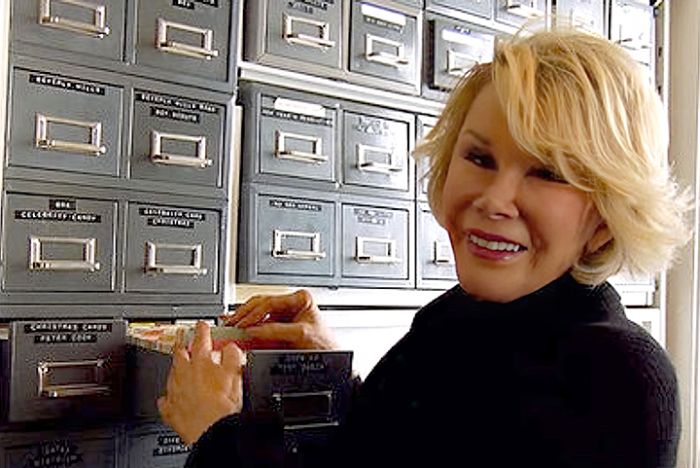
via Joan Rivers: A Piece of Work.(Break Thru Films/IFC, 2010)
National Comedy Center Becomes Home to Joan Rivers’ Career Archive<br /> by National Comedy Center
564 jokes are filed under PARENTS HATED ME (see: NOT WANTED) and over 300 within the STEWARDESSES category.
a file cabinet containing over 65,000 original jokes spanning from the start of her career in the 1950s to 2014 when she passed away.
The NY Times blew her obituary date of 2014 when they published material based on this press release.
Joan Rivers card index of jokes comprised 65,000 cards spanning the start of her career in the 1950s to 2014, when she passed away.
taz-Interview mit Alison Schultz zu Debt for Nature Swaps und anderen Instrumenten der Klimafinanzierung für Länder des globalen Südens.
Chapter 23 examines the 32-bar ABAC form and its two tonal variants: on-tonic and off-tonic. As an example of this formal design, “All Of You” is analyzed
Chapter 22 undertakes a study of song forms and its most common type: the 32-barAABA. Two tonal variants, on-tonic and off-tonic, are examined and, as an example ofthe on-tonic AABA formal design, “Have You Met Miss Jones?” is analyzed.
I'm not saying never mark methods private. I'm saying the better rule of thumb is to "make methods protected unless there's a good reason not to".
I can't count the number of times I've been wrong about whether or not there will ever be a need to override a specific method I've written.
It often eliminates the only practical solution to unforseen problems or use cases.
Today, you either thrive on that word processor model or you don’t. I really don’t, which is why I’ve invested effort, as you have, in researching previous writing workflows, older than the all-conquering PC of the late 1980s and early 90s. At the same time, new writing tools are challenging the established Microsoft way, but in doing so are drawing attention to the fact that each app locks the user into a particular set of assumptions about the drafting and publishing process.
via u/atomicnotes at https://www.reddit.com/r/Zettelkasten/comments/149knhj/comment/jobi9ro/?utm_source=reddit&utm_medium=web2x&context=3 on 2023-06-15
https://www.imdb.com/title/tt1568150/
Based on having watched the documentary Joan Rivers: A Piece of Work and the depictions of Rivers' card index in the film and using her hands and a lateral file for scale, her cards seem to have been 3 x 5" index cards.
cross reference: https://hypothes.is/a/RvLTZjCQEe2uuaNwpTBNuA
Zinoman, Jason. “A ‘Crown Jewel of Comedy’: The Joan Rivers Card Catalog of Jokes Finds a Home.” The New York Times, June 8, 2023, sec. Arts. https://www.nytimes.com/2023/06/08/arts/television/joan-rivers-archive.html.
“And yeah, it goes on, and on, and on. And one day, we’re going to get a little intern who thinks they’re in show business and is going to sit and put each and every one of these cards onto a computer so that when I’m in England and I need a joke about doctors, I can just go into my computer and come up with a — oh, this is a tramp. This tramp donated all her organs for transplants, which should make the recipients happy because her body has never rejected anything. [LAUGHS]: So. But it just goes on, and on, and on. These are just jokes over the years, years, and years, and years of jokes. And when I die, I can sell this to some lucky, lucky comedian who will then, if they’re smart, have enough to keep them going for their whole life.”
standing in front of her card index for comedy, built into a wall of other files.
In a scene from the documentary “Joan Rivers: A Piece of Work,” the comedian explains how she kept a record of her jokes and cross-indexed them.CreditCredit...Break Thru Films/IFC
In the documentary Joan Rivers: A Piece of Work, she explains how she kept and filed records of her jokes.
Example typewritten jokes from Joan Rivers' card index of comedy:


Rivers, who wrote gags at all hours, paid close attention to setups and punchlines, typing them up and cross-referencing them by categories like “Parents hated me” or “Las Vegas” or “No sex appeal.” The largest subject area is “Tramp,” which includes 1,756 jokes.
Joan Rivers card index of jokes is categorized by topical headings like "Parents hated me", "Las Vegas", and "No sex appeal". The largest subject category in her collection was "Tramp" with 1,756 jokes.
In Carlin’s archives, by contrast, the jokes were “mainly scraps of paper organized into Ziploc baggies then put into a folder by topic.”
quote by Journey Gunderson, the executive director of the National Comedy Center
When it comes to the Joan Rivers joke collection, “I don’t know that another exists that is nearly as vast,” Gunderson said.
Ignoring Bob Hope's collection or possibly that by Sid Caesar.
Joan Rivers’s card catalog of jokes and include material covering a vast swath of comedy history, from the 1950s to 2015.
Joan Rivers card index of jokes spans material covering the 1950s to 2015.
Instead, Rivers is donating the extensive collection to the National Comedy Center, the high-tech museum in Jamestown, N.Y., joining the archives of A-list comics like George Carlin and Carl Reiner. The fact that the jokes will be accessible is only one of the reasons for Melissa Rivers’s decision.
To avoid the Raiders of the Lost Ark problem, Melissa Rivers donated her mother's joke collection to the National Comedy Center so it would be on display and accessible. The New York-based museum is also home to the archives of George Carlin and Carl Reiner.
Take a look at some of the artifacts from her archive, which includes 65,000 cross-referenced gags and is headed to the National Comedy Center.
Joan Rivers' card catalog of ~65,000 cross referenced jokes will be housed at the National Comedy Center, a museum in Jamestown, NY.
Toccata for Madiba wascommissioned by the SouthAfrican Music RightsOrganisation Endowment forthe National Arts in 1996 forform part of the firstinternational organ competitionin 1998.In this piece influences oftraditional South African musiccan be observed. Kwela andmbaqanga-styles can beobserved in separate sections.South Africa’s national anthem,Nkosi Sikelele is also quoted
The signs of the Lord’s Second Coming may be divided into two main categories: (1) signs that are part of the Restoration of the gospel and its eventual expansion throughout the world and (2) signs that are part of the increase of evils and the calamities and judgments to come upon the world. Some of the signs and events of the Second Coming that are described in Doctrine and Covenants 45:16–59 include the following: Gentiles and Jews will be gathered (see D&C 45:25, 30, 43) “Wars and rumors of wars, and the whole earth shall be in commotion” (D&C 45:26) The fulness of the gospel will be restored (see D&C 45:28) “A desolating sickness shall cover the land” (D&C 45:31) The Lord’s disciples “shall stand in holy places, and shall not be moved” (D&C 45:32) “Earthquakes … in divers places, and many desolations” (D&C 45:33) “Signs and wonders … shown forth in the heavens above, and in the earth beneath” (D&C 45:40) “The sun shall be darkened, and the moon be turned into blood” (D&C 45:42) The Lord will come “clothed with power and great glory; with all the holy angels” (D&C 45:44) “Saints that have slept shall come forth” (D&C 45:45) The Lord will appear on the Mount of Olives and converse with the Jews (see D&C 45:48, 51–53)
“What shall be the sign of thy coming, and of the end of the world?” (Matthew 24:3). Jesus Christ’s teachings found in Matthew 24:3–51 were greatly expanded through the inspired translation made by the Prophet Joseph Smith, as found in Joseph Smith—Matthew 1:4–55 (in the Pearl of Great Price). Several sections in the Doctrine and Covenants also help to explain the events of the last days and how God’s children can prepare for them (examples include D&C 29; 38; 45; 63; 84; 88; 101; 133).
i wonder then what the true essence of studying the signs of the second coming of jesus christ if it isn't to merely pinpoint the exact date and time, but rather to inspire us to prepare in the present, to draw closer to him, so that we may have no regrets when the day arrives
Jeff Zucker, the former NBC executive and now president of CNN, coined the phrase “trading analog dollars for digital pennies” in 2008.
All digital transitions have had losers, some of whom we may care about more than others. Musicians seem to have a raw deal in the streaming age, receiving fractions of pennies for streams when they used to get dollars for the sales of physical media. Countless regional newspapers went out of business in the move to the web and the disappearance of lucrative classified advertising. The question before society, with even a partial transition to digital books, is: Do we want libraries to be the losers?
Will libraries have the same problems with the digital transition that music and journalism have had?
Project Tailwind by Steven Johnson
Zettelkasten Lesson Plan Intro
Not much here beyond his longer article, though it does have a sample format for zettel which can be useful for those starting out.
European Law Identifier (ELI) and the European Case Law Identifier (ECLI), which provide technical specifications for Web identifiers and suggestions for vocabularies to be used to describe metadata pertaining to legal documents in a machine readable format. Notably, these ECLI and ELI metadata standards adhere to the RDF data format which forms the basis of Linked Data, and therefore have the potential to form a basis for a pan-European legal Knowledge Graph.
ELI (european law identifier) ECLI (European case law identifier) technical specification for web identifiers suggested vocabularies for metadata goal : legal documents in machine readable format.
But some counties don't have this implemted and that stands in the way of a pan-European legal Knowledge Graph.
This analysis will result in the form of a new knowledge-based multilingual terminological resource which is designed in order to meet the FAIR principles for Open Science and will serve, in the future, as a prototype for the development of a new software for the simplified rewriting of international legal texts relating to human rights.
software to rewrite international legal texts relating to human rights, a well written prompt and a few examples, including the FAIR principles will let openAI's chatGPT do it effectively.
Santalucia, Nick. “The Zettelkasten in the Secondary Classroom.” Blog, July 6, 2021. https://www.nicksantalucia.com/blog/the-zettelkasten-in-the-secondary-classroom-k12.
Hyper-zettelkastenStudents stick all of their zettels on the walls with sticky tack or tape (be sure students initial or mark their zettels before doing this).Then, students walk around the room and search for connections and create original ideas using those connections.Students physically attach those zettels with string (like a conspiracy theorist would) and stick a zettel on the string explaining the connection.
ObsidianI am an academic, so a critic might say that intellectual masturbation is kind of my job description. That said, yes, I am using my ZK all the time to create stuff. Oftentimes, "stuff" may be less tangible things like inspiration for a discussion with my team or with students. But my ZK also helps me tremendously for writing papers and grant proposals because now a lot of my thinking can happen before I start writing. More precisely, of course I had done a lot of thinking even before I ever used a ZK, but now I can record, retrieve, and elaborate these thoughts easily so that they accumulate over time to something bigger. Now, writing a paper or grant proposal often comes down to concatenating a bunch of notes. Ok, maybe that's a bit exaggerated, it still does take some extra editing, but you catch my drift.It took me some experimenting but now I can't imagine going back to my pre-Zettelkasten way of working.
reply to u/enabeh at https://www.reddit.com/r/Zettelkasten/comments/13s6dsg/comment/jluovm9/?utm_source=reddit&utm_medium=web2x&context=3
If you're curious, I've been collecting examples of teachers/professors who used their zettelkasten for teaching: https://hypothes.is/users/chrisaldrich?q=tag%3A%27card+index+for+teaching%27 Examples include Mario Bunge, Frederic L. Paxson, Gotthard Deutsch, Roland Barthes, and Joachim Jungius. In more recent contexts, I've seen Dan Allosso (aka u/danallosso), Mark Robertson (aka calhistorian u/calhistorian), and Sean Graham (https://electricarchaeology.ca/) using zettelkasten or linked notes using Obsidian, Roam, etc. for teaching. Perhaps we should get the group together to trade stories? Ping me with an email if you're interested.
of course I had done a lot of thinking even before I ever used a ZK, but now I can record, retrieve, and elaborate these thoughts easily so that they accumulate over time to something bigger. Now, writing a paper or grant proposal often comes down to concatenating a bunch of notes.
Wittgenstein, Luhmann, Conrad Gessner, Leibniz, Linnaeus and Walter Benjamin are some I can think of off the top of my head.
reply to u/muhlfriedl by way of reply to u/chounosumuheya at https://www.reddit.com/r/Zettelkasten/comments/13s6dsg/comment/jlpt8ai/?utm_source=reddit&utm_medium=web2x&context=3
Examples of zettelkasten users
S.D. Goitein, Beatrice Webb, Ludwig Wittgenstein, Harold Innis, Victor Margolin, Eminem, Aby Warburg, Antonin Sertillanges, Jacques Barzun, C. Wright Mills, Gotthard Deutsch, Roland Barthes, Umberto Eco, Vladimir Nabokov, Gerald Weinberg, Michael Ende, Twyla Tharp, Hans Blumenberg, Keith Thomas, Arno Schmidt, Mario Bunge, Sönke Ahrens, Dan Allosso for a few more. If you go with those who used commonplace books and waste books, which are notebook-based instead of index card-based, there are thousands upon thousands more.
Historically the easier question might be: what creators didn't use one of these systems and was successful?!? The broad outlines of these methods go back much, much farther than Niklas Luhmann. These patterns are not new...
Personally, I've used my own slip box to write large portions of the articles on my website. I also queried it to compile this reply.
framework for making claims with evidence. The simplest of which, which is what I use, is Claim-Evidence-Reasoning (CER). Students are taught to state their claim (The theme of the story is X), support it with evidence (Readers can infer this through the story's plot, particularly...), and explain their reasoning (Because the character's action result in X, ...) Another great framework is The Writing Revolution/The Hochman Method's "single paragraph outline". Students need to be taught that these are the units of thought -- the most basic forms of an argument. And, even before this, they need to know that a sentence is the form of an idea.
PR-Beauftragte der Vereinigten Arabischen Emirate und des COP-Präsidenten Sultan Al Jaber haben systematisch versucht, die Wikipedi- Informationen über Al Jaber zu manipulieren. Dabei soll der Ölminister der Emirate als Vorkämpfer der Energiewende dargestellt werden. Hinweise auf Investitionen in neue fossil-projekte, die mit dem Pariser Abkommen nicht vereinbar sind, und mit Investoren wie Blackrock vereinbart wurden, werden getilgt.
what replaces it isn't a human person free from nature but a market in which that nature 00:24:53 becomes a set of supply and demand problems
https://www.youtube.com/watch?v=dU7efgGEOgk
I wish he'd gotten into more of the detail of the research and index card making here as that's where most of the work lies. He does show some of his process of laying out and organizing the cards into some sort of sections using 1/3 cut tabbed cards. This is where his system diverges wildly from Luhmann's. He's now got to go through all the cards and do some additional re-reading and organizational work to put them into some sort of order. Luhmann did this as he went linking ideas and organizing them up front. This upfront work makes the back side of laying things out and writing/editing so much easier. It likely also makes one more creative as one is regularly revisiting ideas, juxtaposing them, and potentially generating new ones along the way rather than waiting until the organization stage to have some of this new material "fall out".
Levenger sells a line of various "pocket briefcases" which include space for 3 x 5" index card "ticklers" which are similar in form to the old Memindex.
- Set of 52 weekly 3 x 5 accordion tri-folded cards - Undated planner with ruled lines and shaded blank areas for writing appointments, notes or lists on each day of the week - Thick and substantial 250-gsm card stock - Friendly to all types of ink - Unfolded, 9W x 5H
A 9 x 5" card that folds in three to make a 3 x 5" card for planning out one's entire week.
This is quite clever with respect the space of cards like Analog and 3x5 Life.
Discussing the documentary system of surveillance, Foucault points toa “partly official, partly secret hierarchy” in Paris that had been using a card index to managedata on suspects and criminals at least since 1833.
source apparently from: “Apparition de la fiche et constitution des sciences humaines: encore une invention que les historiens célèbrent peu.” Michel Foucault, Surveillir et punir. Naissance de la prison (Paris: Gallimard, 1975), 287, referring to A. Bonneville, De la recidive (Paris, 1844), 92–93.
CD-ROM interactive content and games like Myst (1993)
The 1993 game Myst, available on CD-ROM, had a card index like format.
Compare with other products in this category: - Analog (Jeff Sheldon productivity system) - Memindex - Bullet Journal - Frictionless Capture Cards - Pile of Index Cards

prior coordination
WAT
I've had this on a list for ages, but never put into my digital notes...
If you doubt my claim that internet is broad but not deep, try this experiment. Pick any firm with a presence on the web. Measure the depth of the web at that point by simply counting the bytes in their web. Contrast this measurement with a back of the envelope estimate of the depth of information in the real firm. Include the information in their products, manuals, file cabinets, address books, notepads, databases, and in each employee's head.
Although Niklas Luhmann used zettelkasten on the basis of his academic works, I have seen very few sources on the academic use of zettelkasten, except for a few videos. Is there any source you can recommend on this subject?Another question I have is about the academic reuse of notes. After Luhmann used a note in one academic text, how did he use that note again in another work? Or in general, how can we avoid self-plagiarism in the academic use of zettelkasten?
reply to u/edumanos at https://www.reddit.com/r/antinet/comments/13p0myn/academic_using_of_zettelkasten/
The Luhmann's method was very specific to him, but the broader slip box method has been in wide use in academic settings for centuries, particularly in the humanities. I most often recommend Umberto Eco's book in conjunction with Adler/Van Doren's How to Read a Book, but below are a small selection of manuals on very closely related note taking methods. These can be found in a handful of languages and some even more specific to particular areas of study, though broadly they're all useful to almost any area. You'll note that some are available for free on archive.org as they're out of copyright, have been scanned, or are open educational resources. I've tried to link most of these for convenience.
If this list isn't enough, or you're looking for something written for a specific subfield (sociology, for example), let me know as I'm sure there are a plethora of others, or even some fun short pieces like: - Thomas, Keith. “Diary: Working Methods.” London Review of Books, June 10, 2010. https://www.lrb.co.uk/the-paper/v32/n11/keith-thomas/diary. - Mills, C. Wright. “On Intellectual Craftsmanship (1952).” Society 17, no. 2 (January 1, 1980): 63–70. https://doi.org/10.1007/BF02700062.
My favorite short/overview video is that of Victor Margolin's process: https://www.youtube.com/watch?v=Kxyy0THLfuI.
As for self-plagiarism, some have used a red pencil or other means to mark cards (notes) they've used in specific works as they write so that they know they've been used and can then self-cite their prior works to avoid self-plagiarism or to up their citation count.
Good luck!
I've been using index cards for tracking reading notes (lit or bib notes now) and I want to change this topic of index cards over to the Z system. In the past, the main section was "writing" and two subsections, "nonfiction" and "fiction". They are all how-to. I have some main notes but most are from every writing book published which I've read in the last 10 years (yep, shelves full). Approx. 3000 index cards, maybe more, with lots of sub-subsection, etc. I've been teaching writing for the last 10+ years and would love to connect the dots easier now than I have in the past. On the list, I couldn't find the recommended category to place these under. Maybe productivity is in there somewhere. I'm working on a mind map structure now. Any thoughts or advice on this? Anyone else done this?
Has your prior system not been working for you? What do you want to gain from making the change? What list are you looking at that you don't see a category? Isn't the category "writing", "fiction writing", "nonfiction writing", etc.?
Obsidian for teachers .t3_13khuxs._2FCtq-QzlfuN-SwVMUZMM3 { --postTitle-VisitedLinkColor: #9b9b9b; --postTitleLink-VisitedLinkColor: #9b9b9b; --postBodyLink-VisitedLinkColor: #989898; }
This is great. I'll put it into my collection along with Shawn Graham who has some prior work for teaching with Obsidian (https://shawngraham.github.io/hist1900/#the-big-idea) as does u/danallosso who has also used it quite bit for both classes as well as Open Education Resources. If you search for Dan's YouTube & Substack, you're likely to find some of his writing/resources there.
https://www.reddit.com/r/ObsidianMD/comments/13khuxs/obsidian_for_teachers/
I started making lists on index cards—you know the ones we used back in school.
Note the total lack of any referent to why we used to use index cards in school.

Following a pattern seen in many modern wooden recipe card boxes to hold the current recipe one is working on, Jeff Sheldon has cut a long thin slot into his card holder to allow one to stand up today's card in the front as a means of displaying and featuring what needs to get done.
https://xtiles.app/6249b3f811d8db0dcd173512
Fascinating to see an xTiles page named "competitive analysis", but an interesting example of "eating their own dogfood" to make it.
Introducing BOOX Tab Ultra C: Let the Colors Help You Work Better
They're primarily touting one of the few e-ink tablets that does color (beginning in 2023), but it's fascinating to see the Boox marketing department using this video to sell the idea of color on a screen as a tool for thought this way.
It's subtle and something we take for granted, so they have a point, but somehow odd none the less, perhaps because of its ubiquity.
Let the colors help you think, organize, and work better.
Let the colors help you work better.
Colors inspire
China hat viermal so umfangreiche Projekte zur Kohleverstromung genehmigt wie im Vorjahr. Die Leistung wird damit um 50 Gigawatt gesteigert. Hinter dieser Politik steht die Angst vor Energieknappheit. 2022 würden in China Kapazitäten für 87 Gigawatt erneuerbare Energien geschaffen, sich das ist ein Rekord.
How To Use The ACE Framework This Week
ACE Framework - Add - Connect - Express
yet another acronym
hmmm... because... as a tool for building/developing thoughts
Meet Bard: your creative and helpful collaborator, here to supercharge your imagination, boost your productivity, and bring your ideas to life.
Colorado’s vision is that all children, youth, parents or kin caregivers with these risk factors will be eligible for Title IV-E prevention services—both those who are involved in the child welfare system and those who have not been the subject of a child maltreatment report but share characteristics that deem them at serious risk of out-of-home placement.
families who ARE INVOLVED. ....AND.... NOT INVOLVED with the child welfare system
Reunification, adoption or guardianship arrangements that are at risk of disruption
the existing system cannot just be modified; rather, a fundamental shift in service delivery and support to families must occur.
**annotations were started in a draft version of this document (HERE) and then continued here.
A child is considered to be a IV-E Prevention Candidate when:• The child is designated as being at “serious risk”of out-of-home placement (see FAQs for moreinformation);• There is a prevention/treatment plan in place forthe child/family; and,• The child and/or their family is receiving anevidence-based service (as identified throughColorado’s prevention plan)
circumstancesandcharacteristicsthatputchildrenandyouthatseriousriskofenteringorre-enteringfostercareasidentifiedbyresearchandexperience
The definition below describes the circumstances and characteristics that put children and youth at serious risk of entering or re-entering foster care as identified by research and experience.
InColorado,theintentofplacementpreventionservicesistoproactivelystrengthenandsupportfamiliesasearlyaspossible,beforetheyareincrisis,regardlessofwhethertheyareformallyinvolvedwiththechildwelfaresystemornot
In Colorado, the intent of placement prevention services is to proactively strengthen and support families as early as possible, before they are in crisis, regardless of whether they are formally involved with the child welfare system or not.
Commonplacing, florilegia, anthologies, miscellanies, zettelkasten are such a fascinating tradition. They make a lovely ratchet for thinking.
Commonplacing, florilegia, anthologies, miscellanies, zettelkasten are a ratchet for thinking.
Tinderbox Meetup - Sunday, May 7, 2023 Video: Connect with Sönke Ahrens live, the author of How to Take Smart Notes
reply for Fidel at https://forum.eastgate.com/t/tinderbox-meetup-sunday-may-7-2023-video-connect-with-sonke-ahrens-live-the-author-of-how-to-take-smart-notes/6659
@fidel (I'm presuming you're the same one from the meetup on Sunday, if not perhaps someone might tag the appropriate person?), I was thinking a bit more on your question of using physical index cards for writing fiction. You might find the examples of both Vladimir Nabokov and Dustin Lance Black, a screenwriter, useful as they both use index card-based workflows.
Vladimir Nabokov died in 1977 leaving an unfinished manuscript in note card form for the novel The Original of Laura . Penguin later published the incomplete novel with in 2012 with the subtitle A Novel in Fragments . Unlike most manuscripts written or typewritten on larger paper, this one came in the form of 138 index cards. Penguin's published version recreated these cards in full-color reproductions including the smudges, scribbles, scrawlings, strikeouts, and annotations in English, French, and Russian. Perforated, one could tear the cards out of the book and reorganize in any way they saw fit or even potentially add their own cards to finish the novel that Nabokov couldn't. Taking a look at this might give you some ideas of how Nabokov worked and how you might adapt the style for yourself. Another interesting resource is this article with some photos/links about his method with respect to writing Lolita: https://www.openculture.com/2014/02/the-notecards-on-which-vladimir-nabokov-wrote-lolita.html
You might also find some useful tidbits on his writing process (Bristol cards/Exacompta anyone?) in: Gold, Herbert. “Vladimir Nabokov, The Art of Fiction No. 40.” The Paris Review, 1967. https://www.theparisreview.org/interviews/4310/the-art-of-fiction-no-40-vladimir-nabokov.
Carl Mydans photographed Nabokov while writing in September 1958 and some of those may be interesting to you as well.
Dustin Lance Black outlines his index card process in this video on YouTube: https://www.youtube.com/watch?v=vrvawtrRxsw
If you dig around you'll also find Michael Ende and a variety of other German fiction writers who used index cards on the Zettelkasten page on Wikipedia, but I suspect most of the material on their processes are written in German.
Index cards for fiction writing may allow some writers some useful affordances/benefits. By using small atomic pieces on note cards, one can be far more focused on the idea and words immediately at hand. It's also far easier in a creative and editorial process to move pieces around experimentally.
Similarly, when facing Hemmingway's "White Bull", the size and space of an index card is fall smaller. This may have the effect that Twitter's short status updates have for writers who aren't faced with the seemingly insurmountable burden of writing a long blog post or essay in other software. They can write 280 characters and stop. Of if they feel motivated, they can continue on by adding to the prior parts of a growing thread.
However, if you can, try to use a card catalog drawer with a rod so that you don't spill all of your well-ordered cards the way the character in Robert M. Pirsig's novel Lila (1991) did.
Within the pantheon of types of notes there are: - paraphrasing notes, which one can use to summarize ideas for later recall and review as well as to check one's own knowledge and understanding of what an author has said. - commentary notes, which take the text and create a commentary on them, often as part of having a conversation with the text. These can be seen historically in the Midrashim tradition of commenting on Torah.
separately also: - productivity notes - to do lists, reminders of work to be done, often within or as part of a larger complex project
The few notes I did refer back to frequently where checklists, self-written instructions to complete regular tasks, lists (reading lists, watchlists, etc.) or recipes. Funnily enough the ROI on these notes was a lot higher than all the permanent/evergreen/zettel notes I had written.
Notes can be used for different purposes.
The broad distinction is between productivity goals and knowledge. (Is there a broad range I'm missing here within the traditions?) You can take notes about projects that need to be taken care of, lists of things to do, reminders of what needs to be done. These all fall within productivity and doing and checking them off a list will help one get to a different place or location and this can be an excellent thing, particularly when the project was consciously decided upon and is a worthy goal.
Notes for knowledge sake can be far more elusive for people. The value here generally comes with far more planning and foresight towards a particular goal. Are you writing a newsletter, article, book, or making a video or performance of some sort (play, movie, music, etc.)? Collecting small pieces of these things on a pathway is then important as you build your ideas and a structure toward some finished product.
Often times, before getting to this construction phase, one needs to take notes to be able to scaffold their understanding of a particular topic. Once basically understood some of these notes may be useless and not need to be reviewed, or if they are reviewed, it is for the purpose of ensconcing ideas into long term memory. Once this is finished, then the notes may be broadly useless. (This is why it's simple to "hide them with one's references/literature notes.) Other notes are more seminal towards scaffolding ideas towards larger projects for summarization and dissemination to other audiences. If you're researching a topic, a fair number of your notes will be used to help you understand the basics while others will help you to compare/contrast and analyze. Notes you make built on these will help you shape new structures and new, original thoughts. (note taking for paradigm shifts). These then can be used (re-used) when you write your article, book, or other creative project.
Registration Agencies must comply with the policies and technical standards established by the IDF, but are free to develop their own business model for running their businesses. There is no appropriate “one size fits all” model; RAs may be for-profit or not-for-profit organisations. The costs of providing DOI registration may be included in the services offered by an RA provision and not separately distinguished from these. Examples of possible business models may involve explicit charging based on the number of prefixes allocated or the number of DOI names allocated; volume discounts, usage discounts, stepped charges, or any mix of these; indirect charging through inclusion of the basic registration functions in related value added services; and cross-subsidy from other sources.
{Fee-for-Service}
Durch seine LNG-Importe im vergangenen Jahr hat Europa die Preise so nach oben getrieben, dass Pakistan und wohl auch China stattdessen Kohle verwendet haben. Standard-Interview mit Helen Thompson die sich mit den politischen Auswirkungen von Gas beschäftigt. https://www.derstandard.at/story/2000146167458/cambridge-professorin-thompson-europa-hat-sein-gasproblem-ausgelagert.
The Web does not yet meet its design goal as being a pool of knowledge that is as easy to update as to read. That level of immediacy of knowledge sharing waits for easy-to-use hypertext editors to be generally available on most platforms. Most information has in fact passed through publishers or system managers of one sort or another.
Ein Bericht von Umwelt-Organisationen und des Center for Countering Digital Hate ergibt, dass Google nach wie vor viel Geld mit Anzeigen in der Umgebung von Inhalten von Klimleugnern verdient. 2021 hatte Google versprochen, auf solche Werbung zu verzichten. https://www.nytimes.com/2023/05/02/technology/google-youtube-disinformation-climate-change.html
Die World Weather Attribution Group hat in einer Studie nachgewiesen, dass die große Dürre an Horn von Afrika ein Ergebnis der Erhitzung der Erde durch Treibhausgase ist. Von der Dürre sind 50 Millionen Menschen direkt und weitere 100 Millionen indirekt betroffen. Ohne die Erhöhung der Temperaturen hätten dieselben Regenverhältnisse nicht zu einer Dürre geführt. https://www.theguardian.com/environment/2023/apr/27/human-driven-climate-crisis-fuelling-horn-of-africa-drought-study
Auf Druck von FDP und SPD steht die deutsche Regierung offenbar kurz davor, ihre Unterstützung für die EU-Gebäude-Richtlinie zurückzuziehen, die minimale Energiestandards in der EU durchsetzen soll.
https://www.euractiv.com/section/energy-environment/news/berlin-considers-withdrawing-support-for-eu-buildings-directive/ (via https://graz.social/@AnnikaJoeres@mstdn.social/110253409723826586)
Präsident Biden will in 5 Jahren insgesamt 500 Millionen Dollar für ein Programm zum Schutz des brasilianischen Regenwalds ausgeben. Der Plan stößt auf den Widerstand der Republikaner im Kongress, die die Finanzierung von Klimaschutz außerhalb der USA ablehnen. https://www.nytimes.com/2023/04/20/climate/biden-amazon-deforestation-climate.html
Also I really want to see the someone using their zettlekasten for managing knowledge about stuff not zettlekasten related. Mine mainly revolves about artistic appretiation, creativity and art fundamentals. I've been wanting to make a video series about it, just havent find the time. Your videos serve much as inspiration and as example of how may I go about it.
reply to Sara Martínez at https://www.youtube.com/watch?v=wQPvrcksjUA&lc=UgzbdJ1cdxkjnN0DBOl4AaABAg
Sara, here are some creative/art-related examples that might help:<br /> Dancer/Choreographer Twyla Tharp used a slightly modified slip box method that included much more than notes on cards for her dance-related work. She describes the process well in chapter 6 of her book "The Creative Habit: Learn It and Use It for Life".
If you're into art and image-based work, Aby Warburg had a zettelkasten with images. Search for details on his "Mnemosyne Atlas" at The Warburg Institute at the School of Advanced Study University of London which has some material you may appreciate.
Product designer khimtan has a visual zettelkasten practice you can find examples of on Reddit in the "Antinet" sub.
A variety of comedians like Phyllis Diller, Joan Rivers, Bob Hope, and George Carlin had zettelkasten practices for their comedy work.
Eminem has a fantastic, but tremendously simple zettelkasten for songwriting. Taylor Swift has a somewhat similar digital version which she has talked about using, though she doesn't use the word zettelkasten to describe it.
1. Zettelkasten for INTERMEDIATE users of Obsidian
Buttons for coprolites and oosik... 🤣
His templates look a lot like some of the work and templates I use to import annotations/notes from Hypothes.is into Obsidian.
Musician John Mayer, too, describes his typewriter as more of an emotional companion than a logistical tool. He laments writing lyrics with the judgemental “red squiggly line” of spell check, which he says stops the creative process because he feels compelled to fix the error, and turning to a typewriter which “doesn’t judge you, it just goes, ‘right away, sir, right away’.”
one must also submit to the discipline provided by imitationand practice.
Too many zettelkasten aspirants only want the presupposed "rules" for keeping one or are interested in imitating one or another examples. Few have interest in the actual day to day practice and these are often the most adept. Of course the downside of learning some of the pieces online leaves the learner with some (often broken) subset of rules and one or two examples (often only theoretical) and then wonder why their actual practice is left so wanting.
they weresensible enough to recognize that one does not acquire a skill simply bystudying rules; one must also submit to the discipline provided by imitationand practice. And they recognized too that in order to derive the maximumbenefit from precept, imitation, and practice, the student had to be firedwith a desire to learn as much as his natural endowments permitted.
Going back at least as far as the rhetoric of Aristotle, Cicero, and Quintilian, we recognize that while sets of rules can be helpful to the student, these must also be paired with ample imitation and practice.
A project of the Roy Rosenzweig Center for History and New Media https://rrchnm.org/portfolio-item/tropy/
My biggest realization recently is to do whatever the opposite of atomicity is.
Too many go too deep into the idea of "atomic notes" without either questioning or realizing their use case. What is your purpose in having atomic notes? Most writing about them online talk about the theoretical without addressing the underlying "why".
They're great for capturing things on the go and having the ability to re-arrange and reuse them into much larger works. Often once you've used them a few times, they're less useful, specially for the average person. (Of course it's another matter if you're an academic researcher, they're probably your bread and butter.) For the beekeepers of the world who need some quick tidbits which they use frequently, then keeping them in a larger outlined document or file is really more than enough. Of course, if you're creating some longer book-length treatise on beekeeping, then it can be incredibly helpful to have them at atomic length.
There's a spectrum from the small atomic note to the longer length file (or even book). Ask yourself, "what's your goal in having one or the other, or something in between?" They're tools, choose the best one for your needs.
• Make specific findings to deviate from the assessmentrequired in 19-1-115 (4)(h).• Make findings regarding why an alternative other thanQRTP does not meet the needs of the child/youth.• Lack of available placements cannot be a reason.• Make required findings:• QRTP provides the most effective appropriatelevel of care for the child/youth/juvenile in the leastrestrictive environment.• Consistent with the permanency plan (if set).• Consistent with the child/youth/juvenile’s short- andlong-term goals.• Set QRTP review prior to discharge date or no longerthan 90 days, see 19-1-115(4)(g)
Benchcard QRTP Elgibility Scenario = Court Approves/Orders QRTP | IA does NOT Recommend QRTP
Instruction to judge: * • Make specific findings to deviate from the assessment required in 19-1-115 (4)(h). * • Make findings regarding why an alternative other than QRTP does not meet the needs of the child/youth. * • Lack of available placements cannot be a reason. * • Make required findings: * • QRTP provides the most effective appropriate level of care for the child/youth/juvenile in the least restrictive environment. • Consistent with the permanency plan (if set). • Consistent with the child/youth/juvenile’s short- and long-term goals. • Set QRTP review prior to discharge date or no longer than 90 days, see 19-1-115(4)(g)
*Also see Tags "candidate for foster care"
Reasonable CandidatesReasonable candidates for foster care, for the purposes of Title IV-E program, are childrendetermined to be at risk of imminent placement out of the home as defined in Section 19-1-103(64), C.R.S. Administrative costs may be claimed for children who are determined to be atimminent risk of removal from the home through a voluntary placement agreement or court-ordered custody with the county department. A determination must be made as to whether thechild is at imminent risk of removal from the home no less frequently than every six (6) months.Reasonable efforts shall be made to prevent the removal of the child from the home until suchtime that pursuing removal of the child from the home becomes necessary.
CODE OF COLORADO REGULATIONS 12 CCR 2509-7 Social Services Rule
7.601.71 Title IV-E Foster Care
If the court or administrative review division deviates from the qualified individual’s assessment and recommendation, the court or the administrative review division shall make specific findings of fact regarding the most effective, appropriate, and least restrictive placement for the child or youth and whether the placement is consistent with child- or youth-specific short- and long-term goals for the child or youth and the family. When making such findings of fact, the court or administrative review division shall consider all relevant information, including:(I) Whether the protocol for the qualified residential treatment program assessment was followed;(II) The strengths and specific treatment or service needs of the child or youth and the family;(III) The expected length of stay; and(IV) The placement preference of the child or youth and the family.
C.R.S. 19-1-115 (4)(h)
I just finished my Bachelor thesis working with Obsidian! by u/ThiIsAnkou
100 literature- and about 650 permanentnotes. Thanks to Obsidian and Zettelkasten!
Candidate for Foster Care:For the purposes of Title IV-E Prevention Services,a child is a candidate for foster care when atserious risk of entering or reentering foster careand who is able to remain safely in the home withprovision of mental health, substance use disorder,or In-home parenting services for the child, parentor kin caregiver. Foster youth who are pregnant orparenting are also candidates.COLORADO'S FINALDEFINITION
CODE OF COLORADO REGULATIONS 12 CCR 2509-7 Social Services Rule
7.601.71 Title IV-E Foster Care
Coloradowants:• All kids who need services to have access toservices and to be served in their family’s homeor in a relative’s home whenever possible• Families to have what they need to keep theirfamily safe and together, and• Services available without requiring the family tobe involved in the child welfare system
YOU DO???!!!!!! THEN LET'S GET TO IT
FEDERAL DEFINITION OFCANDIDACYA “child who is a candidate for foster care” is defined asa child who is identified in a title IV-E prevention plan asbeing at imminent risk of entering foster care, but whocan remain safely in the child's home or in a kinshipplacement as long as the title IV-E prevention servicesthat are necessary to prevent the entry of the child intofoster care are provided”This includes a child whose adoption or guardianshiparrangement is at risk of a disruption or dissolution thatwould result in a foster care placement (section 475(13)of the Act).
TL;DR
She qualifies. Adjudication/custody not required
Question 1. May we claim Federal financial participation (FFP) for the administrative costs associated with foster care candidates even for children who never enter foster care? Answer Yes. Federal financial participation for administrative costs listed at 45 CFR 1356.60(c) may be claimed regardless of whether the child is actually placed in foster care and becomes a recipient of title IV-E foster care benefits. However, reimbursement is limited to those individuals the title IV-E agency reasonably views as candidates for title IV-E foster care maintenance payments consistent with section 472(i)(2) of the Social Security Act. The three acceptable methods of documentation indicating that a child is a candidate for title IV-E foster care benefits are: (1) A defined case plan which clearly indicates that, absent effective preventive services, foster care is the planned arrangement for the child, (2) an eligibility determination form which has been completed to establish the child's eligibility under title IV-E, or (3) evidence of court proceedings in relation to the removal of the child from the home, in the form of a petition to the court, a court order or a transcript of the court's proceedings. Should the title IV-E agency determine that the child is no longer a candidate for foster care at any point prior to the removal of the child from his home, subsequent activities will not be allowable for reimbursement of costs under title IV-E. Source/Date ACYF-CB-PA-87-05 (10/22/87); 7/7/2006; (12/17/2019) Legal and Related References Social Security Act - sections 471(a)(15), 472(i)(2), and 479B; DHHS Grant Appeals Board Decision No. 844; ACYF-CB-IM-06-02
*Page [LINK], b/c the relay has a broken redirect*(https://www.acf.hhs.gov/cwpm/public_html/programs/cb/laws_policies/laws/cwpm/policy_dsp.jsp?citID=79)
TL;DR: She qualifies for QRTP; custody/adjudication is not a requirement
The three acceptable methods of documentation indicating that a child is a candidate for title IV-E foster care benefits are: (1) A defined case plan which clearly indicates that, absent effective preventive services, foster care is the planned arrangement for the child, (2) an eligibility determination form which has been completed to establish the child's eligibility under title IV-E, or (3) evidence of court proceedings in relation to the removal of the child from the home, in the form of a petition to the court, a court order or a transcript of the court's proceedings.
By definition, a candidate is a child for whom the title IV-E agency is either pursuing or making reasonable efforts to prevent a remova
Question 2. At what point may a child be considered a candidate for foster care? Answer A candidate for foster care is a child who is at serious risk of removal from home as evidenced by the title IV-E agency either pursuing his/her removal from the home or making reasonable efforts to prevent such removal. The basis for determining when a child may be considered a candidate for foster care can be found in statute, Departmental policy, and Departmental Appeals Board (DAB) decisions: STATUTE: Section 471(a)(15)(B)(i) of the Act provides the frame of reference for determining the point at which a child becomes a candidate for foster care by requiring a title IV-E agency to make reasonable efforts to prevent a child's removal from home. A child may not be considered a candidate for foster care solely because the title IV-E agency is involved with the child and his/her family. In order for the child to be considered a candidate for foster care, the title IV-E agency's involvement with the child and family must be for the specific purpose of either removing the child from the home or satisfying the reasonable efforts requirement with regard to preventing removal. DEPARTMENTAL POLICY: Stipulates the three acceptable methods for documenting a child's candidacy for title IV-E foster maintenance payments. The existence of these forms of documentation indicates that a child legitimately may be considered a candidate for foster care: 1) A defined case plan which clearly indicates that, absent effective preventive services, foster care is the planned arrangement for the child. The decision to remove a child from home is a significant legal and practice issue that is not entered into lightly. Therefore, a case plan that sets foster care as the goal for the child absent effective preventive services is an indication that the child is at serious risk of removal from his/her home because the title IV-E agency believes that a plan of action is needed to prevent that removal. 2) An eligibility determination form which has been completed to establish the child's eligibility for title IV-E foster care maintenance payments. Completing the documentation to establish a child's title IV-E eligibility is an indication that the title IV-E agency is anticipating the child's entry into foster care and that s/he is at serious risk of removal from home. Eligibility forms used to document a child's candidacy for foster care should include evidence that the child is at serious risk of removal from home. Evidence of AFDC eligibility in and of itself is insufficient to establish a child's candidacy for foster care. 3) Evidence of court proceedings in relation to the removal of the child from the home, in the form of a petition to the court, a court order or a transcript of the court proceedings. Clearly, if the title IV-E agency has initiated court proceedings to effect the child's removal from home, s/he is at serious risk of removal from the home. DAB DECISIONS: DAB Decision No. 1428 offers the following guidance for identifying the point at which a child may be considered a candidate: "...The methods of documenting candidacy [identified in the Department's policy guidance] involve activities which occur at a point when the state has initiated efforts to actually remove a child from his or her home or at the point the state has made a decision that the child should be placed in foster care unless preventive services are effective..." The DAB also ruled in Decision No. 1428 that a report of child abuse or neglect is insufficient for establishing a child's candidacy for foster care: "...The fact that a child is the subject of [a child abuse/neglect report] falls far short of establishing that the child is at serious risk of placement in foster care and thus of becoming eligible for IV-E assistance..." A candidate, in the opinion of the DAB, is a child who is at serious risk of removal from his/her home because the title IV-E agency is either pursuing that removal or attempting to prevent it. A child cannot be considered a candidate for foster care when the title IV-E agency has no formal involvement with the child or simply because s/he has been described as "at risk" due to circumstances such as social/interpersonal problems or a dysfunctional home environment. Source/Date ACYF-CB-PA-01-02 (7/3/01); (12/17/2019) Legal and Related References Social Security Act - sections 471(a)(15), 472(i), and 479B; Departmental Appeals Board Decision No. 1428
Our strategies for changing the world are often inspired by a culture created by a physicalist metaphysics. That’s why I propose that metaphysics eats culture for breakfast. What we believe to be real and relevant is the most significant factor in the formation of culture, which in turn influences our thoughts and emotions, which in turn influence our values, which influence our institutions and political policies. The change has to happen at the deepest level if it’s going to have any significant impact on an issue as important as whether or not we go extinct.
// Metaphysics eats culture for breakfast - a takeoff of a well-known business meme - culture eats strategy for breakfast - Beiner goes one level deeper and claims - metaphysics eats culture for breakfast - He justifies this via this argument - Our strategies for changing the world - are often inspired by - a culture created by a physicalist metaphysics. - That’s why I propose that metaphysics eats culture for breakfast. - What we believe to be real and relevant - is the most significant factor - in the formation of culture, - which in turn influences our thoughts and emotions, - which in turn influence our values, - which influence our institutions and political policies. - The change has to happen at the deepest level - if it’s going to have any significant impact - on an issue as important as whether or not we go extinct.
Hypothesis Animated Intro, 2013. https://www.youtube.com/watch?v=QCkm0lL-6lc.
This was an early animation for Hypothes.is as a tool. It was on one of their early homepages and is (still) a pretty good encapsulation of what they do and who they are as a tool for thought.
In the fall of 2015, she assigned students to write chapter introductions and translate some texts into modern English.
Perhaps of interest here, would not be a specific OER text, but an OER zettelkasten or card index that indexes a variety of potential public domain or open resources, articles, pieces, primary documents, or other short readings which could then be aggregated and tagged to allow for a teacher or student to create their own personalized OER text for a particular area of work.
If done well, a professor might then pick and choose from a wide variety of resources to build their own reader to highlight or supplement the material they're teaching. This could allow a wider variety of thinking and interlinking of ideas. With such a regiment, teachers are less likely to become bored with their material and might help to actively create new ideas and research lines as they teach.
Students could then be tasked with and guided to creating a level of cohesiveness to their readings as they progress rather than being served up a pre-prepared meal with a layer of preconceived notions and frameworks imposed upon the text by a single voice.
This could encourage students to develop their own voices as well as to look at materials more critically as they proceed rather than being spoon fed calcified ideas.
What would a list of prompts for teaching creatively look like if it were created using Brian Eno's Oblique Strategies as a model?
Inspired by Sophia Rahming (~09:48)
“Normally, a dictionary just tells you what words mean – and of course we do that – but the scale of the project gives us the space and opportunity to say what we’re not sure of too,” he said. “This is important because it leaves the door open for further scholarship and it gives the reader choices rather than dictating to them what to think. The dictionary can be a catalyst for more research and this is what makes the dictionary a living thing.”
We need more scholarship which leaves open thinking spaces for future scholars.
Project: Thesaurus linguae Latinae<br /> from Bayerische Akademie der Wissenschaften
The advent of computer technology facilitated the assembly of the Demotic Dictionary, which unlike its older sister, the Chicago Assyrian Dictionary, could be organized electronically rather than on index cards.
The Chicago Demotic Dictionary compiled by the Oriental Institute at the University of Chicago was facilitated by computers compared with the Chicago Assyrian Dictionary which relied on index cards.
The Wörterbuch der ägyptischen Sprache was an international collaborative zettelkasten project begun in 1897 and finally published as five volumes in 1926.
https://en.wikipedia.org/wiki/W%C3%B6rterbuch_der_%C3%A4gyptischen_Sprache
Die schiere Menge sprengt die Möglichkeiten der Buchpublikation, die komplexe, vieldimensionale Struktur einer vernetzten Informationsbasis ist im Druck nicht nachzubilden, und schließlich fügt sich die Dynamik eines stetig wachsenden und auch stetig zu korrigierenden Materials nicht in den starren Rhythmus der Buchproduktion, in der jede erweiterte und korrigierte Neuauflage mit unübersehbarem Aufwand verbunden ist. Eine Buchpublikation könnte stets nur die Momentaufnahme einer solchen Datenbank, reduziert auf eine bestimmte Perspektive, bieten. Auch das kann hin und wieder sehr nützlich sein, aber dadurch wird das Problem der Publikation des Gesamtmaterials nicht gelöst.
Google translation:
The sheer quantity exceeds the possibilities of book publication, the complex, multidimensional structure of a networked information base cannot be reproduced in print, and finally the dynamic of a constantly growing and constantly correcting material does not fit into the rigid rhythm of book production, in which each expanded and corrected new edition is associated with an incalculable amount of effort. A book publication could only offer a snapshot of such a database, reduced to a specific perspective. This too can be very useful from time to time, but it does not solve the problem of publishing the entire material.
While the writing criticism of "dumping out one's zettelkasten" into a paper, journal article, chapter, book, etc. has been reasonably frequent in the 20th century, often as a means of attempting to create a linear book-bound context in a local neighborhood of ideas, are there other more complex networks of ideas which we're not communicating because they don't neatly fit into linear narrative forms? Is it possible that there is a non-linear form(s) based on network theory in which more complex ideas ought to better be embedded for understanding?
Some of Niklas Luhmann's writing may show some of this complexity and local or even regional circularity, but perhaps it's a necessary means of communication to get these ideas across as they can't be placed into linear forms.
One can analogize this to Lie groups and algebras in which our reading and thinking experiences are limited only to local regions which appear on smaller scales to be Euclidean, when, in fact, looking at larger portions of the region become dramatically non-Euclidean. How are we to appropriately relate these more complex ideas?
What are the second and third order effects of this phenomenon?
An example of this sort of non-linear examination can be seen in attempting to translate the complexity inherent in the Wb (Wörterbuch der ägyptischen Sprache) into a simple, linear dictionary of the Egyptian language. While the simplicity can be handy on one level, the complexity of transforming the entirety of the complexity of the network of potential meanings is tremendously difficult.
Auch die Korrektur einer Textstelle ist in der Datenbank sofort global wirksam. Im Zettelarchiv dagegen ist es kaum zu leisten, alle alphabetisch einsortierten Kopien eines bestimmten Zettels zur Korrektur wieder aufzufinden.
Correcting a text within a digital archive or database allows the change to propagate to all portions of the collection compared with a physical card index which has the hurdle of multiple storage and requires manual changes on all of the associated copies.
This sort of affordance can be seen in more modern note taking tools like Obsidian which does this sort of work with global search and replace of double bracketed words which change everywhere in the collection.
Die so angelegten Zettel wurden lithographisch jeweils 40mal kopiert. Sodann wurde für jedes auf dem Zettel verzeichnete ägyptische Wort eine solche Kopie herangezogen, das jeweilige Wort in der Textabschrift rot unterstrichen, und die Lautfolge des Wortes, wie man sie damals zu kennen glaubte, in der gebräuchlichen ägyptologischen Umschrift in der rechten oberen Ecke des Zettels notiert. Die so vorbereiteten Zettel wurden dann alphabetisch und unter Trennung der Homonyme nach Wörtern in eigens für das Wör terbuch angefertigte Zettelkästen einsortiert. Dabei wurden von vornherein bestimmte Sondergruppen, die für das Wörterbuch selbst nur von begrenztem Interesse waren, neben dem lexikalischen Hauptalphabet separat gestellt, so vor allem die Namen von Personen, Königen, Göttern und Orten. Aus diesen Nebenprodukten der Verzettelung entstand z.B. Hermann Rankes maßgebliches Lexikon der ägyptischen Personennamen.
Once made, the initial note excerpts were copied 40 times using a lithography process. Then each word in the original slip was underlined in red on respective copies to be filed away alphabetically. At the top right corner of each slip was written down the phonetic sound of the rubricated word's Egyptian transcription. Within the collection certain special words were also separated for the names of people, kings, gods, and places to allow for additional study.
Talk about a problem of multiple storage!!
"There is a robust debate going on in the computing industry about how to create it, and whether it can even be created at all."
Is there? By whom? Why industry only and not government, academia and civil society?
At present I am using index cards as to index the books (and documents saved on the computer).
u/zleonska in discussing their paper notebook commonplace practice reports that finding their material within multiple notebooks isn't difficult but that, like W. Ross Ashby, they use index cards to index their commonplaces.
Industrial concerns doubtless suffer enormous losses from the employment of persons whose mental ability is not equal to the tasks they are expected to perform. The present methods of trying out new employees, transferring them to simpler and simpler jobs as their inefficiency becomes apparent, is wasteful and to a great extent unnecessary. A cheaper and more satisfactory method would be to employ a psychologist to examine applicants for positions and to weed out the unfit. Any business employing as many as five hundred or a thousand workers, as, for example, a large department store, could save in this way several times the salary of a well-trained psychologist.
I think this is interesting because they are saying that intelligence testing could be used to determine job positions. I agree that employing a psychologist to examine applications for positions would be beneficial because the employer doesn't have to worry about certain things the psychologist would look for. I agree that using a psychologist to weed people out of decision of employment could be effective because many people are applying, but the employers only want certain people for that job. I think this is relevant to the history of psychology because there are some companies who use people to determine who is deemed fit for the company, and this is what they wanted to start doing so they could find the best employees for that particular job.
Stroebe, Lilian L. “Die Stellung Des Mittelhochdeutschen Im College-Lehrplan.” Monatshefte Für Deutsche Sprache Und Pädagogik, 1924, 27–36. https://www.jstor.org/stable/44327729
The place of Middle High German in the college curriculum<br /> Lilian L. Stroebe<br /> Monthly magazines for German language and pedagogy (1924), pp. 27-36
... of course to the reading material. Especially in the field of etymology it is easy to stimulate the pupils' independence. For years I have had each of my students create an etymological card dictionary with good success, and I see that at the end of the course they have this card box ...
Wigent, William David, Burton David William Housel, and Edward Harry Gilman. Modern Filing and How to File: A Textbook on Office System. Rochester, N.Y.: Yawman & Erbe Mfg. Co., 1916. http://archive.org/details/modernfilingate02compgoog.
Original .pdf converted with docdrop.org for OCR annotation on 2023-03-24.
annotation target: urn:x-pdf:3c1f14d64c91cf4b513efa16df4ed90d
Annotations: https://hypothes.is/users/chrisaldrich?q=url%3Aurn%3Ax-pdf%3A3c1f14d64c91cf4b513efa16df4ed90d
Wigent, William David, Burton David William Housel, and Edward Harry Gilman. Modern Filing and How to File: A Textbook on Office System. Rochester, N.Y.: Yawman & Erbe Mfg. Co., 1916. http://archive.org/details/modernfilingate02compgoog.
Shaw-Walker. Flexowriter File-Desks. Accessed March 24, 2023. http://archive.org/details/TNM_Flexowriter_File-Desks_-_Shaw-Walker_20171021_0001.
An interesting in-desk filing system for punched cards. Interesting I've not seen anything like this prior for a mini card index maintained in an office desk drawer.
Perhaps such a system wouldn't have been as easily accessible for use on a daily basis versus potentially more portable small systems that could have been transferred from desk to desk (person to person).
9/8b2 "Multiple storage" als Notwendigkeit derSpeicherung von komplexen (komplex auszu-wertenden) Informationen.
Seems like from a historical perspective hierarchical databases were more prevalent in the 1960s and relational databases didn't exist until the 1970s. (check references for this historically)
Of course one must consider that within a card index or zettelkasten the ideas of both could have co-existed in essence even if they weren't named as such. Some of the business use cases as early as 1903 (earlier?) would have shown the idea of multiple storage and relational database usage. Beatrice Webb's usage of her notes in a database-like way may have indicated this as well.
We're going to define a has-many relationship for a user's second factors, to be able to support multiple second factor types, e.g. TOTP, backup codes, or hardware keys.
Bender, Emily M., Timnit Gebru, Angelina McMillan-Major, and Shmargaret Shmitchell. “On the Dangers of Stochastic Parrots: Can Language Models Be Too Big? 🦜” In Proceedings of the 2021 ACM Conference on Fairness, Accountability, and Transparency, 610–23. FAccT ’21. New York, NY, USA: Association for Computing Machinery, 2021. https://doi.org/10.1145/3442188.3445922.
Would the argument here for stochastic parrots also potentially apply to or could it be abstracted to Markov monkeys?