1,303 Matching Annotations
  1. Dec 2024
    1. The learned Dr. Guy Patin says: “On dit que M. de Meziriac avoit corrigé dans son Amyot huit mille fautes, et qu’Amyot n’avoit pas de bons exemplaires, ou qu’il n’avoit pas bien entendu le Grec de Plutarque.”3

      Translation: It is said that M. de Meziriac had corrected eight thousand mistakes in his Amyot, and that Amyot did not have good copies, or that he had not understood Plutarch's Greek well.

    1. We keep your music streaming and downloading quickly and reliably, whether it’s 3am on a Sunday, or the hour your new record drops and Pitchfork gives it a scathingly positive review. We make your tracks available in every format under the sun, so the audiophilic nerderati can have their FLAC and eat mp3 v2. We adorn your songs with all the right metadata, so they sail into iTunes with artwork, album, band and track names intact. We mutter the various incantations necessary to keep your site top-ranked in Google, so when your fans search for your hits, they find your music long before they find bonkersforlyrics.com or iMyFace. We give your fans easy ways to share your music with their friends, and we give you gorgeous tools that reveal exactly how your music is spreading, so you can fan the fire.
    1. the news. It is therefore ironic that the present Life feature ... shouldhave so mortician-like an air – as though Professor Adler and hisassociates had come to bury and not to praise Plato and other greatmen.The ‘great ideas’ whose headstones are alphabetically displayedabove the coffin-like filing boxes have been extracted from the greatbooks in order to provide an index tool for manipulating the booksthemselves. By means of this index the books are made ready forimmediate use. May we not ask how this approach to the content andconditions of human thought differs from any other merely verbaland mechanized education in our time?

      A young man named Marshall McLuhan, having glimpsed the photo shoot in Life, wrote with scathing insight in his first book, The Mechanical Bride (1951):

      The services of Dr. Hutchins and Professor Adler to education are justly celebrated. They have by their enthusiasm put education in


      McLuhan analogizes the tabbed dividers of a card index to tombstones and the card indexes to coffins!

      link to: https://hypothes.is/a/RB4YdNUQEe2NLDvcEZtdKw

    1. “There is no such thing as a new idea. It is impossible. We simply take a lot of old ideas and put them into a sort of mental kaleidoscope. We give them a turn and they make new and curious combinations. We keep on turning and making new combinations indefinitely; but they are the same old pieces of colored glass that have been in use through all the ages.”

      Mark Twain's verbiage on combinatorial creativity: "mental kaleidoscope".

      As quoted from 1906 in the 1912 in the third volume of Mark Twain: A Biography: The Personal and Literary Life of Samuel Langhorne Clemens by Albert Bigelow Paine


      quote and verification via Quote Investigator at https://quoteinvestigator.com/2024/05/08/new-idea/

  2. Nov 2024
    1. The act of making your log-file public requires a rigor that keeping personal notes does not. Writing for a notional audience — particularly an audience of strangers — demands a comprehensive account that I rarely muster when I’m taking notes for myself. I am much better at kidding myself my ability to interpret my notes at a later date than I am at convincing myself that anyone else will be able to make heads or tails of them. Writing for an audience keeps me honest.
  3. Oct 2024
    1. Engagingwith the slip box should feel exciting, not anxiety-producing.

      I often find that people who discuss "workflows" and the idea of "processing" their notes are the ones who are falling trap to the anxiety-producing side of the work.

      BD should have found more exciting words for "processing" which he uses two more times in the next paragraph.

      This relates to Luhmann's quote about only doing what is easy/fun/flow:<br /> - https://hypothes.is/a/TQyC1q1HEe2J9fOtlKPXmA<br /> - https://hypothes.is/a/EyKrfK1WEe2RpEuwUuFA7A

      Compare: - being trapped in the box: https://hypothes.is/a/AY7ABO0qEeympasqOZHoMQ - idea of drudgery in the phrase "word processing"

    2. “e mind is for having ideas,not holding them.”7 Taken from David Allen’s seminal text on productivity,Getting ings Done, this idea, above all others, binds lawyers to Luddites,helping thousands who struggle to put ideas into action.

      I really don't like this David Allen quote which is often seen in these spaces. It's usually used by people who haven't spent any time training their memory.

      I'll give BD the benefit of the doubt that the entirety of this PKM paragraph is sidelining the "PKM scene" altogether.

    1. Soderbeck tells us about a recent job that took 40 hours to complete. He ended up charging the customer just $50.

      "Well, I already gave him an estimate," he says with a chuckle. "I'm not gonna change that quote, I've been here too long to do that."

      It seems like an unwritten rule for typewriter repair shops to go way over on time versus pay to repair a typewriter based on an initial quote.

      I've seen at least one other quote like this, but don't think I collected it.

    1. On October 20, 1949 the Hollywood columnist Erskine Johnson published the tale. This is the earliest instance located by QI:[1] 1949 October 20, Dunkirk Evening Observer, In Hollywood by Erskine Johnson, Page 22, Column 5, Dunkirk, New York. (NewspaperArchive) Groucho Marx’s letter of resignation to the Friars’ Club: “I don’t want to belong to any club that would accept me as one of its members.”

      https://quoteinvestigator.com/2011/04/18/groucho-resigns/

      ref: 1949 October 20, Dunkirk Evening Observer, In Hollywood by Erskine Johnson, Page 22, Column 5, Dunkirk, New York. (NewspaperArchive)

  4. Sep 2024
    1. This particular shed was a floor sample, bought because he wanted it delivered right away. The business’s owner demurred. “So I said the following thing, which is always the magic words with people who work: ‘I can’t lose the days.’ She gets up, sort of pads back around the corner, and I hear her calling someone … and she comes back and she says, ‘You can have it tomorrow.’”

      "I can't lose the days." is a tremendous philosophy.

  5. Aug 2024
    1. Michael: Pam, I have ideas on a daily basis. I know I do. I have a clear memory of telling people my ideas. Um, is there any chance you wrote any of my ideas down? In a folder? A "Michael-idea" folder?Pam: Sorry.Michael: That's unfortunate. How 'bout the suggestion box? There's tons of ideas in there.

      via Season 2 Episode 8: “Performance Review” - The Office<br /> https://genius.com/The-office-usa-season-2-episode-8-performance-review-annotated

      Here we see in Michael Scott's incompetence the potential value of writing down our ideas as we go. Had he written down his ideas, his upcoming meeting with his boss would have gone better.

      Isn't it telling that he hits on the idea of leveraging a commonly used communal zettelkasten structure (the suggestion box) to dig himself out?

    1. This has been an ongoing "philosophers stone" in the repair community for a long time. Hard platens are the result of the rubber losing its moisture, there's virtually no way to fix that long term. Brake fluid, rubber renew, even the wintergreen oil trick only temporarily soften platens/feeds. They will absolutely go back to their former state after a time. (1-2 months) You can sand the exterior and clean with organic solvents to restore grip and improve the original platen, but recovery is really the only long term fix. *There's a ton of back and forth about the sanding method, particularly from the old timers being salty about it. But I have seen HUNDREDS of old platens in machines that have absolutely been sanded by repair folks back in the day, so there's definitely value in the process.

      Kirk Jackson, Nashville Typewriter via https://old.reddit.com/r/typewriters/comments/1ewb36f/rubber_renue_to_soften_platens/lj24vxx/

    1. CHINESE AMBASSADOR Exactly. But you have always taught us that liberty is the same thing as capitalism, as if life, liberty and the pursuit of happiness cannot be crushed by greed. Your American dream is financial, not ethical.

      West Wing S7 E 11 "Internal Displacement"<br /> http://www.westwingtranscripts.com/search.php?flag=getTranscript&id=145<br /> written by Aaron Sorkin & Bradley Whitford

      A powerful quote about what really matters in America

    1. “Man is a Tool-using Animal (Handthierendes Thier). Weakin himself, and of small stature, he stands on a basis, at mostfor the flattest-soled, of some half square-foot, insecurelyenough; has to straddle out his legs, lest the very windsupplant him. Feeblest of bipeds! Three quintals are acrushing load for him; the Steer of the meadow tosses himaloft, like a waste rag. Nevertheless he can use Tools, candevise Tools: with these the granite mountain melts intolight dust before him; he kneads glowing iron, as if it weresoft paste; seas are his smooth highway, winds and fire hisunwearying steeds. Nowhere do you find him without Tools;without Tools he is nothing, with Tools he is all.”

      often shortened to:

      Man is a Tool-using Animal... Nowhere do you find him without Tools; without Tools he is nothing, with Tools he is all.”

      Link to:<br /> - Thoreau https://hypothes.is/a/vooPrPkwEe2r_4MIb6tlFw - Culkin https://hypothes.is/a/6Znx6MiMEeu3ljcVBsKNOw

    Tags

    Annotators

    1. Glenn Horowitz, a rare-book dealer who handled the auction for Mr. McCarthy, told The New York Times earlier this week: “When I grasped that some of the most complex, almost otherworldly fiction of the postwar era was composed on such a simple, functional, frail-looking machine, it conferred a sort of talismanic quality to Cormac’s typewriter. It’s as if Mount Rushmore was carved with a Swiss Army knife.”
  6. Jul 2024
    1. The trees with deep roots are the ones that grow tall. — Frédéric Mistral

      original source?


      This quote works well for individuals, but looking at tree stands in Alaska only thousands of years from glaciation, one sees incredibly tall trees that have shallow root systems, but they utilize each others' root systems to keep groups of trees strong and tall. This apparently even extends to groups of trees looking out for each other to keep the group strong.

      via https://www.saschafast.de/

    1. "The factory cannot only look at the profit index. It must distribute wealth, culture, services, democracy. I think factory for man, not man for factory, right? The divisions between capital and labour, industry and agriculture, production and culture must be overcome. Sometimes, when I work late I see the lights of the workers working double shifts, the clerks, the engineers, and I feel like going to pay my respects." —Adriano Olivetti

      quote likely from Incontro con la Olivetti (Giorgio Ferroni, 1950) via the Archivio Nazionale Cinema Impresa

      via https://www.reddit.com/r/typewriters/comments/1e5gz0i/in_me_non_c%C3%A8_che_futuro/

    1. The keys beingattached to the type bars and working inunison with the carriage movement enabledus for the first time to test the work ofprinting words and sentences. We werethen in the midst of an exciting politicalcampaign, and it was then for the first timethat the well known sentence was inaugu-rated,—"*Now is the time for all good mento come to the aid of the party;” also theopening sentence of the Declaration of In-dependence, ““When in the course of humanevents,” etc., which sentences were repeat-ed many times in order to test the speed ofthe machine.

      While some sources indicate that "Now is the time..." was used as an early typing exercise, Charles Weller in his book on the history of typewriters indicates it, along with the opening of the Declaration of Independence, was "repeated many times in order to test the speed of the [typewriter] machine.

    2. I have been describing the actions of themachine in some of its worst moods. Butdon’t imagine for a moment that this was acontinuous affair. There were times wheneverything worked beautifully, and _ thespeed that could be gotten out of it at suchtimes was something marvelous, especiallywhen we got onto that familiar centence,“Now is the time for all good men to cometo the aid of the party.”

      More recent typing books use a variant: “Now is the time for all good men to come to the aid of their country”. This version fills out a 70-space line if you count the period at the end.

      General lore has it that Charles Weller used the phrase as a typing exercise in the early 1900s.

  7. Jun 2024
    1. Each thought or reference to a source was written or pasted onto a single side of a loose sheet of paper. It might be the source itself – an advertisement, a jam-jar label or an extract from a Xerox – it mattered only that it was attributed and subheaded under a theme. Then the notes were filed in groups. Scholarly prestidigitation allowed the pages to be constantly reshuffled so that new combinations of ideas appeared, presuppositions might be overturned and surprising connections thereby generated ... All that was needed was reams of rough paper, scissors and a pot of glue, phalanxes of lever-arch files, and a hole-puncher.

      brief outline of Raphael Samuel's note taking tools and some scant description of the method.

      I love the phrase "scholarly prestiditation" to describe the "magic of note taking" along with the idea of combinatorial creativity.

      Presumably the quote comes from the Samuel piece quoted in the article.

    1. To Martin a liberal education meant “the kind of education which setsthe mind free from the servitude of the crowd and from vulgar self-interests.”

      He didn't have the framework to describe it in behavioral economic terms, but Everett Dean Martin's idea of a liberal education in 1926 was to encourage the use of Kahneman & Tversky's system two over system one. It takes more work, but system two thinking can generally beat out system one gut reactions for building a better life.

    2. In his 1926 work, The Meaning of a Liberal Education, heargued that education’s task is to “reorient the individual, to enablehim to take a richer and more significant view of his experiences, toplace him above and not within the system of his beliefs and ideals.”

      Is it possible to be above one's own system of beliefs and ideas? Doesn't the system make them a product of it? Evolving from a base at best?

      The idea sounds lovely, but is it possible anthropologically?

  8. May 2024
    1. Walter Wellesley “Red” Smith used a version of this quote by 1949. In April of that year the influential and widely syndicated newspaper columnist Walter Winchell wrote. Boldface has been added to excerpts:[1]1949 April 06, Naugatuck Daily News, Walter Winchell In New York, Page 4, Column 5, Naugatuck, Connecticut. (NewspaperArchive) Red Smith was asked if turning out a daily column wasn’t quite a chore. …”Why, no,” dead-panned Red. “You simply sit down at the typewriter, open your veins, and bleed.”

      via 1949 April 06, Naugatuck Daily News, Walter Winchell In New York, Page 4, Column 5, Naugatuck, Connecticut. (NewspaperArchive)

      https://quoteinvestigator.com/2011/09/14/writing-bleed/

    1. ¹¹ For you al-ways have the poor with you, but you will notalways have me.

      Said in the context of his pending crucifixion, with respect to a woman who had poured expensive ointment on Jesus.

      This is an interesting proposition in this passage with respect to lots of what he'd said about the poor in the past. See also the Beatitudes

      relationship to the idea of "Waging war on poverty, but not on the poor"?

    1. He eschewed computers, often writing by fountain pen in his beloved notebooks.“Keyboards have always intimidated me,” he told The Paris Review in 2003.“A pen is a much more primitive instrument,” he said. “You feel that the words are coming out of your body, and then you dig the words into the page. Writing has always had that tactile quality for me. It’s a physical experience.”He would then turn to his vintage Olympia typewriter to type his handwritten manuscripts. He immortalized the trusty machine in his 2002 book “The Story of My Typewriter,” with illustrations by the painter Sam Messer.

      digging the words into the page sounds adjacent to Seamus Heaney's "Digging" which analogizes writing to digging: https://hypothes.is/a/J-z8OgfQEe-0adtJyXyb3g

      There's something here which suggests pens, typewriters, keyboards, etc. as direct extended mind objects as tools for thought. A sense of rumination and expulsion simultaneously.

  9. Apr 2024
    1. Katherine Hayhoe, author of “Saving Us: A Climate Scientist’s Case for Hope and Healing in a Divided World,” serves as Chief Scientist for the Nature Conservancy and is a distinguished professor at Texas Tech. You might expect that she would be considered a legitimate authority on the subject. p span[style*="font-size"] { line-height: 1.6; } But in the Meta-verse, where it seems virtually impossible to connect with a human being associated with the administration of the platform, rules are rules, and it appears they would prefer to suppress anything that might prove problematic for them. p span[style*="font-size"] { line-height: 1.6; } Hayhoe expressed her personal frustration in a recent post on Facebook. p span[style*="font-size"] { line-height: 1.6; } “Since August 2018, Facebook has limited the visibility of my page,” she writes, “labelling it as ‘political’ because I talk about climate change and clean energy. This change drastically reduced my post views from hundreds to just tens, and the page’s growth has been stagnant ever since.” p span[style*="font-size"] { line-height: 1.6; } The implications of such policies for our democracy are alarming. Why should corporate entities be able to dictate what type of speech or content is acceptable?
    1. ur materials naturally fall into two classes,Materials Camples and literature; they represent oneand the same thing— commodities, the one inconcrete form and the other in abstract form. One is thecommodity and the other describes it.

      the definitions of samples and literature here are presumed and not well defined.

      In the case of note taking for text-based cases, one could potentially considers direct quotes as the "samples".

    2. The progress of the card system in England has•undoubtedly been very slow; a fact which may be due primarilyto the constitutional conservatism of English business men, althoughprobably it is partly accounted for by the natural irritation and reaction•caused by the hustling but not always tactful enthusiasm of the manyAmerican salesmen who for several years past have been its principalmissionaries.

      Early "techbro" culture in America from 1908?!?

    1. System without consistency is an impossibility. 356But let us realise what a difficult matter it is tobe consistent. We are surrounded by changes and inconsistencieseverywhere. Language above all, which we must needs constantlyuse, is not a perfect instrument for giving expression to consistency.We may have our rules all nicely worded and filed in the key cabinet,but if we have not taken the greatest pains in constructing them,if we have not subjected each one to the most searching criticismbefore they are applied, v/e shall find sooner or later that in one

      we have forbidden what we wish to enforce in another in however small a degree it may be ; or very probably we shall find that cases or conditions arise, when our rules are inapplicable, our wording is faulty or our meaning ambiguous.

    2. To run a system effectively, we must be prepared 355Servant to uphold it ourselves, we must give the examplein effective work, we must be the first to submitto it although we supply the directing energy to run it. If we thinkourselves above our own system, then it has already ceased to exist.We must bear in mind therefore that any rules we may make, anyinstructions we may give, any supervision we may effect, applyto ourselves equally with others. We may be the masters of thesystem, we are also its servants, but for all that we need not beslaves to it.
  10. Mar 2024
    1. Many contemporaries connected slavery to English idleness. WilliamByrd weighed in on the ban against slavery in Georgia in a letter to aGeorgia trustee. He saw how slavery had sparked discontent among poorwhites in Virginia, who routinely refused to “dirty their hands with Labourof any kind,” preferring to steal or starve rather than work in the fields.Slavery ruined the “industry of our White People,” he confessed, for theysaw a “Rank of Poor Creatures below them,” and detested the thought ofwork out of a perverse pride, lest they might “look like slaves.”
    2. According to Francis Moore, who visited the settlement in its secondyear of operation, two “peculiar” customs stood out: both alcohol and dark-skinned people were prohibited. “No slavery is allowed, nor negroes,”Moore wrote. As a sanctuary for “free white people,” Georgia “would notpermit slaves, for slaves starve the poor laborer.” Free labor encouragedpoor white men in sober cultivation and steeled them in the event they hadto defend the land from outside aggression. It also promised to cure settlersof that most deadly of English diseases, idleness.41
    1. quote from Schopenhauer’s essay, ‘How to think for oneself’, §268:“the most beautiful thought, if not written down, is in danger of being irretrievably forgotten.”It’s from the passage where he observes that Lichtenberg thought for himself in both senses of the phrase, unlike Herder.The original essay, “Selbstdenken” was part of Schopenhauer’s book Parerga und Paralipomena II. Last authorised edition, Erstausgabe Berlin, A. W. Hayn 1851, online textLooks like Povarnin was a Schopenhauer fan!
  11. Feb 2024
    1. but they left their own belovedmanuscript unclassied and undescribed, and thus it never attainedthe status of a holding, which it so obviously deserved, and wasinstead tacitly understood to be merely a “nding aid,” a piece offurniture, wholly vulnerable to passing predators, subject tojanitorial, rather than curatorial, jurisdiction—even though thiscatalog was, in truth, the one holding that people who entered thebuilding would be likely to have in common, to know how to usefrom childhood, even to love. A new administrator came by onemorning and noticed that there was some old furniture taking upspace that could be devoted to bound volumes of Technicalities, TheElectronic Library, and the Journal of Library Automation. The cardcatalog, for want of having been cataloged itself, was thrown into adumpster.
    2. Together, over the years, they achieved what one of their earlymasters, Charles Ammi Cutter, called a “syndetic” structure—that is,a system of referential links—of remarkable coherency andresolution.

      reference for this?


      definition: syndetic structure is one of coherency and resolution made up by referential links.

      Why is no one using this word in the zettelkasten space?


      The adjective "syndetic" means "serving to connect" or "to be connected by a conjunction". (A conjunction being a word used to connect words, phrases and clauses, for example: and, but, if). The antonym is "asyndetic" (connections made without conjoins)

    1. Virginia Woolf described her childhood at 22 Hyde Park Gate: ‘Ourduties were very plain and our pleasures absolutely appropriate.’ Life wasdivided into two spaces – indoors, in a nursery and a book-lined drawingroom, and outdoors, in Kensington Gardens. ‘There were smells and flowersand dead leaves and chestnuts, by which you distinguished the seasons, andeach had innumerable associations, and power to flood the brain in a second.’
    1. A variation of this quote also appears in the movie Sweet Home Alabama (Touchstone Pictures, 2002) in the lightning sequence at the waterfront at the end of the picture:

      What is it about you Southern Girls? You can't make the right decision until you tried all the wrong ones.<br /> —Jake Perry, portrayed by Josh Lucas

      Link to: https://hypothes.is/a/EoLQ5MLkEe6lqTcB_otgdw a quote often misattributed to Winston Churchill.

    2. Abba Eban who was an Israeli politician and diplomat. In March 1967 Eban visited Japan, and the New York Times reported on a remark that he made:[1] 1967 March 19, New York Times, “Japan Welcomes Eban Warmly; Her Industry Impresses Israeli” by Robert Trumbull, Page 14, New York. (ProQuest) Commenting that the passage of time offered the best hope of an end to the problems of Israel and her neighbors, he said: “Men and nations behave wisely when they have exhausted all other resources.”

      Potential origin of a phrase often misattributed to Winston Churchill in a slightly different form.

      Later in June 1967 Eban commented similarly:

      ...nations do behave wisely once they have exhausted all other alternatives.

      See also: https://hypothes.is/a/ev6_bMLjEe6lotOP3r9I7w

    1. In November 1945, three months after the atomic bombings,Oppenheimer stood firmly behind the scientific attitude, saying, “It isnot possible to be a scientist unless you believe that the knowledge ofthe world, and the power which this gives, is a thing which is of in-trinsic value to humanity, and that you are using it to help in the spreadof knowledge and are willing to take the consequences.”
    2. Among the cognoscenti of nanotechnology, this threat has becomeknown as the “gray goo problem.” Though masses of uncon-trolled replicators need not be gray or gooey, the term “gray goo”emphasizes that replicators able to obliterate life might be less in-spiring than a single species of crabgrass. They might be superiorin an evolutionary sense, but this need not make them valuable.

      quote in Bill Joy originally from the book Engines of Creation.

    1. But lo!men have become the tools of their tools. The manwho independently plucked the fruits when he was hun¬gry is become a farmer; and he who stood under a treefor shelter, a housekeeper.

      p41

      This quote is fascinating when one realizes that the Thoreau family business was manufacturing pencils at John Thoreau & Co., one of the first major pencil companies in the United States. Thoreau's father was the titular John and Henry David worked in the factory and improved upon the hardness of their graphite. https://hypothes.is/a/sm7LUpazEe2tTq_GhGiVIg

      One might also then say that the man who manufactured pencils naturally should become a writer!


      This quote also bears some interesting resemblance to quotes about tools which shape us by Winston Churchill and John M. Culkin see: https://hypothes.is/a/6Znx6MiMEeu3ljcVBsKNOw

    Tags

    Annotators

    1. Perhaps the quickest way to understand the elements of what a novelistis doing is not to read, but to write; to make your own experiment withthe dangers and difficulties of words.

      This seems to be the duality of Millard Kaufman (and certainly other writers'?) advice that to be a good writer, one must first be well read.

      Of course, perhaps the two really are meant to be a hand in a glove and the reader should actively write as they read thereby doing both practices at once.

  12. Jan 2024
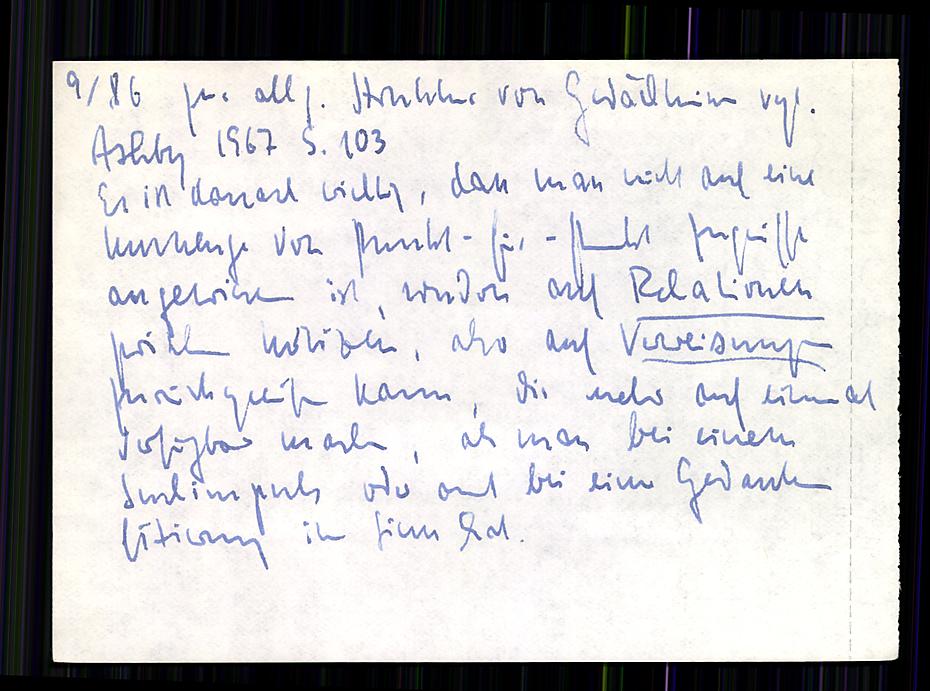
    1. ZK II note 9/8b 9/8b On the general structure of memories, see Ashby 1967, p. 103 . It is then important that you do not have to rely on a huge number of point-by-point accesses , but rather that you can rely on relationships between notes, i.e. references , that make more available at once than you would with a search impulse or with one thought - has fixation in mind.

      This underlies the ideas of songlines and oral mnemonic practices and is related to Vannevar Bush's "associative trails" in As We May Think.

      Luhmann, Niklas. “ZK II Zettel 9/8b.” Niklas Luhmann-Archiv, undated. https://niklas-luhmann-archiv.de/bestand/zettelkasten/zettel/ZK_2_NB_9-8b_V.

    1. You should read with a pen in your hand andenter...short hints of what you feel...may be useful; forthis be the best method of imprinting [them] in yourmemory. Benjamin Franklin (1706-1790)

      original source?

      it's Benjamin Franklin letter to Miss Stevenson, Wanstead. Craven-street, May 16, 1760.<br /> see: https://hyp.is/HZeDKI3YEeyj9GcNWKX4iA/www.gutenberg.org/files/40236/40236-h/40236-h.htm

  13. johnhalbrooks.substack.com johnhalbrooks.substack.com
    1. And everything that I learn, I learn for a particular task, and once it’s done, I immediately forget it, so that if ten years later, I have to – and this gives me great joy — if I have to get involved with something close to or directly within the same subject, I would have to start again from zero, except in certain very rare cases, for example Spinoza, whom I don’t forget, who is in my heart and in my mind.

      https://deleuze.cla.purdue.edu/lecture/lecture-recording-1-f/

      Gilles Deleuze: The ABC Primer / Recording 1 - A to F<br /> DECEMBER 15, 1988

    1. Everything that I learn, I learn for a particular task, and once it’s done, I immediately forget it, so that if ten years later, I have to—and this gives me great joy—if I have to get involved with something close to or directly within the same subject, I would have to start again from zero, except in certain very rare cases... (The ABC Primer)

      I'm definitely not like this and suspect that most people are not either.

    1. By its very nature, moderation is a form of censorship. You, as a community, space, or platform are deciding who and what is unacceptable. In Substack’s case, for example, they don’t allow pornography but they do allow Nazis. That’s not “free speech” but rather a business decision. If you’re making moderation based on financials, fine, but say so. Then platform users can make choices appropriately.
  14. Dec 2023
    1. “I do all my own research,” she said, “though reviewers have speculatedthat I must have a band of hirelings. I like to be led by a footnote ontosomething I never thought of. I rarely photocopy research materials because, for me, note-taking is learning, distilling. That’s the whole essence ofthe business. In taking notes, you have to discard what you don’t need. If you[photocopy] it, you haven’t chewed it.”

      Sounds similar to Umberto Eco's admonition about photocopying: https://hypothes.is/a/U3Sg_r0ZEe25T2tD3U-nmw

    1. without a World En-cyclopedia to hold men's minds togetherin something like a common interpreta-tion of reality there is no hope whateverof anything but an accidental and transi-tory alleviation to any of our world trou-bles. As mankind is so it will remainuntil it pulls its mind together. And if itdoes not pull its mind together then I donot see how it can help but decline.Never was a living species more peril-ously poised than ours at the presenttime. If it does not take thoughtto endits present mental indecisiveness catastro-phe lies ahead. Our species may yet endits strange eventful history as just the last,the cleverest, of the great apes. Thegreat ape that was clever-but not cleverenough. It could escape from mostthings but not from its own mental con-fusion.
    2. I believe thatin some such way as I have sketched, themental forces now largely and regrettablyscattered and immobilized in the univer-sities, the learned societies, research in-stitutions, and technical workers of theworld could be drawn together into areal directive world intelligence, and bythat mere linking and implementing ofwhat is known, human life as a wholecould be made much surer, stronger,bolder, and happier than it has ever beenup to the present time.
    3. My impression is that human brains arevery much of a pattern, that under thesame conditions they react in the sameway, and that were it not for tradition,upbringing, accidents of circumstance,and particularly of accidental individualobsessions, we should find ourselves-since we all face the same universe-muchmore in agreement than is superficiallyapparent. We speak different languagesand dialects of thought and can even attimes catch ourselves flatly contradictingone another in words while we are doingour utmost to express the same idea.How often do we see men misrepresent-ing one another in order to exaggerate adifference and secure the gratification ofan argumentative victory!

      We're far more alike than we imagine says Wells. Most of our difference is nitpicking for the sake of argument itself rather than actual meaning.

    4. They don't want their intimate convic-tions turned over and examined, and itis unfortunate that the emphasis put

      upon minor differences by men of science and belief in their strenuous search for the completest truth and the exactest expression sometimes gives color to this sort of misunderstanding.

      This emphasis on minor differences is exactly what many anti-science critics have done. See examples with respect to evolution and climate science denial.

    Tags

    Annotators

    1. Getting over the fear of perfection .t3_188j2xt._2FCtq-QzlfuN-SwVMUZMM3 { --postTitle-VisitedLinkColor: #9b9b9b; --postTitleLink-VisitedLinkColor: #9b9b9b; --postBodyLink-VisitedLinkColor: #989898; } I have so many half-filled notebooks or ones that I abandoned because I disliked my penmanship or because I “ruined” pages. I am the type of person who will tear out a page if I make a mistake or if it looks bad.I really want to start a commonplace book but I feel like I must get over this fear of “messing up” in a notebook. Anyone else struggle with this?

      reply to u/FusRoDaahh at https://www.reddit.com/r/commonplacebook/comments/188j2xt/getting_over_the_fear_of_perfection/

      I had this problem too, but eventually switched to keeping my commonplace entirely on index cards, which also allows me to move them around and re-arrange them as necessary or when useful. (It also fixed some of my indexing problems.)

      The side benefit is that if I botch a single card, no sweat, just pull out a new one and start over! If you like the higher end stationery scene afforded in notebooks, then take a look at Clairfontaine's bristol cards from Exacompta which are lush and come in a variety of sizes, colors, and rulings. (They're roughly equivalent to the cost per square meter of paper you'll find in finer notebooks like Leuchtturm, Hobonichi, Moleskine, etc., though some of the less expensive index cards still do well with many writing instruments.) Most of their card sizes are just about perfect for capturing the sorts of entries that one might wish to commonplace.

      Once you've been at it a while, if you want to keep up with the luxe route that some notebook practices allow, then find yourself a classy looking box to store them all in to make your neighbors jealous. My card indexes bring me more joy than any notebook ever did.

      When penmanship becomes a problem, then you can fix it by printing your cards, or (even better in my opinion), typing them on your vintage Smith-Corona Clipper.

      And of course the first thing one could type out on their first card and file it at the front where you can see it every day:

      "Le mieux est le mortel ennemi du bien" (The better is the mortal enemy of the good).<br /> — Montesquieu, in Pensées, 1726

      aka "Don't let perfection be the enemy of the good."

  15. Nov 2023
    1. https://en.wikipedia.org/wiki/Boots_theory

      “The Sam Vimes "Boots" Theory of Economic Injustice runs thus:<br /> At the time of Men at Arms, Samuel Vimes earned thirty-eight dollars a month as a Captain of the Watch, plus allowances. A really good pair of leather boots, the sort that would last years and years, cost fifty dollars. This was beyond his pocket and the most he could hope for was an affordable pair of boots costing ten dollars, which might with luck last a year or so before he would need to resort to makeshift cardboard insoles so as to prolong the moment of shelling out another ten dollars.<br /> Therefore over a period of ten years, he might have paid out a hundred dollars on boots, twice as much as the man who could afford fifty dollars up front ten years before. And he would still have wet feet.<br /> Without any special rancour, Vimes stretched this theory to explain why Sybil Ramkin lived twice as comfortably as he did by spending about half as much every month.”<br /> ― Terry Pratchett, Men at Arms (1993)

    Tags

    Annotators

    1. Frank Luntz, a veteran Republican pollster, disavowed work Thursday in the early 2000s to cast doubt on the science behind climate change and said America, on the whole, wants the federal government to “do more, right now, to address it.” “I was wrong in 2001,” Luntz told an ad-hoc Senate Democratic climate panel. “I don’t want credit. I don’t want blame. Just stop using something that I wrote 18 years ago because it’s not accurate today.”

      Of course, one ought to be cognizant of the fact that he knew (or should have known) he was patently wrong then too.

      His statements as quoted here allow him to gloss over the fact that a lot of the blame rests at his own feet.

    1. “This is the science that concerns itself with plants in their local association in the various climates. This science, as vast as its object, paints with a broad brush the immense space occupied by plants, from the regions of perpetual snows to the bottom of the ocean, and into the very interior of the earth, where there subsist in obscure caves some cryptogams that are as little known as the insects feeding upon them.”

      —Alexander von Humboldt, 1807 “Essay on the Geography of Plants”

      Cave paintings/art were known of in Humboldt's time certainly if he's using them to analogize.

    1. One of his most famous students was Alexander von Humboldt, who thanked his mentor Lichtenberg with these words: “I do not merely regard the sum of positive insights that I was able to gather from what you told me – what I value even more is the general direction that my train of thoughts took under your guidance. Truth in itself is precious, but even more precious is the skill to find it.”

      Did Lichtenberg pass along note taking practice to Humboldt?

  16. Oct 2023
    1. They find that exposing populations to lead in their drinking water causes much higher homicide rates 20 years later, relative to similar places where kids avoided such exposure. They find that exposing populations to lead in their drinking water causes much higher homicide rates 20 years later, relative to similar places where kids avoided such exposure.

      Example of the repetition of the body text of an article immediately after it as a featured pull quote to draw the attention of the skimming reader to the importance of the portion of the passage.

    1. Acknowledgement: Great thanks to Chris Aldrich who saw the Quote Investigator article about the saying “We shape our tools, and thereafter our tools shape us”. Aldrich notified QI of the germane quotation examined in this new article. Aldrich pointed to its presence in “Walden”. This led QI to create this article and to update the existing article.

      https://quoteinvestigator.com/2023/10/21/tools-of-tools/

      I'm responsible for a quote investigator article being rewritten! Huzzah!

      Cross reference my note: https://boffosocko.com/2023/05/22/men-have-become-the-tools-of-their-tools-henry-david-thoreau/

    1. Befides, asthe vileft Writer has his Readers, fothe greateft Liarbas his Believers ; and it often happens, that if aLie be believ'd only for an Hour, it has done itsWork, and there is no farther occafion for it. Falfhcod flies, and Truth comes limping after it ; fo thatwhen Men come to be undeceiv'd, it is too late, theJeft is over, and the Tale has had its Effect : Like aMan who has thought of a good Repay per ed . Oh,Repartee, when thelike a Phyfician who has found out an infallible Medicine, after the Patient is dead

      Falsehood flies, and Truth comes limping after it;<br /> —Jonathan Swift, “The Examiner, From Thursday Nov 2 to Thursday Nov 9, 1710.” In The Examiner [Afterw.] The Whig Examiner, edited by Joseph Addison and Jonathan Swift, Vol. 15. London: John Morphew, near Stationers Hall, 1710.


      found via https://quoteinvestigator.com/2014/07/13/truth/

      with variations on "A lie travels around the globe while the truth is putting on its shoes." attributed variously to Mark Twain, Jonathan Swift, Thomas Francklin, Fisher Ames, Thomas Jefferson, John Randolph, Charles Haddon Spurgeon, Winston Churchill, Terry Pratchett?