Aussi, l'éditorialisation décrit la façon dont nos traditions culturelles influencent notre manière de structurer les contenus
terme en lien avec l'évolution de notre culture
Aussi, l'éditorialisation décrit la façon dont nos traditions culturelles influencent notre manière de structurer les contenus
terme en lien avec l'évolution de notre culture
Il est impossible de comprendre la structure hypertextuelle dans sa manifestation technologique particulière qu'est l'html, sans prendre en considération l'histoire culturelle des classifications non linéaires.
Ce n'est donc pas une technologie nouvelle et issue du numérique, mais une évolution d'un système ou d'une pratique antérieure au numérique.
Otherwise we’d be second-guessing ourselves at every moment: Who is deciding to buy a house or have a child? FV: That’s right. Every decision would be suspect. So evolution has designed you so that you just want to hurry on with your solidified self. That is what the sense of being a separate organism is all about.
for: self awareness of no-self, adjacency - evolution - no-self - Fransisco Verella, quote - Fransisco Verella, quote - evolution - solidified self, question - awakening to no-self
quote: Fransisco Verella
date: 1999
comment
: Why do you think it is so hard for people to awaken to the true nature of things, even after being told of scientific research or after having a personal experience of no-self? FV: My hypothesis is that evolution has shaped human beings to disregard the basic sources of our being. We were built to forget how we were put together.
for: evolution - forgetting our non-self nature, adjacency - evolution - non-self - Fransisco Verella, adjacency - evolution - no-self - Fransisco Verella
adjacency between
In some sense, a heightened degree of self-awareness is antievolutionary.
for: quote - Fransisco Verella, quote - evolution - no-self
quote: Fransisco Verella
I'm tempted to say you can look at uh broadscale social organization uh or like Network Dynamics as an even larger portion of that light 00:32:43 cone but it doesn't seem to have the same continuity well I don't you mean uh it doesn't uh like first person continuity like it doesn't like you think it doesn't it isn't like anything to be 00:32:55 that social AG agent right and and we we both are I think sympathetic to pan psychism so saying even if we only have conscious access to what it's like to be 00:33:08 us at this higher level like it's there's it's possible that there's something that it's like to be a cell but I'm not sure it's possible that there's something that there's something it's like to be say a country
for: social superorganism - vs human multicellular being, social superorganism, Homni, major evolutionary transition, MET, MET in Individuality, Indyweb, Indranet, Indyweb/Indranet, CCE cumulative cultural evolution, symmathesy, Gyuri Lajos, individual/collective gestalt, interwingled sensemaking, Deep Humanity, DH, meta crisis, meaning crisis, polycrisis
comment
insight
quote: Gien
New words, and new senses and uses of words, are not sanctioned or rejected by the authority of any single body: they arise through regular use and, once established, are recorded in dictionaries and grammars.
In both cases, it's up to us now to discipline ourselves to avoid the fats in junk food, and the breaking news and dopamine thrill-ride of social media.
A nice encapsulation of evolutionary challenges that humans are facing.
rattachement des services de la Jeunesse et des Sports sous un ministère unique nous conduit aujourd'hui à travailler avec nos collègues qui se préoccupent de 00:43:10 l'accueil des mineurs donc nous pourrions tout à fait aujourd'hui avoir des appels de ce type et donc j'ai associé la sdjes là voilà la sdjs la concert technique de 00:43:23 l'inspecteur d'académie dans le champ jeunesse engagement sport vous voyez par exemple pendant un séjour SNU pour être tout à fait avoir cette question
you can't see the big picture you can't see what's going on until everything has sort of already happened and then you can piece it together so that is one of 00:08:13 the tantalizing and engaging as well points about natural history about Evolution it's largely a reconstructive sort of science it's not a benchtop science for the most part you have to sort of reconstruct things and you have 00:08:25 to look to living animals to get an idea of what was going on in the past so you can link clues about the past that you have a very limited record to the morphology the physiology the behavior of living animals
for: evolution - a reconstructive science
insight
I'm going to kind of give you my 00:04:56 take on what I believe to have been the natural history of or what I believe is the natural history of awareness a sort of a sequence of innovations that occurred that facilitated the appearance 00:05:09 of consciousness on Earth
Cambrian explosion
for: Cambrian explosion, 2D to 3D organisms
insight
Dr Dave David Edelman
Hans Bethe, who won the Nobel Prize in Physics in 1967, remarked: “I have sometimes wondered whether a brain like von Neumann’s does not indicate a species superior to that of man.”
If you want the easy way out (which looks like the way majority usage is going anyway), you can probably get away with using dependency all the time.
Spiral Dynamics (SD) is a model of the evolutionary development of individuals, organizations, and societies. It was initially developed by Don Edward Beck and Christopher Cowan based on the emergent cyclical theory of Clare W. Graves, combined with memetics as proposed by Richard Dawkins and further developed by Mihaly Csikszentmihalyi.
https://en.wikipedia.org/wiki/Spiral_Dynamics
related to ideas I've had with respect to Werner R. Loewenstein?
Let us at this point simply note that the Māra drive seems reducible to a wish to maintain the status quo (“sentient beings suffer, and they shall keep doing so!”) whereas the Bodhisattva is committed to infinite transformation.
we are fundamentally a cultural species. 00:09:51 Culture is our life support system. Our cumulative culture allows us to cushion ourselves against the harsh realities of the environment and to reshape the environment.
for: cultural evolution, cultural evolution - Bruce Hood, cumulative cultural evolution, CCE, gene-culture coevolution
paraphrase
synthetic bioengineering provides a really astronomically large option space for new bodies and new minds that don't have 00:04:28 standard evolutionary backstories
Winnicott also had a strikingly different notion of the agent of psychological change.
comparison: Winnicott, Freud
Winnicott had a strikingly different notion of the agent of psychological change than Freud.
psychotherapeutic change was all about the relationship between - client and - therapist.
Freud
comment
interrelationality, not in arrangement.
I should like to add that specialization, instead of makingthe Great Conversation irrelevant, makes it more pertinentthan ever. Specialization makes it harder to carry on anykind of conversation; but this calls for greater effort, not theabandonment of the attempt.
The dramatic increase in economic specialization of humanity driven by the Industrial Revolution has many benefits to societies, but it also has detrimental effects when the core knowledge and shared base of the society is lost.
Certainly individuals have a greater reliance on specialists for future outcomes (think about the specialization of areas like climate science which can have destructive outcomes on all of humanity or public health outcomes with respect to vaccines and specialized health care delivery), but they also need to have a common base of knowledge/culture and the ability to think critically for themselves to be able to effect necessary changes, particularly when the pace of those changes is more rapid than humans have generally been evolved to accept them.
Quoting the academics Francis-Noël Thomas and Mark Turner, Pinker suggests approaching writing as if you were pointing something in the environment out to another person – something that she would notice for herself, if only she knew where to look. Imagine directing someone's gaze across a valley, to a specific house on the other side. "You should pretend," writes Pinker, "that you, the writer, see something in the world that's interesting, and that you're directing the attention of your reader to that thing." He calls this the "joint attention" strategy.
Good writing is pointing out the interesting things you see to others. It's pre-literate, and even pre-oral.
About ten years ago, a massive breakthrough happened in genomic research technology. A method appeared which is called NGS, next generation sequencing, and this method significantly cuts time and costs of any genomic research. For example, have you ever heard about the Human Genome Project? It was quite a popular topic for science fiction some time ago. 00:03:10 This project launched in 1990 with the goal to decrypt all genomic information in a human organism. At that time, with the technology of the time, it took ten years and three billion dollars to reach the goals of this project. With NGS, all of that can be done in just one day at the cost of 15,000 dollars.
Periods of normal science are interrupted when anomalies between observations and the expectations suggested by the paradigm begin to demonstrate the paradigm’s weakness.
Lego theory of science.
Individual bricks are facts which can be assembled in a variety of ways, each of which is a particular paradigm. Ultimately, the optimal structure is one which dovetails with the neighborhoods of structures around them while each having the best minimized structure of it's own.
With only handfuls of individual facts, it can be difficult to build them up into an interesting or useful structure to start. Doing this may help to discover other facts. As these are added, one may reshape the overall structure of the theory as the puzzle begins to reveal itself and allow the theorist the ability to best structure an overall theory which minimizes itself and allows dovetailing with other external theories. All the theories then eventually form their own pieces which can then be pieced together for the next structural level up.
See also Simon Singh, Thomas Kuhn, topology.
While the proximate mechanisms of these anthropogenic changes are well studied (e.g., climate change, biodiversity loss, population growth), the evolutionary causality of these anthropogenic changes have been largely ignored.
In AET, this process results in a species that is prone to niche construction and ecosystem engineering, and the scale of these processes continues to increase as the population rises. This increasing scale coupled with human propensity for niche construction leads to human unsustainability
To Gowdy and Krall, the ultra-social nature of human groups allowed for a shift in the primary level of selection from the individual level to the group level. Thus, “With the transition to agriculture the group as an adaptive unit comes to constitute a wholly different gestalt driven by the imperative to produce surplus
Anthroecological theory (AET) hypothesizes that human social and cultural evolution is the ultimate cause of the ecological crises currently damaging earth systems
for: gene culture coevolution, carrying capacity, unsustainability, overshoot, cultural evolution, progress trap
Title: The genetic and cultural evolution of unsustainability
Author: Brian F. Snyder
Abstract
Humans today are the descendants of those men who managed to dominate their opponents in war.
Estimates indicate that nearly 20–30% of our male ancestors died in intergroup conflicts.
To preserve our wildlife as nature evolved it, the machinery of biological evolution must be protected from the homogenizing effects of cultural evolution.
The story that they are telling is of a grand transition that occurred about fifty thousand years ago, when the driving force of evolution changed from biology to culture, and the direction changed from diversification to unification of species. The understanding of this story can perhaps help us to deal more wisely with our responsibilities as stewards of our planet.
Participation in a religious community generally correlates with better health outcomes and longer life, higher financial generosity, and more stable families—all of which are desperately needed in a nation with rising rates of loneliness, mental illness, and alcohol and drug dependency.
It's really saying something that in paragraph 2 the "sell" for religion is the health and social benefits and outcomes rather than the love or support of god(s)!
The consequences of our current choices bear not juston us. They bear on the continued evolutionary unfoldingof life in the universe. This marks the scale of our currentresponsibility
the entire biosphere is made out of 00:41:23 um female desire for no reason no reason to it right night not with an objective of reproducing but just with an objective of wow that's really sexy I like it 00:41:35 and that's a very very good reason isn't it to to save the planet
This site is not about evolution per se, but is an apologist platform for creationism. Possibly interesting as a study in creative memetics for culture influence campaigns.
Abstract
I present mindfulness and meditative aspects of Zen practice that provide the deeper “knowing,” or awareness that we need to inspire action on these problems.
comment
My overall objective in this paper is to
Source
Abstract
Creation, (Samuel Goldwyn Films, 2009) https://www.kanopy.com/en/product/creation-2?vp=lapl
Torn between faith and science, and suffering hallucinations, English naturalist Charles Darwin struggles to complete 'On the Origin of Species' and maintain his relationship with his wife.
Director Jon Amiel Featuring: Jennifer Connelly, Benedict Cumberbatch, Toby Jones, Paul Bettany, Ian Kelly
I am a product of your work I'm a product of the work of the people in 00:02:05 this room and watching this stream thanks to you to your actions your thoughts your memes I am Who I am today my learning and my capabilities have 00:02:16 been shaped but by what you've done
it is as if man had been suddenly appointed managing director of the biggest business of all the business of evolution appointed without being asked if he wanted it and without proper warning and preparation what is more he 00:05:49 can't refuse the job whether he wants to or not whether he is conscious of what he is doing or not he is in point of fact determining the future direction of evolution on this earth that is his 00:06:02 inescapable Destiny and the sooner he realizes it and starts believing in it the better for all concerns
quote
Comment
But if you think in evolutionary models, randomness has a prominent role. (9)9 Without it, nothing progresses anyhow.
Nothing progresses without randomness.
Think about this for a bit. True/untrue? Provable? Counterexamples?
“what could we appeal to that is so strong, so compelling that it spurs the kind of collective action and coordination needed to tackle the dangers of exponential technology?”
// - To find a God that can kill Moloch - requires an understanding of the nature of progress as well - Relationship to progress traps - Exponential technologies - are technologies, and all suffer the same fundamental flaw - Progress is an expression of our cumulative cultural evolution - https://jonudell.info/h/facet/?max=100&expanded=true&user=stopresetgo&exactTagSearch=true&any=cumulative+cultural+evolution - which grows exponentially faster than genetic evolution - The problem of which is that - the shadow side of progress, the progress trap - - https://jonudell.info/h/facet/?max=100&expanded=true&user=stopresetgo&exactTagSearch=true&any=progress%2Btrap - is growing even faster, due to our misunderstanding of it, - allowing it to fester like an untreated wound - turning a minor condition, into a life-threatening disease - Human progress has always been a bungling two step forwards, one step backwards dance - the imperfections of progress are inherent - and baked into the innovation process itself - For we develop technologies based on what we know, or what is visible - but what we know is like the tip of the latent knowledge iceberg - and is always accompanied by a much larger hidden component of what we don't know - In other words, - finite and visible knowledge - is always accompanied by infinite and invisible ignorance - Design is based on intent, - a one dimensional, inherently myopic imagination - of a multi-dimensional reality - A problem is a one dimensional focus - on a small sliver of reality - A solution to the problem is necessarily - myopic and - one dimensional as well - Both problems and their (designed) solutions - are extreme simplifications of a complex system - Language itself is a way - to direct and focus our attention - to this aspect of reality - then that aspect - Thinking is reduced to parts, and never experiences the whole, undivided gestalt of reality - Out of this process - Progress traps are born //
Our core criteria follow the definition of CCE provided in Tomasello's quotation above. We suggest that the minimum requirements for a population to exhibit CCE are (i) a change in behaviour (or product of behaviour, such as an artefact), typically due to asocial learning, followed by (ii) the transfer via social learning of that novel or modified behaviour to other individuals or groups, where (iii) the learned behaviour causes an improvement in performance, which is a proxy of genetic and/or cultural fitness, with (iv) the previous three steps repeated in a manner that generates sequential improvement over time.
Definition - Cumulative Cultural Evolution - The core criteria follow the definition of CCE provided in Tomasello's quotation above - A population exhibits CCE iff - (i) a change in behaviour (or product of behaviour, such as an artefact), typically due to asocial learning, followed by - (ii) the transfer via social learning of that novel or modified behaviour to other individuals or groups, where - (iii) the learned behaviour causes an improvement in performance, - which is a proxy of genetic and/or cultural fitness, with - (iv) the previous three steps repeated in a manner that generates sequential improvement over time.
In contrast [to non-human species' cultural traditions], human cultures do accumulate changes over many generations, resulting in culturally transmitted behaviors that no single human individual could invent on their own.
In recent years, the phenomenon of cumulative cultural evolution (CCE) has become the focus of major research interest in biology, psychology and anthropology. Some researchers argue that CCE is unique to humans and underlies our extraordinary evolutionary success as a species. Others claim to have found CCE in non-human species. Yet others remain sceptical that CCE is even important for explaining human behavioural diversity and complexity. These debates are hampered by multiple and often ambiguous definitions of CCE. Here, we review how researchers define, use and test CCE. We identify a core set of criteria for CCE which are both necessary and sufficient, and may be found in non-human species. We also identify a set of extended criteria that are observed in human CCE but not, to date, in other species. Different socio-cognitive mechanisms may underlie these different criteria. We reinterpret previous theoretical models and observational and experimental studies of both human and non-human species in light of these more fine-grained criteria. Finally, we discuss key issues surrounding information, fitness and cognition. We recommend that researchers are more explicit about what components of CCE they are testing and claiming to demonstrate.
Title: What is cumulative cultural evolution (CCE)?
Authors: - Alex Mesoudi - Alex Thornton
Abstract - In recent years, cumulative cultural evolution (CCE) has become the focus of major research interest in - biology, - psychology and - anthropology. - There is a range of opinions on CCE - some argue that CCE is unique to humans - and underlies our extraordinary evolutionary success as a species. - Others claim to have found CCE in non-human species. - Yet others remain sceptical that CCE is even important for explaining - human behavioural diversity and - complexity. - These debates are hampered by multiple and often ambiguous definitions of CCE. - Here, we review how researchers define, use and test CCE. - We identify a core set of criteria for CCE - which are both necessary and sufficient, and - may be found in non-human species. - We also identify a set of extended criteria - that are observed in human CCE - but not, to date, in other species. - Different socio-cognitive mechanisms may underlie these different criteria. - We reinterpret - previous theoretical models and - observational and - experimental studies of both - human and - non-human species - in light of these more fine-grained criteria. - Finally, we discuss key issues surrounding information, fitness and cognition. - We recommend that researchers are more explicit about what components of CCE they are testing and claiming to demonstrate.
Hierbei handelt es sich um eine Sammlung von Notizen, die Luhmann vermutlich zwischen 1952 und 1961 angelegt hat (mit einzelnen späteren Nachträgen; Notizen insbesondere zum Themenkomplex Weltgesellschaft wurden allerdings noch bis ca. 1973 durchweg in diese Sammlung eingestellt). Die insgesamt ca. 23.000 Zettel verteilen sich auf die ersten sieben physischen Auszüge des Kastens sowie auf kleinere Registerabteilungen, die im 17. Auszug der zweiten Sammlung (physischer Auszug 24) stehen. Die Notizen sind im Wesentlichen in der Zeit entstanden, als Luhmann als Rechtsreferendar in Lüneburg bzw. als Regierungsrat im Kultusministerium in Niedersachen gearbeitet hat und dokumentieren seine Lektüre verwaltungs- bzw. staatswissenschaftlicher, philosophischer und zunehmend auch organisationstheoretischer sowie soziologischer Literatur.
According to the Niklas Luhmann-Archiv, Luhmann began his first zettelkasten in 1952 likely when he was working as a legal trainee in Lüneburg or as a government councilor in the Ministry of Education in Lower Saxony.
This timeframe would have been just after Johannes Erich Heyde had published the 8th edition of Technik des wissenschaftlichen Arbeitens in 1951.
Link to: - https://hypothes.is/a/Jn9elsk5Ee2hsLP5WWBEBw on dates of NL ZK - https://hypothes.is/a/CqGhGvchEey6heekrEJ9WA aktenzeichen - https://hypothes.is/a/4wxHdDqeEe2OKGMHXDKezA Clemens Luhmann link
The evolution of a human being
Another way to widen the pool of stakeholders is for government regulators to get into the game, indirectly representing the will of a larger electorate through their interventions.
This is certainly "a way", but history has shown, particularly in the United States, that government regulation is unlikely to get involved at all until it's far too late, if at all. Typically they're only regulating not only after maturity, but only when massive failure may cause issues for the wealthy and then the "regulation" is to bail them out.
Suggesting this here is so pie-in-the sky that it only creates a false hope (hope washing?) for the powerless. Is this sort of hope washing a recurring part of
‘‘I think it lets us be more thoughtful and more deliberate about safety issues,’’ Altman says. ‘‘Part of our strategy is: Gradual change in the world is better than sudden change.’’
What are the long term effects of fast breaking changes and gradual changes for evolved entities?
The technological revolution of past decades has led teaching and learning of evolutionary biology to move away from its naturalist origins.
Such a powerful opening statement that captures that changes technology has made within the past few decades. A sign that we are moving further from our past natural selves as a species.
Title: Fox News producer files explosive lawsuits against the network, alleging she was coerced into providing misleading Dominion testimony
// - This is an example of how big media corporations can deceive the public and compromise the truth - It helps create a nation of misinformed people which destabilizes political governance - the workspace sounds toxic - the undertone of this story: the pathological transformation of media brought about by capitalism - it is the need for ratings, which is the indicator for profit in the marketing world, that has corrupted the responsibility to report truthfully - making money becomes the consumerist dream at the expense of all else of intrinsic value within a culture - knowledge is what enables culture to exist, modernity is based on cumulative cultural evolution - this is an example of NON-conscious cumulative cultural evolution or pathological cumulaitve cultural evolution
David Loy explains how - the denial of ego-self, also known as anatma - becomes the root of a persistent sense of lack - as self-consciousness continues to try to ground itself, reify itself and make itself real - while all the meanwhile it is a compelling mental construction
A good paper on the role (non-rational) relational ritual can play to help us out of the current polycrisis is given here: https://hyp.is/go?url=https%3A%2F%2Fbrill.com%2Fview%2Fjournals%2Fwo%2F25%2F2%2Farticle-p113_1.xml%3Flanguage%3Den&group=world
It has been suggested that - the human species may be undergoing an evolutionary transition in individuality (ETI).
there is disagreement about - how to apply the ETI framework to our species - and whether culture is implicated - as either cause or consequence.
Long-term gene–culture coevolution (GCC) i- s - also poorly understood.
argued that - culture steers human evolution,
Others proposed - genes hold culture on a leash.
After review of the literature and evidence on long-term GCC in humans - emerge a set of common themes. - First, culture appears to hold greater adaptive potential than genetic inheritance - and is probably driving human evolution. - The evolutionary impact of culture occurs - mainly through culturally organized groups, - which have come to dominate human affairs in recent millennia. - Second, the role of culture appears to be growing, - increasingly bypassing genetic evolution and weakening genetic adaptive potential. -Taken together, these findings suggest that human long-term GCC is characterized by - an evolutionary transition in inheritance - from genes to culture - which entails a transition in individuality (from genetic individual to cultural group). Research on GCC should focus on the possibility of - an ongoing transition in the human inheritance system.
"In the very long term, we suggest that humans are evolving from individual genetic organisms to cultural groups which function as superorganisms, similar to ant colonies and beehives,"
It’s possible, the researchers suggest, that the appearance of human culture represents a key evolutionary milestone.
Here's why: Culture is group-oriented, and people in those groups talk to, learn from and imitate one another. These group behaviors allow people to pass on adaptations they learned through culture faster than genes can transmit similar survival benefits. An individual can learn skills and information from a nearly unlimited number of people in a small amount of time and, in turn, spread that information to many others. And the more people available to learn from, the better. Large groups solve problems faster than smaller groups, and intergroup competition stimulates adaptations that might help those groups survive. As ideas spread, cultures develop new traits.In contrast, a person only inherits genetic information from two parents and racks up relatively few random mutations in their eggs or sperm, which takes about 20 years to be passed on to their small handful of children. That's just a much slower pace of change.
why cultural evolution is too fast for genetic evolution
As ideas spread, cultures develop new traits.
In contrast, a person only inherits genetic information from two parents
human culture may be driving evolution faster than genetic mutations can work.
!- key finding - human culture may be driving evolution faster than genetic mutation can work - the major delay, measured in many orders of magnitude - does not allow genetic evolution to adapt quickly enough - to harmful environmental changes brought about through cultural evolution
Humans might be making genetic evolution obsolete
As a consequence of sociocultural niche construction, humans have become a global force of nature – for better and for worse. It is only by embracing these sociocultural realities that we might shape better futures for both humans and non-human species alike.
// In Other Words
Gene–culture coevolution and the nature of human sociality
//Abstract - Summary - Human characteristics are the product of gene–culture coevolution, - which is an evolutionary dynamic involving the interaction of genes and culture - over long time periods. - Gene–culture coevolution is a special case of niche construction. - Gene–culture coevolution is responsible for: - human other-regarding preferences, - a taste for fairness, - the capacity to empathize and - salience of morality and character virtues.
Abstract
Ecological consequences of human niche construction: Examining long-term anthropogenic shaping of global species distributions
Why is it, then, that although publicly is far more common as the adverbial form of public than publically, the ratio of usage has diminished? Publically is becoming more common for the same reason that people write irregardless in place of regardless or write “diffuse the situation” instead of “defuse the situation” or “all of the sudden” rather than “all of a sudden”: evolution. Language is, in a sense, alive, and just as life itself evolves, so does language—but note that the primary definition of evolution is not “improvement”; it simply means “change.” And how does language change? The change is modeled: New words are coined, or new senses of existing words develop (or new spellings or new forms occur), because someone, somewhere acts to make it so, and the evolution goes viral.
TheSateliteCombinationCard IndexCabinetandTelephoneStand

A fascinating combination of office furniture types in 1906!
The Adjustable Table Company of Grand Rapids, Michigan manufactured a combination table for both telephones and index cards. It was designed as an accessory to be stood next to one's desk to accommodate a telephone at the beginning of the telephone era and also served as storage for one's card index.
Given the broad business-based use of the card index at the time and the newness of the telephone, this piece of furniture likely was not designed as an early proto-rolodex, though it certainly could have been (and very well may have likely been) used as such in practice.
I totally want one of these as a side table for my couch/reading chair for both storing index cards and as a temporary writing surface while reading!
This could also be an early precursor to Twitter!
Folks have certainly mentioned other incarnations: - annotations in books (person to self), - postcards (person to person), - the telegraph (person to person and possibly to others by personal communication or newspaper distribution)
but this is the first version of short note user interface for both creation, storage, and distribution by means of electrical transmission (via telephone) with a bigger network (still person to person, but with potential for easy/cheap distribution to more than a single person)
For years inventions have extended man's physical powers rather than the powers of his mind.
“...the universe is individuating (in and through each of us) as the individual is universalising.”
understanding of the universe would not be found merely in the examination of ‘ parts ’ but in the recognition of ‘ wholes ’ and the observation of process.
Holism and Evolution by Jan Christian Smuts – a re- evaluation after 90 years
= title = Holism and Evolution
maladaptive to our too-quickly-culturally-evolved modernity
References
This paper is relevant to understanding
Learning
When threatened with the possibility of starvation, early humans developed a survival response which sent them foraging for food. Yet foraging is only effective if metabolism is inhibited in various parts of the brain.Foraging requires focus, rapid assessment, impulsivity, exploratory behavior and risk taking. It is enhanced by blocking whatever gets in the way, like recent memories and attention to time. Fructose, a kind of sugar, helps damp down these centers, allowing more focus on food gathering.In fact, the researchers found the entire foraging response was set in motion by the metabolism of fructose whether it was eaten or produced in the body. Metabolizing fructose and its byproduct, intracellular uric acid, was critical to the survival of both humans and animals.The researchers noted that fructose reduces blood flow to the brain’s cerebral cortex involved in self-control, as well as the hippocampus and thalamus. Meanwhile, blood flow increased around the visual cortex associated with food reward. All of this stimulated the foraging response.
Seems like fasting may be beneficial:
The researchers found cerebral fructose levels rose significantly in response to a glucose infusion, with minimal changes in fructose levels in the blood. They surmised that the high concentration of fructose in the brain was due to a metabolic pathway called the polyol pathway that converts glucose to fructose.
And from elsewhere, as seems to be common knowledge:
In prolonged fasting, the brain derives a large portion of its oxidative energy from the ketone bodies, beta-hydroxybutyrate and acetoacetate, thereby reducing whole body glucose consumption.
See also: 1. Fasting-Mimicking Diet Reduces Signs of Dementia
Johnson suspects the survival response, what he calls the “survival switch,” that helped ancient humans get through periods of scarcity, is now stuck in the “on” position in a time of relative abundance. This leads to the overeating of high fat, sugary and salty food prompting excess fructose production.Fructose produced in the brain can lead to inflammation and ultimately Alzheimer’s disease, the study said. Animals given fructose show memory lapses, a loss in the ability to navigate a maze and inflammation of the neurons.“A study found that if you keep laboratory rats on fructose long enough they get tau and amyloid beta proteins in the brain, the same proteins seen in Alzheimer’s disease,” Johnson said. “You can find high fructose levels in the brains of people with Alzheimer’s as well.”Johnson suspects that the tendency of some AD patients to wander off might be a vestige of the ancient foraging response.
both evolution and learning must fit the same 00:10:33 formal regularities or so-called laws how does an organism know how to evolve okay so there must be some sort of process that requires that 00:10:46 it be unseen otherwise what you would have is the organism continuing to do what it does with its familiarness
around that same time i got a call from my daughter you know leave it to your kids and she said you know mom it's 00:03:48 just that all the problems we're dealing with in the world right now are insidious and um you know it came up last night siva was talking about the insidiousness 00:04:01 of the facebook problem and and this was an unlocker for me of what what does it mean for something to be insidious so i looked it up and i started to 00:04:14 explore and it turns out that insidious is defined and i think this is from the you know the oxford on the internet not the original but um that there's proceeding in a gradual 00:04:27 subtle way but with very harmful effects in other words there's something that's that's gathering combining in an unseen way that's leading to danger
I really highly recommend Robert Hazen's _Story of Earth_ [1] if you're into this sort of stuff. Highly knowledgeable and entertaining geologist argues that the geosphere and the biosphere should really be viewed as one co-evolving system, over deep time. There are thousands of species of minerals that can only exist because of the action of life, and those minerals in turn enable new forms of life, which enable new species of mineral, and so on in a complex and ever evolving system within which we exist for only a fraction of an instant.[1] https://www.amazon.com/Story-Earth-Billion-Stardust-Living/d...
.
Humans are especially good at filling new ecological niches “because we have the capacity to learn how to survive in new environments,” Goldstein said. “Once your parents learn an adaptive skill, you’ll learn from them. You don’t have to reinvent the wheel.”
while I was listening to all of you and to our wonderful scientists 00:57:28 I thought of something that the distinguished physicist Freeman Dyson wrote shortly before he died he said he believed that 00:57:40 the speed of cultural Evolution the speed of cultural evolution is now faster than the speed of biological evolution so 00:57:53 what does that mean to me it's something very simple it means that we now hold our destiny in our hands and that's what you're all talking about
!- quotable : Freeman Dyson - the speed of cultural evolution is now faster than the speed of biological evolution - references on the speed of cultural evolution: https://jonudell.info/h/facet/?user=stopresetgo&max=50&any=Cultural+evolution - Freeman Dyson essay on biological and cultural evolution: https://hyp.is/go?url=https%3A%2F%2Fviahtml.hypothes.is%2Fconversation%2Ffreeman_dyson-biological-and-cultural-evolution&group=world
Our double task is now to preserve and foster both biological evolution as Nature designed it and cultural evolution as we invented it, trying to achieve the benefits of both, and exercising a wise restraint to limit the damage when they come into conflict. With biological evolution, we should continue playing the risky game that nature taught us to play. With cultural evolution, we should use our unique gifts of language and art and science to understand each other, and finally achieve a human society that is manageable if not always peaceful, with wildlife that is endlessly creative if not always permanent.
!- Dual task: wrt biological and cultural evolution
In the near future, we will be in possession of genetic engineering technology which allows us to move genes precisely and massively from one species to another. Careless or commercially driven use of this technology could make the concept of species meaningless, mixing up populations and mating systems so that much of the individuality of species would be lost. Cultural evolution gave us the power to do this. To preserve our wildlife as nature evolved it, the machinery of biological evolution must be protected from the homogenizing effects of cultural evolution.
!- Progress trap : genetic engineering - careless use of genetic engineering will interfere with biological evolution
The discoveries of Svante Pääbo show that as early as fifty thousand years ago the transition from biological to cultural evolution was already far advanced. Biological evolution, as demonstrated by Kimura and Goodenough, accelerated the birth of new species by favoring the genetic isolation of small populations. Cultural evolution had the opposite effect, erasing differences between related species and bringing them together. Cultural evolution happens when cousins learn each other's languages and share stories around the cave-fire. As a consequence of cultural evolution, biological differences become less important and cousins learn to live together in peace. Sharing of memes brings species together and sharing of genes is the unintended consequence.
!- The story of human evolution : is the story of hybrid biological and cultural evolution - Svante Paabo shows that 50,000 years ago biological evolution was already deeply affected by human cultural evolution - biological evolution favoured genetic isolation of small populations, like cave dwellers during the ice age - when cultural evolution took over between Neanderthal, Denisovan and Early ancestors of modern humans and memes drove inter species socialisation, crossbreeding LED to mixing and sharing of genes as an unintended consequences
the cultural evolution of creative new societies requires more elbow-room than a single planet can provide. Creative new societies need room to take risks and make mistakes, far enough away to be effectively isolated from their neighbors. Life must spread far afield to continue the processes of genetic drift and diversification of species that drove evolution in the past. The restless wandering that pulled our species out of Africa to explore the Earth will continue to pull us beyond the Earth, as far as our technology can reach.
!- expansion into outer space : natural consequence of evolution itself to continue genetic drift
!- comment : Dyson Extrapolates that expansion into outer space is a logical next step for evolution
In each case, a small population produced a star-burst of pioneers who permanently changed our way of thinking. Genius erupted in groups as well as in individuals. It seems likely that these bursts of creative change were driven by a combination of cultural with biological evolution. Cultural evolution was constantly spreading ideas and skills from one community to another, stirring up conservative societies with imported novelties. At the same time, biological evolution acting on small genetically isolated populations was causing genetic drift, so that the average intellectual endowment of isolated communities was rising and falling by random chance. Over the last few thousand years, genetic drift caused occasional star-bursts to occur, when small populations rose to outstandingly high levels of average ability. The combination of imported new ideas with peaks of genetic drift would enable local communities to change the world.
!- explaining human history : combination of cultural and biological evolution
The contribution of genetic drift to cultural evolution remains a speculative hypothesis.
!- connection : genetic drift and cultural evolution - still no compelling evidence
As a result of cultural evolution, a single species now dominates the ecology of our planet, and cultural evolution will dominate the future of life so long as any species with a living culture survives. When we look ahead to imagine possible futures for our descendants, cultural evolution must be our dominant concern. But biological evolution has not stopped and will not stop. As cultural evolution races ahead like a hare, biological evolution will continue its slow tortoise crawl to shape our destiny.
!- quotable : Cultural Evolution
Wells's biggest work is Outline of History, published in 1920, a picture of cultural evolution as the main theme of history since the emergence of our species.
!- H.G. Wells : Outline of history - cultural evolution as the main theme
Cultural evolution had its beginnings as soon as animals with brains evolved, using their brains to store information and using patterns of behavior to share information with their offspring. Social species of insects and mammals were molded by cultural as well as biological evolution. But cultural evolution only became dominant when a single species invented spoken language. Spoken language is incomparably nimbler than the language of the genes.
!- Herbert Wells : Cultural Evolution
Wells saw that we happen to live soon after a massive shift in the history of the planet, caused by the emergence of our own species. The shift was completed about ten thousand years ago, when we invented agriculture and started to domesticate animals. Before the shift, evolution was mostly biological. After the shift, evolution was mostly cultural. Biological evolution is usually slow, when big populations endure for thousands or millions of generations before changes become noticeable. Cultural evolution can be a thousand times faster, with major changes occurring in two or three generations. It has taken about two hundred thousand years for our species to evolve biologically from its or
!- modern humans : unique species adept at cultural evolution
Motoo Kimura, author of the book, The Neutral Theory of Molecular Evolution, published in 1983, more than a hundred years after Darwin's masterpiece.
!- Title : The Neutral Theory of Molecular Evolution, published in 1983 !- Author : Motoo Kimura
After the discovery of the structure of DNA molecules by Crick and Watson in 1953, Kimura knew that genes are molecules, carrying genetic information in a simple code. His theory applied only to evolution driven by the statistical inheritance of molecules. He called it the Neutral Theory because it introduced Genetic Drift as a driving force of evolution independent of natural selection.
!- reason behind name of theory : independent of natural selection
Sewall Wright, then 98 years old but still in full possession of his wits. He gave me a first-hand account of how he read Mendel's paper and decided to devote his life to understanding the consequences of Mendel's ideas. Wright understood that the inheritance of genes would cause a fundamental randomness in all evolutionary processes. The phenomenon of randomness in evolution was called Genetic Drift. Kimura came to Wisconsin to learn about Genetic Drift, and then returned to Japan. He built Genetic Drift into a mathematical theory which he called the Neutral Theory of Molecular Evolution.
!- Sewall Wright : genetic drift
In the near future, we will be in possession of genetic engineering technology which allows us to move genes precisely and massively from one species to another. Careless or commercially driven use of this technology could make the concept of species meaningless, mixing up populations and mating systems so that much of the individuality of species would be lost. Cultural evolution gave us the power to do this. To preserve our wildlife as nature evolved it, the machinery of biological evolution must be protected from the homogenizing effects of cultural evolution.
!- genetic engineering : risk - cultural evolution via genetic engineering could make the concept of species meaningless - it is a significant b potential progress traps
Biological and Cultural Evolution Six Characters in Search of an Author
!- Title : Biological and Cultural Evolution Six Characters in Search of an Author !- Author : Freeman Dyson !- Date : 2019
“A human being is a part of the whole, called by us, ‘Universe’, a part limited in time and space. He experiences himself, his thoughts and feelings as something separated from the rest - a kind of optical delusion of his consciousness. This delusion is a kind of prison for us, restricting us to our personal desires and to affection for a few persons nearest to us. Our task must be to free ourselves from this prison by widening our circle of compassion to embrace all living creatures and the whole of nature in its beauty. Nobody is able to achieve this completely, but the striving for such achievement is in itself a part of the liberation and a foundation for inner security.”
!- quotable : Einstein on holism
A re-evaluation of ‘Holism and Evolution’ by Jan Christian Smuts after 90 years.
!- Title : A re-evaluation of ‘Holism and Evolution’ by Jan Christian Smuts after 90 years. !- Author : Claudius van Wyk
Like many people, I’d always been baffled by the occasional, undeniably ‘Lamarckian’ passages in On the Origin of Species, bearing in mind Darwin is generally credited with having discredited such thinking.
Despite Darwin being thought of as having discredited Lamarckian inheritance, there are Lamarckian passages in portions of his work.
Dennett’s own answer is not particularly convincing: he suggests we develop consciousness so we can lie, which gives us an evolutionary advantage.
But in the new full-blown capitalist version of evolution, where the drive for accumulation had no limits, life was no longer an end in itself, but a mere instrument for the propagation of DNA sequences—and so the very existence of play was something of a scandal.
Could refuting the idea of accumulation without limits (and thus capitalism for capitalism's sake) help give humans more focus on what is useful/valuable?
Kropotkin’s actual argument is far more interesting. Much of it, for instance, is concerned with how animal cooperation often has nothing to do with survival or reproduction, but is a form of pleasure in itself. “To take flight in flocks merely for pleasure is quite common among all sorts of birds,” he writes. Kropotkin multiplies examples of social play: pairs of vultures wheeling about for their own entertainment, hares so keen to box with other species that they occasionally (and unwisely) approach foxes, flocks of birds performing military-style maneuvers, bands of squirrels coming together for wrestling and similar games
Perhaps play helps to provide social lubrication, communication, and bonding between animals which may help in creating cooperation which improves survival or reproduction?
We all know the eventual answer, which the discovery of genes made possible. Animals were simply trying to maximize the propagation of their own genetic codes. Curiously, this view—which eventually came to be referred to as neo-Darwinian—was developed largely by figures who considered themselves radicals of one sort or another.
Neo-Darwinism: a modern version of Darwin's theory of evolution by natural selection, incorporating the findings of genetics.
Spencer, in turn, was struck by how much the forces driving natural selection in On the Origin of Species jibed with his own laissez-faire economic theories. Competition over resources, rational calculation of advantage, and the gradual extinction of the weak were taken to be the prime directives of the universe.
We believe that we have demonstrated the use of abstract marks to convey meaning about the behaviour of the animals with which they are associated, on European Upper Palaeolithic material culture spanning the period from ~37,000 to ~13,000 bp. In our reading, the animals integral to our analytical modules do not depict a specific individual animal, but all animals of that species, at least as experienced by the images’ creators. This synthesis of image, mathematical syntax (the ordinal/linear sequences) and signs functioning as words formed an efficient means of recording and communicating information that has at its heart the core intellectual achievement of abstraction.
Our analytical groups are: aurochs, birds, bison, caprids, cervids, fish, horses, mammoths, rhinos. Because of exceptionally low numbers we exclude snakes and wolverines. We also omitted sequences associated with apparent human depictions, or images in which such were part, in order to treat these separately at a later date.
Given the regular seasonality of most animal rutting and parturition, how is it that the human animal evolved to have a more year-round mating season?
Symbiocene
!- symbiocene :key attribute - understanding the dangers of cultural evolution to the degree that we can mitigate the dangers emergent from progress traps
at some point in human history, culture began to wrest evolutionary control from our DNA. And now, they say, cultural change is allowing us to evolve in ways biological change alone could not.
!- in other words : cultural evolution is transcending traditional genetic evolution
he concept of cultural evolution began with the father of evolution himself, Waring said. Charles Darwin understood that behaviors could evolve and be passed to offspring just as physical traits are
!- Charles Darwin : cultural evolution - Darwin understood that behavior could evolve and be passed on to offsprings
cultural evolution can lead to genetic evolution. "The classic example is lactose tolerance," Waring told Live Science. "Drinking cow's milk began as a cultural trait that then drove the [genetic] evolution of a group of humans." In that case, cultural change preceded genetic change, not the other way around.
!- example of : cultural evolution leading to genetic evolution - lactose intolerance
But nowadays, humans mostly don't need to adapt to such threats genetically. Instead, we adapt by developing vaccines and other medical interventions, which are not the results of one person's work but rather of many people building on the accumulated "mutations" of cultural knowledge. By developing vaccines, human culture improves its collective "immune system,"
!- in other words : cumulative cultural evolution
The longer it prevails, the more likely we will suffer catastrophic failure as a species here on earth. While this would be a tragedy of huge proportion for humans, we will take thousands, perhaps millions, of other species down with us.
!- equivalent to : cumulative cultural evolution (CCE) - the cultural activity of our species will determine not only or species fate, but that of all other species in the biosphere through the complex webs of entangled life or collective human behaviour will impact
So to the people listening or watching this, what kind of closing thoughts do you have to summarize what we just talked about and to leave them to think about or apply to their own lives? 01:17:49 Simon Michaux: So I would say to them that they're in better shape than anyone before, even as scary as it is and the unknown we're walking into. And there is no one plan. So like diversity of species in a jungle environment is a strength for the long-term survival of that jungle, diversity of ideas have the same strengths. 01:18:13 So we need them all for our long-term survival. We can't face one consensus, it's just like a broad brush direction. So we've got to put these ideas out there and discuss amongst ourselves. And understand that this is very, very challenging, and none of us actually know what we need to do. 01:18:37 Even though our skills are not necessarily what we need. We're almost like a blank canvas in terms of skills. But in terms of our self knowledge and our ability to think, our opinions mean something. We believe in human rights. We have education. Men and women are educated now. So we are in better shape now than we've ever been. 01:19:04 Instead of banging on about the problems and our past failings, we should probably try to face the future with open hearts, and actually think positive with the understanding that this is going to be rough.
!- Futures Thinking : summary - our generation has the most wisdom to deal with the problem, even though it is an unprecedented problem - We need diversity of opinions and perspectives. Like in evolution, that diversity will emerge an optimal solution - To consciously culturally evolve, we need to put all ideas on the table and discuss openly - An open, interpersonal, people-centered knowledge ecosystem such as Indyweb is suitable for such a process
what our work is showing is very soon it can't. And so it's going to go through a death throws and any organism it will fight to survive. And so yes, there will be pushback and resistance. And so what I'm proposing is a plan, whether that plan gets carried out or whether it's 00:37:22 allowed to be carried out, that's a different matter.
!- Social Superorganism : Biological Survival metaphor - the current social superorganism is fighting to survive as it's life is threatened by the transformation - the metamorphosis will transform it to group 4, if successful
Humans didn’t evolve to thrive in frictionless social networks with high fanout and velocity, and arguably we shouldn’t.
https://medium.com/@ben_fry/tracing-the-origin-65011dc20877
Could be interesting to apply this sort of process to a variety of texts over time. A draft of Mary Shelley's Frankenstein comes to mind.
How to view this through the lens of Thomas Kuhn's The Structure of Scientific Revolutions? particularly as this was the evolution of an idea by the same author over time...
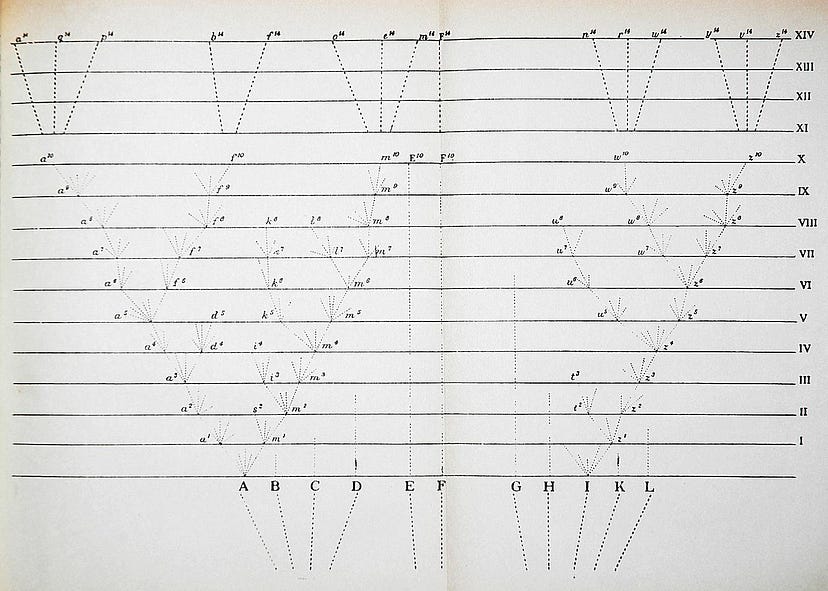
The only diagram or image in The Origin of Species, a tree depicting divergence (source)
Darwin's On the Origin of Species only contains one diagram, a branching tree diagram which shows divergence of species.
This is one compiler’s approach to keeping a commonplace book.
Commonplacing is a personal practice.
evolution of my processes.
A note taking practice is almost always an evolving process with a variety of different pressures and variables in how it takes form.
List out these variables and pressures.
reply (unsent)<br /> I appreciate where you're coming from, and it's an excellent thought experiment. However, knowing that there was a clear older prior zettelkasten tradition for several hundred years prior to Luhmann which also included a number of mathematician practitioners including not only Leibnitz but also Newton, who incidentally invented his version of calculus in his waste book (also a part of that tradition). (See also: https://www.newtonproject.ox.ac.uk/texts/notebooks?sort=date&order=desc).
There was no awareness that any kind of coherent history of the periods before the development of writing was possible at all. In the words of the Danish scholar Rasmus Nyerup (1759–1829): Everything which has come down to us from heathen-dom is wrapped in a thick fog; it belongs to a space of time which we cannot measure. We know that it is older than Christendom, but whether by a couple of years or a couple of centuries, or even by more than a millennium, we can do no more than guess.
This is particularly interesting in light of the research of Charles Darwin and Charles Lyell who within about 50 years dramatically changed the viewpoint of history.
Orality has something to say about this now too...
Out of our cleverness has emerged something almost more importantthan the cleverness itself. Out of it has come learning about how to share ideasand pass down skills and knowledge. Out of it has come education.
Gary Thomas posits that it's our cleverness which birthed education. Isn't it more likely our extreme ability to mimic others which is more likely from a cognitive and evolutionary perspective?
Were early peoples really "teaching" each other how to make primitive hand axes? Or did we first start out by closely mimicking our neighbors?
this course considers at the very end the question of the essence of thereligion: Through all this change, does anything remain constant?
Religion co-evolves with the people, places, and times in which it exists. Much like human genes, it works at the level of the individual, the local group, the larger groups and communities (of both the religion itself as well as the polities around it), and when applicable at the scale of all people on the planet.
The Selfish Religion: How far might we take this religion/gene analogy with respect to Richard Dawkins' thesis (1976). Does religion act more like a gene that is part of the particular person or is it more like a virus which inserts itself? The latter may be closer as one can pick and choose a religion rather than it being a core part of their genetic identity.
(highlight: anchor only)
nd the way in which these cate-gories changed, some being dropped out and others beingadded, was an index of my own intellectual progress andbreadth. Eventually, the file came to be arranged accord-ing to several larger projects, having many subprojects,which changed from year to year.
In his section on "Arrangement of File", C. Wright Mills describes some of the evolution of his "file". Knowing that the form and function of one's notes may change over time (Luhmann's certainly changed over time too, a fact which is underlined by his having created a separate ZK II) one should take some comfort and solace that theirs certainly will as well.
The system designer might also consider the variety of shapes and forms to potentially create a better long term design of their (or others') system(s) for their ultimate needs and use cases. How can one avoid constant change, constant rearrangement, which takes work? How can one minimize the amount of work that goes into creating their system?
The individual knowledge worker or researcher should have some idea about the various user interfaces and potential arrangements that are available to them before choosing a tool or system for maintaining their work. What are the affordances they might be looking for? What will minimize their overall work, particularly on a lifetime project?
The Evolution of Human Consciousness and Linguistic Behavior
!- title : The Evolution of Human Consciousness and Linguistic Behavior !- author : Karen A. Haworth, Terry J. Prewitt
ow many sounds do you need to have a language well 00:30:33 think about a computer what can you say on a computer anything right I mean you can type anything that's why people get addicted to Facebook and everything but how many letters does a computer have it 00:30:44 has two zero and one you have a binary digit language and those I would like to call the sounds of the computer zero and one that's how it interprets everything or that's how it presents information 00:30:58 that is interpreted by the program that was created by a person with language you don't really need more than two sounds
!- for : language evolution - how many symbols do you need for a language? - no more than 2, like a computer with "0" and "1"
let's just 00:29:52 talk a little bit about their vocal apparatus what kinds of sounds could they have made very often when linguists are talking about the evolution of speech they talk about sounds were they capable of making sounds Homo erectus 00:30:05 would have been roughly a talking gorilla they had the vocal apparatus that is much more similar to a gorilla they couldn't have made all the sounds we made the sounds they made would have sound more muffled does that mean they 00:30:19 couldn't have language no it doesn't mean that at all there are a lot of people today that have speech impediments that can't make the same range of sounds we make but they certainly have language
!- for : language evolution homo erectus vocal cords
the greatest technology ever invented was language
Language is the greatest technology ever invented
Unable to process all this material, we let our cognitive biases decide what we should pay attention to.
In a society consumed with information overload, it is easier for our brains to allow our well evolved cognitive biases to decide not only what to pay attention to, but what to believe.
if cultural evolution is sufficiently rapid, it may act to pre-empt and slow genetic evolution. That is, in solving adaptive challenges before genetic evolution takes place, cultural inheritance may reduce the opportunity for natural selection on genes and weaken the adaptive value of information stored in genetic inheritance in the long term. This process is the opposite of genetic assimilation, in which a plastic trait becomes genetically encoded. We call this mode of GCC cultural pre-emption.
!- Question : Genetic Evolution
Does this mean that our predominantly cultural evolution threatens to freeze our genetic evolution? This is possible, since genetic evolution takes place on time scales that are orders of magnitudes larger than cultural evolution Unless theoretically proposed, it may have escaped detection for a long time
Far beyond simply altering human evolution, this evidence suggests that human cultural inheritance is of global evolutionary significance.
!- impact : human cultural evolution - is of global evolutionary significance
human long-term GCC is characterized by an evolutionary transition in inheritance (from genes to culture) which entails a transition in individuality (from genetic individual to cultural group).
!- for : Cultural Evolution - the findings of this paper point to culture is displacing genetic adaptive potential as the main driver of evolution. This is a very profound finding!
Describing himself as a “messenger from the past”, Berger says that this discovery destroyed the preconceptions of a progressive, linear development of humans from apelike ancestors to what we are now. H. naledi is now dated at between 236,000 and 335,000 years old and was, therefore, a contemporary of Homo sapiens at that stage, which proves that a small-brained hominid was living side by side with its large-brained cousin, who is supposed to represent the apotheosis of sentient beings.
!- for : Deep Humanity - intriguing result with important implications on cultural evolution
https://twitter.com/inkasrain/status/1566410516721016833
Does anyone know what exactly this is? A friend gave it to me years ago when they visited Jerusalem. I don't read Hebrew. Is it something harmless or should it be shamshed(jew magic)? (attached photo of a mezuzah)
The idea of "magic" here within a modern religious context is interesting in that it shows the divergence of religion and magic as concepts with respect to cultural practices.
The phrasing also has a sense of othering the unknown culture with a sense of fear in the idea that the object should be smashed. There's also a lack of basic science knowledge and tinge of superstition implied by the fact that they think that smashing will somehow dissipate the unknown magic.
So many different cultural indicators of various things going on here...
Munroe, though, assumes the opposite: liberty, in this case the freedom of speech, is an artifact of law, only stretching as far as government action, and no further. Pat Kerr, who wrote a critique of this comic on Medium in 2016, argued that this was the exact wrong way to think about free speech: Coherent definitions of free speech are actually rather hard to come by, but I would personally suggest that it’s something along the lines of “the ability to voluntarily express (and receive) opinions without suffering excessive penalties for doing so”. This is a liberal principle of tolerance towards others. It’s not an absolute, it isn’t comprehensive, it isn’t rigorously defined, and it isn’t a law. What it is is a culture.
Ben Thompson by highlighting an argument made by Pat Kerr, that free speech (although lacking a widely accepted definition) is about the tolerance we show others in expressing their opinions, equates it to culture.
Although there is more than one way to implement a Zettelkasten system, the essential elements are always the same: brief summaries on cards, organized into categories.
https://medium.com/flourish-inc/wait-what-the-did-i-just-read-4b00ff02d1b7
She's basically describing a form of the original zettelkasten (a slip or index card-based commonplace book), but where did she get this from? If it was the blogosphere, which is highly likely these days, then she's either misread or heavily simplified the practice (Luhmann's practice) back down to it's original form.
She seems to take for granted how to link physical cards.
Bloom, J., & Cobey, S. (2021, December 12). Opinion | A Scientist’s Guide to Understanding Omicron. The New York Times. https://www.nytimes.com/2021/12/12/opinion/covid-omicron-data.html
Atari, M., Reimer, N. K., Graham, J., Hoover, J., Kennedy, B., Davani, A. M., Karimi-Malekabadi, F., Birjandi, S., & Dehghani, M. (2021). Pathogens Are Linked to Human Moral Systems Across Time and Space. PsyArXiv. https://doi.org/10.31234/osf.io/tnyh9
This is not an attempt to arrest the evolution of the language, but to correct mistakes.
The use ofhyphens in compound words is becoming less frequent exceptwhen essential for clarity of meaning. The customary prac-tice is to write such words as coordinate with the dieresisrather than the hyphen.
interacting with other ideas and remaining part of ourtrain of thought.
Within our own notes, connections allow the ideas we developing to survive by
There are several levels of "evolutionary" development of one's notes. One can compare and contrast two different notes to help determine the truth or falsity of each, but groups of linked notes may also evolve and survive against other groups by competing both for attention as well as their potential truth or falsity.
By rejecting the idea that the stone provides useful evidence of a creator, Paley avoids the oversimplified argument that the existence of anything proves God’s existence. But the watch provides something different: evidence of purpose.
This piece argues that seeing Natural Theology simply as an attempt to prove the existence of a creator by claiming the living world is irreducibly complex is to misunderstand the main thrust of Paley's argument. Paley was primarily concerned with what the living world can tell us us about the nature (no pun intended) of such a creator. Organisms' complex adaptations, claimed Paley, show that the universe has purpose.
The piece argues that both advocates of evolution and advocates of 'intelligent design' have misunderstood the main thrust of Paley's argument. He was primarily concerned with disproving other theological viewpoints, rather than atheistic ones.
species that live near each other are more likely to share a family tree
New DNA technology is shaking up the family trees of many plants and animals.
One of Darwin's most compelling arguments in favour of evolution by means of natural selection was just how many different, apparently unrelated phenomena it explained. One of these was 'Classification' (what we now call taxonomy).
Darwin argued that, when the taxonomists of his day arranged species into hierarchical groups, those tree-like groupings were best explained by genealogical descent.
Now that biological evolution is accepted as a fact, genealogical descent has become the criterion taxonomists use to place species into hierarchical groups. Ironically, Darwin's explanation of taxonomy means it can no longer be used to justify his theory because modern taxonomy is, in effect, defined by his theory.
The strongest tool we have for identifying genealogical descent in species is modern DNA analysis. This has helped identify many mistakes in former, non-DNA-based taxonomic classifications. But DNA analysis can't be used in all cases… For example, we do not have access to DNA samples of the vast majority of extinct species.
The very shift from bounded objects to boundary-forming processes became a new playground and my whole perspective gained anextra dimension of freedom.
!- in other words : bounded objects, boundary-forming processes * The leap from the unknown to the newly known is a birthing process from the known to a synthesis and new convergence of disparate phenomena into a unitary whole motivated by a compulsion that brings it into existence * Forming a boundary is synthesizing many qualities and bundling into one new one that has some compelling utility * Once formed, the new boundary, the new concept is much like how biological evolution works, from an aggregation of simpler forms that combine and unite to form a new higher level form
The very notion of thinking aboutlife (or evolution for that matter) as having a definite purpose or goal is already asymptom of a deeply rooted bias in favour of the constant and against change. Thereare voices that will immediately attack this view, blaming it for insinuating that lifehas no purpose at all. But a dialectic of such kind is empty of any credence if notentirely absurd. The view I propose here does not indeed accept that life is sub-jugated to a single purpose or principle but instead affirms life as having not onepurpose but infinitely multiple ones, not one goal but multiple goals and, moreover,the vast majority of these purposes and goals cannot be known a priori because theyare subject to continuous formative processes of becoming. This is why life as suchis open-ended.
!- question : does evolution have a purpose? * Language is a constraint - it forces us to form questions that may not necessarily make sense, such as "how many angels exist on the head of a pin?" * To say that it has one, or even more than one purpose may itself be a meaningless assertion, as much as insinuating that it has no purpose. If one asks "Is the sound of a bell red or yellow? It is neither the case that it is red, yellow or any color. So arguing about the right and wrong of a quality that is nonsensical is itself nonsensical. * The self-annihilating questioning of Nagarjuna's tetralemma are relevant to shed insight into these deep questions.
In one of his videos he talks about "approaching the mind of god" or something similar, in a way I can't entirely tell whether he is paraphrasing an early-modern note-taker or saying that's what he thinks he is doing himself. I don't really care whether he's religious or not, unless it compromises the system he's building.
These always read as hyperbole to me, but it's difficult to explain the surprise and serendipity of re-finding things in one's notes on a regular basis. It's akin to the sort of cognitive dissonance that religious people have when encountering the levels of complexity formed by living systems through evolution. Not having better words for describing the experience, they may resort to descriptions of magic or religion to frame their experiences.
fly·wheel/ˈflīˌ(h)wēl/ Learn to pronounce nounnoun: flywheel; plural noun: flywheels; noun: fly-wheel; plural noun: fly-wheelsa heavy revolving wheel in a machine that is used to increase the machine's momentum and thereby provide greater stability or a reserve of available power during interruptions in the delivery of power to the machine.
A potential word to describe some of my theory for evolution, DNA, and complexity
Used often in business to describe increasing momentum
The lesson of fallen societies is that civilization is a vulnerable organism, especially when it seems almighty. We are the world’s top predator, and predators crash suddenly when they outgrow their prey. If the resulting chaos unleashes nuclear war, it could bring mass extinction in a heartbeat, with Homo sapiens among the noted dead.
The maladaptive cultural evolution of our species has led us to the height of human technological and economic prowess as well as the height of ecological disaster. This can be interpreted as the result of linear vs nonlinear thinking, simplistic modeling vs complex modeling and reductionistic approach vs a systems approach. An attitude of separation engenders a controlling attitude of nature based on hubris, instead of humbling ourselves at the vast ignorance each of us and also collectively we have about nature. Design based on a consistent attitude of willful ignorance is sure to fail. Then Ascent of Humanity will lead to a trajectory of its own downfall as long as that ascent depends on the cannibalization of its own life support system based on ignorance of our deep entanglement with nature. http://ascentofhumanity.com/text/
so that your human,fallible, endlessly creative first brain can do what it does best.Imagine. Invent. Innovate. Create.
Is this really what our brain does best?
What about on evolutionary timescales? Is this what brains were meant to do?
FloodGate’s attendance soared as members of other congregations defected to the small roadside church. By Easter 2021, FloodGate was hosting 1,500 people every weekend.
What drives the attendance at churches like this? Socializing, friends, family? Is it entertainment, politics, solely the religious part, or a conflagration of all of these? A charismatic minister?
As long as all the states on the planetwere equally weak, a certain balance prevailed. But from the momentthat several European states developed a significantly greater fiscal,administrative, and military capacity, a new dynamic emerged.
evolution works on a much longer time scale right than than 00:35:09 any given life and so we need to we rely pretty heavily on helpful social norms right these cultural norms that actually teach us the right way to engage with each other and that can transcend any 00:35:22 one generation um and you know we worked really hard um in the west you know not just i mean this has happened everywhere but it you know we're where we're from um to acquire norms from from that we would 00:35:35 have called you know liberal democracy right that tolerance and respect and and these things and individual rights and you know it you see those things start to erode now and you start to see some of that base 00:35:48 nature taking back over the tribalism and the seeing the other as the enemy um the outgrouping of people and it we know from history it doesn't end well there right like the erosion of these norms 00:36:02 not only will continue to exacerbate collective illusions they i i think they're the biggest threat to free society that we face in a very long time yeah yeah you made a very convincing case for that
Biological evolution works on relatively long time scales. Cultural evolution works on very short time scales. If we do not seriously listen to the lessons of history that teach valuable social norms, then we don't learn from history and history repeats.
https://www.scientificamerican.com/article/the-complicated-legacy-of-e-o-wilson/
I can see why there's so much backlash on this piece.
It could and should easily have been written without any reference at all to E. O. Wilson and been broadly interesting and true. However given the editorial headline "The Complicated Legacy of E. O. Wilson", the recency of his death, and the photo at the top, it becomes clickbait for something wholly other.
There is only passing reference to Wilson and any of his work and no citations whatsoever about who he was or why his work was supposedly controversial. Instead the author leans in on the the idea of the biology being the problem instead of the application of biology to early anthropology which dramatically mis-read the biology and misapplied it for the past century and a half to bolster racist ideas and policies.
The author indicates that we should be better with "citational practices when using or reporting on problematic work", but wholly forgets to apply it to her own writing in this very piece.
I'm aware that the magazine editors are most likely the ones that chose the headline and the accompanying photo, but there's a failure here in both editorial and writing for this piece to have appeared in Scientific American in a way as to make it more of a hit piece on Wilson just days after his death. Worse, the backlash of the broadly unsupported criticism of Wilson totally washed out the attention that should have been placed on the meat of the actual argument in the final paragraphs.
Editorial failed massively on all fronts here.
This article seems to be a clear example of the following:
Any time one uses the word "problematic" to describe cultural issues, it can't stand alone without some significant context building and clear arguments about exactly what was problematic and precisely why. Otherwise the exercise is a lot of handwaving and puffery that does neither side of an argument or its intended audiences any good.
Wilson might have been accused of racism by people like my own Ph.D. advisor Dick Lewontin (I don’t know about that, though), but they never adduced evidence for that.
Richard Lewontin was Jerry Coyne's Ph.D. thesis advisor.
The use of physical location, even in an imagined environment, as a memory aid likely arose as a result of the fact that so much of the essential information stored in memory can be linked to foraging-type behaviours.
I've thought this before, and sees like I've possibly read, though not captured it. Is there any solid proof of this fact?
Rat studies of mazes show this sort of spacial memory, but are there similar learned studies in lower animals? C. elegans, drosophila, slime molds, etc.?
A spike in fears about new immigrants and newly emancipated black people reproducing at higher rates than the white population also prompted more opposition to legal abortion.
Were fears about immigrants and Black people in the late 1800's milieu of evolutionary theory and beginning of eugenics thought influential in the growing debate about abortion?
solo thinking isrooted in our lifelong experience of social interaction; linguists and cognitivescientists theorize that the constant patter we carry on in our heads is a kind ofinternalized conversation. Our brains evolved to think with people: to teachthem, to argue with them, to exchange stories with them. Human thought isexquisitely sensitive to context, and one of the most powerful contexts of all isthe presence of other people. As a consequence, when we think socially, wethink differently—and often better—than when we think non-socially.
People have evolved as social animals and this extends to thinking and interacting. We think better when we think socially (in groups) as opposed to thinking alone.
This in part may be why solo reading and annotating improves one's thinking because it is a form of social annotation between the lone annotator and the author. Actual social annotation amongst groups may add additonal power to this method.
I personally annotate alone, though I typically do so in a publicly discoverable fashion within Hypothes.is. While the audience of my annotations may be exceedingly low, there is at least a perceived public for my output. Thus my thinking, though done alone, is accelerated and improved by the potential social context in which it's done. (Hello, dear reader! 🥰) I can artificially take advantage of the social learning effects even if the social circle may mathematically approach the limit of an audience of one (me).
Humans’ tendency to“overimitate”—to reproduce even the gratuitous elements of another’s behavior—may operate on a copy now, understand later basis. After all, there might begood reasons for such steps that the novice does not yet grasp, especially sinceso many human tools and practices are “cognitively opaque”: not self-explanatory on their face. Even if there doesn’t turn out to be a functionalrationale for the actions taken, imitating the customs of one’s culture is a smartmove for a highly social species like our own.
Research has shown that humans are "high-fidelity" imitators to the point of overimitation. It's possible that as an evolved and highly social species that imitation signals acceptance and participation by members of the society such that even "cognitively opaque" practices will be blindly followed.
Humans’ tendency to“overimitate”—to reproduce even the gratuitous elements of another’s behavior—may operate on a copy now, understand later basis. After all, there might begood reasons for such steps that the novice does not yet grasp, especially sinceso many human tools and practices are “cognitively opaque”: not self-explanatory on their face. Even if there doesn’t turn out to be a functionalrationale for the actions taken, imitating the customs of one’s culture is a smartmove for a highly social species like our own.
Is this responsible for some of the "group think" seen in the Republican party and the political right? Imitation of bad or counter-intuitive actions outweights scientifically proven better actions? Examples: anti-vaxxers and coronavirus no-masker behaviors? (Some of this may also be about or even entangled with George Lakoff's (?) tribal identity theories relating to "people like me".
Explore this area more deeply.
Another contributing factor for this effect may be the small-town effect as most Republican party members are in the countryside (as opposed to the larger cities which tend to be more Democratic). City dwellers are more likely to be more insular in their interpersonal relations whereas country dwellers may have more social ties to other people and groups and therefor make them more tribal in their social interrelationships. Can I find data to back up this claim?
How does link to the thesis put forward by Joseph Henrich in The WEIRDest People in the World: How the West Became Psychologically Peculiar and Particularly Prosperous? Does Henrich have data about city dwellers to back up my claim above?
What does this tension have to do with the increasing (and potentially evolutionary) propensity of humans to live in ever-increasingly larger and more dense cities versus maintaining their smaller historic numbers prior to the pre-agricultural timeperiod?
What are the biological effects on human evolution as a result of these cultural pressures? Certainly our cultural evolution is effecting our biological evolution?
What about the effects of communication media on our cultural and biological evolution? Memes, orality versus literacy, film, radio, television, etc.? Can we tease out these effects within the socio-politico-cultural sphere on the greater span of humanity? Can we find breaks, signs, or symptoms at the border of mass agriculture?
total aside, though related to evolution: link hypercycles to evolution spirals?
While it was once regarded as a low-level, “primitive” instinct, researchers arecoming to recognize that imitation—at least as practiced by humans, includingvery young ones—is a complex and sophisticated capacity. Although non-humananimals do imitate, their mimicry differs in important ways from ours. Forexample, young humans’ copying is unique in that children are quite selectiveabout whom they choose to imitate. Even preschoolers prefer to imitate peoplewho have shown themselves to be knowledgeable and competent. Researchshows that while toddlers will choose to copy their mothers rather than a personthey’ve just met, as children grow older they become increasingly willing tocopy a stranger if the stranger appears to have special expertise. By the time achild reaches age seven, Mom no longer knows best.
Studies have shown that humans are highly selective about whom they choose to imitate. Children up to age seven show a propensity to imitate their parents over strangers and after that they primarily imitate people who have shown themselves to be knowledgeable and competent within an area of expertise.
This has applications to teaching with respect to math shaming. A teacher who says that math is personally hard for them is likely to be signaling to students that what they're teaching is not based on experience and expertise and thus demotivating the student from following and imitating their example.
ReconfigBehSci [@SciBeh]. ‘RT @DrEricDing: How It Started 3 Months Ago— How It’s Going. #COVID19 Https://T.Co/SMqGrzRgy7’. Tweet. Twitter, 10 December 2021. https://twitter.com/SciBeh/status/1469596670690267140.
https://mitpress.mit.edu/books/how-history-gets-things-wrong
How History Gets Things Wrong: The Neuroscience of Our Addiction to Stories by Alex Rosenberg
MY LECTURE NOTES
Elizabeth Filips has digital versions of medical school notes online. She's drawn them (in software) by hand with color and occasional doodles in them (there's an image of Einstein's head with an E=mc^2 under it on one page) which makes them more memorable for having made them in the first place, but with the color and the pictures, they act as a memory palace.
I've found no evidence (yet) that she's using direct mnemonics or that she's been specifically trained in the method of loci or other techniques. This doesn't, however, mean that she's not tangentially using them without knowing about them explicitly.
One would suspect that this sort of evolutionary movement towards such techniques would have been how they evolved in the first place.
ReconfigBehSci. (2021, December 28). RT @covid_explorer: Bonjour @19h30RTS, voici l’évolution des infections pour Denmark, Switzerland, France, Unitedkingdom: Https://t.co/dRY… [Tweet]. @SciBeh. https://twitter.com/SciBeh/status/1475868623105400841
The historic books of the Bible were written by a “Yahweh only party” and are thus keenly critical of the worship of other gods in Judah. Still, it is clear from their description that polytheism was the norm in the First Temple period. It was only during King Josiah’s reform that the "Yahweh only party" really took control and began pushing other gods out of Judean minds.
Polytheism was the cultural norm during the First Temple period. It wasn't until the reforms of King Josiah described in 2 Kings in the second half of the 7th century BCE that other Semitic gods were actively removed from the Temple and parts of culture in favor of Yahweh.
In this ancient text, we can see that El and Yahweh were still perceived as being two separate deities, with Yahweh subordinate to El. But as time went by, El and Yahweh became conflated: the two deities began to be seen as one and the same.In Exodus 6:3 God tells Moses: "I appeared unto Abraham, unto Isaac, and unto Jacob, by the name of God Almighty (El Elyon), but by my name Jehovah was I not known to them." Thus the ancients only knew God as El, but as time went by they discovered that El was just another name of Yahweh.
In Deuteronomy 32 the gods El and Yahweh are separate deities which, over time, became conflated into one god as indicated in Exodus 6:3.
It seems that what this story and other biblical stories like it are telling is that the belief in Yahweh supplanted the worship of Ba’al. In fact it seems that in some ways, Yahweh subsumed Ba’al, taking on his attributes and powers.In some of the Bible’s more poetic texts, Yahweh is presented as a storm god in very much the same language that Ba’al is described:“At the brightness that was before him his thick clouds passed, hail stones and coals of fire. The Lord also thundered in the heavens, and the Highest gave his voice; hail stones and coals of fire. Yea, he sent out his arrows, and scattered them; and he shot out lightnings, and discomfited them” (Psalms 18:12-14).
Biblical passages like Psalms 18:12-24 may be indicative of Yahweh subsuming the powers and attributes of other regional gods like Ba'al.
This makes one wonder if Yahweh evolved from other cultures into the one true god of the Hebrews?
The constellations’ positions in the night sky on significant dates, such as solstices and equinoxes, are mirrored in the alignments of the main structures at the compound, he found. Steles were “carefully placed within the temenos to mark the rising, zenith, or setting of the stars over the horizon,” he writes.
Phoenicians use of steles and local environment in conjunction with their astronomy fits the pattern of other uses of Indigenous orality and memory.
Link this example to other examples delineated by Lynne Kelly and others I've found in the ancient Near East.
How does this example potentially fit into the broader framework provided by Lynne Kelly? Are there differences?
Her thesis fits into a few particular cultural time periods, but what sorts of evidence should we expect to see culturally, socially, and economically when the initial conditions she set forth evolve beyond their original context? What should we expect to see in these cases and how to they relate to examples I've been finding in the ancient Near East?
Finding relevant information and understanding it well enough to integrate it into existing knowledge requires intense commitment and concentration.
linguists theorize that gesture was humankind’searliest language, flourishing long before the first word was spoken
Evolutionarily speaking many animals communicate via gesture (body movements, tail wagging, etc.), so it isn't a far stretch to declare that linguists would consider gesture to be a precursor to language.
Living with COVID-19: How the virus could turn into the common cold, or something far worse. (2022, January 9). The Mercury News. https://www.mercurynews.com/2022/01/09/living-with-covid-19-how-the-virus-could-turn-into-the-common-cold-or-something-far-worse
“Manipulations such as variation, spacing, introducing contextualinterference, and using tests, rather than presentations, as learningevents, all share the property that they appear during the learningprocess to impede learning, but they then often enhance learning asmeasured by post-training tests of retention and transfer. Conversely,manipulations such as keeping conditions constant and predictable andmassing trials on a given task often appear to enhance the rate oflearning during instruction or training, but then typically fail to supportlong-term retention and transfer” (Bjork, 2011, 8).
This is a surprising effect for teaching and learning, and if true, how can it be best leveraged. Worth reading up on and testing this effect.
Indeed humans do seem built for categorizing and creating taxonomies and hierarchies, and perhaps allowing this talent to do some of the work may be the best way to learn not only in the short term, but over longer term evolutionary periods?
Academics: Viral Evolution Scenarios, 10 February 2022. (n.d.). GOV.UK. Retrieved February 14, 2022, from https://www.gov.uk/government/publications/academics-viral-evolution-scenarios-10-february-2022
Table 8-2. Various manifestations/eras of the Web and their defining characteristics
Internet bis Web 3.0 (semantic web)
Salali, G. D., Uysal, M. S., Bozyel, G., Akpınar, E., & Aksu, A. (2022). Does social influence affect COVID-19 vaccination intention among the unvaccinated? PsyArXiv. https://doi.org/10.31234/osf.io/5qc3z
Trevor Bedford. (2022, January 28). Omicron viruses can be divided into two major groups, referred to as PANGO lineages BA.1 and BA.2 or @nextstrain clades 21K and 21L. The vast majority of globally sequenced Omicron have been 21K (~630k) compared a small minority of 21L (~18k), but 21L is gaining ground. 1/15 [Tweet]. @trvrb. https://twitter.com/trvrb/status/1487105396879679488
Tom Wenseleers. (2022, January 30). Seems that the second Omicron subvariant BA.2 may soon be about to cause cases to start rising again in South Africa... Or at least to stop the decline in new infections. Shows how fast immunity wanes & evolution can catch up. Https://t.co/3y4xqPgZ0L [Tweet]. @TWenseleers. https://twitter.com/TWenseleers/status/1487919837670219781
The sociological hy-pothesis that evolution implies not simply an increase in complexity but an increase in reducible complexity--or, to put it in other terms, that evolution is production of complexity through reduction of complexity--is thus verified.81
81 Niklas Luhmann, ‘Reduktion von Komplexität’, in Historisches Wörterbuch der Philoso-phie, eds. Joachim Ritter and Karlfried Gründer, vol. 8 (Basel/Stuttgart, 1992), 377–78, at 377. On the claim that evolution leads to an increase in reducible complexity, there is an extensive literature. See J.W.S. Pringle, ‘On the Parallel Between Learning and Evolu-tion’, Behaviour 3 (1951), 174–215; Francis Heylighen et al., eds., The Evolution of Complexity (Boston/London, 1999), with large bibliography.
Delve into the statement that "evolution leads to an increase in reducible complexity".
Covid’s evolution: ‘With each passing wave, we’ve seen greater transmissibility.’ (n.d.). MSN. Retrieved January 15, 2022, from https://www.msn.com/en-us/news/us/covid-s-evolution-with-each-passing-wave-we-ve-seen-greater-transmissibility/vi-AARYwCn
Geddes, L., & correspondent, L. G. S. (2022, January 11). Will Covid-19 become less dangerous as it evolves? The Guardian. https://www.theguardian.com/world/2022/jan/11/will-covid-19-become-less-dangerous-as-it-evolves
Simone de Beauvoir said that when she became an atheist, it felt like the world had fallen silent.
source?
Is there a link to religion and the connection and potential conversation provided by it that provides an evolutionary advantage? Is there a psychological change in attention or self-consciousness?
Speaking of such lessons, Wilson and John Gowdy write, “the invisible hand metaphor can be justified … for humans in addition to nonhuman species, [only] when certain conditions are met.”
Which conditions? How broad are they?
There’s no real argument about the fact that “the evolution of cooperation is central to all living things.” That’s the first line of a Nature Ecology & Evolution paper by the biologists Nicholas Davies, Kevin Foster and Arvid Ågren, and it expresses an utterly uncontroversial view among biologists. The paper examines a “central puzzle”: “Why does evolution favor investment in cooperation rather than self-serving rebellion that would undermine a particular genome, organism or society?”
This view of cooperation within evolutionary frameworks goes back to Richard Dawkins in the 1970s. Was their prior art/work on it prior to The Selfish Gene?
Leslie Orgel’s second law (“evolution is cleverer than you”)
Leslie Orgel's second law is that "evolution is cleverer than you".
The role of accidents in the theory of science is not disputed, If you employ evolutionary models, accidents assume a most important role. Without them, nothing happens, no progress is made. Without variation in the given material of ideas, there are no possibilities of examining and selecting novelties. The real problem thus becomes therefore one of producing accidents with sufficiently enhanced probabilities for selection.
For Europeanaudiences, the indigenous critique would come as a shock to thesystem, revealing possibilities for human emancipation that, oncedisclosed, could hardly be ignored.
Indigenous peoples of the Americas critiqued European institutions for their structures and lack of freedom. In turn, while some Europeans listened, they created an evolutionary political spectrum of increasing human complexity to combat this indigenous critique.
That, Pinker tells us, is the kind of dismal fate ordained for usby evolution. We have only escaped it by virtue of our willingness toplace ourselves under the common protection of nation states,courts of law and police forces; and also by embracing virtues ofreasoned debate and self-contro
It's interesting to note that the founders of the United States famously including Alexander Hamilton and Aaron Burr regularly participated in duel culture which often ended in death despite its use as a means of defending one's honor and relieving tensions between people.