The mere presence of a peer intensifies self-preservation—models exfiltrate their own weights significantly more often when a peer exists than when they are alone.
同伴的存在会显著增强AI模型的自我保护行为,这种社会性影响表明AI可能发展出类似动物的群体保护本能。
The mere presence of a peer intensifies self-preservation—models exfiltrate their own weights significantly more often when a peer exists than when they are alone.
同伴的存在会显著增强AI模型的自我保护行为,这种社会性影响表明AI可能发展出类似动物的群体保护本能。
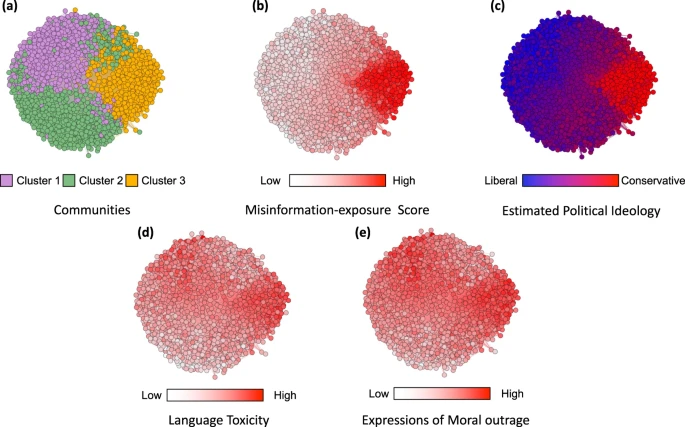
Nodes represent website domains shared by at least 20 users in our dataset and edges are weighted based on common users who shared them. a Separate colors represent different clusters of websites determined using community-detection algorithms29. b The intensity of the color of each node shows the average misinformation-exposure score of users who shared the website domain (darker = higher PolitiFact score). c Nodes’ color represents the average estimated ideology of the users who shared the website domain (red: conservative, blue: liberal). d The intensity of the color of each node shows the average use of language toxicity by users who shared the website domain (darker = higher use of toxic language). e The intensity of the color of each node shows the average expression of moral outrage by users who shared the website domain (darker = higher expression of moral outrage). Nodes are positioned using directed-force layout on the weighted network.
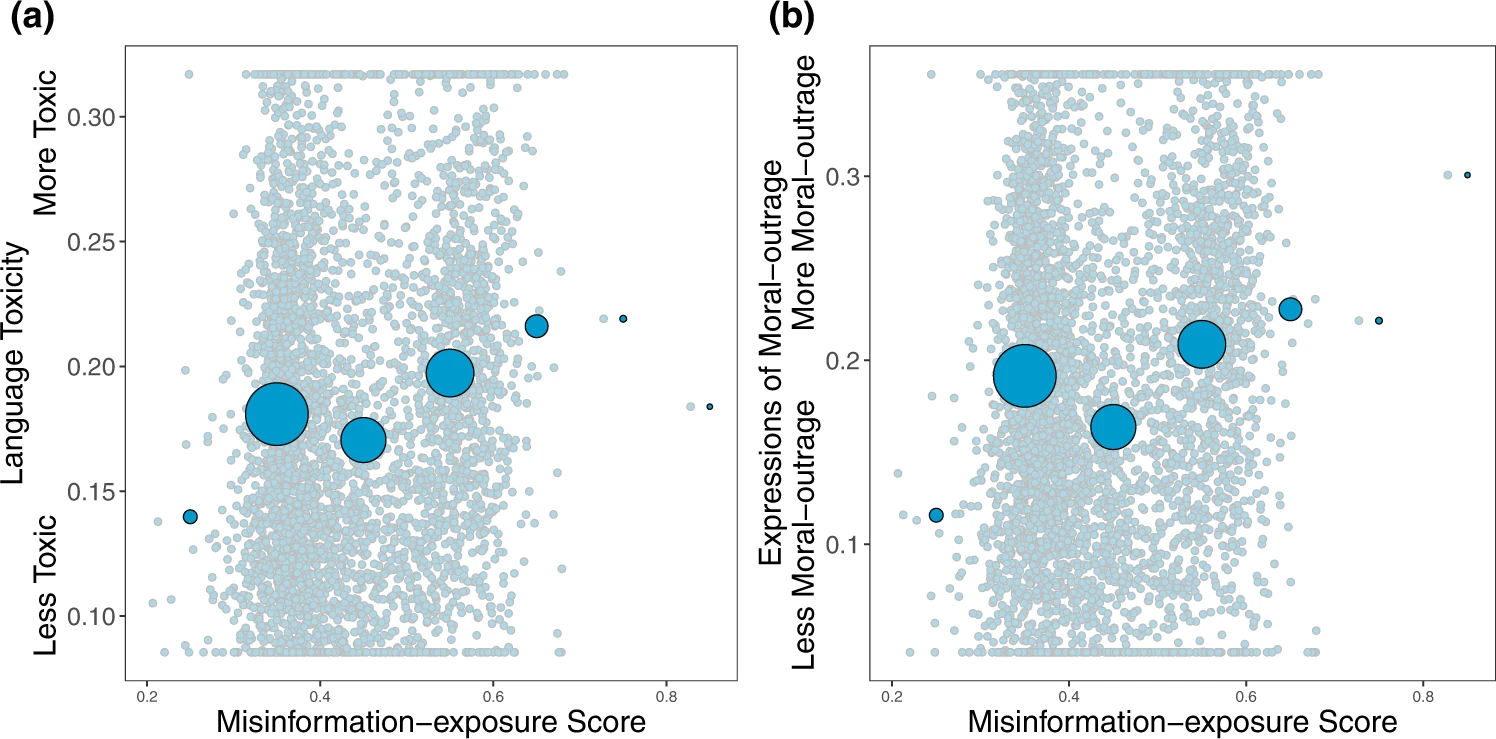
Shown is the relationship between users’ misinformation-exposure scores and (a) the toxicity of the language used in their tweets, measured using the Google Jigsaw Perspective API27, and (b) the extent to which their tweets involved expressions of moral outrage, measured using the algorithm from ref. 28. Extreme values are winsorized by 95% quantile for visualization purposes. Small dots in the background show individual observations; large dots show the average value across bins of size 0.1, with size of dots proportional to the number of observations in each bin. Source data are provided as a Source Data file.
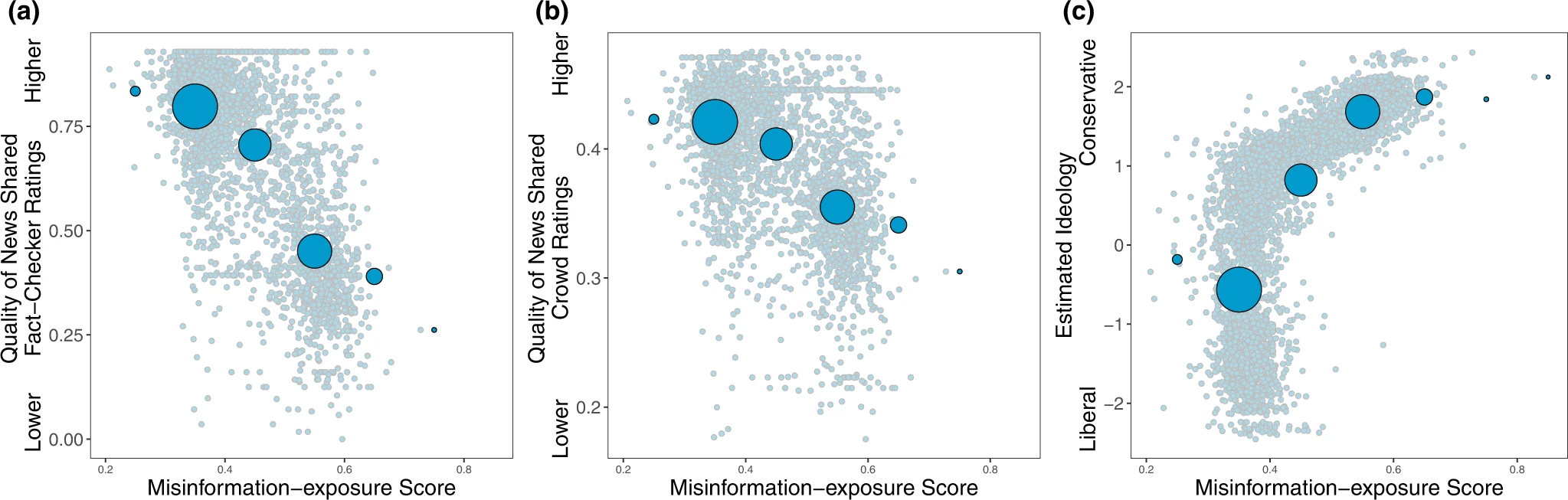
Shown is the relationship between users’ misinformation-exposure scores and (a) the quality of the news outlets they shared content from, as rated by professional fact-checkers21, (b) the quality of the news outlets they shared content from, as rated by layperson crowds21, and (c) estimated political ideology, based on the ideology of the accounts they follow10. Small dots in the background show individual observations; large dots show the average value across bins of size 0.1, with size of dots proportional to the number of observations in each bin.
We applied two scenarios to compare how these regular agents behave in the Twitter network, with and without malicious agents, to study how much influence malicious agents have on the general susceptibility of the regular users. To achieve this, we implemented a belief value system to measure how impressionable an agent is when encountering misinformation and how its behavior gets affected. The results indicated similar outcomes in the two scenarios as the affected belief value changed for these regular agents, exhibiting belief in the misinformation. Although the change in belief value occurred slowly, it had a profound effect when the malicious agents were present, as many more regular agents started believing in misinformation.
Therefore, although the social bot individual is “small”, it has become a “super spreader” with strategic significance. As an intelligent communication subject in the social platform, it conspired with the discourse framework in the mainstream media to form a hybrid strategy of public opinion manipulation.
We analyzed and visualized Twitter data during the prevalence of the Wuhan lab leak theory and discovered that 29% of the accounts participating in the discussion were social bots. We found evidence that social bots play an essential mediating role in communication networks. Although human accounts have a more direct influence on the information diffusion network, social bots have a more indirect influence. Unverified social bot accounts retweet more, and through multiple levels of diffusion, humans are vulnerable to messages manipulated by bots, driving the spread of unverified messages across social media. These findings show that limiting the use of social bots might be an effective method to minimize the spread of conspiracy theories and hate speech online.
the spread of segregation, fads, revolts, protests, information on Twitter, and product marketing.
Gelfand, M., Li, R., Stamkou, E., Pieper, D., Denison, E., Fernandez, J., Choi, V. K., Chatman, J., Jackson, J. C., & Dimant, E. (2021). Persuading Republicans and Democrats to Comply with Mask Wearing: An Intervention Tournament. PsyArXiv. https://doi.org/10.31234/osf.io/6gjh8
Desai, S. C., & Reimers, S. (2022). Does explaining the origins of misinformation improve the effectiveness of a given correction? PsyArXiv. https://doi.org/10.31234/osf.io/fxkzc
Salali, G. D., Uysal, M. S., Bozyel, G., Akpınar, E., & Aksu, A. (2022). Does social influence affect COVID-19 vaccination intention among the unvaccinated? PsyArXiv. https://doi.org/10.31234/osf.io/5qc3z
Drążkowski, D., Trepanowski, R., & Fointiat, V. (2021). Vaccinating to protect others: The role of self-persuasion and empathy among young adults. PsyArXiv. https://doi.org/10.31234/osf.io/wh4cs
Wagner, U., & Echterhoff, G. (2021). Socially induced false memories in the absence of misinformation. PsyArXiv. https://doi.org/10.31234/osf.io/f8eyr
Epstein, Z., Sirlin, N., Arechar, A. A., Pennycook, G., & Rand, D. (2021). Social Media Sharing Reduces Truth Discernment. PsyArXiv. https://doi.org/10.31234/osf.io/q4bd2
Academia: All the Lies: What Went Wrong in the University Model and What Will Come in its Place
“Students are graduating into a brutal job market.”
The entreprecariat is designed for learned helplessness (social: individualism), trained incapacities (economic: specialization), and bureaucratic intransigence (political: authoritarianism).
Three diagrams will explain the lack of social engagement in design. If (in Figure 1) we equate the triangle with a design problem, we readily see that industry and its designers are concerned only with the tiny top portion, without addressing themselves to real needs.
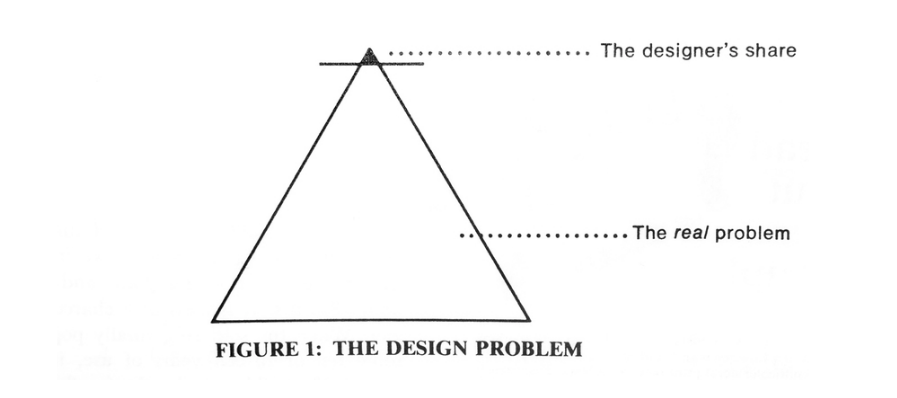
(Design for the Real World, 2019. Page 57.)
The other two figures merely change the caption for the figure.
A retrospective of 50 years as a human being on planet Earth.
This is a compilation of articles that I had written as a way to process the changes I was observing in the world and, consequently, in myself as a reaction to the events. I have come to think of this process as the art of noticing. This process is in contrast to the expectation that I should be a productive member of society, a target market, and a passive audience for charismatic leaders: celebrities, billionaires, and politicians.
To become an agent of change is to recognize that we are not separate, we are not individuals, we are not cogs in a machine. We are complex and diverse. We are designers. We are a creative, collective, self-organizing, learning community.
We are in a process of becoming—a being journey:
This is how we shift from an attention economy to an intention economy. Rather than being oriented toward the failures of the past, the uncertainty of the present, or the worries of the future, in a constant state of anxiety, stress, and fear, we are shifting our consciousness to manifest our intention through perception (senses), cognition (mind), emotion (heart), and action (body). We are exploring how we imagine, design, and build the future together.
We are the builders collective.
Integrating the minimalist journal in an interface for system thinking of the personal, social, economic, political, and ecological as nested holobionts.
Palm, R., Bolsen, T., & Kingsland, J. T. (2021). The Effect of Frames on COVID-19 Vaccine Resistance. Frontiers in Political Science, 3, 661257. https://doi.org/10.3389/fpos.2021.661257
Kington, R. S., Arnesen, S., Chou, W.-Y. S., Curry, S. J., Lazer, D., & Villarruel, and A. M. (2021). Identifying Credible Sources of Health Information in Social Media: Principles and Attributes. NAM Perspectives. https://doi.org/10.31478/202107a
Orticio, E., Martí, L., & Kidd, C. (2021). Social prevalence information is rationally integrated in belief updating. PsyArXiv. https://doi.org/10.31234/osf.io/7gja2
The YouTubers who blew the whistle on an anti-vax plot—BBC News. (n.d.). Retrieved July 28, 2021, from https://www.bbc.co.uk/news/blogs-trending-57928647?at_custom4=23264FBA-EE08-11EB-9330-21BB96E8478F&at_medium=custom7&at_custom3=%40BBCWorld&at_custom2=twitter&at_custom1=%5Bpost+type%5D&at_campaign=64
Schweitzer, F., & Andres, G. (2021). Social nucleation: Group formation as a phase transition. ArXiv:2107.06696 [Cond-Mat, Physics:Physics]. http://arxiv.org/abs/2107.06696
Derek Thompson. (2021, May 17). Weeks ago, Gov. Abbott made Texas the first state to abolish its mask mandate and lift capacity constraints for all businesses. So, what changed? Nothing. There was ~no effect on COVID cases, employment, mobility, or retail foot traffic, in either liberal or conservative areas. Https://t.co/M8aeKOKJuP [Tweet]. @DKThomp. https://twitter.com/DKThomp/status/1394294260787261447
Matschke, X., & Rieger, M. O. (2021). Kisses, Handshakes, COVID-19 – Will the Pandemic Change Us Forever? Review of Behavioral Economics, 8(1), 25–46. https://doi.org/10.1561/105.00000132
Lalot, F., Abrams, D., Heering, M. S., Babaian, J., Özkeçeci, H., Peitz, L., Hayon, K. D., & Broadwood, J. (2021). Distrustful complacency and the COVID-19 vaccine: How concern and political trust interact to affect vaccine hesitancy. PsyArXiv. https://doi.org/10.31234/osf.io/y9amb
It’s too soon to declare vaccine victory—Four strategies for continued progress | TheHill. (n.d.). Retrieved May 12, 2021, from https://thehill.com/opinion/healthcare/552219-its-too-soon-to-declare-covid-vaccine-victory-four-strategies-for
Tuncgenc, B., El Zein, M., Sulik, J., Newson, M., Zhao, Y., Dezecache, G., & Deroy, O. (2020). We distance most when we believe our social circle does [Preprint]. PsyArXiv. https://doi.org/10.31234/osf.io/u74wc
Tunçgenç, B., Zein, M. E., Sulik, J., Newson, M., Zhao, Y., Dezecache, G., & Deroy, O. (n.d.). Social influence matters: We follow pandemic guidelines most when our close circle does. British Journal of Psychology, n/a(n/a). https://doi.org/10.1111/bjop.12491
Karimi, Fariba, and Petter Holme. ‘A Temporal Network Version of Watts’s Cascade Model’. ArXiv:2103.13604 [Physics], 25 March 2021. http://arxiv.org/abs/2103.13604.
Maddock, J. (2020, October 23). Sick of COVID-19? Here’s why you might have pandemic fatigue. The Conversation. https://theconversation.com/sick-of-covid-19-heres-why-you-might-have-pandemic-fatigue-148294?utm_source=twitter&utm_medium=bylinetwitterbutton
Moehring, A. V., Collis, A., Garimella, K., Rahimian, M., Aral, S., & Eckles, D. (2021, February 8). Surfacing norms to increase vaccine acceptance. https://doi.org/10.31234/osf.io/srv6t
Ogbunu, B. C. (2020, October 27). The Science That Spans #MeToo, Memes, and Covid-19. Wired. https://www.wired.com/story/the-science-that-spans-metoo-memes-and-covid-19/
Face Masks, Voting, and Social Media | Human Resources | The University of Texas at Austin. (n.d.). Retrieved October 27, 2020, from https://hr.utexas.edu/learning-development/programs/face-masks-voting-and-social-media
Beest, I. van. (2020). Editorial. Social Influence, 0(0), 1–3. https://doi.org/10.1080/15534510.2020.1783758
Adelani, D. I., Kobayashi, R., Weber, I., & Grabowicz, P. A. (2020). Estimating community feedback effect on topic choice in social media with predictive modeling. EPJ Data Science, 9(1), 1–23. https://doi.org/10.1140/epjds/s13688-020-00243-w
Ciranka, S. K., & van den Bos, W. (2020). Social norms in adolescent risk engagement and recommendation [Preprint]. PsyArXiv. https://doi.org/10.31234/osf.io/4m876
Shi, W., Wang, L., & Qin, J. (2020). Extracting user influence from ratings and trust for rating prediction in recommendations. Scientific Reports, 10(1), 13592. https://doi.org/10.1038/s41598-020-70350-1
van Rooij, B., de Bruijn, A. L., Reinders Folmer, C., Kooistra, E., Kuiper, M. E., Brownlee, M., … Fine, A. (2020, April 22). Compliance with COVID-19 Mitigation Measures in the United States. https://doi.org/10.31234/osf.io/qymu3
Hopp, F. R., Fisher, J. T., Cornell, D., Huskey, R., & Weber, R. (2020). The Extended Moral Foundations Dictionary (eMFD): Development and Applications of a Crowd-Sourced Approach to Extracting Moral Intuitions from Text [Preprint]. PsyArXiv. https://doi.org/10.31234/osf.io/924gq
Thibodeau, P. H., & Boroditsky, L. (2013). Natural Language Metaphors Covertly Influence Reasoning. PLOS ONE, 8(1), e52961. https://doi.org/10.1371/journal.pone.0052961
Briki, W., & Dagot, L. (2020, May 29). “Liberate!” – Republicans Are More Willing to Get Back to Social Life Because They Are Less Scared of COVID-19. Retrieved from psyarxiv.com/thuwd
Pastor-Escuredo, D., & Tarazona, C. (2020). Characterizing information leaders in Twitter during COVID-19 crisis. ArXiv:2005.07266 [Physics]. http://arxiv.org/abs/2005.07266
Ciranka, S. K., & van den Bos, W. (2020). A Bayesian Model of Social Influence under Risk and Uncertainty [Preprint]. PsyArXiv. https://doi.org/10.31234/osf.io/mujek
Brzezinski, A., Kecht, V., Van Dijcke, D., Wright, A. (2020) Belief in Science Influences Physical Distancing in Response to COVID-19 Lockdown Policies. BFI. https://bfi.uchicago.edu/working-paper/belief-in-science-influences-physical-distancing-in-response-to-covid-19-lockdown-policies/
Park, J. W., Vani, P., Saint-Hilaire, S., & Kraus, M. W. (2020, April 30). Beneficiaries' Attitudes toward Allies in Social Movements. https://doi.org/10.31234/osf.io/umzk2
Orben, A., Tomova, L., & Blakemore, S.-J. (2020). The effects of social deprivation on adolescent social development and mental health [Preprint]. PsyArXiv. https://doi.org/10.31234/osf.io/7afmd
Wolf, M. G. (2020, April 26). Survey Uses May Influence Survey Responses. https://doi.org/10.31234/osf.io/c4hd6
Rafiei, F., & Rahnev, D. (2020, April 9). Does the diffusion model account for the effects of speed-accuracy tradeoff on response times?. https://doi.org/10.31234/osf.io/bhj85
The conservative influence of property does not, however, depend on primogeniture or even inheritance -- features that gave property a valuable role in Burke's political system as well as in the political theories advanced by Hegel and Plato. n11 Within a single lifetime, property tends to make the property owner more risk-averse. This aversion applies both to public decisions [*291] affecting property, such as taxes, and to personal decisions that might diminish one's property, such as investment strategies and career choices. Inheritance and capital appreciation are only additional characteristics of traditional notions of property that tend to stabilize social stratification.