In the meanwhile, my was born so I am not going to get back to this issue before a while :)
1,590 Matching Annotations
- May 2022
-
github.com github.com
-
-
disqus.com disqus.com
-
As for publishing this as an actual gem on rubygems.org...I have enough open source I'm involved in all ready (or too much, as my wife would probably say) and I'm not really interested in maintaining another gem.
-
-
Local file Local file
-
V$A*$*=0"$1&$10+'('+,Y$0)#1+'&2$1&4$=*'&2$1$&-+#7--@$0-&*+'+=+#4$1$C-4#$-.$)#18+'C#$'&+#).10#V
-
-
-
Local file Local file
-
We reduce risk in the shaping process by solving open questions before we commit the project to a time box.
We don't give a project to a team that still has rabbit holes or tangled interdependencies.
-
-
themanagershandbook.com themanagershandbook.com
-
The first rule in time management is to ruthlessly protect your time.
-
- Apr 2022
-
intothebook.net intothebook.net
-
But in thinking about providing a permanent home for my writing on the web, this kind of chronology isn’t very useful. Who cares that I wrote this post in 2015, and this one in 2017? Organizing posts that way is only useful if someone is reading along as the collection is being written. For a permanent writing home, with writing from a year ago as well as writing from ten years ago, chronological order isn’t that useful. Who’s going to sift through a hundred pages of old posts?
Part of the question about the ordering of posts on a website comes down first to what the actual content is. Is it posts, pages, articles about particular topics, short notes?
Most blogs typically default to a particular time ordered display, but also provide search and archives for content by topical headings (tags/categories) as well. Digital gardens and wikis are set up with no particular hierarchies and one is encouraged to wander. Most social media notes and photos are created in a time only order.
There aren't enough online zettelkasten yet to look at what that might entail, though affordances there are likely to be similar to that of digital gardens which let you pick out something via keyword and then follow links from one thing to the next.
These are interesting questions for publishers as much as they are from anticipating what one's intended or imagined audience might be looking for.
-
-
www.irrodl.org www.irrodl.org
-
students is the need to have realistic expectations and exercise responsibility in course enrollment by ascertaining beforehand the time, effort, prior knowledge, volume, and quality of work required
-
Most group projects require extra time (Goold, Craig, & Coldwell, 2008), and groups must take responsibility for organizing their collaboration and individual inputs (Lizzio & Wilson, 2005).
-
-
friend.camp friend.camp
-
https://friend.camp/@tripofmice/108204831637556657
-
-
twitter.com twitter.com
-
ReconfigBehSci [@SciBeh]. ‘RT @DrEricDing: How It Started 3 Months Ago— How It’s Going. #COVID19 Https://T.Co/SMqGrzRgy7’. Tweet. Twitter, 10 December 2021. https://twitter.com/SciBeh/status/1469596670690267140.
-
-
journals.plos.org journals.plos.org
-
10-week-long art interventions.
Tags
Annotators
URL
-
-
-
Sanderson, K. (2021). COVID vaccines protect against Delta, but their effectiveness wanes. Nature. https://doi.org/10.1038/d41586-021-02261-8
-
-
twitter.com twitter.com
-
Michael McCarthy. (2021, August 27). #COVD19 vax rates are still increasing in Australia. The over 70s are approaching 90% with first doses. The red line is the rate for all people >=16. That should reach 60% soon. Https://t.co/NH3Q7jumgT [Tweet]. @mickresearch. https://twitter.com/mickresearch/status/1431185640884826112
-
-
www.theguardian.com www.theguardian.com
- Mar 2022
-
dev.to dev.to
Tags
Annotators
URL
-
-
-
The movements of the Sun serve as a timepiece that functions ondifferent scales: daily, seasonally and annually.
The movements of the sun throughout the year function as a timepiece at various scales to indicate days, seasons, and years.
-
-
hackeducation.com hackeducation.com
-
He was, after all, one of the most influential promoters of the "school-as-factory" narrative: that the origins of mass schooling are inextricably bound to the need to reshape a rebellious farming nation's sons and daughters into a docile, industrial workforce.
John Taylor Gatto is one of the most influential promoters of the "school-as-factory" narrative.
-
-
www.theguardian.com www.theguardian.com
-
www.theguardian.com www.theguardian.com
-
Studie von @kevinclimate und anderen (@tyndallcentre): Die reichen Länder müssen die Öl- und Gasproduktion spätestens 2034 beenden, damit eine Chance auf 1,5 Grad bleibt. https://www.theguardian.com/environment/2022/mar/22/rich-countries-must-stop-producing-oil-and-gas-by-2034-says-study
-
-
ratfactor.com ratfactor.com
-
But I take comfort in knowing the past is there, if I want it.
I can appreciate this aspect of things. The issue is the time to put it all together...
Tags
Annotators
URL
-
-
www.cs.umd.edu www.cs.umd.edu
-
Democratic processes take time. The goal of a legislation-writing genex is not necessarily to speed the process or increase the number of bills, but to engage a wider circle of stakeholders, support thoughtful deliberation, and improve the quality of the resulting legislation.
What are the problems here in such a democratic process online or even in a modern context?
People who aren't actually stakeholders feel that they're stakeholders and want to control other's actions even when they don't have a stake. (eg: abortion)
People don't have time to become properly informed about the ever-increasing group of topics and there is too much disinformation and creation of fear, uncertainty and doubt.
Thoughtful deliberation does not happen.
The quality of legislation has dropped instead of increased.
Bikeshedding is too easy.
What if instead of electing people who run, we elected people from the electorate at random? This would potentially at least nudge us to have some representation by "one of the least of these". This would provide us to pay more attention to a broader swath of society instead of the richest and most powerful. What might the long term effects of this be?
-
The danger of working at "internet time" is that hasty decisions may be poor, and rapid changes may cause troubling turbulence for many users.
In 1998, Ben Shneiderman wrote "The danger of working at "internet time" is that hasty decisions may be poor, and rapid changes may cause troubling turbulence for many users." He's essentially admonishing against the dangerous and anti-social idea of what Mark Zuckerberg would later encourage at Facebook when he said "move fast and break things."
-
-
www.w3.org www.w3.org
-
Position Statement W3C Video Workshop 12/13th Dec 2007
"Architecture of a Video Web - Experience with Annodex"
- Dr Silvia Pfeiffer
- Vquence, Xiph.org and Annodex.org
-
-
mementoweb.org mementoweb.org
-
publica.fraunhofer.de publica.fraunhofer.de
Tags
Annotators
URL
-
-
niklasblog.com niklasblog.com
-
Best Instrumental Hindi Songs of All time
The loud piece of sufiscore Best Instrumental Hindi Songs of All time is given out "sahityam" and sahityam is actually like singing the swaras certainly at any rate using the spaces of the tune. The songs of Samaveda contain melodic substance, plan, beat and metric association. This game plan is, regardless, not extraordinary or limited to Samaveda. Best Instrumental Hindi Songs of All time has two focal parts, raga and tala. The raga, considering a varied assortment of swara, structures the outside of a profoundly many-sided melodic course of action, while the tala evaluates the time cycle. The raga gives a specialist a reach to cultivate the tune from sounds, while the tala outfits them with an innovative construction for cadenced unconstrained creation using time. In Best Instrumental Hindi Songs of All time music, the space between the notes is habitually more fundamental than the authentic notes, and it generally avoids Western customary examinations like concordance, inconsistency, harmonies, or change. The foundation of Best Instrumental Hindi Songs of All time in old India are found in the Vedic association of Hinduism. The earliest Indian thought joined three clarifications, syllabic show, melos and dance. As these fields were made, sangeeta changed into a verifiable kind of workmanship, in an advancement muddled from contemporary music. Sufiscore Best Instrumental Hindi Songs of All time is the old style music of the Indian subcontinent. It has two gigantic practices: the North Indian conventional music custom is called Hindustani, while the South Indian verbalization is called Carnatic. These practices were not irrefutable until about the fifteenth century. Best Instrumental Hindi Songs of All time underlines unrehearsed creation and evaluation of all pieces of a raga, while Carnatic grandstands will overall be short connection based. Regardless, the two plans continue to have more common features than contrasts. The central establishments of the Best Instrumental Hindi Songs of All time of India are found in the Vedic game plan of Hinduism and the obsolete Natyashastra, the magnificent Sanskrit text on execution verbalizations by Bharata Muni. The thirteenth period Sanskritic language text Sangita-Ratnakara of Sarangadeva is seen as the convincing substance by both the Hindustani music and the Carnatic music customs.
-
-
www.nps.gov www.nps.gov
-
The Great Basin Bristlecone pines are an extremely rare species found only in California, Nevada and Utah. The dispersion of this species is perhaps thanks to the wind, or the Clark’s nutcracker, or maybe some other bird that is now extinct, as they may have traveled with the seeds to other remote areas of high elevation.
Joshua tree national park
-
- Feb 2022
-
www.sigs-datacom.de www.sigs-datacom.de
-
Schwierigkeiten oft zu ineffizienten Abläufen, und damit verbunden einer unnötig langen „time-to-data“.
- Herausforderung; time-to-data zu lang
-
-
www.freertos.org www.freertos.org
-
twitter.com twitter.com
-
Bill Hanage. (2022, January 7). So a brief thread on the state of the pandemic in the Boston area. It is quite plausible that about 10% of the population is currently infected, more in some age groups than others. A lot of omicron. What next? 1/n https://t.co/aXgc5GYk0V [Tweet]. @BillHanage. https://twitter.com/BillHanage/status/1479574053807697920
-
-
www.jeyamohan.in www.jeyamohan.in
-
உண்மை என ஒன்று இருந்தால் அது அனைவரும் அறியக்கூடியதாக இருக்காது, அவ்வாறு இருந்திருந்தால் அனைவருமே அதை அறிந்திருப்பார்கள்”, “உண்மை கரும்பாறை போன்றது.”
Tags
Annotators
URL
-
-
twitter.com twitter.com
-
Adam Kucharski. (2022, January 18). Below analysis was two years ago (https://bbc.co.uk/news/health-51148303). As well as providing an early warning about the COVID threat, it’s a good illustration of what is often an under-appreciated point: If we want to make sense of epidemic data and dynamics in real-time, we need models… 1/ https://t.co/ZdpzOq3Bzp [Tweet]. @AdamJKucharski. https://twitter.com/AdamJKucharski/status/1483368504392880128
-
-
twitter.com twitter.com
-
Carl Baker. (2022, February 11). When I last updated this chart in September, the maximum y-axis value was ~120. Https://t.co/Fhywj3xweI [Tweet]. @carlbaker. https://twitter.com/carlbaker/status/1492096944390475798
-
-
bugs.ruby-lang.org bugs.ruby-lang.org
-
I am open to discussion but I don't want to jump on the conclusion.
-
The biggest reason is that we still have several options, so I didn't want to restrict the future possibility.
-
-
gis.stackexchange.com gis.stackexchange.com
-
Local file Local file
-
When he was asked if he missed anything in his life, he famouslyanswered: “If I want something, it’s more time. The only thing thatreally is a nuisance is the lack of time.” (Luhmann, Baecker, andStanitzek, 1987, 139)
-
- Jan 2022
-
eleanorkonik.com eleanorkonik.com
-
It’s a lot more work to give people an interesting puzzle to solve, support them with high expectations all the way through them doing something genuinely compelling and interesting with the synthesis (and they know when you’re just BSing them), and hold them to high standards while also modeling the appropriate behaviors yourself. It’s almost impossible with class sizes upwards of 40 and class periods of 40 minutes and most of the system isn’t actually optimized for achieving that anyway
-
-
karenraycosta.medium.com karenraycosta.medium.com
-
What if we designed faculty learning experiences that took less time, were more consistent, and were packed with meaning that compelled us to share and connect with our colleagues and students? What would that look like? I’d think I’d like to explore that question with all of you in 2022.
Fascinating challenge... how do we design education to maximize "viral" reach?
-
Why is the 60-minute workshop the gold-standard in faculty development/learning?
Excellent question. How do we communicate "this is worthy of more time" as well as "this really shouldn't take that long"?
-
-
notesfromasmallpress.substack.com notesfromasmallpress.substack.com
-
If booksellers like to blame publishers for books not being available, publishers like to blame printers for being backed up. Who do printers blame? The paper mill, of course.
The problem with capitalism is that in times of fecundity things can seem to magically work so incredibly well because so much of the system is hidden, yet when problems arise so much becomes much more obvious.
Unseen during fecundity is the amount of waste and damage done to our environments and places we live. Unseen are the interconnections and the reliances we make on our environment and each other.
There is certainly a longer essay hiding in this idea.
-
-
robustlinks.mementoweb.org robustlinks.mementoweb.org
Tags
Annotators
URL
-
-
robustlinks.mementoweb.org robustlinks.mementoweb.org
-
4. Robustifying a link when linking to a specific version
If the main intent is to link to a specific state of an original resource, for example a snapshot of the original resource in a web archive or one of its version in a version control system, then Robust Link information is conveyed as follows:
hreffor the URI that provides the specific state i.e., the snapshot or resource version;data-originalurlfor the URI of the original resource;data-versiondatefor the datetime of the snapshot or resource version.
[...]
<a href="http://en.wikipedia.org/w/index.php?title=Web_archiving&oldid=485347845" data-originalurl="http://en.wikipedia.org/wiki/Web_archiving" data-versiondate="2012-03-20">Robust Link to this specific version of the Wikipedia page</a> -
3. Robustifying a link when linking to the original resource
If the main intent is to link to an original resource but also allow future users of that link to see the state of the original resource around the time the link was put in place, then Robust Link information is conveyed as follows:
hreffor the URI of the original resource for which the snapshot was taken;data-versionurlfor the URI of the snapshot;data-versiondatefor the datetime of linking, of taking the snapshot.
[...]
<a href="http://www.w3.org/" data-versionurl="https://archive.today/r7cov" data-versiondate="2015-01-21">Robust Link to the W3C home page</a> -
The approach proposed here is to convey this information on a link by leveraging HTML5's attribute extensibility mechanism. It introduces the following
data-attributes for the anchor (<a>) element:data-originalurlfor the URI of the original resource;data-versionurlfor the URI of the snapshot;data-versiondatefor the datetime of linking, of taking the snapshot.
-
Robust Links provide multiple pathways to revisit a link's original content, even a long time after the link was put in place. This document describes approaches to robustify links in HTML pages. All approaches assume that, when linking to a web resource, a snapshot of the state of that resource is created, for example, in a web archive or a versioning system. When linking, the URI of the resource, the URI of the snapshot, and the datetime of linking are conveyed.
Tags
Annotators
URL
-
-
www.biorxiv.org www.biorxiv.org
-
Hirose, R., Itoh, Y., Ikegaya, H., Miyazaki, H., Watanabe, N., Yoshida, T., Bandou, R., Daidoji, T., & Nakaya, T. (2022). Differences in environmental stability among SARS-CoV-2 variants of concern: Omicron has higher stability [Preprint]. Microbiology. https://doi.org/10.1101/2022.01.18.476607
-
-
stackoverflow.com stackoverflow.com
-
blog.izs.me blog.izs.me
Tags
Annotators
URL
-
-
medicalxpress.com medicalxpress.com
-
Tsukuba, U. of. (n.d.). Vaccine hesitancy changes over time: Attitudes toward vaccines during the COVID-19 pandemic. Retrieved January 18, 2022, from https://medicalxpress.com/news/2022-01-vaccine-hesitancy-attitudes-vaccines-covid-.html
-
-
support.mozilla.org support.mozilla.org
-
The ticket which tracks issues using Gmail with Thunderbird (Bug 402793)
Notice how it was created >= 14 years ago and is still open.
Notice how they just keep updating it by adding "Depends on:" "No longer depends on:" (cleaner than adding the details of those related/sub issues directly here)
-
-
-
Liu, C., Yang, Y., Chen, B., Cui, T., Shang, F., & Li, R. (2022). Revealing spatio-temporal interaction patterns behind complex cities. ArXiv:2201.02117 [Physics]. http://arxiv.org/abs/2201.02117
-
-
css-tricks.com css-tricks.com
Tags
Annotators
URL
-
-
takingnotenow.blogspot.com takingnotenow.blogspot.com
-
What we Remember by Manfred Kuehn https://takingnotenow.blogspot.com/2007/12/
archive: https://web.archive.org/web/20201021192005/https://takingnotenow.blogspot.com/2007/12/
Dutch psychologist Wilem Wagenaar conducted memory related experiments on recollecting what, where, who, and when for the most interesting experiences of his days. It turned out that the "What?" was most useful followed by where? and who?, but that "when?" was "useless in every instance".
p.116 of Stefan Klein, The Secret Pulse of Time: Making Sense of Life's Scarcest Commodity, Marlowe & Company, 2007, New York.
Despite this, timestamps might serve other functions within a note taking system. The might include conceiving of ideas, temporal order of ideas presented, etc.
-
- Dec 2021
-
github.com github.com
-
This code creates a simple web site that queries Wikipedia to get the edit history of a page and renders it as a "history flow" in SVG.
<figure>  </figure>
-
-
adotg.github.io adotg.github.io
-
Visualize the evolution of a file tracked by git.
Tags
Annotators
URL
-
-
yearsofnolight.medium.com yearsofnolight.medium.com
-
<figure>
 </figure/>
-
-
researchweb.watson.ibm.com researchweb.watson.ibm.com
-
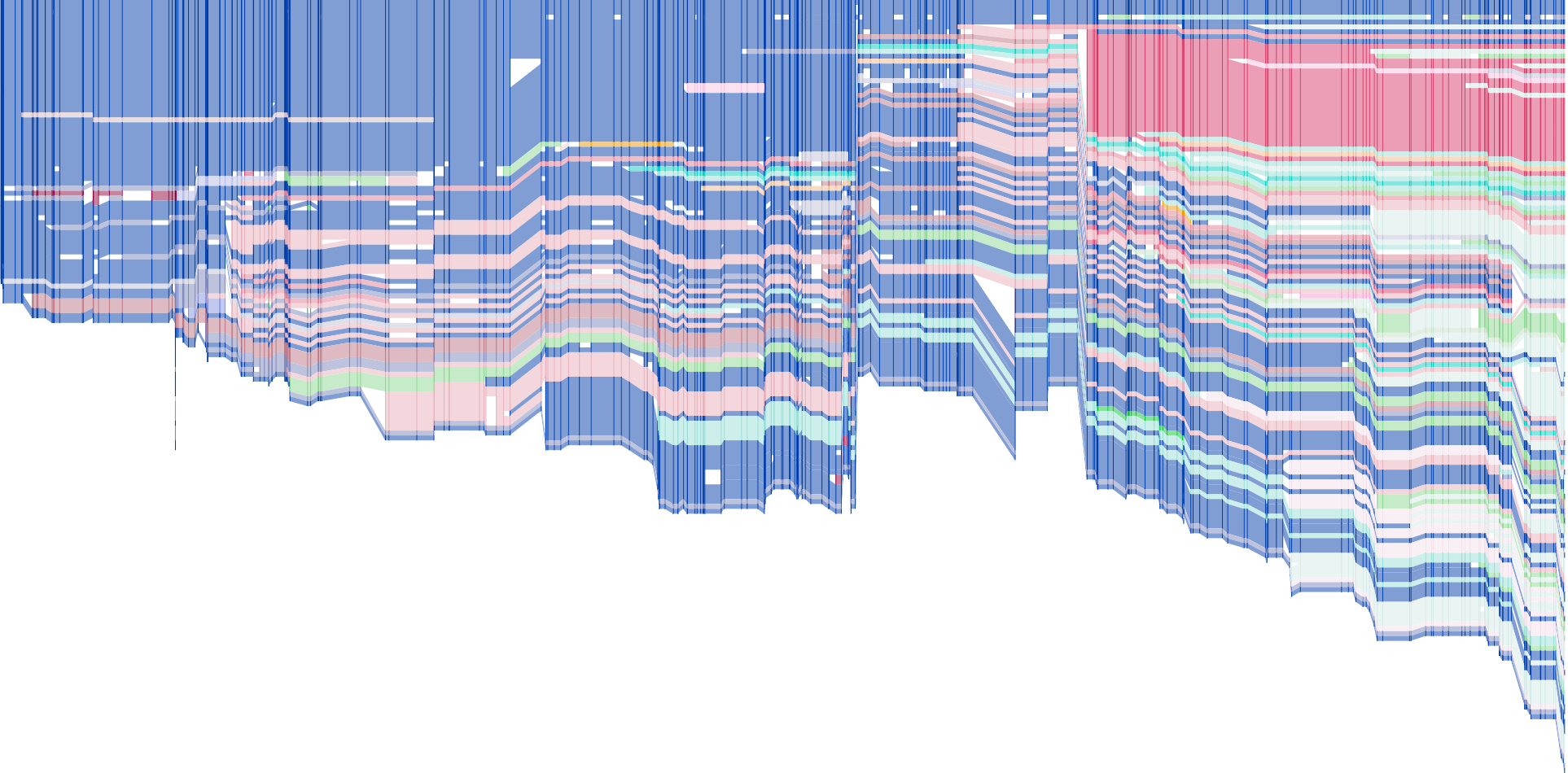
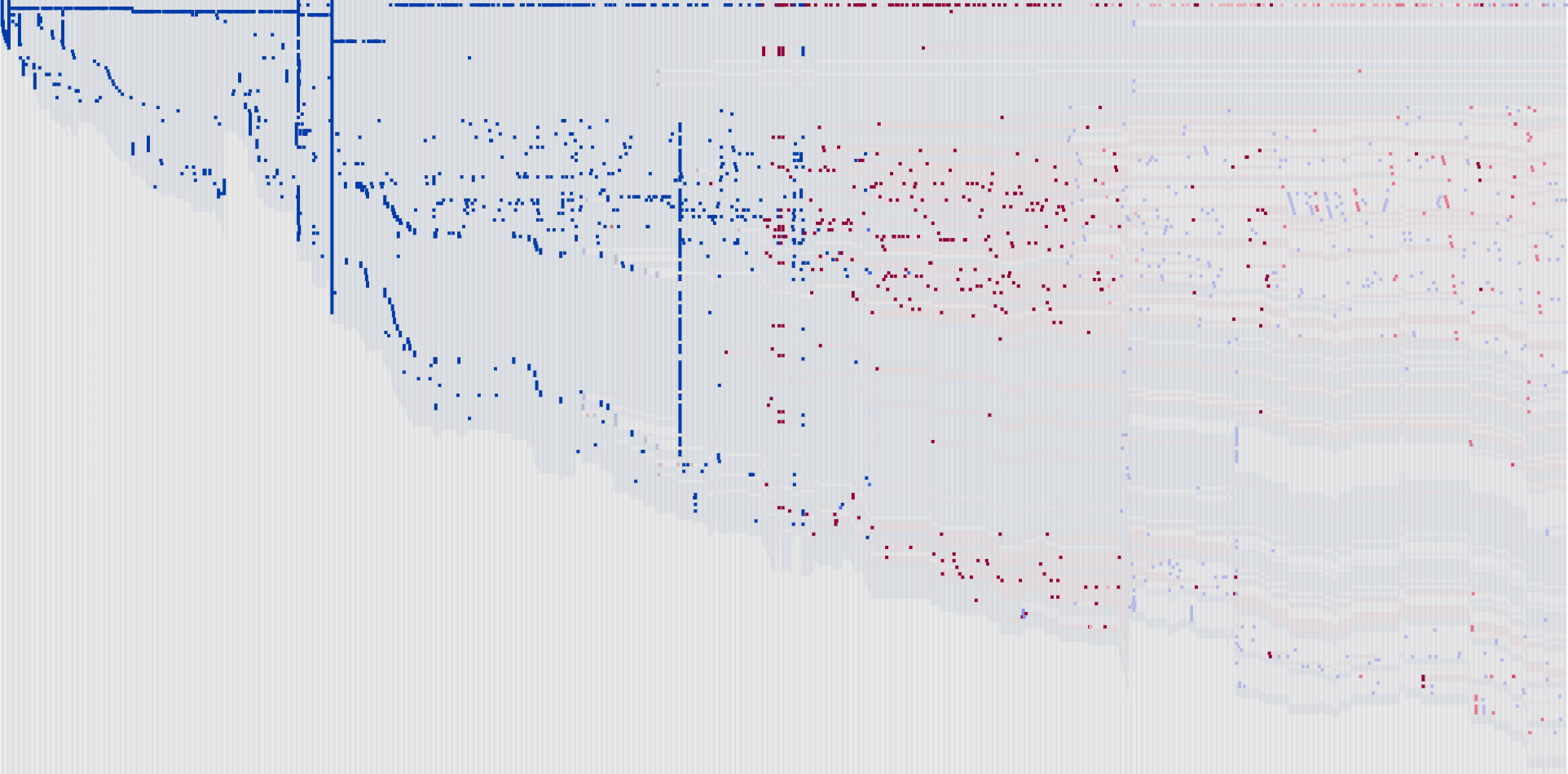
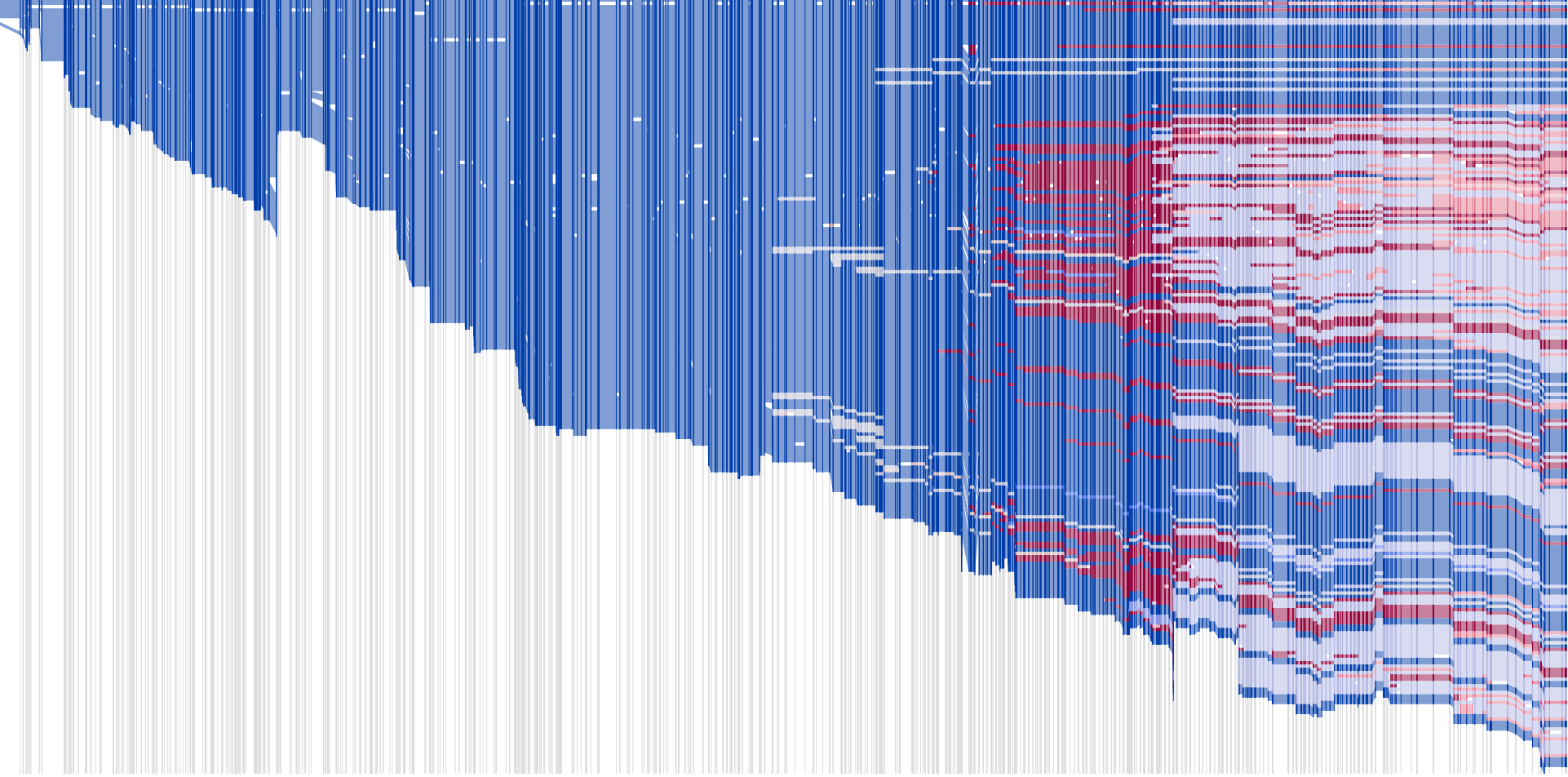
visualizing the editing history of Wikipedia pages
<figure> 
 <figcaption>history flow is a tool for visualizing dynamic, evolving documents and the interactions of multiple collaborating authors. In its current implementation, history flow is being used to visualize the evolutionary history of wiki* pages on Wikipedia. </figcaption>
</figure>
<figcaption>history flow is a tool for visualizing dynamic, evolving documents and the interactions of multiple collaborating authors. In its current implementation, history flow is being used to visualize the evolutionary history of wiki* pages on Wikipedia. </figcaption>
</figure>
-
-
blog.openreplay.com blog.openreplay.com
-
Instant Dates and Times
Temporal.Instantreturns an object representing a date and time to the nearest nanosecond according to an ISO 8601 formatted string:
-
-
blog.bitsrc.io blog.bitsrc.io
-
www.sliderrevolution.com www.sliderrevolution.com
-
<span>See the Pen Timeline Style Navigation by Naila Ahmad (@nailaahmad) on CodePen.</span>
<script async src="https://cpwebassets.codepen.io/assets/embed/ei.js"></script>
Tags
Annotators
URL
-
-
stackoverflow.com stackoverflow.com
-
gist.github.com gist.github.com
-
//getDates.js

// Returns an array of dates between the two dates
function getDates (startDate, endDate) {
  const dates = []
  let currentDate = startDate
  const addDays = function (days) {
    const date = new Date(this.valueOf())
    date.setDate(date.getDate() + days)
    return date
  }
  while (currentDate <= endDate) {
    dates.push(currentDate)
    currentDate = addDays.call(currentDate, 1)
  }
  return dates
}

// Usage
const dates = getDates(new Date(2013, 10, 22), new Date(2013, 11, 25))
dates.forEach(function (date) {
  console.log(date)
})
-
-
-
Abstract: [...] [The HTTP Memento protocol] lacks support for the management of data updated at high frequencies or the interactions during resource modification and only provides inefficient means for managing resources with many revisions. To address these shortcomings, we propose three extensions to the HTTP Memento protocol: arbitrary resolution timestamps, resource creation support and range requests for TimeMaps. We provide a reference implementation of our proposals as open source software and quantitatively evaluate the extensions’ performance, showcasing superior results in terms of resource capacity, insertion correctness, latency and amount of transferred data.
-
-
www.slideshare.net www.slideshare.net
Tags
Annotators
URL
-
-
datatracker.ietf.org datatracker.ietf.org
-
The Annodex annotation format for time-continuous bitstreams, Version 2.0 draft-pfeiffer-annodex-01
Abstract
This specification defines a file format for annotating and indexing time-continuous bitstreams for the World Wide Web. The format has been named "Annodex" for annotating and indexing. The Annodex format enables the specification of named anchor points in time-continuous bitstreams together with textual annotations and hyperlinks in URI [4] format. These anchor points are merged time-synchronously with the time-continuous bitstreams when authoring a file in Annodex format. The ultimate aim of the Annodex format is to enable an integration of time-continous bitstreams into the browsing and searching functionality of the World Wide Web.
-
-
twitter.com twitter.com
-
Dr Duncan Robertson. (2021, December 15). Cases on the dashboard exclude reinfections.And there are a lot of reinfections as far as Omicron is concerned h/t @AlistairHaimes and @Peston And this is only cases reported today—Not from infections today With a 2-day doubling time for Omicron, this isn’t great https://t.co/fU2RLhshtn [Tweet]. @Dr_D_Robertson. https://twitter.com/Dr_D_Robertson/status/1471156538681315336
-
-
www.nature.com www.nature.com
-
Replicating scientific results is tough—But essential. (2021). Nature, 600(7889), 359–360. https://doi.org/10.1038/d41586-021-03736-4
-
-
arxiv.org arxiv.org
-
Kan, U., Feng, M., & Porter, M. A. (2021). An Adaptive Bounded-Confidence Model of Opinion Dynamics on Networks. ArXiv:2112.05856 [Physics]. http://arxiv.org/abs/2112.05856
-
-
-
In her book Meaning in Life and Why it Matters (2010), the US philosopher Susan Wolf has argued, against Taylor, that even if Sisyphus is feeling fulfilled, owing to the nature of the activity in which he is engaged, his feeling fulfilled is not reasonable. She argues that the object of an agent’s feeling of fulfilment is represented in the mind of the agent as being something that is objectively good. In the case of Sisyphus, even if he is fulfilled, he misrepresents the source of his fulfilment as good. So Wolf argues that the meaningfulness of an activity or goal is a function not only of one’s being fulfilled in engaging in it/pursuing it, but the feeling of fulfilment also needs to be a fitting response to the activity or goal. And it is only a fitting response if the activity or goal is objectively pursuit-worthy. What would render an activity or goal objectively pursuit-worthy? Objective pursuit-worthiness is in part owing to the value of the end or activity coming from outside of oneself. Wolf admits that determining objective pursuit-worthiness is not easy, and involves a process of discovery. A possibility not explicitly endorsed by Wolf (but not rejected by her, either) is that an activity or goal is objectively pursuit-worthy if engaging in that activity is conducive to the cultivation of virtues. My suggestion is that, so long as an activity is generally conducive to developing character traits and intellectual traits that will enhance and not impede the flourishing of both an agent and those with whom they interact, it is objectively pursuit-worthy.
Intellectual and character growth holistically, in a positive manner. That is the objective worthiness of any task. These goals, must be outlined in any activity undertaken, and their worth must be scaled according to our own standards. Because time is limited, it serves us well to maximise the objective worthiness that we extract from any task/activity/job/career. Thus time frames must also be defined. A multifaceted growth mindset requires a constant reexamination of all these aspect- i.e.- objective worthiness and time frame. An unexamined life is not worth living, and this shall be applied ona daily basis. One must recognise where they lose time, fill those holes, and proceed to extract some meaning from it.
Tags
Annotators
URL
-
-
supabase.com supabase.com
-
This loop showcases a UI pattern that I think could be improved. There is an "edit" button visible, which opens the sidebar. The principles should more closely resemble the Hypothesis sidebar. Instead of requiring an explicit edit button which the user clicks, the editor should operate on object selections. Merely clicking any of the displayed values should select it, which should provide a handle to the underlying object, which should reveal the editor sidebar (with, ideally, the relevant field focused).
-
- Nov 2021
-
www.tensorflow.org www.tensorflow.org
-
Similarly, the Date Time column is very useful, but not in this string form. Start by converting it to seconds:
timestamp_s = date_time.map(pd.Timestamp.timestamp)and then create "Time of day" and "Time of year" signals:
day = 24*60*60 year = (365.2425)*day df['Day sin'] = np.sin(timestamp_s * (2 * np.pi / day)) df['Day cos'] = np.cos(timestamp_s * (2 * np.pi / day)) df['Year sin'] = np.sin(timestamp_s * (2 * np.pi / year)) df['Year cos'] = np.cos(timestamp_s * (2 * np.pi / year)) -
date_time = pd.to_datetime(df.pop('Date Time'), format='%d.%m.%Y %H:%M:%S')
Tags
Annotators
URL
-
-
docdrop.org docdrop.org
-
That's a picture of it in the background. And this organism has the special trick that we call "photosynthesis," the ability to go take energy from the sun and transform carbon dioxide into oxygen. And over the course of billions of years, so starting from two and a half billion years ago, little by little these bacteria spread across the planet 00:07:08 and converted all that carbon dioxide in the air into the oxygen that we now have. And it was a very slow process. First, they had to saturate the seas, then they had to saturate the oxygen that the earth would absorb, and only then, finally, could oxygen begin to build up in the atmosphere. So you see, just after about 900 million years ago, oxygen starts to build up in the atmosphere. And about 600 million years ago, something really amazing happens. 00:07:35 The ozone layer forms from the oxygen that has been released in the atmosphere. And it sounds like a small deal, like we talked about the ozone a couple decades ago, but it actually turns out that before the ozone layer existed, earth was not really able to sustain complex, multicellular life. We had single-celled organisms, we had a couple of simple, multicellular organisms, but we didn't really have anything like you or me. 00:07:59 And shortly after the ozone layer came into place, the earth was able to sustain complex multicellular life. There was a Cambrian explosion of life in the seas. And the first plants got onto land. In fact, there was actually no life on land ahead of that. Another way to see this is, this is kind of a chart of pretty much most of the animals that you guys are familiar with. 00:08:24 And right at the bottom in time is the formation of the ozone layer. Like nothing that you are familiar with today could exist without the contributions of these tiny organisms over those billions of years. And where are they now? Well actually, they never really left us. The direct descendants of the cyanobacteria were eventually captured by plants. And they're now called chloroplasts. 00:08:49 So this is a zoom-in of a plant leaf - and we probably ate some of these guys today - where tons of little chloroplasts are still trapped - contributing photosynthesis and making energy for the plants that continue to be the other half of our lungs on earth. And in this way, our breaths are very deeply united. Every out-breath is mirrored by the in-breath of a plant,
This would be nice to turn into a science lesson or to represent this in an experiential, participatory Deep Humanity BEing Journey. To do this, it would be important to elucidate the series of steps leading from one stated result to the next, showing how scientific methodology works to link the series of interconnected ideas together. Especially important is the science that glues everything together over deep time.
-
-
psyarxiv.com psyarxiv.com
-
Zubek, J., Ziembowicz, K., Pokropski, M., Gwiaździński, P., Denkiewicz, M., & Boros, A. (2021). Rhythms of the day: How electronic media and daily routines influence mood during COVID-19 pandemic. PsyArXiv. https://doi.org/10.31234/osf.io/czg27
-
-
0oo.li 0oo.li
-
A Human hour (HUR), denoted as ħ, here is defined as population-weighted all-countries average price of an hour (3600 SI seconds) of human labor in all economic sectors.
Tags
Annotators
URL
-
-
-
The type-fest package contains only types, meaning they are only used at compile-time and nothing is ever compiled into actual JavaScript code. This package contains functions that are compiled into JavaScript code and used at runtime.
-
- Oct 2021
-
www.medrxiv.org www.medrxiv.org
-
Follmann, D., & Fay, M. (2021). Vaccine Efficacy at a Point in Time (p. 2021.02.04.21251133). https://doi.org/10.1101/2021.02.04.21251133
-
-
Tags
Annotators
URL
-
-
www.science.org www.science.org
-
Pagel, C., & Yates, C. A. (2021). Tackling the pandemic with (biased) data. Science, 374(6566), 403–404. https://doi.org/10.1126/science.abi6602
-
-
imaginaxiom.com imaginaxiom.com
-
Time, energy, and matter
This article refers to the site I created to document the design process for the builders collective: time, energy, and matter, which redirects to timeenergyresources.com.
Tags
Annotators
URL
-
-
-
time as the new currency
Marilyn Waring
Time: The New Currency
Women tend to be excluded from the national economy because their work is not paid and therefore not value or factored into the Gross Domestic Product of a nation. Money, then, is a mechanism for disempowerment.
-
-
timeenergyresources.com timeenergyresources.com
-
If the Bauhaus existed today, what would it look like?
What would the Bauhaus do differently, learning from the mistakes of the past and how modernism was co-opted by neoliberal capitalism.
-
-
www.quantamagazine.org www.quantamagazine.org
-
General relativity implies that information gets destroyed; quantum theory says it’s preserved. Hence the paradox.
Isn't this an example of the law of the excluded middle? If LoEM doesn't exist (in Gisin's theory), then could there be information that isn't either created or destroyed?
-
-
futureofcoding.org futureofcoding.org
-
More directly about this gilded path through the tool. So, in an initial version of Sketch-n-Sketch and the version that we demoed at Strange Loop, there were many requirements about the syntactic structure of the program that if they weren’t satisfied certain interactions in the output would no longer be available. So a simple example is in that initial milestone, the main expression, the main definition of the program essentially had to be a list literal of shapes. And each of those shapes had to be a top level definition in your program and only then could certain interactions be available to users.
-
-
www.microsoft.com www.microsoft.com
-
We would prefer: stay within single host language, but make code lookas declarative as possible.
-
-
www.theverge.com www.theverge.com
-
Time Well Spent
Tristan Harris’ first big idea for the tech industry, the Time Well Spent movement, was an outsized success.
-
-
mriids.org mriids.orgMRIIDS1
-
MRIIDS. (n.d.). Retrieved September 6, 2021, from https://mriids.org/about
-
-
www.imperial.ac.uk www.imperial.ac.uk
-
Real-time Assessment of Community Transmission findings. (n.d.). Imperial College London. Retrieved August 18, 2021, from http://www.imperial.ac.uk/medicine/research-and-impact/groups/react-study/real-time-assessment-of-community-transmission-findings/
-
- Sep 2021
-
archive.org archive.org
Tags
Annotators
URL
-
-
two.compost.digital two.compost.digital
Tags
Annotators
URL
-
-
sakai.duke.edu sakai.duke.edu
-
Summary:
"What has time done to us?"
-
. . . the Nuer have no expression equivalent to "time" in our language, and they cannot, therefore, as we can, speak of time as though it were something actual, which passes, can be wasted, can be saved, and so forth. I do not think that they ever experience the same feeling of fighting against time or of having to co-ordinate activities with an abstract passage of time because their points of reference are mainly the activities themselves, which are generally of a leisurely character. Events follow a logical order, but they are not controlled by an abstract system, there being no autonomous points of reference to which activities have to conform with precision. Nuer are fortunate. 129 O
129 E. Evans-Pritchard, op. cit., p. 103.
-
em ? Puritanism, in its marriage of convenience with industrial capitalism, was the agent which converted men to new valuations of time; which taught children even in their infancy to improve each shining hour; and which saturated men's minds with the equation, time is money.128 O
-
ple". The Mexican mineworker had the custom of returning to his village for corn planting and harvest: His lack of initiative, inability to save, absences while celebrating too many holidays, willingness to work only three or four days a week if that paid for necessities, insatiable desire for alchohol - all were pointed out as proof of a natural inferiority. He
In the next paragraphs, it turns out that there isn't laziness, but misaligned incentives. The lifeways of the people involved were not those of the writer who jumped to conclusions about the people who were different from him.
In generalizations supported by another study of Mexican labour conditions, Wilbert Moore remarks: "Work is almost always task-orientated in non-industrial societies ... and ... it may be appropriate to tie wages to tasks and not directly to time in newly developing areas".
When comparing and contrasting cultures, empathy for each and their particular incentives must be taken into account.
This is particularly important as he's spent a dozen pages talking about how poorly the English dealt with industrialization over centuries themselves. How quickly we forget.
-
ethodists, the Evangelicals took up the theme. Hannah More contributed her own imperishable lines on "Early Rising": Thou silent murderer, Sloth, no more My mind imprison'd keep; Nor let me waste another hour With thee, thou felon Sleep.10
The number of quotes and passages here makes me wonder what his sources were and how he came to them?
Did he keep a commonplace book and collect references on time? Find them via other's or from published collections? The number and types of them, particularly in the non-technical literature he's citing makes me think that something like a commonplace pattern is being leveraged here.
-
? We should, perhaps, turn the problem around once again, and place it within the evolution of the Puritan ethic.
This immediately brings to mind Max Webber, but before thinking about that,
What about the overall discussion of the relation of time to Christianity in general. Early Christians practiced eschatology and were concerned with the imminent end of the world. How has that affected our relationship with time?
Even the rise of health care has dramatically extended our lives, thus making time a bit less valuable overall, but have we seen that effect psychologically?
-
ty".88 William Temple, when advocating, in 1770, that poor children be sent at the age of four to work-houses where they should be employed in manufactures and given two hours' schooling a day, was explicit about the socializing influence of the process: There is considerable use in their being, somehow or other, constantly employed at least twelve hours a day, whether they earn their living or not; for by these means, we hope that the rising generation will be so habituated to constant employment that it would at length prove agreeable and entertain- ing to them .... .9
Of course now the pendulum, for at least some, has swung the other direction and we now talk about over-scheduling our children.
-
mill dam, attending a Baptist association and a public hanging.56 This general irregularity must be placed within the irregular cycle of the working week (and indeed of the working year) which provoked so much lament from moralists and mercantilists in the seventeenth and eighteenth centu
The irregularity of the work day of the common people in the 17th and 18th centuries ran counter to the desires of both moralists and mercantilists.
What might this tension tell us about both power structures both then and today?
While specialization since that time has increased the value of goods we produce, does it help in the value of our lives and happiness?
-
e task. Attention to time in labour depends in large degree upon the need for the synchronization of labour. But in so far as manufacturing industry remained c
We attend to time in large measure as a need to be able to synchronize our work.
-
the timepiece was the poor man's bank, an investment of savings: it could, in bad times, be sold or put in hock.51 "This 'ere ticker", said one Cockney compositor in the I820S, "cost me but a five-pun note ven I bort it fust, and I've popped it more than twenty times, and had more than forty poun' on it altogether. It's a garjian haingel to a fellar, is a good votch, ven you're hard up".52 Whenever any group of workers passed into a phase of improving liv
Early example of a watching being a store of value and credit.
-
paid urban artisan. Recorded time (one suspects) belonged in the mid-century still to the gentry, the masters, the farmers and the tradesmen; and perhaps the intricacy of design, and the preference for precious metal, were in deliberate accentuation of their symbolism of status
Recall that we measure what we find important. This fashion of timekeeping was a tool for wielding power over others to acquire wealth.
-
Atkins and Overall, op. cit., pp. 302, 308 - estimating (excessively?) 25,000 gold and io,ooo silver watches imported, mostly illegally, per annum; and Anon., Observations on the Art and Trade of Clock and Watchmaking (London, 1812), pp. 16-20.
He mentions earlier that decorated timepieces were more valuable/common than accurate ones. This begins to put timepieces into the area of fashion rather than function. Perhaps there wasn't yet need for more accuracy, but the fact that watches were being made of gold and silver shows a market need for the fashion over function. Was there a market for simpler steel or cheaper metal watches at this time?
-
Thus John Harrison, clock-maker and former carpenter of Barton-on-Humber (Lincs.), perfected a marine chronometer, and in 1730 could claim to have brought a Clock to go nearer the truth, than can be well imagin'd, considering the vast Number of seconds of Time there is in a Month, in which space of time it does not vary above one second . . I am sure I can bring it to the nicety of 2 or 3 seconds in a year.
State of the art of timepieces in 1730.
Could be interesting to see a graph of accuracy of timekeeping over time.
-
A great advance in the accuracy of household clocks came with the application of the pendulum after 1658. Grandfather clocks begin to spread more widely from the I66os, but clocks with minute hands (as well as hour hands) only became common well after th
this time.
-
Voice is lost
Can we, like Shepherds, tell a merry Tale? Stephen Duck, The Thresher's Tale (poem)
There's a link here to shepherds and a bardic tradition. In some sense, shepherds have lots of time to kill during the day and thus potentially tell stories. But they're also moving around their environment which also makes it easier for them to have used songline-like methods for attaching their memories to their environment.
How far back might this tradition go in our literate culture?
I also wonder at the influence of time on oral traditions as the result of this. Lynne Kelly describes calendrical devices in a variety of indigenous settings in Knowledge and Power in Prehistoric Societies for potential use in annual spaced repetition. What about the spaced repetition within daily cycles of regular work as described in this paper with respect to shepherds, fishing communities, and crofting?
The daily cycle of life may have been a part of the spaced repetition for memory.
How might we show this?
A quick example that comes to mind is the French children's song Alouette, Gentille Alouette which details how one kills, cleans, and dresses a chicken for cooking.
-
nt. Time is now currency: it is not passed but spe
Time is now currency: it is not passed but spent.
Some of this essay shows the change in conceptualization of time and its use. Identifying it as currency certainly happened over time.
What else might we equate with time besides money? Happiness instead? Measure it in leisure instead of solely by capitalism?
-
. Three points may be proposed about task-orientation. First, there is a sense in which it is more humanly comprehensible than timed labour. The peasant or labourer appears to attend upon what is an observed necessity. Second, a community in which task-orientation is common appears to show least demarcation between "work" and "life". Social intercourse and labour are intermingled - the working-day lengthens or contracts according to the task - and there is no great sense of conflict between labour and "passing the time of day". Third, to men accustomed to labour timed by the clock, this attitude to labour appears to be wasteful and lacking in urgency.1
-
e Nandi an
Among the Nandi an occupational definition of time evolved covering not only each hour but half hours of the day.
This reminds me of hearing attorneys journaling their day down to 7 1/2 minute increments for billing their clients.
But based on science and with computers, we're now able to discriminate things down to the time it takes atoms to vibrate and we can date and timestamp things in our worklives to the nth degree. Even this post will have a timestamp on it down to the thousandth of a second.
-
J. M. Synge, Plays, Poems, and Prose (Everyman edn., London, 1941), p. 257
Curious that he quotes the writer Synge here or even that this is something Synge would have written.
I like the idea that a culture would have been able to keep time based on the direction of the wind.
-
oud. In Burma in recent times monks rose at daybreak "when there is light enough to see the veins in the hand".'
An interesting definition of daybreak. Our current definitions of daybreak are not too dissimilar.
-
als. In Madagascar time might be measured by "a rice-cooking" (about half an hour) or "the frying of a locust" (a moment).
-
nabled Tristram to date his conception very exactly. It also provoked The Clockmaker's Outcry against the Author: The directions I had for making several clocks for the country are counter- manded; because no modest lady now dares to mention a word about winding- up a clock, without exposing herself to the sly leers and jokes of the family ... Nay, the common expression of street-walkers is, "Sir, will you have your clock wound up
It also provoked The Clockmaker's Outcry against the author:
[...] Nay, the common expression of street-walkers is, "Sir, will you have your clock wound up?"
I've actually heard the euphemism clock in a sexual setting in my youth, but never heard the origin. This is the likely source. It's been 20 years or more since I've heard this in common speech though.
-
The conventional Elizabethan images
The conventional Elizabethan images of time as a devourer, a defacer, a bloody tyrant, a scytheman, are old enough, but there is a new immediacy and insistence.
-
clocks from the fourteenth century onwards, how far this was itself a symptom of a new Puritan discipline and bourgeois exac
I do not wish to argue how far the change was due to the spread of clocks from the fourteenth century onwards, how far this was itself a symptom of a new Puritan discipline and bourgeois exactitude.
For some history of the importance of time with relation to naval navigation and trade, see: Sobel, Dava (1995). Longitude: The True Story of a Lone Genius Who Solved the Greatest Scientific Problem of His Time. New York: Walker and Company.
Tags
- leisure
- measurement
- time
- time management
- racist ideas
- daybreak
- euphemisms
- quote
- racist policies
- eschatology
- productivity
- memory
- fashion
- journaling
- wind
- attorneys
- light
- industrialization
- labor
- socialization
- spaced repetition
- conflict
- Puritanism
- euphemism
- clocks
- pawn shops
- Nandi
- education
- Dava Sobel
- etymology
- overscheduling
- timekeeping
- health care
- analogies
- value
- children
- poetry
- Industrial Revolution
- incentives
- songlines
- bardic tradition
- navigation
- cultural anthropology
- read
- specialization
- power
- J.M. Synge
- commonplace books
- anthropology
- pendulum
- economics
- historical linguistics
- John Harrison
- Nuer
- method of loci
- shepherds
- history
- Christianity
- propaganda of time-thrift
- time is money
- the longitude problem
- happiness
- sleep
- quotes
- longitude
- human resources
- watches
- storytelling
- money
- E. Evans-Pritchard
- laziness
Annotators
URL
-
-
www.theguardian.com www.theguardian.com
-
Ratson and Ben-Dov found that the scroll lays out the most important dates in the Qumran sect’s 364-day calendar, including the festivals of New Wine and New Oil, which are not mentioned in the Bible. It also reveals for the first time the name given to the special days on which the sect would celebrate the transition between seasons, four times a year. The days were referred to as “Tekufah”, which translates as “period”.
Given their focus on dates and calendars, what other evidence of mnemonic traditions might we draw from a culture that was likely near the transition from oral to written transmission?
Would they have had standing stones, stone circles, handheld mnemonic devices?
-
-
www.frontiersin.org www.frontiersin.org
-
Droit-Volet, S., Martinelli, N., Chevalère, J., Belletier, C., Dezecache, G., Gil, S., & Huguet, P. (2021). The Persistence of Slowed Time Experience During the COVID-19 Pandemic: Two Longitudinal Studies in France. Frontiers in Psychology, 12, 3656. https://doi.org/10.3389/fpsyg.2021.721716
-
-
thecultures.libsyn.com thecultures.libsyn.com
-
Data Sabbath
Surfing around on other topics and came across the suggestion of a "data Sabbath" which suggests taking a day off of screens, social media, etc. What a nice little framing.
-
- Aug 2021
-
www.timeanddate.com www.timeanddate.com
-
In everyday usage, MST is often referred to as Mountain Time (MT) or the Mountain Time Zone. This can add a bit of confusion as the term Mountain Time does not differentiate between standard time and Daylight Saving Time, so Mountain Time switches between MST and MDT in areas that use DST during part of the year.
-
Some areas in British Coloumbia, including Creston, Fort Nelson, Fort St. John, and Dawson Creek use Mountain Standard Time all year.
-
Most North American time zones also have generic terms, including Pacific Time (PT), Central Time (CT), Eastern Time (ET), and Atlantic Time (AT).
-
-
charlypoly.com charlypoly.com
-
Introduced in the perfectly named “Typescript and validations at runtime boundaries” article @lorefnon, io-ts is an active library that aim to solve the same problem as Spicery:TypeScript compatible runtime type system for IO decoding/encoding
io-ts
-
It means that when having a type guard:TypeScript and JavaScript runtime are tied to the same behaviour.
-
Inside the if statement, TypeScript will assume that amount cannot be anything else than a string, which is true also at the runtime thanks to typeof JavaScript operator.
-
-
fqxi.org fqxi.org
Tags
Annotators
URL
-
-
brill.com brill.com
Tags
Annotators
URL
-
-
zero.sci-hub.se zero.sci-hub.se
-
While it is clear that technologies of communication change societiesand permit different forms of human organization, it is not clear that theychange the basic human thought processes embedded in language. The humanbrain does adapt differently to different technologies (recall the differences inbrain wiring between readers of ideograms and of phonetic alphabets), butthe evidence to date indicates the human brain adapts in order to translateinformation into language, so as to exchange information and permit concertedaction with others with whom we communicate. This concerted action is nolonger, as at the dawn of language, action undertaken by people in close contactbut rather is activity undertaken because of reliance upon expectations storedin individual and social memory.
-
-
sci-hub.se sci-hub.se
-
web.archive.org web.archive.org
-
-
ugust 14, 2021, rain was observed at the highest point on the Greenland Ice Sheet for several hours, and air temperatures remained above freezing for about nine hours. This was the third time in less than a decade, and the latest date in the year on record, that the National Science Foundation’s Summit Station had above-freezing temperatures and wet snow. There is no previous report of rainfall at this location (72.58°N 38.46°W), which reaches 3,216 meters (10,551 feet) in elevation. Earlier melt events in the instrumental record occurred in 1995, 2012, and 2019; prior to those events, melting is inferred from ice cores to have been absent since an event in the late 1800s
-
-
www.rbb24.de www.rbb24.de
-
Seit Montag dürfen die Berliner Friseursalons wieder öffnen. Da diese unter einem anderen Paragraphen erfasst sind als die körpernahen Dienstleistungen, trifft die Testpflicht für Mitarbeiter hier nicht zu.
§ 17 (1) S. 1, 2 2. InfSchMV
-
Die Beschränkung der Bewegungsfreiheit, die sogenannte 15-Kilometer-Regel, bei hohen Inzidenzen fällt weg.
§ 2 (1a) 2. InfSchMV
-
-
twitter.com twitter.com
-
Seth Trueger. (2021, August 3). Time lapse of community prevelence from 7/1 to 8/1 https://t.co/mPomRzshLG [Tweet]. @MDaware. https://twitter.com/MDaware/status/1422649454293835778
-
-
api.rubyonrails.org api.rubyonrails.org
Tags
Annotators
URL
-
-
developer.mozilla.org developer.mozilla.org
-
Intl.DateTimeFormat().resolvedOptions().timeZone
-
-
momentjs.com momentjs.com
-
-
blog.logrocket.com blog.logrocket.com
-
Intl.DateTimeFormat().resolvedOptions().timeZone
-
- Jul 2021
-
twitter.com twitter.com
-
Hiroki Sayama. (2021, May 28). Weekly update This will be the last US domestic visualization Details -> https://github.com/hsayama/COVID-19-geographical-animations https://t.co/Mz23MDaa6l [Tweet]. @HirokiSayama. https://twitter.com/HirokiSayama/status/1398344774843781128
-
-
delong.typepad.com delong.typepad.com
-
Thus we can roughly define what we mean by the art of reading as follows: the process whereby a mind, with nothing to operate on but the symbols of the readable matter, and with no help from outside, 0 elevates itself by the power of its own operations. The mind passes from understanding less to understanding more. The skilled operations that cause this to happen are the various acts that constitute the art of reading.
I'm not sure I agree with this perspective of not necessarily asking for outside help.
What if the author is at fault for not communicating properly or leaving things too obscure? Is this the exception of which he speaks?
What if the author isn't properly contextualizing all the necessary information to the reader? This can be a particular problem when writing history across large spans of both time and culture or even language.
-
-
psyarxiv.com psyarxiv.com
-
Hartshorne, J. K. (2021). Just give them childcare: The COVID-19 pandemic as a natural experiment in parenting practices [Preprint]. PsyArXiv. https://doi.org/10.31234/osf.io/r64hf
-
-
-
Publication Dates are not important to Digital Gardeners. Posts are connected via references or common themes.
I would argue against this. Many digital gardeners use publication dates and even last updated dates on their posts. Time in particular can be an incredibly important datum with regard to providing useful context to one's content.
-
-
twitter.com twitter.com
-
Leah McElrath 🏳️🌈. (2021, July 12). One reason the right-wing outrage machine is focused on attacking Biden’s plan for door-to door outreach isn’t because they actually fear confiscation of guns or Bibles. It’s because they don’t want poor people to have access to life-saving vaccinations. Https://t.co/GnZMmlBfqK [Tweet]. @leahmcelrath. https://twitter.com/leahmcelrath/status/1414660179061264388
-
-
www.dekudeals.com www.dekudeals.com
-
you must explore the counter-intuitive possibilities time travel permits. You will learn to choreograph your actions across multiple timelines, and to construct seemingly impossible solutions, such as paradoxical time loops, where the future depends on the past and the past depends on the future.
Tags
Annotators
URL
-
-
yaleclimateconnections.org yaleclimateconnections.org
-
www.matthewball.vc www.matthewball.vc
-
reduce the production time
Promotes economies of scale- cost advantage due to the scale of operation. As the cost per unit of output decreasing it causes the scale to increase.
-
-
www.migrationencounters.org www.migrationencounters.org
-
Claudia: How long did you live in the States?Yosell: Let's see, about 24 years. Out here in Mexico, I've probably been here for like a year and a half. Just barely, I guess.Claudia: What was it like coming back to Mexico? You said you made the decision on your own?Yosell: Yeah, I mean, I already did know about it just a little bit, so it wasn't too bad. It was just basically like Los Angeles, it's the same thing, really. Just the differences, the corruption out here, and how people treat you. I would probably walk down the street, and I would always get a dirty look or something. I'd always get checked by the cops here, that's a constant thing for me.
Reflections
Tags
Annotators
URL
-
-
www.berlin.de www.berlin.de
-
Seit 01. Juli 2021 besteht keine Homeoffice-Pflicht mehr.
Tags
Annotators
URL
-
-
ayjay.org ayjay.org
-
After a good deal of reflection and consultation with my family, I have decided that (aside from pre-existing commitments, of which I have a few) I will no longer give lectures or participate in conferences, whether in person or via video link. I have a great deal that I want to think about and write about, and a dwindling supply of time in which to pursue the tasks I care about most. I understand that this decision might limit sales of my books, and make me even more isolated and ignored than I am already. That’s a trade-off that I simply must make. I feel sure that this is the right thing to do; indeed, the necessary thing to do. I hope that the work I produce in the future will bear out that judgment.
An interesting take on valuing one's time.
-
-
www.morgenpost.de www.morgenpost.de
-
Bereits im März war das Besuchsrecht in Krankenhäusern und Pflegeheimen der Hauptstadt stark eingeschränkt worden.
-
- Jun 2021
-
hypothes.is hypothes.is
-
"Many North American music education programs exclude in vast numbers students who do not embody Euroamerican ideals. One way to begin making music education programs more socially just is to make them more inclusive. For that to happen, we need to develop programs that actively take the standpoint of the least advantaged, and work toward a common good that seeks to undermine hierarchies of advantage and disadvantage. And that, inturn, requires the ability to discuss race directly and meaningfully. Such discussions afford valuable opportunities to confront and evaluate the practical consequences of our actions as music educators. It is only through such conversations, Connell argues, that we come to understand “the real relationships and processes that generate advantage and disadvantage”(p. 125). Unfortunately, these are also conversations many white educators find uncomfortable and prefer to avoid."
Tags
Annotators
URL
-
-
-
www.gesundheitsstadt-berlin.de www.gesundheitsstadt-berlin.de
-
Arbeitgeber müssen mehr Home-Office-Arbeitsplätze schaffen
-
-
-
Demnach sind bis Ende Juli Events mit maximal 300 Menschen erlaubt. Am 1. August erhöht sich diese Zahl auf 500, am 1. September auf 750, am 1. Oktober auf 1000 – immer unter Wahrung der Abstands- und Hygieneregeln.
-
Nach dem Beschluss gibt es künftig vor allem keine Kontaktverbote mehr: Durften sich bislang nur maximal fünf Personen oder Angehörige zweier Haushalte treffen, so gilt diese Einschränkung nun nicht mehr.
-
-
www.berliner-zeitung.de www.berliner-zeitung.de
-
Bisher galt die Sperre ab 23 Uhr.
-
-
www.tagesspiegel.de www.tagesspiegel.de
-
Gute Nachrichten auch für die Abschlussklassen in Berlin: Abifeiern dürfen wieder stattfinden, genauso Abschlussfeiern von Berufsausbildungen.
-
Im privaten Bereich bleiben die alten Regeln vorerst bestehen
-
Kneipen, Restaurants und Spätis dürfen nachts, also zwischen 0 und 5 Uhr wieder Alkohol ausschenken. Das nächtliche Verkaufsverbot entfällt.
-
-
www.theguardian.com www.theguardian.com
-
the Guardian. ‘TUC Says Covid Vaccine Efforts Hindered by Lack of Paid Time off for Jab’, 22 March 2021. http://www.theguardian.com/politics/2021/mar/22/tuc-says-covid-vaccine-efforts-hindered-by-lack-of-paid-time-off-for-jab.
-
-
-
Betroffene dürfen demzufolge ohne vorherigen Corona-Test auch abseits des Lebensmittelhandels Einkaufen gehen, einen Friseur oder Kosmetiksalon, ein Museum oder eine Ausstellung besuchen. Greifen soll die Regelung 15 Tage nach der Zweitimpfung.
-
-
www.berliner-zeitung.de www.berliner-zeitung.de
-
Gültigkeit von Test-Bestätigungen:Bisher musste zum Beispiel in Geschäften oder Museen ein tagesaktuelles negatives Testergebnis vorgelegt werden.
-
Corona-Lockdown bis 9. Mai verlängert:Die übrigen bisher schon geltenden Corona-Maßnahmen werden bis zum 9. Mai verlängert. Die bisherige Verordnung war bis Sonntag (18.4.) befristet.
-
Kontaktbeschärnkungen:Damit gelten zum Beispiel Kontaktbeschränkungen weiter.
-
Das war bisher nicht geregelt.
-
Zuvor galt für die Kinder ein Höchstalter von 12 Jahren, ab Samstag sind es 14 Jahre.
-
-
www.berlin.de www.berlin.de
-
Bereits seit Freitag dürfen sich Menschen im Freien nachts zwischen 21.00 und 05.00 Uhr nur noch alleine oder zweit aufhalten.
-
-
arxiv.org arxiv.org
-
Reis, E. F. dos, & Masuda, N. (2021). Metapopulation models imply non-Poissonian statistics of interevent times. ArXiv:2106.10348 [Physics]. http://arxiv.org/abs/2106.10348
-
-
arxiv.org arxiv.org
-
Landry, N. (2021). The effect of time-dependent infectiousness on epidemic dynamics. ArXiv:2106.10384 [Physics, q-Bio]. http://arxiv.org/abs/2106.10384
-
-
www.bz-berlin.de www.bz-berlin.de
-
Restaurants, Bars, Theater, Kinos müssen im November schließen.
-
Und nur zwei Haushalte dürfen sich dann (ab 2. November) noch treffen, maximal zehn Personen.
-
Ab kommender Woche gelten strengere Corona-Regeln: Nur noch zwei Haushalte dürfen sich dann treffen.
-
-
mitvergnuegen.com mitvergnuegen.com
-
Anders als im März, sollen Besuche in Krankenhäusern und Pflegeheimen aber nicht generell untersagt werden, damit keine soziale Isolation herrsche.
-
Den kompletten November und mindestens bis zum 20. Dezember 2020 bleiben Events, Vorstellungen und größere Zusammenkünfte untersagt.
-
Auf jeder Straße, in der Einzelhandel und Handwerksbetriebe ansässig sind, gilt ab 01. Dezember Maskenpflicht. Bislang galt eine solche Pflicht in öffentlichen Verkehrsmitteln und Bahnhöfen, in Büros, im Einzelhandel und Supermärkten, aber auch vor Einkaufsmärkten sowie an belebteren Orten wie beispielsweise Parkplätzen. Auch Wochen-, Floh- und Weihnachtsmärkte gehören dazu, unerheblich, in welcher Form diese stattfinden.
-
Stand jetzt dürfen sich in Berlin auch über Weihnachten und Silvester, also vom 23. Dezember 2020 bis zum 01. Januar 2021, wie bisher maximal 5 Personen aus 2 Haushalten treffen. Von der Zahl der Einzelpersonen sind dabei Kinder bis 12 Jahre explizit ausgenommen.
-
-
www.morgenpost.de www.morgenpost.de
-
Über die Feiertage dürfen sich maximal fünf Personen zu privaten Zusammenkünften treffen, Kinder im Alter bis 14 Jahren nicht mitgerechnet.
-
Bisher gilt eine Obergrenze von zehn Personen.
-
-
www.express.de www.express.de
-
Bundesweit werden ab 2. November bis Ende des Monats Freizeiteinrichtungen und Gastronomie geschlossen, Unterhaltungsveranstaltungen verboten und Kontakte in der Öffentlichkeit sowie Feiern auf Plätzen und in Wohnungen müssen eingeschränkt werden.
-
-
www.bz-berlin.de www.bz-berlin.de
-
Wegen des Wiederanstiegs der Corona-Neuinfektionen in Berlin sollen ab Samstag Besuchsregeln für die Krankenhäuser in der Stadt gelten.
-
-
www.morgenpost.de www.morgenpost.de
-
Der Senat hat beschlossen, dass bei privaten Feiern im Freien künftig eine maximale Zahl von 50 Teilnehmern gelten soll
-
Die Abstandsregel von 1,50 Meter muss in den Schulen nicht mehr eingehalten werden
-
Für Demonstrationen gilt keine Begrenzung der Teilnehmerzahl mehr
-
Künftig gilt die Maskenpflicht auch für Wochenmärkte, bestimmte Einkaufsstraßen und Warteschlangen gelten, in denen der Mindestabstand von 1,5 Metern nicht einzuhalten ist.
-
-
-
the last thirty years
1950-1980, roughly.
-
-
www.rbb24.de www.rbb24.de
-
Anders als die Hotels mussten Kneipen und Gaststätten ab Mitte März komplett schließen und damit fast vollständig auf Umsätze verzichten. Erst nach zwei Monaten durften Restaurants Mitte Mai wieder öffnen, Kneipen ab dem 2. Juni.
-
Bisher müssen in Gaststätten die Stühle so stehen, dass zwischen den Gästen ein Mindestabstand von 1,5 Metern eingehalten wird. Ausnahmen gelten für Ehe- und Lebenspartner und Angehörige des eigenen Haushalts - mit Arbeitskollegen und Bekannten wird das vertraute Gespräch über den Tisch hinweg dagegen manchmal schwierig.
-
Die bisher wegen der Corona-Pandemie geltenden Abstandsregeln in Gaststätten werden in Berlin gelockert.
-
Nach Monaten des Abstands in Gaststätten dürfen Berliner Gäste wieder enger am Tisch zusammenrücken.
-
-
www.tagesspiegel.de www.tagesspiegel.de
-
Seit Sonntag dürfen Cafés und Restaurants auch tagsüber nicht mehr öffnen. Bisher konnten Restaurants von 6 bis 18 Uhr öffnen, nicht aber am Abend.
-
-
www.berlin.de www.berlin.de
-
Das Kontaktverbot gilt zunächst bis zum 5. April 2020.
-
Eine Ausgangssperre gibt es in der Hauptstadt noch nicht.
-
-
www.rbb24.de www.rbb24.de
-
Seit Beginn des bundesweiten Lockdowns Mitte Dezember sind auch in Berlin große Teile des Einzelhandels mit Ausnahme etwa von Supermärkten, Drogerien oder Apotheken geschlossen. Restaurants, Museen, Kinos, Theater, Freizeit- und Sporteinrichtungen sind schon seit Anfang November für das Publikum zu.
-
Zuvor war nur eine haushaltsfremde Person erlaubt.
-
-
-
Haben Geschäfte über Ostern geöffnet?Ja, wie üblich bis einschließlich Gründonnerstag und am Karsamstag.
-