737 Matching Annotations
  1. Feb 2022
    1. Claudia Kemfert geht in diesem auch sonst sehr hörenswerten Podcast ausführlich darauf ein, dass sich Deutschland in eine selbstverschuldete Abhängigkeit von russischen Gaslieferungen gebracht hat. Dabei haben sie selbst und andere über Jahren in Gutachten gezeigt, dass es ökologisch und politisch bessere Alternativen zu den Gaspipelines aus Russland gab. Man muss daraus den Schluss ziehen, dass sich hier Kräfte durchgesetzt haben, in deren Interesse die Abhängigkeit von den Fossilbrennstoffen aus Russland ist—eine Koalition aus russischen Oligarchen und ihren Verbündeten in Deutschland.

    1. “When I moved to Kansas,” Roberts said, “I was like, ‘holy shit, they’re giving stuff away.’”

      This sounds great, but what are the "costs" on the other side? How does one balance out the economics of this sort of housing situation versus amenities supplied by a community in terms of culture, health, health care, interaction, etc.? Is there a maximum on a curve to be found here? Certainly in some places one is going to overpay for this basket of goods (perhaps San Francisco?) where in others one may underpay. Does it have anything to do with the lifecycle of cities and their governments? If so, how much?

  2. Jan 2022
  3. notesfromasmallpress.substack.com notesfromasmallpress.substack.com
    1. If booksellers like to blame publishers for books not being available, publishers like to blame printers for being backed up. Who do printers blame? The paper mill, of course.

      The problem with capitalism is that in times of fecundity things can seem to magically work so incredibly well because so much of the system is hidden, yet when problems arise so much becomes much more obvious.

      Unseen during fecundity is the amount of waste and damage done to our environments and places we live. Unseen are the interconnections and the reliances we make on our environment and each other.

      There is certainly a longer essay hiding in this idea.

  4. Dec 2021
  5. Nov 2021
    1. Like, the world I came to is exactly the same as the world that I left. But what you wouldn't have understood is that every breath that you took contributed to the possibility of countless lives after you - lives that you would never see, lives that we are all a part of today. And it's worth thinking that maybe the meaning of our lives are actually not even within the scope of our understanding.

      This is a profound observation that shows how our collective species death over deep history shapes the universe. From a first person experience of reality, however, does it makes us feel that the universe is intimate? The universe is a grand dance and we are part of that dance. Ernest Becker's Mortality Salience looms large. How do we feel meaningful in the face of our mortality? How do we alleviate the perennial meaning crisis?

    1. Poultry scientists have also succeeded in selecting for parthenogenesis, increasing the incidence in Beltsville small white turkeys more than threefold, to 41.5 percent in five generations. Environmental factors—like high temperatures or a viral infection—also seem to trigger poultry parthenogenesis.

      Parthenogenesis can be selected for in breeding.

      What might this look like in other animal models. What do the long term effects of such high percentages potentially look like?

      Could this be a tool for guarding against rising temperatures in the looming climate crisis?

    1. What Morton means by “the end of the world” is that a world view is passing away. The passing of this world view means that there is no “world” anymore. There’s just an infinite expanse of objects, which have as much power to determine us as we have to determine them. Part of the work of confronting strange strangeness is therefore grappling with fear, sadness, powerlessness, grief, despair. “Somewhere, a bird is singing and clouds pass overhead,” Morton writes, in “Being Ecological,” from 2018. “You stop reading this book and look around you. You don’t have to be ecological. Because you are ecological.” It’s a winsome and terrifying idea. Learning to see oneself as an object among objects is destabilizing—like learning “to navigate through a bad dream.” In many ways, Morton’s project is not philosophical but therapeutic. They have been trying to prepare themselves for the seismic shifts that are coming as the world we thought we knew transforms.

      We are suffering through a meaning crisis due to the huge impacts humanity has had on the planet. As a result, destabilization is happening exponentially as nature blows back to us.Morton's brutal honesty doesn't leave us with many places to hide. We have to confront what we have collectively created.

  6. Oct 2021
    1. Academia: All the Lies: What Went Wrong in the University Model and What Will Come in its Place

      “Students are graduating into a brutal job market.”

      The entreprecariat is designed for learned helplessness (social: individualism), trained incapacities (economic: specialization), and bureaucratic intransigence (political: authoritarianism).


      The Design Problem

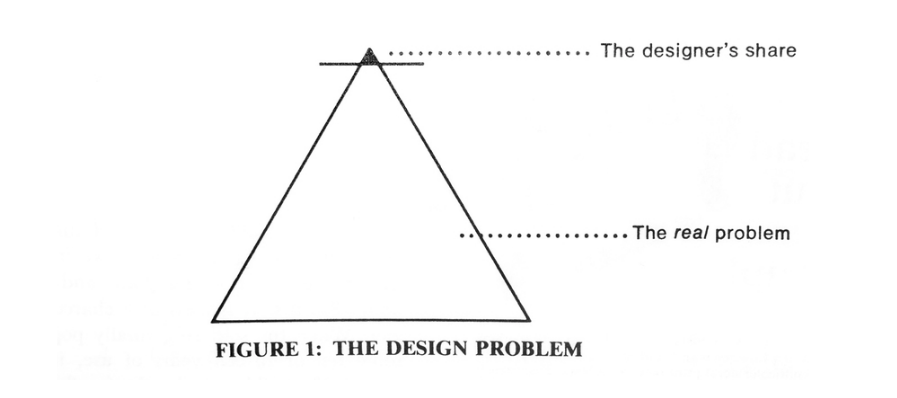
      Three diagrams will explain the lack of social engagement in design. If (in Figure 1) we equate the triangle with a design problem, we readily see that industry and its designers are concerned only with the tiny top portion, without addressing themselves to real needs.

      Figure 1: The Design Problem

      (Design for the Real World, 2019. Page 57.)

      The other two figures merely change the caption for the figure.

      • Figure 1: The Design Problem
      • Figure 2: A Country
      • Figure 3: The World
  7. Sep 2021
    1. No one but Humboldt had looked at the relationship between humankind and nature like this before.

      Apparently even with massive globalization since the 1960s, many humans (Americans in particular) are still unable to see our impacts on the world in which we live. How can we make our impact more noticed at the personal and smaller levels? Perhaps this will help to uncover the harms which we're doing to each other and the world around us?

  8. Aug 2021
  9. Jul 2021
    1. Limiting warming to 1.5°C implies reaching net zero CO2 emissions globally around 2050 and concurrent deep reductions in emissions of non-CO2 forcers, particularly methane (high confidence). Such mitigation pathways are characterized by energy-demand reductions, decarbonization of electricity and other fuels, electrification of energy end use, deep reductions in agricultural emissions, and some form of CDR with carbon storage on land or sequestration in geological reservoirs.

      This is where the net zero by 2050 comes from. Note in this scenario it requires CDR ... plus massive transformations in energy and production systems.

    2. Limiting warming to 1.5°C depends on greenhouse gas (GHG) emissions over the next decades, where lower GHG emissions in 2030 lead to a higher chance of keeping peak warming to 1.5°C (high confidence). Available pathways that aim for no or limited (less than 0.1°C) overshoot of 1.5°C keep GHG emissions in 2030 to 25–30 GtCO2e yr−1 in 2030 (interquartile range). This contrasts with median estimates for current unconditional NDCs of 52–58 GtCO2e yr−1 in 2030.

      i.e. current commitments have 2x the amount of CO2 emitted per year in 2030 that is compatible with 1.5°.

  10. Jun 2021
    1. Ultimately, having access to the top political decision makers and using biased studies, the industrial lobbies have managed to sabotage the reforms the Convention Citoyenne pour le Climat called for. A context and tactic we are only too familiar with.

      Details? What biased studies? how did they sabotage this?

  11. May 2021
    1. Right now, most of the blockchain mining in the world happens in China, where provinces with the cheapest energy set up mining operations to do the ‘proof of work’ calculations that the dominant paradigm of blockchain requires. Factories that ostensibly make other things now acquire significant computing hardware and dedicate energy in order to, essentially, print money that’s then stored offshore. A recent study shows that 40% of China’s mostly bitcoin mining is powered by coal-burning. We also already know that non-blockchain server farms in cheap energy countries consume so much energy they distort national grids, and throw off huge amounts of heat that then need cooling for the servers to operate, creating a vicious cycle of energy consumption
  12. Apr 2021
  13. Mar 2021
    1. ReconfigBehSci on Twitter: ‘Session 1: “Open Science and Crisis Knowledge Management now underway with Chiara Varazzani from the OECD” How can we adapt tools, policies, and strategies for open science to provide what is needed for policy response to COVID-19? #scibeh2020’ / Twitter. (n.d.). Retrieved 5 March 2021, from https://twitter.com/SciBeh/status/1325720293965443072

  14. Feb 2021
    1. Dr Phil Hammond 💙. (2020, December 6). In some parts of the country, 31% of care home staff come from the EU. Some areas already have a 26% vacancy rate. And on January 1, EU recruitment will plummet because workers earn less than the £26,500 threshold. A very predictable recruitment crisis on top of the Covid crisis. [Tweet]. @drphilhammond. https://twitter.com/drphilhammond/status/1335490431837200384

  15. Jan 2021
    1. These predictions are absurd. A 3°C increase could trigger, and a6°C increase would trigger, every “tipping element” shown in Table 2. The Earth would have a climate unlike anything our species has experienced in its existence, and the Earth would transition to it hundreds of times faster than it has in any previous naturally-driven global warming event (McNeall et al., 2011). The Tropics and much of the globe’s temperate zone would be uninhabitable by humans and most other life forms. And yet Nordhaus thinks it would only reduce the global economy by just 8%?Comically, Nordhaus’s damage function is symmetrical — it predicts the same damages from a fall in temperature as for an equivalent rise. It therefore predicts that a 6°C fall in global temperature would also reduce GGP by just 7.9% (see Figure 3). Unlike global warming, we do know what the world was like when the temperature was 6°C below 20th century levels: that was the average temperature of the planet during the last Ice Age (Tierney et al., 2020), which ended about 20,000 years ago. At the time, all of America north of New York, and of Europe north of Berlin, was beneath a kilometre of ice. The thought that a transition to such a climate in just over a century would cause global production to fall by less than 8% is laughable.Again, I found myself in the position of a forensic detective, trying to work out how on Earth could otherwise intelligent people come to believe that climate change would only affect industries that are directly exposed to the weather, and that the correlation between climate today and economic output today across the globe could be used to predict the impact of global warming on the economy? The only explanation that made sense is that these economists were mistaking the weather for the climate.

      Wow!

    1. If human beings really were able to take the long view — to consider seriously the fate of civilization decades or centuries after our deaths — we would be forced to grapple with the transience of all we know and love in the great sweep of time. So we have trained ourselves, whether culturally or evolutionarily, to obsess over the present, worry about the medium term and cast the long term out of our minds, as we might spit out a poison.

      +10

    2. These theories share a common principle: that human beings, whether in global organizations, democracies, industries, political parties or as individuals, are incapable of sacrificing present convenience to forestall a penalty imposed on future generations. When I asked John Sununu about his part in this history — whether he considered himself personally responsible for killing the best chance at an effective global-warming treaty — his response echoed Meyer-Abich. “It couldn’t have happened,” he told me, “because, frankly, the leaders in the world at that time were at a stage where they were all looking how to seem like they were supporting the policy without having to make hard commitments that would cost their nations serious resources.” He added, “Frankly, that’s about where we are today.”
  16. Dec 2020
    1. It seems to also highlight how much our governments, banks and big corporations roles play into the state of our planet, how much we need them to change so that our individual choices can actually make a significant difference. Read more

      Notice the subtle othering: it's not "us" who have been doing this but the "governments, banks and big corporations" ... But who are their shareholders, who are their citizens, staff, customers etc? Us ...

      Note this is a comment on Attenborough's book. I do wonder what his recommendations are...

  17. Nov 2020
  18. Oct 2020
    1. The places migrants left behind never fully recovered. Eighty years later, Dust Bowl towns still have slower economic growth and lower per capita income than the rest of the country. Dust Bowl survivors and their children are less likely to go to college and more likely to live in poverty. Climatic change made them poor, and it has kept them poor ever since.

      Intergenerational social problems here; we should be able to learn from the past and not repeat our mistakes.

    1. There's a grassy vacant lot near her apartment where Franklin often takes a break from her job as a landscaping crew supervisor at Bon Secours Community Works, a nearby community organization owned by Bon Secours Health System. It's one of the few places in the neighborhood with a lot of shade — mainly from a large tree Franklin calls the mother shade. She helped come up with the idea to build a free splash park in the lot for residents to cool down in the heat. Now Bon Secours is taking on the project. "This was me taking my stand," Franklin says. "I didn't sit around and wait for everybody to say, 'Well, who's going to redo the park?' "

      Reminiscent of the story in Judith Rodin's The Resilience Dividend about the Kambi Moto neighborhood in the Huruma slum of Nairobi. The area and some of the responsibility became a part of ownership of the space from the government. Meanwhile NPR's story here is doing some of the counting which parallels the Kambi Moto story.

    1. "The fundamental problem with climate change is that it's a collective problem, but it rises out of lots of individual decisions. Society's challenge is to figure out how we can influence those decisions in a way that generates a more positive collective outcome," says Keith Wiebe, senior research fellow at the International Food Policy Research Institute.
    1. Still, organic farming makes up a small share of U.S. farmland overall. There were 5 million certified organic acres of farmland in 2016, representing less than 1% of the 911 million acres of total farmland nationwide. Some states, however, had relatively large shares of organic farmland. Vermont’s 134,000 certified organic acres accounted for 11% of its total 1.25 million farm acres. California, Maine and New York followed in largest shares of organic acreage – in each, certified organic acres made up 4% of total farmland.
  19. Sep 2020
    1. die Werkzeuge verstanden und genutzt werden, die der Menschheit durch ihre gesamte Geschichte zur Verfügung standen

      Ich will deine Analyse auf gar keinen Fall besserwisserisch kritisieren. Ich kann alle Aussagen unterschreiben, und ich habe Grund, an meinen eigenen Kategorien und an meiner politischen und sozialen Analysefähigkeit zu zweifeln. Meine Einwände—eher Vorschläge, weiter zu gehen—sind:

      1. Klammerst du nicht Machtfragen aus, die für die epistemic crisis, von der du ausgehst entscheidend sind? Hinter Trump, dem Brexit und der Propaganda für sie stehen Interessengruppen und Individuen, wie die Koch-Brüder und Rupert Murdoch.
      2. Sind Aufklärung, Wissen und Technologie einheitliche Phänomene, oder gehören sie nicht zu sehr unterschiedlichen konkreten Konstellationen? Kann man nicht z.B. daran zweifeln, dass die Entwicklung der sozialen Medien tatsächlich im Sinne der Aufklärung verlief? Sollte man nicht eher konkrete working anarchies, demokratische Formen der Kooperation wie in den Wissenschaften oder im offenen Netz verteidigen statt abstrakt für Rationalität und Aufklärung als solche einzutreten?
      3. Sind die ökologischen Krisen, die great acceleration und die globale Ungerechtigkeit nicht auch Ursachen für die epistemic crisis? Betreibt etwas Trump oder die Gruppe, deren Interessen er vertritt, nicht vielleicht deshalb eine wissenschaftsfeindliche Politik, weil wissenschaftliche Ergebnisse klar zeigen, dass diese Machtgruppen die Menschheit in eine Existenzgruppe führen?

      Zusammengefasst ich würde Aufklärung und Wissenschaft als etwas Lokaleres und Bestimmteres verstehen, verbunden mit Interessen und politischen Strukturen, und ich sehe die epistemische Krise als Komponente von Machtkämpfen—Machtkämpfen zwischen den Eliten, aber auch zwischen Eliten und den Interessen anderer Gruppen. Ich will damit aber nicht umgekehrt eine Fragmentierung von Vernunft und Aufklärung betreiben, sondern nur ihre Sozialisierung durch Einbettung in kooperative Strukturen.

    2. Netzpolitik, Digitalpolitik, Wissenspolitik können sich diesen fatalen Entwicklungen entgegenstellen. Die Politikfelder eröffnen zumindest einen argumentativen und institutionellen Rahmen, innerhalb dessen gedacht, gestritten und entschieden werden kann.

      Du schreibst jetzt über drei miteinander verbundene Politikfelder. Aber stellt nicht die Entwicklung, von der du ausgehst, den Politikansatz in Frage, in dem sich solche Themenpolitiken betreiben lassen? Und zeigt die Aufteilung in Netz-, Digital- und Wissenspolitik nicht vielleicht auch, dass die Digitalisierung nicht das einheitliche Phänomen ist, als das sie uns erscheint?

    3. Parallel wird das Internet immer weiter in kleinere Netze aufgespalten

      Hier berührst du auch das Thema der Globalisierung, das man wahrscheinlich nicht von denen der epistemischen Krise und des Digitalen abtrennen kann. - Ist diese Verbindung der Themen nicht ein Indiz dafür, dass es immer zugleich um wirtschaftliche Interessen und um Macht geht? Hypothetisch formuliert: Haben wir es hier nicht mit Koalitionen von antiglobalistischen Eliten und Teilen der Bevölkerung zu tun, die sich durch die weitere Modernisierung bedroht fühlen?

    4. Statt, dank dem jederzeit möglichen Zugriff auf relevante Informationen und Wissen, gut informiert nachhaltige Entscheidungen zu treffen, werden Fakten schlicht abgeleugnet, sogar gegen ein Virus demonstriert oder gleich 5G-Masten abgefackelt?

      Du verstehst diese epistemische Krise als Gegensatz zwischen einem im weitesten Sinn aufkärerischem Herangehen an gesellschaftliche Probleme und einem irrationalistischen, faktenfeindlichen Vorgehen. Wenn ich es richtig sehe, dann argumentierst du im weiteren Verlauf des Textes dafür, mit noch mehr Aufklärung zu reagieren, und differenzierst innerhalb des aufklärerischen Ansatzes zwischen Netz-, Digital- und Wissenspolitik.

    5. Ich würde das, was du hier diagnostizierst, als Epistemic Crisis bezeichnen. Ich nehme sie genauso wahr wie du, und ich bin auch darüber entsetzt. Das erste Warnsignal, das ich ernst genommen habe, war der Brexit, das zweite die Wahl von Trump. Beide habe ich vorher nicht erwartet, weil sie jenseits des Horizonts waren, in dem ich Entwicklungen erwartet habe. ich muss also auch an der Art und Weise zweifeln, in der ich politische Entwicklungen verstanden habe.—Später kam dann für mich der Aufstieg der Freiheitlichen hier in Österreich, bis hin zur Regierungsbeteiligung, und die rechtspopulistische Welle (wenn man es so nennen will) in Frankreich und Italien.

    1. Keenan calls the practice of drawing arbitrary lending boundaries around areas of perceived environmental risk “bluelining,” and indeed many of the neighborhoods that banks are bluelining are the same as the ones that were hit by the racist redlining practice in days past. This summer, climate-data analysts at the First Street Foundation released maps showing that 70% more buildings in the United States were vulnerable to flood risk than previously thought; most of the underestimated risk was in low-income neighborhoods.

      Bluelining--a neologism I've not seen before, but it's roughly what one would expect.

    2. Jesse Keenan, an urban-planning and climate-change specialist then at Harvard’s Graduate School of Design, who advises the federal Commodity Futures Trading Commission on market hazards from climate change. Keenan, who is now an associate professor of real estate at Tulane University’s School of Architecture, had been in the news last year for projecting where people might move to — suggesting that Duluth, Minnesota, for instance, should brace for a coming real estate boom as climate migrants move north.

      Why can't we project additional places like this and begin investing in infrastructure and growth in those places?

    3. That’s what happened in Florida. Hurricane Andrew reduced parts of cities to landfill and cost insurers nearly $16 billion in payouts. Many insurance companies, recognizing the likelihood that it would happen again, declined to renew policies and left the state. So the Florida Legislature created a state-run company to insure properties itself, preventing both an exodus and an economic collapse by essentially pretending that the climate vulnerabilities didn’t exist.

      This is an interesting and telling example.

    4. Similar patterns are evident across the country. Census data shows us how Americans move: toward heat, toward coastlines, toward drought, regardless of evidence of increasing storms and flooding and other disasters.

      And we wonder why there are climate deniers in the United States?

    1. Hanna Rosin of The Atlantic argues that prosperity theology contributed to the housing bubble that caused the late-2000s financial crisis. She maintains that prosperity churches heavily emphasized home ownership based on reliance on divine financial intervention that led to unwise choices based on actual financial ability.[36]

      This is a fascinating theory. I wonder how well it plays out for evidence?

  20. Aug 2020
  21. Jul 2020