Issues of Upgrading Study Courses and Use of Semantic Networks as a Means for Their Evaluation
Penggunaan Jejaring Semantik sebagai metode evaluasi Mata Kuliah.
Issues of Upgrading Study Courses and Use of Semantic Networks as a Means for Their Evaluation
Penggunaan Jejaring Semantik sebagai metode evaluasi Mata Kuliah.
Mettre en place des outils permettant d’évaluer les moyens nécessaires à la mise en œuvreeffective des politiques publiques en faveur de la protection de l’enfance, et s’assurer que lescrédits nécessaires soient affectés conformément aux résultats de cette évaluation.
Procéder à une évaluation nationale des informations recueillies à l’échelon départementalsur les défaillances et dysfonctionnements des établissements de protection de l’enfance, enlien avec les rapports de contrôle et d’audit de ces établissements, afin de disposer d’uneconnaissance précise des difficultés récurrentes rencontrées et de définir les moyens deprévention et d’accompagnement des établissements les plus efficaces.
Adopter, pour toutes les structures qui accueillent ou prennent en charge des enfants, desoutils d’évaluation de leur dispositif de participation des enfants et du recueil de leur parole.
L’évaluation du travail doit découler de l’appréciation du travail uniquement : si la copie d’un élève mérite 19, il doit obtenir 19, même si c’est un perturbateur. Par contre, cela n’empêche pas l’enseignant de lui mettre une heure de colle pour son comportement !
Note you can find the complete code for this blog post on this repository:
Another implementation here
RECOMMANDATION N°6La Défenseure des droits recommandeau ministre des Solidarités, de l’Autonomieet des Personnes handicapées et à la ministredéléguée chargée des Personneshandicapées de rappeler aux MDPHleur obligation de fonder leur évaluationsur les besoins de l’enfant.
Recommandation 06
Recommandation 28. Encourager une évaluation des savoirs des élèves sur l’éducation à la sexualité
Recommandation 26. Établir une analyse annuelle académique de l’éducation à la sexualité, notamment àpartir des bilans fournis par les directions des services académiques de l’éducation nationale.
Partial Evaluation, Constant Propagation, AI的关系是什么?
Call By Need语义下如何做Partial Evaluation?
怎样理解 Partial Evaluation?
III. Absences, évaluations de remplacement et gestion de lafraude
Given all that madness, the need for critical thinking is obvious. But so is the need for critical ignorance — the skill, tuned over time, of knowing what not to spend your attention currency on. It’s great to be able to find the needle in the haystack — but it’s also important to limit the time spent in hay triage along the way.
Sometime page through and consider these
To be a successful physicist requires mastering how to make all 29 decisions, but the reflection decisions (decisions 23–26) are arguably the most difficult to learn.
Of the 29 problem solving decisions identified as important the three "reflection decisions" (23-26 in the list) may be the most difficult to learn as they require metacognition and self-evaluation.
why is there so little correlation between students’ performance in their physics courses and their ability to do physics research?
Corner, A., Hahn, U., & Oaksford, M. (2011). The psychological mechanism of the slippery slope argument. Journal of Memory and Language, 64(2), 133–152. https://doi.org/10.1016/j.jml.2010.10.002
Karan, A. (2022). We cannot afford to repeat these four pandemic mistakes. BMJ, 376, o631. https://doi.org/10.1136/bmj.o631
Kahne and Bowyer (2017) exposed thousands of young people in California tosome true messages and some false ones, similar to the memes they may see on social media
Such methodologicalconcepts might improve the art experience [22], [23], [24
ReconfigBehSci. (2020, November 5). @ToddHorowitz3 2/2 so I would prefer to treat this as an opportunity for empirical observation and learning. Evaluation should focus on trying to assess actual contribution, not a priori judgments. [Tweet]. @SciBeh. https://twitter.com/SciBeh/status/1324367278352355330
Kai Kupferschmidt. (2021, March 16). “I’m not here to give you the outcome of any scientific review”, says EMA director Emer Cooke at start of press conference on AstraZeneca vaccine safety. ‘I’m here to explain the steps in the process, what we’re doing, and when you can expect us to come to a conclusion.’ [Tweet]. @kakape. https://twitter.com/kakape/status/1371811123197001729
Strategic, cost-efficient evidence-building relies onstrong data governance that facilitates the access, pro-tection, and use of program and other administrativedata to enable and support secondary uses, including for
Arechar, A. A., Allen, J. N. L., berinsky, a., Cole, R., Epstein, Z., Garimella, K., … Rand, D. G. (2022, February 11). Understanding and Reducing Online Misinformation Across 16 Countries on Six Continents. https://doi.org/10.31234/osf.io/a9frz
Böhm, Robert, Cornelia Betsch, Yana Litovsky, Philipp Sprengholz, Noel Brewer, Gretchen Chapman, Julie Leask, et al. ‘Crowdsourcing Interventions to Promote Uptake of COVID-19 Booster Vaccines’. PsyArXiv, 10 February 2022. https://doi.org/10.31234/osf.io/n5b6x.
University, G. W. (n.d.). Facebook’s vaccine misinformation policy reduces anti-vax information. Retrieved March 7, 2022, from https://medicalxpress.com/news/2022-03-facebook-vaccine-misinformation-policy-anti-vax.html
Pauer, S., Rutjens, B., & Harreveld, F. van. (2022). Trust is good, control is better: The role of trust and personal control in response to risk. PsyArXiv. https://doi.org/10.31234/osf.io/dvb5x
Dolgin, E. (2022). Omicron thwarts some of the world’s most-used COVID vaccines. Nature. https://doi.org/10.1038/d41586-022-00079-6
We first demonstrate that each StylEx attribute corre-sponds to clear visual concepts, and then show that these canbe used to explain classifier outputs on specific images
Quantative evaluation criteria, see column on the right-hand side here.
However, the three followingcriteria seem key to any such method
Quantitative evaluation criteria.
sense
Summary of evaluation: The eight white clergymen who wrote this letter to civil rights leaders missed an opportunity by not using the Rogerian structure. Classical oration left their audience feeling not heard and not understood. This combined with only first-hand qualitative evidence and several insulting logical fallacies makes for a letter just asking for Martin Luther King's scathing response.
Once we introduce evaluation into our learning spaces, we change the way we interact with student work.
Evaluation is not the same as feedback. Evaluation is almost always directed at unsolicited advice. Feedback may praise or criticize, but usually seeks value in something.
À Singapour, où la profession est très valorisée, les enseignants sont évalués chaque année sur le fondement de leur contribution au développement personnel et académique des élèves, de leur collaboration avec les parents et le reste de la communauté, ainsi que leur contribution au travail collectif au sein de l’établissement. Les enseignants les plus performants reçoivent une prime sur cette base.
Evaluating Omicron and Other COVID Variants to Ensure Test Effectiveness. (n.d.). Abbott. Retrieved December 3, 2021, from https://www.abbott.com/corpnewsroom/diagnostics-testing/monitoring-covid-variants-to-ensure-test-effectiveness.html
Racine, N., Madigan, S., Cardinal, S., Hartwick, C., Leslie, M., Motz, M., & Pepler, D. (2021). Community-Based Research: Perspectives of Psychology Researchers and Community Partners. PsyArXiv. https://doi.org/10.31234/osf.io/cxrmt
er school did an eval re students' experience
like the Finish school, this one also did an evaluation (survey?)
Study: Myocarditis risk 37 times higher for children with COVID-19 than uninfected peers | American Academy of Pediatrics. (n.d.). Retrieved October 10, 2021, from https://www.aappublications.org/news/2021/08/31/covid-myocarditis-risk-children-083121
peut être utile pour évaluer le projet d'établissement mais aussi le projet académique
he first criterion of adequacy in this approach is that the active voice of the subject should be heard
is the interpretation adequate? criteria for answering the question of adequacy is outlined. 1) not objectifying 2) theoretical underpinning must allow for interpretation of the social dynamic of observer-subject. 3) The theoretical reworking has to allow for the revelation of underlying social structures.
Haber, N. A., Wieten, S. E., Rohrer, J. M., Arah, O. A., Tennant, P. W. G., Stuart, E. A., Murray, E. J., Pilleron, S., Lam, S. T., Riederer, E., Howcutt, S. J., Simmons, A. E., Leyrat, C., Schoenegger, P., Booman, A., Dufour, M.-S. K., O’Donoghue, A. L., Baglini, R., Do, S., … Fox, M. P. (2021). Causal and Associational Linking Language From Observational Research and Health Evaluation Literature in Practice: A systematic language evaluation [Preprint]. Epidemiology. https://doi.org/10.1101/2021.08.25.21262631
Since it was founded by longtime charity executive Pierre Barnoti as the international offshoot of a Montreal animal welfare charity, SPCAI has spent little more than 20 percent of its total revenue on actual programs and services that help animals.
Sulik, J., & McKay, R. (2021). Studying science denial with a complex problem-solving task [Preprint]. PsyArXiv. https://doi.org/10.31234/osf.io/huxm7
Gargano, J. W., Wallace, M., Hadler, S. C., Langley, G., Su, J. R., Oster, M. E., Broder, K. R., Gee, J., Weintraub, E., Shimabukuro, T., Scobie, H. M., Moulia, D., Markowitz, L. E., Wharton, M., McNally, V. V., Romero, J. R., Talbot, H. K., Lee, G. M., Daley, M. F., & Oliver, S. E. (2021). Use of mRNA COVID-19 Vaccine After Reports of Myocarditis Among Vaccine Recipients: Update from the Advisory Committee on Immunization Practices — United States, June 2021. MMWR. Morbidity and Mortality Weekly Report, 70(27), 977–982. https://doi.org/10.15585/mmwr.mm7027e2
Hardeman, A., Wong, T., Denson, J. L., Postelnicu, R., & Rojas, J. C. (2021). Evaluation of Health Equity in COVID-19 Vaccine Distribution Plans in the United States. JAMA Network Open, 4(7), e2115653. https://doi.org/10.1001/jamanetworkopen.2021.15653
Policy Opportunities for the Remote Economy | Upwork. (n.d.). Retrieved July 2, 2021, from https://www.upwork.com/press/releases/policy-opportunities-for-the-remote-economy
Winton Centre Cambridge. (n.d.). Retrieved June 26, 2021, from https://wintoncentre.maths.cam.ac.uk/news/communicating-potential-benefits-and-harms-astra-zeneca-covid-19-vaccine/
Drury, J., Mao, G., John, A., Kamal, A., Rubin, G. J., Stott, C., Vandrevala, T., & Marteau, T. M. (2021). Behavioural responses to Covid-19 health certification: A rapid review [Preprint]. Public and Global Health. https://doi.org/10.1101/2021.04.07.21255072
An easy access dashboard now provides links to scientific discussion and evaluation of bioRxiv preprints. (n.d.). Retrieved 30 May 2021, from https://connect.biorxiv.org/news/2021/05/14/dashboard .
Djibuti, M., Gotsadze, G., Zoidze, A., Mataradze, G., Esmail, L. C., & Kohler, J. C. (2009). The role of supportive supervision on immunization program outcome—A randomized field trial from Georgia. BMC International Health and Human Rights, 9(Suppl 1), S11. https://doi.org/10.1186/1472-698X-9-S1-S11
Zhou, F., Shefer, A., Wenger, J., Messonnier, M., Wang, L. Y., Lopez, A., Moore, M., Murphy, T. V., Cortese, M., & Rodewald, L. (2014). Economic Evaluation of the Routine Childhood Immunization Program in the United States, 2009. Pediatrics, 133(4), 577–585. https://doi.org/10.1542/peds.2013-0698
Initiative, T. D. (2020). SARS-CoV-2 Vaccine Development & Implementation; Scenarios, Options, Key Decisions. https://rs-delve.github.io/reports/2020/10/01/covid19-vaccination-report.html
Ioannidis, J. P. A. (n.d.). Reconciling estimates of global spread and infection fatality rates of COVID-19: An overview of systematic evaluations. European Journal of Clinical Investigation, n/a(n/a), e13554. https://doi.org/10.1111/eci.13554
evaluation in the margins
Dr. Laura Gibbs is one of the most inspiring educators I know.
Pleskac, T. J., Kyung, E., Chapman, G. B., & Urminsky, O. (2021, April 23). Single- or double-blind review? A field study of system preference, reliability, bias, and validity. https://doi.org/10.31234/osf.io/q2tkw
Tiokhin, L. (2021, April 21). Why indirect contributions matter for science and scientists. Medium. https://leonidtiokhin.medium.com/why-indirect-contributions-matter-for-science-and-scientists-6c9bf827bc7d
Taquet, M. (2021, April 15). COVID-19 and cerebral venous thrombosis: a retrospective cohort study of 513,284 confirmed COVID-19 cases. https://doi.org/10.17605/OSF.IO/H2MT7
A falsey return value from #validate will deviate the flow and go straight to End.fail_fast.
Similar to: How, in Rails, aborting a before_action causes all later ones to be skipped.
Qualinclus, Guide d'auto-évaluation pour une école inclusive permet de nourrir la réflexion et les échanges pour les équipes pédagogiques et éducatives qui mettent en place une démarche d'auto-évaluation et d'amélioration continue de la qualité. Il s'adresse aux chefs d'établissement et à l'ensemble de la communauté éducative.
à l'ensemble de la communauté éducative
Qualinclus, Guide d'auto-évaluation pour une école inclusive permet de nourrir la réflexion et les échanges pour les équipes pédagogiques et éducatives qui mettent en place une démarche d'auto-évaluation et d'amélioration continue de la qualité. Il s'adresse aux chefs d'établissement et à l'ensemble de la communauté éducative.
Les guides et les fiches Qualéduc Des guides proposent des fiches Qualéduc sur différents thèmes. Celles-ci ont été élaborées par les établissements, les académies (référents Qualéduc, groupes de travail ad-hoc, corps d’inspection…), les groupes de travail nationaux en charge de la rédaction de vadémécums dans le cadre de la voie professionnelle ou encore des personnes et bureaux ressources identifiés.
Qualéduc 2020 : 31 fiches sur la transformation de la voie professionnelle, les enseignements et la pédagogie, de la vie dans l’établissement. Ce guide inclut la mise à jour du guide édité en 2017. Qualéduc Mobilités 2019 : 44 fiches sur la co-construction d’une culture qualité, le parcours de l’élève, le lien école-entreprise. Le projet Qualéduc Mobilités mené de 2017 à 2019 a permis à des équipes académiques d’observer les pratiques dans cinq pays européens innovants dans le domaine de l’assurance qualité dans l’enseignement et la formation professionnelle. Qualinclus pour une école inclusive (2018) ; Qualéduc EFE : fiches à destination des établissements de l’enseignement français à l’étranger ; Autres fiches thématiques : fiches proposées au fur et à mesure de leur élaboration et de leur validation.
Sur l'ensemble des fiches d'évaluation de la qualité, peut concernent les familles, et aucune ne semble faire référence aux représentants de parents élus et délégués, spécifiquement
Fiche 3.9 – Agir sur le climat scolaire et la qualité de vie dans l’établissement
Fiche 3.6 - Travailler la communication interne au sein de l’établissement
C'est le seul point ou l'on voit apparaitre à la marge les parents d'élèves. et aucunement des RPE et de leurs associations.
voici les points cités comme à vérifier • Faciliter l’appropriation de l’information diffusée pour les personnels et les usagers : taux de sollicitation pour demander des informations au sujet de questions ayant déjà fait l’objet d’une communication, taux de réponses aux sollicitations de l’établissement avant d’éventuelles relances…
• Indicateur de visibilité : nombre de connexion à l’ENT de l’établissement, nombre de contributeurs internes au site et autres outils de communication…

• Indicateurs relatifs aux familles : taux de participation aux élections du conseil d’administration, aux réunions parents/professeurs, aux différentes actions, groupes de travail ou manifestations auxquelles elles sont invitées.

• Indicateurs d’enquêtes de satisfaction (construites en interne).

• Identification claire par l’ensemble des membres de la communauté scolaire des « référents communication » de l’établissement.
On peut remarquer qu'il n'est aucunement question de santé ou de la place des parents et de leurs représentants dans cette évaluation de l qualité
Qualéduc Qualéduc est un outil mis à disposition des établissements et des corps d'inspection pour développer une démarche d'assurance qualité fondée sur l'amélioration continue. Mis à jour : décembre 2020
Recommandation 14 Le Défenseur des droits recommande à toutes les structures qui accueillent ou prennent en charge des enfants de se doter d’outils d’évaluation de leur dispositif de participation des enfants et du recueil de la parole des enfants. L’opinion de l’enfant doit être recueillie dans le cadre de l’évaluation de ces outils.
Moynihan, R., Macdonald, H., Bero, L., & Godlee, F. (2020). Commercial influence and covid-19. BMJ, 369. https://doi.org/10.1136/bmj.m2456
Des méthodes d’évaluation proches du terrain
L'éducation nationale pourrait profiter de l'approche de la santé
Quality-adjusted life year. (2021). In Wikipedia. https://en.wikipedia.org/w/index.php?title=Quality-adjusted_life_year&oldid=1009094786
ReconfigBehSci on Twitter. (n.d.). Twitter. Retrieved 1 March 2021, from https://twitter.com/SciBeh/status/1354456391772229632
Lambda defaults are evaluated in the context of the interaction, so you can use the values of other inputs in them.
Le rôle du directeur d'école ou du chef d'établissement : mise en place et suivi du PAP Le PAP est élaboré - comme le PAI - sous la responsabilité du directeur de l’école ou du chef d’établissement. Il comporte deux modalités qui sont aussi celles du PPS : - premièrement, celle du partenariat : le PAP exige la participation des parents mais aussi le concours des professionnels qui suivent l’enfant et qui sont invités aux réunions d’élaboration et de suivi ; - et deuxièmement celle de l’évaluation et du suivi. Le responsable de la mise en oeuvre du PAP – le directeur d’école ou, dans le second degré, le professeur principal – doit procéder chaque année à une évaluation des progrès réalisés par l'élève ; il doit veiller aussi à la bonne transmission du dossier du PAP lors d’un changement d’établissement. Circulaire n°2015-016 du 22-1-2015 2. La procédure de mise en place
Rocca, R., & Yarkoni, T. (2020). Putting psychology to the test: Rethinking model evaluation through benchmarking and prediction. PsyArXiv. https://doi.org/10.31234/osf.io/e437b
Important caveat: in the combined expression, if the middle command has a non-zero exit status, then both the middle and the rightmost command end up getting executed.
I don't think that is surprising, is it? Since && and || have the same order of precedence. So I think this is more of a clarification than a caveat.
I think this is just because:
a && b || c is equivalent to: (a && b) || c (so of course c gets evaluated if
(a && b)is false (that if eitheraorbis false).
I think they just mean, in this case:
bedmap && mv || fail
if mv fails, then fail still gets executed.
Easier to see with a simpler example:
⟫ true && false || echo 'fail'
fail

⟫ false && true || echo 'fail'
fail
Better example/explanation here: https://hyp.is/-foxmCVXEeuhnLM-le_R4w/mywiki.wooledge.org/BashPitfalls
The caveat/mistake here is if you treat it / think that it is equivalent to if a then b else c. That is not the case if b has any chance of failing.
The potential problem: if second_task fails, third_task will not run, and execution will continue to the next line of code - next_task, in this example. This may be exactly the behavior you want. Alternatively, you may be intending that if second_task fails, the script should immediately exit with its error code. In this case, the best choice is to use a block - i.e., curly braces: first_task && { second_task third_task } next_task Because we are using the -e option, if second_task fails, the script immediately exits.
When people write COND && COMMAND, typically they mean "if COND succeeds (or is boolean true), then execute COMMAND. Regardless, proceed to the next line of the script." It's a very convenient shorthand for a full "if/then/fi" clause.
Where was this referenced from? Some svelte/issues/__, I assume....
Haas, I. J., Baker, M., & Gonzalez, F. (2020). Political Uncertainty Moderates Neural Evaluation of Incongruent Policy Positions. https://doi.org/10.31234/osf.io/bmr59
Gupta, R. K., Marks, M., Samuels, T. H. A., Luintel, A., Rampling, T., Chowdhury, H., Quartagno, M., Nair, A., Lipman, M., Abubakar, I., Smeden, M. van, Wong, W. K., Williams, B., & Noursadeghi, M. (2020). Systematic evaluation and external validation of 22 prognostic models among hospitalised adults with COVID-19: An observational cohort study. European Respiratory Journal. https://doi.org/10.1183/13993003.03498-2020
32.17 Evaluation, notation à partir de 12 ans https://youtu.be/b4DcGz9gaNM?t=1937
WIRED. (2020, September 12). How does a Sturgis-sized crowd affect COVID-19? It’s complicated. Ars Technica. https://arstechnica.com/science/2020/09/how-does-a-sturgis-sized-crowd-affect-covid-19-its-complicated/
Is the 4C Mortality Score fit for purpose? Some comments and concerns. (2020). https://www.bmj.com/content/370/bmj.m3339/rr-3
Vlasceanu, M., & Coman, A. (2020). The Impact of Social Norms on Belief Update [Preprint]. PsyArXiv. https://doi.org/10.31234/osf.io/gsem6
Susan Athey, July 22, 2020. (2020, August 2). https://www.youtube.com/watch?v=hqTOPrUxDzM
Hahn, U., & Oaksford, M. (2006). A Normative Theory of Argument Strength. Informal Logic, 26(1), 1–24. https://doi.org/10.22329/il.v26i1.428
Goldman, E. (2020). Exaggerated risk of transmission of COVID-19 by fomites. The Lancet Infectious Diseases, 0(0). https://doi.org/10.1016/S1473-3099(20)30561-2
ScD, N. N. A. (2020, June 11). A Guide to Understanding Pandemic Predictions. Medium. https://elemental.medium.com/a-guide-to-understanding-pandemic-predictions-8ae3439b8224
Daeschler, S. C., Manson, N., Joachim, K., Chin, A. W. H., Chan, K., Chen, P. Z., Jones, A., Tajdaran, K., Mirmoeini, K., Zhang, J. J., Maynes, J. T., Zhang, L., Science, M., Darbandi, A., Stephens, D., Gu, F., Poon, L. L. M., & Borschel, G. H. (2020). Effect of moist heat reprocessing of N95 respirators on SARS-CoV-2 inactivation and respirator function. CMAJ. https://doi.org/10.1503/cmaj.201203
Sun, W., McCroskery, S., Liu, W.-C., Leist, S. R., Liu, Y., Albrecht, R. A., Slamanig, S., Oliva, J., Amanat, F., Schäfer, A., Dinnon, K. H., Innis, B. L., García-Sastre, A., Krammer, F., Baric, R. S., & Palese, P. (2020). A Newcastle disease virus (NDV) expressing membrane-anchored spike as a cost-effective inactivated SARS-CoV-2 vaccine. BioRxiv, 2020.07.30.229120. https://doi.org/10.1101/2020.07.30.229120
Jørgensen, F. J., Bor, A., Lindholt, M. F., & Petersen, M. B. (2020). Lockdown Evaluations During the First Wave of the COVID-19 Pandemic [Preprint]. PsyArXiv. https://doi.org/10.31234/osf.io/4ske2
Chetty, R., Friedman, J. N., Hendren, N., Stepner, M., & Team, T. O. I. (2020). How Did COVID-19 and Stabilization Policies Affect Spending and Employment? A New Real-Time Economic Tracker Based on Private Sector Data (Working Paper No. 27431; Working Paper Series). National Bureau of Economic Research. https://doi.org/10.3386/w27431
Cognitive Performance in the Home Office – Evidence from Professional Chess. COVID-19 and the Labor Market. (n.d.). IZA – Institute of Labor Economics. Retrieved July 29, 2020, from https://covid-19.iza.org/publications/dp13491/
Azim, S. S., roy, arindam, Aich, A., & Dey, D. (2020). Fake news in the time of environmental disaster: Preparing framework for COVID-19 [Preprint]. SocArXiv. https://doi.org/10.31235/osf.io/wdr5v
Barton, C. M., Alberti, M., Ames, D., Atkinson, J.-A., Bales, J., Burke, E., Chen, M., Diallo, S. Y., Earn, D. J. D., Fath, B., Feng, Z., Gibbons, C., Hammond, R., Heffernan, J., Houser, H., Hovmand, P. S., Kopainsky, B., Mabry, P. L., Mair, C., … Tucker, G. (2020). Call for transparency of COVID-19 models. Science, 368(6490), 482.2-483. https://doi.org/10.1126/science.abb8637
Eisen, M. B., & Tibshirani, R. (2020, July 20). Opinion | How to Identify Flawed Research Before It Becomes Dangerous. The New York Times. https://www.nytimes.com/2020/07/20/opinion/coronavirus-preprints.html
Cazabet, R., Boudebza, S., & Rossetti, G. (2020). Evaluating Community Detection Algorithms for Progressively Evolving Graphs. ArXiv:2007.08635 [Physics]. http://arxiv.org/abs/2007.08635
Mulligan, M. J., Lyke, K. E., Kitchin, N., Absalon, J., Gurtman, A., Lockhart, S. P., Neuzil, K., Raabe, V., Bailey, R., Swanson, K. A., Li, P., Koury, K., Kalina, W., Cooper, D., Fonter-Garfias, C., Shi, P.-Y., Tuereci, O., Tompkins, K. R., Walsh, E. E., … Jansen, K. U. (2020). Phase 1/2 Study to Describe the Safety and Immunogenicity of a COVID-19 RNA Vaccine Candidate (BNT162b1) in Adults 18 to 55 Years of Age: Interim Report. MedRxiv, 2020.06.30.20142570. https://doi.org/10.1101/2020.06.30.20142570
Schraff, D. (2020). Political trust during the Covid-19 pandemic: Rally around the flag or lockdown effects? [Preprint]. SocArXiv. https://doi.org/10.31235/osf.io/pu47c
Protogerou, Cleo, and Martin S. Hagger. ‘A Checklist to Assess the Quality of Survey Studies in Psychology’, 14 July 2020. https://doi.org/10.31234/osf.io/uqak8.
Belli, S., & Alonso, C. V. (2020). COVID-19 Pandemic and Emotional Contagion: Societies facing Collapse [Preprint]. SocArXiv. https://doi.org/10.31235/osf.io/gdbw6
Project background – Critical Analysis Project. (n.d.). Retrieved July 10, 2020, from http://critical-analysis.org/project-background/
Argument Quality in Real World Argumentation. (2020). Trends in Cognitive Sciences, 24(5), 363–374. https://doi.org/10.1016/j.tics.2020.01.004
Di Lauro, F., Croix, J.-C., Berthouze, L., & Kiss, I. (2020). PDE-limits of stochastic SIS epidemics on networks. ArXiv:2007.01043 [Physics, q-Bio]. http://arxiv.org/abs/2007.01043
Spreckelsen, P. von, Wessel, I., Glashouwer, K., & Jong, P. J. de. (2020). Preprint Averting Repulsion? Body-Directed Self-Disgust and Autobiographical Memory Retrieval. https://doi.org/10.31234/osf.io/qhc35
Midgley, C., Thai, S., Lockwood, P., Kovacheff, C., & Page-Gould, E. (2020). When Every Day is a High School Reunion: Social Media Comparisons and Self-Esteem [Preprint]. PsyArXiv. https://doi.org/10.31234/osf.io/zmy29
DELVE group publishes evidence paper on the use of face masks in tackling Coronavirus (COVID-19) pandemic | Royal Society. (2020 May 04). https://royalsociety.org/news/2020/05/delve-group-publishes-evidence-paper-on-use-of-face-masks/
Infurna, F. J., & Luthar, S. S. (2018). Re-evaluating the notion that resilience is commonplace: A review and distillation of directions for future research, practice, and policy. Clinical Psychology Review, 65, 43–56. https://doi.org/10.1016/j.cpr.2018.07.003
Leplaa, H. J., Rietbergen, C., & Hoijtink, H. (2020). Bayesian evaluation of replication studies [Preprint]. PsyArXiv. https://doi.org/10.31234/osf.io/49tbz
Bell, K., & Green, J. (2020). Premature evaluation? Some cautionary thoughts on global pandemics and scholarly publishing. Critical Public Health, 0(0), 1–5. https://doi.org/10.1080/09581596.2020.1769406
Bell, Kirsten, and Judith Green. “Premature Evaluation? Some Cautionary Thoughts on Global Pandemics and Scholarly Publishing.” Critical Public Health 0, no. 0 (May 22, 2020): 1–5. https://doi.org/10.1080/09581596.2020.1769406.
Why We Fall Prey to Misinformation. (n.d.). Association for Psychological Science - APS. Retrieved May 29, 2020, from https://www.psychologicalscience.org/news/releases/why-we-fall-prey-to-misinformation.html
For instance, cor does not distribute over cand: compare (A cand B) cor C with (A cor C) cand (B cor C); in the case ¬A ∧ C , the second expression requires B to be defined, the first one does not
Jørgensen, F. J., Bor, A., & Petersen, M. (2020, May 19). Compliance Without Fear: Predictors of Protective Behavior During the First Wave of the COVID-19 Pandemic. https://doi.org/10.31234/osf.io/uzwgf
la motivation et l'assiduité des élèves.
La motivation et l'assiduité sont à prendre avec précaution tant les attendus des enseignants peuvent être en décalage avec ce que les élèves ont pu percevoir des consignes passées par l’entonnoir du numérique.
Tsitsulin, A. & Perozzi B. Understanding the Shape of Large-Scale Data. (2020 May 05). Google AI Blog. http://ai.googleblog.com/2020/05/understanding-shape-of-large-scale-data.html
Davis, N. (2020, May 4). Report on face masks’ effectiveness for Covid-19 divides scientists. The Guardian. https://www.theguardian.com/world/2020/may/04/scientists-disagree-over-face-masks-effect-on-covid-19
ReconfigBehSci en Twitter: “There is now a flood of COVID-19 preprints from the behavioural sciences - these need critical evaluation and discussion! Are you a behavioural scientist? Then please join our community-based discussion platform now, see: https://t.co/zDXjvZFtkM” / Twitter. (n.d.). Twitter. Retrieved May 6, 2020, from https://twitter.com/SciBeh/status/1257923658334511104
Pearson, H., & Balas, B. (2020, May 5). Can naive observers detect suicidality in face images? A replication and extension of Kleiman and Rule (2013). https://doi.org/10.31234/osf.io/prfm3
Kamorowski, J., de Ruiter, C., Schreuder, M., Ask, K., & Jelicic, M. (2020, April 16). Forensic Mental Health Practitioners’ Use of Structured Risk Assessment Instruments, Views About Bias in Risk Evaluations, and Strategies to Counteract It. https://doi.org/10.31234/osf.io/te5c2
Beitner, J., Brod, G., Gagl, B., Kraft, D., & Schultze, M. (2020, April 23). Offene Wissenschaft in der Zeit von Covid-19 – Eine Blaupause für die psychologische Forschung?. https://doi.org/10.31234/osf.io/sh8xg
Giangreco, G. (n.d.). Case fatality rate analysis of Italian COVID-19 outbreak. Journal of Medical Virology, n/a(n/a). https://doi.org/10.1002/jmv.25894
During diagnostic evaluation, type O RBCs (O-negative for women of childbearing age) and thawed AB plasma should be administered at a ratio of 2:1. Type-specific RBCs should be administered as soon as available.
Est-ce que je peux évaluer les élèves et attribuer des notes durant cette période ?Il s’agit de prévoir des séquences compatibles avec des enseignements à distance et d’adapter le travail demandé aux élèves aux contraintes des ENT. Les travaux demandés s’appuient plus spécifiquement sur des compétences variées adossées au travail autonome.
How Complex Systems Fail
Montreal Declaration on Evaluation and Social Impact Measurement (TIESS)
the discomfort of grading highly personal work. Sometimes keeping the spirit of “open pedagogy” may involve the idea of “closed” – considerations of student privacy, personal spaces, and making it equally ok to restrict access
Openness on including and/or creating new/different evaluation strategies that are sensitive to personal dimensions of works produced in the experience.
To Collaborate With My Peers
This is a very rich section: openness in developing skills, connecting materials, skills, roles, feedback and evaluation to other learners, and including other learners in the experience.
enquo() uses some dark magic to look at the argument, see what the user typed, and return that value as a quosure
Learning House offered recommendations based on the study's findings. They include: mandatory or incentivized training for instructors who have not taught online. a regular feedback cycle for continuous professional development. a regular feedback cycle for instructor evaluation, including peer feedback. a uniform learning experience for standard components of an online course.
This article discusses whether or not online professors are assessed and by whom. Nearly 60% of online teachers are never evaluated! Because of this Learning House recommends incentivized trainings, regular feedback/evaluation, professional development and a uniform learning experience with standard components for all online classes. Rating 6/10
This is a discussion of informal learning that focuses on ensuring that incidences of informal learning are recognized. This discussion portrays it has happening through casual conversations, online discussions, or social media. The page is easy enough to read though it does not try to be comprehensive. rating 2/5
Gagne's nine events of instruction I am including this page for myself because it is a nice reference back to Gagne's nine events and it gives both an example of each of the events as well as a list of four essential principles. It also includes some of his book titles. rating 4/5
Edward Thorndike's three laws of learning. The page does not explain this, but his theories came out in about 1900. His three laws of learning appear to be relevant to our course work. This simple page features black text on a white page. It is brief and it simply describes the three laws of learning. rating 5/5
Jack Phillips and ROI. This page describes the Phillips Return on Investment model. The model as presented here is an alternative to Kirkpatrick's model. There's a bulleted list of the components of the model as well as a nice graphic that briefly describes the levels. There is an explanation about how to apply the model, though I think more information would be needed for real world practice. Rating 4/5
This is Bloom's taxonomy of cognitive objectives. I selected this page because it explains both the old and new versions of the taxonomy. When writing instructional objectives for adult learning and training, one should identify the level of learning in Blooms that is needed. This is not the most attractive presentation but it is one of the more thorough ones. rating 4/5
Human Performance Technology Model This page is an eight page PDF that gives an overview of the human performance technology model. This is a black and white PDF that is simply written and is accessible to the layperson. Authors are prominent writers in the field of performance technology. Rating 5/5
This link is to a three-page PDF that describes Gagne's nine events of instruction, largely in in the form of a graphic. Text is minimized and descriptive text is color coded so it is easy to find underneath the graphic at the top. The layout is simple and easy to follow. A general description of Gagne's work is not part of this page. While this particular presentation does not have personal appeal to me, it is included here due to the quality of the page and because the presentation is more user friendly than most. Rating 4/5
This page is a simply presented list of many learning theories, both popular and less well known. The layout is clean. The pages to which the listed items link are somewhat minimal in nature so this would give a basic tour or overview of the models and would allow viewers to review the names of some of the learning theories. This page does not prioritize learning theories or identify and establish those theories that are the most prominent.
This is one of many discussions of Kirkpatrick's four levels of evaluation. More of the page is taken up with decoration and graphics than needs to be the case but this page is included in this list because it offers a printable guide and because the hierarchy of the four levels is clearly shown. The text itself is printed in black on a white background and it is presented as a bulleted list (the bullets are not organized as well as they could be). Nonetheless it is a usable presentation of this model. rating 3/5
This 69 page PDF offers good advice on writing a variety of types of test questions. It is called "Is this a trick question?" Despite the length of the PDF, it is easy to browse if you are interested in writing a specific type of question. As may be suggested by the length, this resource is more comprehensive than others. Rating 5/5
This is a description of the form of backward design referred to as Understanding by Design. In its simplest form, this is a three step process in which instructional designers first specify desired outcomes and acceptable evidence before specifying learning activities. This presentation may be a little boring to read as it is text-heavy and black and white, but those same attributes make it printer friendly. rating 3/5
open peer review
Manage, analyze, and synthesize multiple streams of simultaneously presented information
This is a lot. How do we currently do this? How is this successful?
A Rubric for Evaluating E-Learning Tools in Higher Education
The Rubric for E-Learning Tool Evaluation offers educators a framework, with criteria and levels of achievement, to assess the suitability of an e-learning tool for their learners' needs and for their own learning outcomes and classroom context.
Failing Loudly: An Empirical Study of Methods for Detecting Dataset Shift
该文做的实验是探索对数据集进行 shifts (某种可控的扰动) 后的模型表现,提出了classifier-based的方法/pipeline 来观察和评价:
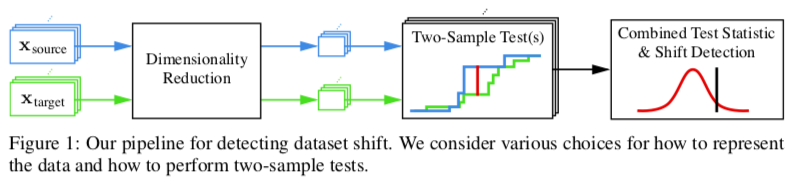
这对于我的引力波数据研究来说,可以借鉴其数据的 shift 方法以及评价机制 (two-sample tests)。
How deep is deep enough? - Optimizing deep neural network architecture
精心构造了一个度量:generalized discrimination value(GDV),实现了对网络各层中对不同输入类别的量化评价。这个评价定义还关于输入数据有平移不变性和缩放不变性 ,同时,并不依赖特征图的数目,也不依赖于每层中神经元的数目和排序。
About a third of 18- to 49-year-olds (32%) correctly identified all five of the factual statements as factual, compared with two-in-ten among those ages 50 and older. A similar pattern emerges for the opinion statements. Among 18- to 49-year-olds, 44% correctly identified all five opinion statements as opinions, compared with 26% among those ages 50 and older.
In a survey conducted Feb. 22 to March 4, 2018, the Center asked U.S. adults to categorize five factual statements and five opinion statements. As a previous report revealed, about a quarter of Americans overall could accurately classify all five factual statements (26%) and about a third could classify all five opinion statements (35%).
Approximate Fisher Information Matrix to Characterise the Training of Deep Neural Networks
深度神经网络训练(收敛/泛化性能)的近似Fisher信息矩阵表征,可自动优化mini-batch size/learning rate
挺有趣的 paper,提出了从 Fisher 矩阵抽象出新的量用来衡量训练过程中的模型表现,来优化mini-batch sizes and learning rates | 另外 paper 中的figure画的很好看 | 作者认为逐步增加batch sizes的传统理解只是partially true,存在逐步递减该 size 来提高 model 收敛和泛化能力的可能。
For one, much of the new research centers on U.S. politics and, specifically, elections. But social networks drive conversations about many other topics such as business, education, health, and personal relationships. To battle bad online information, it would be helpful to know whether people respond to these sorts of topics differently than they respond to information about political candidates and elections. It also would be useful to know whether myths about certain subjects — for instance, a business product or education trend — are trickier to correct than others.
After doing some research, we found mochiglobal, a module that exploits a feature of the VM: if Erlang sees a function that always returns the same constant data, it puts that data into a read-only shared heap that processes can access without copying the data. mochiglobal takes advantage of this by creating an Erlang module with one function at runtime and compiling it.
This is a cool trick and it sounds like partial evaluation and just-in-time compilation.
Because life is a contest, there can only be so many winners, and the winners receive big rewards. Get used to it. Get ready to compete.
In todays society life satisfaction and happiness is presented in the form of a college degree, a powerful career, and the amount of money you have. It seems like the only way to make it in this world is to be robotic and follow the system. We have lost touch of what life should consist of. Todays youth are conditioned to follow the path of money and power instead of happiness. Kids should be kids, not robots.
It is this increasingly intense competition for spots in top universities that is responsible for the rise in parental time spent with children.
Thus the question of the decade is answered. The amount of time spent with parents has increased because of the intense competition for spots in top universities. Parents are prepared to do anything like signing their children up for extra circular activities, sports, even volunteer work in hopes that scholarships and acceptance will be rewarded.
Yet it has become increasingly obvious over the past two decades that the gap between those who succeed in today’s economy and those who merely survive is large, and growing larger.
With more and more people attending college and getting a degree, the market for a successful career is quickly becoming less tangible. This has created an extreme competition between the youth to secure their futures.
And while it might be nice to go to an elite institution, state schools provided great value for money. So you’d need a pretty good reason to shell out the tens of thousands of dollars it would take to go to Yale or Duke.
The process to attend an elite university was ultimately built for the rich and powerful. Any college you choose could teach you a profession, but these were built to be superior. You could attend a state school for a good price, but some are willing to pay tens of thousands of dollars to secure themselves a spot at the top of the social hierarchy.
Rather, school was a practical step on the path toward a sturdy, dependable career. You went to university to learn, first and foremost: to pick up the skills needed to find a trade.
Higher education then was considered the practical way to study, and learn trade skills to get a dependable career.
Instead of increasingly outsourcing child-rearing, parents are devoting more of the scarce time left outside working hours to their children. Over the last two decades, time spent by parents on child-rearing has jumped. In America in the 1980s, for example, young mothers spent about 12 hours per week actively engaged in child care while fathers spent about four hours per week. Those figures have since soared – and the rise in hours spent with children has been greatest among better-educated, higher-earning parents. Mothers without university degrees now spend about 16 hours per week on child care, while those with degrees spend nearly 22 hours per week. For fathers the figures are seven and ten, respectively. This pattern is repeated across the rich world.
The correlation between mothers having high-powered, well-paid professional positions and child outsourcing had an unexpected outcome. Working, better educated, and higher earning parents actually spend more time with their children.
They attend school in Arlington, Virginia, home to one of the best public-school systems in America. Yet many worry that is not enough, and plot their children’s route to Thomas Jefferson, Northern Virginia’s highly selective magnet high school, or to the region’s tony private schools: funnels to America’s top universities and elite society, attended by the offspring of the rich and powerful.
Despite living in an area that is home to one of the best public school systems in the country, these parents worry that their children having only a public school education isn't enough. Consequently causing parents to push their kids harder and put way more pressure on them to succeed. Their elite education prior to college significantly increases attendance to the top tier Universities like Yale or Harvard.
I still have what I imagine must be the naive ideas of a parent of young children, that they will develop their own interests and passions as they grow older: that taking a drill-sergeant approach to learning and to homework would ultimately be counterproductive.
The author knows that she can't push her own hopes onto her children too aggressively because extreme authoritative parenting is ultimately counterproductive. Each child's mind and physical development is different. Although there are countless possibilities of the child's character and personality, good parenting is crucial in their development.
Develop appropriate measurement and monitoring strategies
Recommendation 4
In general, humanities scholars have neglected editorial work because the reward structures in the academy have not favored editing but instead literary and cultural theory. Many academics fail to recognize the theoretical sophistication, historical knowledge, and analytical strengths necessary to produce a sound text or texts and the appropriate scholarly apparatus for a first-rate edition.
Reasons why scholarly editions aren't valued in the academy (c 2008)
The definition of literacy has evolved in the 21st century. The basic definition of literacy means to be able to read and write. To be successful in today’s digital world, literacy goes far beyond being able to read and write. What it means to be digitally literate has reflected the change in how information is processed, delivered, and received in today’s highly connected world.
This is pointing to an expanded definition of literacy with the growth of technology. It argues that literacy in today's world goes far beyond just knowing how to read and write.
There is also a stream of research related to online versus paper surveys of faculty perfor-mance. In general, online ratings were found to be about the same as paper ratings. Theonline ratings were, if anything, slightly higher than paper ratings (Carini et al. 2003). Otherresearchers found that the properties of student ratings were similar for both paper andonline responses (Hardy 2003; McGhee and Lowell 2003). Even though there was a slightlylower response rate for online as opposed to paper ratings, researchers conclude that withacceptance of online ratings by students and faculty, appreciation of the advantages of onlineratings (thoughtful feedback, convenience and user-friendliness) and the development ofonline infrastructure, this response difference will diminish (Ballantyne 2003; Johnson2003)
Online ratings about the same or higher than paper ratings, and the properties (selection, etc.) similar.
Does ratemyprofessor.com really rate my professor?
Otto, James, Douglas A. Sanford Jr, and Douglas N. Ross. 2008. “Does Ratemyprofessor.com Really Rate My Professor?” Assessment & Evaluation in Higher Education 33 (4): 355–68. doi:10.1080/02602930701293405.
RateMyProfessors.com offers biased evaluations
Legg, Angela M., and Janie H. Wilson. 2012. “RateMyProfessors.com Offers Biased Evaluations.” Assessment & Evaluation in Higher Education 37 (1): 89–97. doi:10.1080/02602938.2010.507299.
The opportunities are boundless,
Wearable are something that I think are huge for the future. This article does an excellent job in showing what some of the features that can be sued with them are. It goes into the health industry and analyzes some of the pros and cons that come with wearables. This will help me in evaluating wearable technology in the more general term other than physical fitness.
“My mission in creating this wearable was to come up with a device that would be fashionable and fun for children while allowing their parents to keep a pulse on their safety while they are apart. The Paxie band also tracks activity to encourage healthy and active lifestyles.”
Not only can wearables be used to tracking fitness and encouraging physical activity, parents can use them to help monitor where their kid is and making sure that are safe and out of harms way. However, making sure that the kids keep these devices on is an obstacle that the parents will have to hurdle.
Osuna, C., Crux-Castro, L., & Sanz-Menedez, L. (2011). Overturning some assumptions about the effects ofevaluation systems on publication performance.Scientometrics, 86, 575–592
evaluation systems and publication performance